Calcium Sulfate Price Update: Sustained Growth Across Key Markets in Q2 2026
19-Aug-2026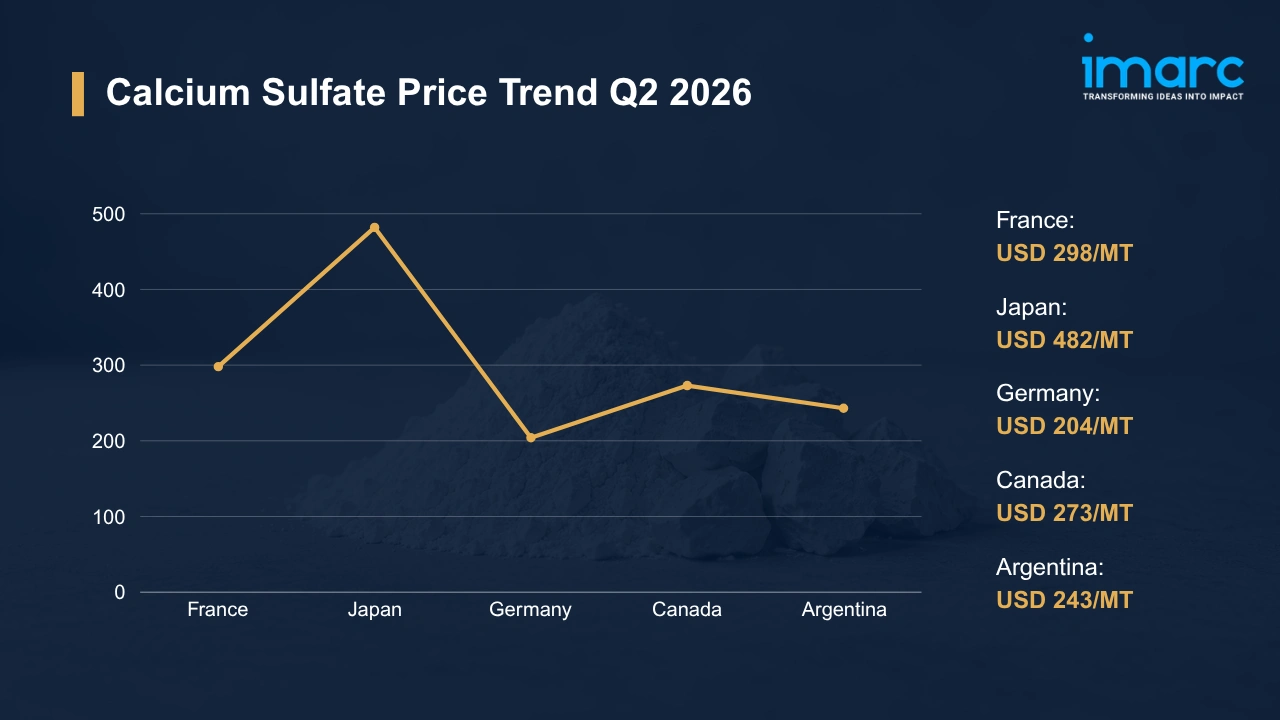
Calcium sulfate is an inorganic mineral found in anhydrous, hemihydrate, and dihydrate forms. Valued across construction wallboard, cement regulation, soil conditioning, pharmaceutical formulations, and food processing, the compound delivers binding and structural properties across multiple product grades. Calcium sulfate prices are principally shaped by upstream gypsum extraction economics, energy expenditure in calcination, logistics costs on key import corridors, and demand cycles within the construction and agricultural sectors.
Global Market Overview:
Globally, the calcium sulfate industry reached a volume of 171.75 Million Tons in 2025. Market projections indicate steady growth, with the industry expected to reach a volume of 231.25 Million Tons by 2034, with a compound annual growth rate (CAGR) of 3.36% during 2026-2034. Driven by gypsum board manufacturing and agricultural soil conditioning programs, the calcium sulfate price trend extends across food-grade and pharmaceutical segments, adding breadth to global demand.
Calcium Sulfate Price Trend Q2 2026:
Regional prices (USD per MT) and QoQ changes Q2 2026 vs Q1 2026:
| Region | Price (USD/MT) | QoQ Change | Direction |
|---|---|---|---|
| France | 298 | +12.34% | ↑ |
| Japan | 482 | +15.82% | ↑ |
| Germany | 204 | +3.11% | ↑ |
| Canada | 273 | +4.45% | ↑ |
| Argentina | 243 | +13.34% | ↑ |
To access real-time prices Request Sample
What Moved Prices:
France:
- In Q2 2026, French calcium sulfate prices reached USD 298/MT. Cement processors and plasterboard manufacturers drove a 12.34% QoQ advance as consistent construction activity supported restocking volumes, while producers passed through higher calcination energy and handling costs with minimal buyer resistance through the quarter.
- Asian supplier imports kept spot competition reasonably active through Q2. With distribution costs across northern European logistics networks placing upward pressure on landed margins, producers adjusted contract offers higher as construction-linked buyers maintained consistent procurement patterns, sustaining the calcium sulfate price chart's upward progression in France.
Japan:
- In Q2 2026, Japanese calcium sulfate prices surged to USD 482/MT. Plasterboard manufacturers and construction materials buyers drove a 15.82% QoQ advance as tighter supply grades and higher energy and logistics costs allowed producers to implement successive pricing revisions against firm downstream procurement and improving building-sector fundamentals.
- Import flows supplemented the domestic supply base. With ocean freight costs on Asia-Pacific corridors exerting upward pressure on delivered pricing, domestic distribution expenses and gypsum board conversion schedules sustained consistent buyer activity through the period, maintaining tight supply conditions and reinforcing the quarterly advance.
Germany:
- In Q2 2026, German calcium sulfate prices edged up to USD 204/MT. Building material producers and agricultural buyers maintained steady procurement schedules as consistent demand across plasterboard and soil conditioning applications persisted, while moderate input cost pressure supported a measured 3.11% QoQ advance through the quarter.
- Domestic supply conditions remained largely adequate, limiting scope for aggressive pricing. Across Germany's established industrial supplier network, balanced output strategies kept procurement manageable for building material formulators, while logistics and compliance expenses contributed to the cost base underpinning the modest quarterly advance.
Canada:
- In Q2 2026, Canadian calcium sulfate prices rose to USD 273/MT. Construction material buyers and agricultural end-users maintained consistent procurement as spring-season activity lifted demand across gypsum board and soil amendment applications, with suppliers adjusting offers higher to reflect rising distribution and operational expenses across the 4.45% QoQ gain.
- Freight remained a meaningful cost factor through the quarter. Spanning Canada's broad inland distribution network, transportation demands added material components to delivered pricing as suppliers maintained reliable gypsum board supply for construction and agricultural buyers, with seasonal procurement activity sustaining consistent upward pressure on market valuations.
Argentina:
- During Q2 2026, Argentine calcium sulfate prices reached USD 243/MT. Backed by strengthening construction and agricultural demand, the market recorded a sharp 13.34% QoQ advance as producers recovered input cost increases through revised pricing and buyers showed improved willingness to accept higher offers across construction and industrial grades.
- Currency-related procurement costs added to transportation pressures through the quarter. With cautious inventory management among buyers preserving consistent demand-pull conditions, Argentine producers leveraged improved market confidence to lock in margin recovery through the period, sustaining higher assessed values across construction, agricultural, and industrial calcium sulfate grades.
Drivers Influencing the Market:
Several factors continue to shape calcium sulfate pricing and market behavior:
- Construction and Industrial Sector Demand: Construction output anchors calcium sulfate demand. Supplied across gypsum board, plaster, and cement regulation applications, consistent volume requirements from residential building projects, infrastructure programs, and commercial construction pipelines sustain procurement across Europe, North America, and Asia Pacific through each quarter. Agricultural soil conditioning, food processing, and industrial filler uses supplement this construction-led base, reducing market exposure to single-sector variability.
- Upstream Gypsum and Feedstock Input Costs: Upstream input costs are central determinants of calcium sulfate production economics. Compounding supply-side pressures from gypsum rock extraction costs, sulfur feedstock availability, and variability in ore quality impact finished material evaluations, while mining delays and site limitations occasionally restrict raw material access in major producing areas. Shifts in feedstock costs translate into the calcium sulfate price index with narrow lag, as producers adjust offers to preserve margins.
- Energy Expenditure in Calcination and Processing: Energy drives calcium sulfate production costs. Per the EIA, US industrial natural gas consumption averaged a record 23.6 Billion cubic feet per day (Bcf/d) in 2025, with chemicals and manufacturing accounting for the largest demand share and shaping cost baselines for gypsum processing facilities globally. Regional gas price differentials continue to influence competitive positioning between North American, European, and Asian producers.
- Ocean Freight and Logistics Economics: Ocean freight rates materially influence delivered calcium sulfate pricing. Crossing Asia-Europe and Transpacific corridors, import-dependent markets face landed cost pressures reflected in Drewry's World Container Index, which stood at USD 4,297 per 40ft container as of early August 2026 following carrier capacity discipline and firm cargo volumes. Port handling charges, demurrage conditions, and inland distribution costs add further pricing layers to regional market assessments.
- Environmental and Regulatory Compliance: Compliance costs add a persistent production layer. Imposed across multiple jurisdictions, chemical registration frameworks, dust control standards, and industrial discharge regulations create administrative and operational expenditures for producers, with stricter European environmental enforcement maintaining notably higher baseline compliance cost structures than more permissive regulatory environments. These costs filter into offer structures, influencing market pricing irrespective of near-term demand conditions.
- Trade Policy and Currency Dynamics: Trade policy and currency dynamics directly shape calcium sulfate procurement costs. Determined by import duty structures, bilateral trade agreements, and tariff adjustments, market access conditions for competing suppliers fluctuate with policy shifts, while currency volatility in import-dependent markets amplifies landed cost variability for buyers managing positions across multiple sourcing regions. Antidumping measures periodically redirect trade flows and alter regional supply balances with tangible pricing consequences.
Recent Highlights & Strategic Developments:
Recent strategic moves within the industry further illustrate evolving dynamics:
- In April 2025, SUL4R-PLUS launched a calcium sulfate fertilizer production facility in Marissa, Illinois, with a nameplate annual capacity of 100,000 Tons. The launch underscored growing agricultural demand for sulfur-enriched soil amendment products and the company's strategy to expand its domestic production footprint.
Outlook & Strategic Takeaways:
Looking ahead, the calcium sulfate market is expected to sustain growth by 2034, supported by resilient construction sector demand, expanding agricultural adoption across emerging markets, and diversifying food-grade and pharmaceutical applications. Upstream feedstock costs, calcination energy pricing, and ocean freight economics across key import corridors will remain the pivotal variables shaping the calcium sulfate price forecast, with demand-driven construction tailwinds underpinning the medium-term trajectory.
To navigate this complex landscape, stakeholders should:
- Monitor Regional Price Differentials: Track quarterly pricing variations across France, Japan, Germany, Canada, and Argentina to identify cost-saving procurement windows. Establish benchmarking protocols comparing landed costs against prevailing contract rates to optimize sourcing decisions and validate supply chain economics.
- Assess Freight Market Developments: Monitor container shipping rate trends on Asia-Europe and Transpacific corridors to anticipate delivered cost movements on import-dependent volumes. Negotiate logistics contracts with rate adjustment mechanisms tied to recognized freight benchmarks to reduce exposure to landed cost spikes.
- Evaluate Downstream Demand Indicators: Monitor construction output indices and agricultural program timelines across principal consuming regions to anticipate quarterly demand shifts. Track the calcium sulfate price per MT against regional procurement baselines to align purchasing volumes, optimize inventory positioning, and reduce excess stock exposure during seasonal demand troughs.
- Review Regulatory Compliance Expenditures: Audit current costs associated with calcium sulfate handling, storage, industrial discharge requirements, and product registration obligations across all operating jurisdictions. Identify operational efficiencies that reduce compliance burden without compromising safety standards, particularly in jurisdictions with tightening environmental frameworks.
- Strengthen Currency Exposure Management: Implement currency hedging strategies for procurement denominated in volatile currencies, particularly for Argentine and Canadian supply contracts subject to exchange rate movement. Coordinate treasury and procurement planning to align foreign exchange coverage with anticipated import payment timelines and seasonal purchasing cycles.
- Explore Emerging Application Segments: Investigate growth potential within food-grade and pharmaceutical-grade calcium sulfate applications as product purity regulatory frameworks expand globally. Engage with research partners to assess commercial viability of novel mineral compound formulations that may broaden addressable demand and reduce dependence on construction sector cycles.
Subscription Plans & Customization:
IMARC offers flexible subscription models to suit varying needs:
- Monthly Updates: 12 deliverables/year
- Quarterly Updates: 4 deliverables/year
- Biannual Updates: 2 deliverables/year
Each includes detailed datasets (Excel + PDF) and post-report analyst support.
Get in Touch With Us
UNITED STATES
Phone: +1-201-971-6302
INDIA
Phone: +91-120-433-0800
UNITED KINGDOM
Phone: +44-753-714-6104
Email: [email protected]
Client Testimonials




.webp)




.webp)












