Chloroprene Price Falls 8.0% in Europe, 5.9% in India — Q1 2026 Update
28-Apr-2026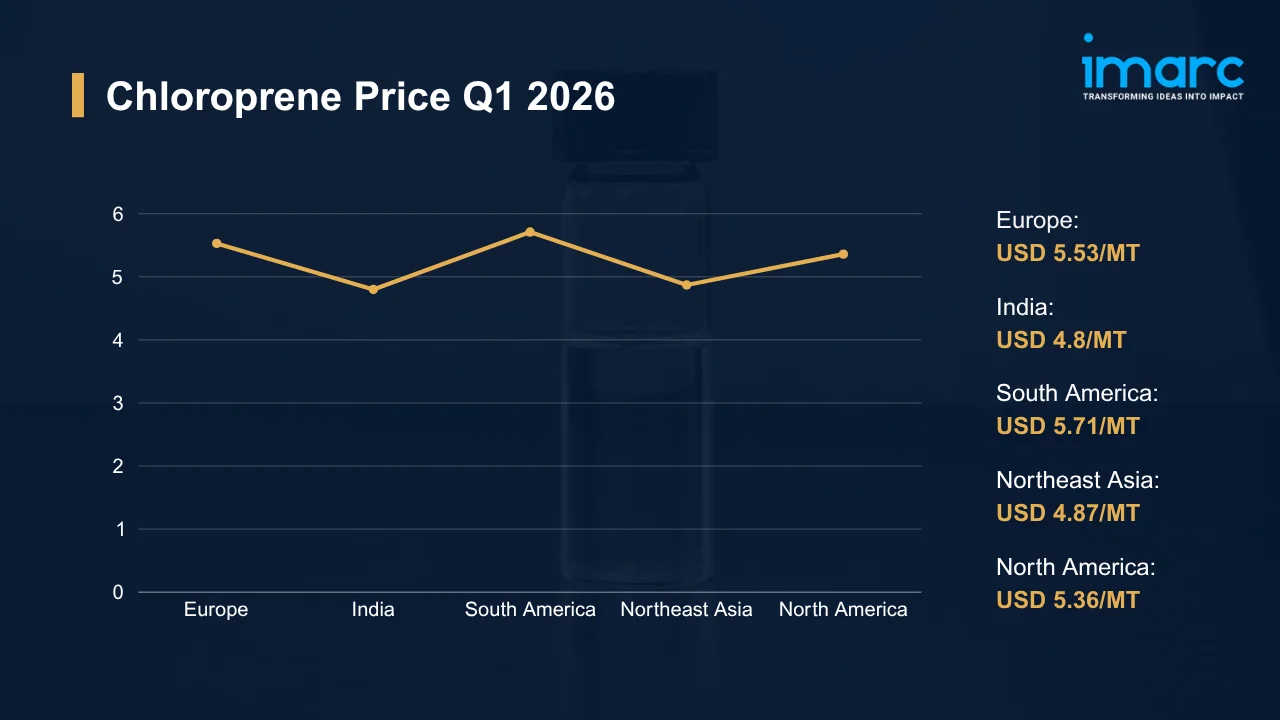
Summary:
Q1 2026 split the chloroprene panel: three regions declined, two climbed. Weaker offtake from polychloroprene rubber, adhesive, and specialty elastomer converters dragged chloroprene prices lower through much of the quarter, while scheduled turnarounds and firmer upstream acetylene and chlorine costs lifted values where supply ran short. Quarterly moves ranged from an 8.0% drop to a 9.6% gain across the five tracked markets. Brent crude reached closer to USD 100/bbl on April 16, 2026, hinting at sharper energy-driven volatility.
Chloroprene Price Q1 2026:
Regional prices (pricing index) and QoQ changes Q1 2026 vs Q4 2025:
| Region | Price (Pricing Index) | QoQ Change | Direction |
|---|---|---|---|
| Europe | 5.53 | -8.0% | ↓ Decline |
| India | 4.8 | -5.9% | ↓ Decline |
| South America | 5.71 | +2.9% | ↑ Growth |
| Northeast Asia | 4.87 | -2.0% | ↓ Decline |
| North America | 5.36 | +9.6% | ↑ Growth |
To access real-time prices Request Sample
Kindly note: IMARC’s pricing database tracks chloroprene price movements across major global markets.
What Moved Prices:
Europe:
- In Q1 2026, European chloroprene prices eased to a 5.53 Pricing Index, down 8.0% QoQ. Mittelstand converter orderbooks thinned visibly through Q1. Across adhesive, polychloroprene rubber, and specialty coating segments, demand dried up against stalled residential construction, weak German and French auto builds, and hesitant CEE industrial buyers who refused to commit forward.
- Rhine-corridor terminals saw steady Asian import arrivals, with CIF offers below domestic benchmarks week after week. That gutted regional producer pricing power. The chloroprene price chart traced a methodical downward stair-step from January into March, as upstream acetylene and chlorine costs softened and sellers cut weekly offers to shift inventory before end-of-quarter stock takes.
India:
- In Q1 2026, India's chloroprene prices slid to a 4.8 Pricing Index, off 5.9% QoQ. Post-festive demand hit a wall by mid-January. Domestic rubber-glove makers, industrial belting producers, and adhesive formulators across Maharashtra and Gujarat cut procurement to hand-to-mouth, while operating rates at downstream converters in Kandla and Mumbai slid week-over-week through January and February.
- Through the quarter, Middle Eastern and Southeast Asian cargoes reached JNPT and Mundra, swelling distributor inventories. Pushback from domestic producers stayed limited. Aggressive discounting combined with softer upstream butadiene and chlorine costs let resellers across the Gujarat and Maharashtra corridor chase turnover at the expense of margin through Q1, with competitive pressure intensifying toward quarter-end.
South America:
- In Q1 2026, South American chloroprene prices climbed to a 5.71 Pricing Index, up 2.9% QoQ. BRL stability through the quarter helped. Firmer pull from synthetic rubber converters, industrial adhesive formulators, and specialty elastomer manufacturers across the São Paulo hub lifted procurement volumes, while steady Brazilian construction and footwear activity kept end-use demand resilient.
- Firmer upstream acetylene and chlorine feedstock costs at regional and importing sites nudged manufacturing expenses upward. Cost support built gradually through February and March. Steady import-cargo availability from Asian and North American suppliers, combined with stable Argentine and Brazilian logistics, held domestic supply comfortably matched against demand and capped further upside into late March 2026.
Northeast Asia:
- In Q1 2026, Northeast Asia chloroprene prices eased to a 4.87 Pricing Index. Mid-quarter weakness did most of the damage. Softer offtake from synthetic rubber producers, contact-adhesive makers, and wire-cable sheathing manufacturers across Chinese hubs in Guangdong and Shandong, and from Japanese converters, tempered procurement through January and February, with values down 2.0% QoQ.
- Regional output stayed comfortable, with Chinese producers running near steady-state and Japanese plants holding scheduled throughput. Conflict-driven jitters barely rippled into the region. Softer upstream acetylene and chlorine feedstock costs at key producing facilities eroded cost support through Q1, keeping spot offer levels under modest pressure even as global energy markets spiked on conflict headlines.
North America:
- In Q1 2026, North American chloroprene prices jumped to a 5.36 Pricing Index, up 9.6% QoQ. The market moved against the global grain. Tight Gulf Coast supply met pull from synthetic rubber, adhesive, and specialty elastomer makers across automotive OEMs, sealant lines, and industrial adhesive formulators, pushing weekly spot offers higher into late March.
- Acetylene and chlorine costs ran hot into Q1, squeezing margins and feeding offer sheets. Scheduled turnarounds at two major chloroprene sites tightened supply. Limited domestic nameplate capacity, the turnaround schedule, and firmer rail and trucking rates out of the Gulf fueled buyer competition and pushed spot offers well above end-of-December benchmarks by late March.
Chloroprene Price Outlook After the Israel–Iran–USA Conflict:
Rising Feedstock Cost Pressure from Natural Gas and LNG Supply Shocks: Conflict-driven disruption to Middle East natural gas infrastructure is impacting global acetylene and chlor-alkali production chains. In the chloroprene market, these upstream constraints can tighten feedstock availability and increase production cost sensitivity across the value chain.
Regional Demand Shifts and Chloroprene Price Volatility: Macro uncertainty from the conflict will likely produce uneven regional chloroprene demand across synthetic rubber, adhesive, and specialty elastomer segments. European and Asian buyers might pull back further as higher energy bills compress household and industrial spending, while North American converters facing thin local supply will accept premium offers through the quarter ahead. Expect the divergence to persist through Q2.
Immediate Market Reaction:
Chloroprene markets are pricing geopolitical signals into every weekly offer sheet. Across North America, Europe, and Northeast Asia, producers watch conflict developments closely, with procurement desks adjusting contract terms, inventory buffers, and bid windows in real time. Key transshipment hubs at Jebel Ali, Rotterdam, and Singapore face direct exposure to altered tanker routings and elevated war-risk premiums. As a result, the chloroprene price index remains unsettled, with intraday volatility now running well above 2024 and 2025 norms and each new headline capable of triggering a spike in regional benchmarks.
Impact on Chloroprene Prices:
The conflict might trigger several key changes in the chloroprene market:
- Feedstock Cost Escalation: Feedstock pressure is building across the board in global chloroprene markets. Sustained disruption to Middle East natural gas and petrochemical output will lift global acetylene, butadiene, and chlorine costs into Q2, feeding directly into chloroprene production economics at plants in North America, Europe, and Northeast Asia; long-term-contract holders might preserve margins briefly, but spot-exposed converters will absorb pass-through from day one.
- Freight and Logistics Cost Surge: Shipping economics are resetting landed-cost math fast. Routes pivoting around the Cape of Good Hope are adding 10-15 days of transit, and with tanker rates elevated, war-risk premiums expanded, and vessel capacity tied up on longer voyages, the landed cost of chloroprene and feedstocks reaching converters in Europe, South Asia, and the Americas will climb materially into Q2 2026.
- Regional Price Arbitrage and Capacity Tightening: Regional price gaps will widen hard. Buyers will feel it across contract books. Divergent conflict exposure will stretch arbitrage spreads between North American, European, and Asian chloroprene benchmarks, pulling procurement teams into mid-contract renegotiation and sourcing reshuffles, while producers outside the immediate conflict zone might grab temporary market share and capacity near Middle Eastern trade nodes could face prolonged operational constraints if hostilities extend.
These pressures will ultimately reshape chloroprene procurement strategy across Q2 2026. Hedging sits higher on corporate agendas, and contract structures now must absorb volatility previously lodged in spot markets only, with how hard prices respond hinging on the pace of any diplomatic thaw and whether Hormuz trade flows normalize through mid-year.
Supply Chain Disruptions:
Chloroprene supply chains face acute exposure at Middle Eastern trade nodes and Asian transshipment hubs, where tanker availability, port-call scheduling, and feedstock lift windows all remain compromised by conflict-driven security constraints and war-risk insurance. Across tanker markets, rates have gone vertical. Very Large Crude Carrier (VLCC) rates on the Middle East-to-China route sat at a record USD 423,736 per day in early March 2026, following a 94% single-session jump, and downstream chloroprene buyers across multiple regions will feel that pass-through directly.
Producers in Northeast Asia and North America with local feedstock integration might hold an edge, while import-reliant converters will face higher landed costs and longer transit windows from Cape of Good Hope rerouting. Across affected lanes, buffer inventories need rebuilding. On the cost side, escalation from extended voyages, higher bunker fuel, and elevated war-risk insurance premiums will pass through into chloroprene offer levels across major regional benchmarks during the coming weeks and into Q2 2026.
Global Market Overview:
Globally, the chloroprene industry was valued at USD 1.3 Billion in 2025. Market projections indicate steady growth, with the industry expected to reach USD 2.0 Billion by 2034, with a compound annual growth rate (CAGR) of 4.75% during 2026-2034. Driven by automotive, construction, and electronics end uses, expansion continues. Sustainable elastomer adoption, adhesive formulation innovation, and steady uptake across rubber goods, industrial coatings, and sealants support the long-term chloroprene price trend, while hazardous substance regulation reshapes product development pipelines globally.
Recent Highlights & Strategic Developments:
Recent strategic moves within the industry further illustrate evolving dynamics:
- In June 2025, Tosoh Corporation confirmed a capacity expansion for its SKYPRENE chloroprene rubber (CR) business. The Japanese producer greenlit a second CR plant at the Nanyo Complex in Shunan City, Yamaguchi Prefecture, responding to tightening global CR availability and steady pull from adhesive and elastomer end-markets.
Chloroprene Price Forecast (2026):
Near-term chloroprene prices will stay tethered to conflict-driven energy costs. Downstream demand recovery looks patchy at best. Import-reliant buyers might push bulk procurement into Q2 while feedstock economics stabilize, whereas North American converters will keep absorbing premium pricing against tight local capacity and the ongoing turnaround schedule at major domestic chloroprene plants through mid-year.
Two scenarios will bracket the year. If hostilities grind on through Q2 and beyond, chloroprene prices will likely push higher as energy and freight costs layer onto already-stretched feedstock supply, with North America and Europe wearing the steepest premiums. Should a diplomatic thaw materialize and Hormuz shipping normalize, prices might drift toward pre-conflict benchmarks by H2 2026 as tanker rates ease and buffer inventories rebuild. Geopolitics will ultimately define the chloroprene price forecast.
Strategic Takeaways:
Looking ahead, the chloroprene market is expected to navigate crosscurrents from shifting feedstock economics, uneven end use demand across rubber and adhesive segments, and an unresolved geopolitical backdrop. Stakeholders face margin compression, regional divergence, and procurement complexity through the coming quarters and into 2027, with contract flexibility now central to sourcing decisions.
To navigate this complex landscape, stakeholders should:
- Monitor Regional Price Differentials: Track monthly pricing swings across North America, Europe, India, Northeast Asia, and South America to flag arbitrage windows. Benchmark landed costs against prevailing contract rates and spot offers so procurement teams can time purchases sharply.
- Monitor Geopolitical Risk Exposure: Track escalation dynamics across the Israel-Iran-USA conflict and gauge how shifts in hostility levels might reshape chloroprene pricing, feedstock availability, and global logistics costs. Set internal alert thresholds that trigger procurement or hedging action promptly.
- Diversify Feedstock Supply Channels: Evaluate alternative acetylene, butadiene, and chlorine suppliers beyond existing vendor portfolios to cut concentration risk. Lock in secondary supply agreements that activate during primary source disruption or regional capacity crunches at major global producing hubs.
- Diversify Supply Chain Routes: Evaluate alternative sourcing geographies and ocean shipping corridors to reduce reliance on conflict-exposed trade lanes. Secondary supplier agreements and contingency freight arrangements will deliver critical resilience if Hormuz, Red Sea, or Suez routes face disruption.
- Adjust Procurement Strategy for Conflict Conditions: Adopt flexible contract frameworks including price reopener clauses and force majeure provisions to shield against sudden geopolitical price spikes. Precautionary inventory buffers and hedged forward positions might cut exposure if global chloroprene supply tightens fast.
- Benchmark Against Regional Cost Spreads: Compare chloroprene price per MT against regional contract rates and Asian FOB offers to surface cost-saving sourcing windows. Review landed costs across North American, European, and Indian hubs monthly to refine strategic procurement decisions sharply.
Subscription Plans & Customization:
IMARC offers flexible subscription models to suit varying needs:
- Monthly Updates — 12 deliverables/year
- Quarterly Updates — 4 deliverables/year
- Biannual Updates — 2 deliverables/year
Each includes detailed datasets (Excel + PDF) and post-report analyst support.
.webp)
Get in Touch With Us
UNITED STATES
Phone: +1-201-971-6302
INDIA
Phone: +91-120-433-0800
UNITED KINGDOM
Phone: +44-753-714-6104
Email: [email protected]
Client Testimonials




.webp)




.webp)












