Glycerol Price Update: Sustained Growth Across Key Markets in Q2 2026
13-Jul-2026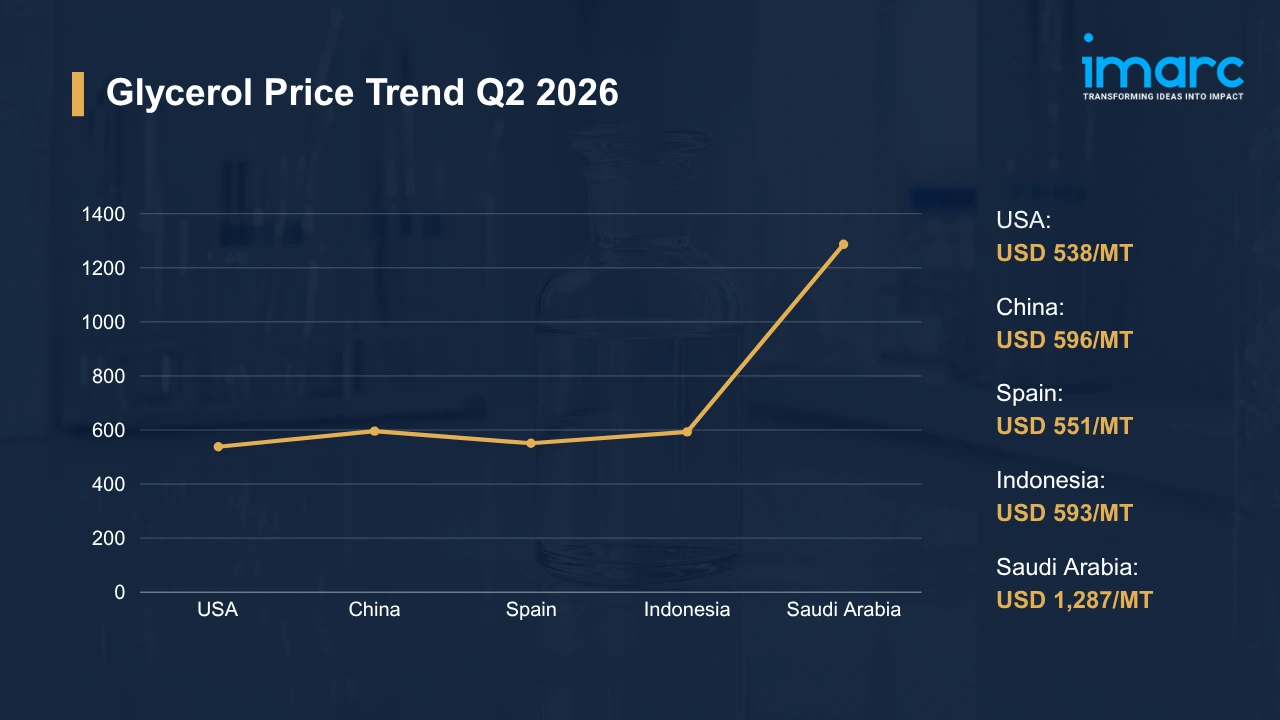
Glycerol is a colorless, viscous liquid with a sweet taste and strong moisture-retention properties. Across personal care, pharmaceutical, food, and resin manufacturing, formulators rely on the compound as a stabilizing and humectant agent, and glycerol prices respond directly to feedstock cost movements. Biodiesel co-product flows, refining energy expenditure, freight economics on import-heavy lanes, and seasonal demand across cosmetics and pharmaceutical segments jointly determine the pricing floor each quarter.
Global Market Overview:
Globally, the glycerol industry was valued at USD 5.3 Billion in 2025. Market projections indicate steady growth, with the industry expected to reach USD 7.4 Billion by 2034, with a compound annual growth rate (CAGR) of 3.36% during 2026-2034. Expanding personal care formulation volumes across emerging economies continue to anchor the glycerol price trend. Pharmaceutical excipient demand and widening oleochemical applications reinforce this underlying growth trajectory.
Glycerol Price Trend Q2 2026:
Regional prices (USD per MT) and QoQ changes Q2 2026 vs Q1 2026:
| Region | Price (USD/MT) | QoQ Change | Direction |
|---|---|---|---|
| USA | 538 | +2.91% | ↑ |
| China | 596 | +2.94% | ↑ |
| Spain | 551 | +2.84% | ↑ |
| Indonesia | 593 | +3.96% | ↑ |
| Saudi Arabia | 1,287 | +3.99% | ↑ |
To access real-time prices Request Sample
What Moved Prices:
USA:
- In Q2 2026, glycerol prices in the USA advanced to USD 538/MT. Tightening biodiesel-linked feedstock supply met steady demand from personal care and pharmaceutical formulators along the Gulf Coast, and converter run rates remained firm as cosmetic and cleaning product manufacturers maintained full order books.
- E-commerce fulfillment demand for packaged personal care goods added incremental pressure on refined grade pricing. Tighter trucking capacity during peak shipping season pushed inland logistics costs higher across the quarter. The glycerol price chart for the period reflected a steady upward trajectory as domestic sellers maintained firm offers.
China:
- During Q2 2026, glycerol prices in China climbed to USD 596/MT as domestic FMCG absorption strengthened. Disciplined offers from oleochemical producers coincided with export curtailment on crude glycerol streams, tightening available volumes as cosmetics and resin manufacturers maintained restocking schedules across major converter hubs.
- A firmer yuan modestly raised import costs for feedstock inputs, pressuring producer margins even as downstream demand remained resilient throughout the period. Converter activity in Guangzhou and Yiwu remained steady, supporting consistent offtake despite periodic logistics bottlenecks at coastal ports.
Spain:
- In the second quarter of 2026, glycerol prices in Spain rose to USD 551/MT. Personal care and pharmaceutical formulators across the converter base sustained steady demand, while biodiesel-linked supply discipline persisted across Europe as producers calibrated output against feedstock costs and offtake conditions.
- Freight costs firmed on Asia-Europe shipping corridors during the quarter, adding directly to landed cost pressure for imported cargoes. Regional gas storage remained adequate, limiting energy-related surcharges, though EU regulatory compliance requirements kept administrative costs elevated for smaller distributors.
Indonesia:
- During Q2 2026, glycerol prices in Indonesia increased to USD 593/MT. Palm-based oleochemical output remained closely tied to biodiesel mandate requirements, tightening available crude glycerol streams even as cosmetics, pharmaceutical, and food processing consumption remained healthy across domestic converters.
- Demand from neighboring Asian markets added competitive tension for available cargoes. Producers maintained firm quotations amid constrained feedstock supply, and buyers pursued need-based procurement rather than aggressive stock building. Converter activity remained active through the quarter despite this cautious posture.
Saudi Arabia:
- In Q2 2026, glycerol prices in Saudi Arabia rose to USD 1,287/MT. Import dependence and constrained regional production availability kept the market tight, while demand from the pharmaceutical, personal care, and food sectors held firm despite elevated landed costs.
- Port dwell charges and Asia-Gulf freight costs added to importer expenses. The pegged-currency framework limited exchange-rate volatility for procurement planning, and free-zone throughput remained steady, though suppliers resisted discounting cargoes given thin regional spot availability.
Drivers Influencing the Market:
Several factors continue to shape glycerol pricing and market behavior:
- End-Use Sector Demand in Personal Care and Pharmaceuticals: Sustained formulation volumes across skincare, oral care, and pharmaceutical excipient applications underpin baseline glycerol procurement worldwide. Urbanization continues to drive order flow higher across emerging economies. Seasonal production cycles among cosmetic manufacturers introduce periodic variability in purchasing patterns through the year.
- Upstream Palm and Soybean Oil Feedstock Costs: Glycerol originates as a biodiesel and oleochemical byproduct, so vegetable oil feedstock movements shape its production economics directly. Per the IMF's Global Price of Palm Oil series published via FRED, benchmark palm oil averaged USD 1,130.03 per Metric Ton in May 2026, reflecting firmer feedstock costs across Southeast Asian supply chains. Tighter crude glycerol streams from biodiesel operations continue to influence downstream valuations.
- Energy Expenditure in Refining and Distillation: Natural gas and electricity costs remain a critical determinant of glycerol refining economics, particularly during vacuum distillation and purification stages. Processing costs vary considerably by region. Producers in energy-intensive zones pass these cost variations into finished product pricing across export-oriented supply chains, and disparities in regional energy pricing continue to shape competitive positioning among global refiners.
- Ocean Freight and Logistics Economics: Container shipping costs materially affect landed prices for import-dependent glycerol markets. Drewry's World Container Index recorded a climb to USD 4,530 per 40-foot container in early July 2026, driven by firmer rate increases across major Transpacific and Asia-Europe trade lanes. Import-heavy regions such as the Middle East are particularly exposed, as elevated freight benchmarks continue to influence the glycerol price index in these markets.
- Environmental and Regulatory Compliance: Tightening wastewater discharge and chemical handling regulations raise operational compliance expenditures for glycerol producers and distributors. Testing and documentation requirements under regional chemical safety frameworks represent a growing share of operating costs. These costs progressively filter into market pricing across jurisdictions with stringent enforcement standards.
- Trade Policy and Currency Dynamics: Import tariffs and currency fluctuations against the US dollar shape competitive positioning for glycerol exporters and importers alike. Buyers frequently adjust procurement timing in response, and supplier selection often shifts accordingly. Exchange-rate volatility in key consuming markets continues to alter landed cost calculations from quarter to quarter.
Recent Highlights & Strategic Developments:
Recent strategic moves within the industry further illustrate evolving dynamics:
- In May 2026, Lupin Limited received US FDA approval for its abbreviated new drug application covering a glycerol phenylbutyrate oral liquid formulation. Regulators confirmed the generic product bioequivalent to an existing reference medicine, a development that expands Lupin's pharmaceutical-grade glycerol derivative portfolio.
Outlook & Strategic Takeaways:
Looking ahead, the glycerol market is expected to maintain steady expansion through 2034, supported by sustained personal care and pharmaceutical consumption alongside diversifying oleochemical applications. Feedstock cost trajectories tied to biodiesel and vegetable oil markets will remain the pivotal variable shaping the glycerol price forecast across regional supplier margins.
To navigate this complex landscape, stakeholders should:
- Monitor Regional Price Differentials: Track quarterly pricing variations across supply regions to identify cost-saving procurement windows. Benchmark landed costs against prevailing contract rates before finalizing sourcing decisions.
- Assess Freight Market Developments: Monitor container shipping rate trends on key trade corridors to anticipate landed cost movements. Negotiate flexible logistics contracts with rate-adjustment provisions tied to prevailing spot market conditions.
- Evaluate Downstream Demand Indicators: Track order books across personal care and pharmaceutical consumption regions on a quarterly basis. Align demand signals with procurement planning to prevent overstocking of finished formulations.
- Review Regulatory Compliance Expenditures: Audit current compliance costs tied to handling, storage, and wastewater discharge requirements. Identify operational efficiencies that reduce regulatory burden without compromising product safety standards.
- Strengthen Currency Exposure Management: Implement hedging strategies for procurement denominated in volatile currencies to stabilize cost projections. Align treasury and procurement timelines so currency coverage matches import payment schedules.
- Explore Emerging Application Segments: Investigate growth potential within emerging industrial and specialty formulation applications for portfolio diversification. Compare glycerol price per MT against regional contract rates to identify favorable sourcing windows.
Subscription Plans & Customization:
IMARC offers flexible subscription models to suit varying needs:
- Monthly Updates: 12 deliverables/year
- Quarterly Updates: 4 deliverables/year
- Biannual Updates: 2 deliverables/year
Each includes detailed datasets (Excel + PDF) and post-report analyst support.

Get in Touch With Us
UNITED STATES
Phone: +1-201-971-6302
INDIA
Phone: +91-120-433-0800
UNITED KINGDOM
Phone: +44-753-714-6104
Email: [email protected]
Client Testimonials




.webp)




.webp)












