Iron Ore Price Update: Sustained Growth Across Key Markets in Q3 2026
09-Oct-2026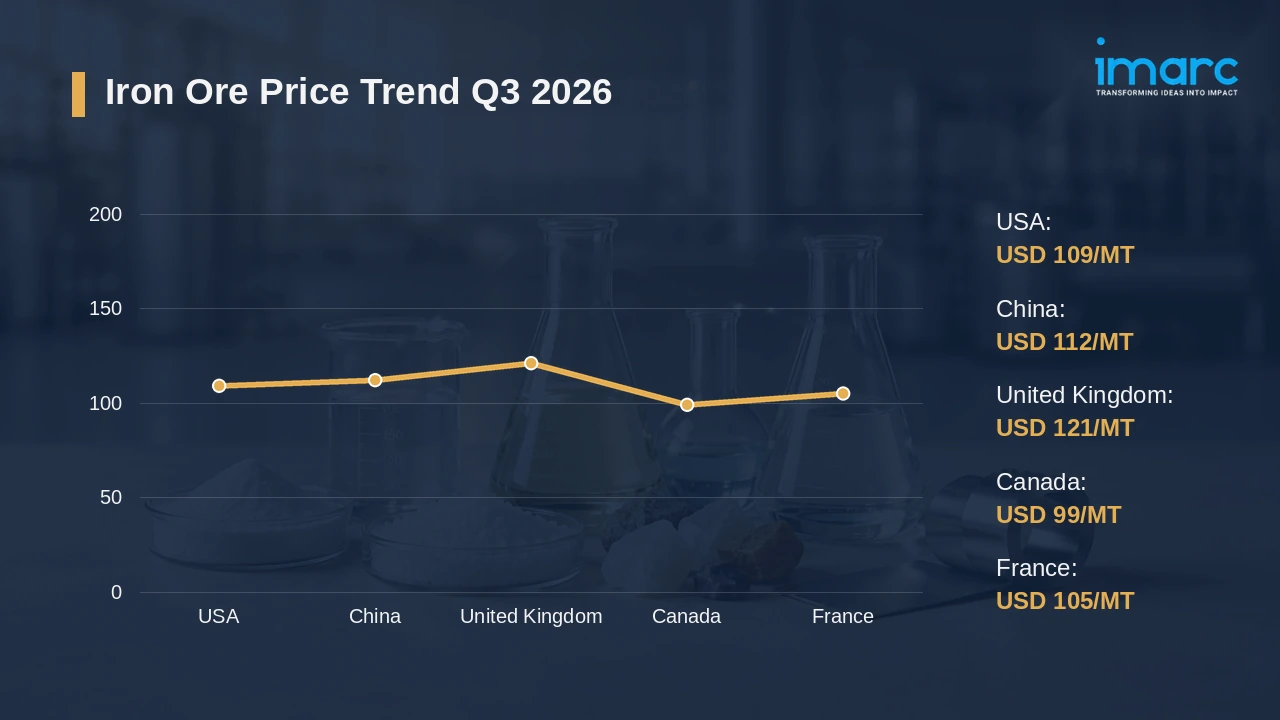
Iron ore is a naturally occurring mineral aggregate from which metallic iron is extracted for industrial use. Steel mills, construction supply chains, automotive lines, and heavy machinery manufacturers form its core buyer base. Movements in seaborne freight rates, energy consumed during mining and beneficiation, and steel output cycles globally move iron ore prices most directly from quarter to quarter. Grade and impurity levels shape mill acceptance.
Global Market Overview:
Globally, the iron ore industry was valued at USD 327.60 Billion in 2025. Market projections indicate steady growth, with the industry expected to reach USD 418.03 Billion by 2034, with a compound annual growth rate (CAGR) of 2.75% during 2026-2034. Steelmaking output worldwide anchors seaborne demand for the ore, and the iron ore price trend therefore tracks blast furnace utilization, pellet demand, and mill restocking closely. Steel decarbonization programs also lift interest in higher-grade ore.
Iron Ore Price Trend Q3 2026:
Regional prices (USD per MT) and QoQ changes Q3 2026 vs Q2 2026:
| Region | Price (USD/MT) | QoQ Change | Direction |
|---|---|---|---|
| USA | 109 | +4.56% | ↑ |
| China | 112 | +5.56% | ↑ |
| United Kingdom | 121 | +3.11% | ↑ |
| Canada | 99 | +4.45% | ↑ |
| France | 105 | +2.07% | ↑ |
To access real-time prices Request Sample
What Moved Prices:
USA:
- In Q3 2026, iron ore values in the USA rose to USD 109/MT, a 4.56% QoQ gain, as Great Lakes pellet supply tightened and domestic mills restocked ahead of autumn furnace campaigns. Value-added pellet premiums lifted delivered quotations across the corridor. Mine maintenance trimmed available tonnage early in the quarter.
- Domestic steelmakers kept blast furnaces running at steady rates through July and August. Rail capacity out of Minnesota stayed open, so inland freight added little to delivered costs at Ohio and Indiana mills. The iron ore price chart for the USA traced a firm upward line as replacement cargoes landed at higher values.
China:
- During Q3 2026, iron ore values in China climbed to USD 112/MT, a 5.56% QoQ rise, as port stocks at Shandong and Jiangsu drew down faster than mills could replenish them. Steel output stayed elevated through the quarter. Seaborne offers firmed on tighter cargo availability at major loading ports.
- Procurement teams accepted higher assessed values rather than risk furnace outages. Rail and barge movements along the Yangtze kept inland delivery costs predictable, though port handling charges edged up at the major northern gateways. A softer yuan against the US dollar raised landed costs on imported cargoes and capped the rally late in September.
United Kingdom:
- In Q3 2026, iron ore values in the United Kingdom advanced to USD 121/MT, a 3.11% QoQ increase, the highest assessed level among the five tracked markets. Imported fines dominate the domestic mill feed. Sterling weakness raised replacement costs on dollar-priced cargoes delivered into Teesport.
- Steelmakers across Scunthorpe and Port Talbot kept buying to schedule rather than building forward stock through the quarter. Atlantic freight held steady, which limited the cost pressure reaching buyers during the period. With continental offers priced above domestic benchmarks, importers absorbed firmer quotations to secure tonnage for winter campaigns.
Canada:
- During Q3 2026, iron ore values in Canada rose to USD 99/MT, a 4.45% QoQ gain, the lowest absolute level among the tracked markets despite a firm quarterly advance. Rail logistics from northern mines ran without disruption through the quarter. Mine output stayed close to contracted volumes.
- Ontario and Quebec mills kept procurement steady as automotive and construction demand held. Because much domestic tonnage moves by rail, diesel and crew availability shaped delivered costs more than ocean freight did. A firmer Canadian dollar trimmed the local-currency burden on imported spare tonnage, which capped further gains late in the quarter.
France:
- In Q3 2026, iron ore values in France edged up to USD 105/MT, a 2.07% QoQ rise, the smallest gain among the tracked markets. Dunkirk and Fos-sur-Mer received regular seaborne deliveries under existing annual contracts. Steel demand from automotive and construction customers stayed measured through the quarter.
- Buyers leaned on contracted volumes instead of chasing spot cargoes at higher assessed values. Stable Atlantic freight and comfortable port inventories kept replacement costs from spiking through the quarter. Energy costs at domestic blast furnaces remained a live concern, which tempered mill willingness to pay up for prompt tonnage.
Drivers Influencing the Market:
Several factors continue to shape iron ore pricing and market behavior:
- Steel Industry Demand and Mill Utilization: Crude steel output sets baseline iron ore consumption because blast furnace routes still dominate global production. Per the World Steel Association, the 70 reporting countries produced 149.2 Million Metric Tons of crude steel in July 2026, a modest 0.3% dip from a year earlier. China's output, at 76.9 Million Metric Tons, fell 3.6% over the same comparison. Beyond headline volumes, mill margins increasingly decide procurement timing and grade selection.
- Upstream Mining and Beneficiation Costs: Strip ratios, haulage distances, and declining ore grades at mature pits raise unit extraction costs for major producers. Before shipment, lower-grade deposits need grinding, magnetic separation, and flotation. Because beneficiation capacity often lags demand for cleaner feed, premiums for high-grade, low-impurity product widen steadily and carry growing weight within the iron ore price index.
- Energy Expenditure in Pelletizing and Sintering: Pelletizing furnaces and sinter strands burn large volumes of natural gas, coke breeze, and electricity, making energy a direct input to the cost of processed ore. In Europe, elevated industrial power tariffs keep conversion margins thin. Producers pass these charges into pellet premiums, so pellet values often diverge from fines when energy markets turn volatile.
- Ocean Freight and Logistics Economics: Capesize freight on Brazil and Western Australia routes forms a sizable share of delivered ore costs. Changes in freight rates, fuel prices, and vessel availability can significantly influence delivered iron ore prices and trading margins. Port congestion, vessel turnaround times, and shipping capacity also affect delivery schedules and procurement costs for international buyers.
- Environmental and Regulatory Compliance: Decarbonization targets are reshaping ore specifications as steelmakers shift toward direct reduction routes that require high-grade pellet feed. Within the EU, carbon pricing under the Emissions Trading System raises the cost of blast furnace output, encouraging buyers to pay more for cleaner, higher-iron material. Mine rehabilitation and tailings storage rules add further producer expense.
- Trade Policy and Currency Dynamics: Iron ore trades almost entirely in US dollars, so currency swings in the AUD, BRL, and CNY directly alter producer margins and the purchasing power of importing mills. In the USA, steel tariffs steer mills toward domestic pellets. Contract benchmark revisions between leading miners and Chinese state buyers add another layer of pricing uncertainty.
Recent Highlights & Strategic Developments:
Recent strategic moves within the industry further illustrate evolving dynamics:
- In March 2026, Fortescue secured funding from major banks on the mainland and adjusted the pricing standard applied to specific iron ore contracts within its arrangements with China Mineral Resources Group Co.
- In June 2025, Roy Hill and Atlas Ore announced a merger to form Hancock Iron Ore, combining the two firms' operating experience and mine strengths. Roy Hill ranked among Australia's largest iron ore miners, exporting more than 64 Million Tons each year to steelmaking markets across Asia.
- In June 2025, Rio Tinto launched Western Range, its newest iron ore mine in the Pilbara region. The operation can produce up to 25 Million Tons of iron ore each year and is expected to support the existing Paraburdoo mining hub for up to 20 years.
Outlook & Strategic Takeaways:
Looking ahead, the iron ore market is expected to grow through 2034. Supported by infrastructure construction, automotive steel output, and expanding direct reduction pellet demand, high-grade premiums will remain the pivotal variable shaping the iron ore price forecast.
To navigate this complex landscape, stakeholders should:
- Evaluate Downstream Steel Output Indicators: Track blast furnace run rates, sinter and pellet intake, and construction order books across the five tracked markets. Aligning procurement timing with those signals keeps inventory from building during slower furnace campaigns.
- Assess Freight Market Developments: Monitor Capesize and Panamax rates on the Atlantic and Pacific ore corridors ahead of quarterly contract renewals. Build rate-adjustment clauses into charter agreements so spot volatility does not land entirely on delivered costs.
- Monitor Regional Price Differentials: Compare quarterly assessments for the USA, China, the United Kingdom, Canada, and France to find favorable sourcing windows. Benchmarking iron ore price per MT against prevailing contract rates shows when switching origin lowers landed cost.
- Review Regulatory Compliance Expenditures: Audit emissions reporting, permit conditions, and site rehabilitation obligations at each producing operation and port facility. Shared laboratory testing and consolidated reporting cut compliance overhead without weakening environmental performance standards.
- Strengthen Currency Exposure Management: Hedge exposure on dollar-priced ore cargoes where local currencies have weakened against the US dollar through the quarter. Align hedge tenors with expected shipment and payment dates so cover does not lapse.
- Explore Emerging Application Segments: Investigate direct reduction and hydrogen-based steelmaking routes that require higher-grade ore and low-impurity pellets. Pilot supply agreements with steelmakers testing these processes before committing long-term capacity to new pellet grades.
Subscription Plans & Customization:
IMARC offers flexible subscription models to suit varying needs:
- Monthly Updates: 12 deliverables/year
- Quarterly Updates: 4 deliverables/year
- Biannual Updates: 2 deliverables/year
Each includes detailed datasets (Excel + PDF) and post-report analyst support.

Get in Touch With Us
UNITED STATES
Phone: +1-201-971-6302
INDIA
Phone: +91-120-433-0800
UNITED KINGDOM
Phone: +44-753-714-6104
Email: [email protected]
Client Testimonials




.webp)




.webp)












