Kraft Paper Market Report Q4 2025: Pricing Volatility, Supply Chain Pressures & 5.47% CAGR Outlook
26-Feb-2026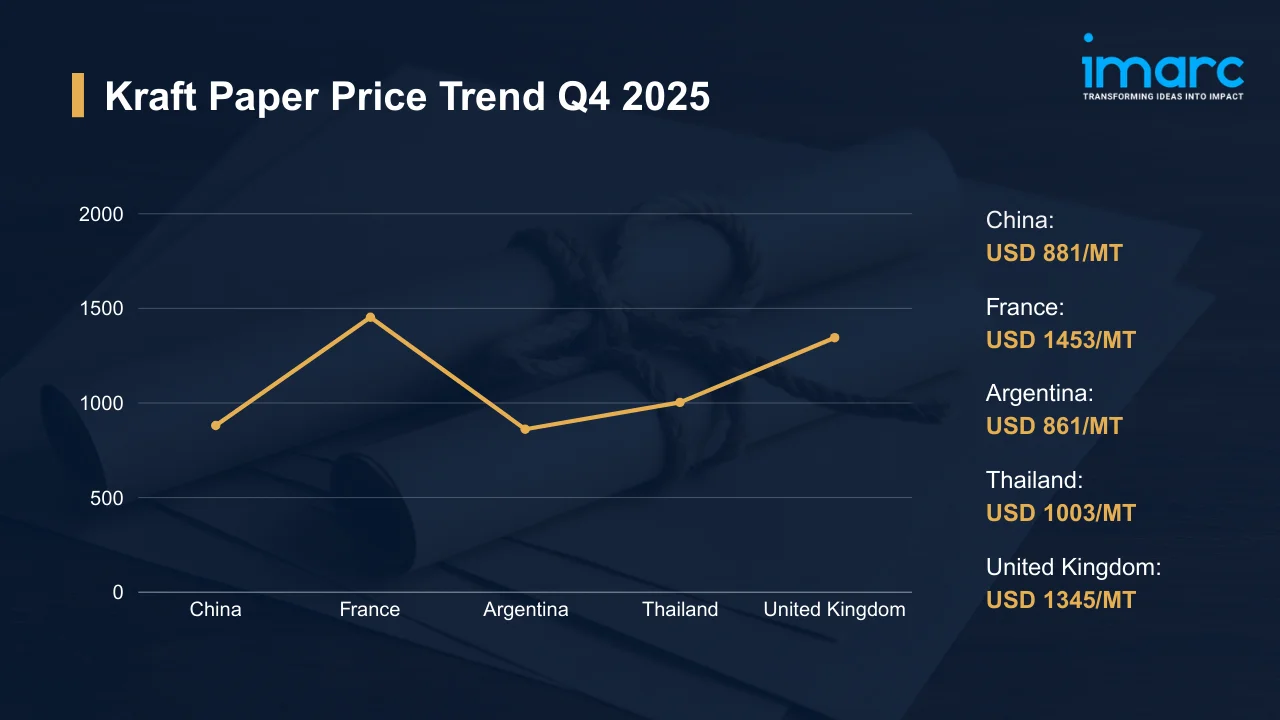
Kraft paper is a robust, recyclable paper product manufactured through the kraft pulping process, in which wood chips are chemically treated with sodium hydroxide and sodium sulfide to isolate cellulose fibers. Recognized for its exceptional tear resistance, tensile strength, and versatility, kraft paper serves critical roles in packaging, industrial wrapping, bag manufacturing, envelope production, and food-grade applications. Pricing sensitivity stems primarily from fluctuations in wood pulp availability, energy input costs, recycled fiber supply conditions, and shifting demand patterns across e-commerce, construction, and consumer goods sectors.
Global Market Overview:
Globally, the kraft paper industry was valued at USD 19.7 Billion in 2025. Market projections indicate steady growth, with the industry expected to reach USD 32.5 Billion by 2034, with a compound annual growth rate (CAGR) of 5.47% during 2026-2034. The expanding adoption of sustainable and recyclable packaging materials continues to fuel robust consumption across multiple end-use industries. E-commerce proliferation and the associated rise in corrugated shipping requirements are amplifying procurement volumes at a global scale. Infrastructure development programs in emerging economies are generating incremental demand for construction-grade paper products, while regulatory mandates favoring biodegradable alternatives over single-use plastics further reinforce long-term market momentum. Technological advancements in pulping efficiency and fiber recovery processes are enabling producers to optimize output while managing cost structures, and macroeconomic factors, including currency movements and trade policy shifts, remain influential in shaping cross-border pricing dynamics.
Kraft Paper Price Trend Q4 2025:
Regional prices (USD per MT) and QoQ changes vs Q3 2025:
| Region | Price (USD/MT) | QoQ Change | Direction |
|---|---|---|---|
| USA | 881 | +1.50% | ↑ |
| France | 1453 | -1.76% | ↓ |
| Argentina | 861 | -2.16% | ↓ |
| Thailand | 1003 | +1.42% | ↑ |
| United Kingdom | 1345 | -1.47% | ↓ |
To access real-time prices Request Sample
What Moved Prices:
- China: In Q4 2025, kraft paper prices in China advanced to USD 881/MT, underpinned by constrained recycled fiber availability and disciplined production management among domestic mills. Elevated capacity utilization rates and firm negotiations reinforced upward pricing momentum, while sustained export appetite from Southeast Asian buyers provided additional demand-side support. Environmental compliance obligations continued to affect operational throughput, and congestion at key port facilities limited inventory turnover, compounding supply tightness across the domestic market.
- France: During Q4 2025, kraft paper prices in France retreated to USD 1453/MT as subdued packaging demand from the food processing and consumer products industries weighed on market sentiment. Accumulated inventory across distribution networks prompted buyers to defer procurement, intensifying competitive dynamics among suppliers. Reduced export flows within European markets further eroded pricing confidence. Producers faced margin compression as elevated production costs persisted alongside weakening order volumes, leaving limited scope for price recovery.
- Argentina: In Q4 2025, kraft paper prices in Argentina declined to USD 861/MT amid restrained industrial output and cautious purchasing strategies adopted by downstream consumers. Currency instability affected import competitiveness, encouraging end users to prioritize domestically sourced material while negotiating aggressively on pricing terms. Local manufacturers encountered additional headwinds from softening construction activity and reduced agricultural packaging requirements, both of which curtailed procurement volumes and reinforced the prevailing downward trajectory in market pricing.
- Thailand: Due to strong export-driven demand and rising packaging use from the food processing and electronics manufacturing sectors, kraft paper prices in Thailand increased to USD 1003/MT in Q4 2025. Sellers' bargaining positions were strengthened, and available stocks were constrained by fewer inflows from rival area suppliers. Higher price levels were reinforced by constant mill operating rates and rising input costs throughout the value chain. Throughout the quarter, optimistic market conditions were maintained by the combination of strict supply control and strong demand fundamentals.
- United Kingdom: As demand from the retail and industrial packaging sectors decreased, kraft paper prices in the UK declined to USD 1345/MT in Q4 2025. Suppliers fighting for market share faced increased competition due to high stockholding levels and few export prospects. In the face of general economic uncertainty, buyers adopted a conservative procurement strategy, postponing discretionary purchases wherever feasible. Suppliers put volume retention ahead of margin preservation despite ongoing production cost pressures, which contributed to the steady decline of current pricing levels.
Drivers Influencing the Market:
Several factors continue to shape kraft paper pricing and market behavior:
- E-Commerce Packaging Expansion: Kraft paper, which is utilized in shipping materials, protective wrapping, and corrugated boxes, is in high demand due to the rapid expansion of online retail channels. Growing parcel volumes via international transportation networks maintain high levels of procurement from package converters, supporting stable consumption trends that uphold pricing firmness in the world's major production countries.
- Recycled Fiber Supply Dynamics: Production costs and mill throughput rates are directly impacted by the availability of recovered paper and recycled fiber feedstock. Manufacturers' access to inputs is limited by tightening collection volumes in important sourcing marketplaces, which forces producers to modify their pricing strategies. When demand for packaging is high, mills compete more fiercely for high-quality secondary fiber.
- Energy and Production Cost Pressures: Fluctuating energy prices, encompassing electricity, natural gas, and thermal coal, significantly affect kraft paper manufacturing economics. Mills operating in energy-intensive pulping processes face variable cost exposure that transmits directly into product pricing. Regional disparities in energy infrastructure and tariff structures create differentiated cost positions among competing global producers.
- Environmental Regulatory Compliance: Increasingly stringent environmental standards governing emissions, effluent treatment, and waste management impose additional operational expenditures on kraft paper producers. Compliance investments in pollution control equipment and sustainable forestry certification programs raise baseline production costs. Regulatory enforcement intensity varies across jurisdictions, generating uneven cost burdens that influence regional competitive positioning.
- Sustainable Packaging Substitution Trends: Regulatory restrictions on single-use plastics and growing consumer preference for biodegradable packaging alternatives channel incremental demand towards kraft paper products. Brand owners across the food, beverage, and consumer goods sectors increasingly specify paper-based packaging solutions to meet sustainability commitments. This structural substitution trend provides durable demand-side support for kraft paper markets globally.
- Logistics and Freight Cost Variability: Kraft paper's landing costs in destination markets are significantly impacted by transportation costs across rail, trucking, and maritime shipping networks. Unpredictable cost components are introduced into supply chain economics by port congestion, limitations on container capacity, and fluctuations in fuel prices. The magnitude of the freight-related price differences seen between markets is determined by the quality of the regional logistics infrastructure.
Recent Highlights & Strategic Developments:
Recent strategic moves within the industry further illustrate evolving dynamics:
- In August 2025, Mondi launched its Ad/Vantage Smooth Brown Semi Extensible product, a next-generation kraft paper engineered to address rigorous industrial and packaging specifications. The material delivered an advanced balance of mechanical strength and flexibility, enabling it to absorb considerable stress without compromising structural performance.
Outlook & Strategic Takeaways:
Looking ahead, the kraft paper market is expected to maintain a growth trajectory driven by expanding sustainable packaging adoption and resilient e-commerce demand across global economies. Additionally, increasing regulatory pressure to reduce plastic usage is expected to further support long-term demand for kraft paper.
To navigate this complex landscape, stakeholders should:
- Monitor Regional Price Differentials: Track quarterly pricing variations across key supply regions to identify favorable procurement windows. Establish benchmarking protocols that compare landed costs against prevailing contract rates for optimal sourcing decisions.
- Diversify Fiber Supply Sources: Evaluate alternative recycled fiber and virgin pulp suppliers beyond current vendor portfolios to reduce concentration risk. Secure secondary supply agreements that activate during periods of primary source disruption or capacity constraint.
- Negotiate Flexible Contract Structures: Pursue pricing agreements incorporating volume-based adjustment mechanisms and index-linked escalation clauses. Build contractual flexibility enabling renegotiation triggers when input cost benchmarks exceed predetermined thresholds significantly.
- Optimize Logistics and Inventory Management: Evaluate transportation routing alternatives and warehousing configurations to minimize landed cost exposure. Implement demand-responsive inventory protocols that balance carrying costs against supply disruption risk during volatile market periods.
- Evaluate Currency Exposure Mitigation: Assess foreign exchange risk associated with cross-border kraft paper procurement and implement appropriate hedging instruments. Monitor currency movement correlations with commodity pricing to refine financial planning assumptions across sourcing geographies.
Subscription Plans & Customization:
IMARC offers flexible subscription models to suit varying needs:
- Monthly Updates — 12 deliverables/year
- Quarterly Updates — 4 deliverables/year
- Biannual Updates — 2 deliverables/year
Each includes detailed datasets (Excel + PDF) and post-report analyst support.

Get in Touch With Us
UNITED STATES
Phone: +1-201-971-6302
INDIA
Phone: +91-120-433-0800
UNITED KINGDOM
Phone: +44-753-714-6104
Email: [email protected]
Client Testimonials




.webp)




.webp)












