Latest Silicon Carbide Prices Reveal Key Regional Trends and Real-Time Market Insights
21-Jul-2026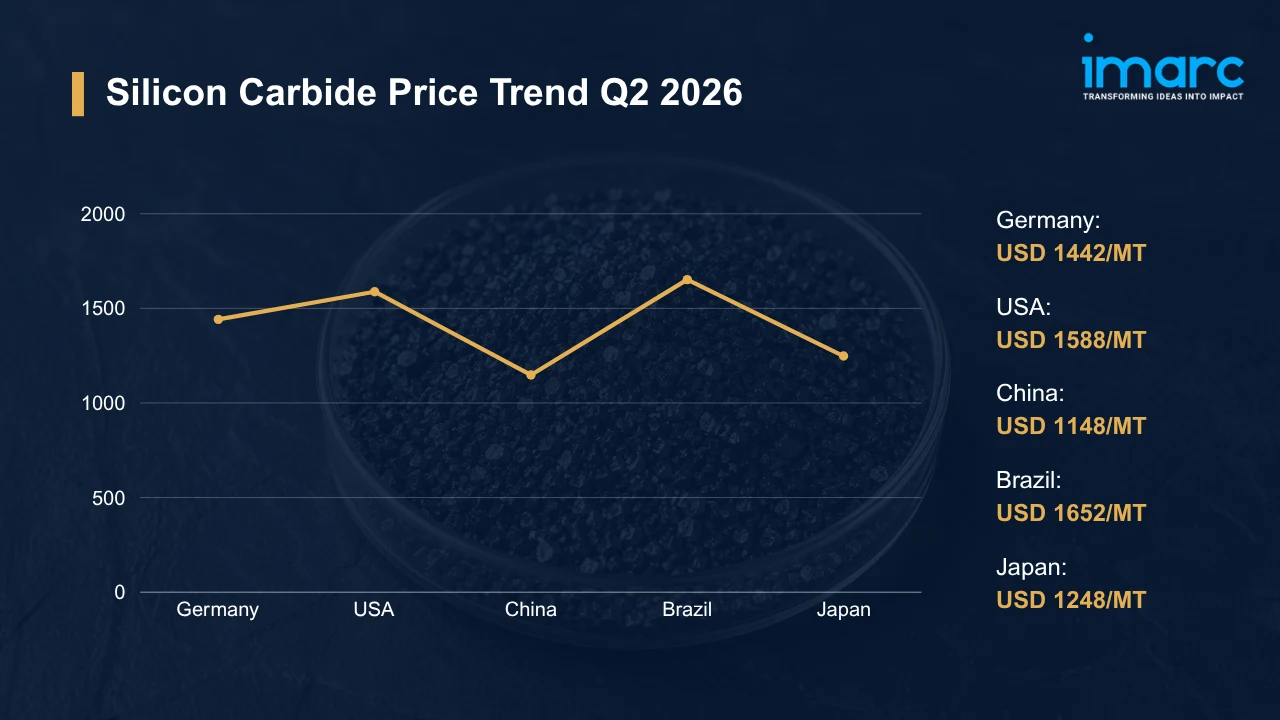
Silicon carbide is a high-performance ceramic and semiconductor material composed of silicon and carbon, exhibiting exceptional hardness and strong wear resistance. Silicon carbide prices are governed by upstream silica sand and petroleum coke input costs, electricity expenditure in energy-intensive Acheson furnace production, and demand cycles within power electronics and industrial manufacturing. Across abrasives, refractories, technical ceramics, metallurgical additives, and EV traction inverters, the material serves a structurally diverse industrial base, with end-use concentration in high-technology sectors reinforcing its pricing sensitivity to semiconductor and automotive market cycles.
Global Market Overview:
Globally, the silicon carbide industry was valued at USD 6.6 Billion in 2025. Market projections indicate steady growth, with the industry expected to reach USD 10.0 Billion by 2034, with a compound annual growth rate (CAGR) of 4.66% during 2026-2034. Growing demand across power electronics and advanced industrial applications continues to strengthen market momentum. Expanding deployment in renewable energy inverters and EV traction systems is reshaping the silicon carbide price trend, while precision abrasives and ceramics continue absorbing baseline volumes across both advanced and emerging industrial markets.
Silicon Carbide Price Trend Q2 2026:
Regional prices (USD per MT) and QoQ changes Q2 2026 vs Q1 2026:
| Region | Price (USD/MT) | QoQ Change | Direction |
|---|---|---|---|
| Germany | 1442 | +10.10% | ↑ |
| USA | 1588 | +2.50% | ↑ |
| China | 1148 | +1.20% | ↑ |
| Brazil | 1652 | +1.72% | ↑ |
| Japan | 1248 | +3.40% | ↑ |
To access real-time prices Request Sample
What Moved Prices:
Germany:
- In Q2 2026, silicon carbide prices in Germany climbed to USD 1442/MT, the sharpest QoQ gain of 10.10% recorded across all tracked regions. Abrasives, refractory materials, and technical ceramics drove procurement volumes, while elevated electricity costs at electric furnace operations reinforced cost floors throughout. Constrained spot availability from select producers converted moderate demand into pronounced upward price pressure.
- Reduced competitive import offerings from Chinese exporters withdrew a key source of landed-cost relief for German buyers during the quarter. Automotive and steel sector procurement teams held to regular replenishment schedules without material inventory builds, sustaining seller confidence in offer levels. Supplier margin discipline remained firm through June.
USA:
- During Q2 2026, at USD 1588/MT, silicon carbide prices in the USA posted a 2.50% QoQ gain as metalworking, semiconductor fabrication, abrasive, and refractory applications absorbed supply at steady rates. The silicon carbide price chart for the period reflected disciplined supplier pricing rather than a demand surge, with buyers replenishing on need rather than building forward inventory positions.
- Production cost floors stayed elevated throughout the quarter, driven by energy and labor expenditures that limited seller flexibility on offer adjustments. Semiconductor and EV related order streams contributed incremental volume without creating excess upward pressure. Import availability remained adequate, preventing supply-side tightness from amplifying the quarterly price movement beyond modest territory.
China:
- In Q2 2026, silicon carbide prices in China edged to USD 1148/MT, a contained 1.20% QoQ gain constrained by abundant domestic production capacity across furnace operators. Downstream demand improved across abrasives, refractories, ceramics, and electronics-linked applications, generating buying activity without exhausting available supply at the prevailing price level.
- Across ceramics and industrial manufacturing clusters in Guangzhou and key interior production regions, procurement schedules remained consistent, sustaining baseline offtake volumes. Energy costs and furnace operating expenses kept producer margins firm, ruling out competitive discounting even where spot inventory was adequate. Export demand from international buyers provided an additional floor beneath domestic assessed values.
Brazil:
- In Q2 2026, silicon carbide prices in Brazil reached USD 1652/MT, a 1.72% QoQ increase driven by firm overseas offer levels and elevated freight costs on trans-Atlantic and Asia-South America trade corridors. Metallurgy, foundry operations, abrasives, and refractory applications maintained stable demand volumes, providing importers with consistent offtake to justify procurement at higher landed cost levels.
- BRL exchange rate fluctuations introduced a compounding cost layer, requiring suppliers to revise quotations upward to defend margin targets after currency conversion. Buyers could not defer replacement purchases despite price pressure, and thin domestic inventory buffers across the distribution network removed the negotiating leverage that accumulated stocks typically provide. Supplier offers stayed firm through the period.
Japan:
- During Q2 2026, silicon carbide prices in Japan advanced to USD 1248/MT, up 3.40% QoQ, as demand from electronics, technical ceramics, precision manufacturing, and abrasive applications held firm. High-purity grade requirements for advanced industrial and semiconductor applications insulated Japanese procurement from the modest softness visible in lower-specification global segments, supporting stable buying interest through the quarter.
- Consistent ocean freight expenditures on Asia-Japan trade lanes kept import costs firm across the period. Precision manufacturing and power electronics producers maintained scheduled procurement without deferral, while silicon carbide-based power component producers serving EV platforms generated incremental demand for higher-specification material. Supplier pricing discipline on origin held, preventing any landed-cost relief for Japanese buyers.
Drivers Influencing the Market:
Several factors continue to shape silicon carbide pricing and market behavior:
- Power Electronics and EV Sector Demand: EV traction inverters, onboard chargers, and DC fast-charging infrastructure collectively constitute the fastest-growing procurement category for silicon carbide. Per the IEA's Global EV Outlook 2026, global electric car sales grew 20% in 2025, exceeding 20 million units, with one in four new vehicles sold being electric. Structural electrification at this scale directly amplifies demand for silicon carbide substrates, wafers, and power modules across automotive and charging infrastructure supply chains, compressing the margin between available capacity and committed order volumes.
- Energy Expenditure in Electric Furnace Production: Sustained high-temperature Acheson furnace operation makes electricity the single largest variable cost in silicon carbide synthesis. Fluctuations in electricity and fuel costs continue to influence production expenses, supplier pricing strategies, and global competitiveness, directly affecting the silicon carbide price index. Regional differences in energy costs further shape pricing trends across major producing markets.
- Upstream Silica and Carbon Feedstock Costs: Petroleum coke availability is tied directly to refinery throughput and crude processing decisions, introducing supply variability that feedstock procurement teams cannot fully hedge through contract structures. Silica sand extraction economics fluctuate with mining productivity and export policy adjustments in key producing regions, periodically shifting input cost baselines for furnace operators. Both movements pass through to finished silicon carbide pricing across spot and contract markets without material lag.
- Ocean Freight and Logistics Economics: Silicon carbide trade routes run primarily from Chinese production centers to consuming markets across Europe, North America, and Japan, making container freight rate dynamics a direct landed cost variable rather than a peripheral market factor. Fluctuating rates on Asia-Europe and trans-Pacific corridors alter delivered cost competitiveness between imported and domestically sourced material within a single quarter. Port congestion events, vessel availability gaps, and shifting freight surcharge structures widen or compress import price spreads at the buyer level.
- Environmental and Regulatory Compliance: Silicon carbide furnace operations generate particulate emissions, chemical byproducts, and dust volumes that fall under increasingly stringent environmental frameworks in China, Europe, and North America. Filtration system upgrades, wastewater treatment investments, and hazardous byproduct disposal protocols raise fixed operating expenditures for producers subject to tightening enforcement cycles. Compliance costs do not fluctuate with demand conditions. They embed a structural cost floor into regional offer levels that persists even during periods of weak downstream activity.
- Trade Policy and Currency Dynamics: Import tariffs, anti-dumping duties, and trade policy revisions in major consuming markets recalibrate the cost competitiveness of Chinese-origin silicon carbide against alternative supply sources on a rolling basis. CNY and BRL exchange rate movements alter landed cost outcomes for buyers sourcing on CIF terms, adding procurement budget uncertainty that cannot be fully mitigated through standard commercial contracts. Exporters adjust offer prices to defend margin targets under fluctuating foreign exchange conditions, transmitting currency volatility directly into assessed market values.
Recent Highlights & Strategic Developments:
Recent strategic moves within the industry further illustrate evolving dynamics:
- In May 2026, Purdue University entered into a five-year collaboration with GeChi Compound Semiconductor Co. to advance the commercialization of silicon carbide for microelectronics applications. The partnership targets thermal, power, and next-generation telecommunications limitations affecting high-compute infrastructure, with GeChi supplying semiconductor materials and Purdue serving as a technology research, development, and workforce training center.
Outlook & Strategic Takeaways:
Looking ahead, the silicon carbide market is expected to reach USD 10.0 Billion by 2034, driven by sustained end-use expansion across EV power modules, renewable energy inverters, and high-temperature industrial ceramics, with the silicon carbide price forecast shaped by ongoing producer capacity additions and competitive feedstock dynamics. Upstream energy costs and petroleum coke pricing trajectories will remain the pivotal variables determining cost structure outcomes for producers across all major supply regions through the forecast horizon.
To navigate this complex landscape, stakeholders should:
- Assess Freight Market Developments: Evaluate container shipping rate trends on Asia-Europe, trans-Pacific, and Asia-South America corridors quarterly to anticipate landed cost movements. Flexible logistics contracts incorporating rate adjustment provisions tied to spot freight indices contain delivered cost variability across procurement cycles.
- Evaluate Downstream Demand Indicators: Track order books and capacity utilization across EV manufacturing, power electronics, and refractory sectors to anticipate procurement cycle inflections. Correlating end-use output signals with inventory positioning prevents overstocking during periods of demand softening.
- Review Regulatory Compliance Expenditures: Audit handling, storage, and environmental discharge costs associated with silicon carbide procurement and processing operations across operating jurisdictions. Identifying procedural efficiencies reduces regulatory cost burden without compromising chemical safety and material handling obligations.
- Strengthen Currency Exposure Management: Implement hedging strategies for procurement denominated in BRL and CNY to stabilize landed cost projections against exchange rate volatility. Aligning treasury and procurement functions ensures foreign exchange coverage matches anticipated import payment timelines across key supply geographies.
- Explore Emerging Application Segments: Investigate commercial opportunities in 6G telecommunications infrastructure, AI data center power conversion, and advanced aerospace components to diversify addressable demand exposure. Engaging R&D partners to assess the commercial viability of novel end-use applications supports medium-term portfolio positioning.
- Monitor Regional Price Differentials: Track quarterly price variations across Germany, USA, China, Brazil, and Japan to identify cost-advantaged procurement windows. Benchmarking the silicon carbide price per MT against prevailing contract rates allows procurement teams to optimize sourcing allocation between spot and term supply.
Subscription Plans & Customization:
IMARC offers flexible subscription models to suit varying needs:
- Monthly Updates: 12 deliverables/year
- Quarterly Updates: 4 deliverables/year
- Biannual Updates: 2 deliverables/year
Each includes detailed datasets (Excel + PDF) and post-report analyst support.

Get in Touch With Us
UNITED STATES
Phone: +1-201-971-6302
INDIA
Phone: +91-120-433-0800
UNITED KINGDOM
Phone: +44-753-714-6104
Email: [email protected]
Client Testimonials




.webp)




.webp)












