Liquid Sulphur Dioxide Price Update: Sustained Growth Across Key Markets in Q2 2026
19-Aug-2026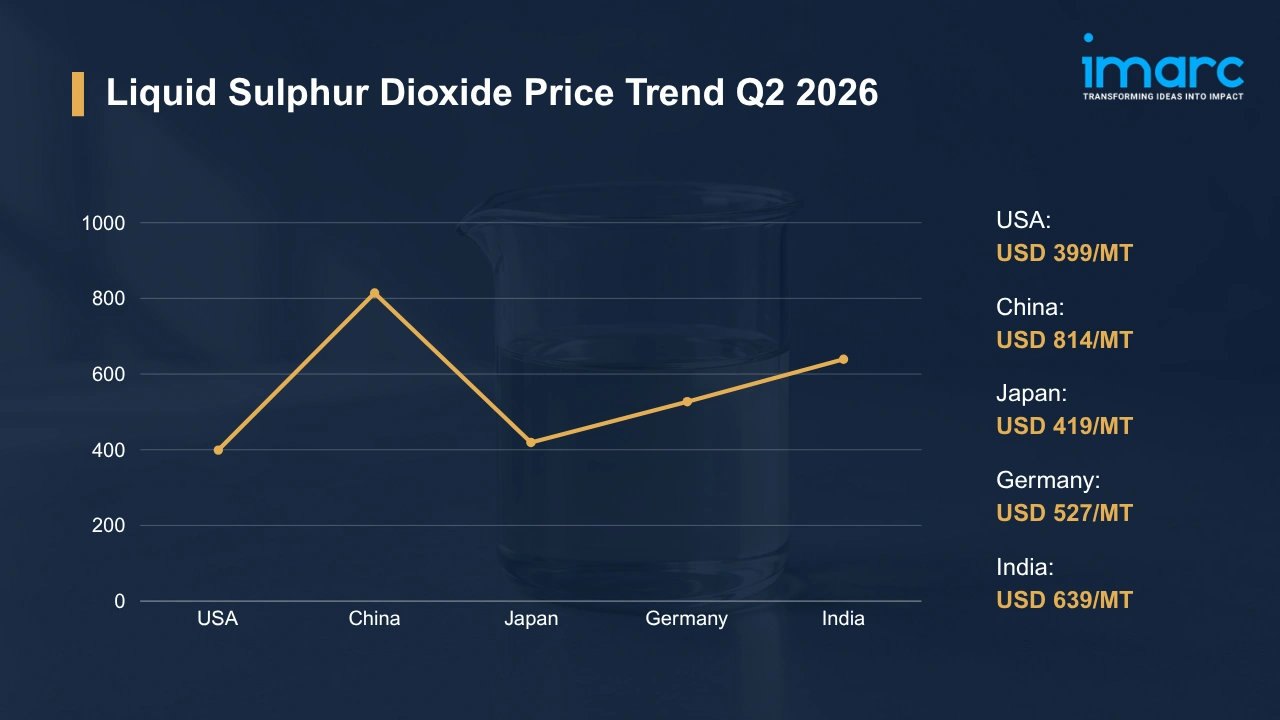
Liquid sulphur dioxide is a colorless liquefied gas. Recognized for strong chemical reactivity, bleaching effectiveness, and antimicrobial properties, the compound is essential to chemical manufacturing, pulp and paper processing, food preservation, water treatment, and pharmaceutical synthesis, supplying critical process inputs across multiple industries. Across the production chain, upstream elemental sulphur costs, energy expenditure in liquefaction and compression, freight logistics, and purchasing cycles in chemical sectors collectively shape liquid sulphur dioxide prices.
Global Market Overview:
Globally, the liquid sulphur dioxide industry reached a volume of 1,281.87 Thousand Tons in 2025. Market projections indicate steady growth, with the industry expected to reach a volume of 2,108.59 Thousand Tons by 2034, with a compound annual growth rate (CAGR) of 5.69% during 2026-2034. Rising chemical sector output and expanding water treatment infrastructure in developing economies underpin consumption growth, while pharmaceutical manufacturing demands further broaden end-use volumes, reinforcing the liquid sulphur dioxide price trend.
Liquid Sulphur Dioxide Price Trend Q2 2026:
Regional prices (USD per MT) and QoQ changes Q2 2026 vs Q1 2026:
| Region | Price (USD/MT) | QoQ Change | Direction |
|---|---|---|---|
| USA | 399 | +15.21% | ↑ |
| China | 814 | +10.12% | ↑ |
| Japan | 419 | +11.21% | ↑ |
| Germany | 527 | +12.10% | ↑ |
| India | 639 | +11.23% | ↑ |
To access real-time prices Request Sample
What Moved Prices:
USA:
- In Q2 2026, liquid sulphur dioxide prices in the USA climbed to USD 399/MT as industrial chemical processing operations and downstream manufacturing applications collectively maintained steady procurement demand. Higher operating costs tied to energy inputs and handling drove firmer supplier offers. Through the quarter, balanced supply conditions limited any significant countervailing downward pressure.
- Transportation expenses on key logistics corridors added to landed cost dynamics, while supply held broadly in line with demand requirements. Across procurement channels, supply tightness sustained pricing pressure. Continuing their purchase activity rather than curtailing demand, buyers tracked the liquid sulphur dioxide price chart as it traced an upward path through the quarter.
China:
- During Q2 2026, liquid sulphur dioxide prices in China advanced to USD 814/MT as chemical manufacturing operations maintained consistent intake and tighter supply conditions emerged among producers. Higher production expenses linked to raw material costs and energy consumption pushed supplier offers higher through the period. Sustaining absorption throughout, industrial processing demand showed no significant order-volume contraction.
- Demand from chemical synthesis and industrial processing sectors held firm throughout the period, while limited supplier capacity flexibility restricted meaningful market supply adjustments. Across supplier tiers, higher production-related cost floors kept assessed pricing elevated. With neighboring supply sources offering constrained availability, buyers found reduced ability to offset upward price movements through alternative procurement channels.
Japan:
- In Q2 2026, liquid sulphur dioxide prices in Japan reached USD 419/MT as production costs rose across domestic manufacturing operations through the quarter. Increased energy expenditure and specialized handling-related expenses influenced supplier pricing decisions. Chemical industry demand and manufacturing sector consumption sustained stable intake without significant order softening.
- Maintaining steady pressure during the quarter, import cost exposure impacted procurement economics as freight-associated expenses and currency fluctuations affected evaluated landed pricing. Domestic buffer capacity remained persistently limited. To ensure operational continuity, buyers sustained procurement schedules despite the firmer pricing environment.
Germany:
- During Q2 2026, liquid sulphur dioxide prices in Germany rose to USD 527/MT as European chemical producers absorbed higher energy-intensive manufacturing costs and maintained disciplined supply availability throughout the period. Stable industrial demand from chemical processing sectors underpinned procurement activity. Absorbing cost increases to sustain production continuity, buyers maintained consistent activity through the reporting quarter.
- Logistics and storage costs reinforced firmness in delivered pricing throughout the quarter. Adjusting output strategies in response to elevated operational expenses, European producers maintained controlled availability while consistent buyer procurement patterns limited meaningful supply surplus that might otherwise have constrained price growth. Supply conditions remained persistently tight.
India:
- In the second quarter of 2026, liquid sulphur dioxide prices in India advanced to USD 639/MT as industrial demand from chemical processing sectors strengthened through the period. Suppliers raised prices against higher operational costs. Contributing further to firmer market conditions, limited production flexibility kept supply responses muted.
- Remaining broadly stable, supply conditions offered limited capacity to accommodate demand shifts without adjustment. Import procurement costs rose steadily. Against this backdrop, consistent chemical manufacturing consumption sustained steady buyer activity through the reporting period while freight-driven procurement cost increases reinforced the upward pricing trajectory.
Drivers Influencing the Market:
Several factors continue to shape liquid sulphur dioxide pricing and market behavior:
- Chemical Processing and Industrial Sector Demand: Chemical manufacturers, water treatment facilities, and food processors drive baseline demand. Driven by urbanization-linked expansion of municipal water infrastructure in developing economies, sustained volume requirements underpin market absorption for liquid sulphur dioxide. Seasonal variability in food preservation activities introduces periodic purchasing cycles, and pharmaceutical as well as pulp and paper end-uses continue adding demand depth through the forecast horizon.
- Upstream Elemental Sulphur and Feedstock Costs: Sourced principally as a byproduct of petroleum refining and natural gas processing, elemental sulphur is the primary feedstock for liquid sulphur dioxide production, making costs closely tied to refinery throughput and maintenance cycles. Supply sourcing is geographically concentrated. Across key producing regions, throughput variability directly affects elemental sulphur availability, driving cost structure adjustments for manufacturers while permitting delays and logistical bottlenecks further compress supply flexibility.
- Energy Expenditure in Liquefaction and Compression: Natural gas and electricity costs represent critical inputs across liquefaction and compression stages, where energy-intensive equipment directly influences liquid sulphur dioxide unit cost structures. Per the EIA, US industrial natural gas consumption averaged a record 23.6 Billion cubic feet per day in 2025, reflecting broad industrial demand growth that tightened energy cost dynamics for chemical producers. Energy remains pivotal in production. Across global manufacturing bases, regional electricity tariff differentials amplify competitive disparities further.
- Ocean Freight and Logistics Economics: Specialized logistics for liquid sulphur dioxide, including pressurized ISO tank handling and hazardous cargo classification, make transportation a meaningful component of landed pricing. Registering USD 4,297 per 40ft container as of early August 2026, Drewry's World Container Index reflects elevated global freight benchmarks that inform cost expectations for chemical shippers. Compliance is not optional. For international routes, regulatory surcharges associated with hazardous sulphur compound transport add further cost layering.
- Environmental and Regulatory Compliance: Regulatory frameworks governing sulphur dioxide production, handling, storage, and disposal impose material compliance costs on manufacturers across multiple jurisdictions. Administratively, registration requirements under chemical safety legislation add ongoing expenditures. Including hazard classification obligations and periodic audit processes, these costs accumulate progressively into finished product pricing. Across markets with tightening occupational exposure limits and emission thresholds, capital investment in containment infrastructure drives incremental cost burden.
- Trade Policy and Currency Dynamics: Shaped by tariff structures, import duty schedules, and bilateral trade frameworks, pricing variability for liquid sulphur dioxide remains pronounced across importing nations where domestic production capacity is limited. Price uniformity is absent. For buyers in markets with weaker currencies relative to the USD, exchange rate volatility introduces additional uncertainty into contract pricing mechanics. Monitoring the liquid sulphur dioxide price index across sourcing regions allows procurement teams to identify cost-effective windows and manage landed cost exposure.
Recent Highlights & Strategic Developments:
Recent strategic moves within the industry further illustrate evolving dynamics:
- In November 2025, researchers evaluated a series of 1-methylimidazolium-based ionic liquids for sulphur dioxide capture efficiency and cycle performance. These findings stood out clearly. The top-performing compound achieved a saturated absorption capacity of 1.986 mol SO2 per mol ionic liquid, sustained 99.71% removal efficiency, and retained over 92% of its capacity across ten regeneration cycles, demonstrating strong thermal durability and reusability potential.
Outlook & Strategic Takeaways:
Looking ahead, the liquid sulphur dioxide market is expected to sustain gradual volume expansion through 2034, supported by rising chemical manufacturing output, accelerating water treatment infrastructure investment across emerging economies, and broadening adoption in pharmaceutical synthesis and food preservation sectors. Upstream elemental sulphur cost trajectories, regional energy price dynamics, and evolving regulatory requirements will remain the pivotal variables shaping the liquid sulphur dioxide price forecast across producing and importing regions.
To navigate this complex landscape, stakeholders should:
- Monitor Regional Price Differentials: Track quarterly pricing variations across key liquid sulphur dioxide supply regions to identify cost-effective procurement windows. Establish benchmarking protocols comparing landed costs against prevailing contract rates to support optimal sourcing decisions.
- Assess Freight and Logistics Developments: Monitor ISO tank and specialized chemical cargo shipping rate trends on major trade corridors to anticipate landed cost movements. Negotiate logistics contracts incorporating rate adjustment mechanisms tied to benchmark freight indices.
- Evaluate Downstream Demand Indicators: Track chemical manufacturing output indices and water treatment project pipelines in key markets to identify procurement volume trends. Benchmark liquid sulphur dioxide price per MT against regional contract rates to align purchasing cycles with demand patterns across pharmaceutical and food preservation sectors.
- Review Regulatory Compliance Expenditures: Audit compliance costs associated with sulphur dioxide handling, storage, and atmospheric emission obligations across operational jurisdictions. Identify process modifications that reduce regulatory burden while maintaining adherence to applicable chemical safety standards.
- Strengthen Currency Exposure Management: Implement hedging strategies for procurement contracts denominated in volatile currencies to stabilize landed cost projections. Align treasury and procurement functions so that foreign exchange coverage matches anticipated import payment timelines.
- Explore Emerging Application Segments: Investigate commercial potential within ionic liquid-based sulphur dioxide absorption technologies and other emerging industrial applications for expanded market coverage. Engage with research partners to assess scalability and market readiness of novel end-use areas that could broaden the addressable demand base.
Subscription Plans & Customization:
IMARC offers flexible subscription models to suit varying needs:
- Monthly Updates: 12 deliverables/year
- Quarterly Updates: 4 deliverables/year
- Biannual Updates: 2 deliverables/year
Each includes detailed datasets (Excel + PDF) and post-report analyst support.

Get in Touch With Us
UNITED STATES
Phone: +1-201-971-6302
INDIA
Phone: +91-120-433-0800
UNITED KINGDOM
Phone: +44-753-714-6104
Email: [email protected]
Client Testimonials




.webp)




.webp)












