PVC Resin Prices: IMARC Group Delivers Real-Time Prices, Historical Data, and Forecast Analysis
29-Jul-2026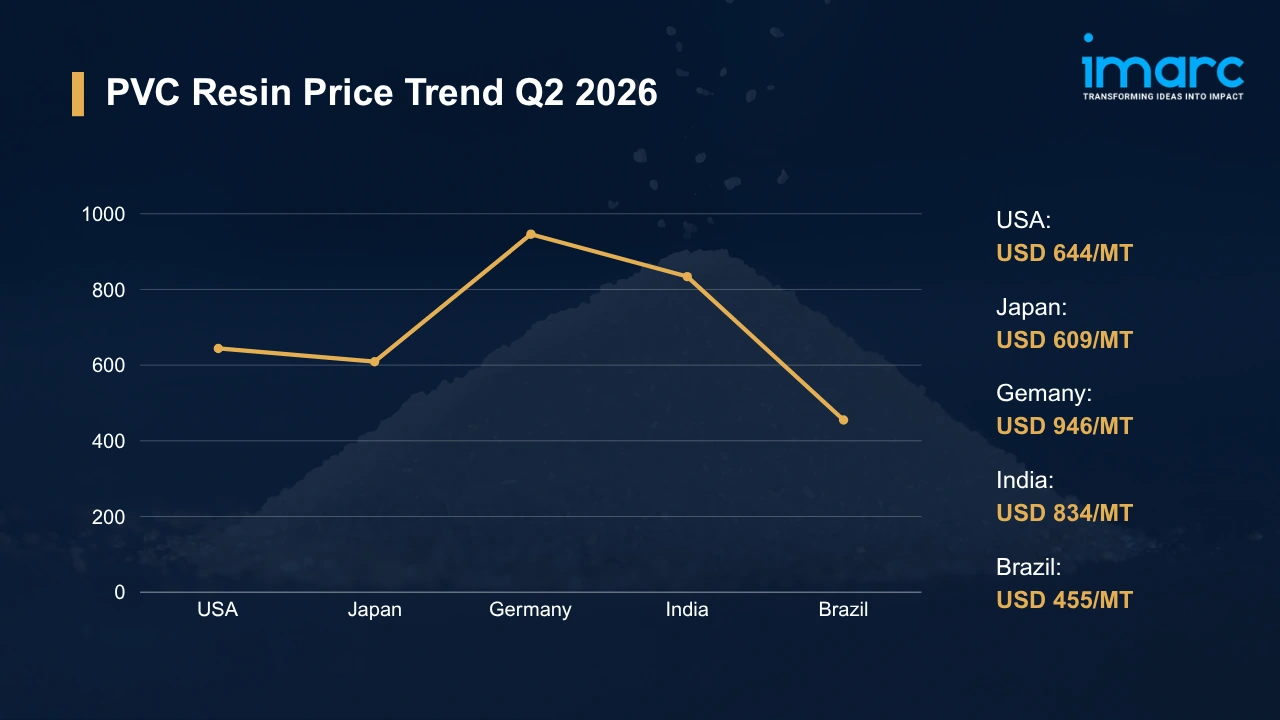
PVC resin, formed through the polymerization of vinyl chloride monomer, offers high chemical resistance, weathering stability, and dual-form versatility across rigid pipes, profiles, and flexible sheeting applications. The compound serves construction pipe fabrication, electrical cable insulation, agricultural irrigation systems, window profiles, and healthcare packaging sectors. PVC resin prices are influenced by fluctuations in upstream VCM and ethylene feedstock, costs associated with energy in polymerization and compounding, shipping trends on major import routes, and the cyclical demand within the construction industry.
Global Market Overview:
Globally, the PVC resin industry was valued at USD 49.5 Billion in 2025. Market projections indicate steady growth, with the industry expected to reach USD 71.1 Billion by 2034, with a compound annual growth rate (CAGR) of 4.10% during 2026-2034. Across the construction, agricultural irrigation, and healthcare sectors, expanding end-use demand sustains consumption growth. Driven by compound formulation improvements and regulatory shifts, the PVC resin price trend reflects evolving cost and compliance dynamics globally.
PVC Resin Price Trend Q2 2026:
Regional prices (USD per MT) and QoQ changes Q2 2026 vs Q1 2026:
| Region | Price (USD/MT) | QoQ Change | Direction |
|---|---|---|---|
| USA | 644 | +19.23% | ↑ |
| Japan | 609 | +8.21% | ↑ |
| Germany | 946 | -1.12% | ↓ |
| India | 834 | +5.13% | ↑ |
| Brazil | 455 | +5.11% | ↑ |
To access real-time prices Request Sample
What Moved Prices:
USA:
- In Q2 2026, at USD 644/MT, PVC resin prices in the USA surged 19.23% QoQ as pipe manufacturers and infrastructure contractors expanded procurement volumes alongside firm construction sector demand. Through the quarter, domestic supply grew progressively tighter. Producers maintained elevated market offers as export commitments reinforced confidence among regional suppliers.
- Competitively positioned against limited import availability, Gulf Coast producers maintained firm offer levels through most of Q2, supported by production economics that prevented significant margin concessions. Manufacturing cost pressures stayed firm through the period. Across domestic distribution channels, inventory remained disciplined, with the PVC resin price chart reflecting a clear upward trend throughout the quarter.
Japan:
- During Q2 2026, PVC resin prices in Japan climbed to USD 609/MT, a gain of 8.21% QoQ as construction material processors and packaging-grade buyers expanded procurement volumes. Post-holiday inventory replenishment drove the improvement. Disciplined supply management by producers limited market oversupply, sustaining upward price momentum through the quarter.
- Steady demand from building material manufacturers and industrial processors underpinned procurement activity, with buyers increasing spot purchases to secure near-term inventory requirements across key production lines. Through Q2, import supply remained tightly managed. Controlled availability across key Asian sourcing regions limited oversupply conditions, sustaining a constructive pricing environment for Japanese converters.
Germany:
- In Q2 2026, PVC resin prices in Germany eased to USD 946/MT, a 1.12% QoQ fall as industrial buyers adopted cautious procurement strategies amid subdued downstream consumption patterns. Buyer purchasing urgency weakened through the period. Against a backdrop of comfortable supply availability, upward pricing pressure remained limited, keeping spot conditions competitive throughout the quarter.
- Purchasing activity from construction and industrial manufacturing segments remained limited through the quarter, with buyers preferring shorter-term spot arrangements over forward commitments amid uncertain consumption signals. Through the quarter, regional inventory positions held comfortable levels. Ample product availability across the market supported strong buyer negotiating leverage, reinforcing the marginal price decline through Q2.
India:
- During Q2 2026, PVC resin prices in India advanced to USD 834/MT, a 5.13% QoQ gain driven by pipe manufacturers, construction processors, and agricultural buyers expanding procurement volumes. Demand momentum across key end-use segments remained firm. Reinforcing the uptick, infrastructure project activity and irrigation system production sustained strong buying across major regional consumption centers.
- Supported by import-parity pricing from Asian origins, buyers secured favorable offer levels across both spot and contract channels throughout major distribution hubs. Across the distribution network, inventory restocking accelerated meaningfully. Distributors and processors moved to replenish holdings ahead of anticipated construction activity, sustaining strong procurement momentum through Q2.
Brazil:
- In Q2 2026, PVC resin prices in Brazil rose to USD 455/MT, a 5.11% QoQ gain as the construction and infrastructure sector buyers steadily expanded procurement to support active production schedules. Market momentum across key segments improved noticeably. Driven by firmer downstream demand, pipe producers and building material manufacturers increased purchasing to align inventory with near-term requirements.
- Import availability from Asian and regional sourcing origins remained manageable throughout the quarter, preventing supply shortfalls that might have amplified pricing volatility and allowing suppliers to maintain relatively firm market positions. Through the period, BRL exchange rate movements moderated CIF cost exposure for Brazilian importers. Disciplined supply management sustained overall pricing stability across major channels.
Drivers Influencing the Market:
Several factors continue to shape PVC resin pricing and market behavior:
- Construction and Infrastructure Sector Demand: Across emerging economies, construction expansion and infrastructure development programs form the primary demand anchor for PVC resin. Pipe systems and window profiles dominate end-use consumption. Constrained by seasonal project timelines, spring and summer procurement typically accelerates as construction activity peaks, driving order volumes across key regional markets and distribution hubs.
- Upstream VCM and Ethylene Feedstock Costs: Vinyl chloride monomer, produced from ethylene and chlorine through a chlorination and cracking process, directly anchors PVC resin production economics to upstream commodity price movements across global supply chains. On the feedstock side, ethylene cost movements matter most. Once Gulf Coast and Asian cracker complex prices shift, VCM economics respond within a quarter, and the PVC resin price index tends to reflect these feedstock cycles with regional lag.
- Energy Expenditure in Polymerization and Production: Natural gas and electricity costs are critical in PVC resin polymerization and thermal processing stages. Persistent energy cost disparities shape competitiveness. American and European cost bases diverge accordingly, influencing global contract pricing.
- Ocean Freight and Logistics Economics: Container freight dynamics on Asia-Pacific and trans-Atlantic corridors shape PVC resin landed costs across major consuming regions. Per Drewry’s World Container Index, composite spot rates reached USD 4,530 per 40-foot container in early July 2026, reflecting peak-season demand pressure on global shipping markets. Higher container freight costs matter significantly. Across Europe and the Americas, elevated freight amplifies landed cost differentials for Asian-origin resin, reinforcing regional price floors.
- Environmental and Regulatory Compliance: Tightening chemical safety regulations governing PVC resin stabilizer composition, recyclability standards, and waste disposal requirements impose growing compliance expenditures on producers and distributors across regulated markets. Pushed by evolving restrictions on lead and cadmium stabilizers, manufacturers shift toward alternative compounding systems. Compliance expenditures continue rising industry-wide. Under chemical classification mandates, registration requirements add administrative burden that filters progressively into regional product pricing.
- Trade Policy and Currency Dynamics: Trade policy shifts, including anti-dumping duty regimes and tariff adjustments, reshape cost competitiveness for PVC resin sourced across international trade lanes. Against these structural dynamics, currency fluctuations amplify import parity effects markedly. Purchasing power movements in major consuming nations, particularly BRL and JPY volatility, introduce landed cost variability for Brazilian and Japanese buyers operating on USD-denominated procurement terms.
Recent Highlights & Strategic Developments:
Recent strategic moves within the industry further illustrate evolving dynamics:
- In August 2025, India’s Directorate General of Trade Remedies recommended the imposition of five-year anti-dumping duties on PVC resin imports, with proposed levies ranging from USD 22 to USD 284 per Metric Ton depending on country of origin. The measure aimed at supporting domestic producer competitiveness and normalizing regional distribution market pricing.
Outlook & Strategic Takeaways:
Looking ahead, the PVC resin market is expected to sustain its growth trajectory through 2034, underpinned by expanding construction, agricultural irrigation, and infrastructure investment across developing and developed regions. Upstream VCM and ethylene feedstock cost movements will remain the most pivotal determinant shaping the PVC resin price forecast and competitive dynamics across supplier markets.
To navigate this complex landscape, stakeholders should:
- Monitor Regional Price Differentials: Track quarterly pricing shifts across key supply regions to identify favorable procurement windows. Establish benchmarking protocols comparing landed costs against prevailing contract rates for optimal sourcing decisions.
- Assess Freight Market Developments: Monitor container shipping rate trends on Asia-Pacific and trans-Atlantic corridors to anticipate landed cost movements. Negotiate logistics contracts incorporating rate adjustment clauses tied to prevailing spot market benchmarks.
- Evaluate Downstream Demand Indicators: Track construction sector activity, infrastructure project pipelines, and agricultural procurement cycles across principal consuming regions. Compare the current PVC resin price per MT against historical contract benchmarks to assess whether spot or forward purchasing is optimal.
- Review Regulatory Compliance Expenditures: Audit current compliance costs for stabilizer handling, environmental discharge, and chemical registration requirements. Identify operational efficiencies that reduce regulatory burden without compromising chemical safety obligations.
- Strengthen Currency Exposure Management: Implement hedging strategies for procurement denominated in BRL or JPY-linked contracts to stabilize landed cost projections. Coordinate treasury and procurement schedules to align foreign exchange coverage with anticipated import payment timelines.
- Explore Emerging Application Segments: Investigate growth opportunities in medical device packaging, electric vehicle components, and specialty construction compound grades. Engage material innovation partners to assess commercial viability of high-value PVC resin variants across emerging end-use categories.
Subscription Plans & Customization:
IMARC offers flexible subscription models to suit varying needs:
- Monthly Updates: 12 deliverables/year
- Quarterly Updates: 4 deliverables/year
- Biannual Updates: 2 deliverables/year
Each includes detailed datasets (Excel + PDF) and post-report analyst support.

.webp)
Get in Touch With Us
UNITED STATES
Phone: +1-201-971-6302
INDIA
Phone: +91-120-433-0800
UNITED KINGDOM
Phone: +44-753-714-6104
Email: [email protected]
Client Testimonials




.webp)




.webp)












