Sodium Bromide Prices Reveal Key Regional Trends and Real-Time Pricing Insights
11-Aug-2026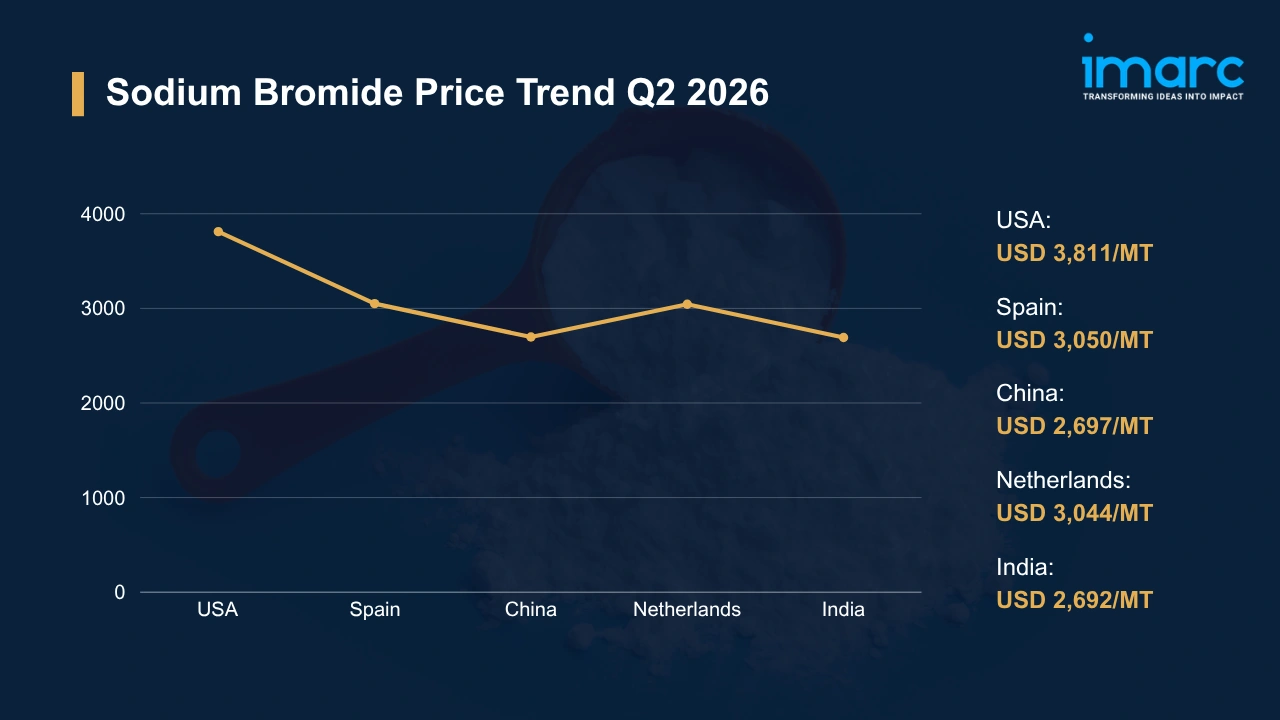
Sodium bromide is a white crystalline salt. Valued for high density and ready bromide ion availability, the salt sees broad industrial use. Across industry, sodium bromide prices reflect the compound’s central role in oil and gas completion and drilling fluids, alongside pharmaceutical synthesis, water treatment, and laboratory applications. Beyond end use demand, upstream bromine costs, energy use during crystallization, and ocean freight economics govern its pricing sensitivity.
Global Market Overview:
Globally, the sodium bromide industry reached a volume of 160.3 Thousand Tons in 2025. Market projections indicate steady growth, with the industry expected to reach a volume of 233.0 Thousand Tons by 2034, with a compound annual growth rate (CAGR) of 4.24% during 2026-2034. Supported by rising exploration budgets, completion work drives baseline offtake. Water treatment programs and bromine-based intermediate chemistry sustain the sodium bromide price trend across forecast years.
Sodium Bromide Price Trend Q2 2026:
Regional prices (USD per MT) and QoQ changes Q2 2026 vs Q1 2026:
| Region | Price (USD/MT) | QoQ Change | Direction |
|---|---|---|---|
| USA | 3,811 | -1.11% | ↓ |
| Spain | 3,050 | +21.13% | ↑ |
| China | 2,697 | +9.21% | ↑ |
| Netherlands | 3,044 | +22.31% | ↑ |
| India | 2,692 | +12.22% | ↑ |
To access real-time prices Request Sample
What Moved Prices:
USA:
- In Q2 2026, USA sodium bromide prices eased to USD 3,811/MT. Balanced domestic output met steady but unhurried oilfield demand, and cautious buyers worked through existing stock rather than chasing fresh spot volumes across drilling and completion programs. Restocking urgency stayed muted through the period.
- Ample raw material availability allowed Gulf Coast producers to hold output steady without cost-driven price increases. Meanwhile, competitive supplier pricing preserved market share. Against a stable demand backdrop, the sodium bromide price chart traced a mild quarterly decline, standing apart from the broad regional gains recorded elsewhere in the quarter.
Spain:
- During Q2 2026, Spain sodium bromide prices climbed to USD 3,050/MT. Tighter regional availability collided with strengthening demand from specialty chemical and oilfield-related applications, forcing industrial buyers to secure volumes earlier and lift procurement activity well ahead of usual cycles. Accordingly, supplier pricing leverage grew through the quarter.
- Firm purchasing requirements from industrial sectors reinforced higher price levels across Spanish distribution channels. Meanwhile, steady export interest from neighboring European markets added support. With inventory rebuilding underway across the converter base, competitive tendering thinned noticeably and suppliers pressed firmer offers into contract negotiations that ran through the remainder of the period.
China:
- During Q2 2026, China sodium bromide prices rose to USD 2,697/MT. Firmer domestic demand and disciplined supplier pricing lifted quotations, as industrial users expanded procurement across chemical processing and oilfield applications while stable plant operations preserved adequate availability. In parallel, export inquiries reinforced market sentiment.
- Steady manufacturing operations balanced domestic requirements against firm international orders during the quarter. Meanwhile, producers managed available inventories fairly tightly. As downstream chemical synthesis and drilling-fluid formulation absorbed available material, spot tightness supported the upward move and encouraged sellers to defend higher assessed values into the following month.
Netherlands:
- During Q2 2026, Netherlands sodium bromide prices surged to USD 3,044/MT. Stronger purchasing from industrial sectors met tighter supply across the European region, and limited availability from several suppliers pushed offers higher through successive transactions during the quarter. Throughout, buyers prioritized reliable supply security.
- Higher logistics and operating costs fed directly into supplier offers as firms defended margins. Yet stable manufacturing output could not fully offset the regional supply squeeze. Because import-dependent buyers faced thin domestic alternatives, procurement teams accepted stepped-up pricing to guarantee supply continuity well into the following quarter’s requirements across the converter base.
India:
- During Q2 2026, India sodium bromide prices advanced to USD 2,692/MT. Rising demand from chemical manufacturing and specialty applications met firm supplier offers, and stronger procurement activity supported the climb even as domestic plants ran at steady rates. Buying interest broadened across the quarter.
- Careful production scheduling helped suppliers balance supply against rising consumption. Meanwhile, import availability and logistics conditions shaped landed costs, adding another layer to price formation. With oilfield chemicals and pharmaceutical intermediates drawing steady volumes through the quarter, distributors restocked well ahead of anticipated demand and firmer quotations held into contract discussions.
Drivers Influencing the Market:
Several factors continue to shape sodium bromide pricing and market behavior:
- Oilfield and Completion-Fluid Demand: Sodium bromide anchors clear brine completion fluids prized for density and formation compatibility. Across major producing basins, demand tracks upstream drilling budgets, offshore exploration activity, and well-completion cycles, so firming rig counts and accelerating completion programs translate quickly into heavier procurement volumes. Softer exploration spending thins near-term offtake. Meanwhile, import-reliant regions feel the swing most acutely.
- Upstream Bromine and Sodium Feedstock Costs: Bromine remains the dominant cost input, extracted from brine reserves concentrated in a handful of producing regions. Alongside it, sodium sources such as caustic soda and soda ash add a second feedstock layer. When bromine availability tightens or extraction economics shift, producers move quickly to reset finished sodium bromide quotations, defending margins against precursor delivery gaps that concentrated supply tends to amplify. Regional feedstock disparities widen the effect.
- Energy Expenditure in Crystallization and Processing: Thermal energy drives crystallization, drying, and purification stages, making natural gas and electricity costs central to production economics. According to the EIA, US natural gas spot prices at the Henry Hub averaged USD 3.52 per Million Btu in 2025, representing a 56% increase from 2024 and raising cost structures for energy-intensive processors. Regional energy price gaps continue reshaping competitive positioning among global producers.
- Ocean Freight and Logistics Economics: Because sodium bromide moves in drums and bulk across long trade lanes, container economics feed directly into landed costs. Drewry’s World Container Index recorded a composite spot rate of USD 4,297 per 40ft container in early August 2026, edging up 1% week-on-week as carriers pushed rate increases and Chinese port congestion tightened capacity. Such freight swings shift import parity quickly.
- Environmental and Regulatory Compliance: Handling, storage, and disposal of bromide compounds fall under tightening chemical safety frameworks across major markets. Under these frameworks, registration, testing, and documentation obligations raise administrative spending for producers and distributors. Progressively, these costs filter into pricing, especially in jurisdictions enforcing stringent discharge and worker-safety standards, where the sodium bromide price index increasingly reflects the added regulatory burden carried by suppliers. Enforcement gaps keep the picture uneven.
- Trade Policy and Currency Dynamics: Sodium bromide trade flows respond to tariff shifts, export controls, and evolving customs treatment across bromine-producing and importing nations. Beyond policy, currency swings alter landed costs for import-dependent buyers, particularly where procurement settles in dollars against weaker local units, forcing rapid repricing when rates move sharply. Policy uncertainty only compounds the volatility.
Recent Highlights & Strategic Developments:
Recent strategic moves within the industry further illustrate evolving dynamics:
- In October 2025, researchers at the University of Warwick unveiled a laboratory demonstrator for ammonia salt resorption heat pump technology aimed at cutting building heating and cooling emissions. The system paired sodium bromide as the low-temperature salt with manganese chloride. Marking the first continuous operation of this pairing, the demonstrator delivered strong cycling performance despite lingering thermal-mass and contact-resistance challenges that researchers flagged for further work.
Outlook & Strategic Takeaways:
Looking ahead, the sodium bromide market is expected to expand steadily through 2034, propelled by resilient oilfield completion-fluid demand, growing water treatment needs, and widening bromine-based intermediate chemistry. Feedstock bromine availability and energy cost trajectories will remain the pivotal variables shaping the sodium bromide price forecast across supplier margin structures.
To navigate this complex landscape, stakeholders should:
- Assess Freight Market Developments: Monitor container spot-rate movements on Asia-Europe and Transpacific lanes to anticipate landed-cost shifts early. Negotiate logistics contracts that embed rate-adjustment mechanisms tied to prevailing spot conditions, protecting budgets from sudden freight spikes.
- Evaluate Downstream Demand Signals: Track oilfield rig counts, completion schedules, and water treatment order books across principal consuming regions. Correlate these indicators with procurement cycles to position inventory sensibly and avoid both overstocking and supply gaps.
- Review Feedstock Cost Exposure: Assess bromine and sodium input price movements that flow directly into finished quotations each quarter. Structure supplier agreements that share feedstock risk and improve forward visibility on production cost trajectories.
- Monitor Regional Price Differentials: Track quarterly gaps between the USA, European, and Asian quotations to time procurement windows precisely. Benchmark sodium bromide price per MT against prevailing contract rates to sharpen sourcing decisions across supply regions.
- Strengthen Currency Risk Management: Implement hedging for procurement settled in volatile currencies to stabilize landed-cost projections. Coordinate treasury and purchasing functions so foreign exchange coverage aligns with anticipated import payment timelines.
- Explore Emerging Application Segments: Investigate demand potential in thermal storage, heat-pump salts, and specialty chemical uses beyond core oilfield markets. Engage research partners to gauge commercial viability and widen the addressable market over time.
Subscription Plans & Customization:
IMARC offers flexible subscription models to suit varying needs:
- Monthly Updates: 12 deliverables/year
- Quarterly Updates: 4 deliverables/year
- Biannual Updates: 2 deliverables/year
Each includes detailed datasets (Excel + PDF) and post-report analyst support.
Get in Touch With Us
UNITED STATES
Phone: +1-201-971-6302
INDIA
Phone: +91-120-433-0800
UNITED KINGDOM
Phone: +44-753-714-6104
Email: [email protected]
Client Testimonials




.webp)




.webp)












