
Philippines Bakery Market Size, Share, Trends and Forecast by Product Type, Distribution Channel, and Region, 2026-2034
Philippines Bakery Market Size, Share, Trends & Forecast (2026-2034)
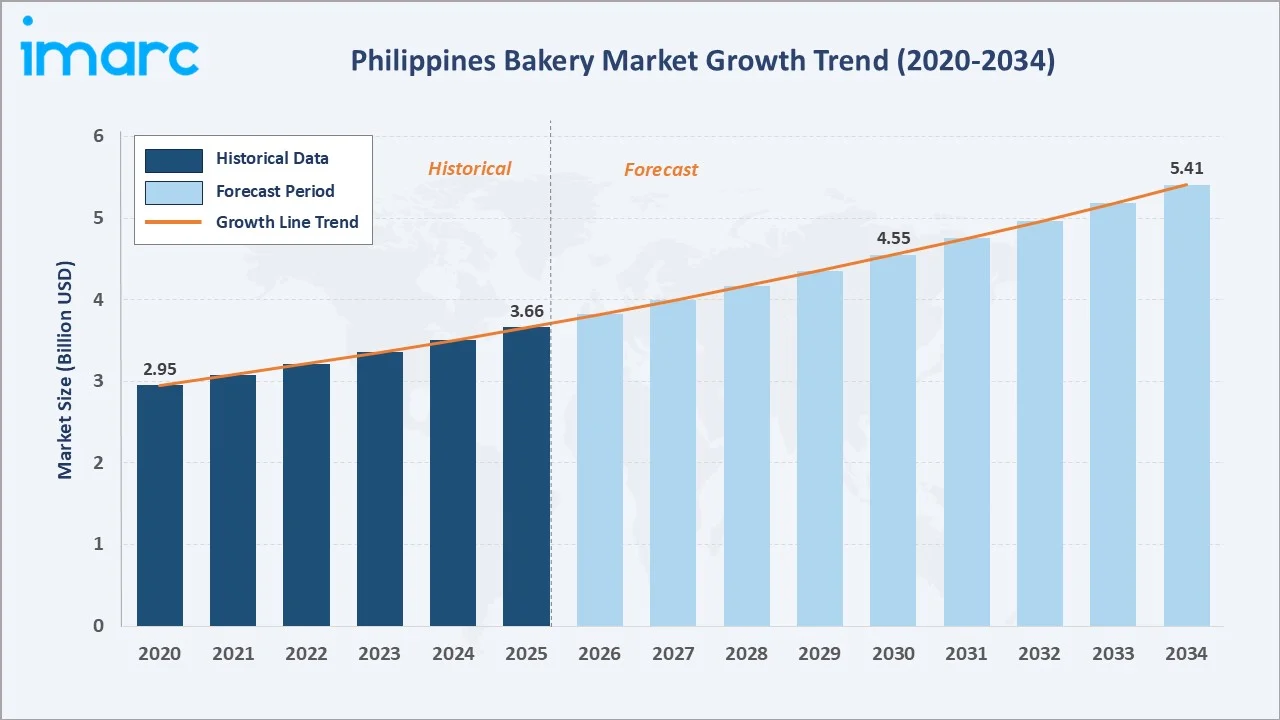
The Philippines bakery market size increased from USD 3.66 Billion in 2025 to USD 3.83 Billion in 2026 and is projected to reach USD 5.41 Billion by 2034, exhibiting a CAGR of 4.42% during 2026-2034. Rising demand for convenient, ready-to-eat baked goods, expanding modern retail networks, and increasing bakery franchising are the primary drivers shaping market growth.
Biscuits lead the product type segment at 42.5%, supermarkets and hypermarkets dominate distribution channel at 32.6%, and Luzon commands 44.7% regional share.
Market Snapshot
|
Metric |
Value |
|
Base Year Market Size (2025) |
USD 3.66 Billion |
| Market Size (2026) | USD 3.83 Billion |
|
Forecast Market Size (2034) |
USD 5.41 Billion |
|
CAGR (2026-2034) |
4.42% |
|
Base Year |
2025 |
|
Historical Period |
2020-2025 |
|
Forecast Period |
2026-2034 |
|
Largest Region |
Luzon (44.7%, 2025) |
|
Second Largest Region |
Visayas (31.8%, 2025) |
|
Leading Product Type |
Biscuits (42.5%, 2025) |
|
Leading Distribution Channel |
Supermarkets and Hypermarkets (32.6%, 2025) |
The Philippines bakery market expanded from USD 2.95 Billion in 2020 to USD 3.66 Billion in 2025 and an estimated USD 3.83 Billion in 2026, supported by steady urban demand, widening retail distribution, and rising household spending on packaged baked goods. Anchored at USD 4.55 Billion in 2030, the forecast to USD 5.41 Billion by 2034 is underpinned by continued franchise expansion, premiumization, and growth of online and convenience-led distribution.
To get more information on this market, Request Sample
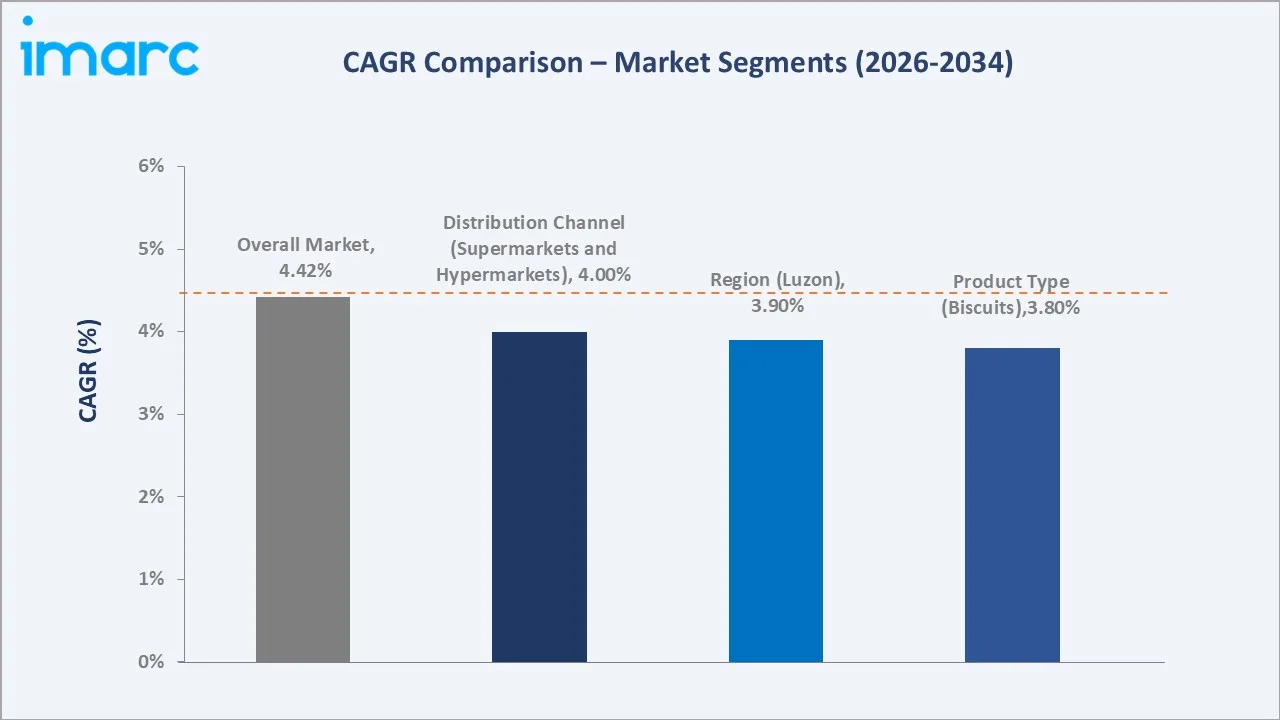
CAGR trajectories across product type, distribution channel, and regional sub-segments show online stores and Mindanao expanding faster than the overall 4.42% market CAGR, driven by digital adoption, rising incomes, and broadening retail infrastructure outside Metro Manila.
Executive Summary
The Philippines bakery market is on a steady growth path, expanding from USD 2.95 Billion in 2020 to an estimated USD 3.83 Billion in 2026 and is projected to reach USD 5.41 Billion by 2034. The industry has shifted from small neighborhood bakeries toward a mix of industrial biscuit makers, national bread brands, and franchised bakeshop chains serving households across Luzon, Visayas, and Mindanao.
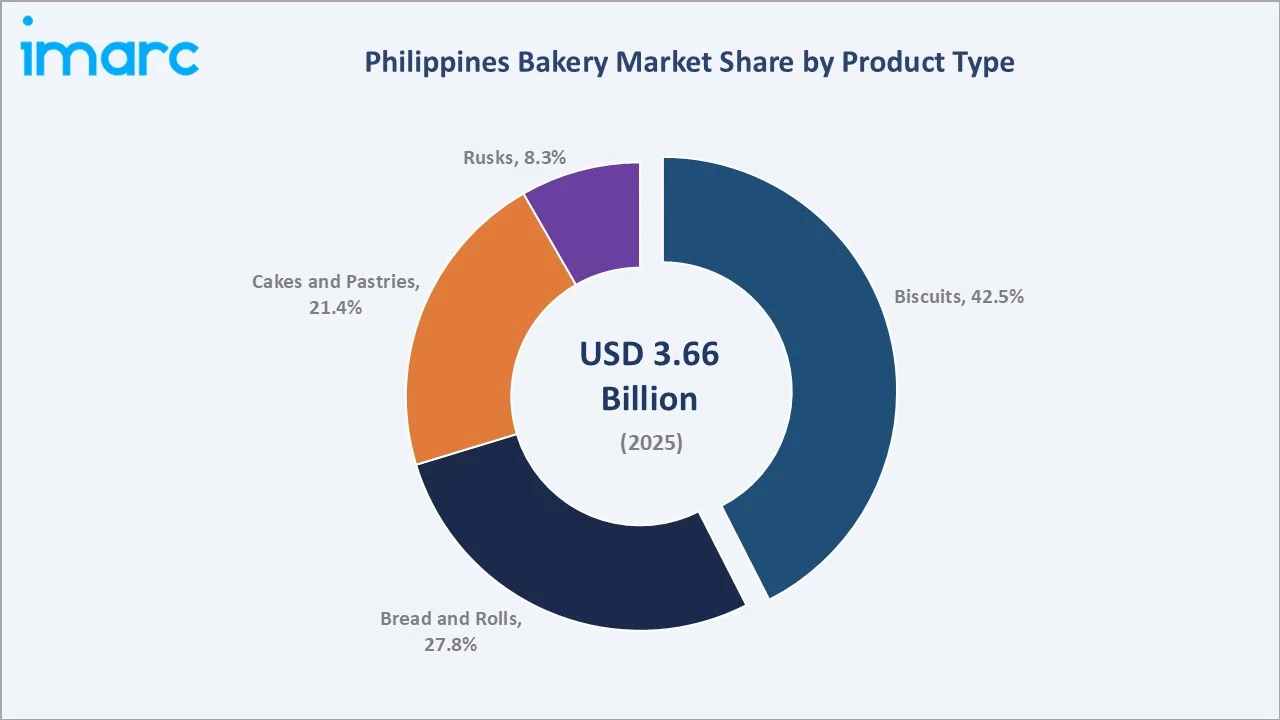
Biscuits lead the product type segment at 42.5% in 2025, supported by affordability and long shelf life. Supermarkets and hypermarkets remain the leading distribution channel at 32.6%, driven by their wide product variety and convenient shopping experience. Luzon commands 44.7% of the regional share, supported by its large population base, urbanization, and concentration of retail and foodservice establishments.
Key Market Insights
|
Insight |
Data |
|
Leading Product Type |
Biscuits - 42.5% share (2025) |
|
Second Largest Product Type |
Bread and Rolls - 27.8% share (2025) |
|
Leading Distribution Channel |
Supermarkets and Hypermarkets - 32.6% share (2025) |
|
Second Largest Distribution Channel |
Convenience Stores - 24.7% share (2025) |
|
Leading Region |
Luzon - 44.7% share (2025) |
|
Second Largest Region |
Visayas - 31.8% share (2025) |
|
Top Companies |
Monde Nissin Corporation, Republic Biscuit Corporation, Jollibee Foods Corporation, QAF Limited, SM Investments Corporation |
Key Analytical Observations Expanding On the Data Above:
- Biscuits dominance at 42.5% is supported by affordability, long shelf life, and wide retail availability across supermarkets, sari-sari stores, and convenience outlets nationwide.
- Bread and rolls at 27.8% are anchored by daily staple consumption of pandesal and sliced bread, reinforced by nationally distributed bread brands and neighborhood bakeshop chains.
- Supermarkets and hypermarkets at 32.6% offer the widest assortment of packaged bakery products alongside private label and imported options.
- Convenience stores share at 24.7% is supported by their widespread presence in urban and suburban areas, extended operating hours, and convenience-oriented purchasing patterns, particularly for ready-to-eat bakery products and packaged snacks.
- Luzon's regional leadership at 44.7% reflects its dense population base and concentration of national bakery manufacturing facilities.
Philippines Bakery Market Overview
Bakery refers to a broad range of food products prepared primarily from flour-based ingredients and consumed as snacks, breakfast items, desserts, and everyday staples. The market spans biscuits, bread and rolls, cakes and pastries, and rusks, sold through supermarkets and hypermarkets, convenience stores, independent retailers, artisanal bakeries, and online stores.
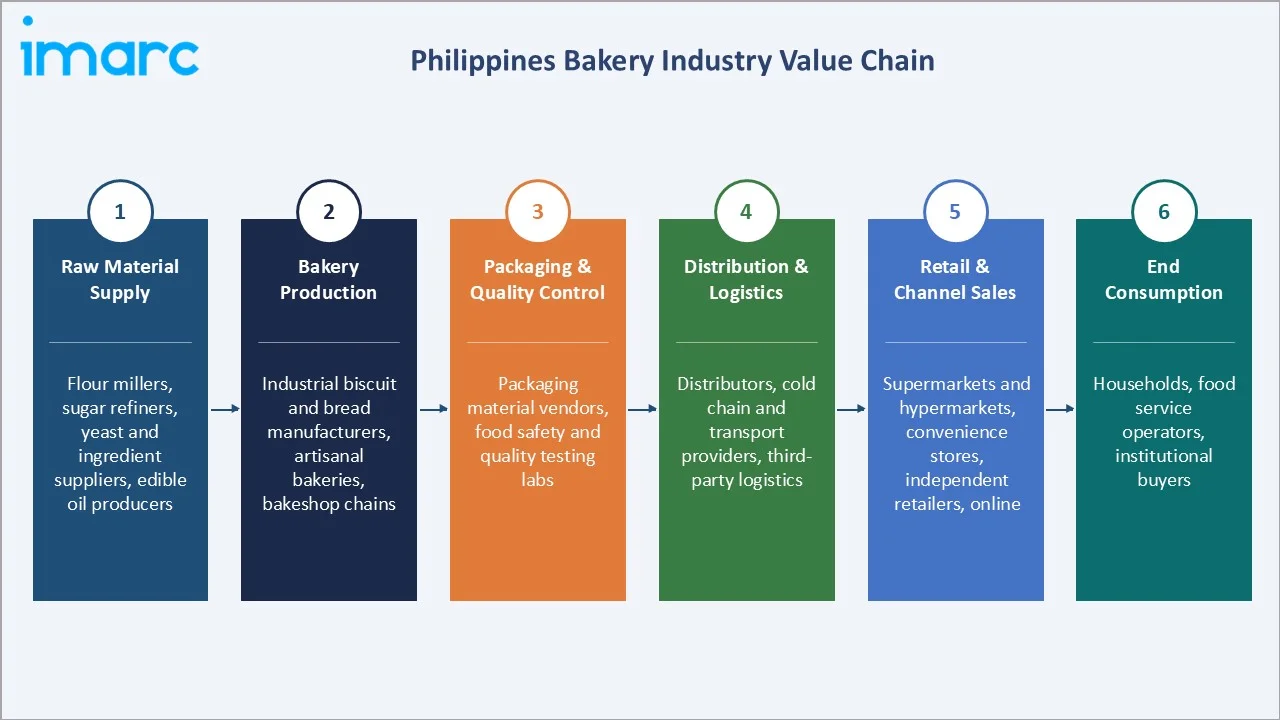
The Philippines bakery ecosystem integrates flour millers and ingredient suppliers, industrial and artisanal bakery manufacturers, packaging and quality assurance providers, logistics and cold chain operators, and retail and franchise networks. Together, they deliver freshly baked and packaged products to households nationwide, supported by a regulatory framework overseen by the Food and Drug Administration Philippines and the Department of Trade and Industry.
Market Dynamics
To evaluate market opportunities, Request Sample
Market Drivers
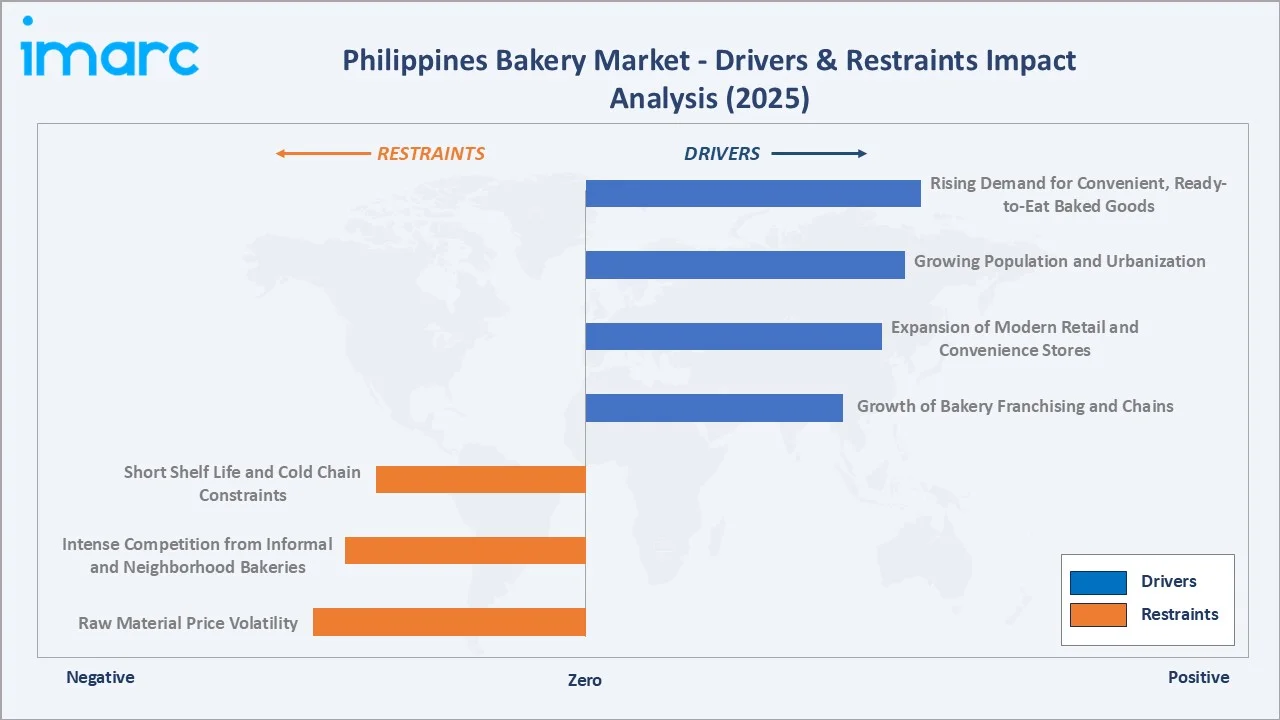
- Rising Demand for Convenient, Ready-to-Eat Baked Goods: Busy urban lifestyles and growing food service use are increasing demand for packaged bread, biscuits, and grab-and-go pastries.
- Growing Population and Urbanization: The Philippine Statistics Authority's 2024 Census of Population recorded the country's population at 112.73 Million as of July 2024, expanding the consumer base for daily bakery staples such as bread and biscuits.
- Expansion of Modern Retail and Convenience Stores: The growing footprint of supermarkets, hypermarkets, and convenience chains is widening product assortment and shelf visibility for packaged bakery brands.
- Growth of Bakery Franchising and Chains: Increasing franchised bakeshop networks are expanding access to fresh bakery products across provincial cities and residential communities, strengthening the bakery industry in the Philippines.
Market Restraints
- Raw Material Price Volatility: Fluctuating global wheat flour, sugar, and edible oil prices weigh on manufacturer margins and retail pricing stability.
- Intense Competition from Informal and Neighborhood Bakeries: Unbranded local bakeries and sari-sari store offerings continue to compete on price, limiting branded product penetration in some areas.
- Short Shelf Life and Cold Chain Constraints: The perishability of fresh bakery items requires tight distribution timelines, restricting reach into remote island and rural markets.
Market Opportunities
- Premium and Artisanal Positioning: Rising disposable incomes are creating room for specialty, health-oriented, and artisanal bakery products beyond mass-market staples.
- E-Commerce and Delivery Platform Integration: Bakery brands and bakeshops are increasingly partnering with food delivery and online grocery platforms to reach digitally engaged consumers.
Market Challenges
- Packaging and Compliance Costs: Evolving food safety and labeling requirements are raising operating costs for manufacturers, particularly smaller bakeries.
- Logistics Complexity Across the Archipelago: The Philippines' island geography adds distribution cost and complexity for maintaining freshness across Luzon, Visayas, and Mindanao.
Emerging Market Trends
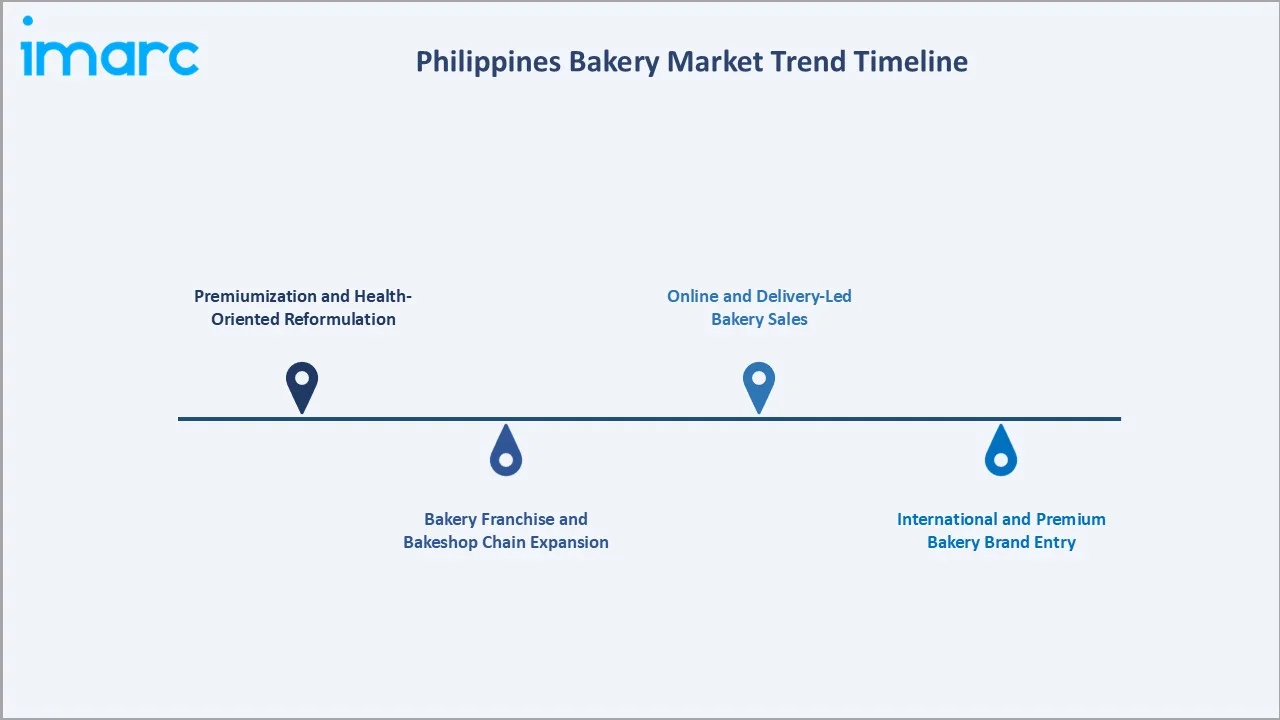
1. Premiumization and Health-Oriented Reformulation
Bakery manufacturers are reformulating products with whole grains, reduced sugar, and functional ingredients as health-conscious consumers seek better-for-you options alongside traditional favorites, a shift that is reshaping product development across the baking industry in the Philippines.
2. Bakery Franchise and Bakeshop Chain Expansion
National bakeshop chains and franchised concepts continue to open new outlets across provincial cities, extending fresh bakery access beyond Metro Manila. Growing franchisee interest and structured brand support systems are accelerating store network growth into residential and secondary urban areas.
3. Online and Delivery-Led Bakery Sales
Bakery brands and bakeshops are increasingly listing products on e-commerce and food delivery platforms, supported by growing digital payment adoption and demand for convenient, at-home ordering.
4. International and Premium Bakery Brand Entry
Global bakery concepts are entering the Philippines market to serve rising demand for premium viennoiserie and artisanal pastries, complementing homegrown biscuit and bread manufacturers.
Industry Value Chain Analysis
The Philippines bakery value chain spans six stages from ingredient supply through end consumption. Bakery production, distribution, and retail capture the highest value-add, while packaging, quality control, and logistics increasingly determine sustainable competitive position across the industry.
|
Stage |
Key Players / Examples |
|
Raw Material Supply |
Flour millers, sugar refiners, yeast and ingredient suppliers, and edible oil producers |
|
Bakery Production |
Industrial biscuit and bread manufacturers, artisanal bakeries, and bakeshop chains |
|
Packaging & Quality Control |
Packaging material vendors and food safety and quality testing laboratories |
|
Distribution & Logistics |
Distributors, cold chain and transport providers, and third-party logistics operators |
|
Retail & Channel Sales |
Supermarkets and hypermarkets, convenience stores, independent retailers, and online platforms |
|
End Consumption |
Households, food service operators, and institutional buyers |
Vertically integrated players, particularly those combining in-house milling, manufacturing, and nationwide distribution, are positioned to capture greater value than smaller bakeries reliant on third-party ingredient and logistics networks.
Technology Landscape in the Philippines Bakery Industry
Automated Baking and Production Systems
Industrial bakery manufacturers are adopting automated mixing, proofing, and baking lines to improve consistency, throughput, and food safety compliance across high-volume biscuit and bread production.
Packaging and Shelf-Life Innovation
Modified atmosphere packaging and improved preservative-free formulations are helping extend shelf life for packaged bakery products, supporting wider distribution into provincial and island markets.
Digital Ordering and Delivery Integration
Bakery brands are integrating with e-commerce marketplaces and food delivery platforms, enabling online ordering, loyalty programs, and direct-to-consumer sales alongside traditional retail channels, a shift expected to underpin Philippines baking industry growth 2026 and beyond.
Market Segmentation Analysis
The report covers the following segments:
|
Segment Category |
Leading Segment |
Market Share |
Year |
|
Product Type |
Biscuits |
42.5% |
2025 |
|
Distribution Channel |
Supermarkets and Hypermarkets |
32.6% |
2025 |
|
Region |
Luzon |
44.7% |
2025 |

By Product Type
Biscuits command a 42.5% majority share in 2025, supported by affordability, long shelf life, and broad retail availability across supermarkets, convenience stores, and sari-sari outlets. The segment benefits from strong household penetration and steady snacking demand nationwide.
To access detailed market analysis, Request Sample
Bread and rolls follow at 27.8%, anchored by daily staple consumption of pandesal and sliced bread. Demand is further supported by their affordability, convenience, and widespread availability through supermarkets, neighborhood bakeries, and independent retailers.
By Distribution Channel
Supermarkets and hypermarkets lead the segment with 32.6% share in 2025, offering the widest bakery product assortment alongside private label options. Their extensive store networks and one-stop shopping convenience support strong consumer traffic and frequent bakery purchases.
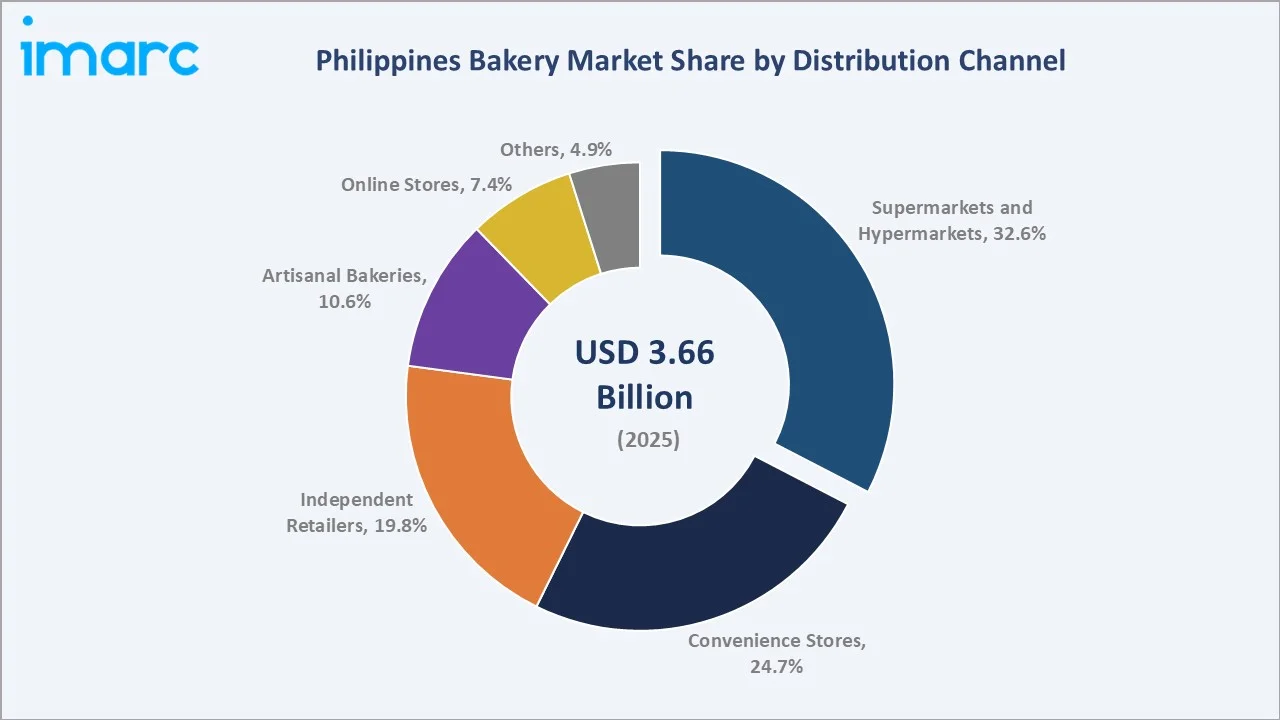
Convenience stores follow at 24.7%, supported by their extensive footprint and impulse-purchase positioning.
Regional Market Insights
|
Region |
Share (2025) |
Key Growth Drivers |
|
Luzon |
44.7% |
Large urban population, dense retail and franchise networks, and concentration of national bakery manufacturing facilities |
|
Visayas |
31.8% |
Growing tourism-linked food service demand, expanding modern retail, and rising urban consumption |
|
Mindanao |
23.5% |
Expanding retail infrastructure, rising disposable incomes, and growing franchised bakeshop presence |
Luzon at 44.7% in 2025 leads the regional landscape, anchored by Metro Manila. Dense population, concentrated manufacturing capacity, and extensive retail networks support sustained leadership across both packaged and fresh bakery channels.
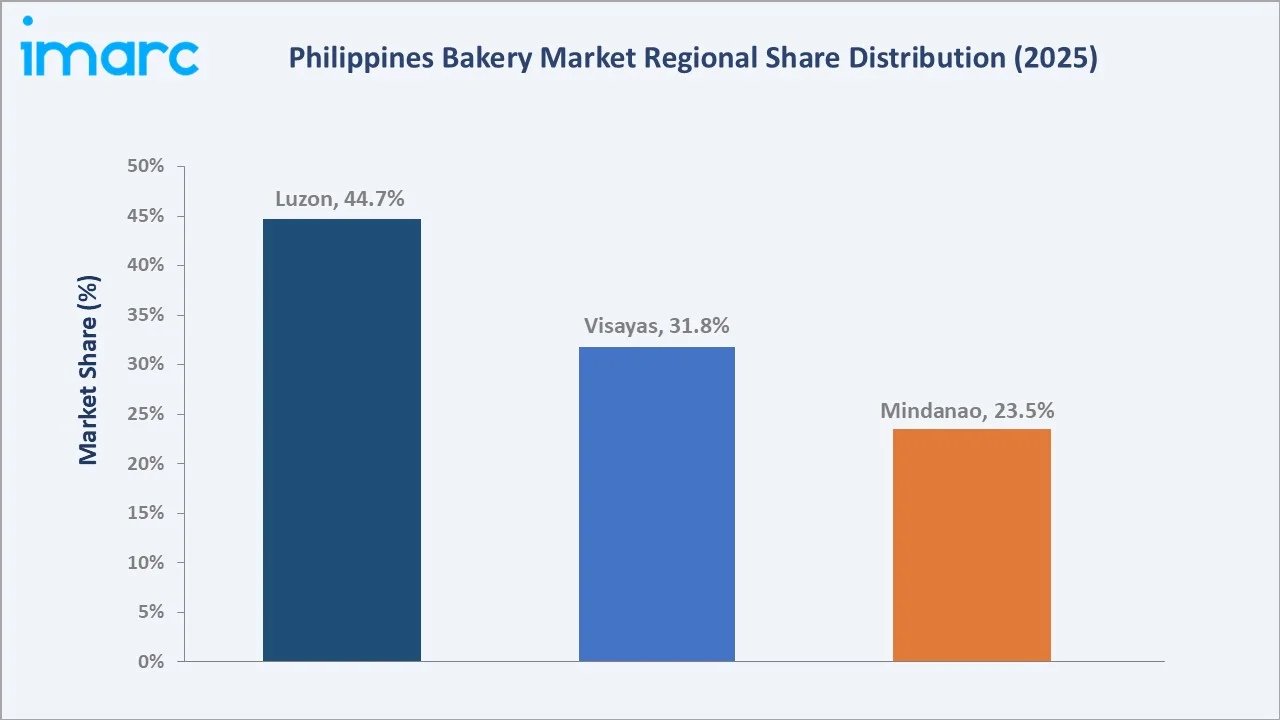
Mindanao at 23.5% share is the fastest-growing region. Expanding retail infrastructure, rising incomes, and growing franchised bakeshop presence are accelerating regional expansion through 2034.
Competitive Landscape
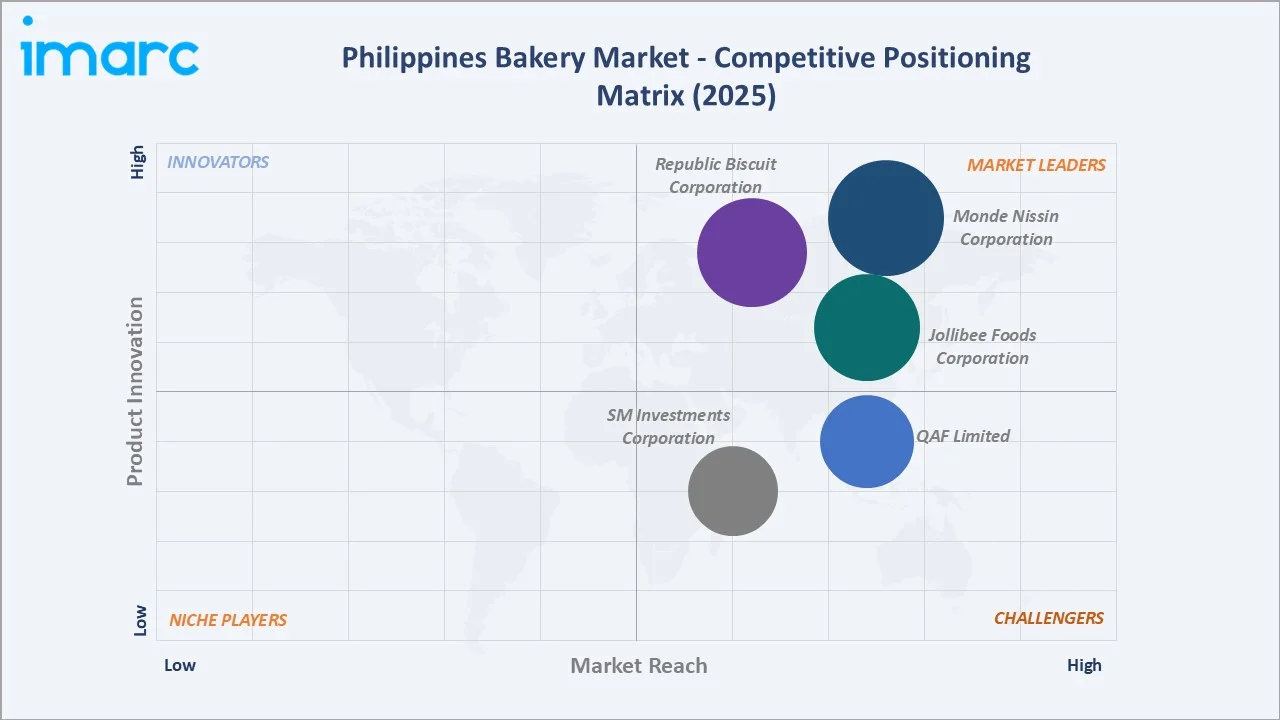
The Philippines bakery market is moderately fragmented, with large branded conglomerates leading biscuit and bread manufacturing while franchised bakeshop chains and regional players compete on freshness, distribution reach, and local brand loyalty. Manufacturing scale, distribution networks, and franchise reach form the key competitive moats across the industry.
|
Company Name |
Brand / Key Product |
Position |
Strategic Focus |
|
Monde Nissin Corporation |
SkyFlakes / Fita |
Leader |
Diversified branded food manufacturer expanding biscuit and packaged bakery portfolio |
|
Republic Biscuit Corporation |
Rebisco |
Leader |
Broad snack and biscuit manufacturer strengthening national distribution reach |
|
Jollibee Foods Corporation |
Red Ribbon Bakeshop |
Leader |
Diversified food service group expanding bakeshop and franchise footprint |
|
QAF Limited |
Gardenia |
Challenger |
Singapore-based bakery conglomerate with nationwide Philippine bread manufacturing and distribution |
|
SM Investments Corporation |
Goldilocks |
Challenger |
Diversified Philippine conglomerate expanding its bakeshop chain focused on cakes and pastries |
Key players include Monde Nissin Corporation, Republic Biscuit Corporation, Jollibee Foods Corporation, QAF Limited, and SM Investments Corporation, among others.
Key Company Profiles
Monde Nissin Corporation
Monde Nissin Corporation is a diversified Philippine food and beverage company that manufactures a wide range of biscuits, crackers, and packaged food products for the domestic and export markets.
- Product Portfolio: SkyFlakes and Fita crackers and biscuits, alongside a broader portfolio of packaged food and beverage brands.
- Recent Developments: In June 2026, the company unveiled investment of over PHP 5 Billion in a new manufacturing facility in Mabalacat, Pampanga, dedicated to its SkyFlakes brand, with commercial operations targeted to begin in 2027.
- Strategic Focus: Strengthening its biscuit and packaged bakery portfolio while expanding manufacturing capacity and distribution reach nationwide.
Republic Biscuit Corporation
Republic Biscuit Corporation is a Philippine snack food company manufacturing a wide range of biscuits, crackers, and packaged snack products.
- Product Portfolio: Rebisco crackers, sandwich biscuits, and a broad range of snack food products.
- Recent Developments: The company continues to strengthen its manufacturing capacity and expand its distribution network across domestic and export markets.
- Strategic Focus: Broadening its biscuit and snack food portfolio while strengthening nationwide and export distribution networks.
Jollibee Foods Corporation
Jollibee Foods Corporation is a diversified Philippine food service group whose portfolio includes Red Ribbon Bakeshop, a cake and pastry chain serving households nationwide.
- Product Portfolio: Red Ribbon cakes, pastries, and bread products sold through company-owned and franchised bakeshop outlets.
- Recent Developments: The company continues to expand its bakeshop footprint and broaden its premium and specialty bakery offerings.
- Strategic Focus: Growing its bakeshop footprint domestically and internationally while broadening its bakery product offerings.
Market Concentration Analysis
The Philippines bakery market is moderately fragmented, with large branded conglomerates including Monde Nissin Corporation, Republic Biscuit Corporation, and Jollibee Foods Corporation, accounting for a significant share of packaged biscuit and cracker sales.
Barriers to entry include the scale required for nationwide distribution, established brand loyalty, and the logistics complexity of serving the Philippines' archipelagic geography. These factors favor well-capitalized incumbents with integrated manufacturing and distribution networks.
Consolidation is gradual, with franchised bakeshop chains expanding store networks while smaller independent and artisanal bakeries continue to serve local and neighborhood demand. Strategic partnerships with retail chains and delivery platforms are reinforcing competitive positioning across the industry.
Investment & Growth Opportunities
Fastest-Growing Segments
Cakes and pastries expand fastest among product types, supported by celebration spending and bakeshop franchise growth. Within distribution channel, online stores lead growth, as e-commerce and delivery integration widens.
Emerging Markets
Mindanao is the fastest-growing region, supported by expanding retail infrastructure and rising incomes. The market represents meaningful opportunity for manufacturers and bakeshop chains extending distribution beyond Luzon.
Venture & Investment Trends
Investment continues to flow into bakery manufacturing capacity expansion, franchise network growth, and e-commerce and delivery integration, aligning with shifting consumer preferences toward convenience and premiumization.
Future Market Outlook (2026-2034)
The Philippines bakery market is forecast to expand from USD 3.66 Billion in 2025 to an estimated USD 3.83 Billion in 2026, reaching USD 5.41 Billion by 2034 at a CAGR of 4.42%, adding roughly USD 1.75 Billion in incremental market value over the forecast period.
Three forces will shape the market through 2034: continued franchise and modern retail expansion, growing e-commerce and delivery integration, and rising demand for premium and health-oriented bakery products.
By 2034, the Philippines bakery market is expected to be defined by broader retail and franchise reach, deeper e-commerce integration, and a wider mix of premium, artisanal, and health-oriented products alongside traditional staples.
Research Methodology
Primary Research
Primary research included structured interviews with bakery manufacturers, franchise operators, retail category managers, and distribution partners, validating market sizing, segment mix, and regional demand patterns.
Secondary Research
Secondary sources included Philippine Statistics Authority publications, Department of Trade and Industry data, company annual reports, and industry association publications.
Forecasting Models
Market forecasts used top-down and bottom-up models combining historical consumption trends, retail distribution expansion, franchise network growth, and macroeconomic variables including population and income growth.
Philippines Bakery Market Report Scope:
| Report Features | Details |
|---|---|
| Base Year of the Analysis | 2025 |
| Historical Period | 2020-2025 |
| Forecast Period | 2026-2034 |
| Units | Billion USD |
| Scope of the Report |
Exploration of Historical and Forecast Trends, Industry Catalysts and Challenges, Segment-Wise Historical and Predictive Market Assessment:
|
| Product Types Covered |
|
| Distribution Channels Covered | Convenience Stores, Supermarkets and Hypermarkets, Independent Retailers, Artisanal Bakeries, Online Stores, Others |
| Regions Covered | Luzon, Visayas, Mindanao |
| Companies Covered | Monde Nissin Corporation, Republic Biscuit Corporation, Jollibee Foods Corporation, QAF Limited, SM Investments Corporation |
| Customization Scope | 10% Free Customization |
| Post-Sale Analyst Support | 10-12 Weeks |
| Delivery Format | PDF and Excel through Email (We can also provide the editable version of the report in PPT/Word format on special request) |
Key Benefits for Stakeholders:
- IMARC’s report offers a comprehensive quantitative analysis of various market segments, historical and current market trends, market forecasts, and dynamics of the Philippines bakery market from 2020-2034.
- The research study provides the latest information on the market drivers, challenges, and opportunities in the Philippines bakery market.
- Porter's Five Forces analysis assists stakeholders in assessing the impact of new entrants, competitive rivalry, supplier power, buyer power, and the threat of substitution. It helps stakeholders to analyze the level of competition within the Philippines bakery industry and its attractiveness.
- Competitive landscape allows stakeholders to understand their competitive environment and provides an insight into the current positions of key players in the market.
Frequently Asked Questions About the Philippines Bakery Market Report
The Philippines bakery market size is estimated at USD 3.83 Billion in 2026, driven by rising demand for convenient baked goods, growing population, and expanding modern retail distribution.
The market is projected to grow at a CAGR of 4.42% from 2026-2034, reaching USD 5.41 Billion, supported by franchise expansion and e-commerce integration.
Biscuits lead the product type segment at 42.5% share in 2025, supported by affordability, long shelf life, and wide retail availability across supermarkets and hypermarkets, convenience stores, and sari-sari outlets nationwide.
Supermarkets and hypermarkets dominate distribution channel at 32.6% share in 2025, offering the widest bakery product assortment alongside private label options across the Philippines.
Luzon commands 44.7% share in 2025, led by dense population and concentrated manufacturing capacity.
Leading players include Monde Nissin Corporation, Republic Biscuit Corporation, Jollibee Foods Corporation, QAF Limited, and SM Investments Corporation, among others.
E-commerce and delivery platform integration are enabling bakery brands and bakeshops to reach digitally engaged consumers.
Raw material price volatility, competition from informal bakeries, and short shelf life constraints on distribution across the Philippines' archipelagic geography restrain broader market expansion.
Need more help?
- Speak to our experienced analysts for insights on the current market scenarios.
- Include additional segments and countries to customize the report as per your requirement.
- Gain an unparalleled competitive advantage in your domain by understanding how to utilize the report and positively impacting your operations and revenue.
- For further assistance, please connect with our analysts.
 Request Customization
 Speak to an Analyst
 Request Brochure
 Inquire Before Buying
Benefits of Customization
- Personalize this research
- Triangulate with your data
- Get data as per your format and definition
- Gain a deeper dive into a specific application, geography, customer, or competitor
- Any level of personalization
Get in Touch With Us
UNITED STATES
Phone: +1-201-971-6302
INDIA
Phone: +91-120-433-0800
UNITED KINGDOM
Phone: +44-753-714-6104
Email: [email protected]
Client Testimonials




.webp)




.webp)













Related Reports

Choose your plan
*Please note that the prices mentioned below are starting prices for each bundle type. Kindly contact our team for further details.*
Single User License
- 1 User License, Access on 2 Devices
- PDF Report + Excel Dataset (Password Protected)
- Lifetime Access
- No Printing Rights
- 10% Free Report Customization
- 10–12 Weeks of Analyst Support
Five User License
- Access for 5 Users, 2 Devices per User
- PDF Report + Excel Dataset (Password Protected)
- Lifetime Access
- Dedicated Account Manager
- 12–14 Weeks of Analyst Support
- No Printing Rights
- 15% Free Report Customization
- 25% Discount on Your Next Purchase
Corporate User License
- Unlimited User Access (Within Your Organization)
- PDF Report + Excel Dataset
- Lifetime Access
- Dedicated Account Manager
- 14–20 Weeks of Analyst Support
- No Printing Rights
- 20% Free Report Customization
- 30% Discount on Your Next Purchase
Essential Insights
What's included:
3 reports
- Lifetime Access
- PDF Reports
- Excel Datasets
- 2 Weeks of Free Analyst Support
- 2 User Licenses
- Access on 2 Devices
- Printing Rights
- Complimentary PowerPoint (PPT) Version
- Complimentary License Upgrade
Professional Access
What's included:
5 reports
- Lifetime Access
- PDF Reports
- Excel Datasets
- 8 Weeks of Free Analyst Support
- 2 User Licenses
- Access on 2 Devices
- Printing Rights
- Complimentary PowerPoint (PPT) Version
- Complimentary License Upgrade
Business Advantage
What's included:
8 reports
- Lifetime Access
- PDF Reports
- Excel Datasets
- 14 Weeks of Free Analyst Support
- 2 User Licenses
- Access on 2 Devices
- Printing Rights
- Complimentary PowerPoint (PPT) Version
- Complimentary License Upgrade
Enterprise Intelligence
What's included:
10 reports
- Lifetime Access
- PDF Reports
- Excel Datasets
- 20 Weeks of Free Analyst Support
- 2 User Licenses
- Access on 2 Devices
- Printing Rights
- Complimentary PowerPoint (PPT) Version
- Complimentary License Upgrade