
Philippines Cheese Market Size, Share, Trends and Forecast by Source, Type, Product, Format, Distribution Channel, and Region, 2026-2034
Philippines Cheese Market Size and Share:
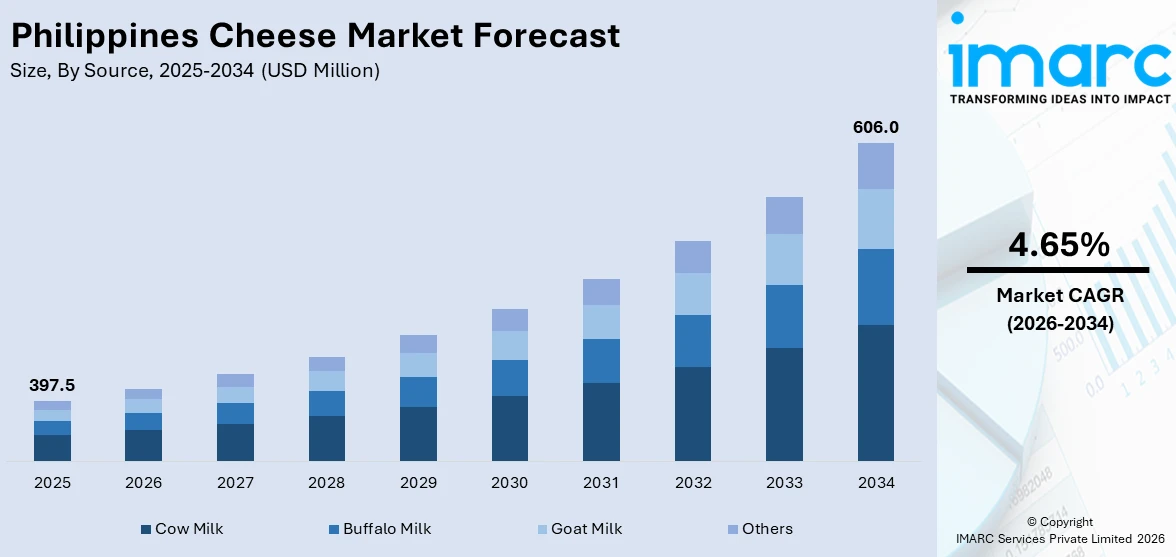
The Philippines cheese market size reached USD 397.5 Million in 2025. The market is projected to reach USD 606.0 Million by 2034, exhibiting a growth rate (CAGR) of 4.65% during 2026-2034. The market is experiencing steady growth fueled by growing consumer demand, wider product availability, and changing dietary patterns. Heightened use of cheese in local fare combined with better cold chain facilities and retail distribution is improving access to urban and regional markets. Health-related and premium cheeses are also on the move as consumer preferences change. Bolstered by economic development and modernization of lifestyle, the market is diversified in both formats and segments and continually contributes to rising Philippines cheese market share.
|
Report Attribute
|
Key Statistics
|
|---|---|
|
Base Year
|
2025 |
|
Forecast Years
|
2026-2034
|
|
Historical Years
|
2020-2025
|
| Market Size in 2025 | USD 397.5 Million |
| Market Forecast in 2034 | USD 606.0 Million |
| Market Growth Rate 2026-2034 | 4.65% |
Key Trends of Philippines Cheese Market:
Increasing Domestic Consumption and Culinary Adoption
Cheese consumption in the Philippines is on a consistent rise, fueled by changing culinary habits and mounted usage of cheese as a part of regular Filipino diets. Pasta, bread, and rice-based foods, which are typical traditional foods, are now being made with processed and natural types of cheese, indicating changes in consumer trends. For instance, in January 2025, Julie's Bakeshop introduced the Milky Cheese De Sal, a savory and sweet bread studded with cheese and glazed with milk and sugar, adding to its roster of creative products to address changing Filipino palates. Moreover, amplified use of cheese in home foods, street foods, and high-end restaurant offerings indicates its increasing role beyond isolated use. Higher availability of cheese through new trade and specialty outlets has enhanced accessibility for middle-class families, which has helped to raise per capita consumption. In addition, urbanization and exposure to international food through media and travel are driving cheese adoption in different segments. These drivers are playing a major role in Philippines cheese market growth, suggesting long-term potential for both conventional and innovative cheese forms in everyday and gourmet consumption.
To get more information on this market Request Sample
Health-Oriented and Premium Cheese Preferences
Philippine consumers are demonstrating an increasing preference for cheese that is viewed as healthier or premium, mirroring wider dietary trends. High-protein, low-sodium, and naturally aged cheeses are becoming popular, especially with health-oriented and high-income consumers in urban markets. Heightened nutrition awareness and international food trends are redefining product preferences, driving demand for artisan and imported-style cheeses. Plant-based cheese alternatives are also becoming visible, especially among younger consumers exploring flexitarian diets. These trends fit the global clean-label and high-quality food direction. Furthermore, dairy educational campaigns and enhanced packaging transparency are underpinning such tastes. This conscious consumption trend is becoming a defining characteristic of Philippines cheese market trends, with consumers highly linking cheese with flavor, along with nutrition and wellness, further diversifying products across retail shelves.
Infrastructural Increase in Retail Distribution and Cold Chain
According to the Philippines cheese market analysis, the ongoing upgradation of retail distribution chains and cold storage logistics throughout the Philippines is serving as a key driver of nationwide availability for cheese. Supermarkets, convenience stores, and online retailers are now more adequately prepared to manage dairy products, thus facilitating greater access to a range of cheeses, both those needing special storage conditions and others. With further areas being incorporated into cold chain transport and storage networks, smaller city centers and rural areas are experiencing greater cheese availability, which was once reserved for central cities. This movement is also allowing seasonal and specialty cheeses to penetrate new consumer groups. Contemporary retail environments accommodate promotional efforts, in-store tasting, and appealing packaging, leading to trial and repeat purchases. These infrastructure developments are supporting supply-side capacities and facilitating stable consumer availability, thus promoting growth in the Philippines cheese market and supporting long-term opportunities for further market development outside Metro Manila and other major metropolitan cities.
Growth Drivers of Philippines Cheese Market:
Westernization of Diets and Fast-Food Expansion
The Westernization of diets and the spread of fast foods are among the major drivers of growth in the Philippine cheese market. In the last few decades, cuisines from the rest of the world, especially American and European cuisine, have taken root in the urban food culture of the Philippines. Cheese, which was previously viewed as a luxury or imported item, is now a common condiment in most Filipino households and restaurants. Its popularity among these foods is so widespread that cheese has become a core ingredient in home-cooked meals and commercially cooked dishes. The fast-food chain, led by brands like McDonald's, Jollibee, and Pizza Hut, has also extended their menu offerings featuring different kinds of cheese that greatly contribute to heightened consumer demand. This is also accentuated by food delivery websites and online access to foreign recipes, shaping the local palate. As the urbanization of the country expands and Western-style food chains expand to provincial regions, cheese becomes increasingly relevant in daily Filipino fare.
Expanded Middle Class and Evolving Consumption Patterns
Philippines' expanding middle class has been followed by larger disposable income as well as higher spending propensity on diversified food choices, including the likes of dairy products, i.e., cheese. As Filipinos become increasingly health- and quality-conscious, the market for better-tasting, quality, and imported cheese products is on the rise. This trend can be observed in urban areas like Metro Manila, Cebu, and Davao, where supermarkets and specialty shops have a larger variety of cheese beyond the usual processed types. Additionally, there is a societal trend in home cooking where consumers experiment with cheese-containing recipes owing to social media and television cooking shows. With family meals being transformed to include fusion meals and gourmet-style cuisine, cheese seeps into classic and new Filipino cuisine. In addition, the younger generation, with increased exposure to global food trends via travel and online content, considers cheese a pantry staple as opposed to an occasional treat, increasing market demand even further.
Local Production and Foodservice Industry Integration
Another compelling growth driver for the Philippines cheese market demand is the expanding role of local producers and the increasing integration of cheese into the domestic foodservice sector. Although imported cheese is still the favored variety, local producers have started making affordable, culturally modified versions of the product that appeal to Filipino palates. Local companies are formulating processed cheeses with extended shelf lives, which are well-suited to tropical temperatures, and providing smaller, more affordable package sizes with which to accommodate the typical Filipino household. Meanwhile, the foodservice sector, from street stalls to fancy restaurants, adores cheese in both old and new forms. Cheese-topped halo-halo, cheesy palabok, and artisan cheese fusion-style ensaymada are some of the dishes that are becoming increasingly popular. Locally inspired cheese-based offerings at food expos and regional festivals are also becoming more common, an indicator of a heightened culinary appreciation for cheese. The localized strategies increase accessibility and also open up an emotional and cultural attachment to cheese, which continues to drive long-term market growth.
Philippines Cheese Market Segmentation:
IMARC Group provides an analysis of the key trends in each segment of the market, along with forecasts at the country and regional levels for 2026-2034. Our report has categorized the market based on source, type, product, format, and distribution channel.
Source Insights:
- Cow Milk
- Buffalo Milk
- Goat Milk
- Others
The report has provided a detailed breakup and analysis of the market based on the source. This includes cow milk, buffalo milk, goat milk, and others.
Type Insights:
- Natural
- Processed
A detailed breakup and analysis of the market based on the type have also been provided in the report. This includes natural and processed.
Product Insights:
- Mozzarella
- Cheddar
- Feta
- Parmesan
- Roquefort
- Others
The report has provided a detailed breakup and analysis of the market based on the product. This includes mozzarella, cheddar, feta, parmesan, roquefort, and others.
Format Insights:
- Slices
- Diced/Cubes
- Shredded
- Blocks
- Spreads
- Liquid
- Others
A detailed breakup and analysis of the market based on the format have also been provided in the report. This includes slices, diced/cubes, shredded, blocks, spreads, liquid, and others.
Distribution Channel Insights:
To get detailed segment analysis of this market Request Sample
- Supermarkets and Hypermarkets
- Convenience Stores
- Specialty Stores
- Online
- Others
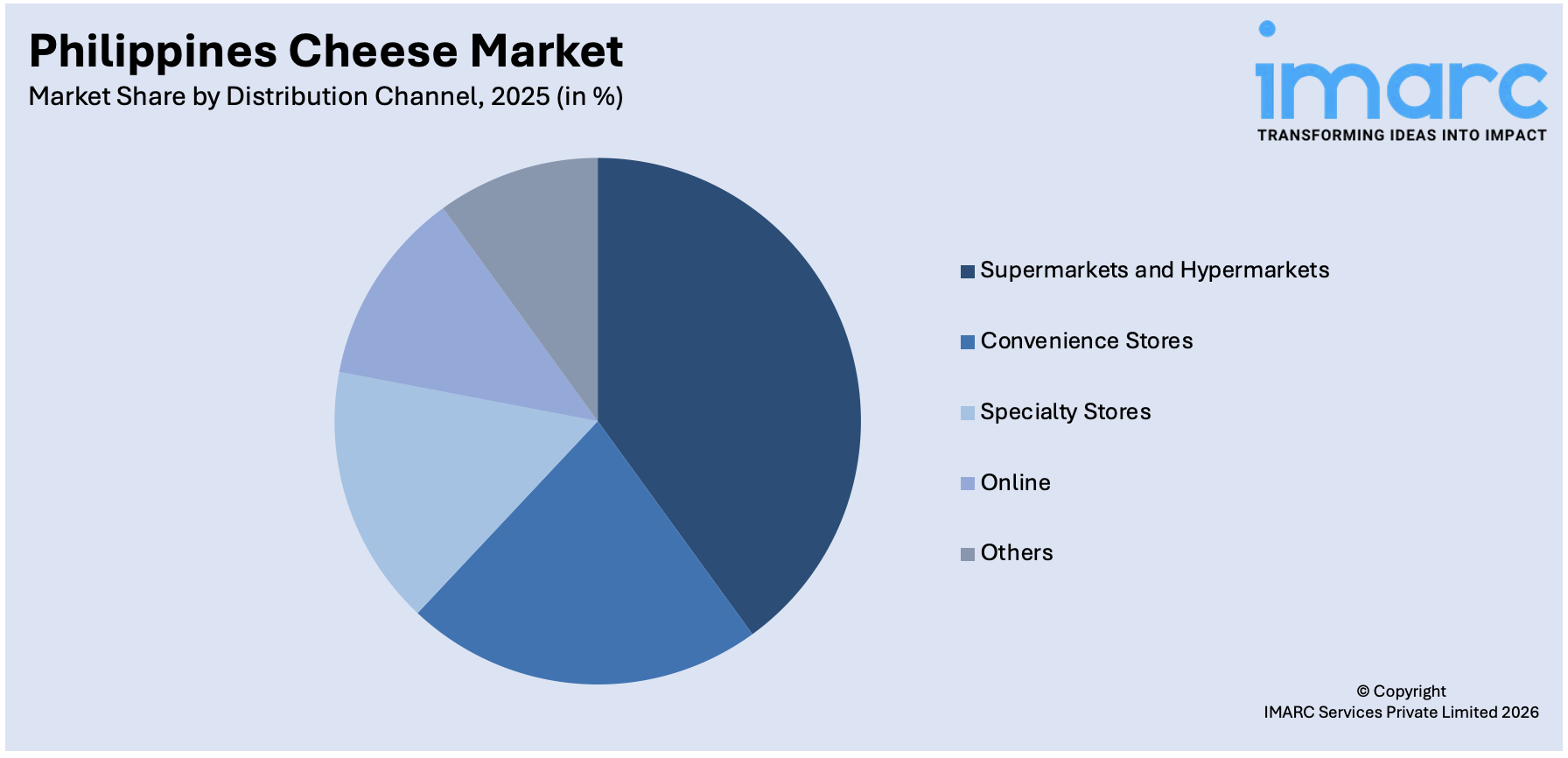
The report has provided a detailed breakup and analysis of the market based on the distribution channel. This includes supermarkets and hypermarkets, convenience stores, specialty stores, online, and others.
Regional Insights:
- Luzon
- Visayas
- Mindanao
The report has also provided a comprehensive analysis of all the major regional markets, which include Luzon, Visayas, and Mindanao.
Competitive Landscape:
The market research report has also provided a comprehensive analysis of the competitive landscape. Competitive analysis such as market structure, key player positioning, top winning strategies, competitive dashboard, and company evaluation quadrant has been covered in the report. Also, detailed profiles of all major companies have been provided.
Philippines Cheese Market News:
- In October 2024, Kenny Rogers Roasters Philippines unveiled its cheesiest product yet the Four Cheese Roast, which comes with roasted chicken that is marinated and topped with cheddar, cream cheese, blue cheese, and parmesan. The rollout mirrors the increasing penchant for rich, multi-cheese flavor profiles of Filipino consumers in casual dining.
- In September 2024, Malagos Farmhouse launched Leon's Lounge in Davao City, a new cheese room featuring its complete lineup of handcrafted cheeses such as Chèvre, Feta, Pepato, and La Regina. Established by Olive Puentespina, the establishment promotes local cheese appreciation through tasting sessions and specially curated culinary pairings.
- In July 2024, the Laughing Cow introduced Cheez Dippers in the Philippines with Strawberry and Blueberry flavor variants to address increasing demand for healthier, convenient foods. With real fruit and creamy cheese, the portion-packed offerings signal a confident move into the expanding Southeast Asian healthier snacking space.
Philippines Cheese Market Report Coverage:
| Report Features | Details |
|---|---|
| Base Year of the Analysis | 2025 |
| Historical Period | 2020-2025 |
| Forecast Period | 2026-2034 |
| Units | Million USD |
| Scope of the Report | Exploration of Historical Trends and Market Outlook, Industry Catalysts and Challenges, Segment-Wise Historical and Future Market Assessment:
|
| Sources Covered | Cow Milk, Buffalo Milk, Goat Milk, Others |
| Types Covered | Natural, Processed |
| Products Covered | Mozzarella, Cheddar, Feta, Parmesan, Roquefort, Others |
| Formats Covered | Slices, Diced/Cubes, Shredded, Blocks, Spreads, Liquid, Others |
| Distribution Channels Covered | Supermarkets and Hypermarkets, Convenience Stores, Specialty Stores, Online, Others |
| Regions Covered | Luzon, Visayas, Mindanao |
| Customization Scope | 10% Free Customization |
| Post-Sale Analyst Support | 10-12 Weeks |
| Delivery Format | PDF and Excel through Email (We can also provide the editable version of the report in PPT/Word format on special request) |
Key Benefits for Stakeholders:
- IMARC’s industry report offers a comprehensive quantitative analysis of various market segments, historical and current market trends, market forecasts, and dynamics of the Philippines cheese market from 2020-2034.
- The research report provides the latest information on the market drivers, challenges, and opportunities in the Philippines cheese market.
- Porter's five forces analysis assist stakeholders in assessing the impact of new entrants, competitive rivalry, supplier power, buyer power, and the threat of substitution. It helps stakeholders to analyze the level of competition within the Philippines cheese industry and its attractiveness.
- Competitive landscape allows stakeholders to understand their competitive environment and provides an insight into the current positions of key players in the market.
Frequently Asked Questions About the Philippines Cheese Market Report
The Philippines cheese market was valued at USD 397.5 Million in 2025.
The Philippines cheese market is projected to exhibit a CAGR of 4.65% during 2026-2034.
The Philippines cheese market is expected to reach a value of USD 606.0 Million by 2034.
The Philippines cheese market is witnessing trends like rising demand for processed and ready-to-eat cheese, increased popularity of mozzarella and cheddar in fast food, and growing use in home cooking. Local production is expanding, while premium and flavored cheese varieties gain traction. Health-conscious consumers also seek low-fat and plant-based options.
The Philippines cheese market is driven by rising Western food influence, growing fast-food and bakery sectors, and increasing disposable incomes. Urbanization and changing dietary habits boost demand for cheese-based products. Expansion of supermarkets and foodservice outlets, along with product innovation and affordable options, further fuel market growth across the country.
Need more help?
- Speak to our experienced analysts for insights on the current market scenarios.
- Include additional segments and countries to customize the report as per your requirement.
- Gain an unparalleled competitive advantage in your domain by understanding how to utilize the report and positively impacting your operations and revenue.
- For further assistance, please connect with our analysts.
 Request Customization
 Speak to an Analyst
 Request Brochure
 Inquire Before Buying
Benefits of Customization
- Personalize this research
- Triangulate with your data
- Get data as per your format and definition
- Gain a deeper dive into a specific application, geography, customer, or competitor
- Any level of personalization
Get in Touch With Us
UNITED STATES
Phone: +1-201-971-6302
INDIA
Phone: +91-120-433-0800
UNITED KINGDOM
Phone: +44-753-714-6104
Email: [email protected]
Client Testimonials




.webp)




.webp)













Related Reports

Choose your plan
*Please note that the prices mentioned below are starting prices for each bundle type. Kindly contact our team for further details.*
Single User License
- 1 User License, Access on 2 Devices
- PDF Report + Excel Dataset (Password Protected)
- Lifetime Access
- No Printing Rights
- 10% Free Report Customization
- 10–12 Weeks of Analyst Support
Five User License
- Access for 5 Users, 2 Devices per User
- PDF Report + Excel Dataset (Password Protected)
- Lifetime Access
- Dedicated Account Manager
- 12–14 Weeks of Analyst Support
- No Printing Rights
- 15% Free Report Customization
- 25% Discount on Your Next Purchase
Corporate User License
- Unlimited User Access (Within Your Organization)
- PDF Report + Excel Dataset
- Lifetime Access
- Dedicated Account Manager
- 14–20 Weeks of Analyst Support
- No Printing Rights
- 20% Free Report Customization
- 30% Discount on Your Next Purchase
Essential Insights
What's included:
3 reports
- Lifetime Access
- PDF Reports
- Excel Datasets
- 2 Weeks of Free Analyst Support
- 2 User Licenses
- Access on 2 Devices
- Printing Rights
- Complimentary PowerPoint (PPT) Version
- Complimentary License Upgrade
Professional Access
What's included:
5 reports
- Lifetime Access
- PDF Reports
- Excel Datasets
- 8 Weeks of Free Analyst Support
- 2 User Licenses
- Access on 2 Devices
- Printing Rights
- Complimentary PowerPoint (PPT) Version
- Complimentary License Upgrade
Business Advantage
What's included:
8 reports
- Lifetime Access
- PDF Reports
- Excel Datasets
- 14 Weeks of Free Analyst Support
- 2 User Licenses
- Access on 2 Devices
- Printing Rights
- Complimentary PowerPoint (PPT) Version
- Complimentary License Upgrade
Enterprise Intelligence
What's included:
10 reports
- Lifetime Access
- PDF Reports
- Excel Datasets
- 20 Weeks of Free Analyst Support
- 2 User Licenses
- Access on 2 Devices
- Printing Rights
- Complimentary PowerPoint (PPT) Version
- Complimentary License Upgrade