
Philippines Ice Cream Market Size, Share, Trends and Forecast by Flavor, Category, Product, Distribution Channel, and Region, 2026-2034
Philippines Ice Cream Market Size, Share, Trends & Forecast (2026-2034)
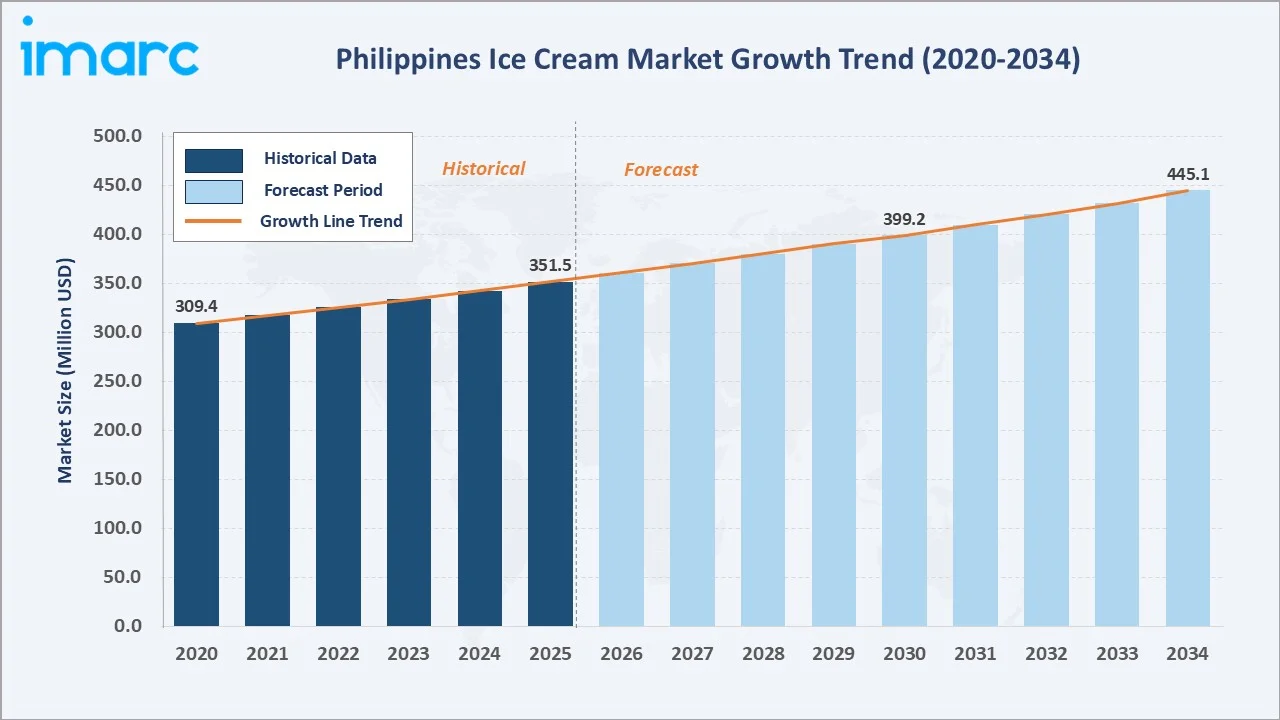
The Philippines ice cream market size increased from USD 351.5 Million in 2025 to USD 363.1 Million in 2026 and is projected to reach USD 445.1 Million by 2034, exhibiting a CAGR of 2.58% during 2026-2034. The Philippines ice cream market growth is primarily driven by rising disposable incomes, rapid urbanization, and growing preference for premium and artisanal flavors among Filipino consumers. Expanding modern retail networks and rising demand for convenient, ready-to-eat frozen desserts are further strengthening the Philippines ice cream market share. Chocolate leads the flavor segmentation with a 36.8% share in 2025, while impulse ice cream dominates the category segmentation at 45.7%. Luzon commands the largest regional share at 61.5%, supported by dense urban populations and concentrated cold-chain infrastructure in Metro Manila.
Market Snapshot
|
Metric |
Value |
|
Base Year Market Size (2025) |
USD 351.5 Million |
| Market Size (2026) | USD 363.1 Million |
|
Forecast Market Size (2034) |
USD 445.1 Million |
|
CAGR (2026-2034) |
2.58% |
|
Base Year |
2025 |
|
Historical Period |
2020-2025 |
|
Forecast Period |
2026-2034 |
|
Dominant Flavor |
Chocolate (36.8%, 2025) |
|
Dominant Category |
Impulse Ice Cream (45.7%, 2025) |
|
Leading Region |
Luzon (61.5%, 2025) |
The Philippines ice cream market expanded from USD 309.4 Million in 2020 to USD 351.5 Million in 2025 and an estimated USD 363.1 Million in 2026, anchored at USD 399.2 Million in 2030, and forecast to reach USD 445.1 Million by 2034. Rising modern retail penetration and expanding cold-chain logistics are helping brands reach secondary cities beyond Metro Manila. Premiumization and artisanal flavor innovation, alongside growing demand for health-conscious and low-sugar formats, are expected to sustain steady Philippines ice cream market growth through the forecast period.
To get more information on this market, Request Sample
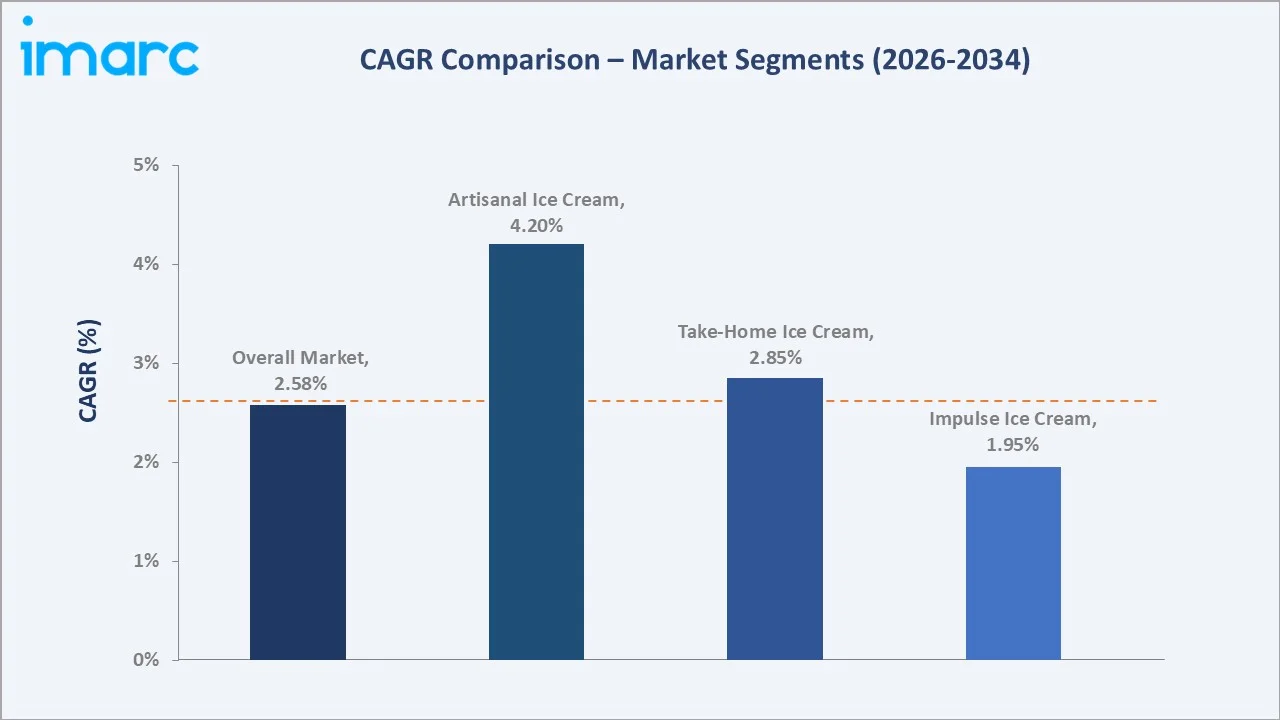
Artisanal ice cream is emerging as the fastest-growing category segment as small-batch producers expand retail presence, while take-home formats gain share amid rising at-home consumption. These divergent growth patterns across category segments underscore the Philippines ice cream industry's ongoing shift toward premium, differentiated, and health-oriented product formats.
Executive Summary
The Philippines ice cream market expanded from USD 351.5 Million in 2025 to an estimated USD 363.1 Million in 2026, reflecting the country's position as one of Southeast Asia's fastest-urbanizing frozen dessert markets. The market encompasses dairy sourcing, ingredient processing, ice cream manufacturing, cold-chain logistics, and retail and foodservice distribution of chocolate, vanilla, fruit, and specialty flavors across impulse, take-home, and artisanal categories, forming the core of this Philippines ice cream industry analysis.
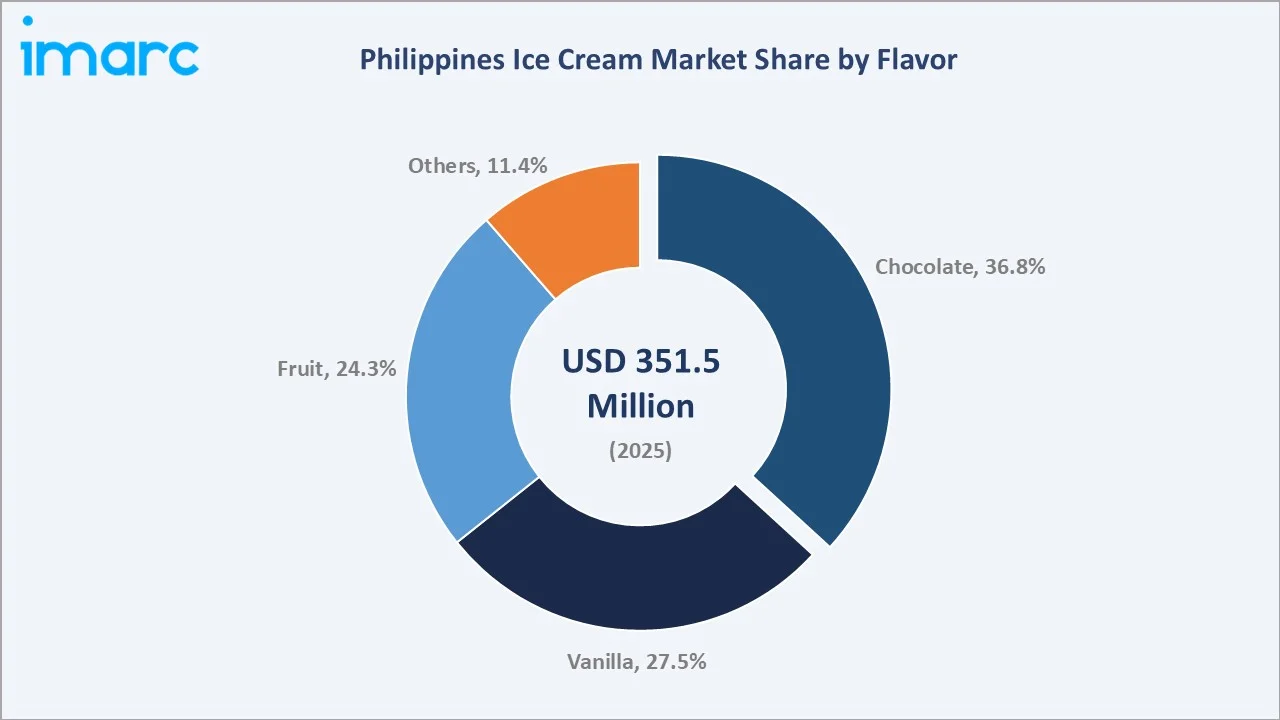
Chocolate accounted for 36.8% of the Philippines ice cream market in 2025, reflecting its enduring popularity among Filipino consumers, while vanilla followed at 27.5% and fruit-based flavors, including mango and ube-inspired variants, held 24.3%. Impulse ice cream led category segmentation at 45.7%, underscoring the importance of single-serve formats sold through sari-sari stores and convenience outlets, while take-home ice cream, at 35.6%, is gaining ground through supermarket and hypermarket expansion.
Luzon dominates the Philippines ice cream market with a 61.5% regional share in 2025, driven by Metro Manila's population density and cold-chain infrastructure. Visayas follows at 22.7% and Mindanao at 15.8%, both supported by expanding modern retail footprints. Looking ahead, the Philippines ice cream market outlook remains positive, supported by premiumization, health-conscious innovation, and rising e-commerce penetration through 2034.
Key Market Insights
|
Insight |
Data |
|
Dominant Flavor |
Chocolate - 36.8% share (2025) |
|
Dominant Category |
Impulse Ice Cream - 45.7% market share (2025) |
|
Leading Region |
Luzon - 61.5% market share (2025) |
|
Fastest-Growing Category |
Artisanal Ice Cream - Estimated ~4.20% CAGR (2026-2034) |
|
Top Companies |
RFM Corporation, Nestlé S.A., Arcefoods Corporation, The Laguna Creamery, Inc., and Bohol Bee Farm |
|
Market Opportunity |
Premium and artisanal flavor innovation, health-conscious and low-sugar formats, cold-chain expansion, e-commerce and delivery channel growth |
Key Analytical Observations Supporting the Above Data:
- Chocolate at 36.8%: Chocolate retains a dominant 36.8% share as it remains the most familiar and widely stocked flavor across sari-sari stores, supermarkets, and quick-service outlets nationwide, though fruit and specialty flavors are gradually narrowing the gap.
- Impulse Ice Cream at 45.7%: Impulse ice cream continues to lead category-level demand at 45.7%, reflecting the popularity of single-serve cups, sticks, and cones sold through convenience stores and roadside vendors across urban and rural areas alike.
- Luzon at 61.5%: Luzon's 61.5% share is anchored by Metro Manila's population density, the concentration of leading manufacturers including RFM Corporation and Nestlé S.A., and superior cold-chain and retail infrastructure.
- Artisanal Category Growth: Artisanal ice cream is estimated to grow fastest among category segments through 2034, as small-batch producers such as Carmen's Best and The Buzzz Ice Cream expand retail and franchise presence built on locally sourced ingredients.
- Health-Conscious Innovation: Rising demand for low-sugar, dairy-free, and functional formulations is prompting manufacturers to launch new-age products, including plant-based ice creams and reduced-sugar variants, for health-conscious urban consumers.
- Regulatory Oversight: The Philippines' Food and Drug Administration enforces food safety and labeling compliance across the ice cream industry, requiring disclosure of nutritional content and allergens on retail packaging.
Philippines Ice Cream Market Overview
The Philippines ice cream market encompasses the sourcing of dairy and non-dairy inputs, ingredient and flavor processing, ice cream manufacturing, cold-chain logistics, and distribution through retail and foodservice channels. The market's ecosystem spans large integrated manufacturers, artisanal small-batch producers, ingredient and flavoring suppliers, cold storage and logistics providers, and retail channels including supermarkets, convenience stores, and ice cream parlors, reflecting the broader Philippines ice cream industry size and structure.
Macroeconomic factors shaping the Philippines ice cream market include GDP growth of 4.4% in 2025, according to the Philippine Statistics Authority, rising per-capita incomes, and continued urban migration toward Metro Manila and secondary cities. The country's population reached approximately 112.7 million as of the 2024 census, supporting a broad and expanding consumer base for frozen desserts.
Market Dynamics
To evaluate market opportunities, Request Sample
Market Drivers
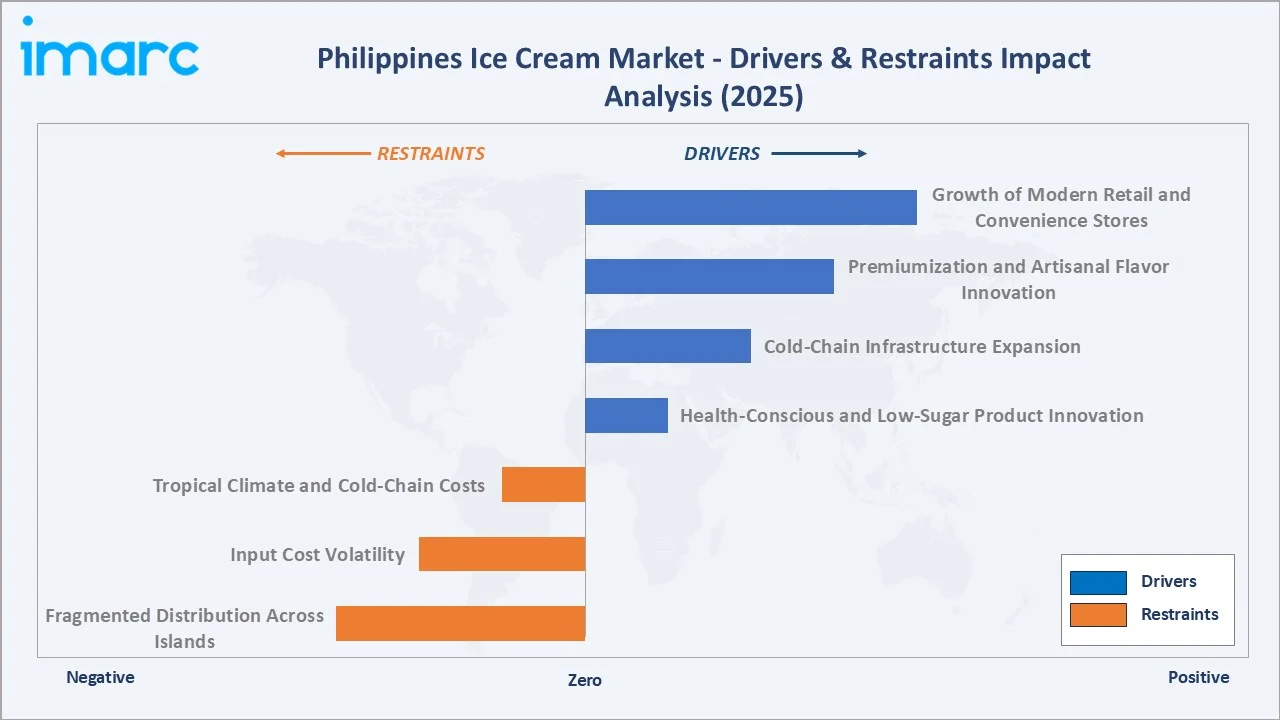
- Rising Disposable Incomes and Urbanization: Household incomes in the Philippines have risen steadily alongside GDP growth of 4.4% in 2025, enabling greater spending on discretionary food items. Urban migration toward Metro Manila and Calabarzon is expanding the customer base for supermarkets and modern retail ice cream formats, supporting sustained Philippines ice cream market growth.
- Growth of Modern Retail and Convenience Stores: Supermarkets, hypermarkets, and convenience store chains are expanding rapidly across Philippine cities, lifting demand for take-home and impulse ice cream formats. RFM Corporation disclosed plans in December 2025 to expand production capacity for its Selecta, Magnum, and Cornetto ice cream joint venture to meet rising volume demand into 2026.
- Premiumization and Artisanal Flavor Innovation: Rising consumer interest in gourmet, small-batch, and locally inspired flavors is driving premiumization across the category. In May 2024, The Buzzz Ice Cream of Bohol Bee Farm opened a new franchise location at Robinsons Cybergate, expanding artisanal ice cream made from locally sourced ingredients.
- Cold-Chain Infrastructure Expansion: Continued investment in refrigerated warehousing and transport is improving product availability beyond Metro Manila. Expanding cold-chain logistics is reducing spoilage and enabling wider distribution of packaged ice cream products into Visayas and Mindanao.
Market Restraints
- Tropical Climate and Cold-Chain Costs: The Philippines' hot and humid tropical climate raises the cost of maintaining unbroken cold-chain logistics from manufacturing sites to retail outlets, particularly in areas outside Metro Manila with limited refrigerated transport infrastructure.
- Input Cost Volatility: Volatile prices for imported dairy, sugar, and packaging inputs continue to squeeze margins for both large manufacturers and small artisanal producers, particularly amid currency fluctuations affecting imported raw material costs.
Market Opportunities
- Health-Conscious and Low-Sugar Product Innovation: Rising demand for low-sugar, dairy-free, and functional ice cream formats is creating opportunities for new product launches targeting health-conscious, dual-income urban households seeking indulgence without excess sugar intake.
- E-Commerce and Delivery Channel Expansion: Growing adoption of food delivery platforms is opening new distribution opportunities for ice cream brands, particularly during peak summer months when online ordering convenience drives incremental impulse purchases.
Market Challenges
- Seasonal Demand Fluctuation: Ice cream consumption in the Philippines fluctuates seasonally, with demand concentrated during the hot summer months of March through May, creating capacity utilization and inventory management challenges for manufacturers.
- Fragmented Distribution Across Islands: The archipelagic geography of the Philippines complicates last-mile distribution to secondary islands and rural areas, requiring manufacturers to maintain multiple regional cold-storage hubs to ensure product freshness.
Emerging Market Trends
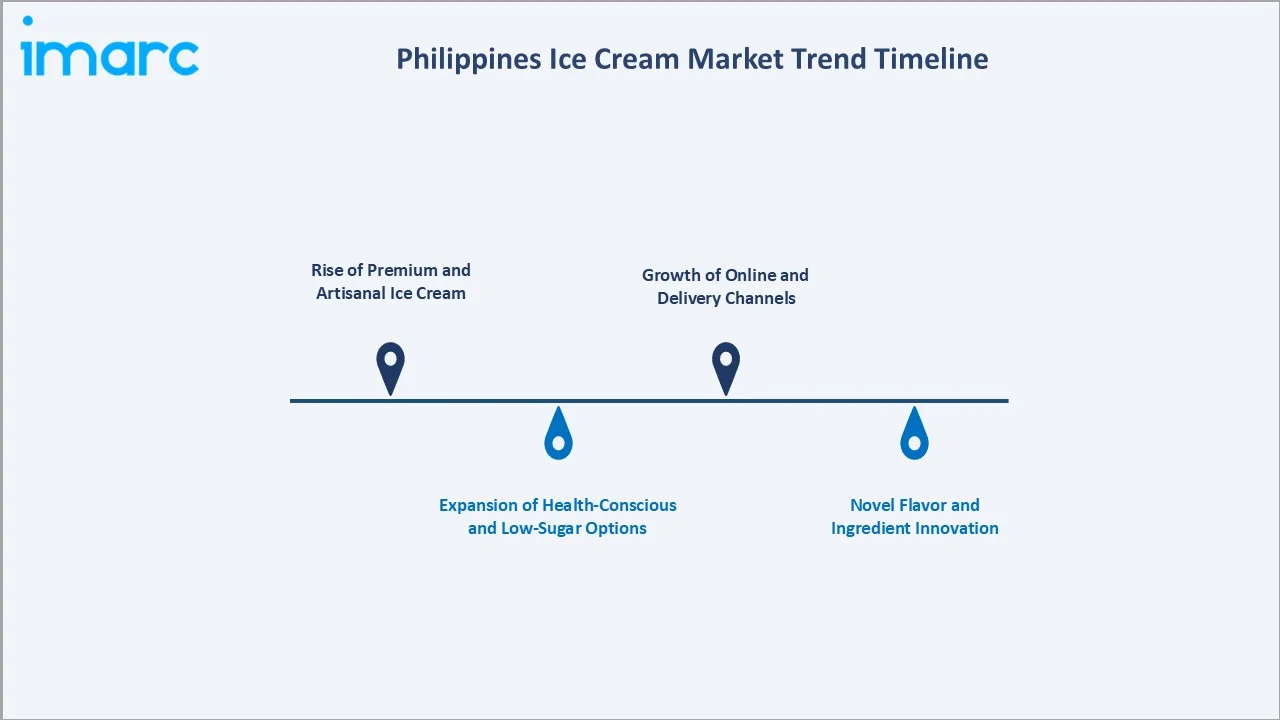
1. Rise of Premium and Artisanal Ice Cream
Filipino consumers are increasingly seeking distinctive, small-batch ice cream made with local ingredients such as ube, mango, and leche flan. Rising food tourism is encouraging brands to introduce flavor combinations inspired by both local heritage and international culinary trends.
2. Expansion of Health-Conscious and Low-Sugar Options
Manufacturers are introducing dairy-free, low-sugar, and functional ice cream formulations using coconut, almond, and soy milk bases. This shift reflects a broader wellness movement among Filipino consumers seeking guilt-free indulgence without compromising on taste.
3. Growth of Online and Delivery Channels
Digital platforms and food delivery applications are reshaping how ice cream reaches Filipino households, particularly during peak summer demand periods. Brands are using social media to promote limited-time offers and drive impulse purchases among younger, digitally engaged consumers.
4. Novel Flavor and Ingredient Innovation
Local food scientists and manufacturers are experimenting with unconventional ingredients to diversify the category. In January 2024, researchers at Central Luzon State University introduced a protein-rich, tilapia-based ice cream recognized at the NSAARRD 2023 awards, aiming to pair nutrition with novel taste profiles.
Industry Value Chain Analysis
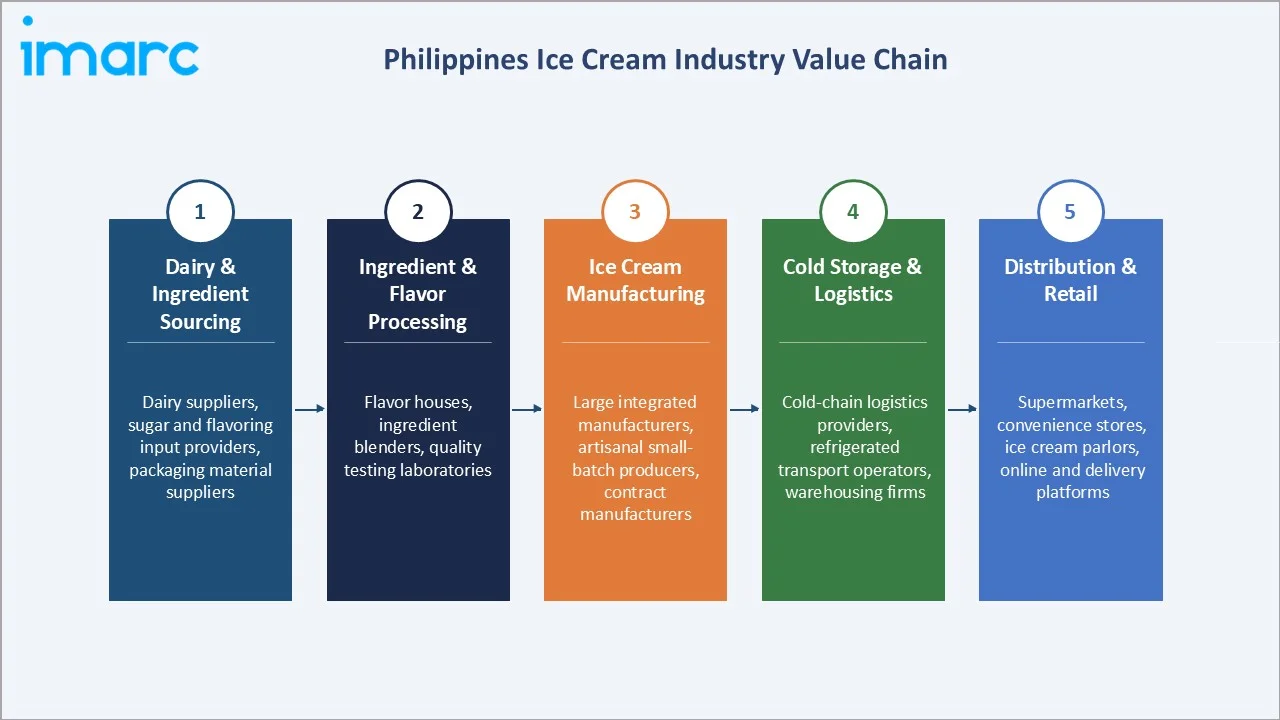
The Philippines ice cream industry value chain integrates dairy and ingredient sourcing, flavor and ingredient processing, ice cream manufacturing, cold storage and logistics, and distribution through retail and foodservice channels nationwide.
|
Stage |
Key Participants |
|
Dairy & Ingredient Sourcing |
Dairy suppliers, sugar and flavoring input providers, packaging material suppliers |
|
Ingredient & Flavor Processing |
Flavor houses, ingredient blenders, quality testing laboratories |
|
Ice Cream Manufacturing |
Large integrated manufacturers, artisanal small-batch producers, contract manufacturers |
|
Cold Storage & Logistics |
Cold-chain logistics providers, refrigerated transport operators, warehousing firms |
|
Distribution & Retail |
Supermarkets, convenience stores, ice cream parlors, online and delivery platforms |
Ice cream manufacturing represents the value chain's most quality-regulated phase, overseen by the Philippines' Food and Drug Administration to ensure food safety compliance. Cold-chain logistics is emerging as the most capital-intensive growth layer, sustaining product quality as distribution extends into secondary cities.
Technology Landscape in the Philippines Ice Cream Industry
Cold-Chain Monitoring Systems
Expanding refrigerated warehousing and transport is increasingly paired with temperature-monitoring and traceability systems that help manufacturers maintain product quality across longer distribution routes into Visayas and Mindanao.
Automated Manufacturing & Packaging
Leading ice cream manufacturers are investing in automated filling, freezing, and packaging lines to improve production efficiency and consistency, supporting higher output volumes to meet rising Philippines ice cream market demand.
Alternative Ingredient & Formulation Technology
Advances in plant-based ingredient processing are enabling manufacturers to develop dairy-free and low-sugar formulations using coconut, almond, and soy milk bases, expanding product portfolios for health-conscious consumers.
Digital Retail & Delivery Platforms
Integration with e-commerce and food delivery platforms is helping manufacturers and artisanal brands reach consumers directly, using digital ordering and route optimization technology to improve last-mile delivery efficiency.
Market Segmentation Analysis
The report covers the following segments:
|
Segment Category |
Leading Segment |
Market Share |
Year |
|
Flavor |
Chocolate |
36.8% |
2025 |
|
Category |
Impulse Ice Cream |
45.7% |
2025 |
|
Product |
🔒 |
🔒 |
2025 |
|
Distribution Channel |
🔒 |
🔒 |
2025 |
|
Region |
Luzon |
61.5% |
2025 |

By Flavor
Chocolate leads the Philippines ice cream market at 36.8% in 2025, reflecting deep-rooted consumer preference for classic flavors sold through sari-sari stores, supermarkets, and ice cream parlors across both urban and rural areas.
To access detailed market analysis, Request Sample
Vanilla, at 27.5% in 2025, remains a versatile base flavor frequently paired with mix-in ingredients, while fruit-based flavors, at 24.3%, are gaining ground through mango, ube, and other locally inspired variants. Other specialty flavors account for the remaining 11.4% of the Philippines ice cream market.
By Category
Impulse ice cream leads category-level segmentation at 45.7% in 2025, underscoring its centrality to Filipino snacking habits through single-serve cups, sticks, and cones sold via convenience outlets and roadside vendors.
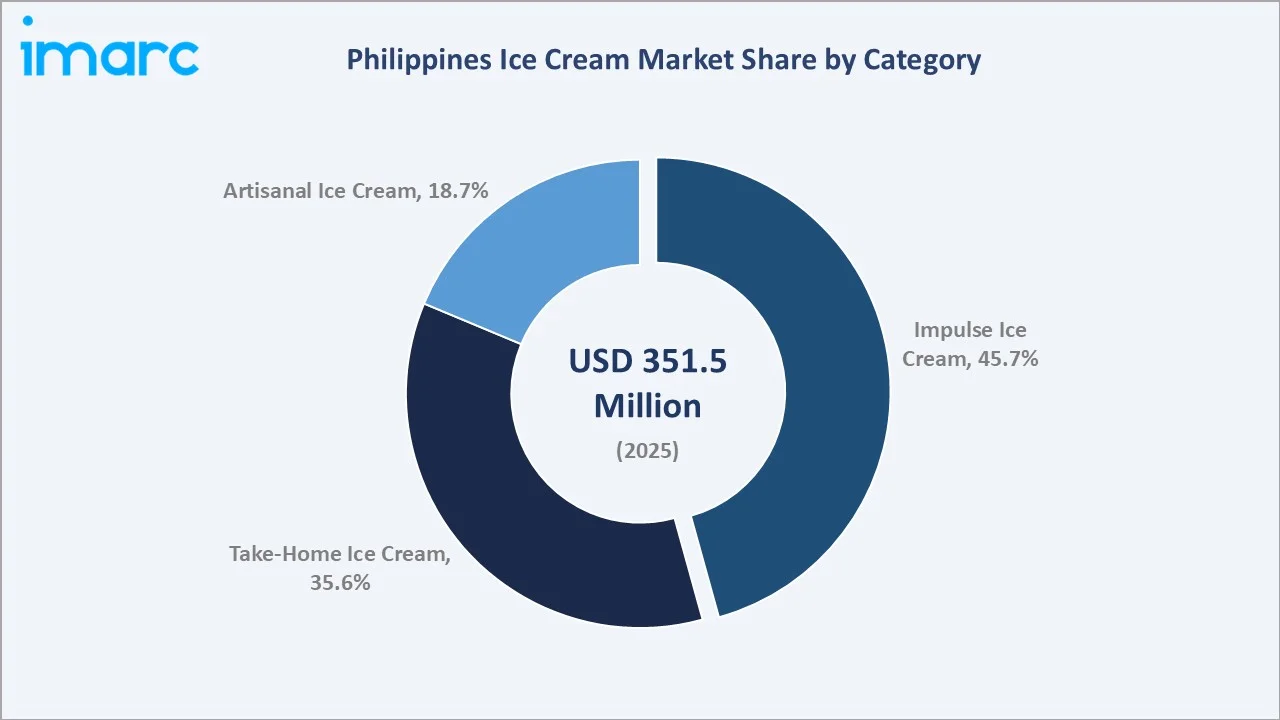
Take-home ice cream follows at 35.6% and is expanding through supermarket and hypermarket growth, while artisanal ice cream, at 18.7%, is estimated to be the fastest-growing category through 2034, supported by premiumization and small-batch production trends.
Regional Market Insights
|
Region |
Share (2025) |
Key Philippines Ice Cream Market Drivers & Characteristics |
|
Luzon |
61.5% |
Anchored by Metro Manila's population density, concentrated manufacturing and cold-chain infrastructure, and the presence of leading producers including RFM Corporation and Nestlé S.A. |
|
Visayas |
22.7% |
Supported by regional urban centers such as Cebu, expanding modern retail access, and growing artisanal ice cream ventures including Bohol-based producers. |
|
Mindanao |
15.8% |
Driven by rising urbanization, expanding commercial retail investment, and growing demand tied to regional population and tourism growth. |
Luzon's 61.5% share reflects both its outsized population base and its role as the primary hub for ice cream manufacturing, cold storage, and distribution infrastructure, with most major producers headquartered in or around Metro Manila.
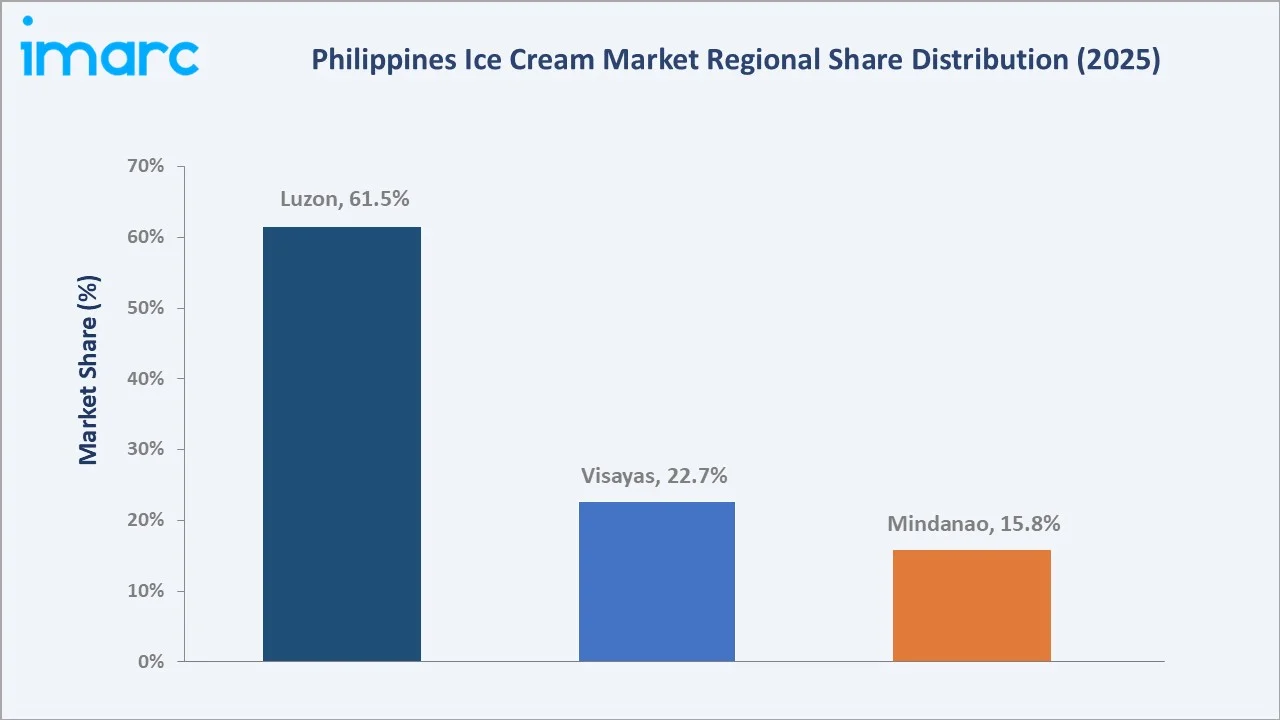
Visayas and Mindanao together account for approximately 38.5% of the Philippines ice cream market, with both regions benefiting from expanding modern retail and cold-chain investment that is gradually narrowing the distribution gap with Luzon.
Competitive Landscape
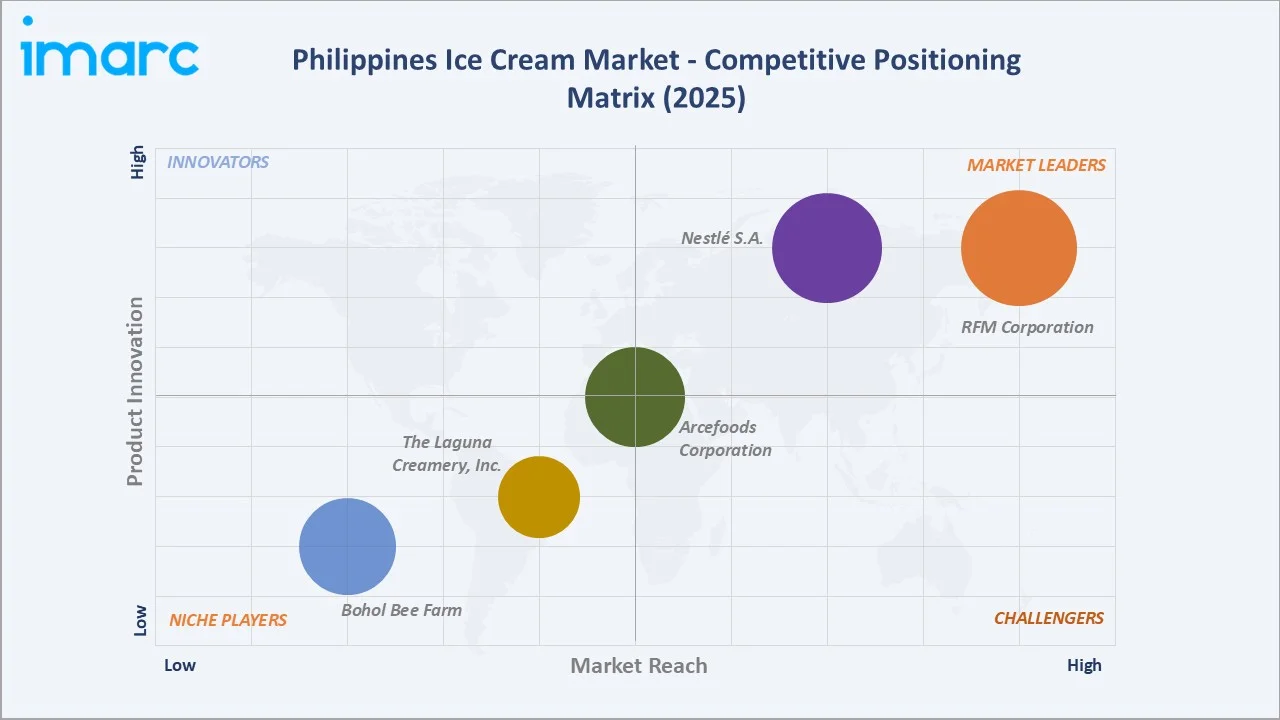
The Philippines ice cream market's competitive landscape spans multinational dairy conglomerates, heritage domestic brands, and artisanal small-batch producers competing across manufacturing, retail, and franchise distribution.
|
Company Name |
Brand Names |
Market Position |
Core Strength |
|
RFM Corporation |
Selecta, Magnum, Cornetto |
Market Leader |
Operates its ice cream business via joint venture Magnum RFM Ice Cream Inc. with Unilever, heritage brand equity, and a nationwide distribution network. |
|
Nestlé S.A. |
Kimy, Twin Pops |
Market Leader |
Operates via Froneri Philippines, Inc., a joint-venture between Nestlé S.A. and PAI Partners, global R&D-backed indulgent and health-focused product portfolio, with extensive cold-chain distribution across retail and foodservice channels. |
|
Arcefoods Corporation |
ArceDairy Ice Cream |
Established Player |
Founding-family heritage brand revived in 1995, focused on premium and nostalgic flavor positioning across select retail channels. |
|
The Laguna Creamery, Inc. |
Carmen's Best local gourmet ice cream |
Niche Player |
Local farm-to-table dairy integration, premium product quality, and strong corporate backing. |
|
Bohol Bee Farm |
The Buzzz Ice Cream |
Niche Player |
Popular organic ice cream in the Philippines, using coconut milk bases and gluten-free cassava cones |
RFM Corporation and Nestlé S.A. lead the Philippines ice cream market through established manufacturing scale and nationwide distribution networks. Arcefoods Corporation competes through focused heritage branding, while artisanal producers sustain premium positioning in urban centers.
Key Company Profiles
RFM Corporation
RFM Corporation, which operates its ice cream business through joint venture, Magnum RFM Ice Cream Inc., with Unilever, is a leading Philippine food and beverage company producing Selecta, Magnum, and Cornetto branded ice cream products.
- Key Products: Selecta tub and stick ice cream, Magnum premium bars, Cornetto cones, and other frozen dessert formats.
- Strategic Focus: Focused on production capacity expansion and volume growth for its ice cream joint venture heading into 2026, alongside its broader food and beverage portfolio.
Nestlé S.A.
Nestlé S.A., which operates via Froneri Philippines, Inc., a joint-venture with PAI Partners, markets a diverse ice cream portfolio spanning indulgent and health-focused variants, leveraging its parent company's global research and development capabilities to introduce new flavors and formats to Filipino consumers.
- Key Products: Kimy novelty sticks, Twin Pops flavored ice lollies, and others.
- Strategic Focus: Centered on product innovation and distribution expansion across modern retail and foodservice channels nationwide.
Market Concentration Analysis
The Philippines ice cream market is moderately concentrated, with a small number of multinational and heritage domestic brands, including RFM Corporation and Nestlé S.A., commanding a leading share of nationwide distribution. Arcefoods Corporation competes as established mid-tier player with focused heritage branding.
Fragmentation persists at the artisanal and small-batch production tier, where independent ice cream parlors and franchise operators, including The Laguna Creamery, Inc. and Bohol Bee Farm, compete on flavor differentiation and local sourcing rather than distribution scale. Consolidation is progressing fastest in the impulse and take-home categories, where scale advantages in cold-chain access and retail distribution favor established manufacturers.
Investment & Growth Opportunities
Highest Growth Segments
Artisanal ice cream and health-conscious, low-sugar formats represent the fastest-growing segments of the Philippines ice cream market, supported by premiumization trends and rising urban demand for differentiated products through 2034.
Emerging Investment Opportunities
Cold-chain logistics expansion beyond Metro Manila represents a significant near-term investment opportunity, as demonstrated by RFM Corporation's December 2025 disclosure of plans to expand production capacity for its Selecta, Magnum, and Cornetto ice cream joint venture. Investors establishing early cold-storage and distribution infrastructure in Visayas and Mindanao are positioned to capture rising regional demand.
Investment Themes
- Artisanal and Premium Flavor Innovation: Investment in small-batch, locally sourced ice cream production targeting urban, dual-income households offers above-market margin potential as consumer preference shifts toward premium and differentiated formats.
- Health-Conscious Product Development: Development of dairy-free, low-sugar, and functional ice cream formulations addresses growing consumer demand for guilt-free indulgence, positioning early movers to capture a fast-emerging wellness-oriented consumer segment.
Future Market Outlook (2026-2034)
The Philippines ice cream market is projected to grow from USD 351.5 Million in 2025 to USD 363.1 Million in 2026, reaching USD 445.1 Million by 2034, delivering a 2.58% CAGR over the forecast period. The market's anchor value of USD 399.2 Million in 2030 reflects steady premiumization, continued cold-chain infrastructure build-out, and progressive expansion of modern retail formats.
Three structural forces will shape Philippines ice cream market growth through 2034. First, premiumization and artisanal flavor innovation are expected to continue reshaping category-level demand, as consumers increasingly favor differentiated, small-batch products over standard offerings. Second, expanding cold-chain and modern retail investment is set to extend ice cream access into Visayas and Mindanao, narrowing the regional consumption gap with Luzon. Third, rising health-consciousness and e-commerce penetration will continue to lift demand for low-sugar formulations and digitally ordered products, reinforcing the market's shift toward differentiated, convenience-oriented formats.
Research Methodology
Primary Research
Primary research involved structured consultations with ice cream manufacturers, artisanal producers, cold-chain logistics operators, and retail stakeholders across Luzon, Visayas, and Mindanao to validate market sizing and segmentation.
Secondary Research
Secondary research drew on Philippine Statistics Authority publications, Food and Drug Administration regulatory disclosures, Philippine Stock Exchange company filings, and disclosures from leading ice cream manufacturers and distributors.
Forecasting Models
Market revenue forecasts were developed using a segment-level bottom-up model incorporating: (i) flavor and category consumption trends; (ii) regional demand patterns across Luzon, Visayas, and Mindanao; and (iii) macroeconomic indicators including GDP growth and urbanization rates.
Philippines Ice Cream Market Report Coverage:
| Report Features | Details |
|---|---|
| Base Year of the Analysis | 2025 |
| Historical Period | 2020-2025 |
| Forecast Period | 2026-2034 |
| Units | Million USD |
| Scope of the Report |
Exploration of Historical Trends and Market Outlook, Industry Catalysts and Challenges, Segment-Wise Historical and Future Market Assessment:
|
| Flavors Covered | Chocolate, Fruit, Vanilla, Others |
| Categories Covered | Impulse Ice Cream, Take-home Ice Cream, Artisanal Ice Cream |
| Products Covered | Cup, Stick, Cone, Brick, Tub, Others |
| Distribution Channels Covered | Supermarkets and Hypermarkets, Convenience Stores, Ice Cream Parlours, Online Stores, Others |
| Regions Covered | Luzon, Visayas, Mindanao |
| Companies Covered | RFM Corporation, Nestlé S.A., Arcefoods Corporation, The Laguna Creamery, Inc., Bohol Bee Farm, etc. |
| Customization Scope | 10% Free Customization |
| Post-Sale Analyst Support | 10-12 Weeks |
| Delivery Format | PDF and Excel through Email (We can also provide the editable version of the report in PPT/Word format on special request) |
Key Benefits for Stakeholders:
- IMARC’s industry report offers a comprehensive quantitative analysis of various market segments, historical and current market trends, market forecasts, and dynamics of the Philippines ice cream market from 2020-2034.
- The research report provides the latest information on the market drivers, challenges, and opportunities in the Philippines ice cream market.
- Porter's five forces analysis assist stakeholders in assessing the impact of new entrants, competitive rivalry, supplier power, buyer power, and the threat of substitution. It helps stakeholders to analyze the level of competition within the Philippines ice cream industry and its attractiveness.
- Competitive landscape allows stakeholders to understand their competitive environment and provides an insight into the current positions of key players in the market.
Frequently Asked Questions About the Philippines Ice Cream Market Report
The Philippines ice cream market size is estimated at USD 363.1 Million in 2026, driven by rising disposable incomes, urbanization, and growing demand for premium and artisanal frozen dessert products.
The Philippines ice cream market is projected to grow at a CAGR of 2.58% during 2026-2034, reaching USD 445.1 Million by 2034, supported by premiumization and cold-chain expansion.
Chocolate leads the Philippines ice cream market with a 36.8% share in 2025, reflecting continued consumer preference for classic flavors sold through supermarkets and convenience outlets nationwide.
Impulse ice cream dominates at 45.7% share in 2025, followed by take-home ice cream at 35.6% and artisanal ice cream at 18.7%, reflecting single-serve formats' centrality to Filipino snacking habits.
Luzon leads with a 61.5% share in 2025, driven by Metro Manila's population density and the concentration of major ice cream manufacturers and cold-chain infrastructure in the region.
Leading companies include RFM Corporation, Nestlé S.A., Arcefoods Corporation, The Laguna Creamery, Inc., and Bohol Bee Farm, among others.
The market is projected to reach approximately USD 399.2 Million by 2030, supported by continued premiumization, cold-chain investment, and rising modern retail penetration.
Artisanal ice cream held an 18.7% share in 2025 and is estimated to be the fastest-growing category, driven by small-batch producers offering locally inspired, premium flavor experiences.
Growing adoption of food delivery platforms is expanding distribution reach for ice cream brands, particularly during peak summer months when online ordering convenience drives incremental impulse purchases.
Rising demand for low-sugar, dairy-free, and functional ice cream formulations is prompting manufacturers to launch new-age products catering to health-conscious, wellness-oriented Filipino consumers.
Need more help?
- Speak to our experienced analysts for insights on the current market scenarios.
- Include additional segments and countries to customize the report as per your requirement.
- Gain an unparalleled competitive advantage in your domain by understanding how to utilize the report and positively impacting your operations and revenue.
- For further assistance, please connect with our analysts.
 Request Customization
 Speak to an Analyst
 Request Brochure
 Inquire Before Buying
Benefits of Customization
- Personalize this research
- Triangulate with your data
- Get data as per your format and definition
- Gain a deeper dive into a specific application, geography, customer, or competitor
- Any level of personalization
Get in Touch With Us
UNITED STATES
Phone: +1-201-971-6302
INDIA
Phone: +91-120-433-0800
UNITED KINGDOM
Phone: +44-753-714-6104
Email: [email protected]
Client Testimonials




.webp)




.webp)













Related Reports

Choose your plan
*Please note that the prices mentioned below are starting prices for each bundle type. Kindly contact our team for further details.*
Single User License
- 1 User License, Access on 2 Devices
- PDF Report + Excel Dataset (Password Protected)
- Lifetime Access
- No Printing Rights
- 10% Free Report Customization
- 10–12 Weeks of Analyst Support
Five User License
- Access for 5 Users, 2 Devices per User
- PDF Report + Excel Dataset (Password Protected)
- Lifetime Access
- Dedicated Account Manager
- 12–14 Weeks of Analyst Support
- No Printing Rights
- 15% Free Report Customization
- 25% Discount on Your Next Purchase
Corporate User License
- Unlimited User Access (Within Your Organization)
- PDF Report + Excel Dataset
- Lifetime Access
- Dedicated Account Manager
- 14–20 Weeks of Analyst Support
- No Printing Rights
- 20% Free Report Customization
- 30% Discount on Your Next Purchase
Essential Insights
What's included:
3 reports
- Lifetime Access
- PDF Reports
- Excel Datasets
- 2 Weeks of Free Analyst Support
- 2 User Licenses
- Access on 2 Devices
- Printing Rights
- Complimentary PowerPoint (PPT) Version
- Complimentary License Upgrade
Professional Access
What's included:
5 reports
- Lifetime Access
- PDF Reports
- Excel Datasets
- 8 Weeks of Free Analyst Support
- 2 User Licenses
- Access on 2 Devices
- Printing Rights
- Complimentary PowerPoint (PPT) Version
- Complimentary License Upgrade
Business Advantage
What's included:
8 reports
- Lifetime Access
- PDF Reports
- Excel Datasets
- 14 Weeks of Free Analyst Support
- 2 User Licenses
- Access on 2 Devices
- Printing Rights
- Complimentary PowerPoint (PPT) Version
- Complimentary License Upgrade
Enterprise Intelligence
What's included:
10 reports
- Lifetime Access
- PDF Reports
- Excel Datasets
- 20 Weeks of Free Analyst Support
- 2 User Licenses
- Access on 2 Devices
- Printing Rights
- Complimentary PowerPoint (PPT) Version
- Complimentary License Upgrade