
Philippines Menswear Market Size, Share, Trends and Forecast by Product Type, Season, Distribution Channel, and Region, 2026-2034
Philippines Menswear Market Size and Share:
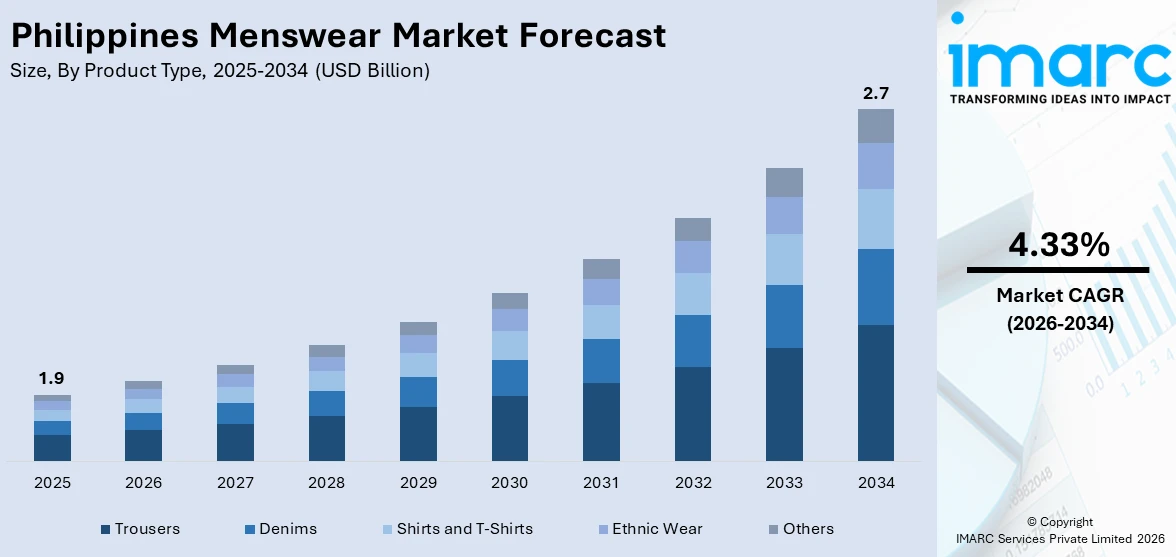
The Philippines menswear market size reached USD 1.9 Billion in 2025. Looking forward, the market is expected to reach USD 2.7 Billion by 2034, exhibiting a growth rate (CAGR) of 4.33% during 2026-2034. The market is experiencing steady growth, driven by urbanization, rising disposable incomes, and growing focus on personal style. Brands are expanding through omni-channel strategies, integrating online and offline retail with tailored offerings like smart-casual and athleisure. Local designers and international labels are capitalizing on consumer demand for quality, sustainable materials, and modern fits. Enhanced brand loyalty and fashion awareness are steering market dynamics, reinforcing Philippines menswear market share.
|
Report Attribute
|
Key Statistics
|
|---|---|
|
Base Year
|
2025
|
|
Forecast Years
|
2026-2034
|
|
Historical Years
|
2020-2025
|
| Market Size in 2025 | USD 1.9 Billion |
| Market Forecast in 2034 | USD 2.7 Billion |
| Market Growth Rate 2026-2034 | 4.33% |
Philippines Menswear Market Trends:
Athleisure and Performance Wear Driving Style and Comfort
In the Philippines, the athleisure trend has become a significant aspect of the menswear market blending style with practicality. Shoppers are increasingly drawn to clothing that provides everyday comfort while also presenting a fashionable and athletic look. For instance, in May 2025, UK sports fashion retailer JD Sports announced its plans to enter the Philippines opening two flagship stores at SM Mall of Asia in June 2025 and Glorietta in July 2025. Managed by SSI Group, the stores will feature exclusive sneakers, apparel, and accessories to enhance local retail experiences. This trend includes items like joggers, moisture-wicking shirts, and adaptable sneakers that easily transition from the gym to casual events. The warm climate also contributes to a demand for lightweight and breathable fabrics that promote mobility and comfort. Additionally, as men become health-conscious and incorporate fitness into their daily lives the allure of performance-oriented clothing grows stronger. In response, brands are unveiling collections that meet both aesthetic and athletic requirements. Whether for a relaxed office environment or leisure activities on weekends, athleisure embodies the changes in modern lifestyles. This rising preference for versatile clothing is significantly influencing Philippines menswear market growth.
To get more information on this market Request Sample
Sustainable and Ethical Fashion
Sustainability is becoming an important factor for male consumers in the menswear market in the Philippines, as increased awareness about environmental and ethical issues affects buying choices. Consumers are becoming willing to choose brands that prioritize sustainable materials, including organic cotton, recycled fabrics, and environmentally friendly dyes. Furthermore, ethical production practices spanning fair labor conditions and minimized water and energy usage are becoming significant to fashion-conscious buyers. For instance, in June 2025, Maligaya Clothing Co., founded by Roko Arceo, is pioneering the slow fashion movement in the Philippines, emphasizing sustainability and heritage. The brand redefines menswear with eco-conscious materials and upcycling, reflecting Filipino cultural nostalgia. Its recent collection, "Maligayang Mundo," showcases vibrant, upcycled pieces, promoting mindful consumption in fashion. There is a growing expectation for transparency in sourcing and supply chains, with consumers seeking accountability and authenticity from the brands they choose. This shift is prompting both local and international brands to implement more responsible business practices. As sustainability becomes a regular part of fashion, men are placing greater value on quality over quantity, reflecting global trends toward mindful consumption. This changing preference is establishing a solid foundation for future innovation and growth in ethical menswear.
Growth Drivers of Philippines Menswear Market:
Urban Middle‑Class Growth and Lifestyle Change
One of the most potent drivers of growth according to the Philippines menswear market analysis, is the fast growth of its urban middle class, particularly within Metro Manila, Cebu, and Davao. With increasing numbers of Filipinos migrating from rural or semi-urban locations to urban centers, incomes rise and there is enhanced access to international fashion through the media, malls, and foreign travel. This repositions choice toward clothing that expresses both social standing and contemporariness, with menswear that compromises formal with smart casual, and leisurewear that can double up as streetwear. Young professionals, particularly in city center business areas, are now dressing for image as a part of social and working life. There is increasing demand for nice-fitting shirts, trousers, and bespoke pieces, for formal working environments, social events, weddings, and parties. Filipino males are more open to investing in utility items like blazers with the ability to dress down, polo shirts that can be dressed up in formal environments, and materials appropriate for both hot days and interior air‑conditioned spaces.
Impact of Digital Media, E-Commerce, and Domestic Fashion Identity
Another potent driver of growth lies in the spread of digital media, social media influencers, and the emergence of e‑commerce sites in the nation. Global fashion trends like Korean streetwear, Western athleisure, Japanese minimalism, are passed through Instagram, TikTok, and local influencers; Filipino men's wear consumers are extremely sensitive to such visual signals. Local brands are taking advantage of this, using influencer marketing and online promotions to engage younger consumers who may not visit high‑end retail. E‑commerce sites like Shopee and Lazada are bringing men's wear into reach even in minor cities and towns, circumventing traditional brick‑and‑mortar restrictions. Meanwhile, there is also a developing interest in clothing that calls attention to Filipino culture and heritage, with retooled styles of the barong tagalog or tropical prints, indigenous textile motifs, or tailoring styles appropriate for the climate. This blending of the international style with local identity provides Filipino menswear with its own voice, and customers are increasingly seeking fashion that appears international and remains based on their own culture, which also contributes to the growth of Philippines menswear market demand.
Need for Function, Comfort, and Eco-Friendly Practices
One of the aspects unique to the Philippines is the weather and how daily activities blend outdoor with indoor spaces; heat, humidity, and constant commuting (traffic, public transportation) cause menswear to have to balance comfort with fashion. Light, airy materials, sweat-away fabrics, and wearable mobility are gaining priority. Athleisure and sportswear are becoming staples in men's wardrobes for workouts and daily wear like casual affairs, working out, work‑at‑coffee shops. Moreover, sustainability is emerging as an apparent issue among Filipino consumers. Issues of ethical labor, eco‑friendly fabric, lower water consumption, local sourcing, and upcycling now impact buying decisions. Local slow‑fashion or heritage brands that focus on quality rather than quantity are earning respect. Consumers are increasingly looking for brands to be open, where the materials are sourced, how the garments are constructed. Brands that can provide fashionable menswear that aligns with comfort, climatic appropriateness, and environmental considerations are likely to resonate better in today's market.
Philippines Menswear Market Segmentation:
IMARC Group provides an analysis of the key trends in each segment of the market, along with forecasts at the country and regional levels for 2026-2034. Our report has categorized the market based on product type, season, and distribution channel.
Product Type Insights:
- Trousers
- Denims
- Shirts and T-Shirts
- Ethnic Wear
- Others
The report has provided a detailed breakup and analysis of the market based on the product type. This includes trousers, denims, shirts and t-shirts, ethnic wear, and others.
Season Insights:
- Summer Wear
- Winter Wear
- All-Season Wear
A detailed breakup and analysis of the market based on the season have also been provided in the report. This includes summer wear, winter wear, and all-season wear.
Distribution Channel Insights:
To get detailed segment analysis of this market Request Sample
- Supermarkets and Hypermarkets
- Exclusive Stores
- Multi-Brand Retail Outlets
- Online Stores
- Others
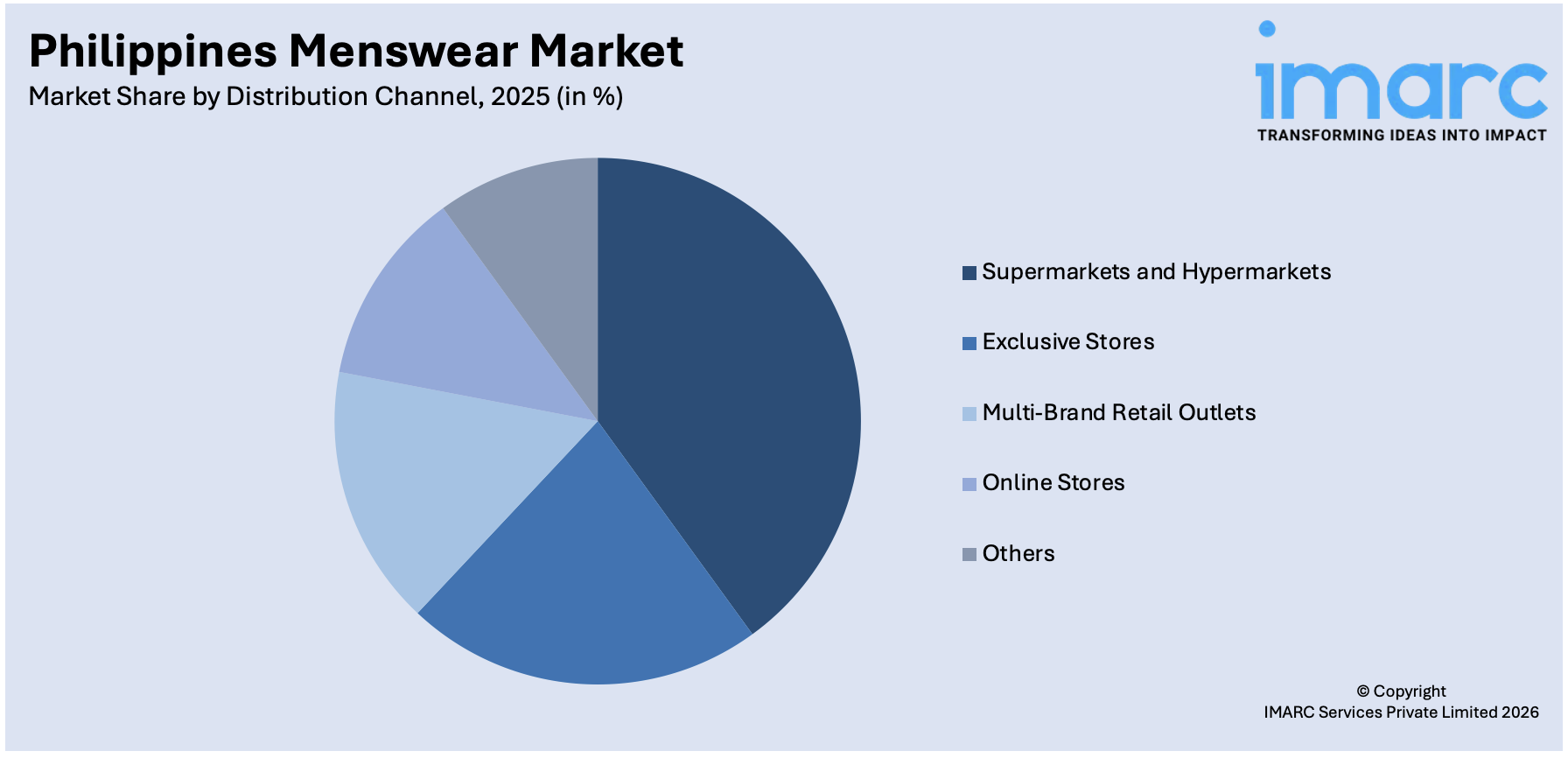
A detailed breakup and analysis of the market based on the distribution channel have also been provided in the report. This includes supermarkets and hypermarkets, exclusive stores, multi-brand retail outlets, online stores, and others.
Regional Insights:
- Luzon
- Visayas
- Mindanao
The report has also provided a comprehensive analysis of all the major regional markets, which include Luzon, Visayas, and Mindanao.
Competitive Landscape:
The market research report has also provided a comprehensive analysis of the competitive landscape. Competitive analysis such as market structure, key player positioning, top winning strategies, competitive dashboard, and company evaluation quadrant has been covered in the report. Also, detailed profiles of all major companies have been provided.
Philippines Menswear Market News:
- In October 2024, Boggi Milano opened its first flagship store in the Philippines at Greenbelt 5, showcasing its Fall/Winter 2024-2025 collection. Known for blending traditional tailoring with modern fabrics, the brand emphasizes sustainability and versatility in its menswear, featuring refined pieces for the modern man in neutral tones.
- In January 2024, Coldplay bassist Guy Berryman launched his menswear label, Applied Art Forms (A/A/F), in the Philippines. A/A/F features utilitarian, military-inspired designs. Berryman emphasizes timeless, functional fashion, moving away from fast trends, with key items like a modular parka system showcased at the launch.
Philippines Menswear Market Report Coverage:
| Report Features | Details |
|---|---|
| Base Year of the Analysis | 2025 |
| Historical Period | 2020-2025 |
| Forecast Period | 2026-2034 |
| Units | Billion USD |
| Scope of the Report |
Exploration of Historical Trends and Market Outlook, Industry Catalysts and Challenges, Segment-Wise Historical and Future Market Assessment:
|
| Product Types Covered | Trousers, Denims, Shirts and T-Shirts, Ethnic Wear, Others |
| Seasons Covered | Summer Wear, Winter Wear, All-Season Wear |
| Distribution Channels Covered | Supermarkets and Hypermarkets, Exclusive Stores, Multi-Brand Retail Outlets, Online Stores, Others |
| Regions Covered | Luzon, Visayas, Mindanao |
| Customization Scope | 10% Free Customization |
| Post-Sale Analyst Support | 10-12 Weeks |
| Delivery Format | PDF and Excel through Email (We can also provide the editable version of the report in PPT/Word format on special request) |
Key Benefits for Stakeholders:
- IMARC’s industry report offers a comprehensive quantitative analysis of various market segments, historical and current market trends, market forecasts, and dynamics of the Philippines menswear market from 2020-2034.
- The research report provides the latest information on the market drivers, challenges, and opportunities in the Philippines menswear market.
- Porter's five forces analysis assist stakeholders in assessing the impact of new entrants, competitive rivalry, supplier power, buyer power, and the threat of substitution. It helps stakeholders to analyze the level of competition within the Philippines menswear industry and its attractiveness.
- Competitive landscape allows stakeholders to understand their competitive environment and provides an insight into the current positions of key players in the market.
Frequently Asked Questions About the Philippines Menswear Market Report
The Philippines menswear market was valued at USD 1.9 Billion in 2025.
The Philippines menswear market is projected to exhibit a CAGR of 4.33% during 2026-2034.
The Philippines menswear market is expected to reach a value of USD 2.7 Billion by 2034.
Philippines menswear trends reflect a shift toward smart-casual styles, breathable fabrics, and minimalist designs suited for tropical climates. Influenced by Korean and Western fashion, local brands blend modern aesthetics with cultural elements. Athleisure, oversized fits, and sustainable clothing are gaining popularity, especially among younger, fashion-forward urban consumers.
The Philippines menswear market is driven by rising urbanization, digital media influence, and increasing fashion consciousness among young professionals. Local climate demands breathable, functional clothing, while e-commerce boosts accessibility. There is growing interest in sustainable fashion and modern takes on traditional styles, reflecting a blend of cultural pride and global trends.
Need more help?
- Speak to our experienced analysts for insights on the current market scenarios.
- Include additional segments and countries to customize the report as per your requirement.
- Gain an unparalleled competitive advantage in your domain by understanding how to utilize the report and positively impacting your operations and revenue.
- For further assistance, please connect with our analysts.
 Request Customization
 Speak to an Analyst
 Request Brochure
 Inquire Before Buying
Benefits of Customization
- Personalize this research
- Triangulate with your data
- Get data as per your format and definition
- Gain a deeper dive into a specific application, geography, customer, or competitor
- Any level of personalization
Get in Touch With Us
UNITED STATES
Phone: +1-201-971-6302
INDIA
Phone: +91-120-433-0800
UNITED KINGDOM
Phone: +44-753-714-6104
Email: [email protected]
Client Testimonials




.webp)




.webp)













Related Reports

Choose your plan
*Please note that the prices mentioned below are starting prices for each bundle type. Kindly contact our team for further details.*
Single User License
- 1 User License, Access on 2 Devices
- PDF Report + Excel Dataset (Password Protected)
- Lifetime Access
- No Printing Rights
- 10% Free Report Customization
- 10–12 Weeks of Analyst Support
Five User License
- Access for 5 Users, 2 Devices per User
- PDF Report + Excel Dataset (Password Protected)
- Lifetime Access
- Dedicated Account Manager
- 12–14 Weeks of Analyst Support
- No Printing Rights
- 15% Free Report Customization
- 25% Discount on Your Next Purchase
Corporate User License
- Unlimited User Access (Within Your Organization)
- PDF Report + Excel Dataset
- Lifetime Access
- Dedicated Account Manager
- 14–20 Weeks of Analyst Support
- No Printing Rights
- 20% Free Report Customization
- 30% Discount on Your Next Purchase
Essential Insights
What's included:
3 reports
- Lifetime Access
- PDF Reports
- Excel Datasets
- 2 Weeks of Free Analyst Support
- 2 User Licenses
- Access on 2 Devices
- Printing Rights
- Complimentary PowerPoint (PPT) Version
- Complimentary License Upgrade
Professional Access
What's included:
5 reports
- Lifetime Access
- PDF Reports
- Excel Datasets
- 8 Weeks of Free Analyst Support
- 2 User Licenses
- Access on 2 Devices
- Printing Rights
- Complimentary PowerPoint (PPT) Version
- Complimentary License Upgrade
Business Advantage
What's included:
8 reports
- Lifetime Access
- PDF Reports
- Excel Datasets
- 14 Weeks of Free Analyst Support
- 2 User Licenses
- Access on 2 Devices
- Printing Rights
- Complimentary PowerPoint (PPT) Version
- Complimentary License Upgrade
Enterprise Intelligence
What's included:
10 reports
- Lifetime Access
- PDF Reports
- Excel Datasets
- 20 Weeks of Free Analyst Support
- 2 User Licenses
- Access on 2 Devices
- Printing Rights
- Complimentary PowerPoint (PPT) Version
- Complimentary License Upgrade