
Philippines Social Commerce Market Report by Business Model (Business to Consumer (B2C), Business to Business (B2B), Consumer to Consumer (C2C)), Device Type (Laptops and PCs, Mobiles), Product Type (Personal and Beauty Care, Apparel, Accessories, Home Products, Health Supplements, Food and Beverages, and Others), and Region 2026-2034
Philippines Social Commerce Market Overview:
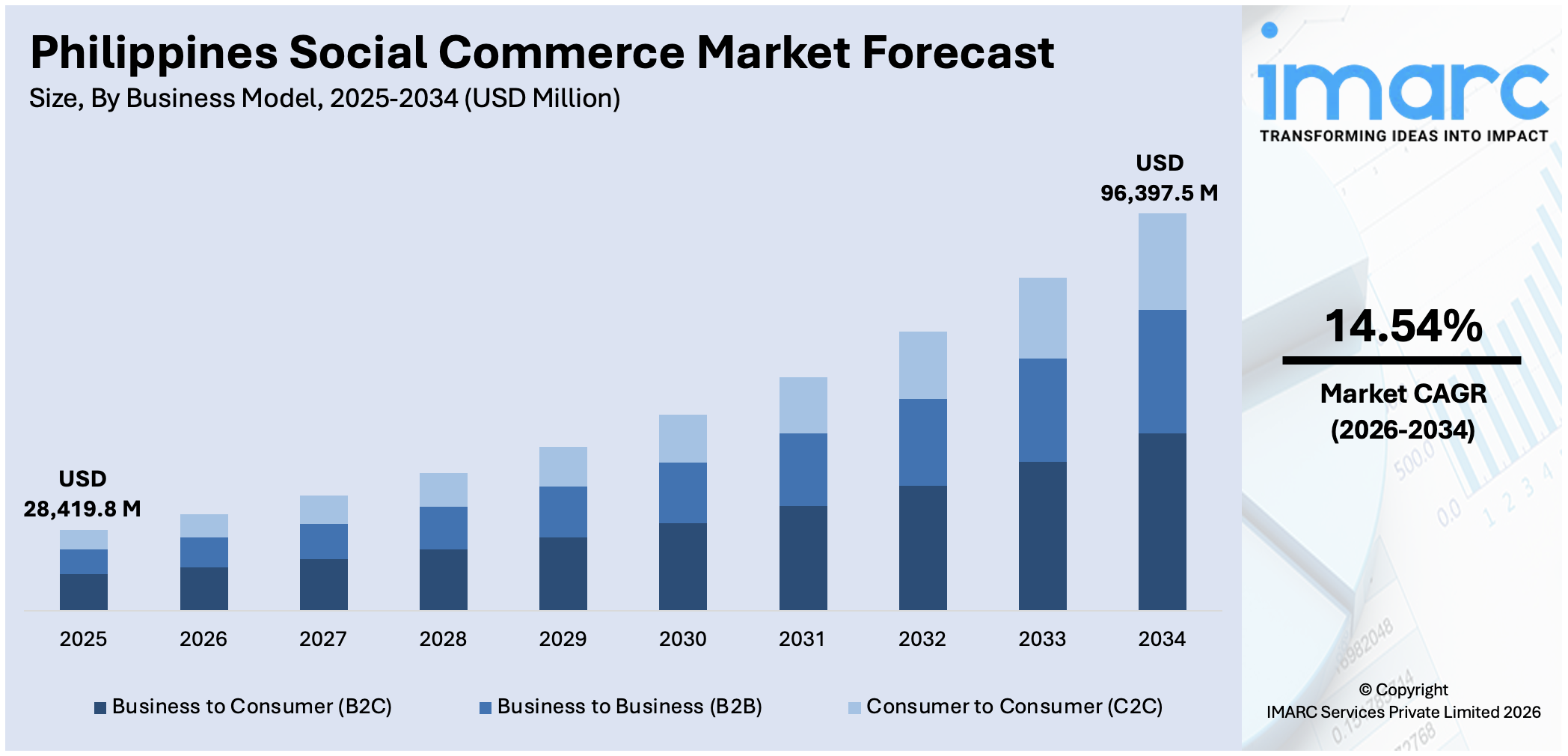
The Philippines social commerce market size reached USD 28,419.8 Million in 2025. Looking forward, the market is expected to reach USD 96,397.5 Million by 2034, exhibiting a growth rate (CAGR) of 14.54% during 2026-2034. The increasing internet penetration, rising smartphone usage, expanding e-commerce platforms, growing digital payment adoption, social media engagement, and the convergence of online shopping with social networking platforms are some of the factors contributing to the market expansion.
|
Report Attribute
|
Key Statistics
|
|---|---|
|
Base Year
|
2025 |
|
Forecast Years
|
2026-2034
|
|
Historical Years
|
2020-2025
|
| Market Size in 2025 | USD 28,419.8 Million |
| Market Forecast in 2034 | USD 96,397.5 Million |
| Market Growth Rate (2026-2034) | 14.54% |
Key Trends of Philippines Social Commerce Market:
Rising Internet penetration
The country has been witnessing a steady increase in internet users, primarily fueled by improved infrastructure, the affordability of smartphones, and the availability of affordable internet data plans. As more people gain access to the internet, they are exploring online shopping opportunities, with social commerce emerging as a convenient avenue for purchasing products and services. For instance, the Philippines had 86.98 million internet users, accounting for 73.6 percent of the total population by January 2024. The trend of high smartphone usage is especially notable among the younger demographic, who are digitally adept and prefer interacting with brands via social media. With their inclination toward mobile browsing and online shopping, younger users are a significant contributor to the expansion of the social commerce platforms market.
To get more information on this market Request Sample
Widespread adoption of smartphones
The country boasts a high smartphone penetration rate, with a significant portion of the population relying on their mobile devices for internet access and various digital activities. With the increasing affordability of smartphones and the availability of budget-friendly models, more Filipinos are empowered to browse social media platforms and make purchases directly through their mobile devices. According to the results of the Women and ICT (Information Communications Technology) Development Index (WIDI) survey, 84.9 percent of women respondents in households used smartphones in 2022. This increasing mobile penetration, prompting social commerce platforms to optimize their interfaces for mobile users, offering seamless shopping experiences tailored to the preferences and behaviors of users, is providing an impetus to the Philippines social commerce market growth.
Convergence of online shopping with social networking platforms
Based on the Digital 2023 report on the Philippines, there were 84.45 million social media users in the Philippines in January 2023. Social media sites like Facebook, Instagram, and Twitter are emerging as powerful e-commerce platforms where companies can display their goods, engage with clients, and complete transactions. These sites have developed beyond being simple communication tools. Moreover, these platforms are leveraging features such as shoppable posts, in-app checkout options, and influencer marketing to create immersive shopping experiences that blur the lines between social interaction and online commerce, which is creating a positive outlook for market expansion. With Filipinos spending a significant amount of time on social media, businesses are capitalizing on this trend by establishing a strong presence on these platforms and tapping into the vast potential of social commerce, thus contributing to the market growth.
Growth Drivers of Philippines Social Commerce Market:
Digital Payment Infrastructure Expansion
The rapid adoption and evolution of digital payment solutions across the Philippines has emerged as a fundamental driver of social commerce growth. Digital wallet providers such as GCash and Maya have revolutionized the way Filipinos make online transactions, reshaping consumer payment behavior through secure and convenient digital solutions. These platforms seamlessly integrate with social commerce channels, allowing users to complete purchases directly within social media applications without needing external payment gateways. The availability of instant fund transfers, QR code payments, and flexible buy-now-pay-later options has minimized transaction barriers, fostering greater purchasing frequency. Furthermore, the growing adoption of digital payments among small and medium enterprises, along with individual sellers on social platforms, has made e-commerce participation more accessible. According to the Philippines social commerce market analysis, this increasing digital inclusion is creating a more dynamic and inclusive ecosystem that supports the continuous expansion of the Philippines’ social commerce landscape. This infrastructure development, supported by favorable government policies and increasing consumer trust in digital financial services, continues to fuel the expansion of the market, making it easier for businesses of all sizes to engage in online selling through social media channels.
Influencer Marketing and Live Commerce Revolution
The proliferation of influencer-driven commerce and live-streaming shopping experiences has fundamentally reshaped consumer purchasing behavior in the Philippines. Filipino consumers demonstrate strong trust in recommendations from content creators, with studies indicating that several users have purchased products based on influencer endorsements. Social commerce platforms have capitalized on this trend by integrating live commerce features, where sellers and influencers can showcase products in real-time, interact with potential buyers, and facilitate immediate purchases. Platforms such as TikTok Shop, Facebook Live, and Instagram Live have become virtual marketplaces where authentic engagement translates directly into sales conversions, which are boosting the Philippines social commerce market demand. The interactive nature of live commerce builds consumer confidence, addresses purchase hesitations instantly, and creates a sense of urgency that drives buying decisions. Additionally, the growth of affiliate creator programs, which increased by 87 percent in the first half of 2024, demonstrates how content creators are recognizing social platforms as viable revenue channels beyond traditional advertising. This symbiotic relationship between influencers, brands, and consumers has created a dynamic ecosystem that sustains the market growth through authentic storytelling and community-driven recommendations.
Supportive Government Policies and Digital Economy Initiatives
Government commitment to advancing the digital economy through progressive policies and infrastructure investments has created an enabling environment for social commerce expansion. The Philippine government's Financial Inclusion Steering Committee has implemented strategic initiatives aimed at increasing digital payment adoption and improving internet accessibility across urban and rural areas, which is further fueling the Philippines social commerce market share. The Department of Trade and Industry's E-Commerce Philippines Roadmap 2022 and programs like the One Town, One Product Philippines initiative actively encourage small and medium-sized enterprises to establish an online presence and leverage digital platforms for market expansion. Furthermore, the implementation of the Internet Transactions Act of 2023 has established clear regulatory frameworks that protect both consumers and sellers in online transactions, building trust in digital commerce activities. These policies are complemented by significant infrastructure improvements, including the expansion of telecommunications networks and the rollout of 5G technology, which enhance connectivity and enable seamless social commerce experiences. The government's target to achieve 70 percent digital retail payment volume by 2028, up from the achieved 50 percent in 2023, signals continued policy support for digital transformation. Such comprehensive governmental backing not only addresses current market needs but also creates long-term confidence among businesses and investors, thereby sustaining momentum in the market demand and positioning the country as a regional leader in digital commerce innovation.
Philippines Social Commerce Market Segmentation:
IMARC Group provides an analysis of the key trends in each segment of the market, along with forecasts at the country level for 2026-2034. Our report has categorized the market based on business model, device type, and product type.
Business Model Insights:
- Business to Consumer (B2C)
- Business to Business (B2B)
- Consumer to Consumer (C2C)
The report has provided a detailed breakup and analysis of the market based on the business model. This includes business to consumer (B2C), business to business (B2B), and consumer to consumer (C2C).
Device Type Insights:
Access the comprehensive market breakdown Request Sample
- Laptops and PCs
- Mobiles
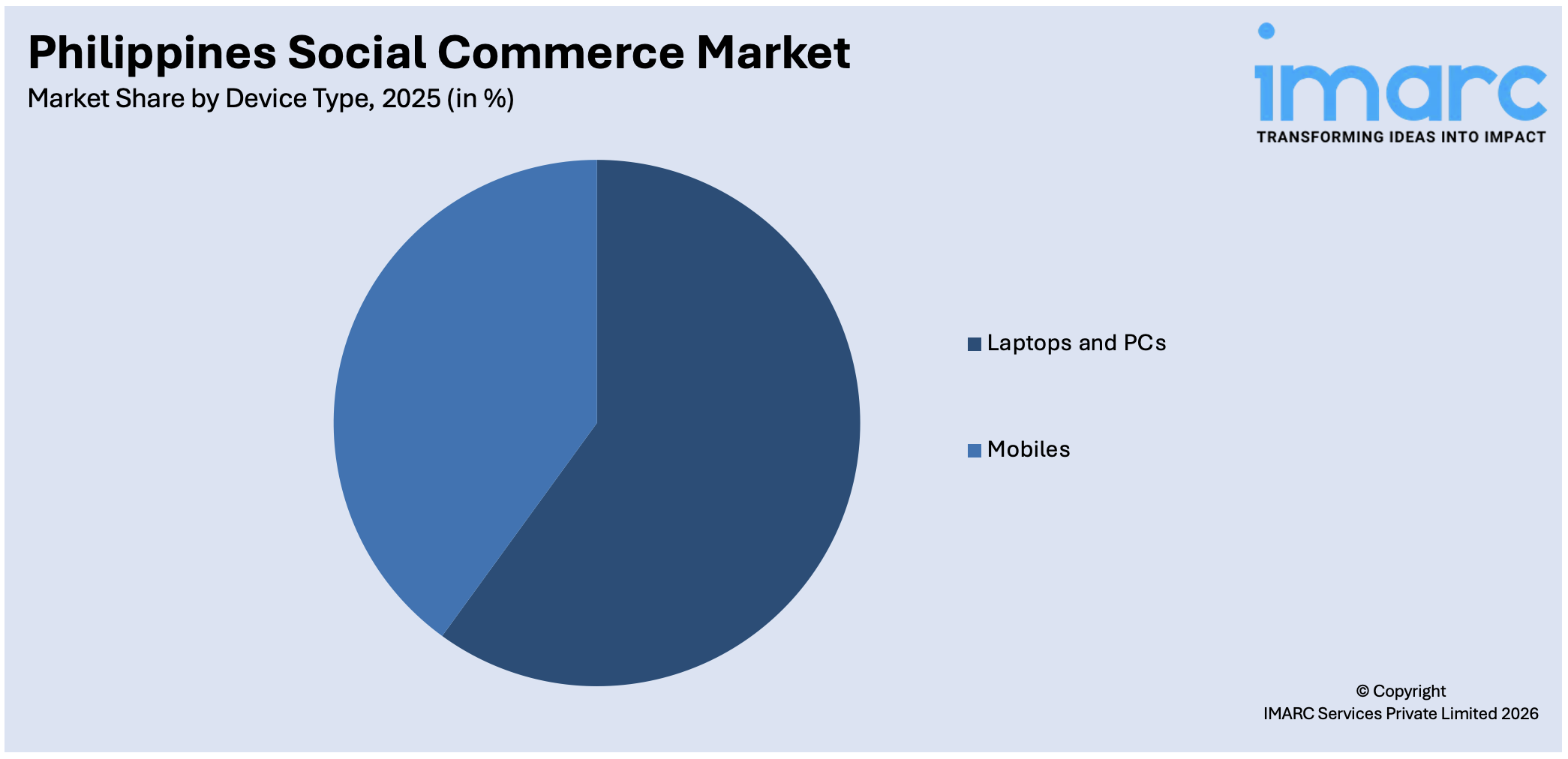
A detailed breakup and analysis of the market based on the device type have also been provided in the report. This includes laptops and PCs and mobiles.
Product Type Insights:
- Personal and Beauty Care
- Apparel
- Accessories
- Home Products
- Health Supplements
- Food and Beverages
- Others
The report has provided a detailed breakup and analysis of the market based on the product type. This includes personal and beauty care, apparel, accessories, home products, health supplements, food and beverages, and others.
Regional Insights:
- Luzon
- Visayas
- Mindanao
The report has also provided a comprehensive analysis of all the major regional markets, which include Luzon, Visayas, and Mindanao.
Competitive Landscape:
The market research report has also provided a comprehensive analysis of the competitive landscape. Competitive analysis such as market structure, key player positioning, top winning strategies, competitive dashboard, and company evaluation quadrant has been covered in the report. Also, detailed profiles of all major companies have been provided.

Philippines Social Commerce Market News:
- In August 2023, Temu entered Southeast Asia, challenging Shopee, Lazada & TikTok Shop. Its quiet launch in the Philippines in August 2023 signifies the beginning of Temu's anticipated entry into the region.
Philippines Social Commerce Market Report Coverage:
| Report Features | Details |
|---|---|
| Base Year of the Analysis | 2025 |
| Historical Period | 2020-2025 |
| Forecast Period | 2026-2034 |
| Units | Million USD |
| Scope of the Report | Exploration of Historical and Forecast Trends, Industry Catalysts and Challenges, Segment-Wise Historical and Predictive Market Assessment:
|
| Business Models Covered | Business to Consumer (B2C), Business to Business (B2B), Consumer to Consumer (C2C) |
| Device Types Covered | Laptops and PCs, Mobiles |
| Product Types Covered | Personal and Beauty Care, Apparel, Accessories, Home Products, Health Supplements, Food and Beverages, Others |
| Regions Covered | Luzon, Visayas, Mindanao |
| Customization Scope | 10% Free Customization |
| Post-Sale Analyst Support | 10-12 Weeks |
| Delivery Format | PDF and Excel through Email (We can also provide the editable version of the report in PPT/Word format on special request) |
Key Benefits for Stakeholders:
- IMARC’s industry report offers a comprehensive quantitative analysis of various market segments, historical and current market trends, market forecasts, and dynamics of the Philippines social commerce market from 2020-2034.
- The research report provides the latest information on the market drivers, challenges, and opportunities in the Philippines social commerce market.
- Porter's five forces analysis assist stakeholders in assessing the impact of new entrants, competitive rivalry, supplier power, buyer power, and the threat of substitution. It helps stakeholders to analyze the level of competition within the Philippines social commerce industry and its attractiveness.
- Competitive landscape allows stakeholders to understand their competitive environment and provides an insight into the current positions of key players in the market.
Frequently Asked Questions About the Philippines Social Commerce Market Report
The social commerce market in Philippines was valued at USD 28,419.8 Million in 2025.
The Philippines social commerce market is projected to exhibit a CAGR of 14.54% during 2026-2034.
The Philippines social commerce market is projected to reach a value of USD 96,397.5 Million by 2034.
Key trends in the Philippines social commerce market include the rise of influencer-led shopping, integration of live-streaming features, mobile-first purchasing behavior, digital payment adoption, and increasing use of AI-driven personalization to enhance customer engagement and conversions.
The Philippines social commerce market growth is driven by expanding internet connectivity, increasing smartphone penetration, supportive e-commerce regulations, and the growing participation of small and medium enterprises leveraging social platforms for business. Additionally, rising consumer trust in online transactions and convenient delivery services further boost market expansion.
Need more help?
- Speak to our experienced analysts for insights on the current market scenarios.
- Include additional segments and countries to customize the report as per your requirement.
- Gain an unparalleled competitive advantage in your domain by understanding how to utilize the report and positively impacting your operations and revenue.
- For further assistance, please connect with our analysts.
 Request Customization
 Speak to an Analyst
 Request Brochure
 Inquire Before Buying
Benefits of Customization
- Personalize this research
- Triangulate with your data
- Get data as per your format and definition
- Gain a deeper dive into a specific application, geography, customer, or competitor
- Any level of personalization
Get in Touch With Us
UNITED STATES
Phone: +1-201-971-6302
INDIA
Phone: +91-120-433-0800
UNITED KINGDOM
Phone: +44-753-714-6104
Email: [email protected]
Client Testimonials




.webp)




.webp)













Related Reports

Choose your plan
*Please note that the prices mentioned below are starting prices for each bundle type. Kindly contact our team for further details.*
Single User License
- 1 User License, Access on 2 Devices
- PDF Report + Excel Dataset (Password Protected)
- Lifetime Access
- No Printing Rights
- 10% Free Report Customization
- 10–12 Weeks of Analyst Support
Five User License
- Access for 5 Users, 2 Devices per User
- PDF Report + Excel Dataset (Password Protected)
- Lifetime Access
- Dedicated Account Manager
- 12–14 Weeks of Analyst Support
- No Printing Rights
- 15% Free Report Customization
- 25% Discount on Your Next Purchase
Corporate User License
- Unlimited User Access (Within Your Organization)
- PDF Report + Excel Dataset
- Lifetime Access
- Dedicated Account Manager
- 14–20 Weeks of Analyst Support
- No Printing Rights
- 20% Free Report Customization
- 30% Discount on Your Next Purchase
Essential Insights
What's included:
3 reports
- Lifetime Access
- PDF Reports
- Excel Datasets
- 2 Weeks of Free Analyst Support
- 2 User Licenses
- Access on 2 Devices
- Printing Rights
- Complimentary PowerPoint (PPT) Version
- Complimentary License Upgrade
Professional Access
What's included:
5 reports
- Lifetime Access
- PDF Reports
- Excel Datasets
- 8 Weeks of Free Analyst Support
- 2 User Licenses
- Access on 2 Devices
- Printing Rights
- Complimentary PowerPoint (PPT) Version
- Complimentary License Upgrade
Business Advantage
What's included:
8 reports
- Lifetime Access
- PDF Reports
- Excel Datasets
- 14 Weeks of Free Analyst Support
- 2 User Licenses
- Access on 2 Devices
- Printing Rights
- Complimentary PowerPoint (PPT) Version
- Complimentary License Upgrade
Enterprise Intelligence
What's included:
10 reports
- Lifetime Access
- PDF Reports
- Excel Datasets
- 20 Weeks of Free Analyst Support
- 2 User Licenses
- Access on 2 Devices
- Printing Rights
- Complimentary PowerPoint (PPT) Version
- Complimentary License Upgrade