
Mung Beans Market: Global Industry Trends, Share, Size, Growth, Opportunity and Forecast, 2026-2034
Mung Beans Market Size, Share, Trends & Forecast (2026-2034)
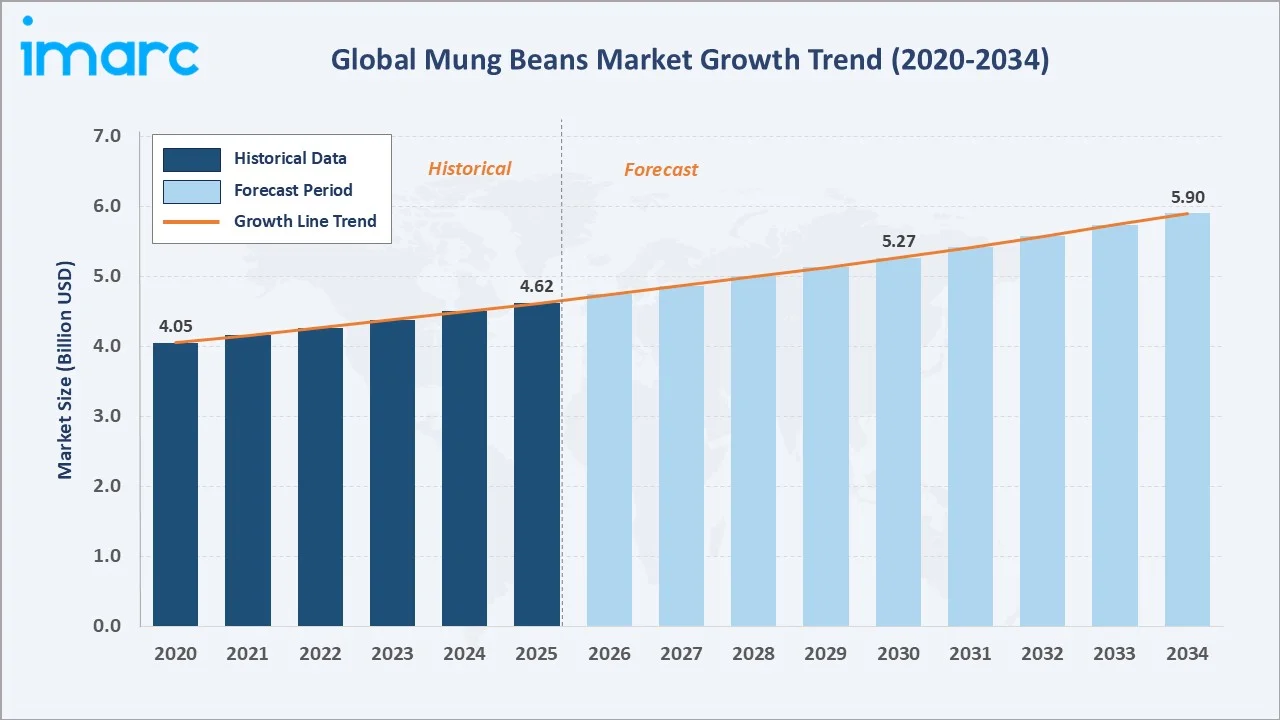
The global mung beans market grew from USD 4.62 Billion in 2025 to USD 4.77 Billion in 2026 and is projected to reach USD 5.90 Billion by 2034, growing at a CAGR of 2.68% during 2026-2034. Growth is justified by rising demand for plant-based protein, expanding use in sprouting and processed foods, and government support for pulse cultivation.
India leads global supply and consumption, contributing 42.8% of the 2025 market, followed by China at 31.6% and Myanmar at 17.4%, reflecting the crop's concentration across South and Southeast Asia's traditional pulse-growing belts.
Market Snapshot
|
Metric |
Value |
|
Base Year Market Size (2025) |
USD 4.62 Billion |
| Market Size (2026) | USD 4.77 Billion |
|
Forecast Market Size (2034) |
USD 5.90 Billion |
|
CAGR (2026-2034) |
2.68% |
|
Base Year |
2025 |
|
Historical Period |
2020-2025 |
|
Forecast Period |
2026-2034 |
|
Leading Region |
India (42.8%, 2025) |
The market expanded from USD 4.05 Billion in 2020 to USD 4.62 Billion in 2025 and an estimated USD 4.77 Billion in 2026, a gain justified by steady post-pandemic recovery in cultivation area and consistent dal and sprout consumption across South and Southeast Asia. The market is anchored at USD 5.27 Billion by 2030 and is forecast to reach USD 5.90 Billion by 2034, a trajectory justified by continued government procurement support, gradual export market development, and rising plant-based protein consumption that together sustain low-single-digit compounding growth typical of a mature staple pulse crop.
To get more information on this market, Request Sample
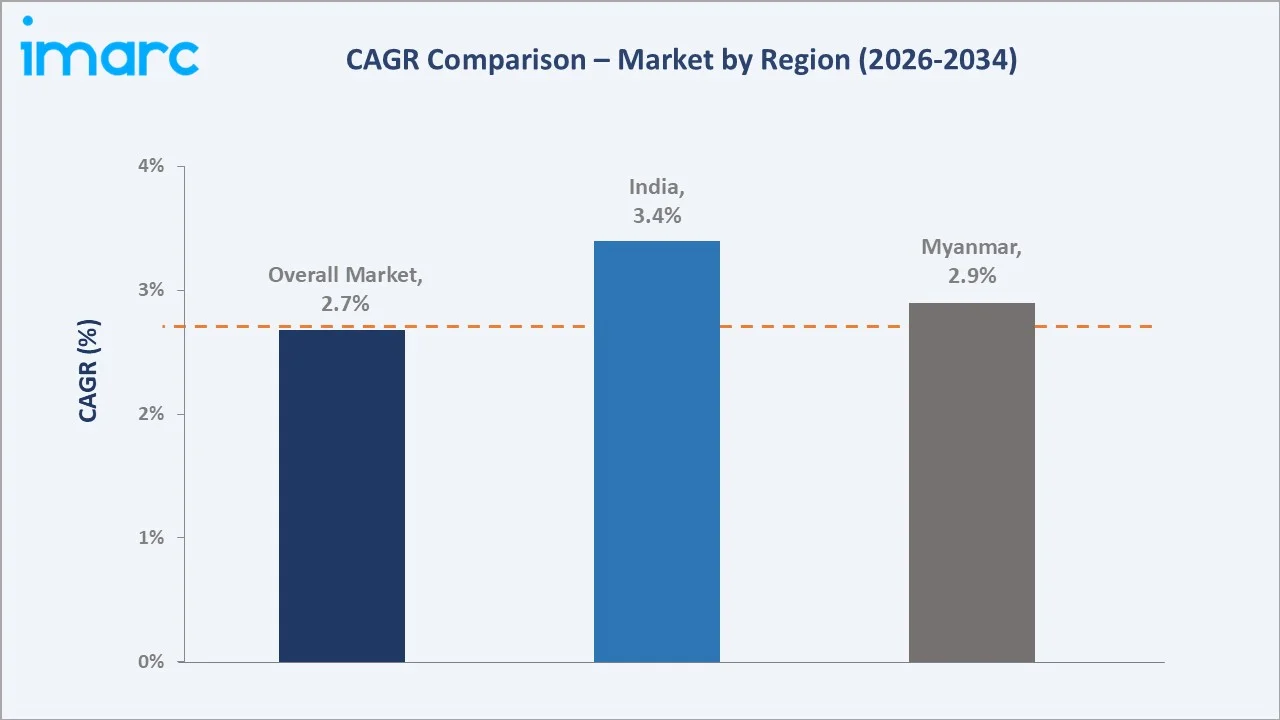
Among the top producing and consuming countries, India grows fastest at an estimated ~3.4% CAGR through 2034, a rate justified by government-backed pulse self-sufficiency programs and minimum support price policy that continue to expand sown area. China and Myanmar grow steadily at ~2.6% and ~2.9% CAGR respectively, justified by their established production and export-processing base that supplies regional demand across Asia-Pacific, while smaller importing markets grow at ~2.1%.
Executive Summary
The global mung beans market, which increased from USD 4.62 Billion in 2025 to an estimated USD 4.77 Billion in 2026, underscoring the crop's role as a dietary staple pulse across Asia and a growing plant-based protein ingredient worldwide. Mung beans are consumed as whole beans, dal (split pulses), sprouts, starch, and flour, and are increasingly used in noodles, snacks, and vegan protein formulations. The market is projected to reach USD 5.90 Billion by 2034.
India leads the market at 42.8% share in 2025, supported by the largest cultivation base, strong domestic consumption, and government minimum support price programs for pulses. China follows at 31.6% through large-scale cultivation and its established mung bean noodle and starch processing industry, while Myanmar at 17.4% remains a major export-oriented producer serving India and China.
Key Market Insights
|
Insight |
Data |
|
Leading Region |
India - 42.8% market share (2025) |
|
Second Region |
China - 31.6% market share (2025) |
|
Third Region |
Myanmar - 17.4% market share (2025) |
|
Market Opportunity |
Plant-based protein ingredients; sprouted mung bean snacks; export-oriented processing capacity |
- India at 42.8%: The country benefits from the largest sown pulse area globally, government procurement support, and deep-rooted consumption of dal and sprouts across households.
- China at 31.6%: A well-established processing base for starch, noodles, and packaged foods sustains high domestic offtake and steady import requirements.
- Myanmar at 17.4%: Favourable growing conditions and low production costs support Myanmar's position as a leading exporter to India and China.
Mung Beans Market Overview
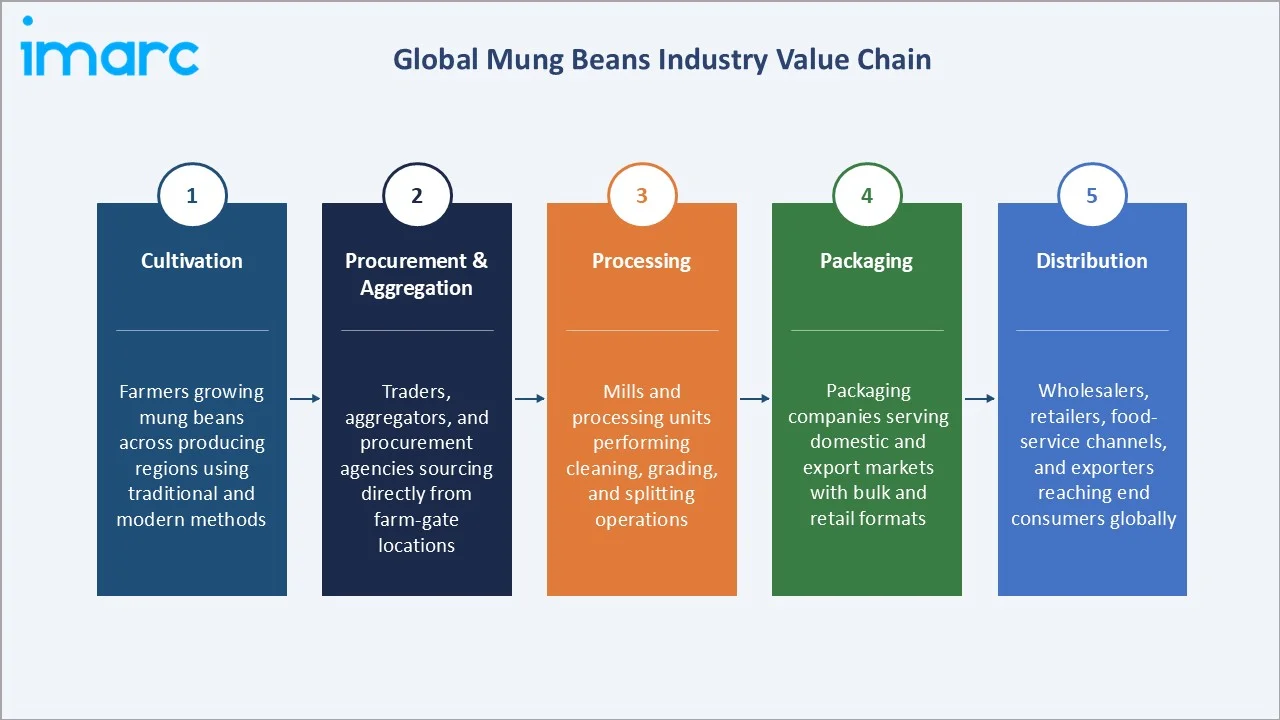
The global mung beans market encompasses the cultivation, procurement, processing, and distribution of mung beans (Vigna radiata) across whole bean, split dal, sprout, starch, and flour formats. The value chain integrates smallholder farmers, grain traders and aggregators, dal mills and processing plants, packaging companies, exporters, and retail and food-service distribution channels. Macroeconomic factors shaping the market include monsoon-dependent yields, government pulse procurement policy, rising health and protein consciousness, and expanding cross-border trade between South and Southeast Asian producing nations and importing markets worldwide.
Market Dynamics
To evaluate market opportunities, Request Sample
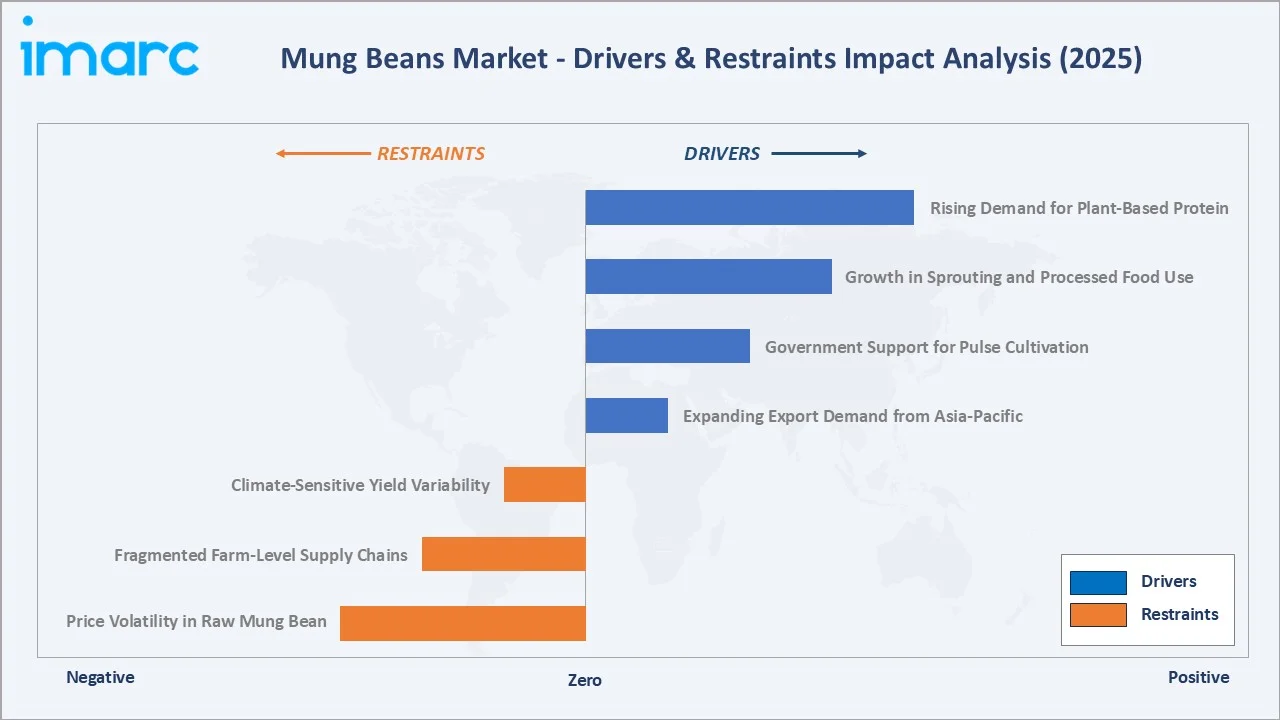
Market Drivers
- Rising Demand for Plant-Based Protein: Growing consumer preference for plant-based, high-protein diets is boosting demand for mung beans as whole pulses, sprouts, and protein-rich flour used in vegan and clean-label food formulations. This shift is justified by rising health consciousness and the global move away from animal-based protein sources. Food manufacturers are increasingly reformulating products to include mung bean protein, further reinforcing this driver.
- Growth in Sprouting and Processed Food Use: Expanding use of mung bean sprouts in fresh salads, Asian cuisine, and quick-service restaurants, alongside processed products such as noodles, snacks, and starch, is widening the crop's end-use base. This trend is justified by growing urban food-service penetration and rising consumer interest in convenient, nutrient-dense ingredients. Retailers are also expanding fresh sprout shelf space, reinforcing consistent demand.
- Government Support for Pulse Cultivation: Government minimum support price schemes and pulse self-sufficiency programs in India and other producing nations are encouraging farmers to expand mung bean acreage and improve yields. This support is justified by national food-security priorities that favour pulse crops for their low water requirement and soil-nitrogen benefits. Continued policy backing is expected to sustain stable production growth through the forecast period.
- Expanding Export Demand from Asia-Pacific: Rising cross-border trade flows from Myanmar and China to import-dependent Asian and Middle Eastern markets are strengthening global demand for traded mung bean volumes. This driver is justified by structural production surpluses in exporting nations and growing consumption in markets with limited domestic cultivation capacity. Improving trade logistics and bilateral agreements further support this expansion.
Market Restraints
- Climate-Sensitive Yield Variability: Mung bean cultivation remains highly sensitive to monsoon timing, temperature, and rainfall variability, creating year-to-year yield volatility that can constrain supply. This restraint is justified by the crop's reliance on rain-fed farming in most producing regions, where irrigation infrastructure remains limited. Unpredictable weather patterns linked to climate change are expected to add further supply uncertainty.
- Fragmented Farm-Level Supply Chains: Production is dominated by smallholder farmers with limited access to modern storage, grading, and processing infrastructure, resulting in post-harvest losses and inconsistent quality. This restraint is justified by the fragmented land-holding patterns common across producing countries, which limit economies of scale. Inconsistent quality also reduces the price premium smallholders can command in export markets.
- Price Volatility in Raw Mung Bean: Fluctuating raw mung bean prices, driven by variable harvests and speculative trading, create margin uncertainty for processors, traders, and exporters. This restraint is justified by the crop's relatively thin global trading volumes compared with major grains, which amplifies price swings. Such volatility can discourage long-term investment in processing capacity.
Market Opportunities
- Expansion into Plant-Based Ingredient Applications: Rising interest in mung bean protein isolates and plant-based beverages, including mung bean-derived egg and dairy alternatives, is opening new high-value processing and ingredient revenue streams.
- Premiumization Through Organic Certification: Increasing certification of organic and sustainably farmed mung beans allows producers to access premium pricing tiers in developed export markets seeking traceable, chemical-free pulse supply.
Market Challenges
- Post-Harvest Infrastructure Gaps: Limited on-farm storage and cold-chain access in producing regions continues to constrain quality retention and bargaining power for smallholder growers. This challenge is justified by low levels of rural infrastructure investment relative to production growth. Addressing this gap requires coordinated public and private investment in storage and logistics networks.
- Intensifying Competition Among Exporting Nations: Multiple exporting nations, including India, Myanmar, China, and Uzbekistan, compete on price and volume, compressing margins for exporters without differentiated product positioning.
Emerging Market Trends
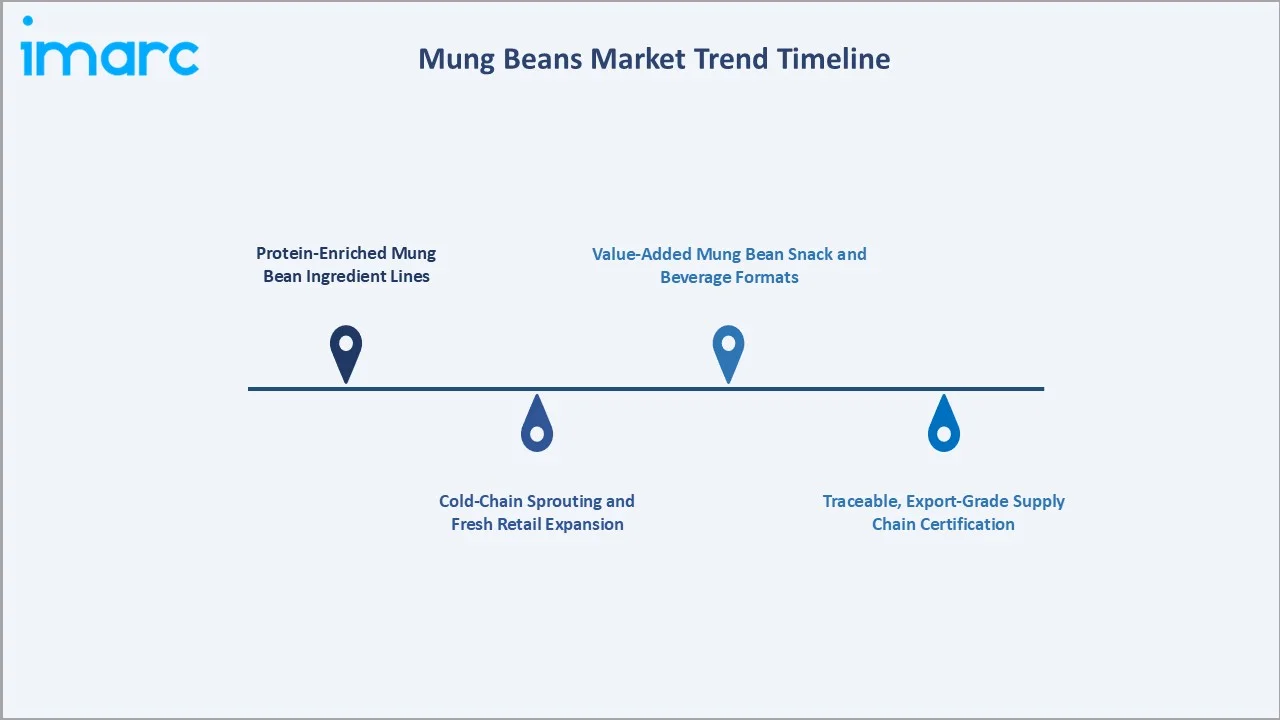
1. Protein-Enriched Mung Bean Ingredient Lines
Food manufacturers are developing protein-enriched mung bean flour and isolate ingredient lines for use in bakery, beverage, and snack formulations. This trend is supported by growing consumer demand for allergen-friendly, plant-based protein sources, and is encouraging processors to invest in dedicated protein extraction lines.
2. Cold-Chain Sprouting and Fresh Retail Expansion
Expansion of cold-chain logistics is enabling wider retail availability of fresh mung bean sprouts beyond traditional wet markets. This supports longer shelf life, broader geographic reach, and growing incorporation of sprouts into packaged salad and ready-to-eat product lines.
3. Traceable, Export-Grade Supply Chain Certification
Exporters in Myanmar and India are adopting traceability and quality certification systems to meet the stricter import standards of premium overseas buyers. This trend is improving price realization for certified supply chains and encouraging further formalization of smallholder aggregation networks.
4. Value-Added Mung Bean Snack and Beverage Formats
New product development is expanding mung bean use into roasted snacks, plant-based beverages, and functional food formats. As consumer interest in nutrient-dense pulses grows, manufacturers are launching differentiated, higher-margin products beyond traditional dal and sprout formats.
Industry Value Chain Analysis
The mung beans value chain integrates farm-level cultivation, aggregation and procurement, processing, packaging, and distribution through wholesale, retail, and export channels.
|
Stage |
Key Participants |
|
Cultivation |
Farmers growing mung beans across producing regions using traditional and modern methods |
|
Procurement & Aggregation |
Traders, aggregators, and procurement agencies sourcing directly from farm-gate locations |
|
Processing |
Mills and processing units performing cleaning, grading, and splitting operations |
|
Packaging |
Packaging companies serving domestic and export markets with bulk and retail formats |
|
Distribution |
Wholesalers, retailers, food-service channels, and exporters reaching end consumers globally |

Technology Landscape in the Mung Beans Industry
Mechanical Dehulling and Splitting Technology
Mechanical dehulling and splitting technology improves processing efficiency, product uniformity, and yield recovery when converting whole mung beans into split dal. Modern milling equipment reduces breakage and improves grading consistency, supporting higher-value product output for domestic and export markets.
Controlled-Environment Sprouting Technology
Controlled-environment sprouting technology uses temperature- and humidity-managed systems to produce consistent, high-quality mung bean sprouts at scale. This technology supports year-round supply, longer shelf life, and compliance with food-safety standards required by modern retail and food-service buyers.
Protein Extraction and Isolation Technology
Protein extraction and isolation technology enables processors to convert mung beans into high-purity protein isolate and concentrate for use in plant-based food and beverage formulations. Adoption of this technology is expanding processors' addressable market beyond traditional pulse trade into higher-margin value-added ingredients.
The report covers the following segments:
|
Segment Category |
Leading Segment |
Market Share |
Year |
|
Region |
India |
42.8% |
2025 |
Regional Market Insights
|
Region |
Share (2025) |
Key Market Drivers & Characteristics |
|
India |
42.8% |
Large cultivation base, strong domestic consumption, and supportive government procurement policy |
|
China |
31.6% |
Large-scale cultivation supported by an established processing industry |
|
Myanmar |
17.4% |
Favourable growing conditions supporting export-led supply |
|
Others |
8.2% |
Growing demand across other importing regions |
India, at 42.8%, leads through its expansive cultivation area, deep-rooted household consumption of dal and sprouts, and supportive minimum support price policy.
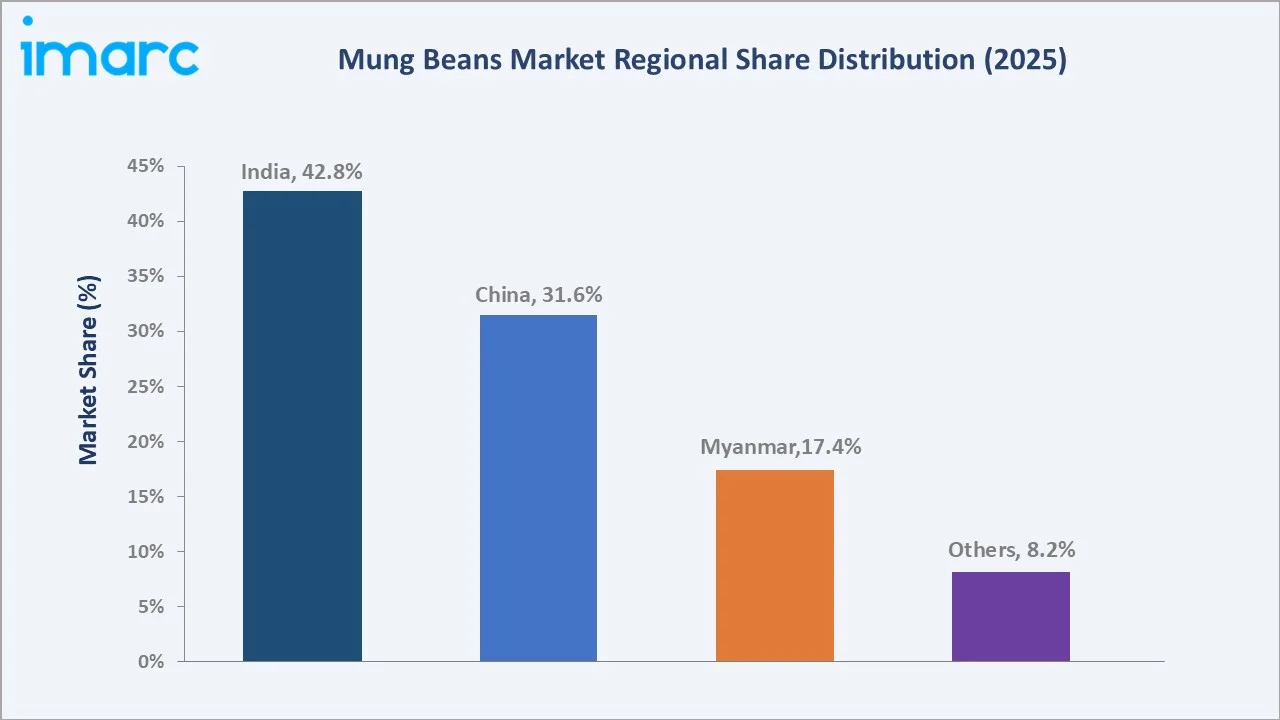
China, at 31.6%, reflects large-scale farming combined with an established processing industry converting mung beans into starch, noodles, and packaged foods.
Myanmar, at 17.4%, remains a key export-oriented producer supplying India and China. The Others category, at 8.2%, reflects smaller but steadily growing demand pockets across the rest of Asia, the Middle East, and other importing markets.
Competitive Landscape
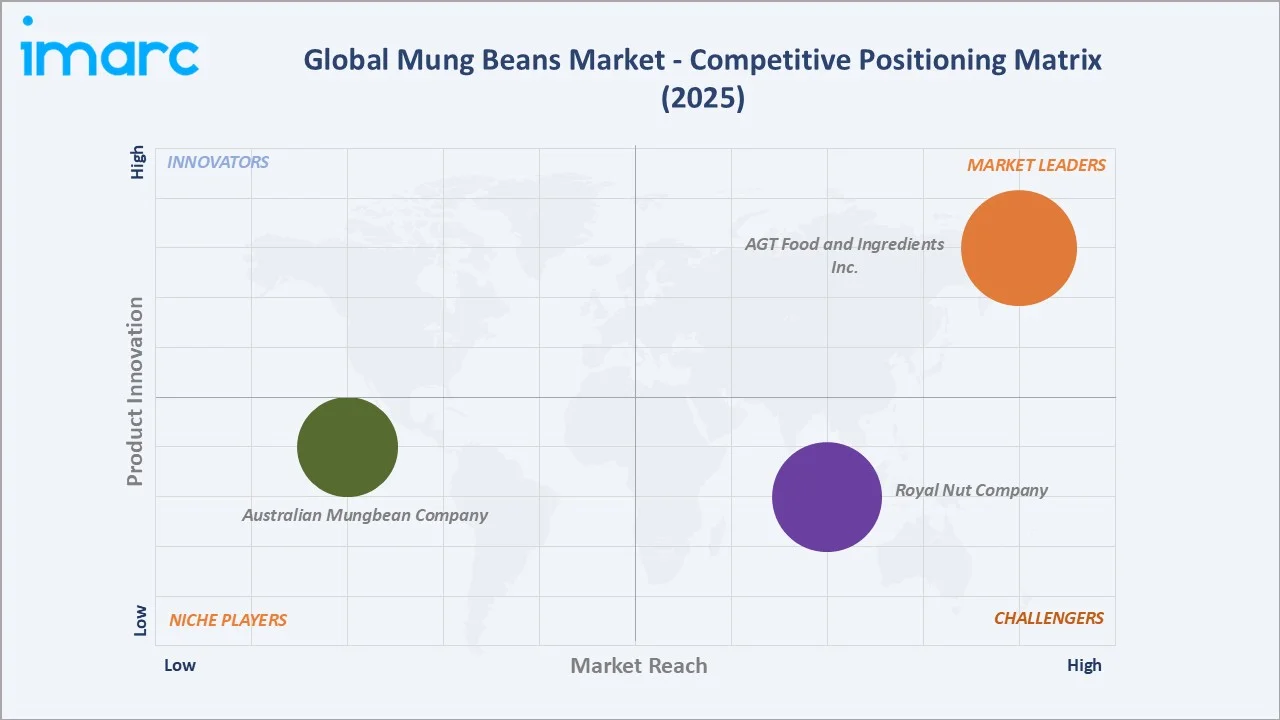
The global mung beans market is fragmented, comprising diversified global agri-food trading houses, regional pulse specialists, and export-focused processors across the leading producing countries.
|
Company Name |
Key Products |
Market Position |
Core Strength |
|
AGT Food and Ingredients Inc. |
Whole mung beans, split pulses |
Market Leader |
Global pulse sourcing, processing, and distribution network |
|
Australian Mungbean Company |
Whole and processed mung beans |
Niche Specialist |
Specialist mung bean sourcing and export from Australia |
|
Royal Nut Company |
Processed mung beans, snacks |
Strong Challenger |
Value-added processed pulse and snack product portfolio |
Key players include AGT Food and Ingredients Inc., Australian Mungbean Company, Royal Nut Company, and others.
Key Company Profiles
AGT Food and Ingredients Inc.
AGT Food and Ingredients Inc. is a Canada-based global agri-food company with a diversified presence in pulse sourcing, processing, and value-added ingredient manufacturing, including mung beans.
- Key Products: Whole mung beans, split mung dal, and pulse-based ingredients.
- Strategic Focus: Continued expansion of processing capacity and pulse ingredient product lines to serve global food manufacturers. The company is deepening investment in advanced pulse processing technology to improve product consistency, yield recovery, and ingredient functionality for food manufacturing customers. It is also broadening its global sourcing footprint to strengthen supply chain resilience across key producing regions.
Royal Nut Company
Royal Nut Company is an Australia-based processed food company with a growing presence in the mung beans market through its value-added pulse and snack product portfolio. Additionally, Royal Nut Company continues to build closer sourcing partnerships with regional pulse suppliers to ensure consistent raw material quality and supply reliability.
- Key Products: Processed mung beans, snacks
- Strategic Focus: Expanding value-added, ready-to-eat mung bean snack offerings to capture rising demand from health-conscious retail and export consumers. The company is investing in product innovation to diversify its snack portfolio across flavoured, roasted, and seasoned mung bean formats. It is also strengthening quality control and packaging standards to support wider retail distribution and export competitiveness.
Market Concentration Analysis
The mung beans market remains fragmented at the global processing and trading level, with leading players competing alongside a large base of regional mills and smallholder-linked aggregators across India, China, and Myanmar.
Investment & Growth Opportunities
Highest Growth Segments
India's pulse cultivation expansion (~3.1% CAGR, est.), value-added mung bean protein and flour formats, and export-oriented processing in Myanmar represent the highest-growth investment vectors through 2034.
Investment Themes
- Post-Harvest Infrastructure Development: Investment in modern storage, grading, and processing infrastructure across smallholder-dominated producing regions can reduce post-harvest losses and improve export competitiveness.
- Value-Added Product Manufacturing: Building capacity for mung bean protein isolate, flour, and sprouted snack products can capture rising demand from the plant-based food industry.
Future Market Outlook (2026-2034)
The global mung beans market is projected to grow from USD 4.62 Billion in 2025 to USD 4.77 Billion in 2026, reaching USD 5.90 Billion by 2034, delivering a 2.68% CAGR over the forecast period. Growth will be shaped by continued government support for pulse cultivation in India, steady processing-led demand in China, and sustained export-oriented supply from Myanmar, alongside gradual gains from plant-based protein applications and value-added processed mung bean products.
Research Methodology
Primary Research
Primary research comprised structured interviews with industry stakeholders, including pulse farmers, traders, dal mill operators, exporters, and food manufacturers across key producing and importing regions.
Secondary Research
Secondary research encompassed government agricultural statistics, pulse trade body reports, company disclosures, and international trade databases covering production, consumption, and export-import trends.
Forecasting Models
Market forecasts were developed using a bottom-up model incorporating regional cultivation area, yield trends, domestic consumption patterns, and trade flow projections across the historical and forecast periods.
Frequently Asked Questions About the Mung Beans Market Report
The global mung beans market size is estimated at USD 4.77 Billion in 2026, led by India at 42.8% share, followed by China at 31.6% and Myanmar at 17.4%.
The market is projected to grow at a 2.68% CAGR during 2026-2034, reaching USD 5.90 Billion by 2034.
India leads at 42.8% share in 2025, supported by the largest cultivation base and strong domestic consumption.
Leading companies include AGT Food and Ingredients Inc., Australian Mungbean Company, Royal Nut Company, and others.
Rising demand for plant-based protein, growth in sprouting and processed food use, government support for pulse cultivation, and expanding export demand are key drivers.
Key opportunities include post-harvest infrastructure development and value-added mung bean protein and processed product manufacturing.
Need more help?
- Speak to our experienced analysts for insights on the current market scenarios.
- Include additional segments and countries to customize the report as per your requirement.
- Gain an unparalleled competitive advantage in your domain by understanding how to utilize the report and positively impacting your operations and revenue.
- For further assistance, please connect with our analysts.
 Request Customization
 Speak to an Analyst
 Request Brochure
 Inquire Before Buying
Benefits of Customization
- Personalize this research
- Triangulate with your data
- Get data as per your format and definition
- Gain a deeper dive into a specific application, geography, customer, or competitor
- Any level of personalization
Get in Touch With Us
UNITED STATES
Phone: +1-201-971-6302
INDIA
Phone: +91-120-433-0800
UNITED KINGDOM
Phone: +44-753-714-6104
Email: [email protected]
Client Testimonials




.webp)




.webp)













Related Reports

Choose your plan
*Please note that the prices mentioned below are starting prices for each bundle type. Kindly contact our team for further details.*
Single User License
- 1 User License, Access on 2 Devices
- PDF Report + Excel Dataset (Password Protected)
- Lifetime Access
- No Printing Rights
- 10% Free Report Customization
- 10–12 Weeks of Analyst Support
Five User License
- Access for 5 Users, 2 Devices per User
- PDF Report + Excel Dataset (Password Protected)
- Lifetime Access
- Dedicated Account Manager
- 12–14 Weeks of Analyst Support
- No Printing Rights
- 15% Free Report Customization
- 25% Discount on Your Next Purchase
Corporate User License
- Unlimited User Access (Within Your Organization)
- PDF Report + Excel Dataset
- Lifetime Access
- Dedicated Account Manager
- 14–20 Weeks of Analyst Support
- No Printing Rights
- 20% Free Report Customization
- 30% Discount on Your Next Purchase
Essential Insights
What's included:
3 reports
- Lifetime Access
- PDF Reports
- Excel Datasets
- 2 Weeks of Free Analyst Support
- 2 User Licenses
- Access on 2 Devices
- Printing Rights
- Complimentary PowerPoint (PPT) Version
- Complimentary License Upgrade
Professional Access
What's included:
5 reports
- Lifetime Access
- PDF Reports
- Excel Datasets
- 8 Weeks of Free Analyst Support
- 2 User Licenses
- Access on 2 Devices
- Printing Rights
- Complimentary PowerPoint (PPT) Version
- Complimentary License Upgrade
Business Advantage
What's included:
8 reports
- Lifetime Access
- PDF Reports
- Excel Datasets
- 14 Weeks of Free Analyst Support
- 2 User Licenses
- Access on 2 Devices
- Printing Rights
- Complimentary PowerPoint (PPT) Version
- Complimentary License Upgrade
Enterprise Intelligence
What's included:
10 reports
- Lifetime Access
- PDF Reports
- Excel Datasets
- 20 Weeks of Free Analyst Support
- 2 User Licenses
- Access on 2 Devices
- Printing Rights
- Complimentary PowerPoint (PPT) Version
- Complimentary License Upgrade