
Premium Messaging Market Size, Share, Trends and Forecast by Type, Tools, End User, and Region, 2026-2034
Premium Messaging Market Size, Share, Trends & Forecast (2026-2034)
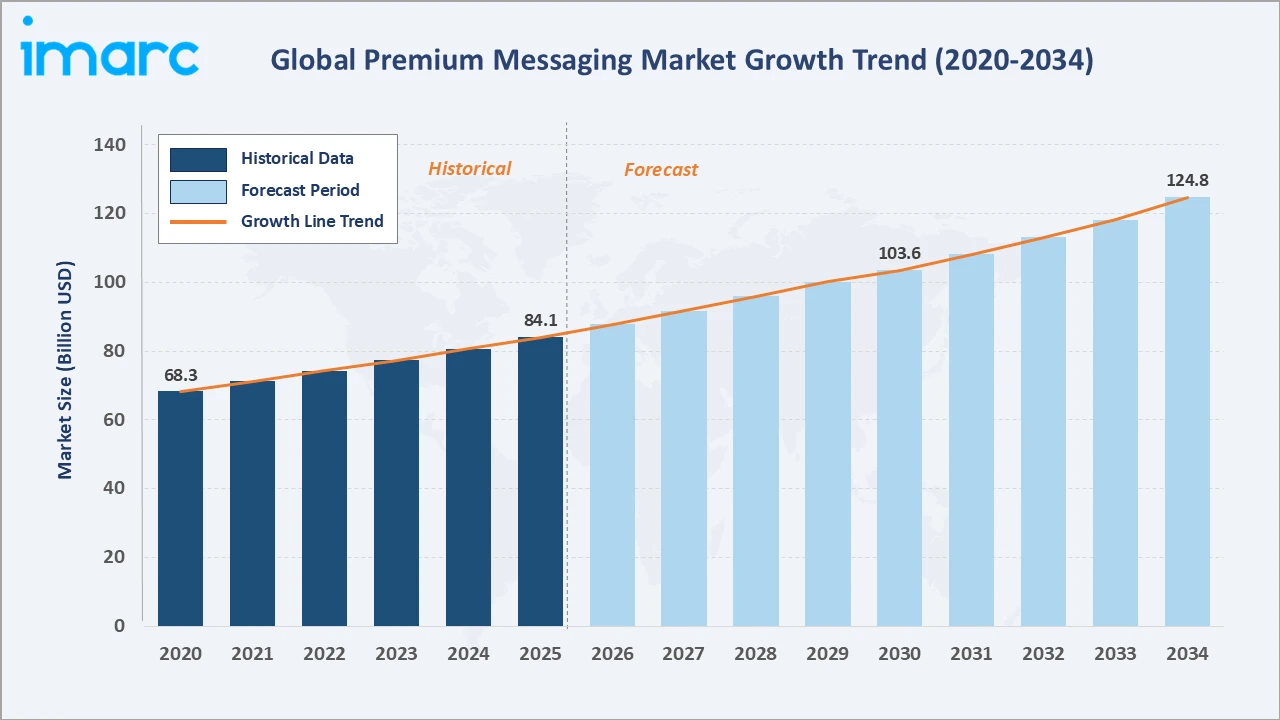
The global premium messaging market reached USD 84.1 Billion in 2025 and is projected to reach USD 124.8 Billion by 2034, growing at a CAGR of 4.26% during 2026-2034. The market is driven by rising enterprise adoption of A2P messaging for customer engagement, growth of digital payment authentication, and expanding e-commerce driving transactional SMS demand. The expansion of e-commerce, digital identity solutions, and the gig and creator economies collectively accounts for approximately USD 6.8 trillion in global payment volumes. This growing digital transaction ecosystem is driving the premium messaging market by increasing demand for secure, real-time communication for payment confirmations, authentication codes, fraud alerts, transaction updates, and customer engagement. P2A messaging leads type at 58.3%. BFSI leads end users at 24.8%. North America leads regionally at 34.8%.
Market Snapshot
|
Metric |
Value |
|
Market Size (2025) |
USD 84.1 Billion |
|
Forecast Market Size (2034) |
USD 124.8 Billion |
|
CAGR (2026-2034) |
4.26% |
|
Base Year |
2025 |
|
Historical Period |
2020-2025 |
|
Forecast Period |
2026-2034 |
|
Dominant Type |
P2A Messaging (58.3%, 2025) |
|
Dominant End User |
BFSI (24.8%, 2025) |
|
Leading Region |
North America (34.8%, 2025) |
The global premium messaging market has demonstrated steady growth, increasing from USD 68.3 Billion in 2020 to USD 84.1 Billion in 2025, reflecting sustained enterprise demand for authenticated, transactional, and promotional messaging. The market is projected to reach USD 103.6 Billion by 2030 and further grow to USD 124.8 Billion by 2034, supported by expanding CPaaS platform adoption, RCS Business Messaging rollout, and AI-powered messaging personalization.
To get more information on this market, Request Sample
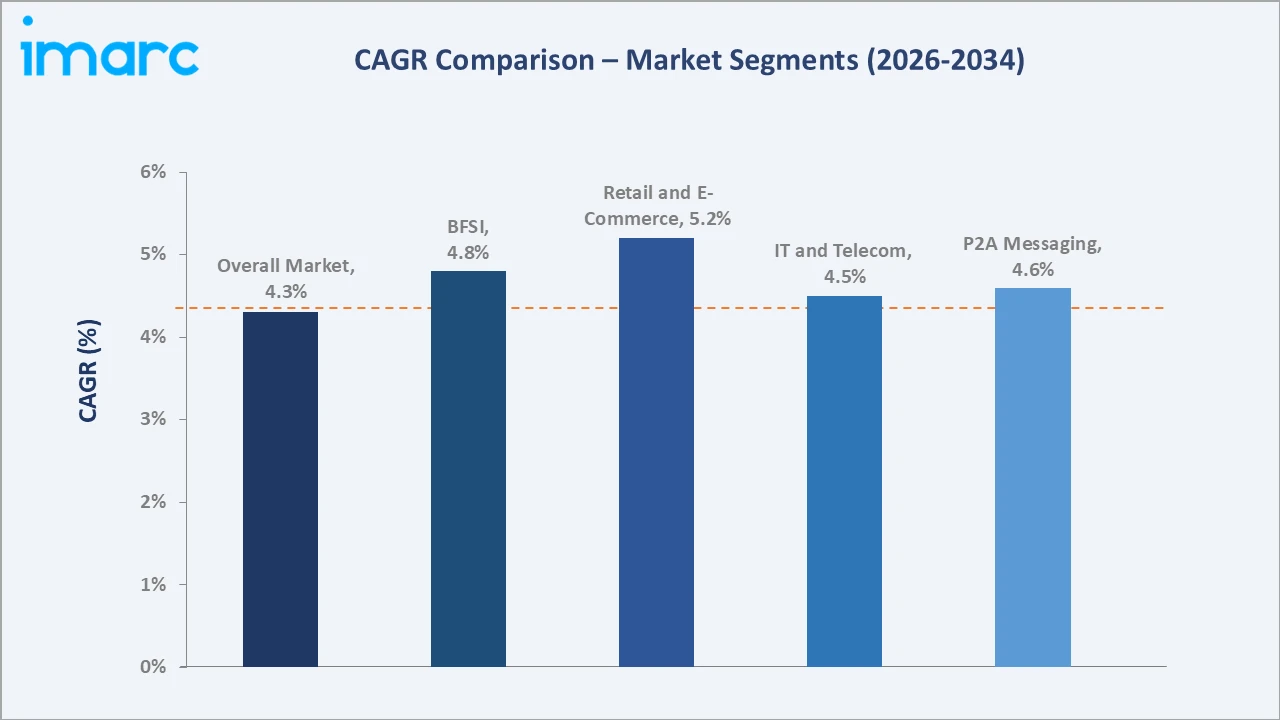
Retail & e-commerce grows fastest at ~5.2% CAGR through transactional alerts and promotional messaging integration. BFSI leads at ~4.8% CAGR through OTP authentication and fraud alert demand. P2A messaging grows at ~4.6% CAGR through customer-initiated enterprise interaction expansion.
Executive Summary
The global premium messaging market is witnessing steady growth, supported by rising enterprise demand for authenticated business messaging, expanding digital payment ecosystems requiring OTP verification, and the rapid adoption of CPaaS (Communications Platform as a Service) solutions.
Growing deployment of A2P and P2A messaging across BFSI, retail, healthcare, and government sectors is strengthening the market's position as a critical enterprise communication infrastructure layer. P2A messaging at 58.3% leads through customer-initiated interaction channels. BFSI at 24.8% leads end users through OTP and fraud alert volumes. North America leads regionally at 34.8%.
Key Market Insights
|
Insight |
Data |
|
Dominant Type |
P2A Messaging – 58.3% share (2025) |
|
Leading End User |
BFSI – 24.8% market share (2025) |
|
Leading Region |
North America – 34.8% share (2025) |
|
Market Opportunity |
RCS Business Messaging expansion; AI-powered conversational messaging; CPaaS platform adoption; OTP authentication demand; omnichannel enterprise communication integration |
Key Analytical Observations Supporting the Above Data:
- P2A Messaging at 58.3%: P2A (Person-to-Application) messaging dominates as it enables consumers to initiate interactions with enterprise applications, including customer service requests, balance inquiries, appointment bookings, and loyalty program queries, through standard SMS channels.
- BFSI at 24.8%: BFSI dominates end users due to the sector's intensive use of premium messaging for OTP authentication, transaction alerts, fraud notifications, account statements, and KYC verification. Regulatory mandates for two-factor authentication across banking and payments in major markets drive consistently high BFSI messaging volumes, making it the largest and most recurring premium messaging end-user segment.
- North America at 34.8%: North America leads regionally due to its mature enterprise messaging infrastructure, high smartphone penetration, large BFSI and retail sectors with intensive OTP and transactional messaging requirements, and early adoption of CPaaS and cloud API messaging platforms.
Premium Messaging Market Overview
The global premium messaging market encompasses commercial messaging services exchanged between enterprises and consumers or between consumers and enterprise applications through network operator infrastructure. It includes A2P (Application-to-Person) messaging, where enterprise applications send messages to end users, and P2A (Person-to-Application) messaging, where consumers initiate interactions with enterprise platforms. The market covers transactional messages (OTPs, alerts, notifications), promotional messages (marketing campaigns, offers), and conversational messages (chatbot interactions, customer service). It serves enterprise clients across BFSI, retail, healthcare, government, IT, telecom, and media sectors. The market spans cloud API messaging platforms, traditional managed messaging services, and emerging RCS business messaging infrastructure. Growing adoption of CPaaS, AI-driven message personalization, and omnichannel communication strategies are expanding the scope and value of premium messaging solutions globally.
Market Dynamics
To evaluate market opportunities, Request Sample
Market Drivers
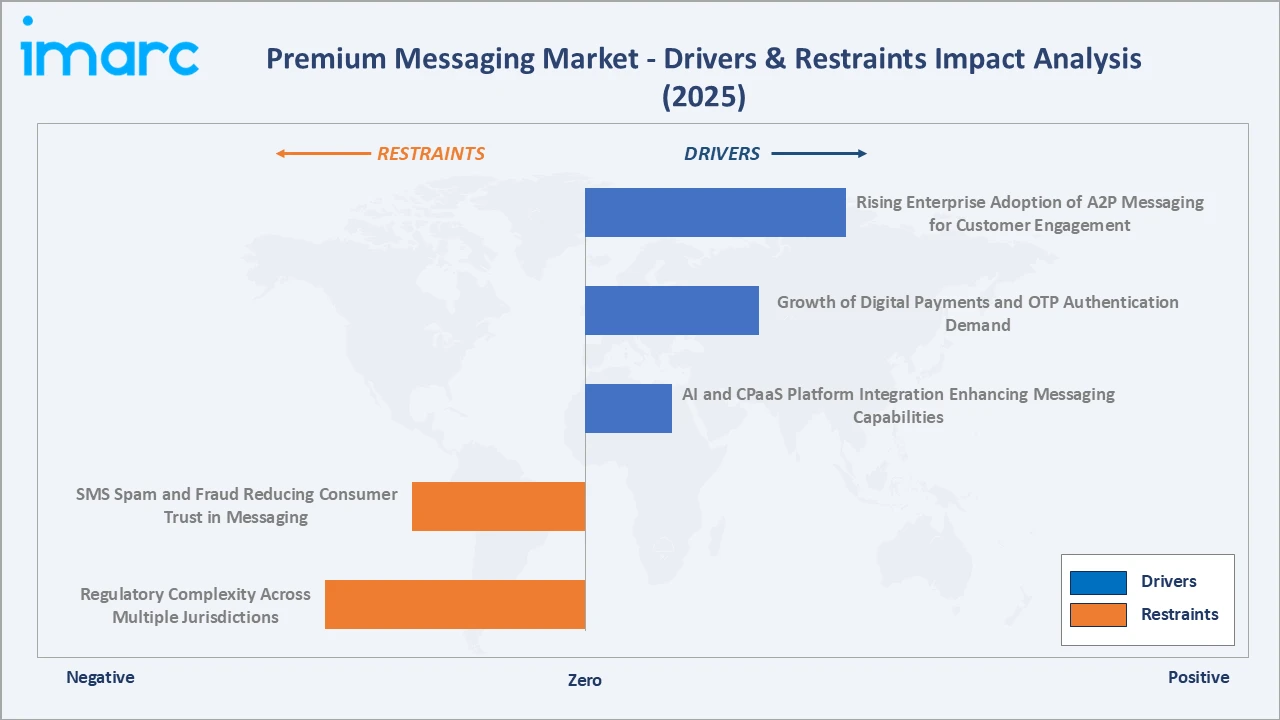
- Rising Enterprise Adoption of A2P Messaging for Customer Engagement: Enterprise adoption of A2P messaging for OTP authentication, transaction confirmations, delivery notifications, and promotional campaigns is expanding across BFSI, retail, and logistics sectors. Approximately 90% of A2P messages are opened and read within just three minutes of delivery, driven by digital service proliferation and the critical role of SMS in two-factor authentication workflows across banking and e-commerce platforms.
- Growth of Digital Payments and OTP Authentication Demand: The rapid expansion of digital payment platforms, mobile banking apps, and e-wallet services is driving strong and sustained demand for OTP-based two-factor authentication messaging. Regulatory mandates for strong customer authentication (SCA) and multi-factor authentication requirements across major banking jurisdictions are embedding SMS OTP as a recurring, high-volume messaging use case with strong revenue visibility.
- AI and CPaaS Platform Integration Enhancing Messaging Capabilities: The integration of AI and machine learning into CPaaS messaging platforms is enabling dynamic message personalization, predictive send-time optimization, conversational chatbot deployment, and real-time sentiment analysis. In February 2024, Sinch India launched Sinch Trust, a platform designed to strengthen transparency, accountability, and reliability in business messaging. As enterprises increasingly use SMS for marketing, customer engagement, alerts, and notifications through CPaaS providers and messaging aggregators, visibility across the delivery chain remains a key concern.
Market Restraints
- SMS Spam and Fraud Reducing Consumer Trust in Messaging: Rising volumes of SMS phishing (smishing), spoofed sender IDs, and fraudulent OTP interception are undermining consumer trust in premium messaging channels. Scams, including network attacks, fraud, phishing, and social engineering, cause over USD 1 trillion in global losses, driving regulatory pressure for tighter sender verification and increasing enterprise compliance costs for maintaining messaging channel trust and deliverability.
- Regulatory Complexity Across Multiple Jurisdictions: Premium messaging operators must navigate a complex and fragmented regulatory landscape spanning numerous national telecom regulatory frameworks. Inconsistent sender ID registration requirements, message content restrictions, and opt-in/opt-out mandates across jurisdictions increase compliance overhead for global enterprise messaging deployments and limit standardized platform rollout.
Market Opportunities
- RCS Business Messaging Commercial Rollout: Rich Communication Services (RCS) business messaging represents a significant upgrade path from SMS. RCS enables branded, interactive messaging with images, buttons, and verified sender identity. As RCS reaches critical mass across Android devices in 2024-2026, enterprise messaging platforms stand to capture premium pricing for advanced messaging formats.
- Conversational Commerce and AI Chatbot Integration: The convergence of messaging platforms with conversational AI is enabling enterprises to conduct end-to-end commerce, product discovery, purchase completion, and post-sale support through messaging interfaces. WhatsApp Business API, RCS chatbots, and SMS-triggered conversational workflows are creating new high-value messaging revenue streams beyond traditional transactional and promotional use cases.
Market Challenges
- OTT Messaging Platform Competition: Free over-the-top messaging platforms including WhatsApp, iMessage, and more are capturing consumer communication volumes that would otherwise generate SMS revenue for network operators and premium messaging aggregators. The migration of consumer messaging to OTT platforms is constraining P2P SMS revenue while shifting enterprise messaging investment toward OTT business APIs and multichannel platform providers.
- Message Routing Quality and Gray Route Arbitrage: Gray route messaging, where messages are routed through unofficial channels to avoid operator interconnect fees, undermines legitimate premium messaging revenue and creates quality of service inconsistencies.
Emerging Market Trends
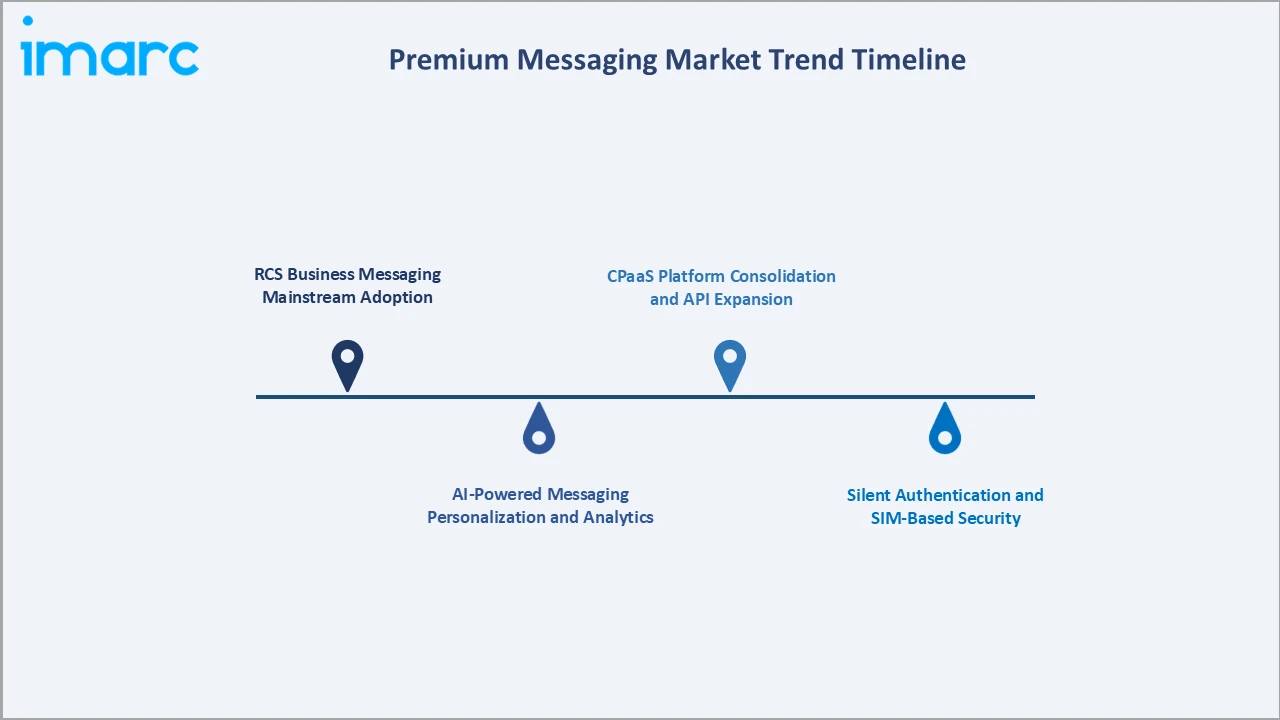
1. RCS Business Messaging Mainstream Adoption
Infobip reported a 108% increase in RCS interactions in India between H1 2025 and H1 2026, highlighting the rapid adoption of richer, more interactive business messaging across the country’s large smartphone user base. Rich Communication Services (RCS) business messaging enables enterprise messaging with branded sender verification, high-resolution media, interactive buttons, and read receipts, capabilities unavailable in standard SMS.
2. AI-Powered Messaging Personalization and Analytics
AI and machine learning are transforming enterprise messaging from batch-send broadcast models to intelligent, personalized communication. AI-powered send-time optimization, content personalization based on behavioral data, and predictive engagement scoring are enabling enterprises to significantly improve messaging ROI. Leading CPaaS platforms are embedding AI analytics dashboards and A/B testing tools directly into their messaging APIs, democratizing advanced messaging optimization for mid-market enterprises.
3. CPaaS Platform Consolidation and API Expansion
The CPaaS (Communications Platform as a Service) market is undergoing rapid consolidation, with leading providers expanding their API portfolios through acquisitions and organic development. In January 2026, Dove Soft Limited launched CPaaS 2.0, an AI-powered platform that integrates WhatsApp, SMS, RCS, Instagram, Voice, Email, and AI bots into a unified communication ecosystem. The platform uses a single wallet and centralized dashboard to simplify billing, improve transparency, and help enterprises automate and scale customer engagement. This consolidation is creating enterprise-friendly single-vendor communication stacks and increasing switching costs for enterprise clients.
4. Silent Authentication and SIM-Based Security
Silent authentication technologies, where network operators verify user identity at the SIM level without requiring an OTP message to be delivered and entered, are emerging as a higher-security, lower-friction alternative to SMS OTP for authentication use cases.
Industry Value Chain Analysis
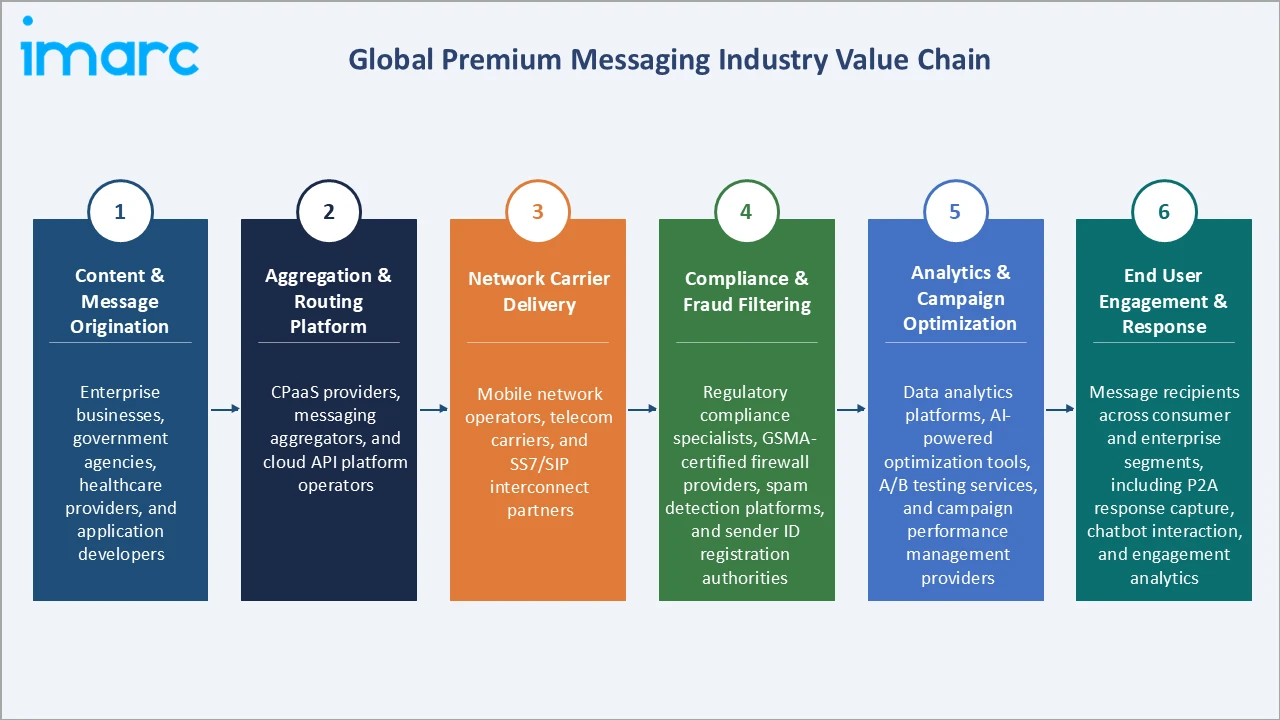
The premium messaging value chain integrates content origination, message aggregation and routing, network carrier delivery, compliance and fraud filtering, analytics and optimization, and end-user engagement and response.
|
Stage |
Key Participants |
|
Content & Message Origination |
Enterprise businesses, government agencies, healthcare providers, and application developers. |
|
Aggregation & Routing Platform |
CPaaS providers, messaging aggregators, and cloud API platform operators. |
|
Network Carrier Delivery |
Mobile network operators, telecom carriers, and SS7/SIP interconnect partners. |
|
Compliance & Fraud Filtering |
Regulatory compliance specialists, GSMA-certified firewall providers, spam detection platforms, and sender ID registration authorities. |
|
Analytics & Campaign Optimization |
Data analytics platforms, AI-powered optimization tools, A/B testing services, and campaign performance management providers. |
|
End User Engagement & Response |
Message recipients across consumer and enterprise segments, including P2A response capture, chatbot interaction, and engagement analytics. |
The aggregation and routing platform represents the most value-added stage in the premium messaging value chain, as it directly determines message deliverability, routing cost optimization, compliance management, and analytics quality. This phase encompasses protocol conversion, intelligent routing, sender ID management, and real-time fraud filtering, making it the most technically complex and commercially critical segment.
Technology Landscape in the Premium Messaging Industry
Cloud API Messaging Platforms
Cloud API messaging platforms enable enterprise developers to integrate premium messaging capabilities through simple REST APIs without managing telecom infrastructure. CPaaS providers offer multi-carrier routing, global number provisioning, and real-time delivery analytics through unified API surfaces. The cloud API model has democratized enterprise messaging, enabling startups and enterprises alike to deploy sophisticated messaging workflows within hours of API key provisioning.
RCS (Rich Communication Services) Infrastructure
RCS business messaging infrastructure is being actively deployed by major mobile network operators globally. RCS enables enterprise messaging with brand verification, rich media (images, carousels, video), interactive action buttons, and conversational chatbot integration, all delivered over operator networks with delivery guarantees superior to OTT alternatives.
Traditional and Managed Messaging Services
Traditional managed messaging services, including legacy SS7-based SMS infrastructure, SMPP-connected aggregators, and hosted messaging bureau services, continue to serve enterprise clients with specific compliance, latency, or geographic requirements that cloud-native platforms cannot fully address. These services remain particularly relevant in emerging markets with limited cloud API infrastructure and for enterprises in regulated industries requiring on-premises or managed service deployment models.
Market Segmentation Analysis
The report covers the following segments:
|
Segment Category |
Leading Segment |
Market Share |
Year |
|
Type |
P2A Messaging |
58.3% |
2025 |
|
Tools |
🔒 |
🔒 |
2025 |
|
End User |
BFSI |
24.8% |
2025 |
|
Region |
North America |
34.8% |
2025 |

By Type
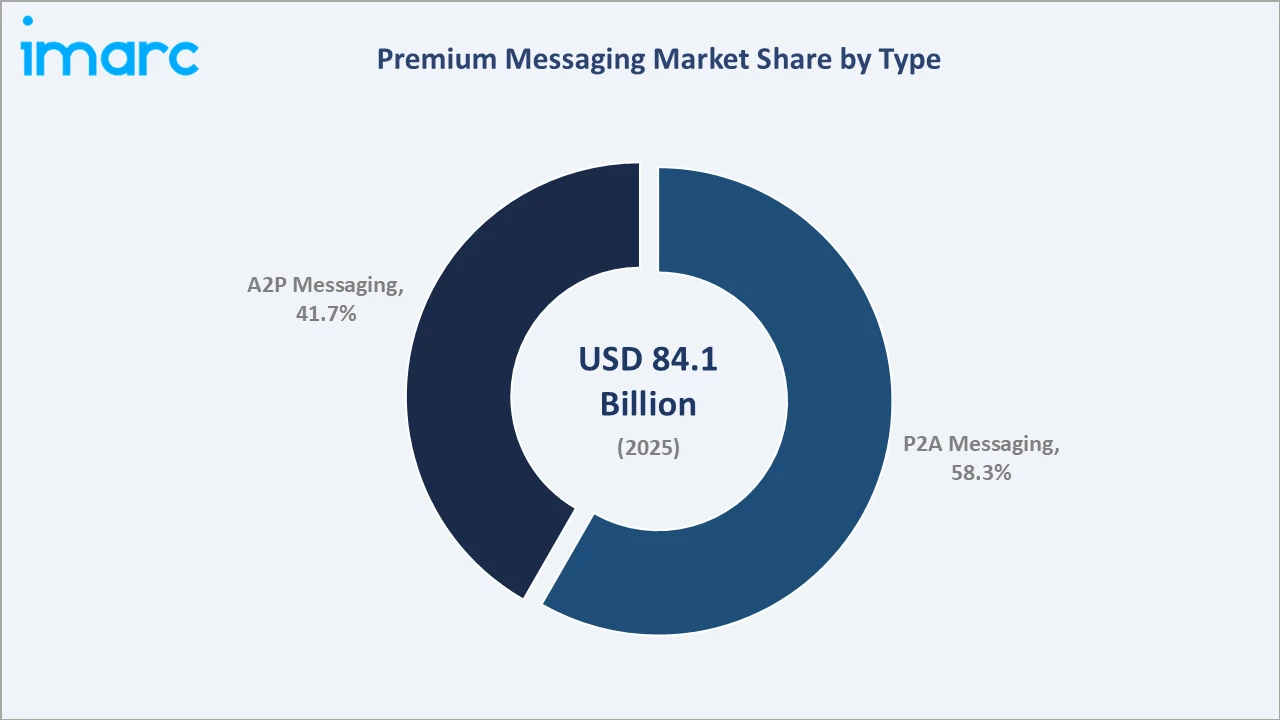
P2A messaging leads at 58.3% (2025), reflecting the dominance of consumer-initiated messaging interactions with enterprise applications, including customer service requests, balance inquiries, subscription management, and appointment bookings. P2A's two-way interaction capability and high consumer engagement make it the preferred premium messaging type for enterprises focused on customer experience optimization and self-service automation.
To access detailed market analysis, Request Sample
A2P messaging accounts for 41.7% (2025), representing application-initiated messaging including OTP authentication, transaction alerts, promotional campaigns, and automated notifications. While P2A leads by share, A2P maintains the highest absolute message volume, driven by the massive scale of OTP and transactional messaging requirements across BFSI, e-commerce, and healthcare enterprise workflows.
By End User
BFSI leads at 24.8% (2025), driven by intensive use of premium messaging for OTP authentication, transaction confirmations, fraud alerts, account balance notifications, and KYC verification. Regulatory mandates for two-factor authentication across banking jurisdictions drive consistent, high-volume BFSI messaging demand that is relatively insensitive to economic cycles, providing stable revenue visibility for premium messaging operators.
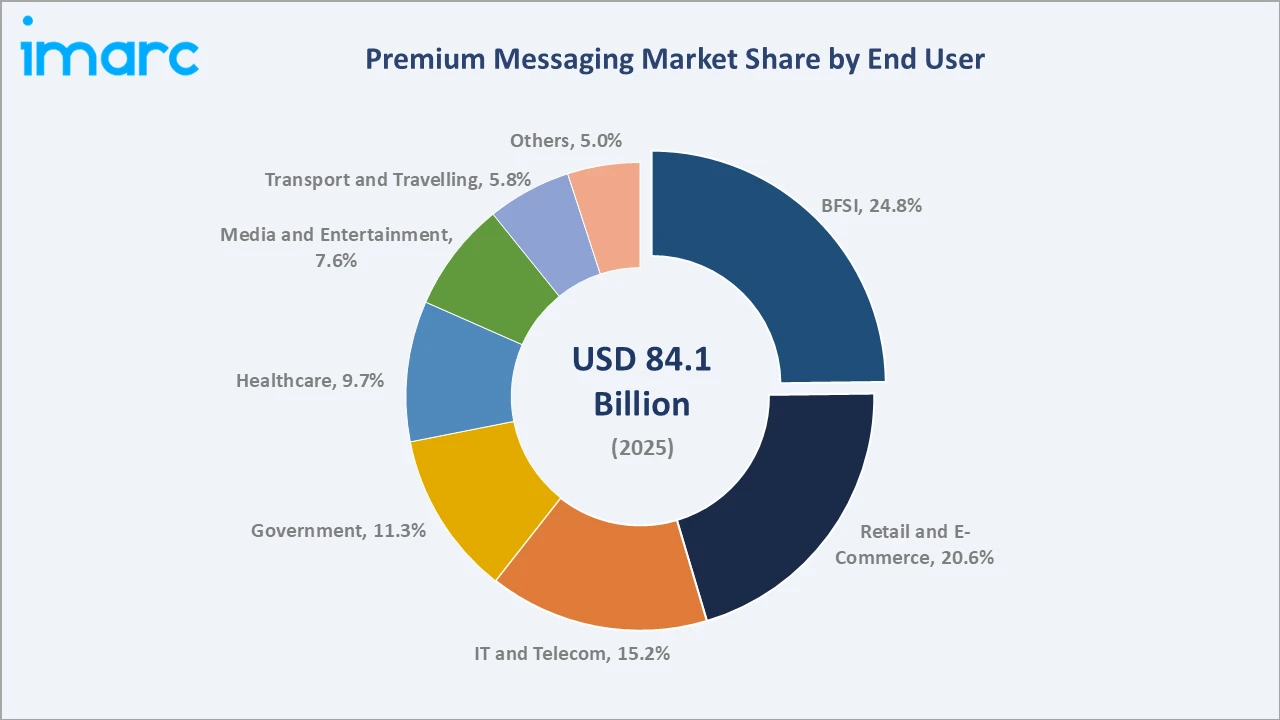
Retail and e-commerce hold 20.6% (2025) as the second-largest end user, driven by order confirmations, shipping updates, promotional campaigns, and abandoned cart recovery messaging. IT and telecom accounts for 15.2%, followed by government at 11.3%, healthcare at 9.7%, media and entertainment at 7.6%, transport and travelling at 5.8%, and others at 5.0%.
Regional Market Insights
|
Region |
Share (2025) |
Key Premium Messaging Market Drivers & Characteristics |
|
North America |
34.8% |
Largest regional market driven by mature enterprise messaging infrastructure, intensive BFSI and e-commerce OTP requirements, high CPaaS platform adoption, and regulated commercial messaging frameworks supporting premium sender verification. |
|
Asia-Pacific |
31.6% |
Fastest-growing region with the highest A2P message volumes globally, driven by large mobile subscriber bases in China, India, and Southeast Asia, rapid digital payment ecosystem growth, and expanding enterprise digital transformation investments. |
|
Europe |
21.9% |
Strong market driven by stringent compliance requirements mandating explicit opt-in for commercial messaging, high RCS business messaging adoption among major operators, and mature BFSI and e-commerce sectors with intensive transactional messaging requirements. |
|
Latin America |
6.4% |
Growing market with expanding mobile banking and e-commerce penetration driving OTP and transactional messaging volumes; Brazil and Mexico represent the largest national markets; increasing CPaaS platform adoption among regional enterprise clients. |
|
Middle East and Africa |
5.3% |
Emerging market with growing enterprise messaging adoption in UAE, Saudi Arabia, and South Africa; expanding financial inclusion through mobile money platforms driving OTP messaging demand; government digital service initiatives supporting citizen messaging volumes. |
North America's 34.8% dominance reflects the region's mature enterprise communication infrastructure, high-value BFSI and retail messaging programs, and early CPaaS platform adoption by leading technology companies. Asia-Pacific's 31.6% positions it as the fastest-growing region, with India and China contributing the largest A2P message volumes globally due to their large mobile subscriber bases and rapidly expanding digital payment and e-commerce ecosystems.
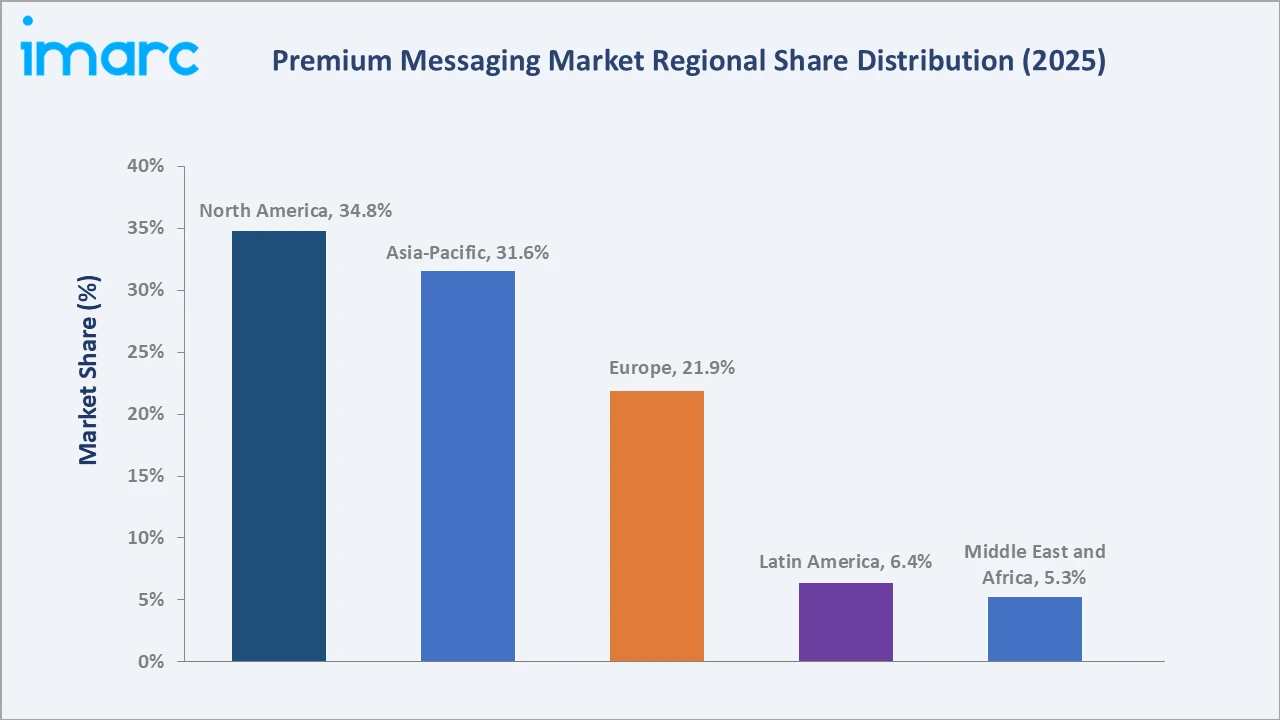
Europe's 21.9% is characterized by messaging quality standards that favor premium, consent-based communication over bulk SMS approaches, supporting higher per-message revenue for compliant enterprise senders. Latin America at 6.4% and Middle East and Africa at 5.3% represent growing markets with increasing enterprise messaging adoption, supported by expanding mobile financial services, e-commerce, and government digital service deployment.
Competitive Landscape
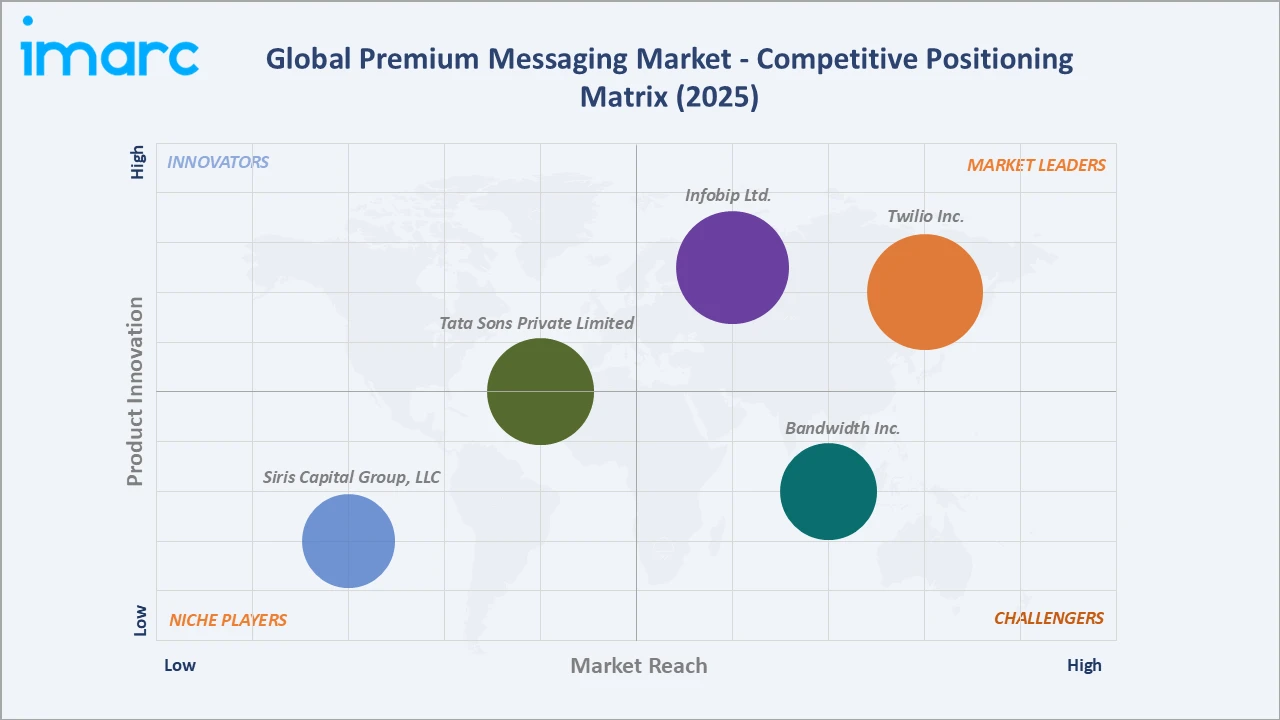
The global premium messaging market is moderately concentrated, with a mix of specialist CPaaS providers, telecom operators with messaging platforms, and enterprise communication technology companies. Market participants compete on global network coverage, API reliability and latency, pricing transparency, multi-channel platform capabilities, compliance tooling, and analytics depth. RCS business messaging readiness, AI-powered messaging optimization, and enterprise customer success programs are emerging as key competitive differentiators.
|
Company |
Key Offerings |
Market Position |
Core Strength |
|
Twilio Inc. |
API, SMS, WhatsApp, Facebook, Messenger for Business, MMS, Chat, RCS Business Messaging, Apple Messages for Business |
Market Leader |
Twilio Inc. powers premium messaging by providing robust APIs that allow businesses to send and receive high-value, rich interactive messages. |
|
Infobip Ltd. |
SMS, RCS, Email, MMS, Live Chat, In-app messaging, WhatsApp, Viber for Business, Messenger, Instagram, Telegram, Apple Messages for Business |
Market Leader |
Infobip Ltd. is a global cloud communications platform that connects businesses with customers through seamless, secure messaging. |
|
Tata Sons Private Limited |
WhatsApp, RCS, SMS, MMS, Premium SMS, Video, Email, Chatbots |
Established Player |
Through its acquisition of Kaleyra, Tata Communications offers a full suite of cloud-based premium messaging solutions. |
|
Siris Capital Group, LLC |
RCS Business Messaging, Campaign Manager, Templated Chatbots, A Visual Conversational Flow Builder, Payment Integrations, Advanced Analytics, Multiple Channel Connectors |
Niche Player |
Through Mavenir, Siris plays a key role in the evolution of premium business messaging by helping telecom operators modernize their networks. |
|
Bandwidth Inc. |
SMS, MMS, RCS |
Challenger |
Bandwidth Inc. acts as a global cloud communications infrastructure provider, with a primary role in premium messaging such as A2P SMS, MMS, and Rich Communication Services/RCS. |
Companies are also investing in RCS business messaging platform development, AI-powered analytics, omnichannel API expansion, and direct operator network partnerships to improve messaging deliverability and enterprise platform stickiness. The market is expected to see further consolidation through CPaaS platform acquisitions and operator-aggregator partnership agreements as leading providers seek global network coverage and enterprise platform breadth.
Key Company Profiles
Twilio Inc.
Twilio is the leading CPaaS provider, offering a comprehensive cloud communications platform that enables enterprises to build messaging, voice, video, and email capabilities through developer-friendly APIs. Twilio's Messaging API serves a high number of active enterprise customers globally, processing billions of A2P and P2A messages monthly across SMS, WhatsApp Business, and RCS channels.
- Key Offerings: API, SMS, WhatsApp, Facebook, Messenger for Business, MMS, Chat, RCS Business Messaging, Apple Messages for Business.
- Strategic Focus: AI-powered messaging personalization through Segment integration, RCS Business Messaging enterprise rollout, developer ecosystem expansion through startup credits and certification programs, enterprise customer success investment for account retention.
Infobip Ltd.
Infobip is a full-stack omnichannel CPaaS provider with a proprietary global messaging network spanning direct connections to network operators. Unlike API-first CPaaS providers, Infobip operates its own telecom infrastructure, enabling enterprise-grade SLA guarantees and superior deliverability. The company's Conversations customer engagement platform and chatbot builder position it as a comprehensive enterprise CX platform provider beyond messaging API provision.
- Key Offerings: SMS, RCS, Email, MMS, Live Chat, In-app messaging, WhatsApp, Viber for Business, Messenger, Instagram, Telegram, Apple Messages for Business.
- Strategic Focus: Full-stack omnichannel platform differentiation, direct network infrastructure investment for deliverability leadership, enterprise CX platform expansion beyond messaging into customer journey orchestration, emerging market CPaaS network development.
Market Concentration Analysis
The global premium messaging market is moderately concentrated, with the top five players, Twilio Inc., Infobip Ltd., Tata Sons Private Limited, Siris Capital Group, LLC, and Bandwidth Inc., collectively estimated to account for approximately 45-55% of total global premium messaging platform revenue in 2025. Telecom operators command significant revenue shares within their domestic markets through direct network OTP and A2P messaging delivery, while specialist CPaaS providers capture the majority of cloud API messaging platform revenue globally.
Fragmentation persists across geographic regions, enterprise vertical specializations, and messaging channel types, creating a competitive landscape where direct carrier connections, compliance expertise, and omnichannel platform breadth determine enterprise platform selection. The market is expected to see further consolidation through CPaaS platform acquisitions and operator-aggregator partnership agreements as leading providers seek global network coverage and full omnichannel enterprise platform capability.
Investment & Growth Opportunities
Highest Growth Segments
Retail and e-commerce messaging (~5.2% CAGR), BFSI authentication messaging (~4.8% CAGR), RCS business messaging premium formats (~12%+ CAGR from emerging base), Asia-Pacific CPaaS platform expansion, and AI-powered conversational commerce messaging represent the highest-growth investment vectors through 2034.
Investment Themes
- AI-powered messaging personalization and analytics: CPaaS platforms embedding AI for send-time optimization, content personalization, and predictive engagement scoring are differentiating in an increasingly commoditized A2P SMS market. Investment in AI messaging capabilities enables premium pricing and higher enterprise account retention through measurable ROI improvement versus standard broadcast messaging.
- Asia-Pacific CPaaS infrastructure expansion: India, Indonesia, Philippines, and Vietnam represent large and fast-growing A2P messaging markets with increasing enterprise digital transformation investment. CPaaS providers establishing direct operator connections and local regulatory compliance capabilities in these markets can capture a significant share of the region's growing enterprise messaging demand.
Future Market Outlook (2026-2034)
The global premium messaging market is projected to grow from USD 84.1 Billion in 2025 to USD 124.8 Billion by 2034, delivering a 4.26% CAGR over the forecast period through enterprise A2P and P2A messaging expansion, RCS Business Messaging commercial rollout, AI-powered CPaaS platform adoption, and growing OTP authentication demand across digital payment ecosystems. The market's anchor value of USD 103.6 Billion in 2030 represents the premium messaging ecosystem at RCS mainstream adoption and AI-powered conversational messaging inflection.
Three structural forces are expected to define the growth of the global premium messaging market through 2034. First, the accelerating digital transformation of enterprise customer communication will sustain strong and growing demand for authenticated, personalized, and interactive messaging at scale, with OTP authentication, transactional alerts, and conversational commerce driving durable high-volume messaging requirements. Second, the commercial rollout of RCS business messaging across iOS and Android ecosystems will enable enterprises to deliver rich, branded, interactive messaging experiences through operator networks. Third, AI-powered CPaaS platform evolution will expand the total addressable market for premium messaging beyond transactional use cases into continuous, value-added customer engagement workflows, supporting sustained market growth through 2034.
Research Methodology
Primary Research
Primary research comprised in-depth interviews with senior executives from CPaaS platform providers, mobile network operators, enterprise messaging technology vendors, regulatory compliance specialists, and industry analysts. Discussions validated market size estimates, assessed platform adoption trends, evaluated competitive dynamics, and provided insights into regulatory developments, RCS rollout timelines, and AI messaging investment priorities across the global premium messaging market.
Secondary Research
Secondary research encompassed company financial reports, GSMA messaging industry publications, telecom statistics, operator annual reports, CPaaS platform usage data, regulatory filings, and credible technology industry analyst reports. These sources supported market trend analysis, competitive positioning assessment, regulatory framework evaluation, and regional messaging volume data across global enterprise messaging markets.
Forecasting Models
Forecasting models were developed using historical market revenue data, enterprise messaging volume growth rates, regional digitalization indicators, and macroeconomic indicators. Both top-down and bottom-up approaches were applied and validated through primary expert consultations. RCS business messaging adoption timelines, AI platform investment trajectories, regulatory framework evolution, and competitive CPaaS platform consolidation dynamics were incorporated to generate reliable forecasts through 2034.
Report Coverage:
| Report Features | Details |
|---|---|
| Base Year of the Analysis | 2025 |
| Historical Period | 2020-2025 |
| Forecast Period | 2026-2034 |
| Units | Billion USD |
| Scope of the Report |
Exploration of Historical Trends and Market Outlook, Industry Catalysts and Challenges, Segment-Wise Historical and Future Market Assessment:
|
| Types Covered | A2P Messaging, P2A Messaging |
| Tools Covered | Cloud API Messaging Platform, Traditional and Managed Messaging Services |
| End Users Covered | BFSI, Transport and Travelling, Healthcare, Media and Entertainment, Retail and E-Commerce, IT and Telecom, Government, Others |
| Regions Covered | Asia Pacific, Europe, North America, Latin America, Middle East and Africa |
| Countries Covered | United States, Canada, Germany, France, United Kingdom, Italy, Spain, Russia, China, Japan, India, South Korea, Australia, Indonesia, Brazil, Mexico |
| Companies Covered | Twilio Inc., Infobip Ltd., Tata Sons Private Limited, Siris Capital Group, LLC, Bandwidth Inc., etc. |
| Customization Scope | 10% Free Customization |
| Post-Sale Analyst Support | 10-12 Weeks |
| Delivery Format | PDF and Excel through Email (We can also provide the editable version of the report in PPT/Word format on special request) |
Frequently Asked Questions About the Premium Messaging Market Report
The global premium messaging market reached USD 84.1 Billion in 2025, driven by rising enterprise A2P messaging adoption, expanding OTP authentication requirements, and growing e-commerce transactional messaging demand. Increasing CPaaS platform adoption and AI-powered messaging capabilities are further supporting near-term market growth.
The global premium messaging market grows at a 4.26% CAGR during 2026-2034, reaching USD 124.8 Billion by 2034. The CAGR reflects steady enterprise messaging volume growth, RCS business messaging premium channel uplift, and expanding AI-powered conversational messaging use cases across BFSI, retail, and healthcare sectors.
P2A messaging leads at 58.3% (2025), driven by consumer-initiated interactive messaging workflows including customer service requests, balance inquiries, and appointment bookings. P2A's two-way communication capability and high engagement rates make it the preferred messaging type for enterprises focused on customer experience optimization and service automation.
BFSI dominates at 24.8% (2025), driven by intensive use of premium messaging for OTP authentication, transaction alerts, fraud notifications, and KYC verification. Regulatory mandates for two-factor authentication across banking jurisdictions drive consistently high BFSI messaging volumes that are relatively insensitive to economic cycles.
North America leads at 34.8% (2025), supported by mature enterprise messaging infrastructure, high CPaaS platform adoption, intensive BFSI and e-commerce OTP requirements, and regulated commercial messaging frameworks.
Leading companies include Twilio Inc., Infobip Ltd., Tata Sons Private Limited, Siris Capital Group, LLC, and Bandwidth Inc., among others.
The market is projected to reach approximately USD 103.6 Billion by 2030, driven by RCS business messaging commercial mainstream adoption, expanding AI-powered CPaaS platform enterprise deployment, and sustained OTP authentication volume growth from global digital payment ecosystem expansion.
RCS is transforming traditional business messaging into richer, interactive customer experiences. It enables verified sender profiles, multimedia content, branded messages, and interactive buttons, improving engagement and trust. Growing smartphone adoption and enterprise use of conversational messaging are expected to accelerate RCS adoption as an alternative to conventional A2P SMS.
Need more help?
- Speak to our experienced analysts for insights on the current market scenarios.
- Include additional segments and countries to customize the report as per your requirement.
- Gain an unparalleled competitive advantage in your domain by understanding how to utilize the report and positively impacting your operations and revenue.
- For further assistance, please connect with our analysts.
 Request Customization
 Speak to an Analyst
 Request Brochure
 Inquire Before Buying
Benefits of Customization
- Personalize this research
- Triangulate with your data
- Get data as per your format and definition
- Gain a deeper dive into a specific application, geography, customer, or competitor
- Any level of personalization
Get in Touch With Us
UNITED STATES
Phone: +1-201-971-6302
INDIA
Phone: +91-120-433-0800
UNITED KINGDOM
Phone: +44-753-714-6104
Email: [email protected]
Client Testimonials




.webp)




.webp)













Related Reports

Choose your plan
*Please note that the prices mentioned below are starting prices for each bundle type. Kindly contact our team for further details.*
Single User License
- 1 User License, Access on 2 Devices
- PDF Report + Excel Dataset (Password Protected)
- Lifetime Access
- No Printing Rights
- 10% Free Report Customization
- 10–12 Weeks of Analyst Support
Five User License
- Access for 5 Users, 2 Devices per User
- PDF Report + Excel Dataset (Password Protected)
- Lifetime Access
- Dedicated Account Manager
- 12–14 Weeks of Analyst Support
- No Printing Rights
- 15% Free Report Customization
- 25% Discount on Your Next Purchase
Corporate User License
- Unlimited User Access (Within Your Organization)
- PDF Report + Excel Dataset
- Lifetime Access
- Dedicated Account Manager
- 14–20 Weeks of Analyst Support
- No Printing Rights
- 20% Free Report Customization
- 30% Discount on Your Next Purchase
Essential Insights
What's included:
3 reports
- Lifetime Access
- PDF Reports
- Excel Datasets
- 2 Weeks of Free Analyst Support
- 2 User Licenses
- Access on 2 Devices
- Printing Rights
- Complimentary PowerPoint (PPT) Version
- Complimentary License Upgrade
Professional Access
What's included:
5 reports
- Lifetime Access
- PDF Reports
- Excel Datasets
- 8 Weeks of Free Analyst Support
- 2 User Licenses
- Access on 2 Devices
- Printing Rights
- Complimentary PowerPoint (PPT) Version
- Complimentary License Upgrade
Business Advantage
What's included:
8 reports
- Lifetime Access
- PDF Reports
- Excel Datasets
- 14 Weeks of Free Analyst Support
- 2 User Licenses
- Access on 2 Devices
- Printing Rights
- Complimentary PowerPoint (PPT) Version
- Complimentary License Upgrade
Enterprise Intelligence
What's included:
10 reports
- Lifetime Access
- PDF Reports
- Excel Datasets
- 20 Weeks of Free Analyst Support
- 2 User Licenses
- Access on 2 Devices
- Printing Rights
- Complimentary PowerPoint (PPT) Version
- Complimentary License Upgrade