
Qatar Airport Infrastructure Market Size, Share, Trends and Forecast by Operation Type, Infrastructure, Airport Type, and Region, 2026-2034
Qatar Airport Infrastructure Market Summary:
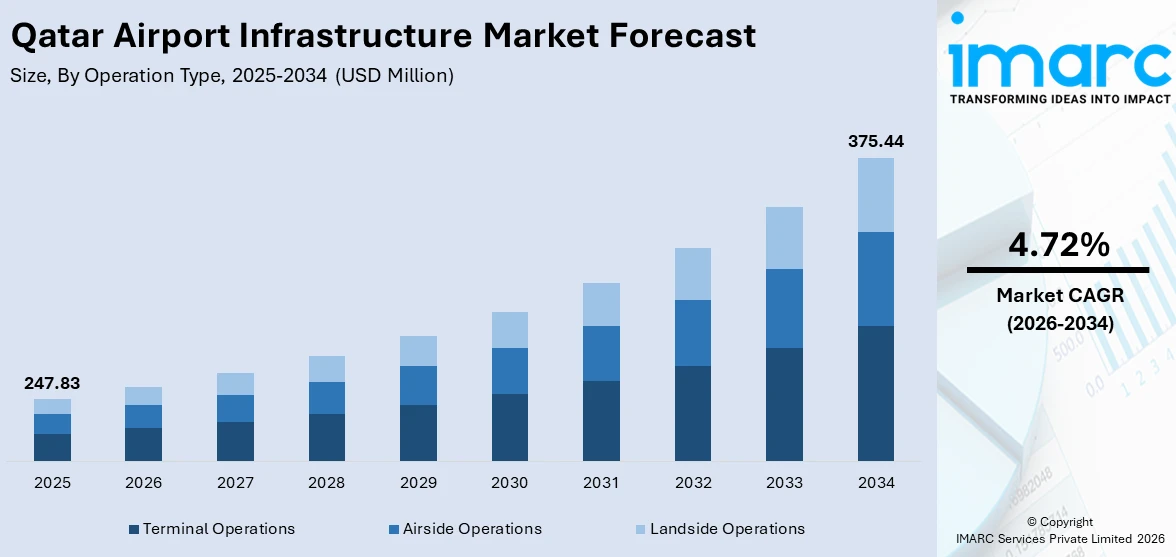
The Qatar airport infrastructure market size was valued at USD 247.83 Million in 2025 and is projected to reach USD 375.44 Million by 2034, growing at a compound annual growth rate of 4.72% from 2026-2034.
The Qatar airport infrastructure market is gaining strong momentum as the country accelerates its aviation development in alignment with national economic diversification goals. Rising international passenger traffic, increasing airline connectivity, and government-backed modernization programs are strengthening airport operations. Advancements in smart airport technologies, expanded terminal capacities, and growing investments in sustainable infrastructure are reshaping the aviation landscape, positioning Qatar as a prominent global aviation hub for next-generation airport infrastructure solutions and Qatar airport infrastructure market share.
Key Takeaways and Insights:
- By Operation Type: Terminal operations dominate the market with a share of 49.1% in 2025, driven by extensive investments in passenger processing systems, baggage handling upgrades, retail concessions, and security infrastructure modernization across Qatar’s primary aviation hub.
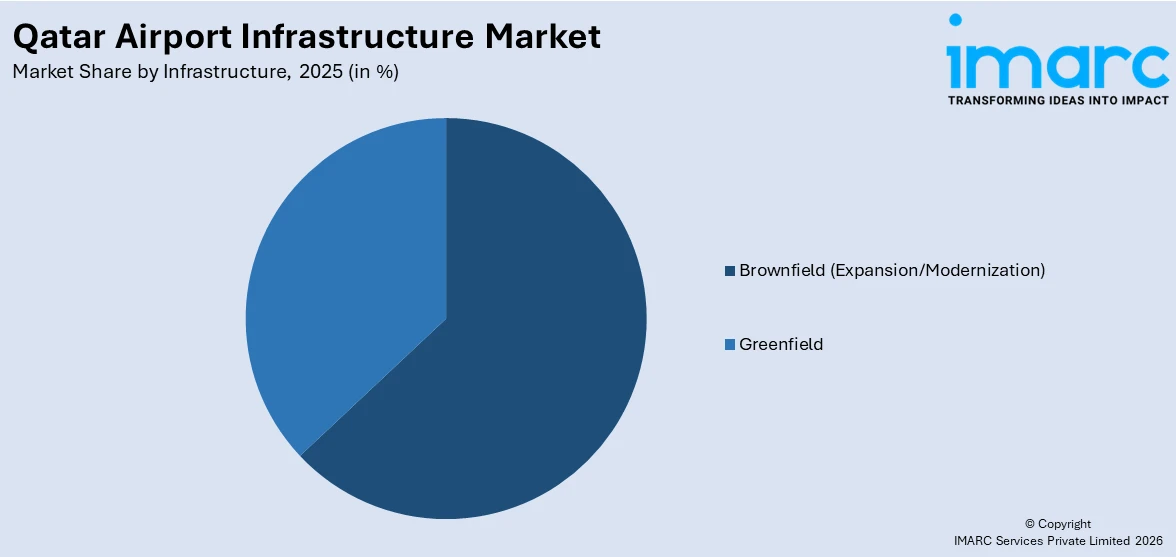
- By Infrastructure: Brownfield (expansion/modernization) leads the market with a share of 62.7% in 2025, reflecting Qatar’s strategic emphasis on maximizing existing asset utilization through terminal expansions, concourse additions, and technology-driven operational enhancements.
- By Airport Type: International exhibits a clear dominance in the market with 94.6% share in 2025, underscoring Qatar’s role as a critical global transit hub connecting Asia, Europe, and Africa through its award-winning Hamad International Airport.
- By Region: Ad Dawhah represents the largest region with 78.5% share in 2025, driven by the concentration of Qatar’s primary international airport and associated aviation infrastructure within the capital’s metropolitan area.
- Key Players: Key players drive the Qatar airport infrastructure market by expanding terminal capacities, deploying advanced passenger processing technologies, integrating sustainable construction practices, and forming strategic partnerships with global aviation firms to strengthen operational efficiency, enhance passenger experience, and ensure consistent infrastructure development across diverse aviation segments.
To get more information on this market Request Sample
The Qatar airport infrastructure market is advancing as government authorities, aviation operators, and technology providers collaborate to deliver world-class aviation facilities. Sustained passenger growth, strategic fleet expansion by Qatar Airways, and the country's ambition to significantly increase annual tourist arrivals are fueling infrastructure demand. The completion of new concourses at Hamad International Airport, which added multiple boarding gates and substantially expanded the terminal area, exemplifies the scale of ongoing modernization efforts. Additionally, the integration of biometric passenger processing, automated boarding systems, and energy-efficient building designs reflects a broader commitment to technology-led infrastructure development. These factors, combined with Qatar's strategic geographic position and robust public investment framework, continue to create favorable conditions for sustained Qatar airport infrastructure market growth.
Qatar Airport Infrastructure Market Trends:
Accelerated Adoption of Smart Airport Technologies
Qatar's aviation sector is embracing digital transformation through the widespread deployment of artificial intelligence, biometric verification, and automated passenger processing systems. Hamad International Airport has implemented facial recognition technology across self-check-in kiosks, security e-gates, and automated boarding gates as part of its Smart Airport program, enabling contactless passenger journeys. The Middle East region has emerged as a global leader in biometric adoption during airport journeys, reflecting rapid regional acceptance of identity-based travel solutions and reinforcing Qatar's commitment to technology-driven aviation infrastructure modernization.
Sustainability-Driven Infrastructure Development
Environmental sustainability is becoming a central pillar of airport infrastructure planning in Qatar, with facilities increasingly designed to meet international green building certifications. The newly completed Concourses D and E at Hamad International Airport are targeting GSAS 4-Star Design and Build Certification and LEED Gold Certification, incorporating energy-efficient systems, innovative water management, and optimized thermal comfort strategies. In 2025, the airport achieved zero waste to landfill across its entire campus, encompassing terminal operations, airside areas, and shared facilities through recycling, composting, and energy recovery programs.
Terminal Capacity Optimization Through Existing Asset Utilization
Qatar is pursuing a strategic approach to capacity enhancement by maximizing the utilization of existing airport assets before committing to entirely new construction. In September 2025, Doha’s Hamad International Airport’s Chief Operating Officer announced plans to increase annual passenger capacity to approximately 77 million through improvements in check-in halls, arrivals processing, baggage operations, and traffic management during off-peak hours. This optimization-first strategy enables cost-effective capacity growth while maintaining operational excellence and service quality standards.
Market Outlook 2026-2034:
The Qatar airport infrastructure market is poised for sustained expansion over the forecast period, driven by escalating passenger traffic, strategic aviation investments, and national economic diversification priorities. Continued terminal modernization, deployment of next-generation passenger processing systems, runway rehabilitation programs, and alignment with Qatar National Vision 2030 objectives are expected to sustain robust investment flows into airport infrastructure. The convergence of rising air travel demand, government-led development initiatives, and ongoing capacity enhancement projects will further reinforce long-term market growth throughout the projection period. The market generated a revenue of USD 247.83 Million in 2025 and is projected to reach a revenue of USD 375.44 Million by 2034, growing at a compound annual growth rate of 4.72% from 2026-2034.
Qatar Airport Infrastructure Market Report Segmentation:
|
Segment Category |
Leading Segment |
Market Share |
|
Operation Type |
Terminal Operations |
49.1% |
|
Infrastructure |
Brownfield (Expansion/Modernization) |
62.7% |
|
Airport Type |
International |
94.6% |
|
Region |
Ad Dawhah |
78.5% |
Operation Type Insights:
- Airside Operations
- Runways and Taxiways
- Airfield Lighting and Navigation Aids
- Refueling and Fuel Hydrant Systems
- Drainage Systems
- Others
- Terminal Operations
- Baggage Handling Systems
- Security Equipment and Infrastructure
- Airport Management Systems (AMS)
- Passenger Processing Systems (check-in, boarding, biometrics)
- Airport Retail and Concessions
- Food and Beverage Facilities
- Others
- Landside Operations
- Car Parking
- Car Rental Facilities
- Ground Transportation Infrastructure
- Others
Terminal operations dominate with a share of 49.1% of the total Qatar airport infrastructure market in 2025.
Terminal operations represent the largest operational segment in Qatar's airport infrastructure market, driven by sustained investment in passenger processing technologies, security systems, retail concessions, and food and beverage facilities. The completion of the Phase B expansion at Hamad International Airport, which added new concourses encompassing significant additional space and multiple new contact boarding gates, significantly enhanced terminal processing capabilities and reduced reliance on remote stands and bus transfers for passenger boarding.
The segment benefits from Qatar’s focus on delivering premium passenger experiences across the entire terminal journey. Qatar Duty Free expanded its offerings with the concourse additions, introducing over 10 new retail outlets and food and beverage venues while increasing the airport’s retail space by 2,700 square meters. These enhancements, combined with the deployment of automated self-boarding systems and ergonomic seating arrangements with built-in power outlets, reinforce terminal operations as the primary investment destination within Qatar’s airport infrastructure ecosystem.
Infrastructure Insights:
Access the comprehensive market breakdown Request Sample
- Greenfield
- Brownfield (Expansion/Modernization)
Brownfield (expansion/modernization) leads with a share of 62.7% of the total Qatar airport infrastructure market in 2025.
Brownfield expansion and modernization activities account for the largest share of Qatar's airport infrastructure market, reflecting the country's strategic preference for upgrading and optimizing existing facilities rather than pursuing entirely new greenfield developments. The comprehensive expansion of Hamad International Airport exemplifies this approach, having substantially increased terminal area and elevated annual passenger handling capacity. This sustained focus on enhancing established aviation assets underscores Qatar's commitment to maximizing returns on existing infrastructure investments while ensuring operational excellence across its airport ecosystem.
The emphasis on brownfield development continues as airport authorities prioritize asset optimization strategies to achieve further capacity gains within the existing infrastructure footprint. Planned improvements encompass enhancements to check-in and arrivals halls, baggage handling operations, and off-peak traffic management systems. Additionally, scheduled runway rehabilitation programs to meet International Civil Aviation Organization safety standards demonstrate ongoing commitment to brownfield modernization initiatives, ensuring that Qatar's aviation infrastructure remains aligned with evolving international regulatory requirements and growing passenger demand.
Airport Type Insights:
- Domestic
- International
International exhibits a clear dominance with a 94.6% share of the total Qatar airport infrastructure market in 2025.
International airport infrastructure commands the overwhelming majority of Qatar's aviation investment, driven by Hamad International Airport's role as one of the world's busiest international transit hubs. The airport continues to serve a rapidly growing passenger base, partnering with numerous airlines to connect travelers to an extensive global destination network. The ongoing addition of new carrier partnerships further expands the airport's international connectivity, reinforcing its position as a premier global aviation gateway and transit point.
Qatar's strategic geographic position, situated within a short flight radius of the majority of the world's population, underpins the dominance of international airport infrastructure. Qatar Airways continued fleet expansion through significant widebody aircraft orders signals sustained growth in international flight operations, necessitating proportional airport infrastructure scaling to accommodate increased passenger volumes. This convergence of geographic advantage, carrier expansion, and rising transit demand ensures that international airport infrastructure remains the primary focus of Qatar's aviation investment strategy.
Regional Insights:
- Ad Dawhah
- Al Rayyan
- Al Wakrah
- Others
Ad Dawhah represents the leading region with a 78.5% share of the total Qatar airport infrastructure market in 2025.
Ad Dawhah dominates the Qatar airport infrastructure market owing to its position as the location of Hamad International Airport, the country's primary international gateway and one of the busiest airports globally by international passenger traffic. The region's infrastructure investments are anchored by the airport's comprehensive expansion program, which delivered new concourses featuring additional boarding gates and significantly expanded the terminal footprint. These developments have substantially enhanced passenger processing capabilities and reinforced Ad Dawhah's standing as Qatar's principal aviation hub.
The concentration of aviation-related economic activity in Ad Dawhah is further reinforced by the region's role as a hub for tourism, trade, and major international events. Point-to-point passenger volumes traveling to and from Doha continue to grow steadily, driven by rising tourism and business travel demand. The airport's ongoing support for major sporting events and international business summits continues to drive sustained infrastructure investment in the Ad Dawhah region, ensuring its continued dominance within Qatar's airport infrastructure market.
Market Dynamics:
Growth Drivers:
Why is the Qatar Airport Infrastructure Market Growing?
Qatar National Vision 2030 and Economic Diversification Initiatives
Qatar’s airport infrastructure market is experiencing sustained growth as the government prioritizes aviation as a key enabler of economic diversification under the Qatar National Vision 2030 framework. The national strategy positions the tourism sector as a critical contributor to economic output, with the Qatar Tourism Strategy 2030 targeting six million annual international visitors by the end of the decade. In 2025, Qatar welcomed 5.1 million international visitors, reflecting a 3.7% increase over the previous year. This ambitious tourism growth trajectory necessitates continued investment in airport facilities, passenger processing capabilities, and ground transportation connectivity to accommodate rising visitor volumes. The government’s commitment to hosting major global sporting, cultural, and business events further amplifies demand for world-class aviation infrastructure that can support peak travel periods while maintaining operational excellence.
Strategic Fleet Expansion by Qatar Airways and Rising Air Connectivity
The rapid expansion of Qatar Airways' fleet and route network is creating substantial demand for corresponding airport infrastructure development. The airline's significant widebody aircraft orders signal an aggressive growth trajectory aimed at substantially increasing annual passenger capacity by the end of the decade. Qatar Airways currently operates an extensive fleet and serves a wide-ranging global destination network through numerous airline partners at Hamad International Airport. This fleet modernization strategy, encompassing next generation widebody aircraft, requires parallel infrastructure investment in expanded gate capacity, enhanced baggage handling systems, upgraded fuel hydrant networks, and additional maintenance facilities to support larger aircraft volumes and more complex operational demands across the airport ecosystem.
Surging Passenger Traffic and International Transit Hub Status
Accelerating passenger growth is driving continuous infrastructure investment as Qatar's aviation sector expands to meet escalating travel demand. Hamad International Airport continues to serve record passenger volumes, with recent years demonstrating consistent year-on-year growth and peak travel periods reaching unprecedented levels. The airport's recognition as one of the world's leading aviation facilities and its consistent ranking among the busiest international airports globally reinforce Qatar's strategic position as a premier transit hub. Aircraft movements and air cargo volumes continue to rise steadily, reflecting the airport's expanding operational scale. These growing operational demands, combined with Qatar's geographic advantage of connecting three continents within a short flight radius, create persistent demand for capacity expansion, operational optimization, and infrastructure modernization.
Market Restraints:
What Challenges the Qatar Airport Infrastructure Market is Facing?
High Capital Expenditure Requirements for Infrastructure Modernization
Airport infrastructure projects in Qatar require substantial capital outlays for construction, technology integration, and long-term maintenance, placing significant financial pressure on project stakeholders. The scale of investment needed for terminal expansions, advanced passenger processing systems, and sustainable building features increases project complexity and extends return-on-investment timelines, challenging the pace of infrastructure delivery.
Operational Disruptions During Expansion and Maintenance Activities
Ongoing infrastructure upgrades and maintenance programs, including the planned eastern runway rehabilitation in 2026, present operational continuity challenges. Phased construction within active airport environments requires meticulous planning to minimize disruptions to passenger services, airline operations, and cargo handling, creating logistical complexity that can temporarily constrain capacity during critical maintenance periods.
Intensifying Regional Competition from Neighboring Aviation Hubs
Qatar’s airport infrastructure market faces competitive pressure from neighboring Gulf states investing heavily in mega-airport developments. Rival hubs are pursuing aggressive capacity expansion and premium service strategies, creating competition for transit passengers, airline partnerships, and international route allocations that could potentially limit Qatar’s market share growth in the broader regional aviation landscape.
Competitive Landscape:
The Qatar airport infrastructure market is characterized by a concentrated competitive landscape involving government aviation authorities, international engineering firms, and global technology providers. MATAR, Qatar’s airport management authority, oversees strategic infrastructure planning and execution, partnering with international contractors and consultants for large-scale expansion and modernization projects. Competition is driven by expertise in delivering integrated solutions that combine civil engineering, smart technology deployment, and sustainability compliance. Companies are differentiating through capabilities in biometric passenger processing, automated systems integration, energy-efficient design, and advanced security infrastructure. Strategic partnerships between local authorities and global aerospace firms continue to shape market dynamics and drive innovation.
Qatar Airport Infrastructure Market Report Coverage:
|
Report Features |
Details |
|
Base Year of the Analysis |
2025 |
|
Historical Period |
2020-2025 |
|
Forecast Period |
2026-2034 |
|
Units |
Million USD |
|
Scope of the Report |
Exploration of Historical Trends and Market Outlook, Industry Catalysts and Challenges, Segment-Wise Historical and Future Market Assessment:
|
|
Operation Types Covered |
|
|
Infrastructures Covered |
Greenfield, Brownfield (Expansion/Modernization) |
|
Airport Types Covered |
Domestic, International |
|
Regions Covered |
Ad Dawhah, Al Rayyan, Al Wakrah, Others |
|
Customization Scope |
10% Free Customization |
|
Post-Sale Analyst Support |
10-12 Weeks |
|
Delivery Format |
PDF and Excel through Email (We can also provide the editable version of the report in PPT/Word format on special request) |
Frequently Asked Questions About the Qatar Airport Infrastructure Market Report
The Qatar airport infrastructure market size was valued at USD 247.83 Million in 2025.
The Qatar airport infrastructure market is expected to grow at a compound annual growth rate of 4.72% from 2026-2034 to reach USD 375.44 Million by 2034.
Terminal operations dominated the market with a share of 49.1%, driven by extensive investments in passenger processing systems, baggage handling upgrades, security infrastructure, and expanded retail and dining concessions across Qatar’s primary aviation hub.
Key factors driving the Qatar airport infrastructure market include government-backed economic diversification under Vision 2030, strategic fleet expansion by Qatar Airways, surging international passenger traffic, rising tourism demand, and sustained modernization of terminal facilities and smart airport technologies.
Major challenges include high capital expenditure requirements for large-scale infrastructure projects, operational disruptions during expansion and maintenance activities, intensifying competition from neighboring regional aviation hubs, supply chain constraints, and the complexity of integrating advanced technologies within active airport environments.
Need more help?
- Speak to our experienced analysts for insights on the current market scenarios.
- Include additional segments and countries to customize the report as per your requirement.
- Gain an unparalleled competitive advantage in your domain by understanding how to utilize the report and positively impacting your operations and revenue.
- For further assistance, please connect with our analysts.
 Request Customization
 Speak to an Analyst
 Request Brochure
 Inquire Before Buying
Benefits of Customization
- Personalize this research
- Triangulate with your data
- Get data as per your format and definition
- Gain a deeper dive into a specific application, geography, customer, or competitor
- Any level of personalization
Get in Touch With Us
UNITED STATES
Phone: +1-201-971-6302
INDIA
Phone: +91-120-433-0800
UNITED KINGDOM
Phone: +44-753-714-6104
Email: sales@imarcgroup.com
Client Testimonials




.webp)




.webp)













Related Reports

Choose your plan
*Please note that the prices mentioned below are starting prices for each bundle type. Kindly contact our team for further details.*
Single User License
- 1 User License, Access on 2 Devices
- PDF Report + Excel Dataset (Password Protected)
- Lifetime Access
- No Printing Rights
- 10% Free Report Customization
- 10–12 Weeks of Analyst Support
Five User License
- Access for 5 Users, 2 Devices per User
- PDF Report + Excel Dataset (Password Protected)
- Lifetime Access
- Dedicated Account Manager
- 12–14 Weeks of Analyst Support
- No Printing Rights
- 15% Free Report Customization
- 25% Discount on Your Next Purchase
Corporate User License
- Unlimited User Access (Within Your Organization)
- PDF Report + Excel Dataset
- Lifetime Access
- Dedicated Account Manager
- 14–20 Weeks of Analyst Support
- No Printing Rights
- 20% Free Report Customization
- 30% Discount on Your Next Purchase
Essential Insights
What's included:
3 reports
- Lifetime Access
- PDF Reports
- Excel Datasets
- 2 Weeks of Free Analyst Support
- 2 User Licenses
- Access on 2 Devices
- Printing Rights
- Complimentary PowerPoint (PPT) Version
- Complimentary License Upgrade
Professional Access
What's included:
5 reports
- Lifetime Access
- PDF Reports
- Excel Datasets
- 8 Weeks of Free Analyst Support
- 2 User Licenses
- Access on 2 Devices
- Printing Rights
- Complimentary PowerPoint (PPT) Version
- Complimentary License Upgrade
Business Advantage
What's included:
8 reports
- Lifetime Access
- PDF Reports
- Excel Datasets
- 14 Weeks of Free Analyst Support
- 2 User Licenses
- Access on 2 Devices
- Printing Rights
- Complimentary PowerPoint (PPT) Version
- Complimentary License Upgrade
Enterprise Intelligence
What's included:
10 reports
- Lifetime Access
- PDF Reports
- Excel Datasets
- 20 Weeks of Free Analyst Support
- 2 User Licenses
- Access on 2 Devices
- Printing Rights
- Complimentary PowerPoint (PPT) Version
- Complimentary License Upgrade