
Radar Level Transmitter Market Size, Share, Trends and Forecast by Technology, Frequency Range, Application, End Use Industry, and Region, 2026-2034
Radar Level Transmitter Market Size and Share:
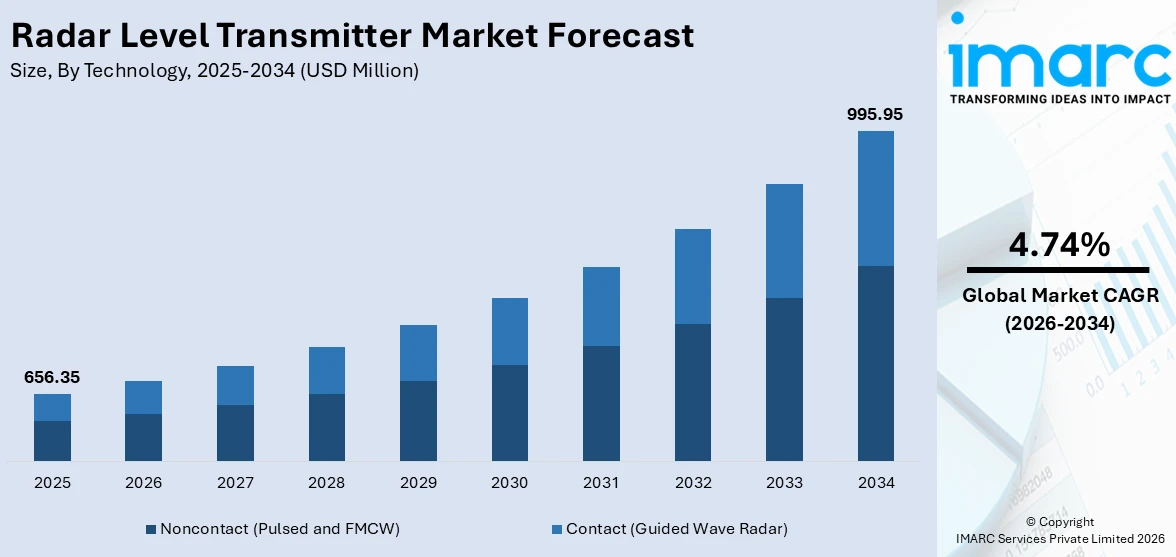
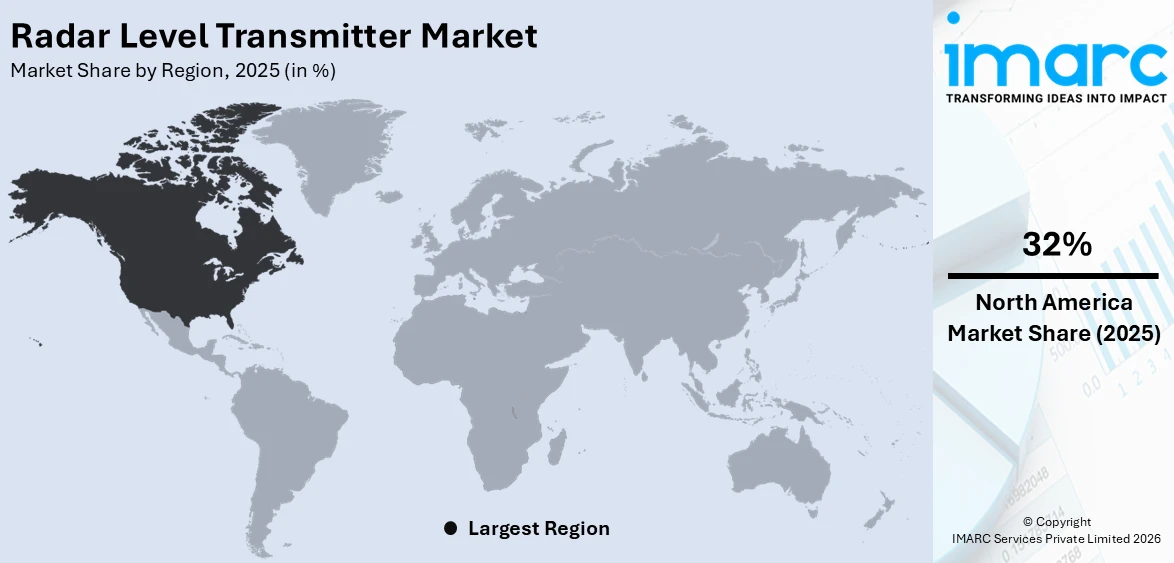
The global radar level transmitter market grew from USD 656.35 Million in 2025 to USD 687.60 Million in 2026. Looking forward, IMARC Group estimates the market to reach USD 995.95 Million by 2034, exhibiting a CAGR of 4.74% from 2026-2034. North America currently dominates the market, holding a market share of 32% in 2025. The region's leadership is driven by robust industrial infrastructure, a high concentration of leading instrumentation manufacturers, substantial investments in modernizing aging water utilities, and widespread adoption of precision measurement technologies across the oil and gas and chemical sectors, all expanding the radar level transmitter market share.
The global radar level transmitter market is propelled by expanding demand for accurate and reliable process measurement across diverse industrial verticals. The rapid advancement of Industry 4.0 principles and the proliferation of smart manufacturing practices have elevated the strategic importance of continuous, uninterrupted level monitoring, driving adoption of sophisticated radar-based instruments. Key end-use sectors such as oil and gas, chemicals, and water and wastewater treatment increasingly require precise and dependable level measurement to ensure process safety, regulatory compliance, and operational efficiency. The progressive transition from ultrasonic and other conventional measurement technologies to radar-based systems is intensifying, as radar excels under challenging conditions including high temperatures, elevated pressures, vapors, foam, and corrosive media. Growing capital investments in process automation and the optimization of asset performance are further bolstering the radar level transmitter market growth.
To get more information on this market Request Sample
The United States has emerged as a major region in the radar level transmitter market owing to many factors. The country's mature petroleum and chemical processing sector, extensive water and wastewater treatment infrastructure, and advanced power generation facilities collectively create sustained demand for high-performance level measurement devices. Stringent regulatory mandates from authorities such as the Environmental Protection Agency (EPA) and the Occupational Safety and Health Administration (OSHA) require continuous process monitoring and safety compliance, compelling plant operators to adopt advanced radar transmitters. The U.S. EPA's 2024 wastewater infrastructure needs assessment estimated national wastewater infrastructure requirements of USD 630.1 billion over the next 20 years, reflecting enormous investment momentum that generates lasting demand for precision instrumentation. Furthermore, accelerating automation across food and beverage, metals and mining, and pharmaceutical industries is expanding the addressable market for radar level transmitters throughout the United States.
Radar Level Transmitter Market Trends:
Rising Adoption of Noncontact Radar Technology
The increasing preference for noncontact radar level transmitters is significantly reshaping measurement practices across industrial sectors. Noncontact radar systems, encompassing frequency-modulated continuous wave (FMCW) and pulsed radar technologies, deliver compelling advantages over contact-based solutions by eliminating the need for physical probe insertion into process media, thereby substantially reducing maintenance demands and minimizing the risk of product contamination or process disruption. These systems are capable of delivering accurate and reliable measurements under highly challenging conditions, including elevated temperatures, extreme pressures, heavy vapors, and aggressive chemical media, making them indispensable in oil and gas refineries, chemical plants, and petrochemical facilities. The growing complexity of modern industrial processes has further propelled the migration to noncontact measurement as operators prioritize instruments capable of maintaining precision regardless of changing media properties, foam formation, or surface turbulence. Advances in signal processing algorithms, miniaturized antenna designs, and integration with digital communication standards have simultaneously broadened the application scope. In October 2025, Emerson launched the Rosemount 3408, the world's first native WirelessHART noncontacting radar level transmitter based on 80 GHz FMCW technology, eliminating measurement blind spots and reducing cabling complexity in remote industrial facilities.
Integration with Industrial IoT and Digitalization
The convergence of radar level transmitters with industrial Internet of Things (IoT) platforms and digital automation ecosystems represents one of the most transformative radar level transmitter market trends in the current decade. Connected radar transmitters enable real-time data acquisition, remote diagnostic monitoring, and seamless integration with supervisory control systems and enterprise asset management platforms, fundamentally elevating operational efficiency and enabling predictive maintenance strategies. This digital transformation is particularly pronounced in sectors such as oil and gas, chemicals, and water treatment, where downtime carries significant financial and environmental consequences. The ability to access continuous level data from cloud-based dashboards is revolutionizing inventory management and process optimization. Advanced self-diagnostic features embedded within IoT-enabled transmitters provide early warning of device performance degradation, extending instrument service life and reducing unplanned maintenance interventions. In January 2025, the strategic partnership between SICK and Endress+Hauser became fully operational, with Endress+Hauser assuming global sales and service responsibilities for SICK's process analyzers and gas flow meters, a joint venture employing approximately 730 specialists, delivering integrated digital process solutions to global industries.
Expanding Demand in Water and Wastewater Management
The rapidly expanding global water and wastewater treatment sector represents one of the most significant growth avenues for the radar level transmitter market outlook. Radar transmitters are uniquely suited to the demanding conditions encountered in water management facilities, providing reliable and accurate measurement of water surface levels, sludge interfaces, and chemical dosing tanks without being affected by foam, turbulence, or condensation. Municipal and industrial water treatment operators are increasingly replacing obsolete ultrasonic and float-based measurement systems with modern radar instruments that deliver superior accuracy, lower maintenance requirements, and compliance with stringent regulatory standards. Government infrastructure investment programs across major economies are amplifying this transition. In fiscal year 2024, the United States Environmental Protection Agency made USD 11.5 billion in water infrastructure funding available through the Clean Water and Drinking Water State Revolving Fund programs, underscoring the massive scale of public investment driving adoption of advanced instrumentation across the nation's water treatment network, with similar programs unfolding in Europe, China, and other major economies.
Radar Level Transmitter Industry Segmentation:
IMARC Group provides an analysis of the key trends in each segment of the global radar level transmitter market, along with forecast at the global, regional, and country levels from 2026-2034. The market has been categorized based on technology, frequency range, application, and end use industry.

Analysis by Technology:
- Contact (Guided Wave Radar)
- Noncontact (Pulsed and FMCW)
Noncontact (Pulsed and FMCW) holds 55% of the market share. Noncontact radar transmitters, which include both frequency-modulated continuous wave (FMCW) and pulsed radar variants, are increasingly favored across industrial measurement applications due to their ability to deliver continuous, accurate level readings without physical contact with the measured medium. This characteristic makes them particularly suited for corrosive, high-temperature, high-pressure, and hazardous process environments where probe degradation would pose operational or safety risks. FMCW systems are especially valued for their high resolution and long-range measurement capabilities, making them the preferred choice in large storage tanks, separators, and open channel applications. Pulsed radar variants provide cost-effective solutions for general-purpose liquid and solid measurement in a broad range of tank geometries and process conditions. Manufacturers are continuously advancing antenna designs, signal processing capabilities, and digital connectivity options to extend the performance envelope of noncontact systems.
Analysis by Frequency Range:
- C and X Band
- W Band
- K Band
C and X band leads the market with a share of 50%. The c and x band frequency range, operating within the microwave spectrum at approximately 5–12 GHz, has long served as the established standard for industrial radar level measurement across diverse process applications. These frequency bands offer a well-proven balance between microwave beam penetration, signal stability, and resolution, making them suitable for a wide variety of tank sizes, vessel configurations, and process media encountered in oil and gas, chemical, and storage terminal environments. C and X Band sensors demonstrate robust performance in conditions involving foam, vapor, and temperature fluctuations, maintaining signal integrity where optical or ultrasonic instruments would suffer performance degradation. Their widespread adoption is reinforced by decades of field experience, extensive global installed base, and compatibility with established process control protocols including HART and PROFIBUS.
Analysis by Application:
Access the comprehensive market breakdown Request Sample
- Liquids, Slurries and Interfaces
- Solids
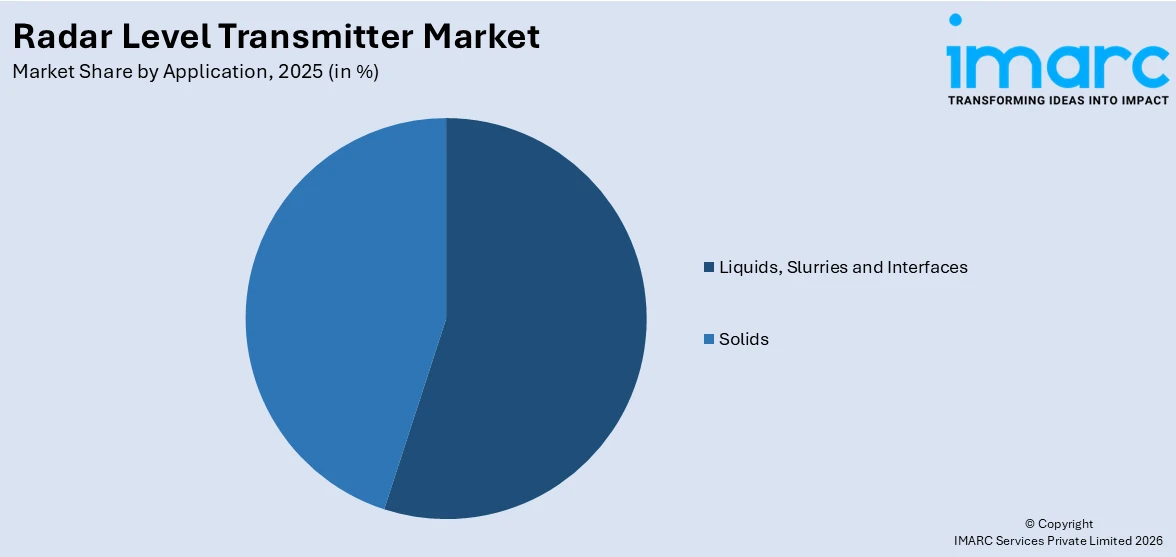
Liquids, slurries and interfaces dominate the market, with a share of 38%. Liquid level measurement constitutes the foundational application domain for radar level transmitters, encompassing storage tanks, process vessels, separators, tank farms, and open-channel measurement points across a broad spectrum of industrial facilities. Radar instruments excel in liquid applications due to their ability to deliver continuous, contactless measurement across a wide range of dielectric constants, from hydrocarbons and low-permittivity liquids to high-dielectric aqueous solutions and chemical intermediates. The growing complexity of process streams, including emulsions, foaming liquids, and interface measurement between immiscible layers, has reinforced the preference for advanced FMCW and guided wave radar technologies that can accurately resolve multiple liquid layers and low-permittivity interfaces. The water and wastewater sector is a particularly dynamic growth driver.
Analysis by End Use Industry:
- Oil and Gas
- Food and Beverages
- Water and Wastewater
- Chemicals and Petrochemical
- Metals and Mining
- Others
Oil and gas represent the leading segment, with a market share of 29%. The oil and gas industry constitutes the most significant end-user of radar level transmitters globally, driven by the critical requirement for reliable, non-intrusive measurement in storage facilities, separators, crude oil and product tanks, and offshore platforms where operational safety and custody transfer accuracy are of paramount importance. Radar transmitters are uniquely positioned for oil and gas applications due to their compliance with hazardous area certifications including ATEX, IECEx, and NEC, as well as their ability to deliver stable measurement in the presence of flammable vapors, extreme temperatures, and high-pressure process conditions. The expansion of downstream storage infrastructure, refinery modernization programs, and the proliferation of liquefied natural gas terminals are all sustaining healthy demand for advanced measurement instruments.
Regional Analysis:
To get more information on the regional analysis of this market Request Sample
- North America
- United States
- Canada
- Asia Pacific
- China
- Japan
- India
- South Korea
- Australia
- Indonesia
- Others
- Europe
- Germany
- France
- United Kingdom
- Italy
- Spain
- Russia
- Others
- Latin America
- Brazil
- Mexico
- Others
- Middle East and Africa
North America, accounting for 32% of the share, enjoys the leading position in the market. The region's preeminence is underpinned by its highly developed oil and gas sector, extensive chemical and petrochemical manufacturing base, and mature water and wastewater treatment infrastructure, all of which sustain robust demand for precision level measurement instruments. The United States and Canada collectively house a large concentration of operational refineries, pipeline terminals, and industrial processing facilities that continuously require reliable and accurate process instrumentation. The strong presence of global measurement technology leaders in North America also facilitates rapid technology adoption, shorter product development cycles, and well-established service ecosystems that support instrument lifecycle management. Moreover, stringent federal and state-level environmental and process safety regulations mandate continuous monitoring across numerous industry sectors.
Key Regional Takeaways:
United States Radar Level Transmitter Market Analysis
The United States represents the most mature and technologically advanced market for radar level transmitters globally, characterized by a dense concentration of oil and gas processing facilities, chemical plants, power generation infrastructure, and sophisticated water treatment networks. The country's stringent regulatory framework, enforced through the EPA, OSHA, and sector-specific standards bodies such as the American Petroleum Institute (API), mandates continuous and highly accurate process monitoring across critical industries, driving consistent investment in advanced measurement instrumentation. The accelerating modernization of aging industrial infrastructure and the widespread adoption of Industry 4.0 practices are creating substantial replacement demand for next-generation radar instruments equipped with digital communication and wireless connectivity capabilities. The Bipartisan Infrastructure Law's USD 630.1 billion estimated wastewater infrastructure needs over 20 years, as assessed by the EPA in 2024, highlights the enormous scale of public sector investment underway in the country's water management sector, which directly supports procurement of advanced level measurement solutions. The radar level transmitter market forecast for the United States remains highly positive, driven by continuous technology adoption across upstream, midstream, and downstream energy sectors, expanding automation in food and beverage manufacturing, and growing water treatment investment programs nationwide.
Europe Radar Level Transmitter Market Analysis
Europe represents the second-largest regional market for radar level transmitters, anchored by strong industrial manufacturing traditions and increasingly stringent regulatory requirements governing process safety, emissions, and environmental monitoring. Germany, France, the United Kingdom, Italy, and Spain collectively host extensive petrochemical, pharmaceutical, food and beverage, and water treatment facilities that form the core demand base for advanced level measurement instruments. European regulators mandate strict overfill protection, environmental emissions monitoring, and process integrity standards across industrial facilities, incentivizing operators to replace legacy measurement technologies with precision radar systems. The EU Green Deal's commitment to mobilize EUR 1 trillion in sustainable investments by 2030 is stimulating widespread adoption of energy-efficient and environmentally responsible process instrumentation, including modern radar level transmitters that minimize maintenance interventions and reduce operational carbon footprint. The transition of European oil storage terminals from ultrasonic to high-frequency 80 GHz radar measurement systems is further accelerating, driven by compact antenna designs and improved accuracy in complex vapor and temperature environments.
Asia-Pacific Radar Level Transmitter Market Analysis
Asia-Pacific is the fastest-growing regional market for radar level transmitters, propelled by rapid industrialization, large-scale infrastructure investment, and expanding manufacturing activity across China, India, Japan, South Korea, and emerging Southeast Asian economies. The region's burgeoning oil refining, petrochemical, and chemical sectors are generating strong baseline demand for process instrumentation, while simultaneously expanding water and wastewater management infrastructure is driving additional uptake. Government-led development programs represent a particularly powerful demand catalyst. In 2025, China's state planner greenlighted significant projects and an investment strategy for the central government's budget for 2026, totaling approximately 295 billion yuan ($42.21 billion), marking its latest effort to boost investment and promote economic growth, encompassing extensive industrial and utility projects that require comprehensive process measurement solutions across new and upgraded facilities. Japan and South Korea are also advancing industrial automation and smart manufacturing agendas, creating favorable conditions for sophisticated radar level transmitter adoption across process industries.
Latin America Radar Level Transmitter Market Analysis
Latin America represents a growing regional market for radar level transmitters, with Brazil and Mexico serving as the primary drivers of demand. The region's extensive oil and gas reserves, active mining sectors, and expanding food and beverage and petrochemical industries collectively require reliable process measurement instrumentation. Brazil's state energy company Petrobras approved a comprehensive USD 111 billion investment plan for the 2024–2028 period, encompassing expansion of offshore platforms and onshore processing facilities that require sophisticated level measurement systems. Mexico's refinery modernization programs and growing chemical industry are further supporting regional market expansion across multiple industry segments.
Middle East and Africa Radar Level Transmitter Market Analysis
The Middle East and Africa region presents significant opportunities for radar level transmitter manufacturers, driven primarily by the region's world-scale oil and gas operations, large-scale desalination infrastructure, and ongoing industrialization in African economies. Gulf Cooperation Council countries host extensive crude oil storage terminals, LNG facilities, and petrochemical complexes that require high-accuracy, explosion-proof level measurement instrumentation. Saudi Arabia's Vision 2030 initiative is directing substantial capital toward industrial diversification and water infrastructure, creating sustained demand for advanced process measurement technologies including radar level transmitters.
Competitive Landscape:
The global radar level transmitter market features a moderately consolidated competitive landscape comprising global industrial automation conglomerates and specialized instrumentation manufacturers. Leading players collectively command a significant revenue share, leveraging broad product portfolios, global service networks, and strong distributor relationships to maintain market leadership. Key competitors are investing heavily in research and development, particularly focusing on advancing 80 GHz and W-band radar platforms, integrating IoT connectivity and wireless communication protocols, and developing artificial intelligence-enabled diagnostics that support predictive maintenance. Strategic alliances and partnerships are reshaping the competitive dynamic, enabling firms to combine complementary sensing, analytics, and automation capabilities into comprehensive process solutions. Companies are simultaneously expanding geographic footprints in high-growth Asia-Pacific and Middle East markets while pursuing compliance with international hazardous area certifications.
The report provides a comprehensive analysis of the competitive landscape in the radar level transmitter market with detailed profiles of all major companies, including:
- ABB Ltd.
- Automation Products Group Inc.
- Emerson Electric Co.
- Endress+Hauser Group Services AG
- FineTek Co. Ltd.
- Honeywell International Inc.
- KROHNE Messtechnik GmbH
- Magnetrol International Inc. (Ametek Inc.)
- Matsushima Measure Tech Co. Ltd.
- Pepperl+Fuchs SE
- Schneider Electric SE
- Siemens AG
- VEGA India Level & Pressure Measurement Private Limited
Radar Level Transmitter Market Report Scope:
| Report Features | Details |
|---|---|
| Base Year of the Analysis | 2025 |
| Historical Period | 2020-2025 |
| Forecast Period | 2026-2034 |
| Units | Million USD |
| Scope of the Report |
Exploration of Historical Trends and Market Outlook, Industry Catalysts and Challenges, Segment-Wise Historical and Future Market Assessment:
|
| Technologies Covered | Contact (Guided Wave Radar), Noncontact (Pulsed and FMCW) |
| Frequency Ranges Covered | C and X Band, W Band, K Band |
| Applications Covered | Liquids, Slurries and Interfaces, Solids |
| End Use Industries Covered | Oil and Gas, Food and Beverages, Water and Wastewater, Chemicals and Petrochemical, Metals and Mining, Others |
| Region Covered | Asia Pacific, Europe, North America, Latin America, Middle East and Africa |
| Countries Covered | United States, Canada, Germany, France, United Kingdom, Italy, Spain, Russia, China, Japan, India, South Korea, Australia, Indonesia, Brazil, Mexico |
| Companies Covered | ABB Ltd., Automation Products Group Inc., Emerson Electric Co., Endress+Hauser Group Services AG, FineTek Co. Ltd., Honeywell International Inc., KROHNE Messtechnik GmbH, Magnetrol International Inc. (Ametek Inc.), Matsushima Measure Tech Co. Ltd., Pepperl+Fuchs SE, Schneider Electric SE, Siemens AG, VEGA India Level & Pressure Measurement Private Limited, etc. |
| Customization Scope | 10% Free Customization |
| Post-Sale Analyst Support | 10-12 Weeks |
| Delivery Format | PDF and Excel through Email (We can also provide the editable version of the report in PPT/Word format on special request) |
Key Benefits for Stakeholders:
- IMARC’s report offers a comprehensive quantitative analysis of various market segments, historical and current market trends, market forecasts, and dynamics of the radar level transmitter market from 2020-2034.
- The research study provides the latest information on the market drivers, challenges, and opportunities in the global radar level transmitter market.
- The study maps the leading, as well as the fastest-growing, regional markets. It further enables stakeholders to identify the key country-level markets within each region.
- Porter's Five Forces analysis assists stakeholders in assessing the impact of new entrants, competitive rivalry, supplier power, buyer power, and the threat of substitution. It helps stakeholders to analyze the level of competition within the radar level transmitter industry and its attractiveness.
- Competitive landscape allows stakeholders to understand their competitive environment and provides an insight into the current positions of key players in the market.
Frequently Asked Questions About the Radar Level Transmitter Market Report
The radar level transmitter market size increased from USD 656.35 Million in 2025 to USD 687.60 Million in 2026.
The radar level transmitter market is projected to exhibit a CAGR of 4.74% during 2026-2034, reaching a value of USD 995.95 Million by 2034.
The radar level transmitter market is driven by growing industrial automation adoption, rising demand for non-contact and continuous level measurement across oil and gas, chemicals, and water treatment sectors, expansion of smart manufacturing practices integrating IoT-enabled sensors, increasing infrastructure investments in water utilities worldwide, and stringent safety and environmental compliance requirements mandating precision process monitoring.
North America currently dominates the radar level transmitter market, accounting for a share of 32% in 2025. The region benefits from a mature oil and gas sector, stringent regulatory compliance requirements, high industrial automation levels, significant water infrastructure investment, and a strong base of global instrumentation manufacturers.
Some of the major players in the radar level transmitter market include ABB Ltd., Automation Products Group Inc., Emerson Electric Co., Endress+Hauser Group Services AG, FineTek Co. Ltd., Honeywell International Inc., KROHNE Messtechnik GmbH, Magnetrol International Inc. (Ametek Inc.), Matsushima Measure Tech Co. Ltd., Pepperl+Fuchs SE, Schneider Electric SE, Siemens AG, VEGA India Level & Pressure Measurement Private Limited, etc.
Need more help?
- Speak to our experienced analysts for insights on the current market scenarios.
- Include additional segments and countries to customize the report as per your requirement.
- Gain an unparalleled competitive advantage in your domain by understanding how to utilize the report and positively impacting your operations and revenue.
- For further assistance, please connect with our analysts.
 Request Customization
 Speak to an Analyst
 Request Brochure
 Inquire Before Buying
Benefits of Customization
- Personalize this research
- Triangulate with your data
- Get data as per your format and definition
- Gain a deeper dive into a specific application, geography, customer, or competitor
- Any level of personalization
Get in Touch With Us
UNITED STATES
Phone: +1-201-971-6302
INDIA
Phone: +91-120-433-0800
UNITED KINGDOM
Phone: +44-753-714-6104
Email: [email protected]
Client Testimonials




.webp)




.webp)













Related Reports

Choose your plan
*Please note that the prices mentioned below are starting prices for each bundle type. Kindly contact our team for further details.*
Single User License
- 1 User License, Access on 2 Devices
- PDF Report + Excel Dataset (Password Protected)
- Lifetime Access
- No Printing Rights
- 10% Free Report Customization
- 10–12 Weeks of Analyst Support
Five User License
- Access for 5 Users, 2 Devices per User
- PDF Report + Excel Dataset (Password Protected)
- Lifetime Access
- Dedicated Account Manager
- 12–14 Weeks of Analyst Support
- No Printing Rights
- 15% Free Report Customization
- 25% Discount on Your Next Purchase
Corporate User License
- Unlimited User Access (Within Your Organization)
- PDF Report + Excel Dataset
- Lifetime Access
- Dedicated Account Manager
- 14–20 Weeks of Analyst Support
- No Printing Rights
- 20% Free Report Customization
- 30% Discount on Your Next Purchase
Essential Insights
What's included:
3 reports
- Lifetime Access
- PDF Reports
- Excel Datasets
- 2 Weeks of Free Analyst Support
- 2 User Licenses
- Access on 2 Devices
- Printing Rights
- Complimentary PowerPoint (PPT) Version
- Complimentary License Upgrade
Professional Access
What's included:
5 reports
- Lifetime Access
- PDF Reports
- Excel Datasets
- 8 Weeks of Free Analyst Support
- 2 User Licenses
- Access on 2 Devices
- Printing Rights
- Complimentary PowerPoint (PPT) Version
- Complimentary License Upgrade
Business Advantage
What's included:
8 reports
- Lifetime Access
- PDF Reports
- Excel Datasets
- 14 Weeks of Free Analyst Support
- 2 User Licenses
- Access on 2 Devices
- Printing Rights
- Complimentary PowerPoint (PPT) Version
- Complimentary License Upgrade
Enterprise Intelligence
What's included:
10 reports
- Lifetime Access
- PDF Reports
- Excel Datasets
- 20 Weeks of Free Analyst Support
- 2 User Licenses
- Access on 2 Devices
- Printing Rights
- Complimentary PowerPoint (PPT) Version
- Complimentary License Upgrade