
Australia Energy Efficient Transformers Market Size, Share, Trends and Forecast by Type, Cooling Type, Efficiency Level, Application, and Region, 2026-2034
Australia Energy Efficient Transformers Market Size, Share, Trends & Forecast (2026-2034)
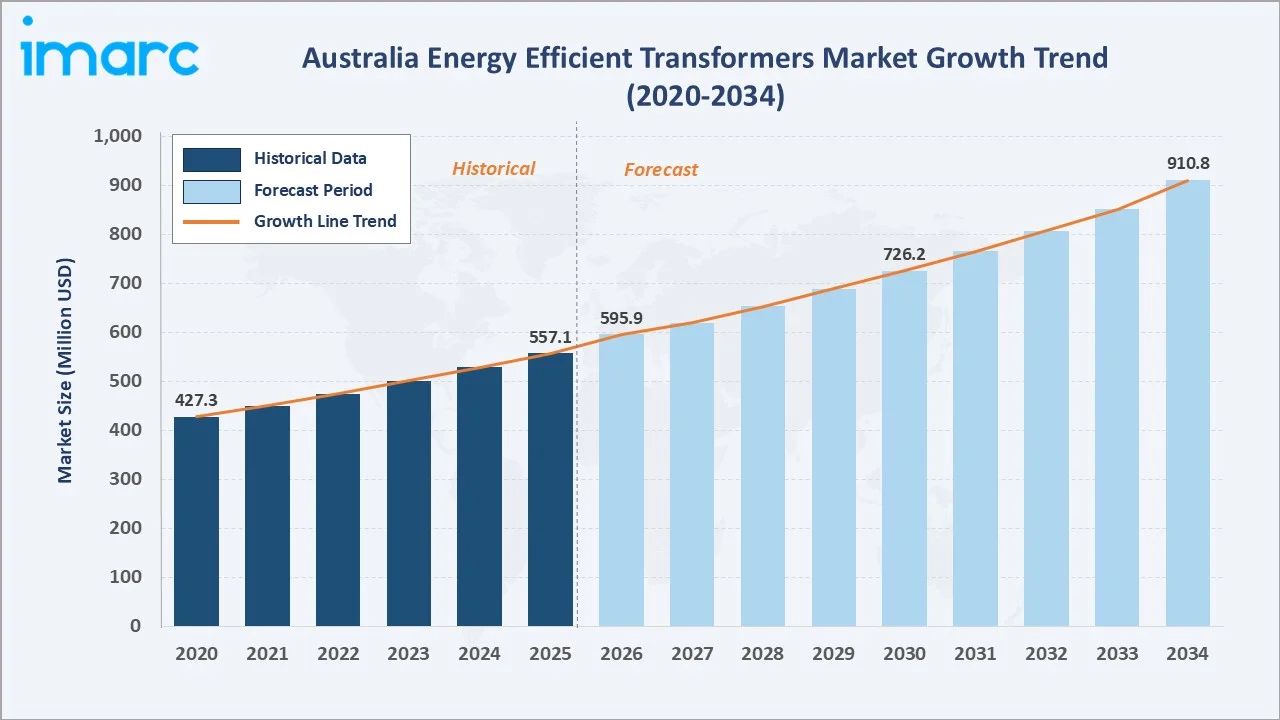
The Australia energy efficient transformers market grew from USD 557.1 Million in 2025 to USD 595.9 Million in 2026 and is projected to reach USD 910.8 Million by 2034, growing at a CAGR of 5.45% during 2026-2034. The market is driven by the integration of renewable energy, government mandated energy performance standards (MEPS), ageing grid infrastructure replacement, and rising electricity demand across commercial, industrial, and utility segments.
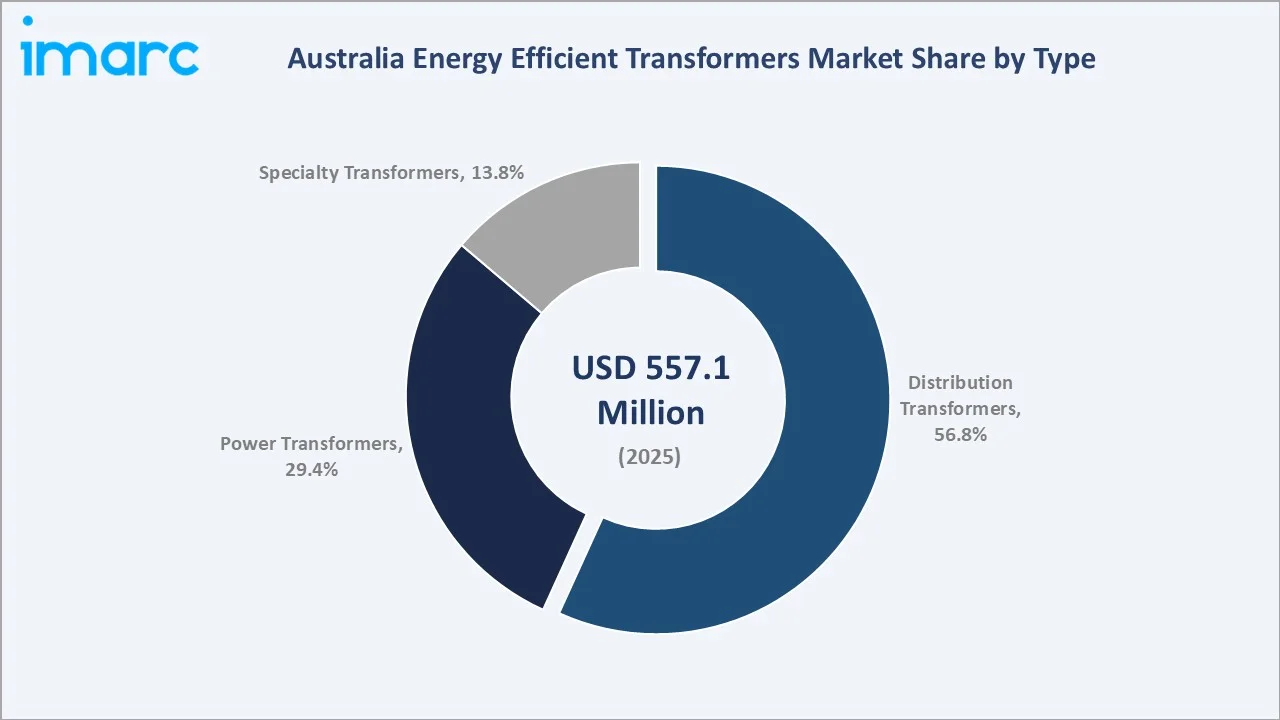
Distribution Transformers dominate at 56.8%. Oil-Cooled Transformers lead the cooling segment at 67.5%. Australia Capital Territory & New South Wales commands 34.8% of the national market share.
Market Snapshot
|
Metric |
Value |
|
Base Year Market Size (2025) |
USD 557.1 Million |
|
Market Size (2026) |
USD 595.9 Million |
|
Forecast Market Size (2034) |
USD 910.8 Million |
|
CAGR (2026-2034) |
5.45% |
|
Base Year |
2025 |
|
Historical Period |
2020-2025 |
|
Forecast Period |
2026-2034 |
|
Dominant Type |
Distribution Transformers (56.8%, 2025) |
|
Dominant Cooling Type |
Oil-Cooled Transformers (67.5%, 2025) |
|
Leading Region |
ACT & New South Wales (34.8%, 2025) |
The Australia energy efficient transformers market size increased from USD 427.3 Million in 2020 to USD 557.1 Million in 2025 and is estimated to reach USD 595.9 Million in 2026. The market is further expected to grow to USD 726.2 Million by 2030 and USD 910.8 Million by 2034. Australia energy efficient transformers market is driven by the nation's accelerating renewable energy integration, mandatory efficiency standards, and large-scale grid modernization programs across all states and territories.
To get more information on this market, Request Sample
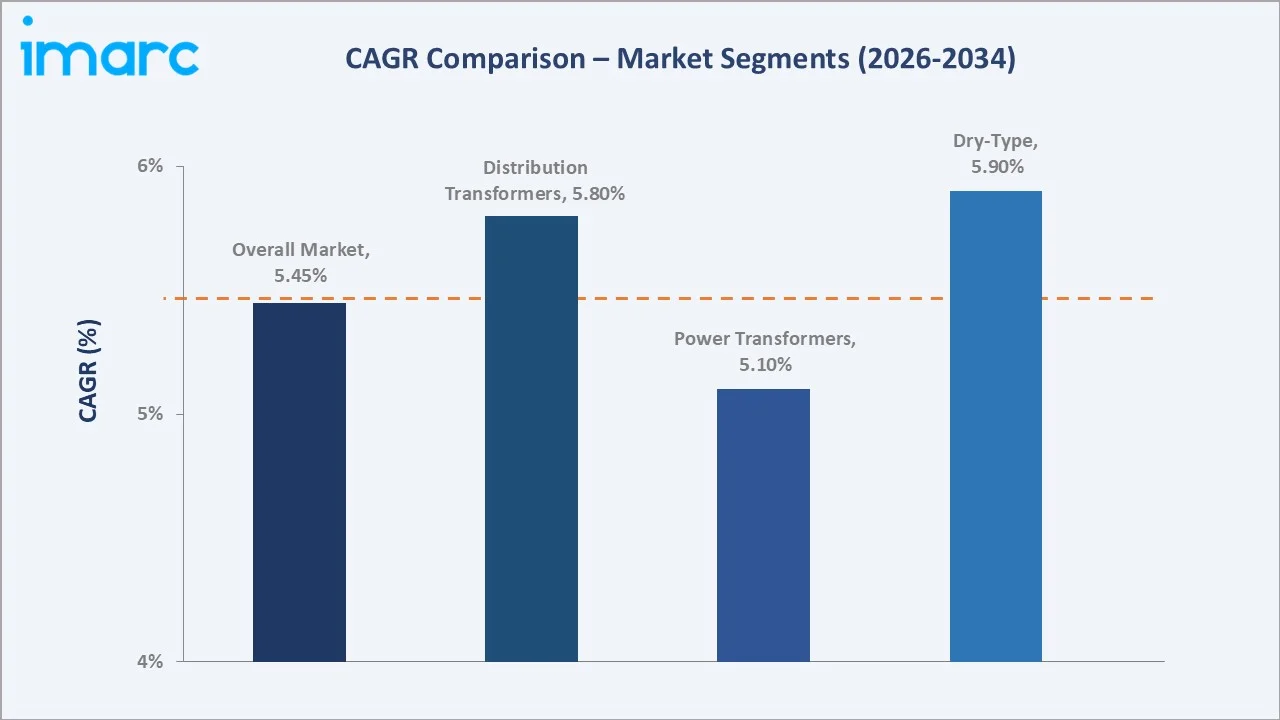
Distribution Transformers grow at approximately 5.8% CAGR through Australia's extensive grid upgrade programs and residential solar integration. Power Transformers grow at approximately 5.1% CAGR driven by large renewable energy connections to the national grid.
Executive Summary
The Australia energy efficient transformers market expanded from USD 557.1 Million in 2025 to an estimated USD 595.9 Million in 2026, positioning it as one of the Asia-Pacific's most commercially active energy infrastructure markets. The market's scale is underpinned by Australia's ambitious renewable energy targets, government-mandated minimum energy performance standards, and substantial grid modernization investments.
The market is projected to reach USD 910.8 Million by 2034. Distribution Transformers at 56.8% lead through grid expansion demand. Oil-Cooled Transformers at 67.5% reflect utility-scale deployment dominance. ACT & New South Wales leads regionally at 34.8%.
Key Market Insights
|
Insight |
Data |
|
Dominant Type |
Distribution Transformers – 56.8% share (2025) |
|
Dominant Cooling Type |
Oil-Cooled Transformers – 67.5% market share (2025) |
|
Leading Region |
ACT & New South Wales – 34.8% share (2025) |
|
Market Opportunity |
Grid modernisation programs; renewable energy integration; MEPS-driven upgrades; industrial electrification and EV charging infrastructure expansion |
Key Analytical Observations Supporting the Above Data:
- Distribution Transformers at 56.8%: The segment dominates due to extensive grid distribution networks, widespread residential solar adoption creating reverse power flow demands, and ongoing network upgrade programs by state-owned utilities across all Australian territories.
- Oil-Cooled Transformers at 67.5%: Oil-cooled variants lead through their suitability for high-voltage utility-scale applications and lower lifecycle costs in outdoor grid environments, making them the preferred choice for transmission and distribution network operators.
- ACT & New South Wales at 34.8%: This region dominates due to Sydney's dense urban grid infrastructure, ACT's 100% renewable energy target driving transformer procurement, and the highest concentration of commercial and industrial electricity consumers in Australia.
Australia Energy Efficient Transformers Market Overview
Australia energy efficient transformers market is commercially positioned at the intersection of the nation's energy transition, infrastructure investment cycle, and regulatory reform agenda. The combination of federal renewable energy commitments, state-level grid modernisation programs, and AEMO's Integrated System Plan creates a structured procurement pipeline.
Australia energy efficient transformers ecosystem integrates global manufacturers, domestic fabricators, EPC contractors, and utility operators. Macroeconomic factors include record renewable energy investment, rising electricity prices driving efficiency incentives, and national decarbonisation commitments supporting sustained market expansion.
Market Dynamics
To evaluate market opportunities, Request Sample
Market Drivers
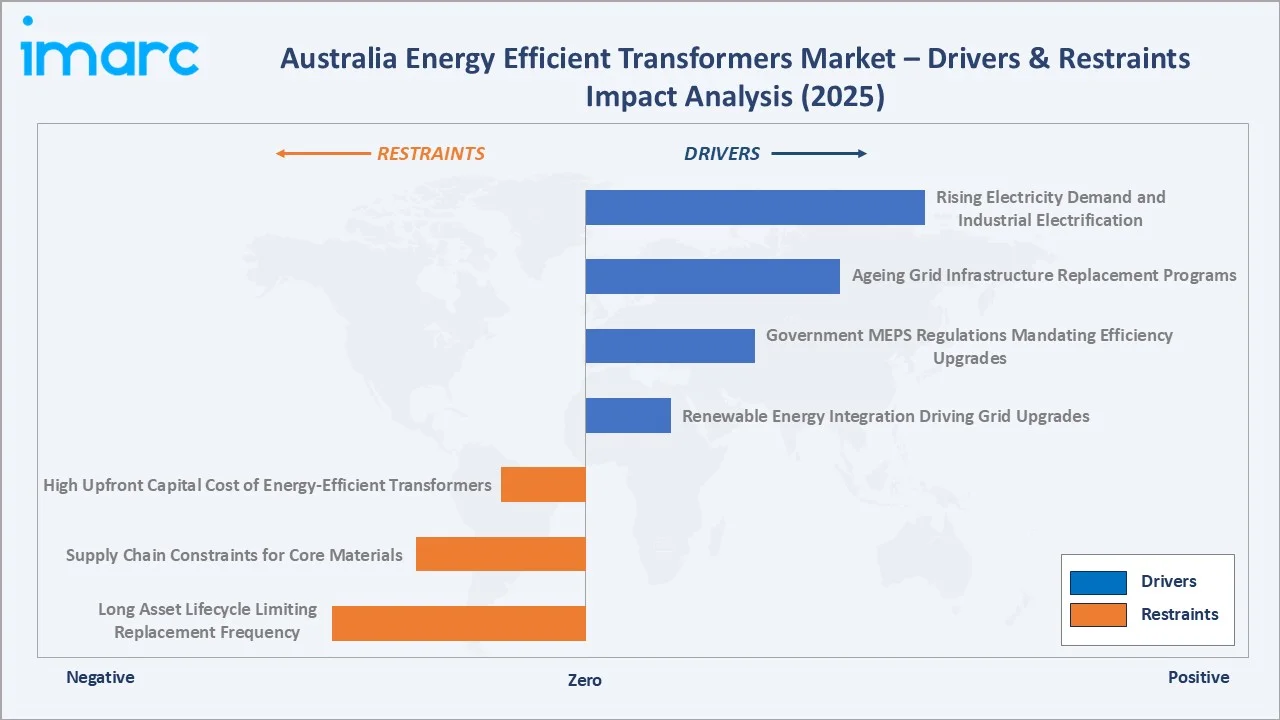
- Renewable Energy Integration Driving Grid Upgrades: Australia's accelerating transition to solar and wind energy requires advanced energy efficient transformers to manage variable power inputs and maintain grid stability. Integrating distributed generation requires significant upgrades to both transmission and distribution transformer infrastructure. This trend is accelerating as Australia's renewable energy capacity targets drive procurement across all grid levels, from utility-scale transmission to residential distribution networks connecting rooftop solar installations.
- Government MEPS Regulations Mandating Efficiency Upgrades: Australia's Minimum Energy Performance Standards (MEPS) for distribution transformers, administered through AS/NZS 2374, mandate that utilities and commercial operators replace underperforming legacy units with certified high-efficiency models. Government consultations on raising MEPS thresholds are actively underway, creating a pipeline of regulatory-driven replacement demand. These mandatory standards create non-discretionary procurement cycles, providing market participants with reliable, policy-protected demand that is structurally insulated from economic downturns and utility budget cycles.
- Ageing Grid Infrastructure Replacement Programs: A significant portion of Australia's distribution transformer fleet was installed between the 1970s and 1990s, creating a substantial wave of end-of-life asset replacement. State-owned network businesses are executing multi-year capital expenditure programs to replace ageing assets with modern energy-efficient units. This replacement cycle is generating consistent and growing demand for efficient transformers, particularly in legacy urban and regional networks where decades-old equipment is approaching technical limits and no longer meets modern safety and efficiency specifications.
- Rising Electricity Demand and Industrial Electrification: Growing electricity demand from data centres, electric vehicle charging infrastructure, industrial electrification, and residential heat pumps is requiring capacity upgrades across Australia's distribution networks. These demand drivers necessitate the installation of additional or higher-rated transformers at key network nodes. The electrification of transport and industrial heating applications is creating new transformer procurement requirements in locations previously underserved by the electricity network, expanding the total addressable market beyond traditional utility replacement cycles.
Market Restraints
- High Upfront Capital Cost of Energy-Efficient Transformers: Premium energy-efficient transformers command significant price premiums over standard legacy units, creating procurement barriers particularly for smaller utilities, municipal councils, and commercial building operators with constrained capital budgets. The higher upfront cost, despite superior lifecycle economics, requires sophisticated total-cost-of-ownership analysis that many procurement teams lack capacity to undertake. This cost barrier disproportionately impacts smaller distribution network operators and commercial building owners, slowing market penetration in the lower-voltage distribution segment.
- Supply Chain Constraints for Core Materials: The global shortage of grain-oriented electrical steel (GOES), a critical core material for energy efficient transformers, has created supply chain bottlenecks affecting production capacity and delivery timelines. Copper and aluminium winding material price volatility further complicates procurement cost forecasting. These supply chain constraints are limiting the ability of transformer manufacturers to rapidly scale production to meet accelerating demand from Australia's grid modernisation programs, creating delivery delays and upward price pressure.
- Long Asset Lifecycle Limiting Replacement Frequency: Distribution transformers typically have operational lifespans of 30-40 years, meaning that procurement decisions made during previous capital expenditure cycles lock in asset bases for decades. This long replacement cycle structurally limits the pace at which the existing transformer fleet can be upgraded to more efficient modern units, even when economic and regulatory incentives are present. The extended asset life creates a natural inertia in fleet modernisation programs that constrains the market's organic growth rate.
Market Opportunities
- Smart Grid and Digital Transformer Deployment: Australia's investment in smart grid technology is creating demand for digitally enabled transformers equipped with IoT sensors, real-time monitoring, and predictive maintenance capabilities. These smart transformer solutions command premium pricing and are being specified in major grid modernisation tenders by network operators seeking to improve asset management efficiency and reduce outage risks across their distribution infrastructure.
- Utility-Scale Renewable Energy Connection Investments: The pipeline of utility-scale solar, wind, and battery storage projects requiring grid connection is generating substantial demand for large power transformers at both transmission and substation levels. Australia's Clean Energy Regulator's renewable investment pipeline represents a multi-year procurement opportunity for high-efficiency power transformer suppliers with proven utility-scale delivery capabilities.
Market Challenges
- Skilled Workforce Shortage for Installation and Maintenance: Australia faces a structural shortage of licensed electrical engineers and transformer specialists capable of installing and maintaining advanced energy efficient transformer systems. This workforce constraint creates project delivery bottlenecks and increases installation costs, particularly in regional and remote areas where qualified contractors are scarce and mobilisation costs are prohibitive.
- Import Dependency and Freight Cost Pressures: Australia's transformer market relies heavily on imported units from global manufacturers, exposing procurement programs to currency volatility, shipping cost escalation, and extended lead times. Domestic manufacturing capacity, while growing through initiatives such as Wilson Transformer Company's AUD 8.7 million government-funded expansion, remains insufficient to fully satisfy the accelerating domestic demand from grid modernisation and renewable energy programs.
Emerging Market Trends
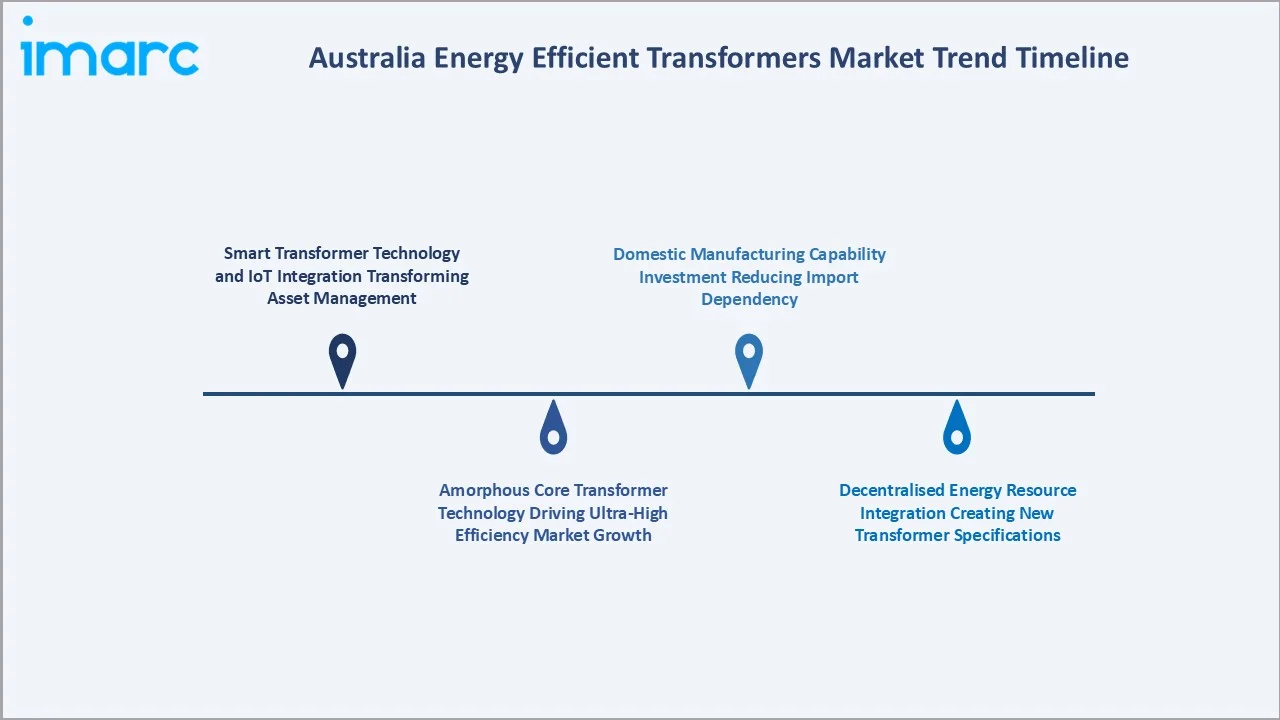
1. Smart Transformer Technology and IoT Integration Transforming Asset Management
Digital and smart transformer adoption is accelerating as network operators seek real-time performance monitoring, predictive maintenance, and remote diagnostics capabilities. These connected transformer solutions enable utilities to optimise asset utilisation, reduce outage risks, and improve network efficiency. The integration of IEC 61850 communications protocols and embedded sensor networks is becoming a standard specification requirement in major distribution network procurement tenders across eastern Australia.
2. Amorphous Core Transformer Technology Driving Ultra-High Efficiency Market Growth
Amorphous metal core transformers, which offer 70-80% lower no-load losses compared to conventional silicon steel core units, are gaining significant traction in Australia's distribution segment. Network operators facing rising energy costs and stringent efficiency regulations are specifying amorphous core units in new installations and replacements. The technology's superior efficiency characteristics align directly with Australia's MEPS upgrade trajectory and lifecycle cost optimisation requirements.
3. Decentralised Energy Resource Integration Creating New Transformer Specifications
The proliferation of rooftop solar, battery storage, and electric vehicle charging is creating unprecedented bidirectional power flows across distribution networks, requiring transformers designed and rated for variable loading patterns. Network operators are specifying transformers with on-load tap changers, voltage regulation capabilities, and dynamic thermal rating systems that can manage the variable power quality conditions created by distributed energy resources.
4. Domestic Manufacturing Capability Investment Reducing Import Dependency
Government initiatives supporting domestic transformer manufacturing capacity, exemplified by Wilson Transformer Company's AUD 8.7 million Modern Manufacturing Initiative grant, are reducing Australia's import dependency and improving supply chain resilience. This domestic production expansion is shortening lead times for critical grid assets and supporting the nation's sovereign capability objectives in energy infrastructure.
Industry Value Chain Analysis
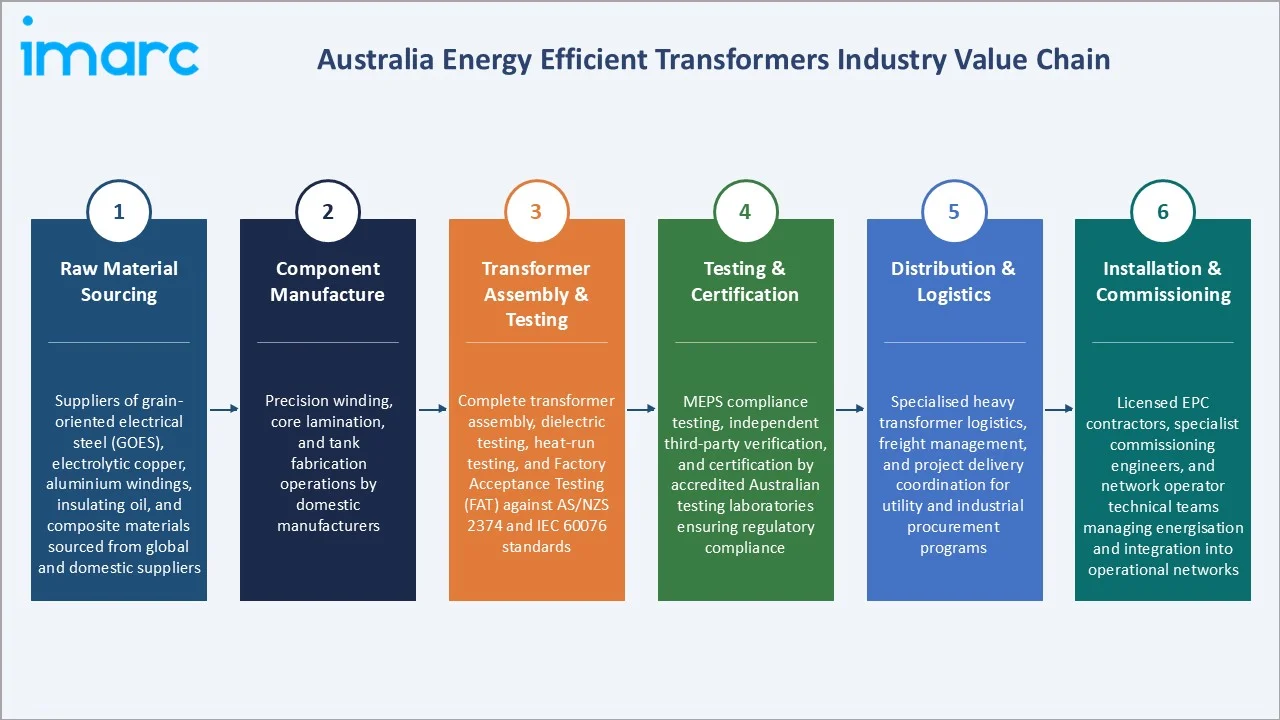
Australia energy efficient transformers value chain connects raw material suppliers through precision manufacturing processes, rigorous testing and certification regimes, and specialised distribution channels to reach utility operators, industrial consumers, and commercial building owners. The value chain's integrity is governed by AS/NZS 2374 standards and international IEC certifications.
|
Stage |
Key Participants |
|
Raw Material Sourcing |
Suppliers of grain-oriented electrical steel (GOES), electrolytic copper, aluminium windings, insulating oil, and composite materials sourced from global and domestic suppliers |
|
Component Manufacture |
Precision winding, core lamination, and tank fabrication operations by domestic manufacturers |
|
Transformer Assembly & Testing |
Complete transformer assembly, dielectric testing, heat-run testing, and Factory Acceptance Testing (FAT) against AS/NZS 2374 and IEC 60076 standards |
|
Testing & Certification |
MEPS compliance testing, independent third-party verification, and certification by accredited Australian testing laboratories ensuring regulatory compliance |
|
Distribution & Logistics |
Specialised heavy transformer logistics, freight management, and project delivery coordination for utility and industrial procurement programs |
|
Installation & Commissioning |
Licensed EPC contractors, specialist commissioning engineers, and network operator technical teams managing energisation and integration into operational networks |
The testing and certification stage is Australia energy efficient transformers value chain's most commercially critical regulatory step, where MEPS compliance verification separates high-efficiency certified units from standard equipment, enabling manufacturers to command significant price premiums in regulated procurement processes.
Technology Landscape in the Australia Energy Efficient Transformers Industry
Silicon Steel and Amorphous Core Technologies
Grain-oriented silicon steel and amorphous metal core technologies represent the two primary transformer core materials, each optimised for different efficiency and cost profiles. Silicon steel cores dominate in power transformers and large distribution units where mechanical robustness and temperature tolerance are paramount. Amorphous metal cores, offering dramatically reduced no-load losses, are increasingly specified in distribution transformer applications where continuous energisation creates significant cumulative energy loss differences that justify their premium cost.
Dry-Type and Cast Resin Transformer Technology
Dry-type and cast resin transformer technologies eliminate the fire risk associated with insulating oil, making them preferred for indoor commercial, industrial, and transit infrastructure applications in Australia. These technologies meet safety requirements for building-integrated substations, mining operations, and offshore platform applications. The growing specification of dry-type units in commercial buildings and data centres is driving technology development toward higher voltage ratings and improved thermal management in compact form factors.
Digital Monitoring and Smart Grid Integration Technology
Advanced embedded sensor networks, real-time thermal monitoring, dissolved gas analysis, and IEC 61850 compliant communications interfaces are transforming transformer functionality beyond passive power conversion into active grid intelligence assets. Australian network operators are specifying these digital capabilities in major asset replacement programs, enabling predictive maintenance regimes that reduce unplanned outages and extend effective asset life beyond traditional inspection-based maintenance cycles.
Market Segmentation Analysis
The report covers the following segments:
|
Segment Category |
Leading Segment |
Market Share |
Year |
|
Type |
Distribution Transformers |
56.8% |
2025 |
|
Cooling Type |
Oil-Cooled Transformers |
67.5% |
2025 |
|
Efficiency Level |
🔒 |
🔒 |
2025 |
|
Application |
🔒 |
🔒 |
2025 |
|
Region |
ACT & New South Wales |
34.8% |
2025 |

By Type
Distribution Transformers lead at 56.8% (2025). This segment encompasses the largest volume of transformer units across Australia's electricity networks, serving residential, commercial, and light industrial consumers through low-voltage step-down applications at the final stage of the distribution network.
To access detailed market analysis, Request Sample
Power Transformers at 29.4% serve Australia's high-voltage transmission network and large renewable energy connection projects, commanding the highest individual unit values. Specialty Transformers at 13.8% serve mining, rail traction, and offshore applications requiring bespoke specifications.
By Cooling Type
Oil-Cooled Transformers lead at 67.5% (2025). Oil-cooled units dominate through their superior thermal management for high-voltage utility applications, established maintenance infrastructure, and lower manufacturing costs at the utility scale that make them the default specification for network operators.
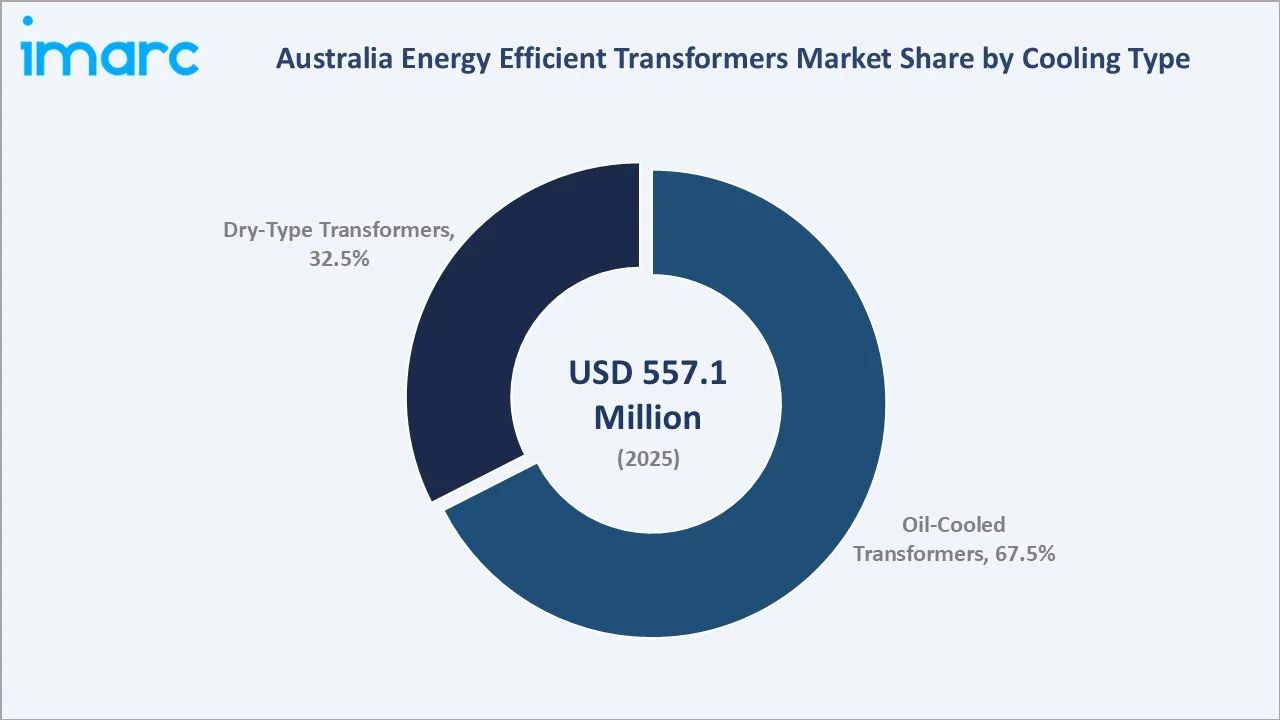
Dry-Type Transformers at 32.5% are growing at approximately 5.9% CAGR, the highest of any cooling segment, driven by increasing specification in commercial buildings, data centres, and indoor substation applications where fire safety considerations and environmental regulations preclude oil-cooled equipment.
Regional Market Insights
|
Region |
Share (2025) |
Key Australia Energy Efficient Transformers Market Drivers & Characteristics |
|
Australia Capital Territory & New South Wales |
34.8% |
Driven by Sydney's dense urban network, ACT's 100% renewable energy target, and the highest concentration of commercial and industrial electricity demand in Australia. |
|
Victoria & Tasmania |
24.6% |
Supported by Victoria's major renewable energy projects, the Golden Plains Wind Farm connection, and Melbourne's extensive distribution network upgrade programs. |
|
Queensland |
18.7% |
Reflects Queensland's strong resource and industrial sector electricity demand, coal-to-renewable transition programs, and significant grid connection requirements for large-scale solar farms. |
|
Western Australia |
13.4% |
Driven by Western Australia's standalone power systems, mining sector electrification, and the South West Interconnected System (SWIS) upgrade and renewable integration programs. |
|
Northern Territory & Southern Australia |
8.5% |
Rising renewable energy penetration in South Australia, the nation's highest per-capita renewable share, is driving transformer upgrades and smart grid investments across the region. |
ACT & New South Wales 34.8% market leadership reflects Sydney's extensive distribution network density, ACT Government's 100% renewable electricity procurement mandate, and New South Wales' Electricity Infrastructure Roadmap driving large-scale transmission infrastructure investment. Victoria & Tasmania's 24.6% reflects Melbourne's network upgrade cycle and major wind farm connection transformer procurement.
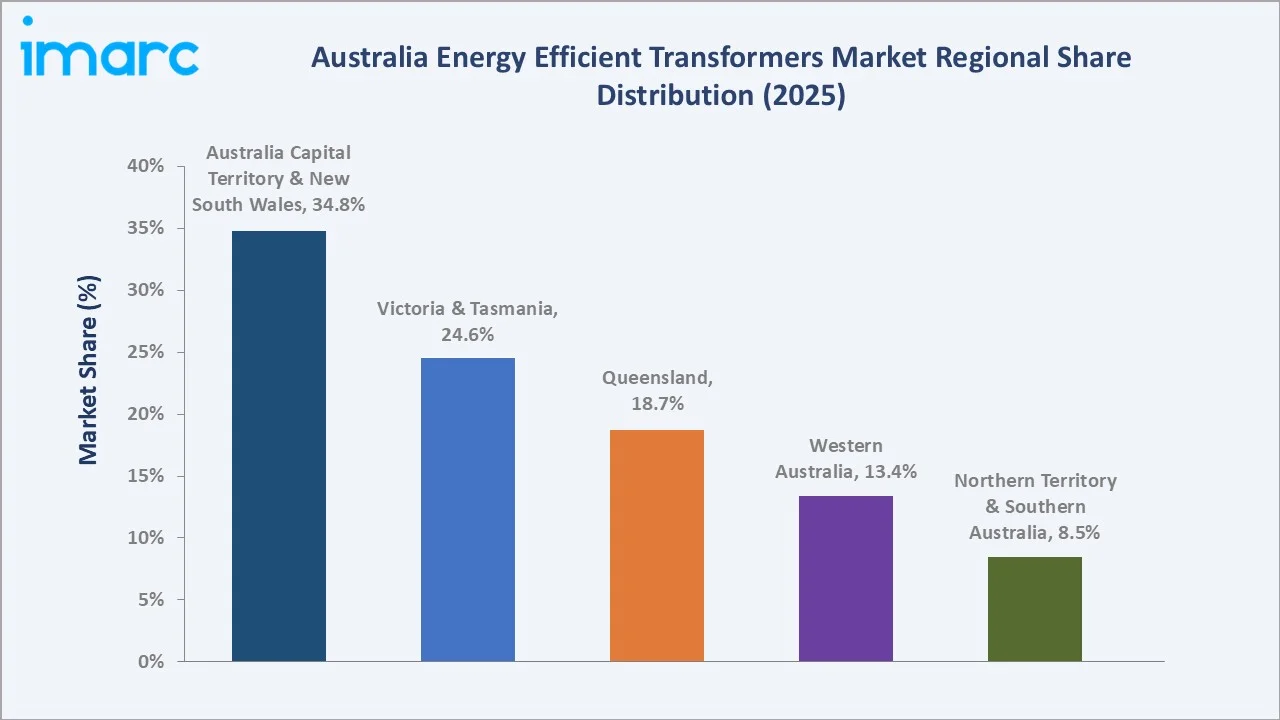
Queensland's 18.7% captures the state's significant renewable energy development pipeline and industrial electrification programs across mining and resources sectors. Western Australia's 13.4% reflects the South West Interconnected System upgrade and significant standalone power system investments in remote communities and mining operations.
Competitive Landscape
Australia energy efficient transformers market competitive landscape combines global electrical equipment majors with a significant domestic manufacturer. Competition is intensifying through MEPS compliance requirements, smart transformer specifications, and major utility procurement tenders for grid modernisation programs.
|
Company |
Key Products |
Market Position |
Core Strength |
|
ABB |
PowerTransformer, EcoDry |
Market Leader |
Global leader with long-standing Australian market presence, Perth manufacturing heritage, and comprehensive product portfolio across all transformer categories. |
|
Siemens |
GEAFOL Cast Resin, SLIM Distribution, ONAN Power |
Strong Challenger |
Global engineering giant with proven Australian utility credentials and comprehensive digital transformer and smart grid integration capabilities. |
|
Hitachi, Ltd. |
PowerTrans, TXpert Digital, RESIBLOC |
Strong Challenger |
Major renewable energy connection partner; delivered 850 MVA transformers for Golden Plains Wind Farm, establishing premium project credentials. |
|
Schneider Electric |
Minera Oil, Trihal Cast Resin |
Innovator |
Commercial and industrial building-integrated transformer specialist with strong Australian EPC contractor and data centre sector relationships. |
|
Wilson Transformer Company |
Distribution Transformers ≤5,000kVA, Compact MV Substations |
Domestic Leader |
Australia's largest domestic manufacturer; government-funded capacity expansion and CIGRE Gold Sponsor; deep utility procurement relationships. |
|
Eaton |
Cooper Power Trident |
Regional Player |
Strong distribution transformer range with established Australian utility and mining sector customer base and local technical support capabilities. |
Key players include ABB, Siemens, Hitachi, Ltd., Schneider Electric, Wilson Transformer Company, Eaton, and others.
Key Company Profiles
ABB
ABB is a leading global technology company in electrification and automation, with a significant presence in Australia's energy efficient transformers market spanning utility, industrial, and commercial applications.
- Key Products: PowerTransformer, EcoDry Transformer, RESIBLOC Cast Resin Transformer, among others.
- Strategic Focus: Maintaining market leadership through comprehensive product portfolio, digital transformer technology, and deep Australian utility relationship management across all states and territories. ABB continues to invest in smart transformer capabilities and is actively targeting the growing renewable energy connection market across Australia's national electricity grid.
Wilson Transformer Company
Wilson Transformer Company Pty Ltd. is Australia's largest domestic transformer manufacturer, established in 1933 and operating two state-of-the-art manufacturing facilities in Victoria, serving Australia's critical energy infrastructure with distribution and power transformer solutions.
- Key Products: Distribution Transformers (≤5,000kVA), Compact MV Substations, Special Application Transformers, among others.
- Strategic Focus: Leveraging domestic manufacturing advantages, government support, and deep utility procurement relationships to maintain leadership in the distribution transformer segment while expanding service capabilities across Australia and internationally. The company actively participated as Gold Sponsor at CIGRE Australia 2025 in Adelaide, underscoring its commitment to energy transition technology leadership.
Market Concentration Analysis
Australia energy efficient transformers market is moderately concentrated in the premium utility and power transformer segment, with the key players commanding the majority of high-voltage project value. The distribution transformer segment is more competitive, with domestic players maintaining strong domestic share alongside global players.
Market concentration is evolving as renewable energy connection projects create large individual procurement events that favour globally scaled manufacturers with proven high-voltage project credentials, while MEPS-driven distribution transformer replacement programs support Wilson Transformer Company's domestic manufacturing cost advantages.
Investment & Growth Opportunities
Highest Growth Segments
Dry-Type Transformers (~5.9% CAGR through commercial and data centre growth), Power Transformers (~5.1% CAGR through renewable energy connections), amorphous core distribution transformer niche (~8-10% CAGR), smart digital transformer segment (~12-15% CAGR from small base), and ACT & New South Wales regional procurement (~5.5% CAGR through infrastructure investment) represent Australia's highest-growth transformer investment vectors through 2034.
Emerging Investment Opportunities
Australia's digital transformer market, growing at 12-15% annually from a nascent base, represents the highest-CAGR specialty segment. The adoption of TXpert-class digital monitoring platforms in utility asset management programs is creating a premium product category with significant recurring service revenue potential beyond the initial equipment sale.
Investment Themes
- Domestic Manufacturing Capacity Expansion: Government support for transformer manufacturing through the Modern Manufacturing Initiative creates co-investment opportunities for domestic production expansion, reducing import dependency and improving supply chain resilience for critical energy infrastructure.
- Smart Grid and Digital Transformer Platforms: Investment in IoT-enabled transformer monitoring and management platforms aligned with AEMO's digital grid roadmap represents the highest-growth commercial opportunity in Australia's transformer market through the forecast period.
Future Market Outlook (2026-2034)
The Australia energy efficient transformers market is projected to grow from USD 557.1 Million in 2025 to USD 595.9 Million in 2026, reaching USD 910.8 Million by 2034, registering a CAGR of 5.45% during 2026–2034. The market's anchor value of USD 726.2 Million in 2030 represents Australia energy efficient transformers industry at a structural expansion inflection driven by renewable energy connection acceleration, MEPS stringency increases, and smart grid program execution.
Three structural forces define Australia energy efficient transformers market growth through 2034: the nation's renewable energy capacity build driving transformer procurement at unprecedented scale; mandatory efficiency standards creating non-discretionary replacement demand; and digital transformation of grid management creating premium specification opportunities across all transformer categories.
Research Methodology
Primary Research
Primary research comprised structured interviews with Australia energy efficient transformers industry stakeholders, including Procurement Managers, Network Operations Directors, EPC Project Managers, transformer testing laboratory specialists, and regulatory affairs executives from ARENA, AEMO, and state network businesses.
Secondary Research
Secondary research encompassed AEMO Integrated System Plan data, Australian Energy Regulator determinations, AER network investment reports, company annual reports, AS/NZS 2374 standards documentation, ARENA project databases, and Australia transformer import-export data. Over 45 secondary sources reviewed.
Forecasting Models
Market revenue forecasts were developed using a project pipeline model: AEMO's renewable energy connection forecast multiplied by average transformer value per MW of connection capacity, aggregated with MEPS-driven replacement demand modelling and industrial electrification loading growth rates.
Australia Energy Efficient Transformers Market Report Coverage:
| Report Features | Details |
|---|---|
| Base Year of the Analysis | 2025 |
| Historical Period | 2020-2025 |
| Forecast Period | 2026-2034 |
| Units | Million USD |
| Scope of the Report |
Exploration of Historical Trends and Market Outlook, Industry Catalysts and Challenges, Segment-Wise Historical and Future Market Assessment:
|
| Types Covered | Distribution Transformers, Power Transformers, Specialty Transformers |
| Cooling Types Covered | Oil-Cooled Transformers, Dry-Type Transformers |
| Efficiency Levels Covered | Low-Efficiency Transformers, High-Efficiency Transformers, Ultra-High-Efficiency Transformers |
| Applications Covered | Residential, Commercial, Industrial, Utilities |
| Regions Covered | Australia Capital Territory & New South Wales, Victoria & Tasmania, Queensland, Northern Territory & Southern Australia, Western Australia |
| Companies Covered | ABB, Siemens, Hitachi, Ltd., Schneider Electric, Wilson Transformer Company, Eaton, etc. |
| Customization Scope | 10% Free Customization |
| Post-Sale Analyst Support | 10-12 Weeks |
| Delivery Format | PDF and Excel through Email (We can also provide the editable version of the report in PPT/Word format on special request) |
Key Benefits for Stakeholders:
- IMARC’s industry report offers a comprehensive quantitative analysis of various market segments, historical and current market trends, market forecasts, and dynamics of the Australia energy efficient transformers market from 2020-2034.
- The research report provides the latest information on the market drivers, challenges, and opportunities in the Australia energy efficient transformers market.
- Porter's five forces analysis assist stakeholders in assessing the impact of new entrants, competitive rivalry, supplier power, buyer power, and the threat of substitution. It helps stakeholders to analyze the level of competition within the Australia energy efficient transformers industry and its attractiveness.
- Competitive landscape allows stakeholders to understand their competitive environment and provides an insight into the current positions of key players in the market.
Frequently Asked Questions About the Australia Energy Efficient Transformers Market Report
Australia energy efficient transformers market size is estimated at USD 595.9 Million in 2026, driven by renewable energy integration, government MEPS mandates, ageing grid replacement programs, and rising electricity demand across industrial and commercial sectors.
Australia energy efficient transformers market grows at 5.45% CAGR during 2026-2034, reaching USD 910.8 Million by 2034. Growth is sustained by renewable energy capacity expansion, mandatory efficiency standard upgrades, grid modernisation investment, and industrial electrification demand.
Distribution Transformers lead at 56.8% through Australia's extensive electricity distribution network, widespread residential solar integration, and continuous utility network upgrade programs across all states and territories.
Oil-Cooled Transformers lead at 67.5% through their suitability for high-voltage utility-scale applications, lower lifecycle costs in outdoor grid environments, and established maintenance infrastructure across Australian network operators.
ACT & New South Wales leads at 34.8% through Sydney's dense urban distribution network, ACT's 100% renewable energy mandate, and New South Wales' Electricity Infrastructure Roadmap driving major transmission investments.
Leading companies include ABB, Siemens, Hitachi, Ltd., Schneider Electric, Wilson Transformer Company, Eaton, and others.
Australia energy efficient transformers market is projected to reach approximately USD 726.2 Million by 2030, with digital transformer adoption accelerating, renewable energy connections driving premium power transformer demand, and MEPS stringency increases creating sustained distribution transformer replacement cycles.
Three priority investment opportunities: domestic manufacturing capacity expansion supporting supply chain resilience, smart digital transformer platform development aligned with AEMO's grid digitalisation roadmap, and amorphous core distribution transformer deployment targeting MEPS-driven utility replacement programs.
Need more help?
- Speak to our experienced analysts for insights on the current market scenarios.
- Include additional segments and countries to customize the report as per your requirement.
- Gain an unparalleled competitive advantage in your domain by understanding how to utilize the report and positively impacting your operations and revenue.
- For further assistance, please connect with our analysts.
 Request Customization
 Speak to an Analyst
 Request Brochure
 Inquire Before Buying
Benefits of Customization
- Personalize this research
- Triangulate with your data
- Get data as per your format and definition
- Gain a deeper dive into a specific application, geography, customer, or competitor
- Any level of personalization
Get in Touch With Us
UNITED STATES
Phone: +1-201-971-6302
INDIA
Phone: +91-120-433-0800
UNITED KINGDOM
Phone: +44-753-714-6104
Email: [email protected]
Client Testimonials




.webp)




.webp)













Related Reports

Choose your plan
*Please note that the prices mentioned below are starting prices for each bundle type. Kindly contact our team for further details.*
Single User License
- 1 User License, Access on 2 Devices
- PDF Report + Excel Dataset (Password Protected)
- Lifetime Access
- No Printing Rights
- 10% Free Report Customization
- 10–12 Weeks of Analyst Support
Five User License
- Access for 5 Users, 2 Devices per User
- PDF Report + Excel Dataset (Password Protected)
- Lifetime Access
- Dedicated Account Manager
- 12–14 Weeks of Analyst Support
- No Printing Rights
- 15% Free Report Customization
- 25% Discount on Your Next Purchase
Corporate User License
- Unlimited User Access (Within Your Organization)
- PDF Report + Excel Dataset
- Lifetime Access
- Dedicated Account Manager
- 14–20 Weeks of Analyst Support
- No Printing Rights
- 20% Free Report Customization
- 30% Discount on Your Next Purchase
Essential Insights
What's included:
3 reports
- Lifetime Access
- PDF Reports
- Excel Datasets
- 2 Weeks of Free Analyst Support
- 2 User Licenses
- Access on 2 Devices
- Printing Rights
- Complimentary PowerPoint (PPT) Version
- Complimentary License Upgrade
Professional Access
What's included:
5 reports
- Lifetime Access
- PDF Reports
- Excel Datasets
- 8 Weeks of Free Analyst Support
- 2 User Licenses
- Access on 2 Devices
- Printing Rights
- Complimentary PowerPoint (PPT) Version
- Complimentary License Upgrade
Business Advantage
What's included:
8 reports
- Lifetime Access
- PDF Reports
- Excel Datasets
- 14 Weeks of Free Analyst Support
- 2 User Licenses
- Access on 2 Devices
- Printing Rights
- Complimentary PowerPoint (PPT) Version
- Complimentary License Upgrade
Enterprise Intelligence
What's included:
10 reports
- Lifetime Access
- PDF Reports
- Excel Datasets
- 20 Weeks of Free Analyst Support
- 2 User Licenses
- Access on 2 Devices
- Printing Rights
- Complimentary PowerPoint (PPT) Version
- Complimentary License Upgrade