
Australia Online Grocery Market Size, Share, Trends and Forecast by Product Type, Business Model, Platform, Purchase Type, and Region, 2026-2034
Australia Online Grocery Market Size, Share, Trends & Forecast (2026-2034)
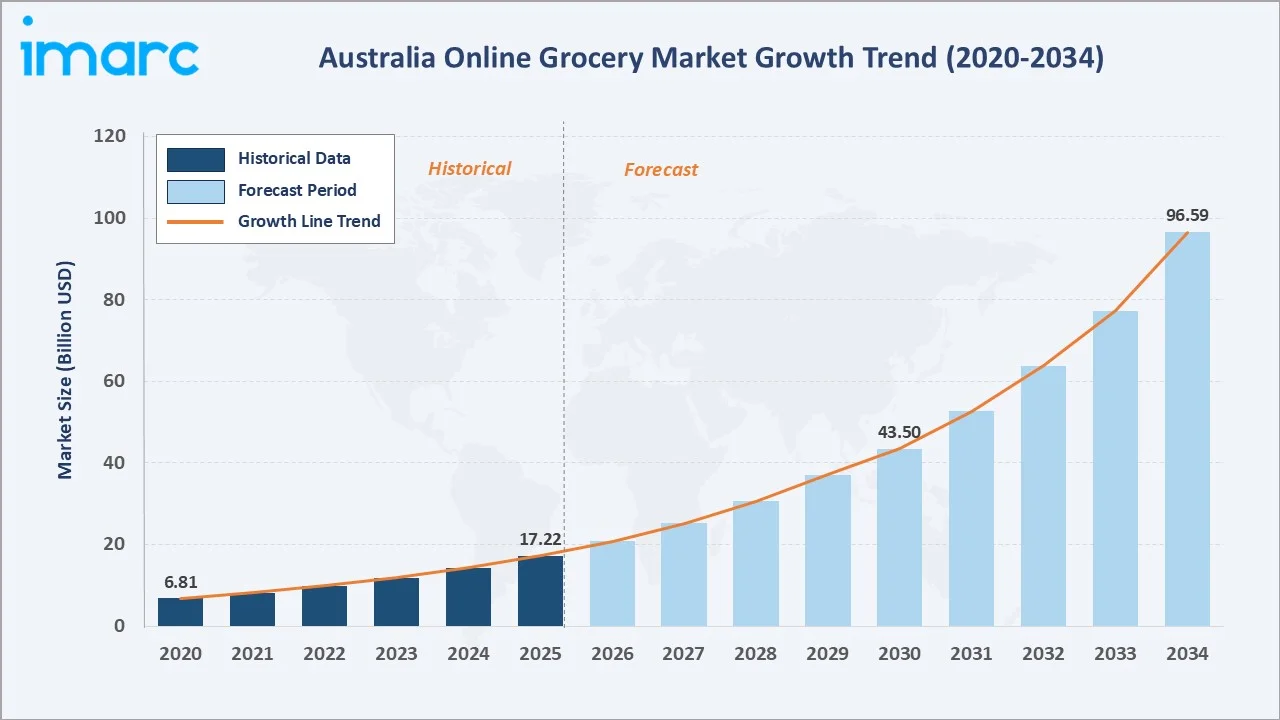
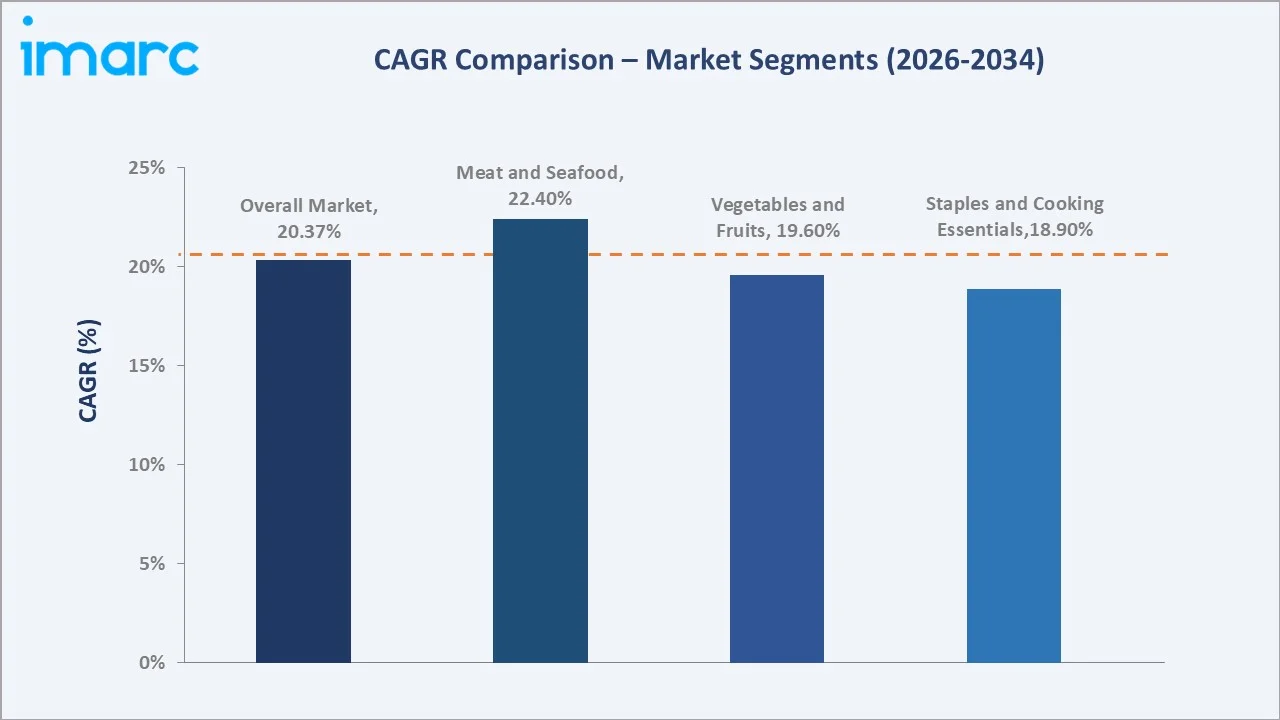
The Australia online grocery market reached USD 17.22 Billion in 2025 and is projected to reach USD 96.59 Billion by 2034, growing at a CAGR of 20.37% during 2026-2034. Growth in the Australia food and grocery retail market's digital channel is driven by a predominantly mobile-oriented consumer base, continued capital deployment into automated fulfilment infrastructure across Sydney and Melbourne, and broad-based adoption of application-driven grocery procurement. Staples and cooking essentials lead product type demand at 25.8%, hybrid marketplace dominates the business model split at 47.2%, and Australia Capital Territory & New South Wales commands 34.5% of the national market.
Market Snapshot
|
Metric |
Value |
|
Market Size (2025) |
USD 17.22 Billion |
|
Forecast Market Size (2034) |
USD 96.59 Billion |
|
CAGR (2026-2034) |
20.37% |
|
Base Year |
2025 |
|
Historical Period |
2020-2025 |
|
Forecast Period |
2026-2034 |
|
Dominant Product Type |
Staples and Cooking Essentials (25.8%, 2025) |
|
Dominant Business Model |
Hybrid Marketplace (47.2%, 2025) |
|
Leading Region |
ACT & New South Wales (34.5%, 2025) |
The market expanded from USD 6.81 Billion in 2020 to USD 17.22 Billion in 2025 - more than doubling in five years - anchored at USD 43.50 Billion in 2030 and forecast to reach USD 96.59 Billion by 2034. Continued capital deployment into automated Customer Fulfilment Centres across Sydney and Melbourne, together with rising smartphone-based reordering behaviour, has sustained the online grocery industry growth trajectory through successive waves of digital adoption.
To get more information on this market, Request Sample
Meat and seafood is the fastest-growing product type at an estimated ~22.4% CAGR as cold-chain technology and AI-assisted quality grading resolve residual consumer trust barriers around fresh-item selection. The hybrid marketplace business model grows at ~21.5% CAGR, ahead of the overall market, as operators combine first-party inventory with third-party seller participation to widen catalogue breadth without full merchant ownership.
Executive Summary
The Australia online grocery market reached USD 17.22 Billion in 2025, one of the fastest-digitising categories within Australia's retail economy as households shift essential purchasing from physical supermarkets to application-driven procurement. The market is projected to reach USD 96.59 Billion by 2034, underpinned by near-universal broadband connectivity, mature digital payments infrastructure, and sustained retailer investment in automated fulfilment.
Staples and cooking essentials at 25.8% dominate product type demand through habitual replenishment behaviour. Hybrid marketplace at 47.2% leads the business model segmentation by integrating first-party inventory with third-party seller listings on a single platform. ACT & New South Wales at 34.5% leads regionally, reflecting Sydney's population density and the co-location of major automated fulfilment centres.
Key Market Insights
|
Insight |
Data |
|
Dominant Product Type |
Staples and Cooking Essentials - 25.8% share (2025) |
|
Dominant Business Model |
Hybrid Marketplace - 47.2% market share (2025) |
|
Leading Region |
ACT & New South Wales - 34.5% market share (2025) |
|
Market Opportunity |
Quick commerce expansion; AI-driven basket personalisation; subscription delivery pass conversion; regional cold-chain network build-out |
Key Analytical Observations Supporting the Above Data:
- Staples and Cooking Essentials at 25.8%: Pantry staples represent one of the most naturally suited categories for online fulfilment: well-recognised products, established brand preferences, minimal quality-assessment uncertainty, and a replenishment cycle aligned with scheduled delivery windows. Coles Group reported that pantry essentials record the highest repeat-transaction frequency on its platform.
- Hybrid Marketplace at 47.2%: The hybrid model lets operators combine proprietary inventory with third-party vendor participation on one platform, achieving catalogue breadth that pure-play retail approaches struggle to replicate at comparable scale. Woolworths Everyday Market has expanded its independent-vendor partnerships to widen assortment and deepen cross-category engagement.
- ACT & New South Wales at 34.5%: Sydney's population density, extended commute times, and high concentration of dual-income households have positioned New South Wales as the pre-eminent hub of the country's digital grocery network, reinforced by the co-location of major Customer Fulfilment Centres within the greater metropolitan basin.
Australia Online Grocery Market Overview
The Australia online grocery market encompasses the sale and digital fulfilment of vegetables and fruits, dairy products, staples and cooking essentials, snacks, meat and seafood, and other grocery products through web-based and app-based platforms, spanning pure marketplace and hybrid marketplace business models across every Australian state and territory.
The ecosystem integrates grocery and FMCG suppliers, online grocery retailers, platform providers, automated fulfilment and logistics partners, and the millions of Australian households now transacting through digital channels. Macroeconomic factors shaping the Australia supermarket market share split between physical and digital channels include rising urban time-poverty and continued retailer capital expenditure on delivery infrastructure.
Market Dynamics
To evaluate market opportunities, Request Sample
Market Drivers
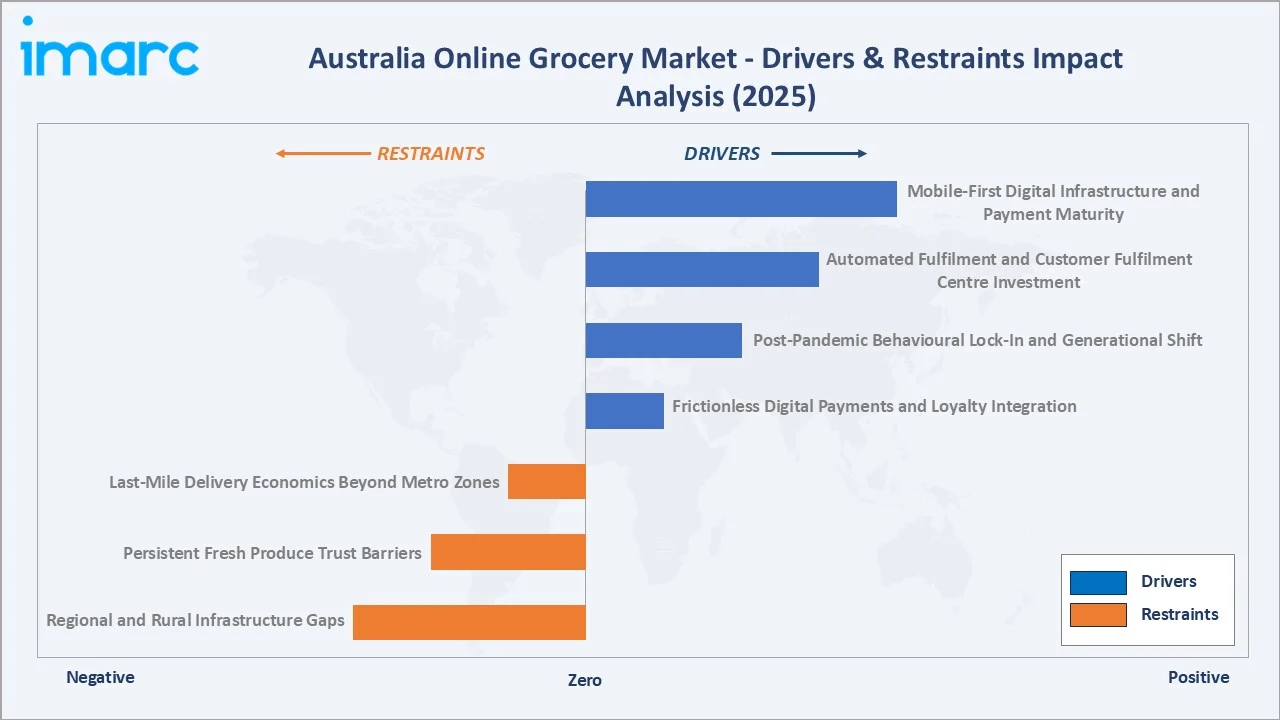
- Mobile-First Digital Infrastructure and Payment Maturity: Very few markets globally combine near-universal broadband connectivity, high smartphone ownership, and mature digitised payments infrastructure the way Australia does. As of February 2026, the country counted 25.94 million active internet users, equivalent to 96.7% of the population, with mobile sessions outnumbering desktop across every retail category. This foundational capability removes friction points that have historically impeded digital adoption among older demographic groups, sustaining strong online grocery industry analysis outlooks.
- Automated Fulfilment and Customer Fulfilment Centre Investment: Woolworths Group's Moorebank Customer Fulfilment Centre in Sydney, confirmed in June 2025, targets processing over 60,000 online orders per week from a single site, fundamentally reconfiguring the unit economics of online grocery operations. Coles' Witron-powered automated facility in Truganina, Victoria, similarly expanded daily order-picking capacity at materially reduced cost relative to conventional in-store fulfilment.
- Post-Pandemic Behavioural Lock-In and Generational Shift: A significant proportion of Australian consumers who first engaged with online grocery during COVID-related restrictions did not revert to exclusively in-store purchasing. As digitally native Millennial and Generation Z cohorts assume primary household purchasing responsibility, application-first retail engagement becomes the expected default, providing a durable structural tailwind for channel expansion.
- Frictionless Digital Payments and Loyalty Integration: The widespread integration of digital wallets, contactless payment functionality, and buy-now-pay-later platforms has eliminated much of the checkout-related hesitation that previously impeded new consumer conversion. Woolworths' Everyday Rewards programme recorded 10.2 million active members as of February 2025, positioning loyalty-integrated engagement as a consequential retention mechanism reinforcing repeat digital transactions.
Market Restraints
- Last-Mile Delivery Economics Beyond Metro Zones: In a market where physical supermarkets remain highly accessible, last-mile grocery delivery imposes significant operational costs, while consumers demonstrate persistent resistance to absorbing delivery fee charges. Even well-capitalised operators encounter difficulty substantiating the commercial rationale for regular home delivery beyond established metropolitan catchment areas, constraining network expansion timelines and near-term profitability.
- Persistent Fresh Produce Trust Barriers: A considerable segment of Australian consumers, particularly those who habitually prepare meals from fresh ingredients, retain reluctance to delegate produce selection to an unfamiliar picker. Adoption within the highest-frequency grocery categories continues to be moderated by concerns over substitution transparency, freshness standards, and the absence of direct sensory evaluation at the point of selection.
- Regional and Rural Infrastructure Gaps: Most regional, rural, and remote Australian communities lack access to the competitive online grocery infrastructure that metropolitan consumers regard as standard, including same-day fulfilment and price-competitive delivery terms. Inadequate broadband coverage and insufficient cold-chain network development collectively produce a bifurcated market structure that constrains national channel penetration.
Market Opportunities
- Quick Commerce (Q-Commerce) Expansion: Within Sydney and Melbourne, on-demand grocery delivery within a sub-two-hour window is moving from a high-end proposition to an expected feature of the service mix. As leading retailers extend rapid-commerce coverage into outer suburban catchments, quick commerce is opening a new layer of high-frequency, high-margin order volume beyond standard next-day delivery slots.
- Subscription Conversion and AI-Driven Personalisation: Woolworths and Coles are both pursuing conversion strategies that turn one-off buyers into loyal delivery-pass subscribers, while advanced recommendation engines increasingly surface contextually relevant items at valuable points in the shopping journey. Together, subscription conversion and AI-driven personalisation represent a durable lever for raising basket value and purchase frequency.
Market Challenges
- Delivery Fee Sensitivity Amid Cost-of-Living Pressures: Cost-of-living pressures have heightened Australian consumers' sensitivity to delivery fee charges, even as retailers seek to recover the true cost of last-mile fulfilment. This tension between affordability expectations and delivery economics continues to cap full-basket digital conversion among price-sensitive households.
- Competitive Intensity Sustaining High Capex Requirements: Intensifying competitive pressure among Woolworths, Coles, and Amazon Fresh is sustaining elevated capital expenditure requirements on fulfilment infrastructure, constraining near-term sector-wide profitability improvement. Smaller independent operators face a widening technology and logistics investment gap relative to the two dominant national chains.
Emerging Market Trends
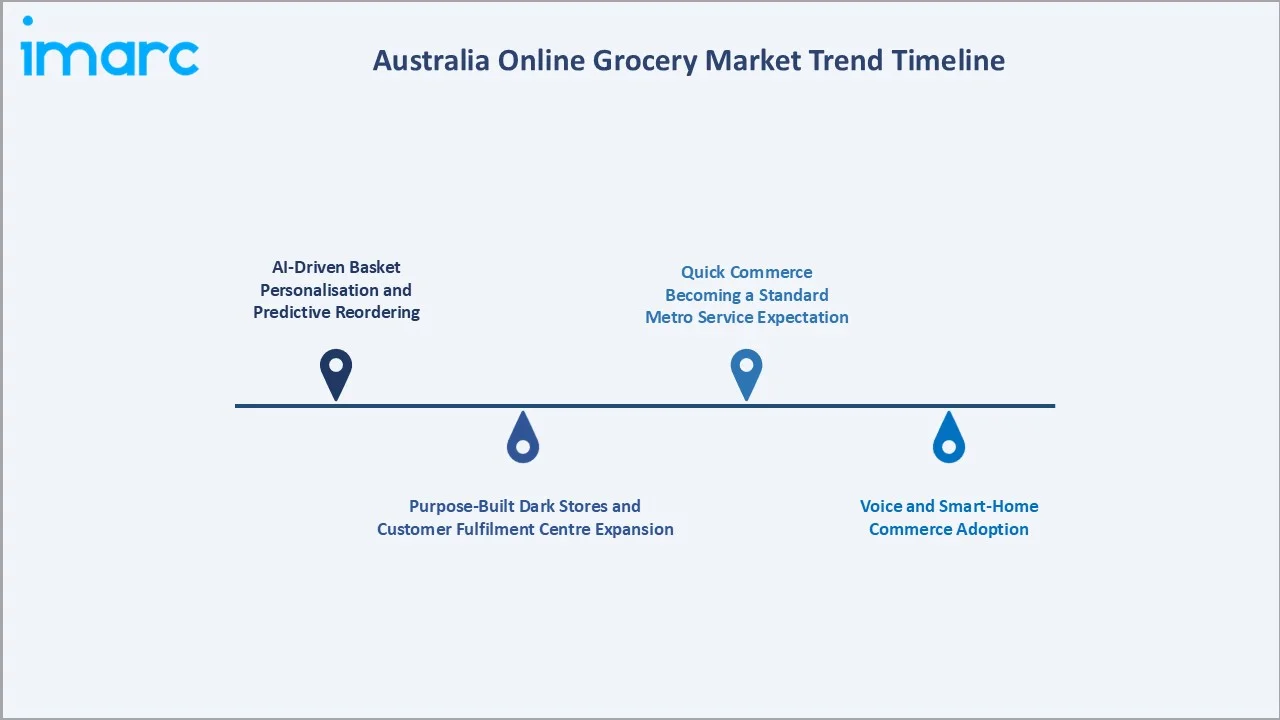
1. AI-Driven Basket Personalisation and Predictive Reordering
Advanced recommendation engines are leveraging machine learning to surface contextually appropriate items at relevant junctures within the shopping journey. Coles' redesigned mobile application, incorporated AI-powered basket recommendation capabilities alongside personalised aisle-view functionality to extend session duration and lift conversion.
2. Purpose-Built Dark Stores and Customer Fulfilment Centre Expansion
Leading retailers are systematically reducing cost-per-order through a network of purpose-engineered fulfilment nodes, spanning large suburban Customer Fulfilment Centres through to compact urban micro-warehouses. Capital committed to such infrastructure converts delivery from a cost-centre function into a durable competitive differentiator.
3. Quick Commerce Becoming a Standard Metro Service Expectation
Sub-two-hour on-demand grocery delivery within Sydney and Melbourne is transitioning from a premium service proposition to a baseline consumer expectation, prompting retailers to extend express delivery pilots into new catchments including Perth's northern suburbs.
4. Voice and Smart-Home Commerce Adoption
Time-constrained metropolitan living is showing early signs of adoption for smart speaker-enabled grocery reorder features, expanding consumer touchpoints beyond screen-based interfaces and further embedding online grocery within everyday household routines.
Industry Value Chain Analysis
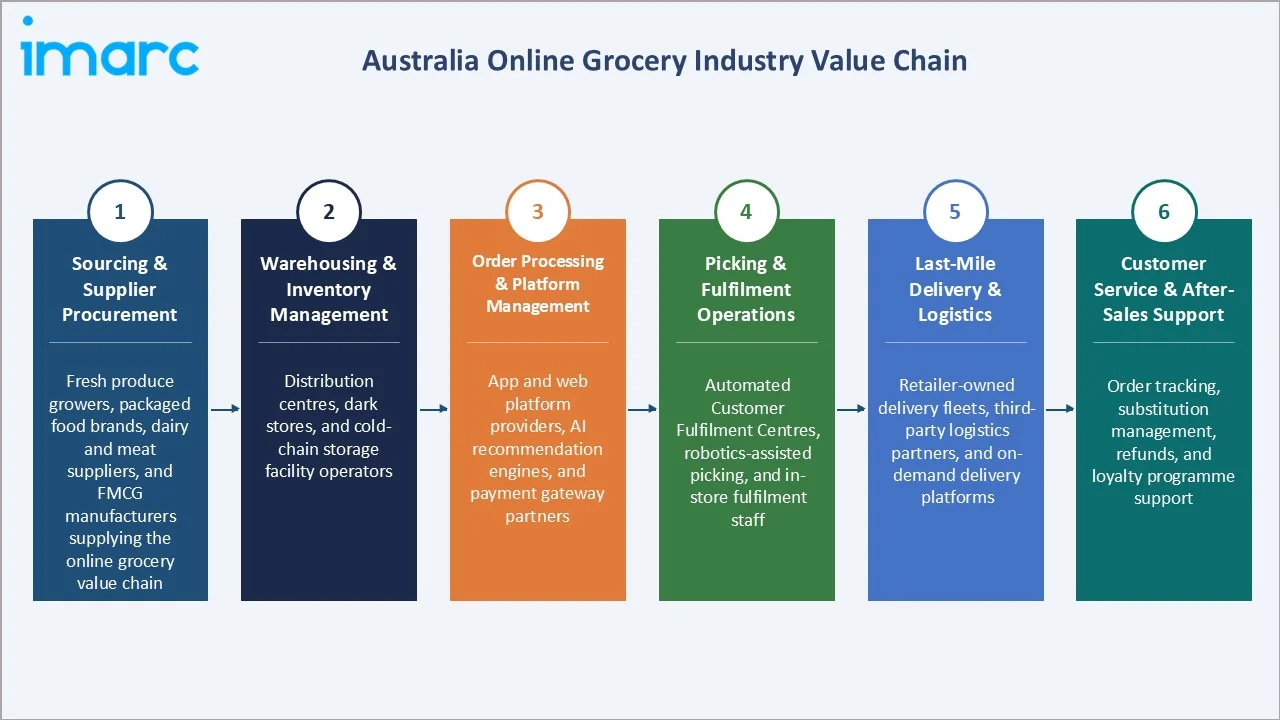
The Australia online grocery value chain integrates supplier sourcing, warehousing and inventory management, order processing through digital platforms, picking and fulfilment operations, last-mile delivery and logistics, and post-purchase customer service. The chain's commercial architecture has progressively consolidated toward automated, technology-integrated fulfilment as the primary operating format.
|
Stage |
Key Participants |
|
Sourcing & Supplier Procurement |
Fresh produce growers, packaged food brands, dairy and meat suppliers, and FMCG manufacturers |
|
Warehousing & Inventory Management |
Distribution centres, dark stores, and cold-chain storage facility operators |
|
Order Processing & Digital Platform Management |
App and web platform providers, AI recommendation engines, and payment gateway partners |
|
Picking & Fulfilment Operations |
Automated Customer Fulfilment Centres, robotics-assisted picking, and in-store fulfilment staff |
|
Last-Mile Delivery & Logistics |
Retailer-owned delivery fleets, third-party logistics partners, and on-demand delivery platforms |
|
Customer Service & After-Sales Support |
Order tracking, substitution management, refunds, and loyalty programme support |
The picking and fulfilment stage is the value chain's most rapidly automating segment, as robotics-enabled Customer Fulfilment Centres progressively displace manual in-store picking. The last-mile delivery stage remains the chain's most commercially sensitive link, given persistent consumer resistance to delivery fee charges.
Technology Landscape in the Australia Online Grocery Industry
AI-Powered Personalisation and Recommendation Technology
AI-powered personalisation technology analyses purchase history and browsing behaviour to surface relevant products and streamline reordering, improving basket value and platform loyalty. This capability is a central investment priority for Woolworths and Coles' respective digital platforms.
Automated Fulfilment and Robotics Technology
Automated fulfilment technology, including Witron and Ocado-style robotics, enables high-volume order picking at substantially reduced cost-per-order relative to manual in-store fulfilment. Coles' Truganina facility and Woolworths' Moorebank Customer Fulfilment Centre exemplify this shift toward robotics-driven fulfilment at national scale.
Mobile Application and Digital Payment Technology
App-based platforms, accounting for 62.4% of platform usage in 2025, are supported by digital wallets, contactless payment functionality, and buy-now-pay-later integration, remaining central to sustaining conversion across Australia's smartphone-based consumer base.
Market Segmentation Analysis
The report covers the following segments:
|
Segment Category |
Leading Segment |
Market Share |
Year |
|
Product Type |
Staples and Cooking Essentials |
25.8% |
2025 |
|
Business Model |
Hybrid Marketplace |
47.2% |
2025 |
|
Platform |
App-Based |
62.4% |
2025 |
|
Purchase Type |
One-Time |
65.7% |
2025 |
|
Region |
ACT & New South Wales |
34.5% |
2025 |

By Product Type
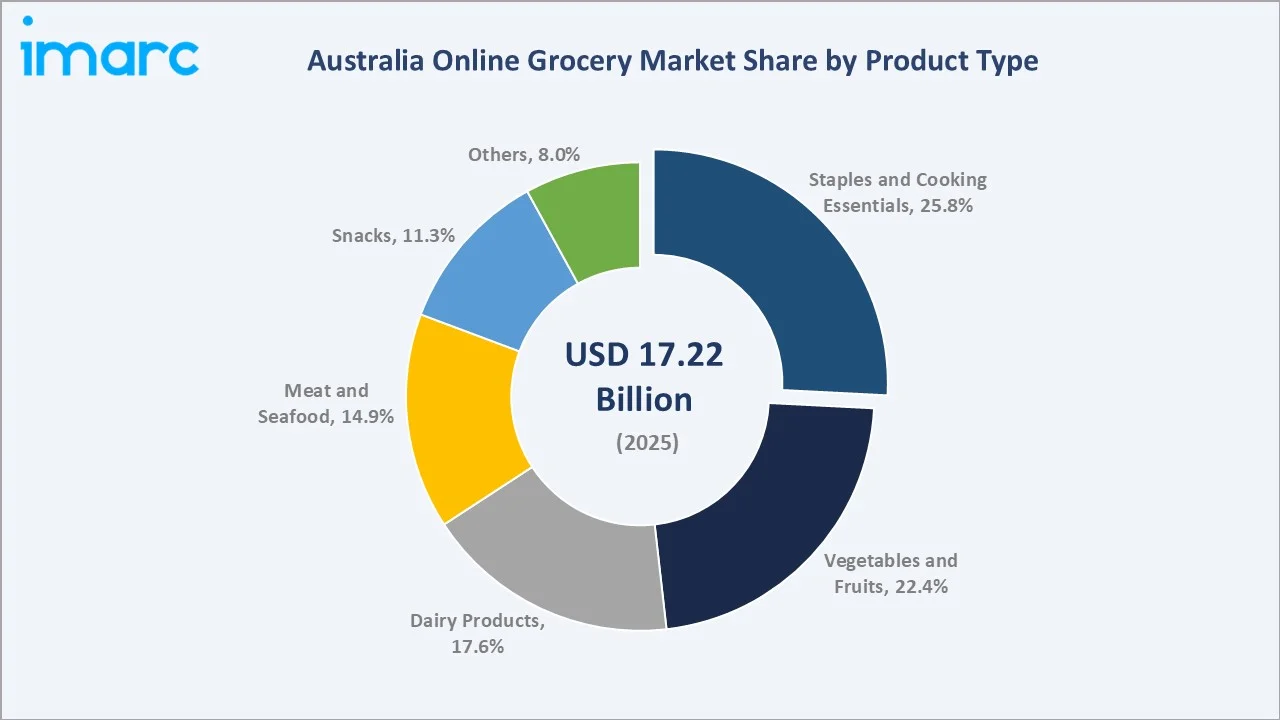
Staples and cooking essentials lead product type demand at 25.8% in 2025, reflecting the category's habitual replenishment behaviour and strong compatibility with scheduled delivery. This structural advantage explains why no discretionary category has meaningfully displaced it from the leading position within the Australia online grocery industry analysis.
To access detailed market analysis, Request Sample
Vegetables and fruits at 22.4% face the greatest consumer trust concerns around fresh-item selection, area retailers are addressing through AI-assisted quality grading. Dairy at 17.6% and meat and seafood at 14.9% reflect growing confidence in cold-chain-enabled fresh fulfilment, while snacks at 11.3% and other categories at 8.0% round out the mix.
By Business Model
Hybrid marketplace leads the business model split at 47.2% in 2025, the preferred architecture for Australian online grocery as it enables comprehensive catalogue management without requiring full merchant ownership of every product unit. Operators such as Woolworths Everyday Market combine proprietary inventory with third-party vendor participation to achieve product ranges pure-play retail models cannot easily replicate.
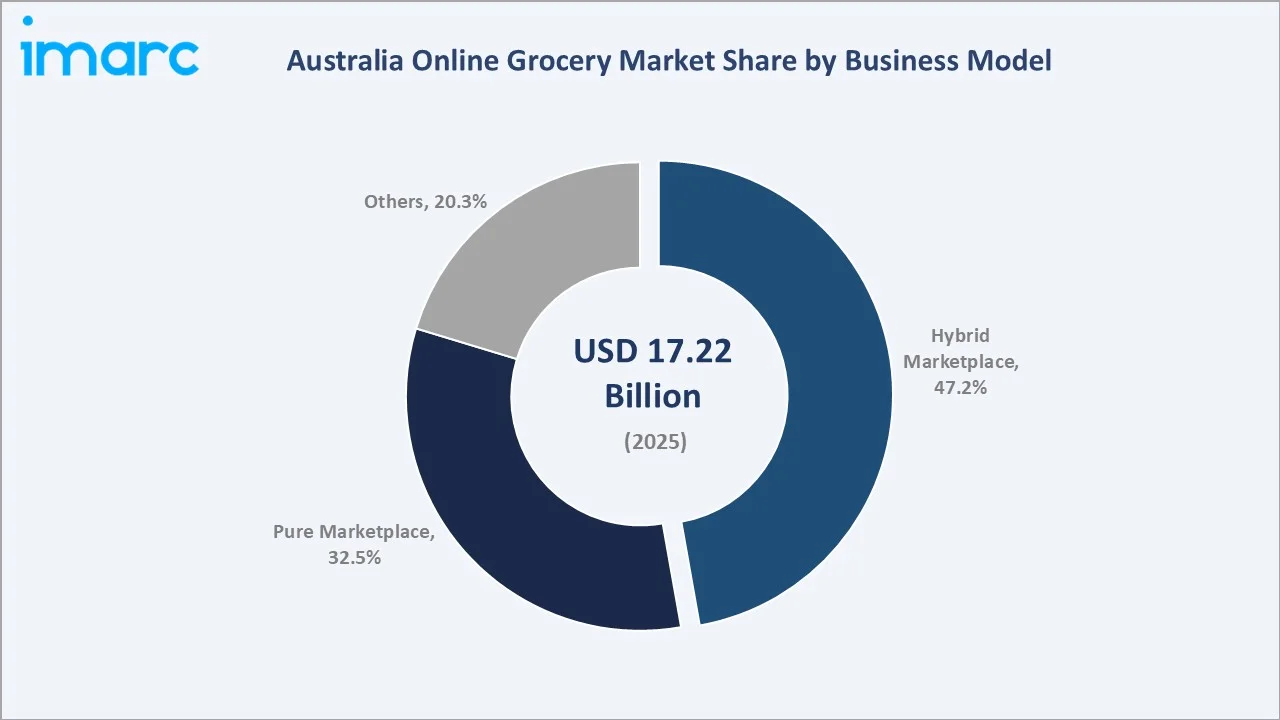
Pure marketplace at 32.5% serves consumers seeking a single retailer's own-brand and first-party assortment without third-party listings. Other business models at 20.3% include independent-retailer and click-and-collect-oriented formats concentrated outside the two dominant national chains.
Regional Market Insights
|
Region |
Share (2025) |
Key Market Drivers & Characteristics |
|
Australia Capital Territory & New South Wales |
34.5% |
Sydney's population density, concentration of automated Customer Fulfilment Centres, and high per-capita grocery spend |
|
Victoria & Tasmania |
25.7% |
High inner-metropolitan logistics density, Melbourne's Truganina Customer Fulfilment Centre, and strong digital retail culture |
|
Queensland |
17.8% |
Southeast Queensland growth corridor, Heathwood Customer Fulfilment Centre commissioning, and rising Gold Coast demand |
|
Western Australia |
13.4% |
Mining-sector household income, Perth express delivery pilots, and significant untapped delivery-coverage headroom |
|
Northern Territory & Southern Australia |
8.6% |
Independent-retailer digitalisation through Metcash's IGA Shop Online, and early-stage but expanding infrastructure |
ACT & New South Wales, at 34.5%, leads through Sydney's metropolitan density and the co-location of major automated fulfilment infrastructure. Victoria & Tasmania, at 25.7%, represents the most credible near-term challenger to New South Wales' national lead, with the margin between the two markets progressively narrowing as Melbourne's dark-store network continues to expand.
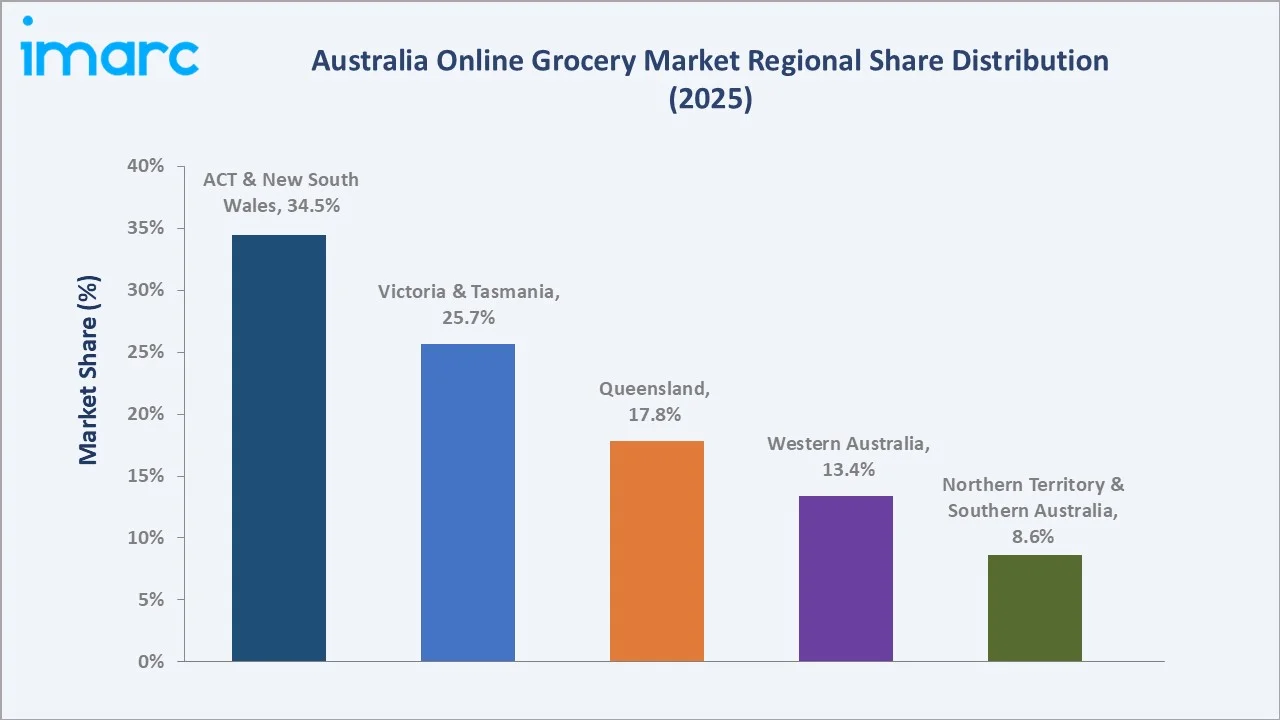
Queensland, at 17.8%, is expanding rapidly on Southeast Queensland's population growth corridor and new Customer Fulfilment Centre investment in Brisbane. Western Australia, at 13.4%, and the Northern Territory & Southern Australia, at 8.6%, remain earlier-stage but structurally improving markets as delivery coverage and independent-retailer digitalisation extend nationally.
Competitive Landscape
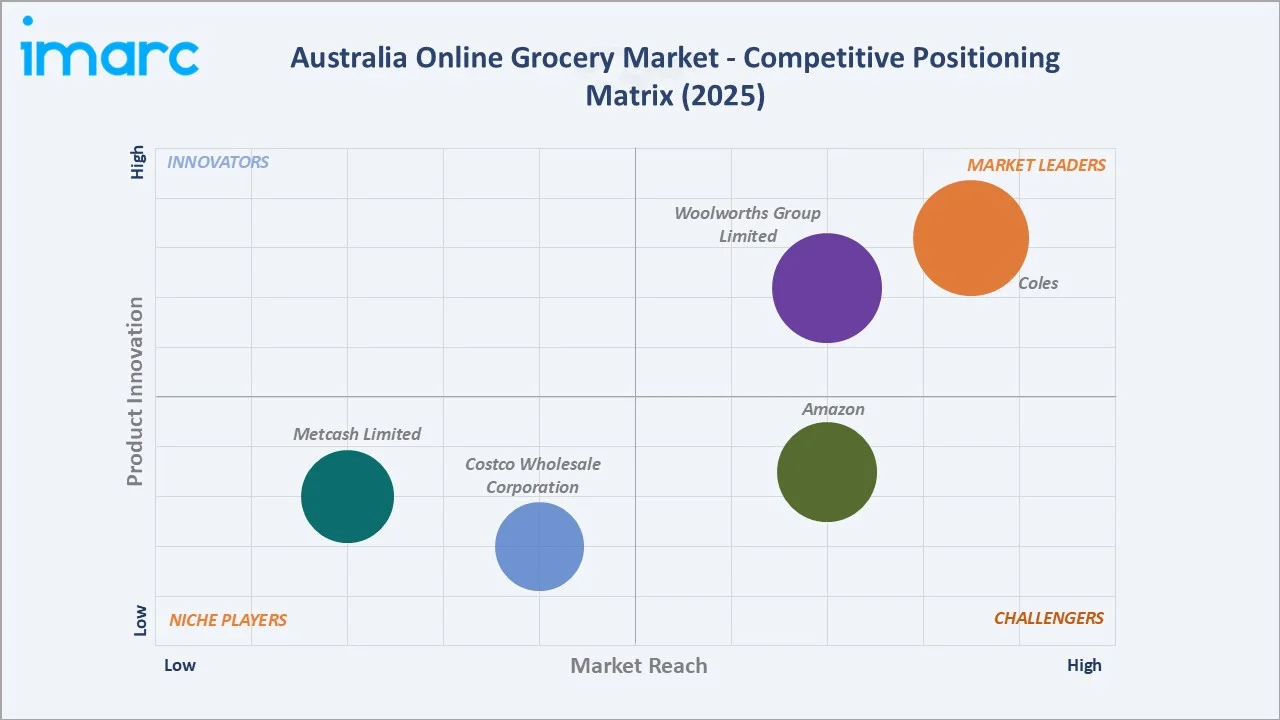
The Australia online grocery market competitive landscape is concentrated in structure yet substantively contested in practice. Key players retain commanding positional advantages through fulfilment infrastructure scale and loyalty programme depth, while other companies’ geographic expansion, disciplined value pricing, and independent network sustain meaningful competitive discipline across the sector.
|
Company Name |
Key Products / Brands |
Market Position |
Core Strength |
|
Woolworths Group Limited |
Vegetables and Fruits, Dairy Products, Snacks, Meat and Seafood |
Market Leader |
Australia's largest online grocery platform, combining same-day and next-day delivery with a market-leading loyalty ecosystem |
|
Coles |
Vegetables and Fruits, Dairy Products, Snacks, Meat and Seafood, Liquorland |
Market Leader |
Heavy investment in Witron-powered automated fulfilment and expanded on-demand delivery reach through its broadened Uber Eats partnership |
|
Amazon |
Vegetables and Fruits, Dairy Products, Snacks, Meat and Seafood, Staples and Cooking Essentials |
Strong Challenger |
Extending Amazon Fresh's same-day delivery coverage across Sydney suburbs while investing in large-scale robotics-enabled fulfilment infrastructure |
|
Metcash Limited |
IGA Shop Online, Foodland, Drakes |
Niche Leader |
Australia's largest independent-retailer network, with IGA Shop Online extending digital grocery access through hundreds of independent stores |
|
Costco Wholesale Corporation |
Snacks, Staples and Cooking Essentials |
Niche Player |
Membership-based bulk-purchasing model, offering value-focused grocery assortments to individual and business consumers |
Key players include Woolworths Group Limited, Coles, Amazon, Metcash Limited, Costco Wholesale Corporation, and others.
Key Company Profiles
Woolworths Group Limited
Woolworths Group Limited is Australia's largest grocery retailer, operating a leading online grocery platform through Woolworths Online, supported by its Everyday Rewards loyalty programme and expanding automated fulfilment network.
- Key Products: Vegetables and Fruits, Dairy Products, Snacks, Meat and Seafood
- Recent Developments: In February 2026, Woolworths Group secured 100% renewable electricity across its stores, distribution centres, Big W locations, and support offices in Australia and New Zealand, sourcing more than two-thirds of its power from wind, solar, and onsite generation.
- Strategic Focus: Expanding fulfilment and distribution capabilities to support growing online demand, strengthening customer loyalty and engagement, leveraging AI-enabled technologies to improve fresh-product quality, and continuing investments in sustainable infrastructure across the national network.
Coles
Coles operates one of Australia's two dominant supermarket chains, with a rapidly automating online grocery fulfilment network and an expanding on-demand delivery partnership footprint.
- Key Products: Vegetables and Fruits, Dairy Products, Snacks, Meat and Seafood, Liquorland
- Recent Developments: In December 2025, Coles broadened its partnership with Uber Eats to offer Australia's most extensive on-demand grocery selection via the Uber Eats app, boosting available Coles items by more than 50% for quick delivery.
- Strategic Focus: Scaling Witron-powered automated fulfilment following the Truganina Customer Fulfilment Centre commissioning, while extending on-demand delivery reach through expanded third-party platform partnerships. Coles continues investing in AI-powered basket recommendation features within its redesigned application to lift digital engagement and conversion.
Market Concentration Analysis
The Australia online grocery market is moderately concentrated, with the key players collectively accounting for most of the online grocery revenue through combined fulfilment infrastructure and loyalty programme scale. Independent network account for a growing share of remaining volume as digital penetration extends into regional and value-oriented segments. Concentration is expected to moderate gradually as quick commerce specialists and independent-retailer digitalisation create new competitive segments outside the two dominant chains.
Investment & Growth Opportunities
Highest Growth Segments
Meat and seafood product type (~22.4% CAGR), hybrid marketplace business model (~21.5% CAGR), quick commerce delivery formats, AI-driven basket personalisation infrastructure, and regional cold-chain network expansion represent the highest-growth investment vectors through 2034.
Emerging Investment Opportunities
Regional and rural fulfilment infrastructure represents the market's highest-headroom emerging opportunity: extending automated Customer Fulfilment Centre coverage and cold-chain logistics beyond Sydney, Melbourne, and Brisbane into underserved regional centres could unlock a substantial addressable population currently excluded from competitive online grocery access.
Investment Themes
- Automated fulfilment vertical integration as a structural cost advantage: Automated Customer Fulfilment Centre capacity represents a structural cost advantage through 2034: retailers that achieve below-market cost-per-order through robotics-enabled fulfilment create a delivery economics advantage that smaller competitors cannot easily replicate in a market where delivery fee sensitivity remains high.
- Regional fulfilment network expansion capturing underserved population growth: Extending same-day and next-day delivery infrastructure into Queensland, Western Australia, and Northern Territory & Southern Australia captures the market's fastest-growing regional volume pools, currently underserved relative to metropolitan New South Wales and Victoria.
Future Market Outlook (2026-2034)
The Australia online grocery market is projected to grow from USD 17.22 Billion in 2025 to USD 96.59 Billion by 2034, delivering a 20.37% CAGR. The market's anchor value of USD 43.50 Billion in 2030 represents an industry at its most transformative infrastructure-scaling phase, as automated Customer Fulfilment Centres extend same-day delivery capability beyond Sydney and Melbourne into Brisbane, Perth, and eventually regional centres.
Three structural forces define the Australia online grocery industry growth trajectory through 2034. Continued fulfilment automation investment converts delivery from a cost-centre function into a durable competitive differentiator. Subscription delivery-pass conversion and AI-driven personalisation raise basket value above simple population growth. The progressive transfer of primary household purchasing responsibility to digitally native generational cohorts create a self-reinforcing demand cycle that sustains channel expansion well beyond the initial post-pandemic acceleration.
Research Methodology
Primary Research
Primary research comprised structured interviews with industry stakeholders across Australia's grocery retail sector, including digital commerce executives, supply chain and fulfilment operations leads, and loyalty programme managers at major national retailers.
Secondary Research
Secondary research encompassed company annual reports and investor disclosures; Australia Post's Annual eCommerce Report; ACCC supermarket sector inquiry findings; state and territory digital infrastructure statistics; and industry association publications covering Australia's grocery retail and e-commerce sectors.
Forecasting Models
Market revenue forecasts were developed using a channel-share bottom-up model: (i) total Australia grocery retail spend by state and territory; (ii) online channel penetration rate by region and demographic segment; (iii) average online basket value and order frequency by product type and business model; (iv) fulfilment infrastructure capacity adjustment reflecting Customer Fulfilment Centre commissioning schedules.
Australia Online Grocery Market Report Coverage:
| Report Features | Details |
|---|---|
| Base Year of the Analysis | 2025 |
| Historical Period | 2020-2025 |
| Forecast Period | 2026-2034 |
| Units | Billion USD |
| Scope of the Report | Exploration of Historical Trends and Market Outlook, Industry Catalysts and Challenges, Segment-Wise Historical and Future Market Assessment:
|
| Product Types Covered | Vegetables and Fruits, Dairy Products, Staples and Cooking Essentials, Snacks, Meat and Seafood, Others |
| Business Models Covered | Pure Marketplace, Hybrid Marketplace, Others |
| Platforms Covered | Web-Based, App-Based |
| Purchase Types Covered | One-Time, Subscription |
| Regions Covered | Australia Capital Territory & New South Wales, Victoria & Tasmania, Queensland, Northern Territory & Southern Australia, Western Australia |
| Companies Covered | Woolworths Group Limited, Coles, Amazon, Metcash Limited, Costco Wholesale Corporation, etc. |
| Customization Scope | 10% Free Customization |
| Post-Sale Analyst Support | 10-12 Weeks |
| Delivery Format | PDF and Excel through Email (We can also provide the editable version of the report in PPT/Word format on special request) |
Key Benefits for Stakeholders:
- IMARC’s industry report offers a comprehensive quantitative analysis of various market segments, historical and current market trends, market forecasts, and dynamics of the Australia online grocery market from 2020-2034.
- The research report provides the latest information on the market drivers, challenges, and opportunities in the Australia online grocery market.
- Porter's five forces analysis assist stakeholders in assessing the impact of new entrants, competitive rivalry, supplier power, buyer power, and the threat of substitution. It helps stakeholders to analyze the level of competition within the Australia online grocery industry and its attractiveness.
- Competitive landscape allows stakeholders to understand their competitive environment and provides an insight into the current positions of key players in the market.
Frequently Asked Questions About the Australia Online Grocery Market Report
The Australia online grocery market reached USD 17.22 Billion in 2025, driven by staples and cooking essentials leading product type demand at 25.8%, hybrid marketplace dominating the business model split at 47.2%, and ACT & New South Wales commanding 34.5% of the national market through Sydney's fulfilment infrastructure concentration.
The Australia online grocery market grows at a 20.37% CAGR during 2026-2034, reaching USD 96.59 Billion by 2034. This growth reflects sustained automated fulfilment investment, generational shift toward app-first grocery procurement, and continued quick commerce and subscription delivery-pass expansion.
Staples and cooking essentials lead at 25.8%, capturing the category's habitual replenishment behaviour and strong compatibility with scheduled delivery windows. Meat and seafood is the fastest-growing product type at an estimated ~22.4% CAGR as cold-chain and AI-grading technology improve fresh-item trust.
Hybrid marketplace leads at 47.2% through its ability to combine first-party inventory with third-party seller participation on a unified platform, delivering catalogue breadth that pure-play retail models cannot easily replicate at comparable scale.
ACT & New South Wales leads at 34.5%, reflecting Sydney's metropolitan density, concentration of automated Customer Fulfilment Centres, and high per-capita household grocery spend across the greater Sydney basin.
Leading companies include Woolworths Group Limited, Coles, Amazon, Metcash Limited, Costco Wholesale Corporation, and others.
The Australia online grocery market is projected to reach approximately USD 43.50 Billion by 2030, with automated Customer Fulfilment Centres extending same-day delivery capability into Brisbane and Perth, and quick commerce becoming a standard metropolitan service expectation.
Three priority investment opportunities stand out: automated Customer Fulfilment Centre capacity expansion, regional and rural fulfilment infrastructure extension, and AI-driven basket personalisation and subscription delivery-pass conversion technology.
Need more help?
- Speak to our experienced analysts for insights on the current market scenarios.
- Include additional segments and countries to customize the report as per your requirement.
- Gain an unparalleled competitive advantage in your domain by understanding how to utilize the report and positively impacting your operations and revenue.
- For further assistance, please connect with our analysts.
 Request Customization
 Speak to an Analyst
 Request Brochure
 Inquire Before Buying
Benefits of Customization
- Personalize this research
- Triangulate with your data
- Get data as per your format and definition
- Gain a deeper dive into a specific application, geography, customer, or competitor
- Any level of personalization
Get in Touch With Us
UNITED STATES
Phone: +1-201-971-6302
INDIA
Phone: +91-120-433-0800
UNITED KINGDOM
Phone: +44-753-714-6104
Email: [email protected]
Client Testimonials




.webp)




.webp)













Related Reports

Choose your plan
*Please note that the prices mentioned below are starting prices for each bundle type. Kindly contact our team for further details.*
Single User License
- 1 User License, Access on 2 Devices
- PDF Report + Excel Dataset (Password Protected)
- Lifetime Access
- No Printing Rights
- 10% Free Report Customization
- 10–12 Weeks of Analyst Support
Five User License
- Access for 5 Users, 2 Devices per User
- PDF Report + Excel Dataset (Password Protected)
- Lifetime Access
- Dedicated Account Manager
- 12–14 Weeks of Analyst Support
- No Printing Rights
- 15% Free Report Customization
- 25% Discount on Your Next Purchase
Corporate User License
- Unlimited User Access (Within Your Organization)
- PDF Report + Excel Dataset
- Lifetime Access
- Dedicated Account Manager
- 14–20 Weeks of Analyst Support
- No Printing Rights
- 20% Free Report Customization
- 30% Discount on Your Next Purchase
Essential Insights
What's included:
3 reports
- Lifetime Access
- PDF Reports
- Excel Datasets
- 2 Weeks of Free Analyst Support
- 2 User Licenses
- Access on 2 Devices
- Printing Rights
- Complimentary PowerPoint (PPT) Version
- Complimentary License Upgrade
Professional Access
What's included:
5 reports
- Lifetime Access
- PDF Reports
- Excel Datasets
- 8 Weeks of Free Analyst Support
- 2 User Licenses
- Access on 2 Devices
- Printing Rights
- Complimentary PowerPoint (PPT) Version
- Complimentary License Upgrade
Business Advantage
What's included:
8 reports
- Lifetime Access
- PDF Reports
- Excel Datasets
- 14 Weeks of Free Analyst Support
- 2 User Licenses
- Access on 2 Devices
- Printing Rights
- Complimentary PowerPoint (PPT) Version
- Complimentary License Upgrade
Enterprise Intelligence
What's included:
10 reports
- Lifetime Access
- PDF Reports
- Excel Datasets
- 20 Weeks of Free Analyst Support
- 2 User Licenses
- Access on 2 Devices
- Printing Rights
- Complimentary PowerPoint (PPT) Version
- Complimentary License Upgrade