
India Construction Safety Equipment Market Size, Share, Trends and Forecast by Equipment Type, Construction Type, Application, and Region, 2026-2034
India Construction Safety Equipment Market Size, Share, Trends & Forecast (2026-2034)
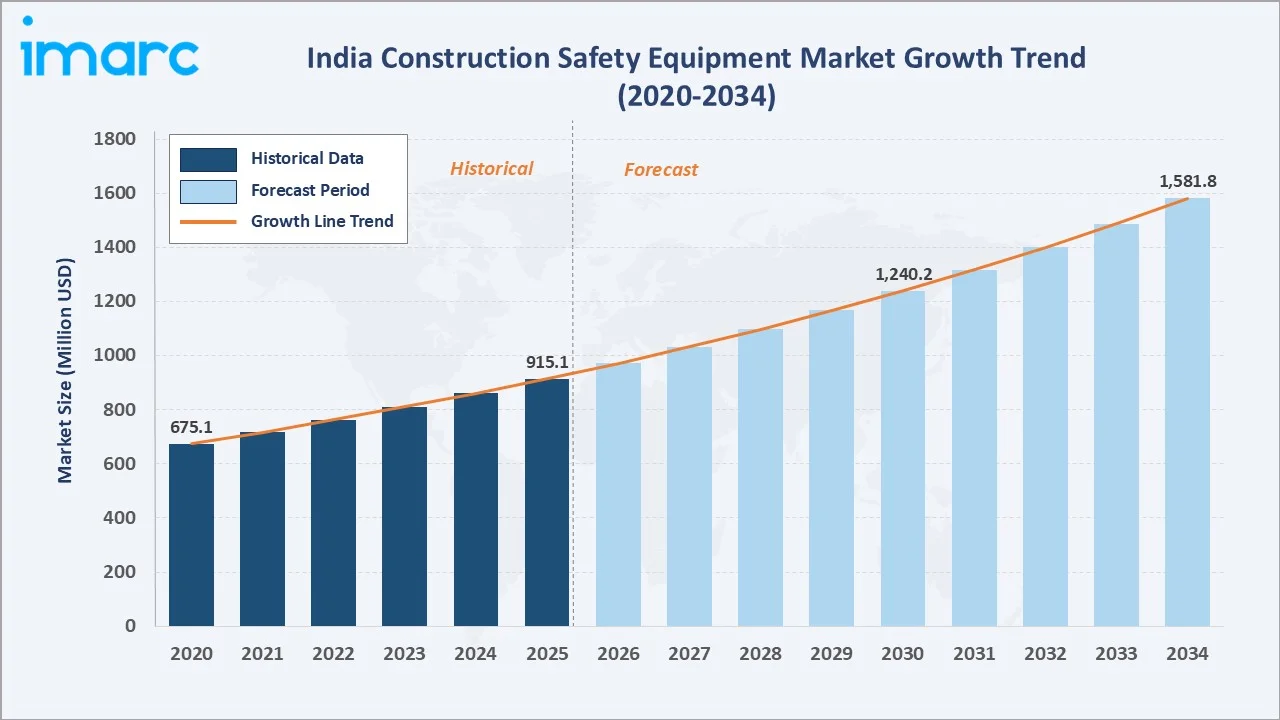
The India construction safety equipment market grew from USD 915.1 Million in 2025 to USD 972.4 Million in 2026 and is projected to reach USD 1,581.8 Million by 2034, growing at a CAGR of 6.27% during 2026-2034. India's construction safety equipment market is underpinned by the infrastructure expansion program, the National Infrastructure Pipeline (NIP), committing USD 1.4 Trillion across roads, railways, and irrigation, rising worker fatality awareness, and multinational EPC contractor compliance mandates driving systematic PPE procurement across India's construction workforce. Commercial construction leads at 38.5%, worker body safety dominates application at 61.5%, and West India commands the highest regional share at 29.5%.
Market Snapshot
|
Metric |
Value |
|
Base Year Market Size (2025) |
USD 915.1 Million |
|
Market Size (2026) |
USD 972.4 Million |
|
Forecast Market Size (2034) |
USD 1,581.8 Million |
|
CAGR (2026-2034) |
6.27% |
|
Base Year |
2025 |
|
Historical Period |
2020-2025 |
|
Forecast Period |
2026-2034 |
|
Dominant Construction Type |
Commercial Construction (38.5%, 2025) |
|
Dominant Application |
Worker Body Safety (61.5%, 2025) |
|
Leading Region |
West India (29.5%, 2025) |
The India construction safety equipment market size grew from USD 675.1 Million in 2020 to USD 915.1 Million by 2025 and is estimated to reach USD 972.4 Million in 2026. The market is projected to reach USD 1,240.2 Million by 2030 and USD 1,581.8 Million by 2034.
To get more information on this market, Request Sample
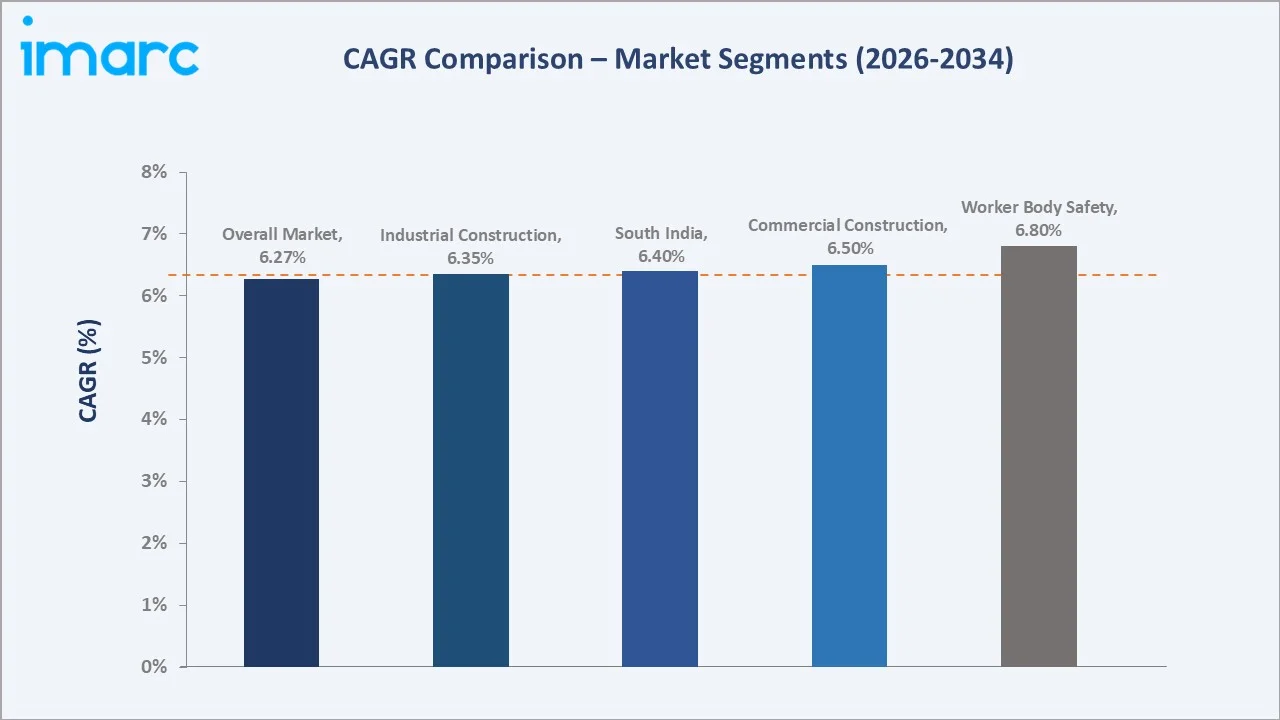
Worker body safety application segment grows fastest at ~6.8% CAGR through mandatory personal protective equipment (PPE) adoption across India's expanding construction workforce. Commercial construction leads segment growth at ~6.5% CAGR through metro rail, commercial real estate, and urban infrastructure project safety equipment mandates.
Executive Summary
The India construction safety equipment market is a structurally growth-driven segment of the industrial safety industry, propelled by India's unprecedented infrastructure investment cycle, rising construction worker injury awareness, and systematic safety equipment procurement mandates from multinational EPC contractors.
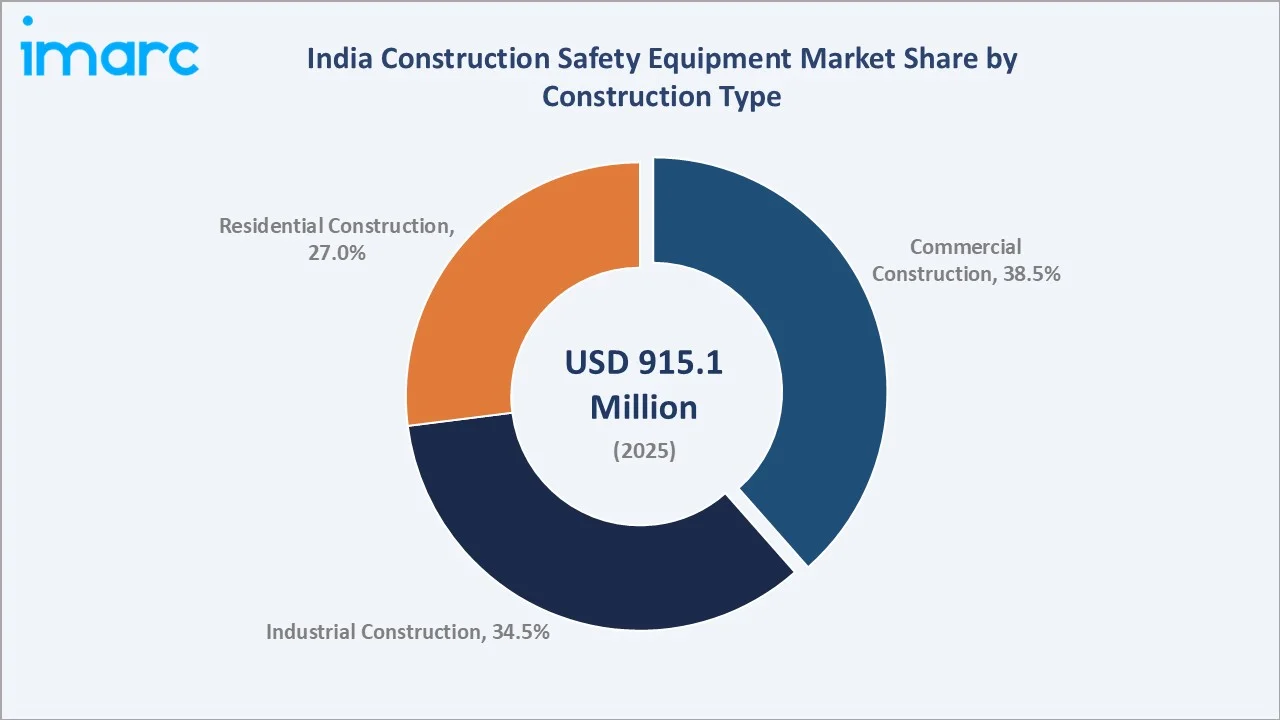
Commercial construction commands 38.5% construction type share through the safety equipment intensity of metro rail, commercial real estate, and large infrastructure project environments. Worker body safety leads application at 61.5% through the mandatory regulatory and contractor requirements for personal protective equipment, including helmets, harnesses, respirators, safety shoes, and gloves across India's active construction workers. West India leads regionally at 29.5%, supported by rapid infrastructure development, extensive construction activity, industrial expansion, and stringent workplace safety requirements.
Key Market Insights
|
Insight |
Data |
|
Dominant Construction Type |
Commercial Construction - 38.5% share (2025) |
|
Dominant Application |
Worker Body Safety - 61.5% share (2025) |
|
Leading Region |
West India - 29.5% (2025) |
|
Key Market Opportunity |
India's National Infrastructure Pipeline (NIP), committing USD 1.4 Trillion in infrastructure investment, is creating a structurally mandated, government-enforced safety equipment procurement opportunity in incremental annual construction PPE spend. |
Key Analytical Observations Supporting the Above Data:
- Commercial Construction at 38.5%: Commercial construction projects, encompassing metro rail systems, office complexes, shopping centers, hotels, hospitals, airports, and large infrastructure projects, generate the highest per-site safety equipment expenditure intensity in India's construction market through the combination of mandatory safety compliance requirements from institutional clients and lenders, multinational EPC contractor EHS management systems requiring certified PPE, and the large workforce concentrations on single project sites that create economies of scale for systematic safety equipment procurement.
- Worker Body Safety at 61.5%: Worker Body Safety, encompassing head protection, fall protection, respiratory protection, hand protection, foot protection, eye and face protection, and body protection, dominates the India construction safety equipment market.
- West India at 29.5%: West India leads through concentration of India's highest-value and highest-safety-compliance active construction projects. Maharashtra's NIP-driven mega-infrastructure portfolio creates the highest density of safety-compliant large construction project sites of any Indian state, with multinational lenders and EPC partners.
India Construction Safety Equipment Market Overview
The India construction safety equipment market encompasses personal protective equipment (PPE) and workplace safety systems specifically designed for construction site environments. The product scope spans head protection, fall protection, respiratory protection, hand protection, foot protection, eye and face protection, hearing protection, and high-visibility apparel. India's construction safety regulatory framework mandates employers with construction workers to register, provide PPE at employer cost, maintain accident registers, and comply with safety equipment standards. Certifications are mandatory for safety helmets, safety belts, and safety shoes sold in India.
Market Dynamics
To evaluate market opportunities, Request Sample
Market Drivers
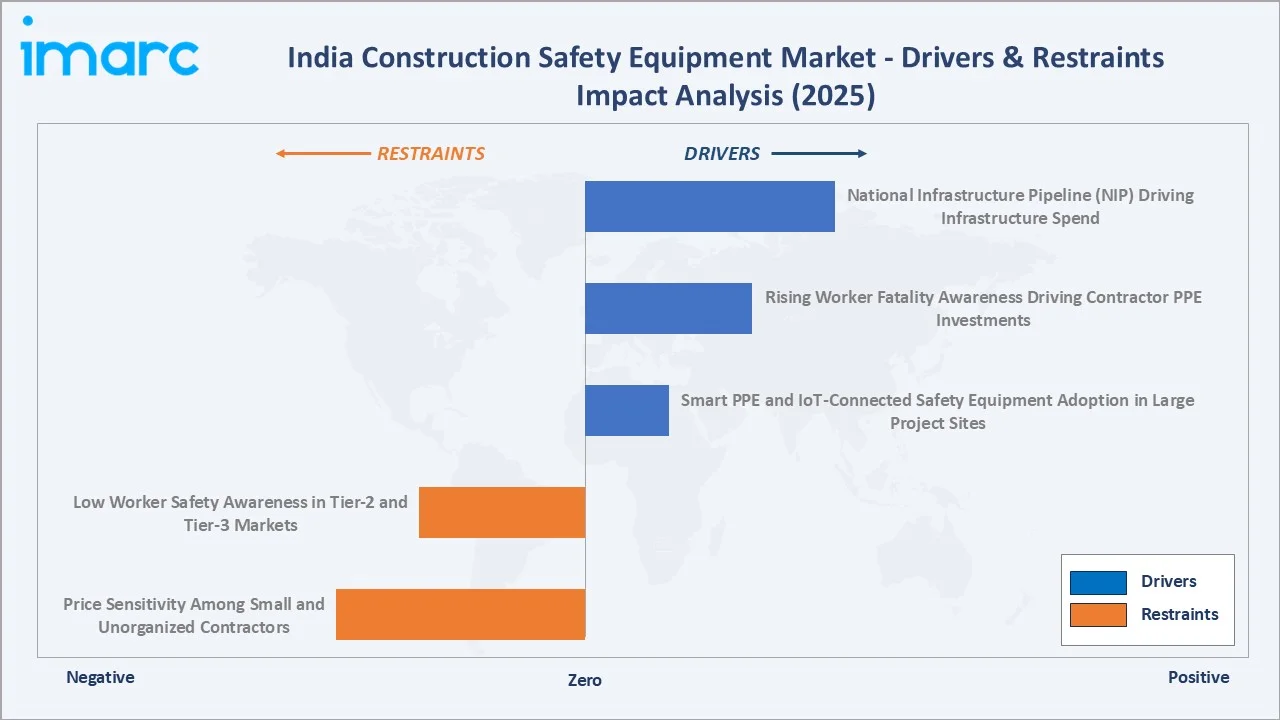
- National Infrastructure Pipeline (NIP) Driving Infrastructure Spend: India's National Infrastructure Pipeline, covering projects across transport, energy, urban development, digital, and social infrastructure sectors with a total outlay of USD 1.4 Trillion, is the most powerful structural demand driver in the India construction safety equipment market.
- Rising Worker Fatality Awareness Driving Contractor PPE Investments: Data from the Karnataka Building & Other Construction Workers Welfare Board indicates that 223 construction workers died in the state during the period from 2020–21 to 2025–26, creating growing regulatory, civil society, and media scrutiny of construction site safety that is translating into EHS investment mandates from project developers, institutional lenders, and insurance underwriters.
- Smart PPE and IoT-Connected Safety Equipment Adoption in Large Project Sites: The integration of IoT sensors, GPS tracking, RFID identification, and biometric monitoring into construction safety equipment is emerging in India's largest infrastructure projects. Smart hard hats with embedded IoT sensors (temperature monitoring, impact detection, fatigue sensing) are being piloted on metro and highway projects. Connected gas detection systems enabling real-time multi-gas hazard alerts on tunnels and confined-space construction sites are a standard specification for underground infrastructure projects.
Market Restraints
- Price Sensitivity Among Small and Unorganized Contractors: Limited project budgets often encourage these contractors to prioritize lower-cost alternatives or minimize spending on certified protective equipment. This restricts the adoption of premium helmets, harnesses, protective footwear, and other advanced safety solutions, particularly across smaller construction projects.
- Low Worker Safety Awareness in Tier-2 and Tier-3 Markets: Inadequate safety training and inconsistent use of personal protective equipment (PPE) reduce demand for certified safety products. Moreover, the preference for low-cost or basic protective gear further restricts the adoption of advanced construction safety equipment in these markets.
Market Opportunities
- Government Infrastructure Mega-Projects Driving Captive Safety Equipment Procurement: India's five high-priority infrastructure development corridors collectively represent multi-decade construction programs with captive safety equipment procurement requirements that create long-term revenue visibility for established safety equipment suppliers. Suppliers achieving approved vendor status gain access to recurring procurement cycles with institutional payment reliability superior to private sector construction client relationships.
- Export Opportunity for Indian Safety Equipment Manufacturers: India's established domestic safety equipment manufacturers have developed manufacturing capabilities that can serve export markets in Middle East construction, Southeast Asian infrastructure, and African mining and construction sectors where Indian-manufactured safety equipment at competitive price points is gaining acceptance. India's PLI-supported domestic manufacturing scale, combined with certifications that are accepted in multiple export markets, creates an export revenue opportunity by 2030.
Market Challenges
- Counterfeit and Sub-Standard Safety Equipment Undercutting Organized Market Prices: The India construction safety equipment market faces severe competition from counterfeit and sub-standard safety equipment that carry fake BIS marks but fail to meet actual performance specifications. This counterfeiting undermines both worker safety and legitimate safety equipment manufacturers' market economics, requiring continuous BIS market surveillance and enforcement action that remains resource-constrained.
- Fragmented Distribution and Last-Mile Reach Challenges in Tier-3 Construction Markets: India's construction safety equipment distribution ecosystem outside Tier-1 and major Tier-2 cities remains fragmented, with limited authorized dealer presence, inadequate product knowledge among general hardware store retailers, and no organized after-sales support infrastructure for technical safety products. Construction safety equipment manufacturers face a last-mile challenge in serving the construction project segments in Tier-3 cities and rural areas where project safety requirements are growing, but distribution infrastructure to serve them professionally has not yet developed.
Emerging Market Trends
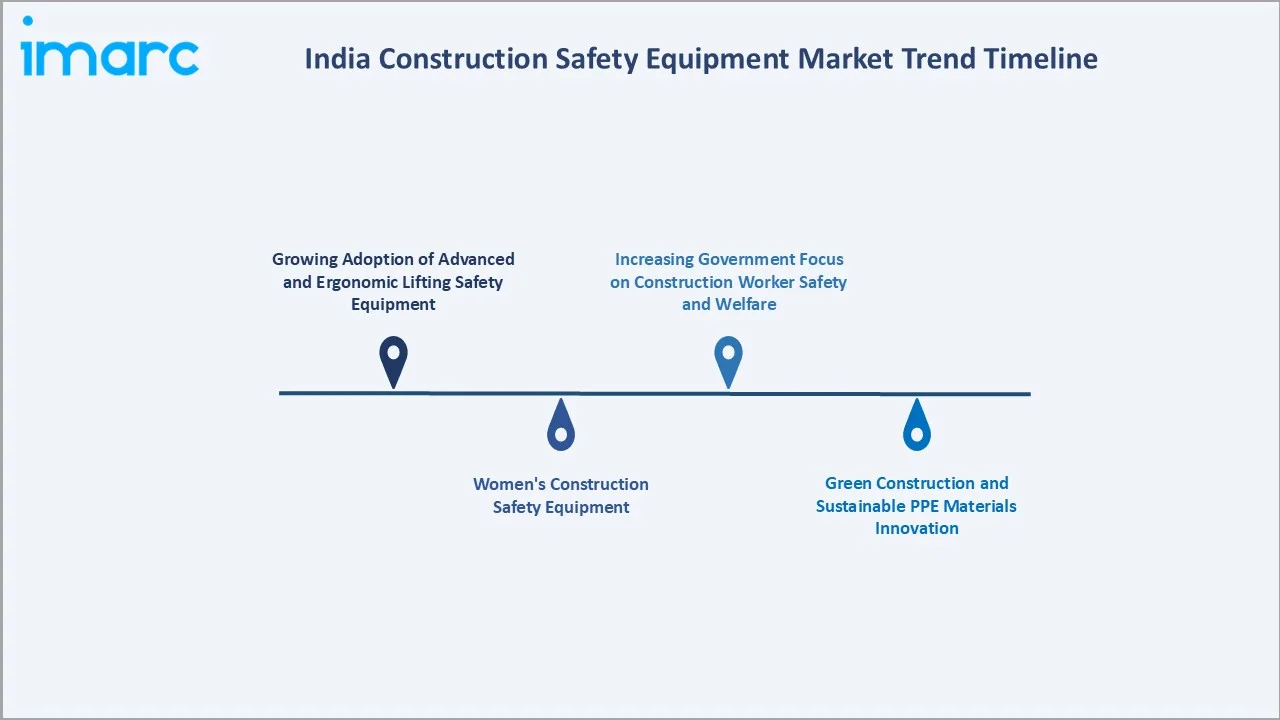
1. Growing Adoption of Advanced and Ergonomic Lifting Safety Equipment
Contractors are increasingly adopting lightweight, ergonomic equipment and precision load-monitoring devices to reduce operator effort and improve lifting safety. This trend is encouraging manufacturers to develop safety equipment that combines higher accuracy, operational convenience, and improved worker protection. In 2025, Kito India introduced a new range of lifting hardware at EXCON 2025, emphasizing construction-site safety and ease of use. The lineup included a hand-bolted rotating lifting point, a lightweight polyester sling designed to reduce operator effort, and a load-measuring device claimed to provide 99.9% accuracy.
2. Women's Construction Safety Equipment
Ill-fitting safety harnesses, oversized helmets, and safety boots designed for male foot widths generate poor compliance among female construction workers. Safety equipment manufacturers are developing India-specific female-anthropometry safety equipment lines, correctly fitted harnesses for female body dimensions, smaller helmet sizes with adjustable retention systems, and lighter safety shoe variants for female foot shapes, addressing a significant compliance gap that large EPC contractors are increasingly highlighting in their diversity and inclusion EHS programs.
3. Increasing Government Focus on Construction Worker Safety and Welfare
In May 2026, Delhi Chief Minister Rekha Gupta announced new welfare measures for construction workers, including mobile health vans at labor chowks and construction sites. The initiative also provides financial support for workers’ daughters’ weddings and special enrolment camps to help workers register for government benefits. Such initiatives are strengthening awareness of occupational risks and encouraging contractors to adopt better workplace safety practices. This trend is expected to support demand for personal protective equipment (PPE), first-aid solutions, and other construction safety equipment across India.
4. Green Construction and Sustainable PPE Materials Innovation
India's growing green building certification market is beginning to incorporate sustainable PPE requirements into project environmental management plans. Construction developers are specifying recycled material safety equipment and responsible PPE disposal programs to contribute to LEED Materials and Resources credits. International safety equipment brands are developing sustainable PPE product lines with recycled content, bio-based materials, and take-back recycling programs, creating a premium-priced sustainable PPE segment among India's organized green construction project segment.
Industry Value Chain Analysis
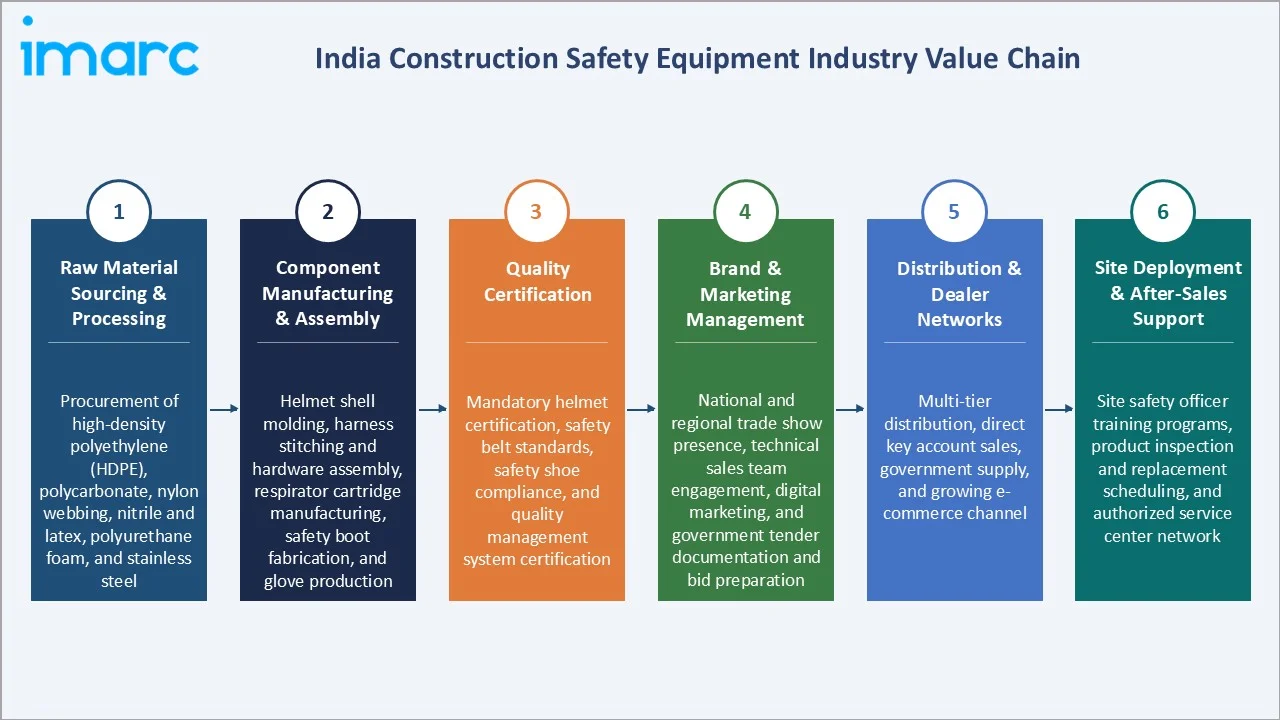
The India construction safety equipment value chain comprises six stages from raw material sourcing to site deployment and after-sales support, with each stage representing distinct competitive advantages and market entry requirements.
|
Stage |
Description |
|
Raw Material Sourcing & Processing |
Procurement of high-density polyethylene (HDPE), polycarbonate, nylon webbing, nitrile and latex, polyurethane foam, and stainless steel. |
|
Component Manufacturing & Assembly |
Helmet shell molding, harness stitching and hardware assembly, respirator cartridge manufacturing, safety boot fabrication, and glove production. |
|
Quality Certification |
Mandatory helmet certification, safety belt standards, safety shoe compliance, and quality management system certification. |
|
Brand & Marketing Management |
National and regional trade show presence, technical sales team engagement, digital marketing, and government tender documentation and bid preparation. |
|
Distribution & Dealer Networks |
Multi-tier distribution, direct key account sales, government supply, and growing e-commerce channel. |
|
Site Deployment & After-Sales Support |
Site safety officer training programs, product inspection and replacement scheduling, and authorized service center network. |
The distribution and dealer network stage represents the most critical competitive differentiator for India's construction safety equipment market, where brands with established relationships with specialized safety equipment distributors, inclusion on approved vendor lists of major EPC contractors, and portal registration achieve structural procurement advantages over new entrants regardless of product specifications.
Technology Landscape in the India Construction Safety Equipment Industry
Head Protection Technology Evolution
India's construction helmet market is evolving beyond the basic HDPE hard hat toward advanced materials and integrated technology. Polycarbonate composite helmets offering superior impact resistance at lower weight are gaining specification in premium project environments. Vented helmets with integrated sweat-management systems addressing thermal comfort in India's hot climate construction environments are gaining adoption as contractors recognize that helmet removal due to heat discomfort is a leading cause of preventable head injuries. Integrated face shield mounting systems, LED inspection lighting, and RFID chip integration for worker identification are driving a premium helmet category.
Fall Protection Technology Innovation
Fall protection is India's highest-consequence construction safety category and is receiving significant technology investment from both international and domestic manufacturers. Self-Retracting Lifelines (SRLs) with automatic fall arrest mechanisms that activate within 300mm of fall initiation are replacing traditional lanyards on high-rise construction projects. Full-body harness ergonomics for extended wear through anti-chafe webbing padding and adjustable load distribution are growing specification requirements from progressive EPC contractors.
Respiratory Protection and Gas Detection
India's construction site respiratory hazard profile, including RCS (Respirable Crystalline Silica) from concrete cutting, isocyanate vapors from polyurethane applications, and tunnel atmosphere gas hazards, requires a more sophisticated respiratory protection response than basic N95 dust masks. Powered Air-Purifying Respirators (PAPR), enabling longer protection durations with reduced breathing resistance, are growing specifications for underground metro tunnel boring and highway tunnel construction.
Market Segmentation Analysis
The report covers the following segments:
|
Segment Category |
Leading Segment |
Market Share |
Year |
|
Equipment Type |
🔒 |
🔒 |
2025 |
|
Construction Type |
Commercial Construction |
38.5% |
2025 |
|
Application |
Worker Body Safety |
61.5% |
2025 |
|
Region |
West India |
29.5% |
2025 |

By Construction Type
Commercial construction leads at 38.5% in 2025, driven by the safety equipment procurement intensity of metro rail systems, commercial real estate, airports, hospitals, educational institutions, and mixed-use urban development projects. Commercial projects typically involve higher worker concentrations on single sites, more rigorous safety compliance requirements from institutional developers and lenders, and multinational EPC contractor involvement that brings international EHS standards requiring BIS and globally certified PPE.
To access detailed market analysis, Request Sample
Industrial construction at 34.5% reflects the safety equipment demand from refinery, petrochemical, power plant, manufacturing facility, and logistics warehouse construction projects that require specialized industrial PPE beyond standard construction safety equipment. Residential construction at 27.0% is the fastest-growing construction type by project volume but has lower per-site safety equipment compliance rates due to the dominance of small contractors operating below registration thresholds.
By Application
Worker body safety dominates at a 61.5% share in 2025, encompassing all personal protective equipment categories worn directly by construction workers, such as helmets, harnesses, respirators, safety shoes, gloves, eye protection, and high-visibility apparel. Worker body safety spending is growing fastest at ~6.8% CAGR as enforcement expands, per-worker PPE budgets increase, and product upgrades from basic to certified premium equipment accelerate.
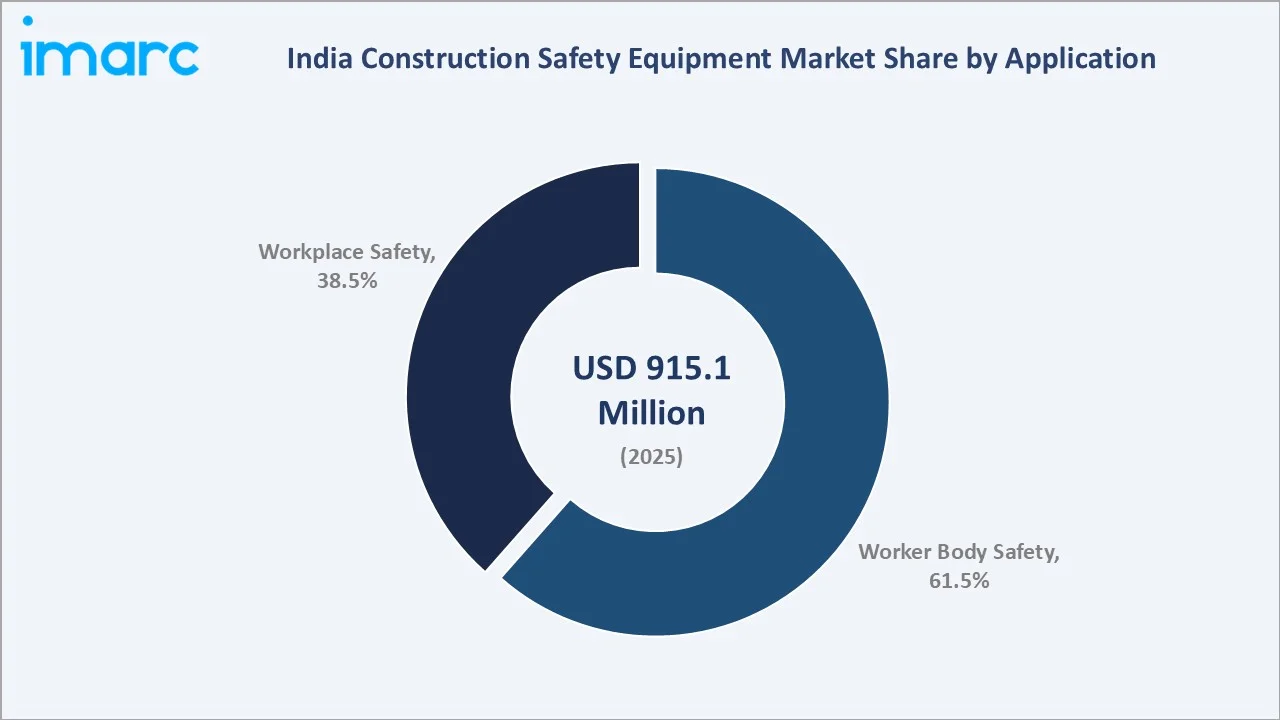
Workplace safety at 38.5% encompasses safety equipment protecting the construction work environment rather than individual workers, including safety barriers, warning signs, fall protection anchors and horizontal lifeline systems, scaffolding safety accessories, confined space entry equipment (tripods, winches), site lighting, and fire suppression equipment. Workplace safety equipment is growing through large infrastructure project site safety management requirements and increasing contractor liability awareness, driving investment in site-level hazard control systems beyond individual PPE.
Regional Market Insights
|
Region |
Share (2025) |
Key India Construction Safety Equipment Market Drivers & Characteristics |
|
West India |
29.5% |
Leads through concentration of India's largest infrastructure and commercial construction activity and the various mega-projects generating massive safety equipment procurement volumes across EPC contractors, infrastructure developers, and labor contractors. |
|
South India |
27.5% |
Reflects the region's exceptionally active infrastructure development pipeline, IT commercial real estate construction boom, metro Phase 2 and industrial park development, and commercial and residential construction. |
|
North India |
24.5% |
Anchored by the massive infrastructure investment pipeline, national master plan infrastructure projects are concentrated across Northern India. |
|
East India |
18.5% |
Reflects the region's significant ongoing infrastructure development and aggressive road and bridge infrastructure construction programs. |
West India leads at 29.5%, reflecting its unique position as India's most safety-compliant large construction market, hosting the highest concentration of multinational-EPC-contractor-executed projects with EHS requirements, and the most developed construction safety equipment distributor network of any Indian state.
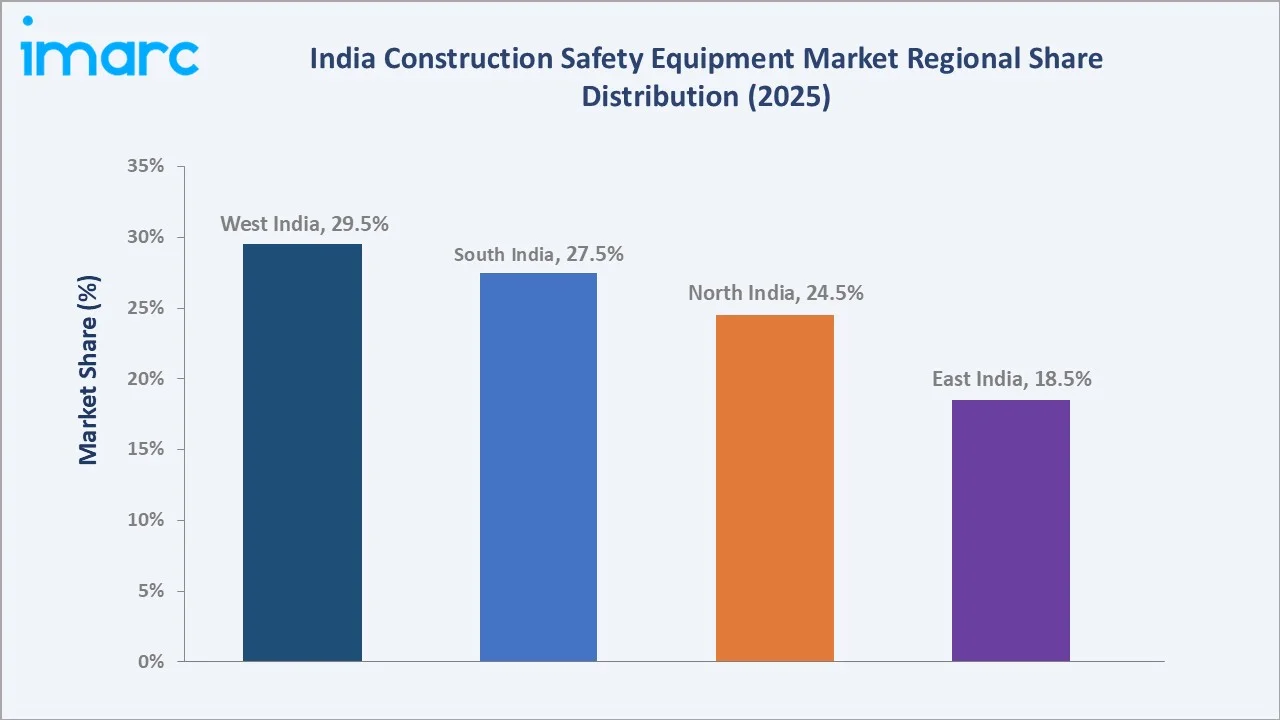
South India at 27.5%, with active infrastructure development, strong EPC contractor EHS culture, and certified construction company concentration, makes it the second largest and fastest-growing regional safety equipment market. North India at 24.5%, with a massive NIP-driven infrastructure pipeline and East India at 18.5% through its growing compliance environment position them as the medium- and long-term high-growth regional opportunities in the India construction safety equipment market through 2034.
Competitive Landscape
The India construction safety equipment market features a tiered competitive structure with multinational premium brands commanding the large project and institutional procurement segment, a strong domestic mid-market layer serving volume construction PPE demand, and a growing challenger tier competing through technology innovation or value positioning.
|
Company |
Key Products |
Market Position |
Core Strength |
|
Honeywell International Inc |
Safety Glasses, Safety Goggles, Safety Helmets, Fall Protection |
Market Leader |
Honeywell International Inc. provides head-to-toe personal protective equipment, fall protection systems, and safety compliance solutions for construction environments. |
|
3M |
Apparel & Workwear, Safety Glasses, Fall Protection, Welding Helmets, Respiratory Protection Systems |
Market Leader |
3M plays a vital role in India's construction safety sector by supplying advanced personal protective equipment (PPE), fall protection systems, and structural safety solutions designed to mitigate major hazards. |
|
MSA Safety Incorporated |
V-Gard 930 Vented Protective Cap, V-SHOCK Mini Personal Fall Limiter, MSA Tripod |
Market Leader |
MSA Safety Incorporated supplies high-performance personal protective equipment (PPE) and worksite safety infrastructure to protect construction workers from various hazards. |
|
Drägerwerk AG & Co. KGaA |
Dräger HPS SafeGuard, Dräger HPS 7000, Dräger HPS 3500, Body protection / protective clothing, Disposable FFP masks, Reusable respiratory masks |
Established Player |
Drägerwerk AG & Co. KGaA operates in India through its subsidiary, Dräger India Private Limited, supplying advanced safety technology, personal protective equipment (PPE), and hazard management solutions tailored to high-risk industries, including infrastructure and construction. |
|
KARAM Safety Pvt. Ltd. |
Safety Helmets, Eye Protection Glasses and Spectacles, Protective Workwear, Hand Protection Gloves |
Innovator |
KARAM Safety Pvt. Ltd. is a leading Indian manufacturer and solutions provider of personal protective equipment (PPE) and fall-protection gear, playing a vital role in setting safety standards for India's construction industry. |
Competitive dynamics in India's construction safety equipment market are driven by the certification requirement as a non-negotiable market entry credential, the EPC contractor approved vendor list as the dominant procurement gatekeeping mechanism for large project segments, and price competitiveness as the primary decision factor for small and mid-tier construction contractor procurement.
Key Company Profiles
Honeywell International Inc
Honeywell International Inc. is a diversified global technology and manufacturing company with a presence in India’s industrial and workplace safety ecosystem. In the India construction safety equipment market, the company provides personal protective equipment (PPE) and safety solutions designed to enhance worker protection and workplace compliance. Its broad product portfolio, technological expertise, and established distribution presence support its position in the construction safety segment.
- Key Products: Safety Glasses, Safety Goggles, Safety Helmets, Fall Protection.
- Strategic Focus: Focuses on product innovation, worker protection, and advanced safety technologies to strengthen its presence in the India construction safety equipment market. The company emphasizes developing reliable, ergonomic, and compliance-oriented safety solutions while leveraging its distribution network to address evolving construction-site safety requirements.
3M
3M is a diversified global technology and manufacturing company with an established presence in India across industrial and workplace safety applications. In the India construction safety equipment market, the company provides a broad range of personal protective equipment (PPE), including respiratory, hearing, eye, face, and fall protection solutions. Its strong product portfolio, focus on innovation, and extensive market reach support its presence across construction and infrastructure applications.
- Key Products: Apparel & Workwear, Safety Glasses, Fall Protection, Welding Helmets, Respiratory Protection Systems.
- Strategic Focus: Strengthening its position through product innovation, worker protection, and compliance-oriented safety solutions. The company emphasizes advanced PPE technologies, ergonomic designs, and reliable performance while expanding product accessibility to address evolving safety requirements across construction and infrastructure projects.
Market Concentration Analysis
The India construction safety equipment market exhibits a dual-tier concentration structure. In the premium organized segment serving large EPC contractors, multinational construction companies, and government mega-projects, Honeywell International Inc., 3M, MSA Safety Incorporated, and Drägerwerk AG & Co. KGaA command an estimated 35-45% of organized market revenue through superior certifications, technical support, and specification access.
In the volume mid-market serving Tier-1 and Tier-2 construction contractors, domestic manufacturers command through competitive BIS-certified product pricing and distribution breadth. The remaining share is served by smaller domestic manufacturers, importers of Chinese and European safety equipment, and counterfeit/sub-standard products in unorganized channels.
Market consolidation is progressing at the top as large EPC contractors reduce approved vendor lists to manageable suppliers with demonstrated quality management systems and technical support capabilities, benefiting established brands at the expense of smaller domestic manufacturers without certification infrastructure.
Investment & Growth Opportunities
Highest Growth Segments
Worker body safety (~6.8% CAGR), smart PPE and IoT safety systems (~12-15% CAGR in the premium segment), fall protection equipment growing through revised standards, government portal procurement expansion, women-specific PPE product development, export to Middle East construction markets, and domestic manufacturing capacity expansion under PLI incentives represent the highest-return investment vectors in the India construction safety equipment market through 2034.
Investment Themes
- Smart PPE Platform Development for NIP Mega-Projects: The convergence of India's infrastructure mega-project pipeline and multilateral lender IFC Performance Standard EHS requirements is creating a mandate for IoT-connected safety equipment management platforms on high-range projects. Investment in India-specific smart PPE systems addressing the NIP project specification pipeline represents a premium segment opportunity through 2030.
- Domestic Fall Protection Manufacturing Scale-Up Under PLI: India's fall protection market is currently served by most of the imported products due to limited domestic manufacturing capacity for SRLs and advanced harness components. Investment in domestic SRL manufacturing capability would enable domestic brands to capture import substitution share in the growing SRL category while qualifying for export market development in the Middle East.
Future Market Outlook (2026-2034)
The India construction safety equipment market is projected to grow from USD 915.1 Million in 2025 to USD 972.4 Million in 2026, reaching USD 1,581.8 Million by 2034, exhibiting a CAGR of 6.27% during 2026-2034. The market is projected to reach USD 1,240.2 Million by 2030, the mid-period milestone when India's National Infrastructure Pipeline will have committed the majority of its USD 1.4 Trillion project portfolio to active construction.
Three transformative forces will define the India construction safety equipment market through 2034. First, investments in inspection capacity, digital worker registration under the e-Shram portal creates an enforceable construction workforce database, and court-mandated safety compliance on high-profile construction projects establishes precedent. Second, the technology transformation of construction PPE from passive mechanical protection toward active connected safety systems will create a growing premium IoT safety technology layer. Third, the Make in India manufacturing localization of construction safety equipment components will support Indian domestic safety equipment manufacturers' market share expansion against imported products.
Research Methodology
Primary Research
Primary research comprised structured interviews with EHS managers at India's top EPC contractors, construction safety equipment distributors across Mumbai, Delhi, Bengaluru, Chennai, and Kolkata, National Safety Council India program directors, technical committee members for construction safety standards, and safety equipment product managers from leading domestic and international brands. Interview insights validated market sizing, growth driver analysis, and competitive positioning assessments.
Secondary Research
Secondary research incorporated certification database analysis for construction safety product registrations, National Infrastructure Pipeline project database, market surveillance and enforcement reports on counterfeit safety equipment, company annual reports and disclosures, portal safety equipment procurement data, and import-export data for construction safety equipment.
Forecasting Models
Forecasting employed construction activity value projections from the NIP project timeline and active project value modeling, per-worker PPE expenditure trajectory analysis linked to enforcement intensity indicators, import substitution scenario modeling for domestic manufacturing share, and competitive landscape pricing dynamics under domestic brand capacity expansion.
India Construction Safety Equipment Market Report Coverage:
| Report Features | Details |
|---|---|
| Base Year of the Analysis | 2025 |
| Historical Period | 2020-2025 |
| Forecast Period | 2026-2034 |
| Units | Million USD |
| Scope of the Report |
Exploration of Historical Trends and Market Outlook, Industry Catalysts and Challenges, Segment-Wise Historical and Future Market Assessment:
|
| Equipment Types Covered |
|
| Construction Types Covered | Residential Construction, Commercial Construction, And Industrial Construction |
| Applications Covered | Worker Body Safety, Workplace Safety |
| Regions Covered | North India, South India, East India, West India |
| Companies Covered | Honeywell International Inc, 3M, MSA Safety Incorporated, Drägerwerk AG & Co. KGaA, KARAM Safety Pvt. Ltd., etc. |
| Customization Scope | 10% Free Customization |
| Post-Sale Analyst Support | 10-12 Weeks |
| Delivery Format | PDF and Excel through Email (We can also provide the editable version of the report in PPT/Word format on special request) |
Key Benefits for Stakeholders:
- IMARC’s industry report offers a comprehensive quantitative analysis of various market segments, historical and current market trends, market forecasts, and dynamics of the India construction safety equipment market from 2020-2034.
- The research report provides the latest information on the market drivers, challenges, and opportunities in the India construction safety equipment market.
- Porter's five forces analysis assist stakeholders in assessing the impact of new entrants, competitive rivalry, supplier power, buyer power, and the threat of substitution. It helps stakeholders to analyze the level of competition within the India construction safety equipment industry and its attractiveness.
- Competitive landscape allows stakeholders to understand their competitive environment and provides an insight into the current positions of key players in the market.
Frequently Asked Questions About the India Construction Safety Equipment Market Report
The India construction safety equipment market reached USD 972.4 Million in 2026, driven by the National Infrastructure Pipeline construction boom, strengthening compliance enforcement, multinational EPC contractor EHS mandates, and rising construction worker safety awareness.
The market is projected to grow at a CAGR of 6.27% during 2026-2034, driven by NIP infrastructure construction activity, mandatory PPE compliance expansion, smart PPE technology adoption on large projects, and growing domestic manufacturing capacity under PLI scheme support.
The market is projected to reach USD 1,240.2 Million by 2030, coinciding with India's NIP peak concurrent construction activity, smart PPE mandatory specifications on large infrastructure projects, and progressive enforcement expanding organized PPE procurement to a larger share of India's construction workers.
Commercial construction leads with a 38.5% share in 2025, driven by the safety equipment procurement intensity of metro rail, commercial real estate, airports, hospitals, and large infrastructure projects with institutional developer and multinational EPC contractor EHS compliance requirements.
Worker body safety leads with a 61.5% share in 2025, encompassing helmets, harnesses, respirators, safety shoes, gloves, eye protection, and high-visibility apparel.
West India leads with a 29.5% share in 2025, driven by the concentration of multinational EPC-contractor-executed mega-infrastructure projects and the DMIC and port corridor industrial construction pipeline.
Key players include Honeywell International Inc, 3M, MSA Safety Incorporated, Drägerwerk AG & Co. KGaA, and KARAM Safety Pvt. Ltd., among others.
The market is projected to reach USD 1,581.8 Million by 2034, driven by sustained NIP infrastructure investment, enforcement maturation expanding organized PPE procurement, smart PPE IoT platform adoption, Make in India manufacturing localization, and export market development.
Key investment opportunities include smart PPE platform development for NIP mega-projects, domestic fall protection (SRL) manufacturing under PLI incentives for import substitution, construction worker safety training ecosystem development in Hindi and regional languages, women-specific PPE product development, and export market development in Middle East construction.
Need more help?
- Speak to our experienced analysts for insights on the current market scenarios.
- Include additional segments and countries to customize the report as per your requirement.
- Gain an unparalleled competitive advantage in your domain by understanding how to utilize the report and positively impacting your operations and revenue.
- For further assistance, please connect with our analysts.
 Request Customization
 Speak to an Analyst
 Request Brochure
 Inquire Before Buying
Benefits of Customization
- Personalize this research
- Triangulate with your data
- Get data as per your format and definition
- Gain a deeper dive into a specific application, geography, customer, or competitor
- Any level of personalization
Get in Touch With Us
UNITED STATES
Phone: +1-201-971-6302
INDIA
Phone: +91-120-433-0800
UNITED KINGDOM
Phone: +44-753-714-6104
Email: [email protected]
Client Testimonials




.webp)




.webp)













Related Reports

Choose your plan
*Please note that the prices mentioned below are starting prices for each bundle type. Kindly contact our team for further details.*
Single User License
- 1 User License, Access on 2 Devices
- PDF Report + Excel Dataset (Password Protected)
- Lifetime Access
- No Printing Rights
- 10% Free Report Customization
- 10–12 Weeks of Analyst Support
Five User License
- Access for 5 Users, 2 Devices per User
- PDF Report + Excel Dataset (Password Protected)
- Lifetime Access
- Dedicated Account Manager
- 12–14 Weeks of Analyst Support
- No Printing Rights
- 15% Free Report Customization
- 25% Discount on Your Next Purchase
Corporate User License
- Unlimited User Access (Within Your Organization)
- PDF Report + Excel Dataset
- Lifetime Access
- Dedicated Account Manager
- 14–20 Weeks of Analyst Support
- No Printing Rights
- 20% Free Report Customization
- 30% Discount on Your Next Purchase
Essential Insights
What's included:
3 reports
- Lifetime Access
- PDF Reports
- Excel Datasets
- 2 Weeks of Free Analyst Support
- 2 User Licenses
- Access on 2 Devices
- Printing Rights
- Complimentary PowerPoint (PPT) Version
- Complimentary License Upgrade
Professional Access
What's included:
5 reports
- Lifetime Access
- PDF Reports
- Excel Datasets
- 8 Weeks of Free Analyst Support
- 2 User Licenses
- Access on 2 Devices
- Printing Rights
- Complimentary PowerPoint (PPT) Version
- Complimentary License Upgrade
Business Advantage
What's included:
8 reports
- Lifetime Access
- PDF Reports
- Excel Datasets
- 14 Weeks of Free Analyst Support
- 2 User Licenses
- Access on 2 Devices
- Printing Rights
- Complimentary PowerPoint (PPT) Version
- Complimentary License Upgrade
Enterprise Intelligence
What's included:
10 reports
- Lifetime Access
- PDF Reports
- Excel Datasets
- 20 Weeks of Free Analyst Support
- 2 User Licenses
- Access on 2 Devices
- Printing Rights
- Complimentary PowerPoint (PPT) Version
- Complimentary License Upgrade