
India LNG Bunkering Market Size, Share, Trends and Forecast by Ship Type, End-User, and Region, 2026-2034
India LNG Bunkering Market Size, Share, Trends & Forecast (2026-2034)
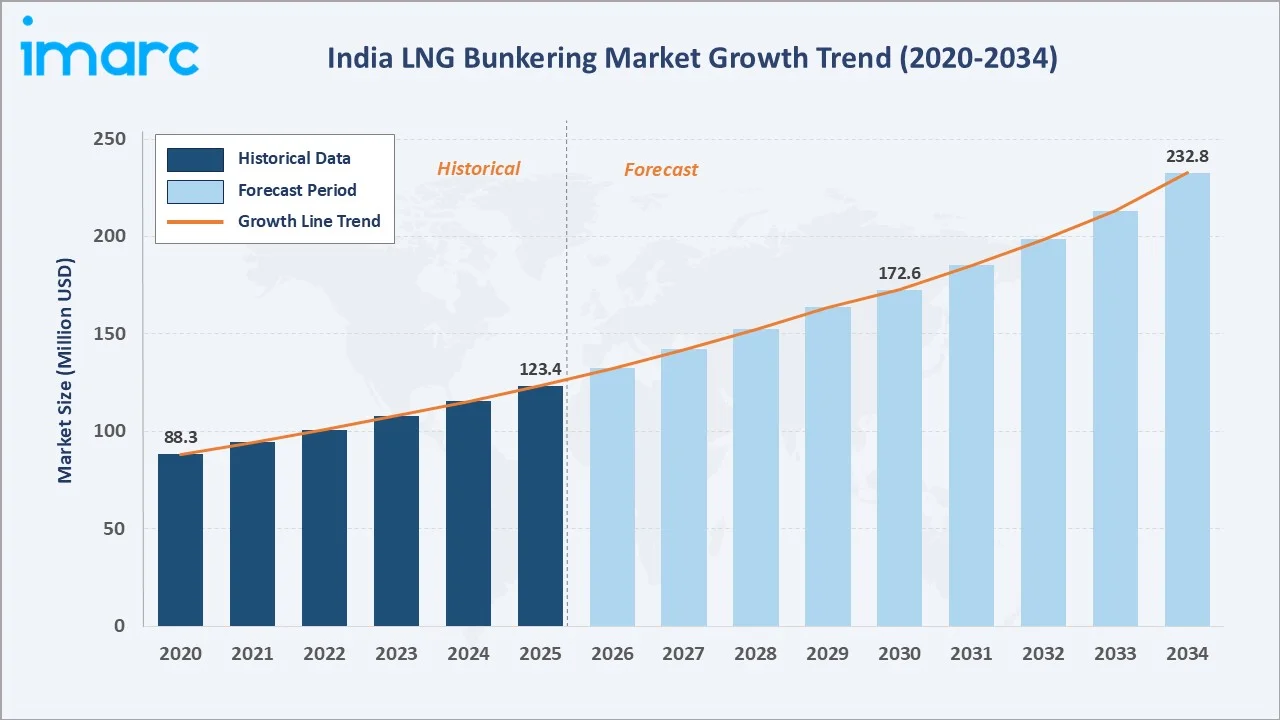
The India LNG bunkering market grew from USD 123.4 Million in 2025 to USD 136.1 Million in 2026 and is projected to reach USD 232.8 Million by 2034, growing at a CAGR of 6.94% during 2026-2034. The market is driven by increasing adoption of cleaner marine fuels, tightening maritime emission regulations, expansion of LNG infrastructure at major ports, and growth in domestic and international shipping activities. Government initiatives supporting natural gas and lower-emission transportation are further encouraging LNG use as a marine fuel. Container ships lead ship type share at 35.0%, the tanker fleet dominates end-user at 30.0%, and West India commands 32.0% regional share.
Market Snapshot
|
Metric |
Value |
|
Base Year Market Size (2025) |
USD 123.4 Million |
|
Market Size (2026) |
USD 136.1 Million |
|
Forecast Market Size (2034) |
USD 232.8 Million |
|
CAGR (2026-2034) |
6.94% |
|
Base Year |
2025 |
|
Historical Period |
2020-2025 |
|
Forecast Period |
2026-2034 |
|
Dominant Ship Type |
Container Ships (35.0%, 2025) |
|
Dominant End-User |
Tanker Fleet (30.0%, 2025) |
|
Leading Region |
West India (32.0%, 2025) |
The India LNG bunkering market grew from USD 88.3 Million in 2020 to USD 123.4 Million by 2025 and is estimated to reach USD 136.1 Million in 2026. The market is projected to reach USD 172.6 Million by 2030 and USD 232.8 Million by 2034.
To get more information on this market, Request Sample
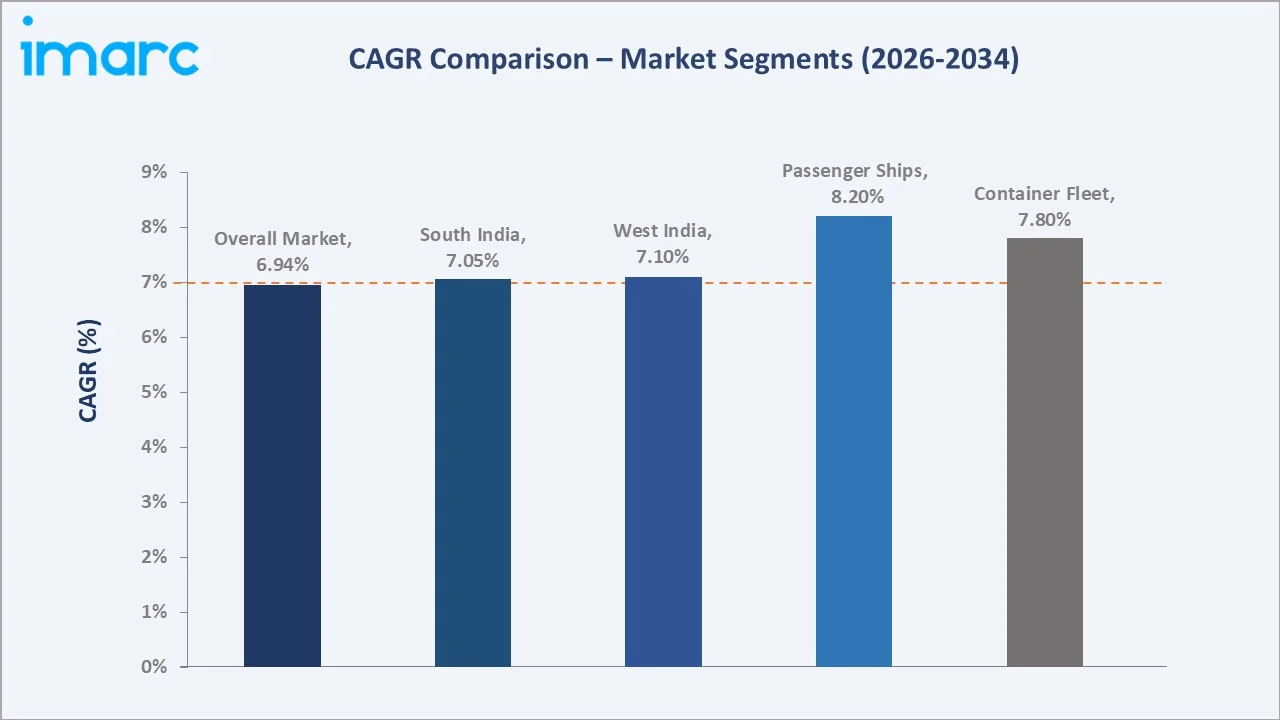
Passenger ships grow fastest at ~8.2% CAGR through coastal cruise and inland waterway ferry LNG transition driven by India's passenger shipping decarbonization mandates. Container ships expand at ~7.8% CAGR through dual-fuel container fleet growth. West India leads regional growth at ~7.1% CAGR through LNG bunkering infrastructure development.
Executive Summary
The India LNG bunkering market is an emerging and strategically important segment of India's maritime energy transition ecosystem, decarbonization regulatory pressure on shipping operators calling at Indian ports, and India's ambition to develop a competitive LNG supply and distribution infrastructure serving both domestic coastal vessels and international fleet operators. Container ships command a 35.0% ship type share through the rapid dual-fuel LNG containership orderbook growth. Tanker fleet leads end-user at 30.0% through India's large crude oil and product tanker traffic. West India dominates at 32.0% through LNG terminal infrastructure concentration.
Key Market Insights
|
Insight |
Data |
|
Dominant Ship Type |
Container Ships - 35.0% share (2025) |
|
Dominant End-User |
Tanker Fleet - 30.0% share (2025) |
|
Leading Region |
West India - 32.0% (2025) |
|
Key Market Opportunity |
Expansion of LNG bunkering infrastructure at major ports, development of LNG-fueled vessel fleets, ship-to-ship bunkering services, small-scale LNG supply chains, and growing adoption of LNG in coastal and inland shipping. |
Key Analytical Observations Supporting the Above Data:
- Container Ships at 35.0%: Container ships represent the largest and most commercially active LNG bunkering market segment through the global container shipping industry's systematic shift toward LNG dual-fuel vessels responding to cost pressure on European trade routes.
- Tanker Fleet at 30.0%: India's tanker fleet dominance reflects India's position as one of the largest crude oil importers, creating substantial potential LNG bunkering demand as tighter vessel efficiency ratings compel tanker operators to adopt LNG dual-fuel or methanol alternative fuel strategies on India-Europe and India-Middle East trade routes.
- West India at 32.0%: West India's market leadership reflects the strategic concentration of India's LNG import terminal infrastructure and the highest density of international container and tanker vessel traffic on India's western seaboard.
India LNG Bunkering Market Overview
The India LNG bunkering market encompasses the supply, storage, transfer, and commercial management of liquefied natural gas as a marine fuel for ships calling at Indian ports and operating on Indian inland waterways. LNG bunkering infrastructure encompasses three primary delivery modalities: ship-to-ship (STS) bunkering from dedicated LNG bunker vessels to receiving ships at anchorage or berth, shore-to-ship (STS) pipeline bunkering from port-side cryogenic LNG storage tanks through insulated transfer arms to vessel tanks, and truck-to-ship (TTS) delivery from LNG road tankers to vessels at berth or inland waterway terminals.
Market Dynamics
To evaluate market opportunities, Request Sample
Market Drivers
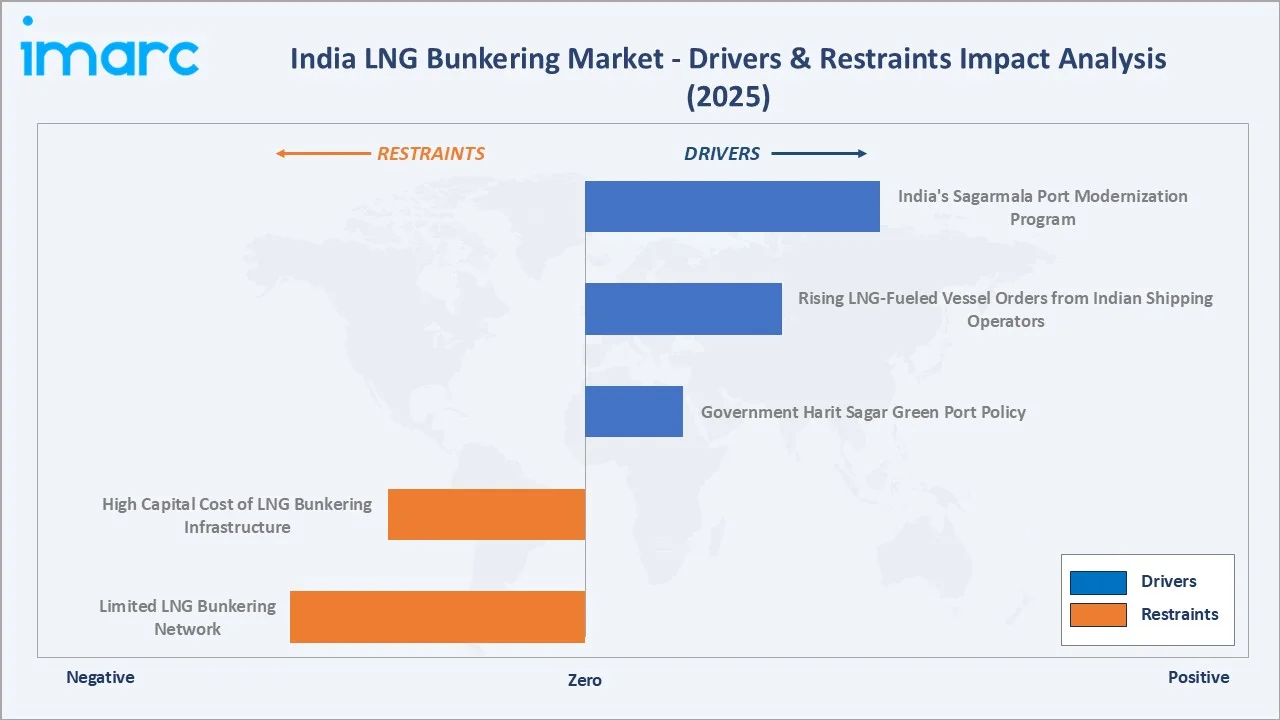
- India's Sagarmala Port Modernization Program: The Sagarmala National Perspective Plan, with USD 82 Billion investment in port infrastructure projects. India’s Sagarmala Program modernizing ports, improving maritime connectivity, and strengthening port-linked infrastructure. Upgraded port facilities and increased cargo and vessel traffic create favorable conditions for developing LNG storage, handling, and bunkering infrastructure, thereby encouraging the adoption of LNG as a marine fuel.
- Rising LNG-Fueled Vessel Orders from Indian Shipping Operators: Rising orders for LNG-fueled vessels by Indian shipping operators are increasing the need for reliable LNG bunkering facilities across domestic ports. Expansion of the LNG-powered fleet is encouraging investments in storage, refueling, and supply infrastructure, thereby supporting the development of India’s LNG bunkering ecosystem.
- Government Harit Sagar Green Port Policy: Harit Sagar Green Port Guidelines target reducing carbon emissions per ton of cargo by 30% by 2030, and by 70% by 2047. These guidelines specifically reference LNG bunkering infrastructure development as a recommended port decarbonization action, all including LNG bunkering facility projects in their Harit Sagar action plans submitted to the Ministry. The Harit Sagar policy creates regulatory certainty for LNG bunkering infrastructure investment and positions India's port LNG bunkering development within a government-mandated sustainability framework rather than as an optional commercial initiative.
Market Restraints
- High Capital Cost of LNG Bunkering Infrastructure: High capital requirements for LNG storage tanks, cryogenic handling systems, bunkering vessels, and specialized port infrastructure are restraining the development of LNG bunkering facilities in India. The substantial upfront investment, coupled with uncertain near-term LNG bunker demand, can extend payback periods and discourage infrastructure investment.
- Limited LNG Bunkering Network: The limited availability of LNG bunkering facilities across Indian ports restricts reliable fuel access for LNG-powered vessels, reducing operational flexibility on domestic routes. Inadequate geographic coverage also creates uncertainty around refueling availability, discouraging shipping operators from expanding LNG-fueled fleets and slowing broader market adoption.
Market Opportunities
- National Waterway LNG Bunkering Development for Inland Vessel Decarbonization: India’s 32 operational National Waterways spanning approximately 5,155 km of navigable routes present a unique inland LNG bunkering opportunity where vessel sizes are small, travel distances are bounded by waterway length, and LNG bunkering infrastructure can be scaled from small cryogenic storage at inland terminals without the large-vessel infrastructure requirements of maritime ports.
- LNG as Bridge Fuel for India's Maritime Energy Transition to Green Ammonia and Hydrogen: India's shipping decarbonization strategy positions LNG bunkering as the commercially available bridge fuel enabling Indian fleet decarbonization while green ammonia and hydrogen bunkering technologies mature. LNG infrastructure investments will be repurposed for bio-LNG and synthetic LNG bunkering as India's biogas and green hydrogen economy develops through 2030-2040, extending the useful economic life of LNG bunkering infrastructure beyond LNG's fossil fuel era toward renewable gas bunkering applications.
Market Challenges
- LNG Price Volatility and Competitiveness: India's shipping operators are highly price-sensitive to marine fuel cost differentials, as fuel typically represents a high vessel operating cost on Indian coastal routes. Indian vessel operators have limited ability to forward-contract LNG at stable prices due to the nascent Indian LNG bunker market structure without established long-term LNG bunkering supply contracts.
- Safety Compliance Complexity: Safety compliance complexity poses a significant challenge due to the cryogenic and flammable nature of LNG, which requires stringent handling, storage, and transfer procedures. Compliance with multiple technical and maritime safety standards increases operational complexity, training requirements, and costs for port and bunkering operators.
Emerging Market Trends
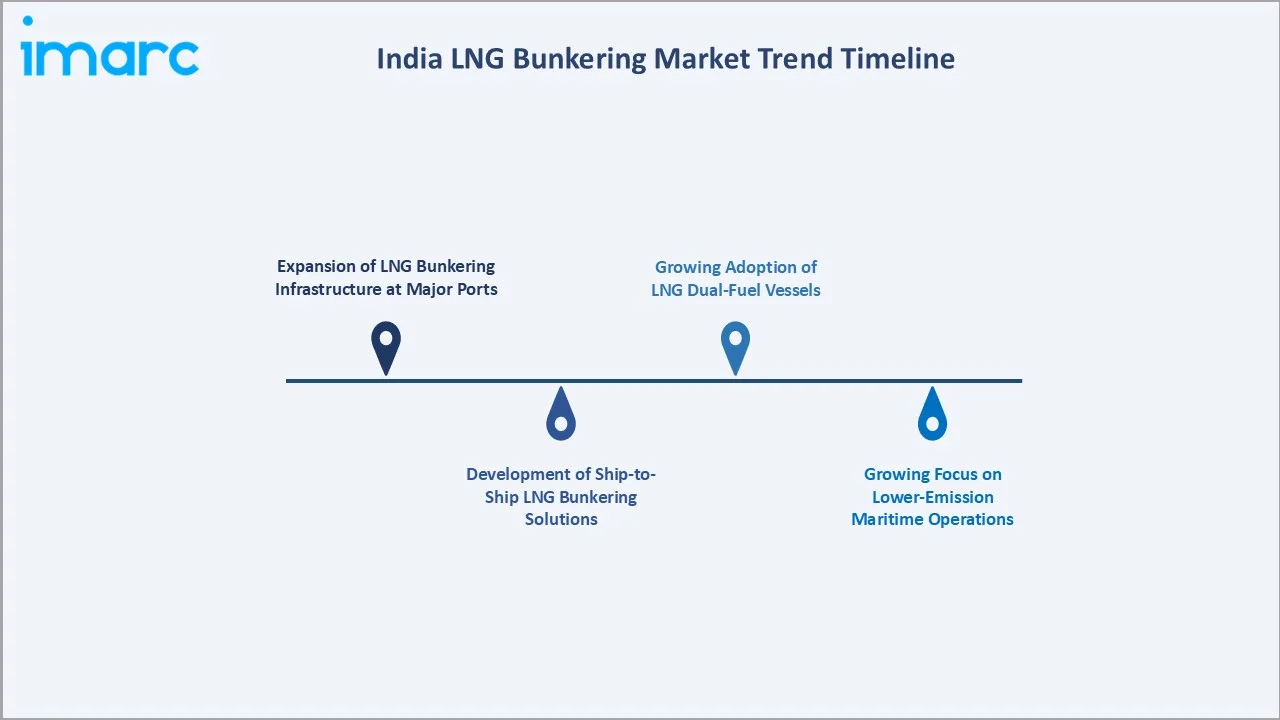
1. Expansion of LNG Bunkering Infrastructure at Major Ports
India is witnessing growing collaboration among energy companies, port authorities, and technical specialists to develop LNG bunkering facilities at strategic ports. In August 2026, GAIL (India) Limited, Deendayal Port Authority (DPA), and DNV entered into a tripartite agreement to jointly explore the development of LNG bunkering infrastructure at Kandla Port. Such partnerships are expected to strengthen LNG storage and refueling infrastructure, improve fuel accessibility for LNG-powered vessels, and support the development of a broader marine LNG ecosystem.
2. Development of Ship-to-Ship LNG Bunkering Solutions
The market is gradually moving toward flexible ship-to-ship bunkering, particularly at ports handling larger commercial vessels. LNG bunker vessels can refuel ships without requiring them to rely solely on fixed terminal infrastructure. This approach can improve turnaround times and extend bunkering services across multiple berths or anchorages. Increasing vessel traffic could strengthen the commercial viability of these solutions.
3. Growing Adoption of LNG Dual-Fuel Vessels
The Indian shipping sector is witnessing increasing adoption of LNG dual-fuel vessels as operators seek greater fuel flexibility and lower-emission maritime transportation. Expansion of LNG-capable fleets is expected to stimulate demand for reliable bunkering facilities and encourage further investment in LNG supply infrastructure at Indian ports. In August 2026, Shipping Corporation of India (SCI) invited bids for up to six LNG dual-fuel container vessels, comprising two confirmed orders and options for four additional ships. Each vessel will have an 8,000 TEU capacity and operate on both LNG and conventional marine fuels, with eligible Indian and international shipyards permitted to participate.
4. Growing Focus on Lower-Emission Maritime Operations
Shipping companies are increasingly focusing on reducing emissions from marine operations amid tightening environmental requirements and corporate sustainability initiatives. LNG is considered a transitional marine fuel due to its lower sulfur oxides, particulate matter, and certain other emissions compared with conventional marine fuels. This shift is encouraging investment in LNG-compatible vessels and refueling infrastructure. Consequently, environmental considerations are becoming increasingly influential in fleet and fuel strategies.
Industry Value Chain Analysis
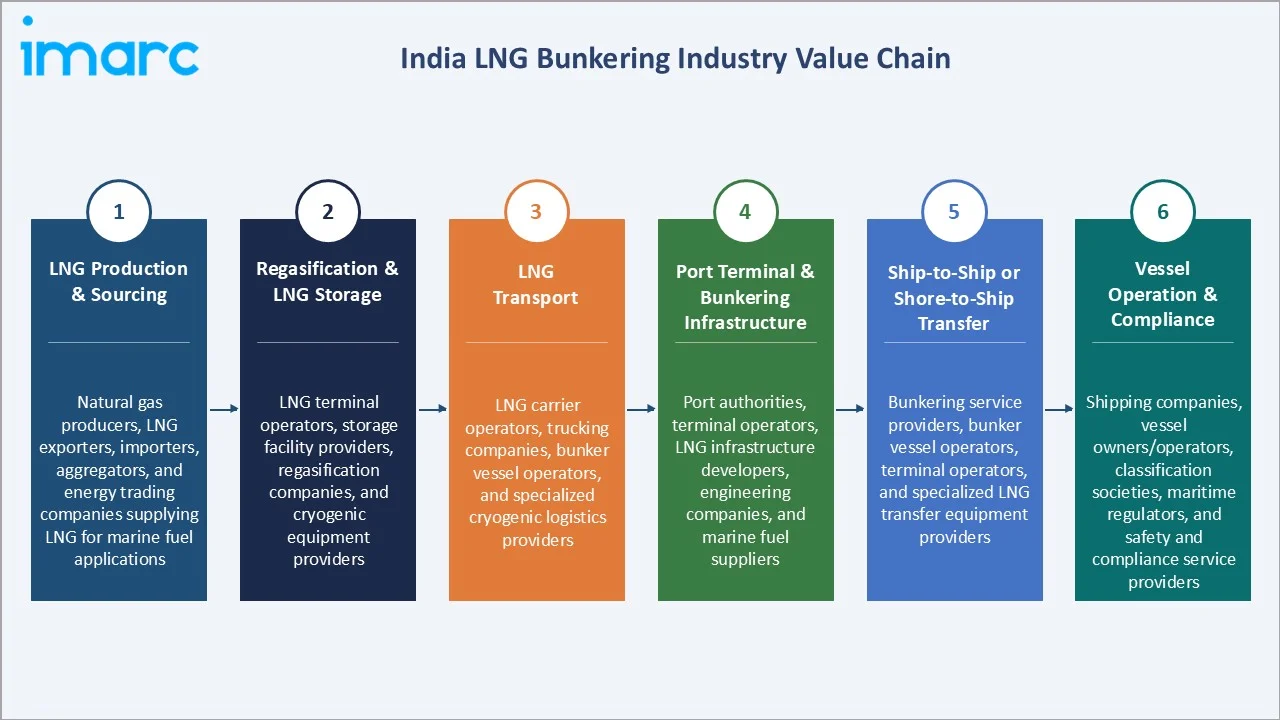
India LNG bunkering value chain spans six stages, from LNG production and sourcing through vessel operation and compliance, with port terminal and bunkering infrastructure representing the critical investment bottleneck stage determining India's LNG bunkering market development pace.
|
Stage |
Key Participants |
|
LNG Production & Sourcing |
Natural gas producers, LNG exporters, importers, aggregators, and energy trading companies supplying LNG for marine fuel applications. |
|
Regasification & LNG Storage |
LNG terminal operators, storage facility providers, regasification companies, and cryogenic equipment providers. |
|
LNG Transport |
LNG carrier operators, trucking companies, bunker vessel operators, and specialized cryogenic logistics providers. |
|
Port Terminal & Bunkering Infrastructure |
Port authorities, terminal operators, LNG infrastructure developers, engineering companies, and marine fuel suppliers. |
|
Ship-to-Ship or Shore-to-Ship Transfer |
Bunkering service providers, bunker vessel operators, terminal operators, and specialized LNG transfer equipment providers. |
|
Vessel Operation & Compliance |
Shipping companies, vessel owners/operators, classification societies, maritime regulators, and safety and compliance service providers. |
The port terminal and bunkering infrastructure stage is the most critical and capital-intensive value chain bottleneck for India's LNG bunkering market development, where the absence of operational LNG bunkering facilities at major Indian ports creates a supply availability constraint that prevents vessel operators from committing to LNG dual-fuel vessel procurement programs dependent on Indian port LNG bunkering.
Technology Landscape in the India LNG Bunkering Industry
LNG Fuel Gas Supply System (FGSS) Technology for Marine Applications
FGSS technology manages storage, conditioning, pressure regulation, and delivery of LNG from onboard fuel tanks to a vessel’s dual-fuel or gas engine. The system typically incorporates pumps, vaporizers, pressure-control units, valves, and safety equipment. It converts LNG into gaseous fuel at the required pressure and temperature for efficient combustion. Advanced FGSS solutions also emphasize automation, leak detection, and operational safety.
LNG Bunker Vessel Design and Bunkering Operational Technology
This technology covers specialized LNG bunker vessels and transfer systems designed to safely refuel LNG-powered ships, particularly through ship-to-ship operations. Bunker vessels incorporate cryogenic tanks, transfer pumps, hoses, emergency shutdown systems, and gas detection equipment. Advanced control and monitoring technologies help manage transfer rates, pressure, and temperature during bunkering. Standardized operating procedures further improve safety and reduce vessel turnaround time.
Boil-Off Gas Management and LNG Storage Technology
LNG storage technology uses highly insulated cryogenic tanks to maintain LNG at approximately −162°C and minimize evaporation during storage and transportation. Any vapor generated, known as boil-off gas (BOG), is managed through reliquefaction, pressure-control, compression, or utilization as vessel fuel. Effective BOG management reduces product losses and controls tank pressure. Advanced insulation and monitoring systems further enhance storage efficiency and operational safety.
Market Segmentation Analysis
The report covers the following segments:
|
Segment Category |
Leading Segment |
Market Share |
Year |
|
Ship Type |
Container Ships |
35.0% |
2025 |
|
End-User |
Tanker Fleet |
30.0% |
2025 |
|
Region |
West India |
32.0% |
2025 |

By Ship Type
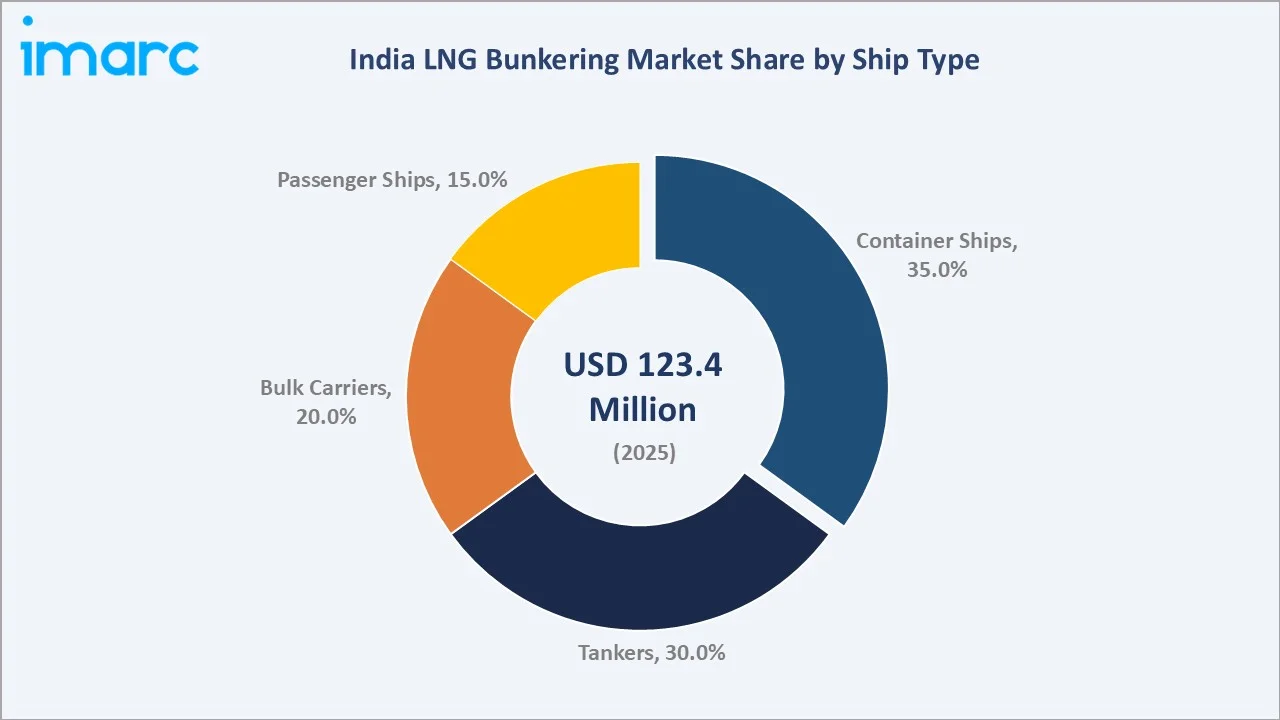
Container ships command 35.0% in 2025, driven by the global container shipping industry's accelerated LNG dual-fuel vessel ordering, creating growing LNG bunkering demand as these vessels make Indian port calls on Asia-Europe trade routes.
To access detailed market analysis, Request Sample
Tankers at 30.0% reflect India's position as one of the largest crude oil importers, with a high-frequency tanker call pattern at Indian oil import terminals. Bulk carriers at 20.0% serve India's large coal and iron ore import trade through vessels where regulations are creating LNG transition pressure. Passenger ships at 15.0% grow fastest at ~8.2% CAGR through India's nascent coastal cruise and inland waterway ferry LNG transition programs.
By End-User
The tanker fleet leads at 30.0%, reflecting the large number of crude and product tankers calling at Indian oil import and export terminals whose regulatory compliance trajectory is driving LNG dual-fuel evaluation for fleet renewal programs.
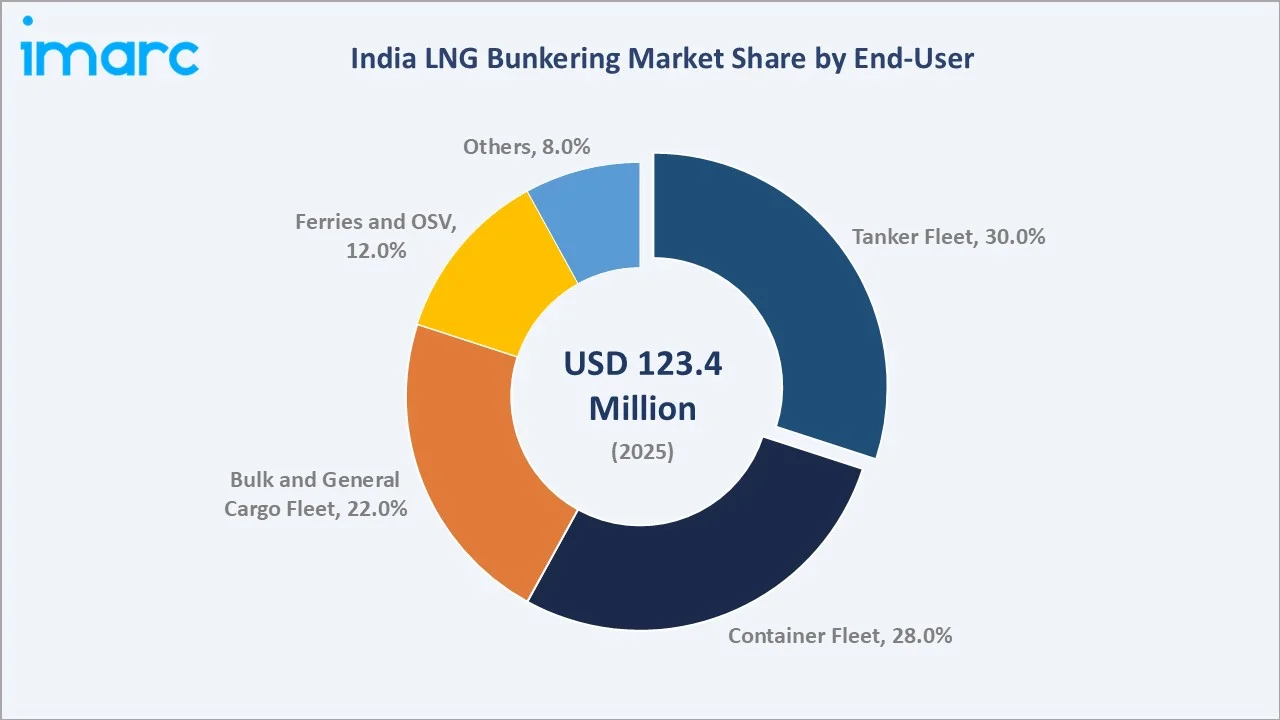
Container fleet at 28.0% reflects international container vessel LNG bunkering demand from global liner operators' LNG dual-fuel fleets calling at India's primary container gateway. Bulk and general cargo fleet at 22.0% serves India's bulk commodity trade with growing compliance pressure. Ferries and OSVs at 12.0% include coastal ferry LNG transition and offshore oil field support vessel programs. Others at 8.0% cover research vessels, naval auxiliaries, and specialized vessels.
Regional Market Insights
|
Region |
Share (2025) |
Key India LNG Bunkering Market Drivers & Characteristics |
|
West India |
32.0% |
Strong presence of major ports, LNG import terminals, and established gas infrastructure supports LNG availability and the development of marine bunkering facilities. |
|
South India |
30.0% |
Extensive coastline, high maritime activity, and presence of major commercial ports create favorable conditions for LNG bunkering infrastructure and vessel adoption. |
|
East India |
23.0% |
Growing port modernization, coastal shipping, and development of energy infrastructure are creating opportunities for LNG bunkering services across the eastern coastline. |
|
North India |
15.0% |
Market activity is primarily supported by inland waterways, LNG logistics networks, and growing development of cleaner-fuel transportation infrastructure. |
West India accounted for the largest share of 32.0% in 2025, supported by major ports, LNG terminals, and established gas infrastructure. South India represented 30.0%, benefiting from its extensive coastline and significant commercial shipping activity.
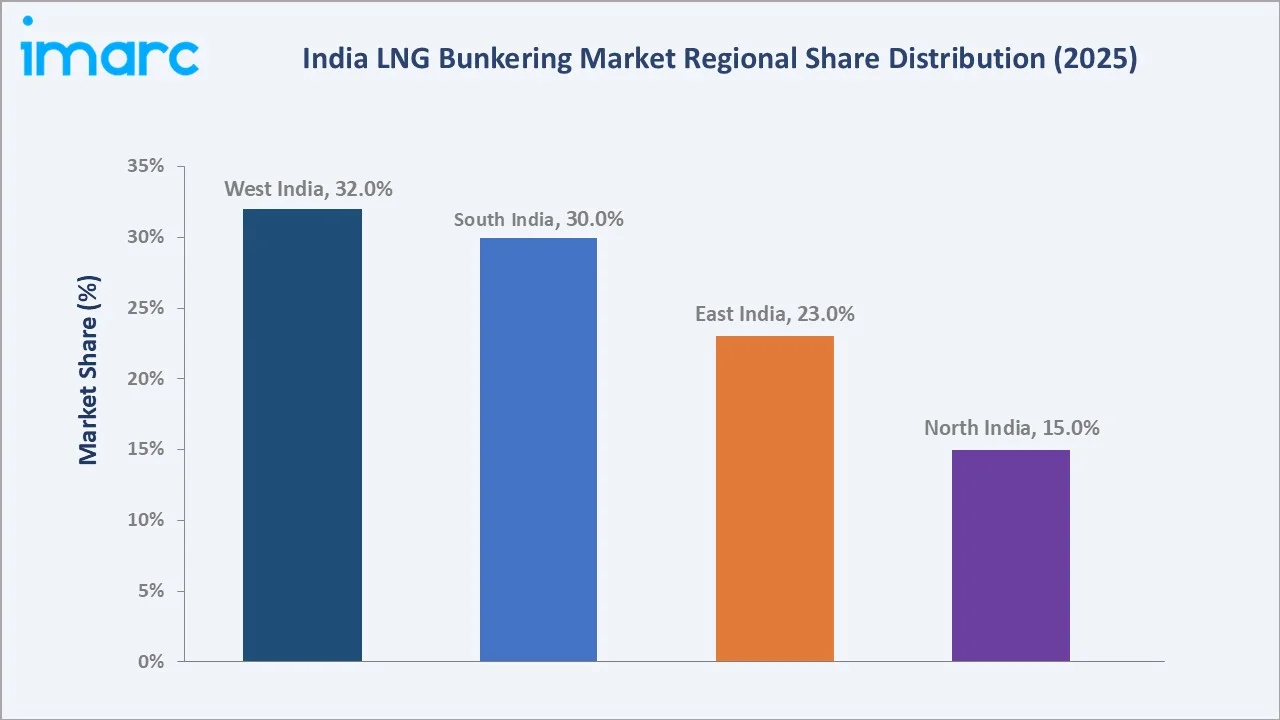
East India held a 23.0% share, supported by port modernization and expanding coastal shipping and energy infrastructure. Meanwhile, North India accounted for 15.0%, with opportunities primarily associated with inland waterways and LNG logistics development.
Competitive Landscape
India LNG bunkering market features a supply chain-oriented competitive structure led by LNG import terminal operators who control the LNG supply source critical to bunkering viability, alongside international energy majors providing global LNG bunkering expertise, port developers providing the infrastructure platform, and technology providers enabling the vessel-side LNG adoption that drives bunkering demand.
|
Company |
Key Offerings |
Market Position |
Core Strength |
|
GAIL (India) Limited |
LNG sourcing, shipping and regasification |
Market Leader |
GAIL (India) Limited is driving India's adoption of LNG bunkering by spearheading infrastructure development, supply chain integration, and strategic partnerships for cleaner marine fuels. |
|
Petronet LNG Limited |
LNG bunkering (shore to ship) |
Market Leader |
Petronet LNG Limited (PLL) provides pioneering LNG bunkering services at its Kochi Regasification Terminal, acting as a key enabler for cleaner marine fuels in the region. |
|
Indian Oil Corporation Ltd |
Truck-to-ship LNG bunkering |
Established Player |
Indian Oil Corporation Ltd (IOCL) is actively building its presence in India's natural gas and marine fuel sectors, laying the groundwork for LNG (Liquefied Natural Gas) bunkering alongside its established traditional marine oil supply network. |
|
Shell |
LNG, bio-LNG and synthetic LNG |
Established Player |
Shell supports India's emerging LNG ecosystem primarily through large-scale import infrastructure and heavy-duty transport fuel supply, rather than direct marine bunkering operations within Indian ports. |
Competitive dynamics in India's LNG bunkering market are uniquely shaped by the supply-side dependency on LNG import terminal operators, where the competitive moat is held by entities controlling LNG sourcing rather than those providing bunkering services.
Key Company Profiles
GAIL (India) Limited
GAIL (India) Limited is a major integrated natural gas company with operations spanning gas transmission, marketing, LNG sourcing, shipping, and regasification. The company’s extensive LNG sourcing and logistics capabilities provide a strong foundation for participation in India’s developing LNG bunkering ecosystem. GAIL is also developing small-scale and distributed LNG solutions that can support LNG fueling stations and marine bunkering applications. Its integrated gas infrastructure and supply-chain capabilities position the company as an important participant in expanding LNG availability for marine applications in India.
- Key Offerings: LNG sourcing, shipping and regasification.
- Strategic Focus: Focuses on leveraging its integrated LNG sourcing, transportation, and gas infrastructure capabilities to support the development of LNG as a marine fuel in India. The company also emphasizes partnerships with port authorities and technical organizations to explore LNG bunkering infrastructure at strategic maritime locations.
Petronet LNG Limited
Petronet LNG Limited is a major participant in India’s LNG industry, primarily engaged in the import, storage, and regasification of LNG through its terminal infrastructure. The company’s LNG handling capabilities provide a strong foundation for supporting the emerging marine LNG fuel ecosystem. Its terminal and storage assets can facilitate LNG supply to bunkering and other downstream applications. Petronet LNG’s established position in the LNG value chain enables it to contribute to the development of reliable LNG availability for India’s maritime sector.
- Key Offerings: LNG bunkering (shore to ship).
- Strategic Focus: Focuses on leveraging its LNG terminal, storage, and regasification infrastructure to support emerging marine fuel requirements in India. The company can strengthen its role in LNG bunkering by expanding downstream LNG distribution, improving supply accessibility, and supporting infrastructure development around key ports.
Market Concentration Analysis
India LNG bunkering market exhibits high concentration among a small number of LNG terminal operators who collectively control India's LNG import and small-scale supply infrastructure, the foundation that all LNG bunkering commercial operations depend upon. Unlike the more fragmented competitive landscape of conventional marine bunker fuel supply, where bunkering companies compete at major Indian ports, LNG bunkering's supply chain concentration at LNG terminal operators creates a naturally oligopolistic market structure in India's early-stage LNG bunkering development. This concentration is expected to partially fragment as India's LNG bunkering market matures and independent LNG bunker traders enter the market to compete for vessel bunkering business on price and operational service quality, as occurred in Singapore's LNG bunkering market evolution.
Investment & Growth Opportunities
Highest Growth Segments
Passenger ships (~8.2% CAGR), container ships (~7.8% CAGR), LNG bunkering hub development, terminal East India LNG bunkering, waterway LNG bunkering infrastructure, small-scale LNG coastal distribution network, and Indian seafarer training capacity represent the highest-priority investment opportunities in India's LNG bunkering market through 2034.
Investment Themes
- Satellite Liquefaction Network Along India's Coastal Pipeline Corridors: India's extensive natural gas pipeline network creates an ideal feedstock supply system for a network of satellite liquefaction units at pipeline offtake points adjacent to coastal ports, producing small-scale LNG for road tanker distribution to coastal bunkering points.
- Crew Training Center Development for India's LNG Maritime Workforce: India's seafarers require comprehensive LNG vessel certification training as India's LNG fleet grows and international shipping companies crew LNG vessels with Indian officers. Investment in a dedicated advanced training center with LNG fuel system simulators, LNG engine operation training, and emergency response training would position India as the global center for LNG seafarer certification, generating training revenue from Indian and international shipping companies while building the skilled maritime workforce India's LNG bunkering market development requires.
Future Market Outlook (2026-2034)
The India LNG bunkering market is projected to grow from USD 123.4 Million in 2025 to USD 136.1 Million in 2026, reaching USD 232.8 Million by 2034, exhibiting a CAGR of 6.94% during 2026-2034. The market is projected to reach USD 172.6 Million by 2030, the mid-period milestone when LNG bunkering jetties and dedicated LNG bunkering facilities are expected to be fully operational, creating India's first two-port LNG bunkering network enabling Indian coastal vessels to operate LNG propulsion systems with reasonable bunkering range confidence.
Three transformative forces will define India's LNG bunkering market through 2034. First, the regulatory enforcement intensification will create the fleet transition-driven demand acceleration that India's LNG bunkering infrastructure economics have been awaiting. Second, the infrastructure development coordination will unlock the private sector LNG bunkering investment at secondary Indian ports that cannot proceed without the regulatory certainty and bunkering demand signal that government-supported primary hub development provides. Third, the global LNG price normalization will significantly improve LNG bunkering's competitive economics at Indian ports, making LNG the commercially preferred choice for Indian coastal fleet operators even without the regulatory compliance driver alone, and accelerating India's coastal vessel LNG adoption above the regulatory compliance-only adoption scenario that currently underpins conservative India LNG bunkering market forecasts.
Research Methodology
Primary Research
Primary research comprised structured interviews with the LNG bunkering development team, LNG terminal bunkering project managers, port planning and environmental officers, India marine application engineers, fleet management and fuel procurement directors, policy team members, implementation officers, and international vessel operator India port agents with LNG-fueled fleet experience at Indian ports. Supply chain validation encompassed LNG terminal capacity assessments and LNG supply cost analysis.
Secondary Research
Secondary research incorporated vessel registry data for Indian-flag and foreign-flag vessel LNG adoption, program documentation, national waterway development plans and LNG vessel specifications, rating database and India-flag vessel compliance analysis, company annual reports and LNG terminal capacity planning disclosures, global LNG bunkering infrastructure database, LNG vessel orderbook data, and maritime transport statistics for India trade route vessel traffic volumes.
Forecasting Models
Market forecasting integrated India-calling vessel LNG adoption rate modeling from global LNG vessel orderbook data and India trade route vessel traffic analysis, LNG bunkering demand per-vessel calculation from average bunkering volumes at comparable Asian ports, LNG bunkering infrastructure commissioning timeline analysis based on project progress tracking, LNG price scenario modeling from global LNG supply-demand projections, and rating compliance impact analysis quantifying the proportion of India-calling vessels requiring fuel transition for 2026-2030 rating bands.
India LNG Bunkering Market Report Coverage:
| Report Features | Details |
|---|---|
| Base Year of the Analysis | 2025 |
| Historical Period | 2020-2025 |
| Forecast Period | 2026-2034 |
| Units | Million USD |
| Scope of the Report |
Exploration of Historical Trends and Market Outlook, Industry Catalysts and Challenges, Segment-Wise Historical and Future Market Assessment:
|
| Ship Types Covered | Container Ships, Tankers, Bulk Carriers, Passenger Ships |
| End-Users Covered | Tanker Fleet, Container Fleet, Bulk and General Cargo Fleet, Ferries and OSV, Others |
| Regions Covered | North India, South India, East India, West India |
| Companies Covered | GAIL (India) Limited, Petronet LNG Limited, Indian Oil Corporation Ltd, Shell, etc. |
| Customization Scope | 10% Free Customization |
| Post-Sale Analyst Support | 10-12 Weeks |
| Delivery Format | PDF and Excel through Email (We can also provide the editable version of the report in PPT/Word format on special request) |
Key Benefits for Stakeholders:
- IMARC’s industry report offers a comprehensive quantitative analysis of various market segments, historical and current market trends, market forecasts, and dynamics of the India LNG bunkering market from 2020-2034.
- The research report provides the latest information on the market drivers, challenges, and opportunities in the India LNG bunkering market.
- Porter's five forces analysis assist stakeholders in assessing the impact of new entrants, competitive rivalry, supplier power, buyer power, and the threat of substitution. It helps stakeholders to analyze the level of competition within the India LNG bunkering industry and its attractiveness.
- Competitive landscape allows stakeholders to understand their competitive environment and provides an insight into the current positions of key players in the market.
Frequently Asked Questions About the India LNG Bunkering Market Report
The India LNG bunkering market reached USD 136.1 Million in 2026, driven by regulation enforcement compelling vessel operators to adopt LNG at Indian ports, LNG bunkering infrastructure development, and LNG bunkering facility development at major Indian ports.
The market is projected to grow at a CAGR of 6.94% during 2026-2034, driven by regulatory tightening, LNG bunkering hub commissioning, terminal development, and Indian coastal fleet LNG adoption through inland waterway programs.
The market is projected to reach USD 172.6 Million by 2030, when LNG bunkering jetties and dedicated bunkering facilities are fully operational, India's two-port LNG bunkering network is established, inland waterway LNG bunkering is commercial, and global LNG price normalization improves bunkering economics versus conventional fuel.
Container ships lead with a 35.0% share in 2025, driven by the global LNG dual-fuel container ship orderbook, with major container lines operating LNG vessels that require LNG bunkering during Indian port calls.
The tanker fleet leads with a 30.0% share in 2025, reflecting India's position as one of the largest crude oil importers whose compliance trajectory is driving LNG dual-fuel evaluation for fleet renewal programs by international tanker operators.
West India leads with a 32.0% share in 2025, through the geographic concentration of India's LNG import terminal infrastructure and the highest international container and tanker vessel traffic density on India's western seaboard.
Key players include GAIL (India) Limited, Petronet LNG Limited, Indian Oil Corporation Ltd, and Shell, among others.
The market is projected to reach USD 232.8 Million by 2034, driven by regulatory enforcement compelling Indian coastal fleet LNG adoption, multi-port LNG bunkering network completion, inland waterway commercial LNG bunkering scale-up, and global LNG price normalization improving bunkering economics.
Key investment opportunities include a dedicated LNG bunker vessel for India's western seaboard serving shipping lanes, a satellite liquefaction network along India's coastal gas pipeline corridors, seafarer training center development positioning India as a global LNG maritime workforce training hub, and integrated LNG bunkering hub development at Kochi for the regional shipping market.
Need more help?
- Speak to our experienced analysts for insights on the current market scenarios.
- Include additional segments and countries to customize the report as per your requirement.
- Gain an unparalleled competitive advantage in your domain by understanding how to utilize the report and positively impacting your operations and revenue.
- For further assistance, please connect with our analysts.
 Request Customization
 Speak to an Analyst
 Request Brochure
 Inquire Before Buying
Benefits of Customization
- Personalize this research
- Triangulate with your data
- Get data as per your format and definition
- Gain a deeper dive into a specific application, geography, customer, or competitor
- Any level of personalization
Get in Touch With Us
UNITED STATES
Phone: +1-201-971-6302
INDIA
Phone: +91-120-433-0800
UNITED KINGDOM
Phone: +44-753-714-6104
Email: [email protected]
Client Testimonials


.webp)




.webp)











Related Reports

Choose your plan
*Please note that the prices mentioned below are starting prices for each bundle type. Kindly contact our team for further details.*
Single User License
- 1 User License, Access on 2 Devices
- PDF Report + Excel Dataset (Password Protected)
- Lifetime Access
- No Printing Rights
- 10% Free Report Customization
- 10–12 Weeks of Analyst Support
Five User License
- Access for 5 Users, 2 Devices per User
- PDF Report + Excel Dataset (Password Protected)
- Lifetime Access
- Dedicated Account Manager
- 12–14 Weeks of Analyst Support
- No Printing Rights
- 15% Free Report Customization
- 25% Discount on Your Next Purchase
Corporate User License
- Unlimited User Access (Within Your Organization)
- PDF Report + Excel Dataset
- Lifetime Access
- Dedicated Account Manager
- 14–20 Weeks of Analyst Support
- No Printing Rights
- 20% Free Report Customization
- 30% Discount on Your Next Purchase
Essential Insights
What's included:
3 reports
- Lifetime Access
- PDF Reports
- Excel Datasets
- 2 Weeks of Free Analyst Support
- 2 User Licenses
- Access on 2 Devices
- Printing Rights
- Complimentary PowerPoint (PPT) Version
- Complimentary License Upgrade
Professional Access
What's included:
5 reports
- Lifetime Access
- PDF Reports
- Excel Datasets
- 8 Weeks of Free Analyst Support
- 2 User Licenses
- Access on 2 Devices
- Printing Rights
- Complimentary PowerPoint (PPT) Version
- Complimentary License Upgrade
Business Advantage
What's included:
8 reports
- Lifetime Access
- PDF Reports
- Excel Datasets
- 14 Weeks of Free Analyst Support
- 2 User Licenses
- Access on 2 Devices
- Printing Rights
- Complimentary PowerPoint (PPT) Version
- Complimentary License Upgrade
Enterprise Intelligence
What's included:
10 reports
- Lifetime Access
- PDF Reports
- Excel Datasets
- 20 Weeks of Free Analyst Support
- 2 User Licenses
- Access on 2 Devices
- Printing Rights
- Complimentary PowerPoint (PPT) Version
- Complimentary License Upgrade