
India Portable Power Tools Market Size, Share, Trends and Forecast by Product, Application, and Region, 2026-2034
India Portable Power Tools Market Size, Share, Trends & Forecast (2026-2034)
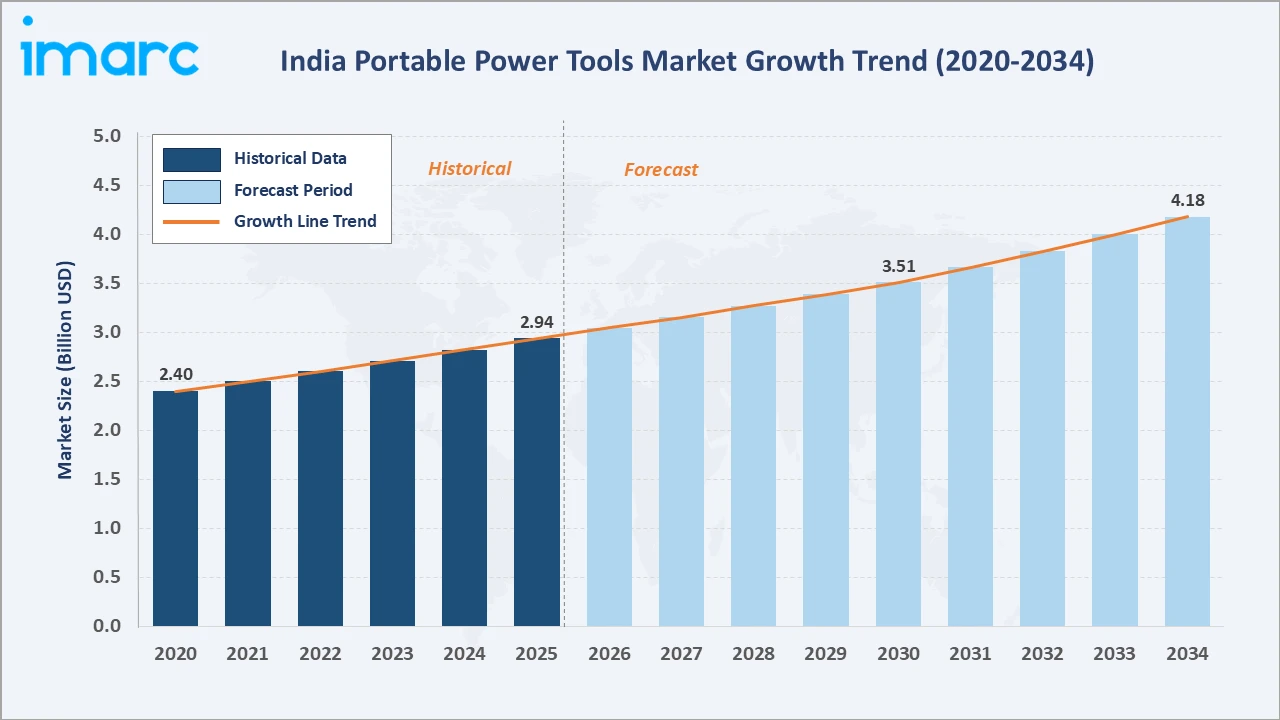
The India portable power tools market was valued at USD 2.94 Billion in 2025 and is projected to reach USD 4.18 Billion by 2034, exhibiting a CAGR of 3.87% during 2026-2034. Rising construction activity, expanding organized retail, and increasing DIY and home-improvement culture are the primary drivers shaping the market growth.
Cordless tools lead the product segment at 63.7%, commercial dominates the application segment at 68.4%, and West India commands 30.8% regional share.
Market Snapshot
|
Metric |
Value |
|
Market Size (2025) |
USD 2.94 Billion |
|
Forecast Market Size (2034) |
USD 4.18 Billion |
|
CAGR (2026-2034) |
3.87% |
|
Base Year |
2025 |
|
Historical Period |
2020-2025 |
|
Forecast Period |
2026-2034 |
|
Largest Region |
West India (30.8%, 2025) |
|
Second Largest Region |
North India (27.6%, 2025) |
|
Leading Product |
Cordless Tools (63.7%, 2025) |
|
Leading Application |
Commercial (68.4%, 2025) |
The India portable power tools market expanded from USD 2.40 Billion in 2020 to USD 2.94 Billion in 2025, driven by steady infrastructure spending, industrial capacity expansion, and rising penetration of organized retail and e-commerce channels for tools. Anchored at USD 3.51 Billion in 2030, the forecast to USD 4.18 Billion by 2034 is supported by accelerating cordless adoption, growing professional contractor demand, and a more structured distribution ecosystem.
To get more information on this market, Request Sample
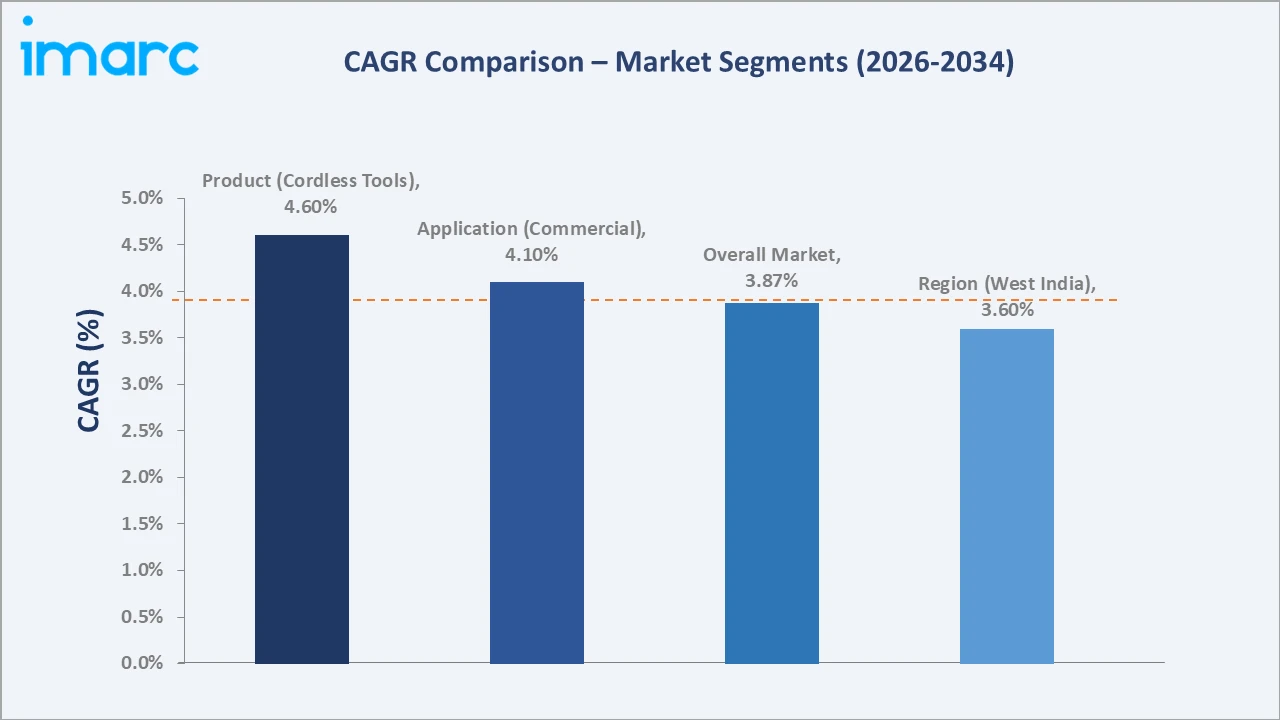
CAGR trajectories across product, application, and regional sub-segments show cordless tools and South India expanding faster than the overall 3.87% market CAGR, driven by battery technology upgrades, contractor mechanization, and rising industrial activity in southern manufacturing clusters.
Executive Summary
The India portable power tools market is on a steady growth trajectory from USD 2.40 Billion in 2020 to USD 4.18 Billion by 2034. The industry has moved from a largely corded, unorganized base toward cordless, battery-powered platforms distributed through organized retail, direct dealer networks, and e-commerce.
Cordless tools dominate the product segment at 63.7% in 2025, supported by lithium-ion battery advances, lighter tool bodies, and multi-tool battery platforms that reduce total cost of ownership for professional users. Commercial leads the application segment at 68.4%, fueled by construction, industrial maintenance, and infrastructure projects. West India commands 30.8% of the regional share, led by concentrated industrial and manufacturing clusters, strong dealer density, and a mature base of commercial contractors.
Key Market Insights
|
Insight |
Data |
|
Leading Product |
Cordless Tools - 63.7% share (2025) |
|
Second Largest Product |
Corded Tools - 36.3% share (2025) |
|
Leading Application |
Commercial - 68.4% share (2025) |
|
Second Largest Application |
Consumer - 31.6% share (2025) |
|
Leading Region |
West India - 30.8% share (2025) |
|
Second Largest Region |
North India - 27.6% share (2025) |
|
Top Companies |
Robert Bosch GmbH, Stanley Black & Decker, Inc., Makita Corporation, Techtronic Industries Co. Ltd., Hilti Corporation |
Key Analytical Observations Supporting the Above Data:
- Cordless tools dominance at 63.7% is supported by improving lithium-ion energy density, faster charging cycles, and multi-tool battery ecosystems that lower the effective cost of switching for professional contractors.
- Corded tools share at 36.3% remains relevant for heavy-duty, continuous-use applications in industrial and workshop settings where uninterrupted power output is prioritized over portability.
- Commercial leadership at 68.4% reflects sustained infrastructure and construction spending. Under the PMAY-Urban and PMAY-Urban 2.0 schemes combined, the government sanctioned over 1.25 Crore houses, of which more than 1 crore were completed and delivered, as of August 2026, sustaining demand for construction-grade tools.
- Consumer share at 31.6% is expanding gradually as organized retail chains and e-commerce marketplaces improve product discovery and after-sales confidence among first-time DIY buyers.
- West India at 30.8% leads regional share, anchored by Maharashtra and Gujarat's dense industrial base, established dealer networks, and concentration of automotive and engineering manufacturing clusters.
India Portable Power Tools Market Overview
Portable power tools are handheld or semi-handheld devices, powered either by electricity through a cord or by rechargeable batteries, used for drilling, cutting, grinding, sanding, and fastening across commercial and consumer applications. They offer greater mobility, operational convenience, and flexibility compared with conventional hand tools, supporting their adoption across diverse work environments.
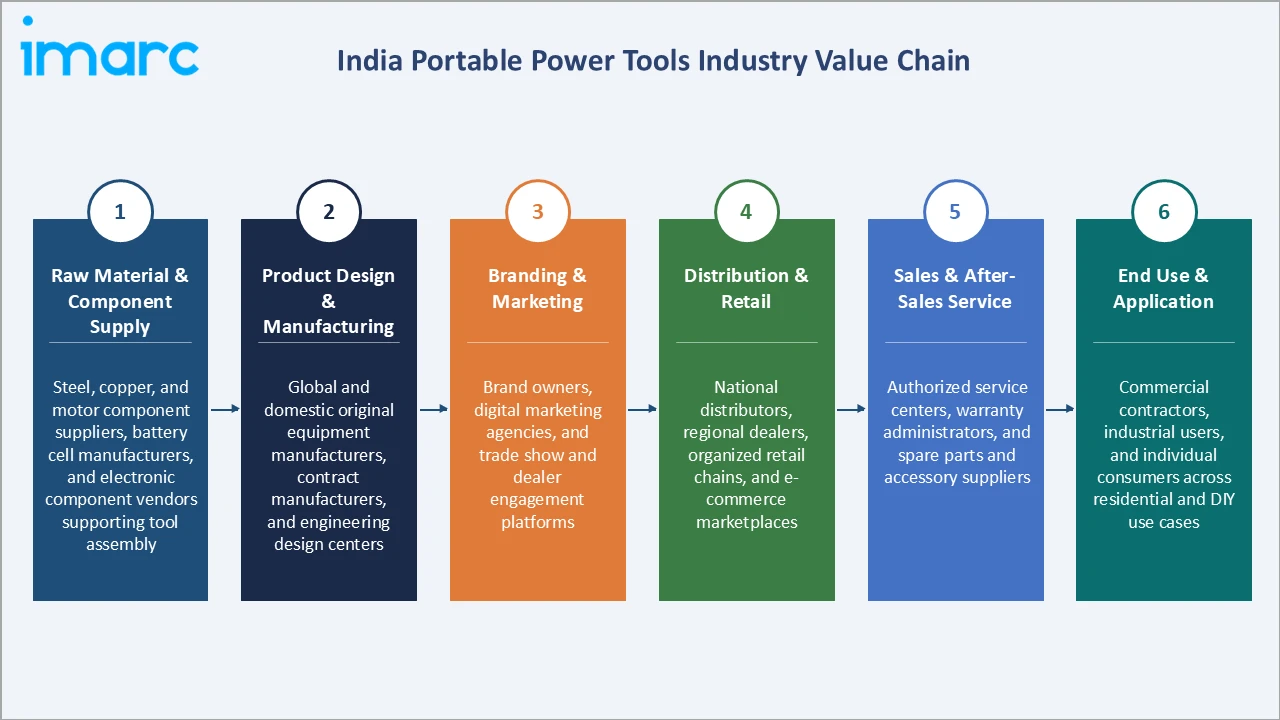
The Indian ecosystem integrates raw material and component suppliers, tool manufacturers and original equipment manufacturers, branding and distribution partners, retail and e-commerce channels, and after-sales service and rental providers. Together, these participants deliver tools to commercial contractors, industrial users, and individual consumers within an increasingly organized and digitally enabled supply chain.
Market Dynamics
To evaluate market opportunities, Request Sample
Market Drivers
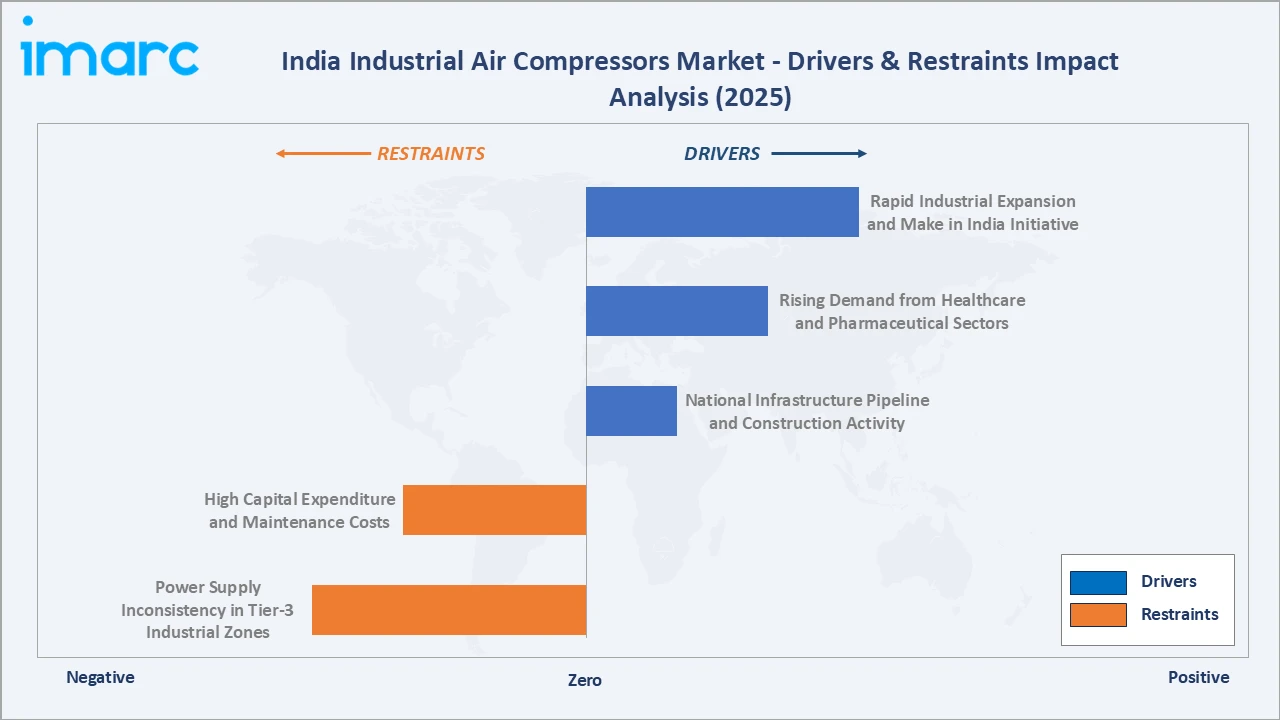
- Infrastructure and Construction Growth: Sustained public and private investment in roads, housing, and industrial facilities is driving continuous replacement and fleet expansion demand for drills, grinders, and cutting tools across commercial job sites.
- Rising DIY and Home Improvement Culture: Growing urban homeownership and renovation activity are encouraging first-time consumer purchases of compact, easy-to-use cordless tools for household repair and improvement tasks.
- Organized Retail and E-commerce Expansion: Wider availability of power tools through modern retail chains and online marketplaces is improving price transparency and product access across tier-2 and tier-3 cities. As per IMARC Group, the India e-commerce market size was valued at USD 129.72 Billion in 2025.
- Cordless and Battery Technology Advancements: Continuous improvement in lithium-ion battery density, charging speed, and multi-tool platform compatibility is reducing the performance gap between cordless and corded tools.
Market Restraints
- Volatile Raw Material Prices: Rising copper and steel prices are increasing input costs for motor windings and wiring components used across power tools, pressuring manufacturer margins.
- High Cost of Advanced Cordless Tools: Premium lithium-ion platforms carry higher upfront costs than conventional corded alternatives, which can slow adoption among price-sensitive consumer and small-contractor buyers.
- Presence of Unorganized and Counterfeit Products: A sizeable unorganized segment offering low-cost, non-certified tools continues to create price pressure and safety concerns that weigh on branded manufacturers' volume growth.
Market Opportunities
- Battery Platform Standardization: Manufacturers offering cross-compatible battery ecosystems across multiple tool categories can capture higher wallet share from repeat commercial buyers seeking lower total cost of ownership.
- Rural and Tier-2/3 City Penetration: Expanding organized retail and service infrastructure into smaller cities presents a substantial untapped opportunity for the India power tool market as construction and renovation activity spreads beyond metro markets.
Market Challenges
- After-Sales Service Gaps: Limited authorized service center density outside major cities creates ownership friction and can discourage repeat purchases among first-time cordless tool buyers.
- Skilled Workforce and Safety Awareness: Inconsistent training on proper tool handling and safety practices among informal-sector workers continues to pose adoption and liability challenges for manufacturers and contractors alike.
Emerging Market Trends
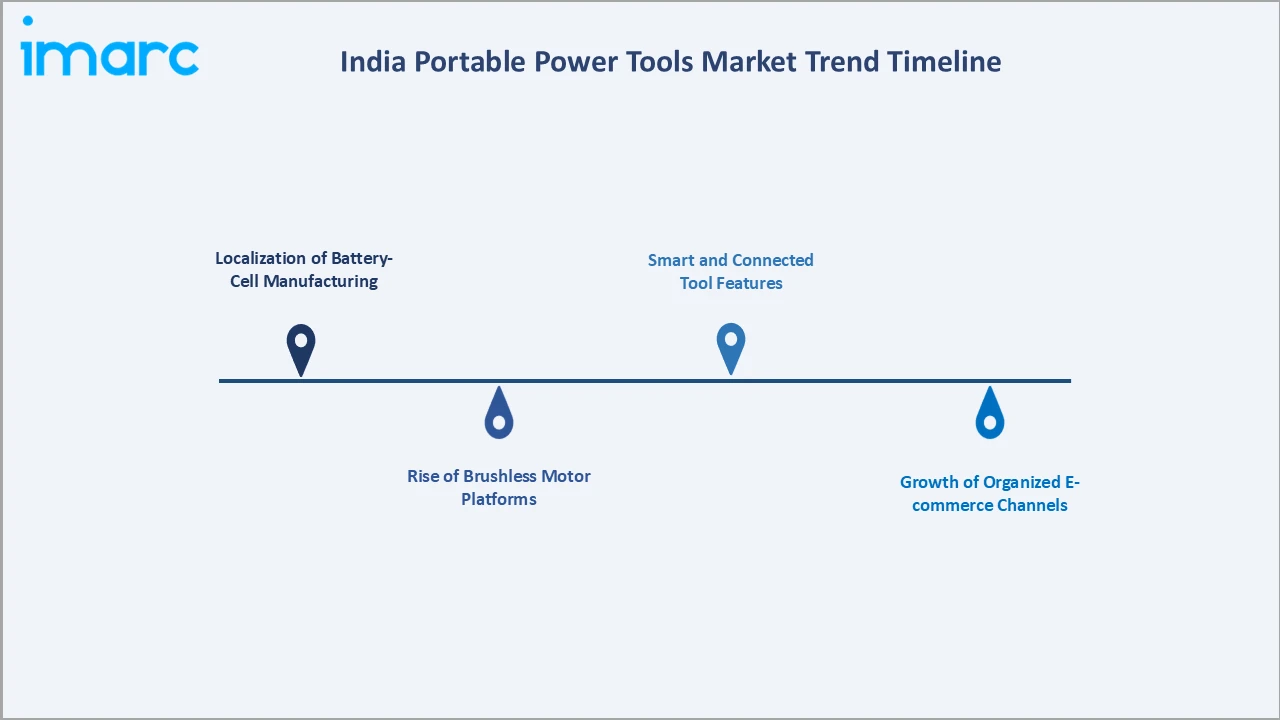
1. Localization of Battery-Cell Manufacturing
Government incentive schemes supporting domestic lithium-ion battery-cell manufacturing capacity are helping build a more localized supply base. As this ecosystem matures, cordless tool manufacturers are expected to benefit from shorter supply chains and more cost-competitive battery packs sourced within India.
2. Rise of Brushless Motor Platforms
Brushless motor technology is steadily replacing brushed motors across mid- and premium-tier tools, offering longer operating life, reduced maintenance, and improved energy efficiency. Adoption is fastest among commercial and industrial buyers seeking lower lifecycle costs.
3. Smart and Connected Tool Features
Bluetooth-enabled tool tracking, usage analytics, and app-based inventory management are gradually entering the premium professional segment, helping fleet managers reduce tool loss and plan maintenance schedules more efficiently.
4. Growth of Organized E-commerce Channels
Digital marketplaces are becoming an increasingly important discovery and purchase channel, particularly for consumer and small-contractor buyers, supported by wider SKU availability, transparent pricing, and improved warranty support compared to unorganized retail, further strengthening the power tools market in India.
Industry Value Chain Analysis
The India portable power tools value chain spans six stages, from raw material and component supply through end-use application. Product design, manufacturing, and distribution capture the highest value-add, while after-sales service and warranty support increasingly influence brand loyalty and repeat purchase behavior in this competitive category.
|
Stage |
Key Players / Examples |
|
Raw Material & Component Supply |
Steel, copper, and motor component suppliers, battery cell manufacturers, and electronic component vendors supporting tool assembly |
|
Product Design & Manufacturing |
Global and domestic original equipment manufacturers, contract manufacturers, and engineering design centers |
|
Branding & Marketing |
Brand owners, digital marketing agencies, and trade show and dealer engagement platforms |
|
Distribution & Retail |
National distributors, regional dealers, organized retail chains, and e-commerce marketplaces |
|
Sales & After-Sales Service |
Authorized service centers, warranty administrators, and spare parts and accessory suppliers |
|
End Use & Application |
Commercial contractors, industrial users, and individual consumers across residential and DIY use cases |
Manufacturers with vertically integrated design, battery technology, and service capabilities are positioned to capture greater value than distributors reliant solely on third-party product sourcing.
Technology Landscape in the India Portable Power Tools Industry
Battery Technology
Lithium-ion battery packs continue to improve in energy density and charge cycle life, narrowing the performance gap with corded tools. Multi-voltage platforms compatible across drills, saws, and grinders are becoming a key purchase driver for professional buyers seeking lower total ownership cost, a shift that is steadily lifting the power tools market size in India.
Materials Innovation
Manufacturers are increasingly using reinforced polymer composites and lightweight alloys in tool housings to reduce operator fatigue while maintaining durability standards required for commercial and industrial use.
Smart Connectivity
Bluetooth-enabled tracking and app-based diagnostics are entering premium tool lines, allowing fleet operators to monitor tool location, usage hours, and maintenance schedules from a centralized dashboard.
Automation and Brushless Motors
Brushless motor adoption is rising across mid- and premium-tier tools, offering higher torque efficiency and reduced maintenance needs. Automated torque-control features are also expanding in impact drivers and wrenches used in assembly-line and fastening applications.
Market Segmentation Analysis
The report covers the following segments:
|
Segment Category |
Leading Segment |
Market Share |
Year |
|
Product |
Cordless Tools |
63.7% |
2025 |
|
Application |
Commercial |
68.4% |
2025 |
|
Region |
West India |
30.8% |
2025 |

By Product
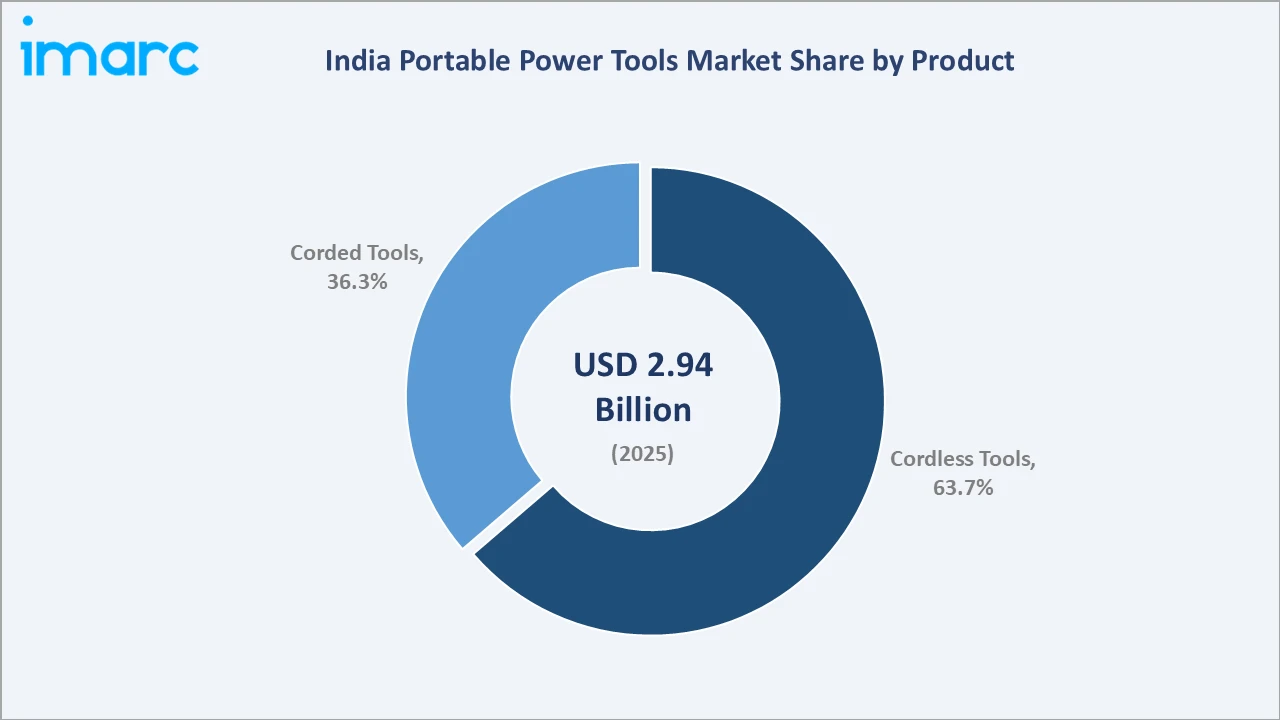
Cordless tools command a 63.7% majority share in 2025, driven by improving battery run-time, lighter tool bodies, and growing preference among commercial contractors for job-site mobility without power cord constraints. The segment benefits from continuous lithium-ion innovation and multi-tool battery platforms that lower switching costs for repeat buyers.
To access detailed market analysis, Request Sample
Corded tools at 36.3% in 2025 remain the preferred choice for heavy-duty, continuous-use industrial applications where uninterrupted power output and lower unit cost outweigh portability benefits. The segment continues to serve workshop and fixed-installation use cases.
By Application
Commercial dominates with 68.4% share in 2025, reflecting sustained construction, infrastructure, and industrial maintenance activity across the country. The segment remains the primary revenue base for premium and professional-grade tool manufacturers.
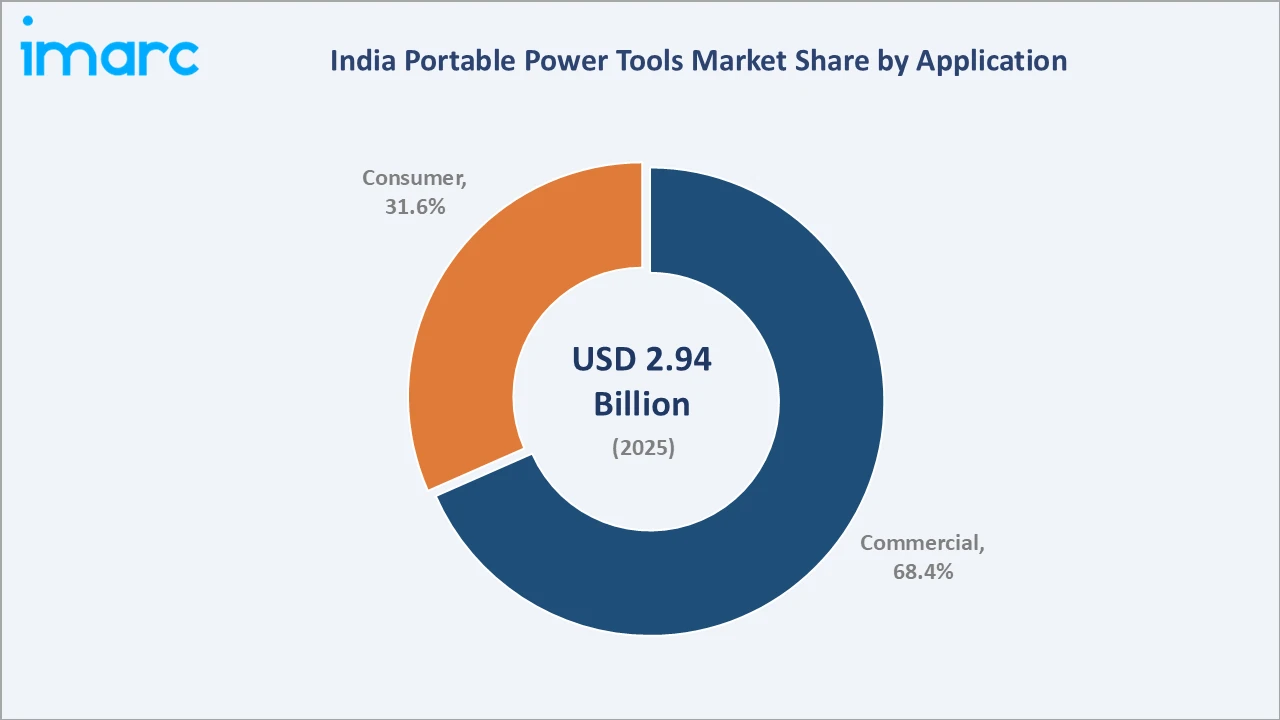
Consumer at 31.6% is expanding steadily through rising DIY and home-improvement activity, supported by wider retail and e-commerce access to affordably priced, entry-level cordless tools.
Regional Market Insights
|
Region |
Share (2025) |
Key Growth Drivers |
|
West India |
30.8% |
Dense industrial and manufacturing clusters, strong dealer and distribution density, and a mature base of commercial contractors |
|
North India |
27.6% |
Large construction and infrastructure pipeline, expanding urban housing activity, and growing organized retail presence |
|
South India |
24.1% |
Fast-growing industrial and IT-linked construction activity, rising disposable incomes, and expanding e-commerce penetration |
|
East India |
17.5% |
Emerging industrial investment, expanding infrastructure spending, and gradually improving distribution network coverage |
West India at 30.8% in 2025 leads the regional landscape, anchored by Maharashtra and Gujarat's concentrated automotive, engineering, and industrial manufacturing base. Deep dealer networks and a mature commercial contractor ecosystem support sustained leadership across both cordless and corded categories.
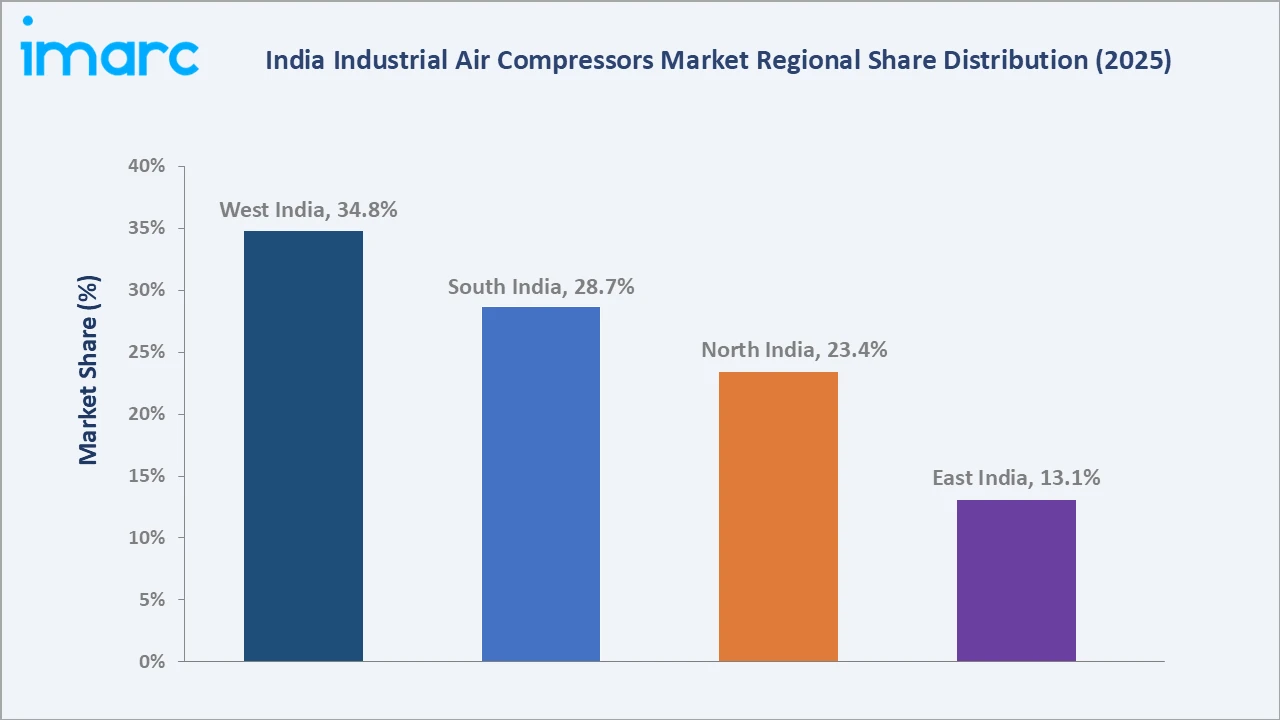
South India at 24.1% is the fastest growing region. Expanding industrial investment, rising urban construction activity, and improving e-commerce and organized retail access are accelerating regional expansion through 2034.
Competitive Landscape
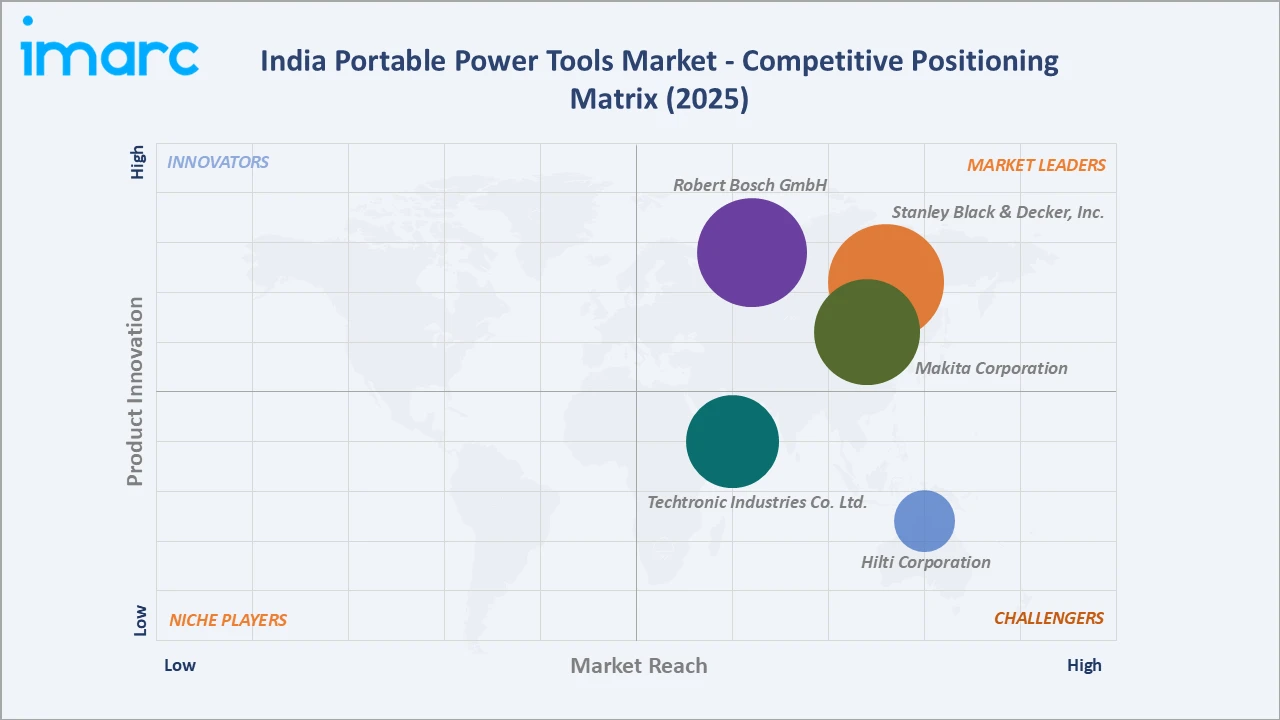
The India portable power tools market is moderately fragmented, with established global manufacturers leading premium and professional segments while domestic and regional brands compete on price and last-mile distribution reach. Brand strength, cordless battery ecosystems, service network depth, and distribution reach form the key competitive moats in this category.
|
Company Name |
Brand / Key Product |
Position |
Strategic Focus |
|
Robert Bosch GmbH |
Bosch Power Tools |
Leader |
Expanding cordless portfolio and strengthening local manufacturing and service presence |
|
Stanley Black & Decker, Inc. |
DEWALT |
Leader |
Broadening professional and consumer product range with deeper dealer network integration |
|
Makita Corporation |
Makita LXT |
Leader |
Growing cordless battery platform adoption among professional and industrial users |
|
Techtronic Industries Co. Ltd. |
Milwaukee, RYOBI |
Challenger |
Scaling brand presence and distribution reach across commercial and consumer channels |
|
Hilti Corporation |
Hilti Power Tools |
Challenger |
Deepening direct-sales relationships with large construction and industrial accounts |
Key players include Robert Bosch GmbH, Stanley Black & Decker, Inc., Makita Corporation, Techtronic Industries Co. Ltd., and Hilti Corporation, among others.
Key Company Profiles
Robert Bosch GmbH
Robert Bosch GmbH is a German multinational engineering and technology company, with its power tools business operating globally under the Bosch brand. In India, the company offers a wide range of corded and cordless power tools for professional and DIY users, supported by a large domestic manufacturing and service footprint.
- Product Portfolio: Bosch Professional and Bosch DIY ranges covering drills, grinders, saws, and cordless battery platforms.
- Recent Developments: The company continues to broaden its cordless tool portfolio and strengthen its power tools presence across professional and consumer applications.
- Strategic Focus: Expanding cordless product depth, strengthening local manufacturing capacity, and growing service center coverage across India.
Stanley Black & Decker, Inc.
Stanley Black & Decker, Inc. is an American industrial company headquartered in New Britain, Connecticut, offering power tools through its DEWALT brand among others. The company serves professional tradespeople, industrial users, and consumers through a broad portfolio of corded and cordless tools and equipment.
- Product Portfolio: DEWALT professional cordless systems spanning drills, saws, grinders, and job-site equipment.
- Recent Developments: The company continues to strengthen its cordless tool portfolio and expand product offerings suited to evolving professional and consumer requirements.
- Strategic Focus: Broadening professional and consumer product range with deeper dealer network integration across India.
Makita Corporation
Makita Corporation is a Japanese power tools manufacturer headquartered in Anjo, known for its cordless LXT battery platform used across a wide range of professional tools. In India, the company serves professional contractors and industrial users.
- Product Portfolio: Makita LXT cordless system spanning drills, grinders, saws, and outdoor power equipment.
- Recent Developments: The company continues to expand its cordless tool offerings and strengthen support for professional users across key application areas.
- Strategic Focus: Growing cordless battery platform adoption among professional and industrial users through expanded dealer training and support.
Market Concentration Analysis
The India portable power tools market is moderately concentrated, with the leading global manufacturers accounting for a significant share of the branded, organized segment, while a large unorganized base of regional and local manufacturers continues to serve price-sensitive commercial and consumer buyers.
Barriers to entry include the need for extensive dealer and service networks, cordless battery platform investment, and brand trust built over years of professional use. These factors favor well-capitalized incumbents with established distribution and after-sales infrastructure.
Consolidation is gradual, with global manufacturers expanding local manufacturing and service capacity while domestic brands compete on price in the value-tier segment. Strategic partnerships with retail chains and e-commerce platforms are further reinforcing competitive positioning across the organized segment of the market.
Investment & Growth Opportunities
Fastest-Growing Segments
Cordless tools expand fastest among product segments, driven by battery technology improvements and rising professional preference for job-site mobility. Their ease of handling, reduced dependence on power outlets, and improving runtime further support adoption across construction and industrial applications.
Emerging Markets
South India is the fastest-growing region, supported by expanding industrial investment and construction activity. Tier-2 and tier-3 cities across South India and East India represent significant untapped opportunity for manufacturers able to expand organized retail presence and after-sales service infrastructure beyond metro markets.
Venture & Investment Trends
Investment is concentrated in domestic battery-cell and component manufacturing capacity, supported by government production-linked incentive schemes. Capital is also flowing into e-commerce-focused distribution models and service network expansion that align with rising cordless tool adoption.
Future Market Outlook (2026-2034)
The India portable power tools market is forecast to expand from USD 2.94 Billion in 2025 to USD 4.18 Billion by 2034 at a CAGR of 3.87%, adding roughly USD 1.24 Billion in incremental market value over the forecast period.
Three forces will shape the market through 2034: continued infrastructure and construction investment; accelerating adoption of cordless and battery-powered platforms; and deeper penetration of organized retail and e-commerce distribution channels across smaller cities.
By 2034, the India portable power tools market is expected to be defined by cordless-first product portfolios, broader after-sales service coverage, and a more formalized, brand-driven distribution ecosystem. Continued investment in domestic battery manufacturing and localization is expected to further support the market's long-term growth trajectory.
Research Methodology
Primary Research
Primary research included structured interviews with tool manufacturers, distributors, retail channel partners, and industrial procurement specialists, validating market sizing, segment mix, and regional demand patterns.
Secondary Research
Secondary sources included government infrastructure and housing scheme publications, industry association reports, company annual reports, and trade and customs data related to power tool imports and domestic manufacturing.
Forecasting Models
Market forecasts used top-down and bottom-up models combining construction and infrastructure spending trends, cordless adoption curves, and regional industrial activity indicators. Scenario analysis addressed raw material price volatility and regulatory developments.
India Portable Power Tools Market Report Coverage:
| Report Features | Details |
|---|---|
| Base Year of the Analysis | 2025 |
| Historical Period | 2020-2025 |
| Forecast Period | 2026-2034 |
| Units | Billion USD |
| Scope of the Report |
Exploration of Historical Trends and Market Outlook, Industry Catalysts and Challenges, Segment-Wise Historical and Future Market Assessment:
|
| Products Covered | Cordless Tools, Corded Tools |
| Applications Covered | Commercial, Consumer |
| Regions Covered | North India, South India, East India, West India |
| Companies Covered | Robert Bosch GmbH, Stanley Black & Decker, Inc., Makita Corporation, Techtronic Industries Co. Ltd., Hilti Corporation, etc. |
| Customization Scope | 10% Free Customization |
| Post-Sale Analyst Support | 10-12 Weeks |
| Delivery Format | PDF and Excel through Email (We can also provide the editable version of the report in PPT/Word format on special request) |
Key Benefits for Stakeholders:
- IMARC’s industry report offers a comprehensive quantitative analysis of various market segments, historical and current market trends, market forecasts, and dynamics of the India portable power tools market from 2020-2034.
- The research report provides the latest information on the market drivers, challenges, and opportunities in the India portable power tools market.
- Porter's five forces analysis assist stakeholders in assessing the impact of new entrants, competitive rivalry, supplier power, buyer power, and the threat of substitution. It helps stakeholders to analyze the level of competition within the India portable power tools industry and its attractiveness.
- Competitive landscape allows stakeholders to understand their competitive environment and provides an insight into the current positions of key players in the market.
Frequently Asked Questions About the India Portable Power Tools Market Report
The India portable power tools market was valued at USD 2.94 Billion in 2025, driven by infrastructure spending, industrial activity, and rising cordless tool adoption..
The market is projected to grow at a CAGR of 3.87% from 2026-2034, reaching USD 4.18 Billion, supported by cordless adoption and expanding organized retail.
Cordless tools dominate at 63.7% in 2025, driven by improving lithium-ion battery density, lighter tool bodies, and rising contractor preference for job-site mobility.
Commercial dominates at 68.4% in 2025, fueled by sustained construction, infrastructure, and industrial maintenance activity across the country.
West India commands 30.8% in 2025, led by dense industrial clusters in Maharashtra and Gujarat and a mature commercial contractor base.
South India, with 24.1% share in 2025, is the fastest-growing region, supported by expanding industrial investment and construction activity.
Leading players include Robert Bosch GmbH, Stanley Black & Decker, Inc., Makita Corporation, Techtronic Industries Co. Ltd., and Hilti Corporation, among others.
Rising copper prices have increased input costs for motor and wiring components, prompting manufacturers to optimize sourcing and pass costs through pricing adjustments.
Advances in lithium-ion energy density and multi-tool battery platforms are accelerating the shift from corded to cordless tools across commercial and consumer segments.
Growing e-commerce penetration is improving price transparency and product access, particularly benefiting consumer and small-contractor buyers in tier-2 and tier-3 cities.
Need more help?
- Speak to our experienced analysts for insights on the current market scenarios.
- Include additional segments and countries to customize the report as per your requirement.
- Gain an unparalleled competitive advantage in your domain by understanding how to utilize the report and positively impacting your operations and revenue.
- For further assistance, please connect with our analysts.
 Request Customization
 Speak to an Analyst
 Request Brochure
 Inquire Before Buying
Benefits of Customization
- Personalize this research
- Triangulate with your data
- Get data as per your format and definition
- Gain a deeper dive into a specific application, geography, customer, or competitor
- Any level of personalization
Get in Touch With Us
UNITED STATES
Phone: +1-201-971-6302
INDIA
Phone: +91-120-433-0800
UNITED KINGDOM
Phone: +44-753-714-6104
Email: [email protected]
Client Testimonials




.webp)




.webp)













Related Reports

Choose your plan
*Please note that the prices mentioned below are starting prices for each bundle type. Kindly contact our team for further details.*
Single User License
- 1 User License, Access on 2 Devices
- PDF Report + Excel Dataset (Password Protected)
- Lifetime Access
- No Printing Rights
- 10% Free Report Customization
- 10–12 Weeks of Analyst Support
Five User License
- Access for 5 Users, 2 Devices per User
- PDF Report + Excel Dataset (Password Protected)
- Lifetime Access
- Dedicated Account Manager
- 12–14 Weeks of Analyst Support
- No Printing Rights
- 15% Free Report Customization
- 25% Discount on Your Next Purchase
Corporate User License
- Unlimited User Access (Within Your Organization)
- PDF Report + Excel Dataset
- Lifetime Access
- Dedicated Account Manager
- 14–20 Weeks of Analyst Support
- No Printing Rights
- 20% Free Report Customization
- 30% Discount on Your Next Purchase
Essential Insights
What's included:
3 reports
- Lifetime Access
- PDF Reports
- Excel Datasets
- 2 Weeks of Free Analyst Support
- 2 User Licenses
- Access on 2 Devices
- Printing Rights
- Complimentary PowerPoint (PPT) Version
- Complimentary License Upgrade
Professional Access
What's included:
5 reports
- Lifetime Access
- PDF Reports
- Excel Datasets
- 8 Weeks of Free Analyst Support
- 2 User Licenses
- Access on 2 Devices
- Printing Rights
- Complimentary PowerPoint (PPT) Version
- Complimentary License Upgrade
Business Advantage
What's included:
8 reports
- Lifetime Access
- PDF Reports
- Excel Datasets
- 14 Weeks of Free Analyst Support
- 2 User Licenses
- Access on 2 Devices
- Printing Rights
- Complimentary PowerPoint (PPT) Version
- Complimentary License Upgrade
Enterprise Intelligence
What's included:
10 reports
- Lifetime Access
- PDF Reports
- Excel Datasets
- 20 Weeks of Free Analyst Support
- 2 User Licenses
- Access on 2 Devices
- Printing Rights
- Complimentary PowerPoint (PPT) Version
- Complimentary License Upgrade