
Japan Lip Care Products Market Size, Share, Trends and Forecast by Product, Distribution Channel, and Region, 2026-2034
Japan Lip Care Products Market Size, Share, Trends & Forecast (2026-2034)
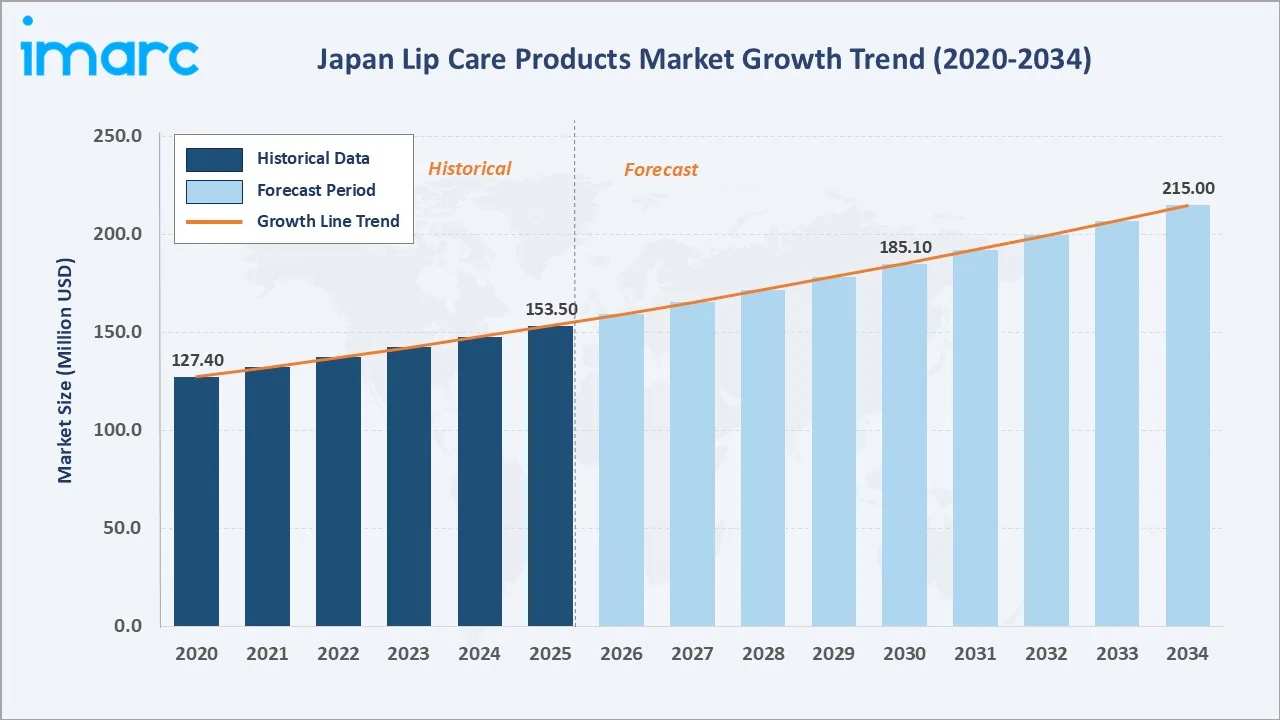
The Japan lip care products market was valued at USD 153.5 Million in 2025 and is projected to reach USD 215.0 Million by 2034, growing at a CAGR of 3.81% during 2026-2034. Rising beauty and grooming awareness, prolonged dry winters, and expanding quasi-drug innovation are lifting demand nationwide. Lip balm dominates the product mix with a 76.8% share, while pharmacy and drug stores lead distribution at 36.4%. The Kanto region anchors the market with 35.1% share, reflecting its dense urban retail network and high per-capita cosmetics spending among Tokyo-based consumers.
Market Snapshot
|
Metric |
Value |
|
Market Size (2025) |
USD 153.5 Million |
|
Forecast Market Size (2034) |
USD 215.0 Million |
|
CAGR (2026-2034) |
3.81% |
|
Base Year |
2025 |
|
Historical Period |
2020-2025 |
|
Forecast Period |
2026-2034 |
The market grew from USD 127.4 Million in 2020 to USD 153.5 Million in 2025, anchored at USD 185.1 Million in 2030, and is forecast to reach USD 215.0 Million by 2034. Quasi-drug medicated balm approvals and multi-functional stick formats are reshaping Japan's lip care economics beyond simple moisturization.
To get more information on this market, Request Sample
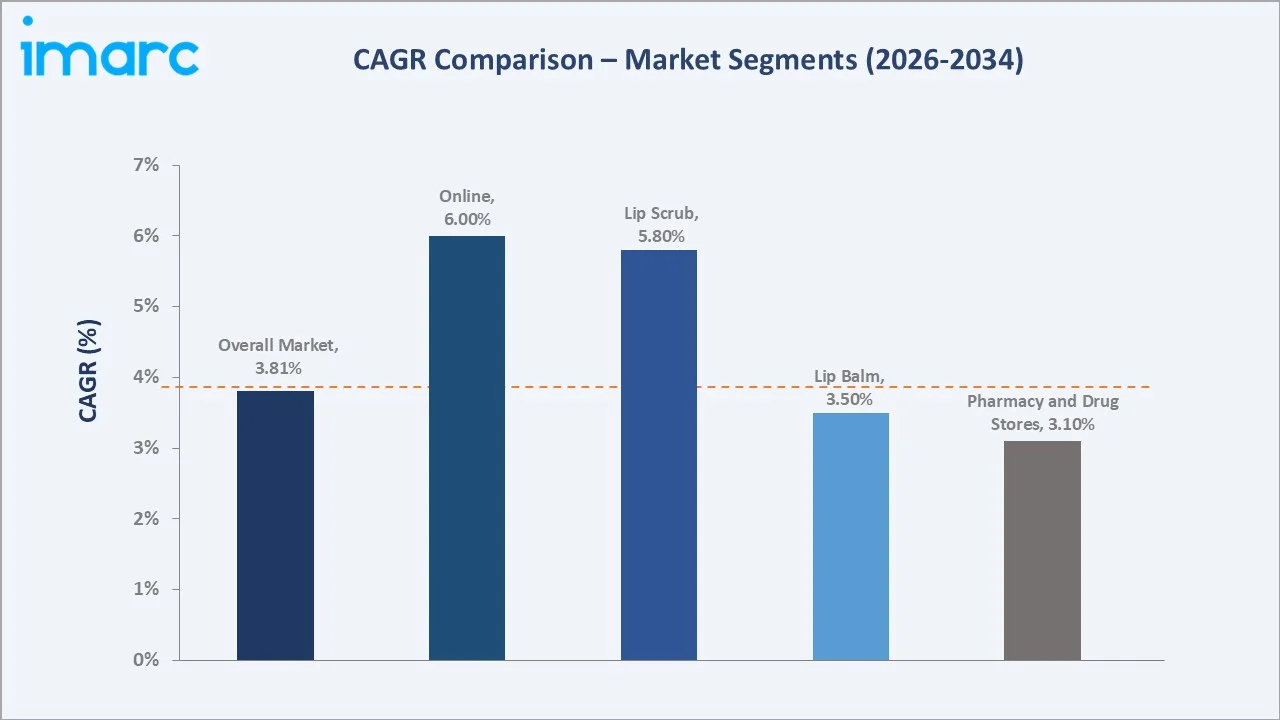
Lip scrub grows fastest at an estimated 5.8% CAGR (2026-2034) as exfoliation routines gain traction among younger consumers. Online distribution follows at roughly 6.0% CAGR, outpacing pharmacy and drug store growth of about 3.1% annually through the forecast period.
Executive Summary
The Japan lip care products market reached USD 153.5 Million in 2025, representing a mature yet steadily expanding segment within Japan's broader personal care industry. Japan's four distinct seasons, including harsh dry winters, create consistent year-round demand for moisturizing and protective lip formulations, sustaining a structurally stable market underpinned by high beauty awareness and strong dermatological trust in domestic brands.
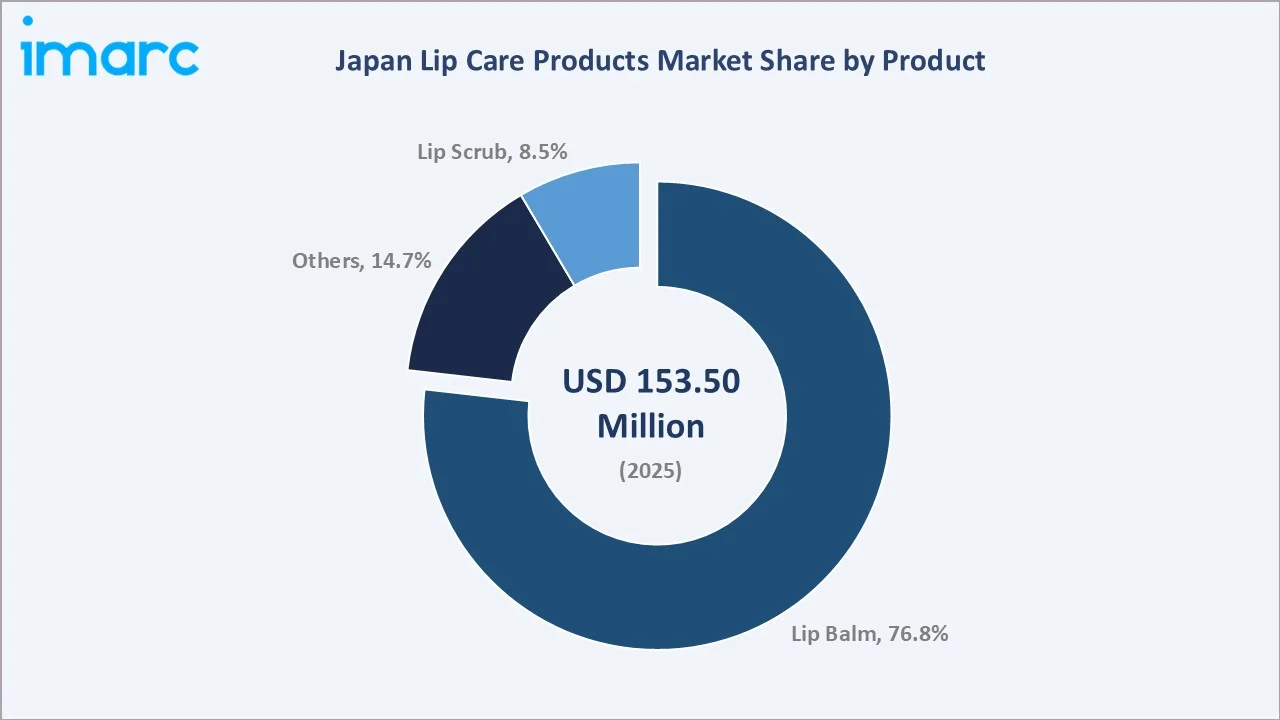
Lip balm leads at 76.8% product share (2025), driven by Japan's daily-use medicated and quasi-drug balm culture. Others, including lip scrubs, tints, and serums, account for 14.7%, while lip scrub itself holds 8.5% and grows fastest as exfoliation becomes part of mainstream lip routines. Pharmacy and drug stores dominate distribution at 36.4%, supported by Japan's dense network of drugstore chains.
Japan's 3.81% CAGR to USD 215.0 Million by 2034 reflects steady volume growth tempered by category maturity, but supported by e-commerce expansion, K-beauty influenced tinted balms, and rising SPF and anti-aging lip serum adoption among Japan's aging, beauty-conscious population.
Key Market Insights
|
Insight |
Data |
|
Largest Segment |
Lip Balm - 76.8% revenue share (2025) |
|
Leading Distribution Channel |
Pharmacy and Drug Stores - 36.4% share (2025) |
|
Fastest Growing Segment |
Lip Scrub - ~5.8% CAGR (2026-2034) |
|
Leading Region |
Kanto Region - 35.1% share (2025) |
|
Top Companies |
Rohto Pharmaceutical Co., Ltd., Kao Corporation, and Shiseido Company, Limited |
|
Market Opportunity |
SPF and anti-aging lip serum expansion |
Key Analytical Observations Supporting The Above Data:
- Lip Balm at 76.8% (2025) anchored by Japan's medicated balm culture: Daily-use quasi-drug balms remain the default lip care choice across all age groups, sustaining category dominance.
- Pharmacy and Drug Stores at 36.4% anchored by Japan's licensed drugstore chains: Chains such as Matsumotokiyoshi, Sugi Holdings, and Welcia stock both cosmetic and quasi-drug lip lines, forming Japan's primary retail backbone.
- Lip Scrub growing at an estimated 5.8% CAGR: Exfoliating sugar-scrub balms are gaining popularity among younger, social-media-influenced consumers seeking smoother lip texture.
- Kanto Region leads at 35.1% share (2025): Tokyo's dense drugstore density and Japan's highest disposable income concentration reinforce the region's market leadership.
- Online channel share of 18.7% (2025) is expanding: Amazon Japan, Rakuten, and @cosme shopping are widening access to niche, imported, and limited-edition lip care brands.
Japan Lip Care Products Market Overview
Japan's lip care products market encompasses moisturizing balms, medicated quasi-drug treatments, tinted balms, lip scrubs, and SPF or anti-aging lip serums sold across pharmacy, retail, and online channels. The ecosystem integrates ingredient suppliers, domestic and multinational cosmetics manufacturers, Japan's MHLW regulatory framework, wholesale distributors, and retail dispensing channels serving beauty-conscious consumers nationwide.
Japan's Ministry of Health, Labour and Welfare (MHLW) oversees both cosmetics and quasi-drug categories under the Pharmaceutical and Medical Device Act, requiring efficacy substantiation for medicated lip balm claims. Macroeconomic drivers include Japan's aging population, JPY exchange fluctuations affecting imported ingredient costs, and sustained per-capita personal care spending.
Market Dynamics
To evaluate market opportunities, Request Sample
Market Drivers
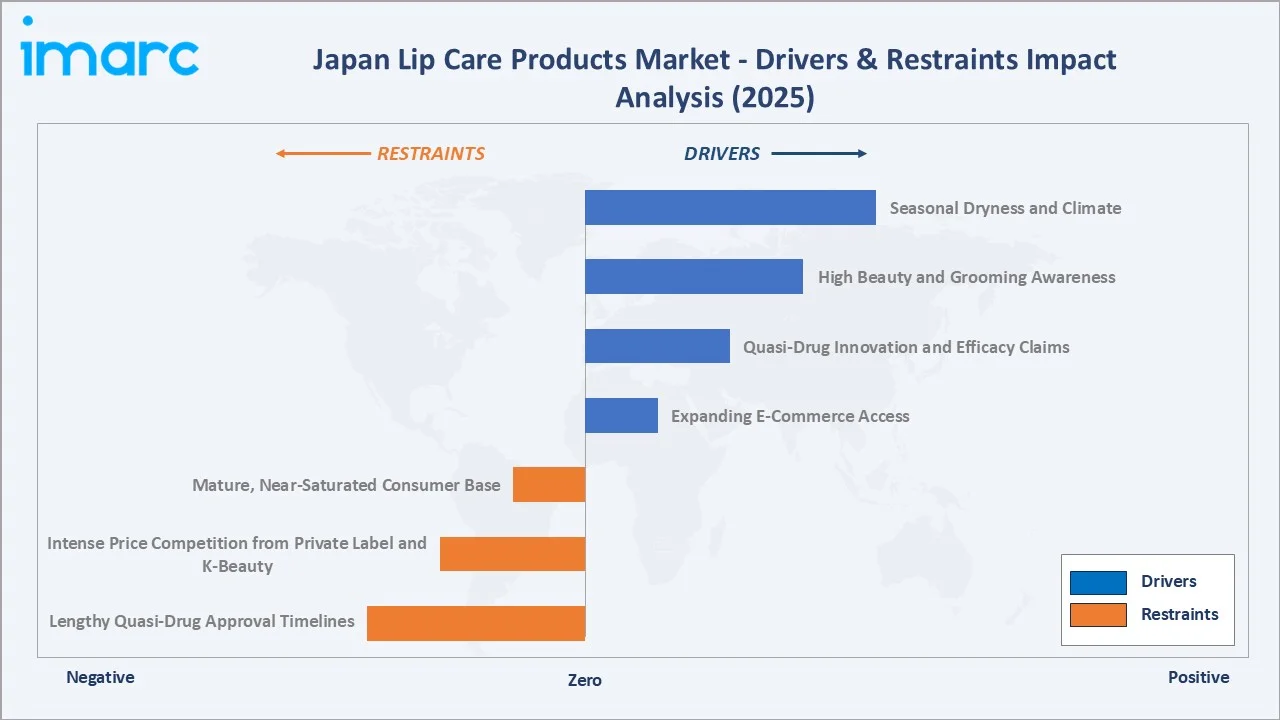
- Seasonal Dryness and Climate: Japan's cold, arid winters, particularly across Hokkaido and Tohoku, drive consistent demand for moisturizing and protective lip balms, sustaining baseline consumption regardless of economic cycles.
- High Beauty and Grooming Awareness: Japanese consumers prioritize skin and lip health as part of daily self-care routines, with smooth, hydrated lips considered essential to a polished appearance.
- Quasi-Drug Innovation and Efficacy Claims: MHLW's quasi-drug classification allows brands like Rohto Mentholatum and Shiseido to market medicated lip balms with substantiated repair claims, commanding premium pricing.
- Expanding E-Commerce Access: Growth of Amazon Japan, Rakuten, and @cosme shopping is widening consumer access to niche, imported, and limited-edition lip care products beyond drugstore shelf space.
Market Restraints
- Mature, Near-Saturated Consumer Base: Japan's lip balm category is a long-established daily-use staple, limiting the scope for significant volume expansion compared with emerging cosmetics markets.
- Intense Price Competition from Private Label and K-Beauty: Affordable domestic private-label balms and Korean brands such as rom&nd pressure premium pricing across drugstore and online channels.
- Lengthy Quasi-Drug Approval Timelines: Securing MHLW approval for new medicated efficacy claims can take 12-18 months, slowing product innovation cycles relative to purely cosmetic launches.
Market Opportunities
- SPF and Anti-Aging Lip Serum Expansion: Rising demand for wrinkle-care lip treatments among Japan's aging population, exemplified by Shiseido's PRIOR Wrinkle Glow Lip, is creating a premium sub-segment.
- Multi-Functional 'Stick' Format Innovation: Combined balm-color-scrub sticks, popularized by brands like Kanebo, reduce routine complexity and appeal to time-constrained urban consumers.
- Inbound Tourism-Linked Retail Growth: Duty-free and airport retail channels benefit from rising inbound tourist demand for Japanese quasi-drug lip care as souvenir and gifting items.
Market Challenges
- Ingredient Cost Volatility: JPY depreciation raises the cost of imported botanical oils and specialty moisturizing agents used in premium lip balm formulations.
- Retail Channel Fragmentation: Balancing presence across pharmacy chains, hypermarkets, specialty stores, and online marketplaces requires complex inventory and pricing coordination.
- Sustainability and Packaging Pressure: Growing consumer expectation for recyclable tube packaging is pushing manufacturers toward costlier sustainable material redesigns.
Emerging Market Trends
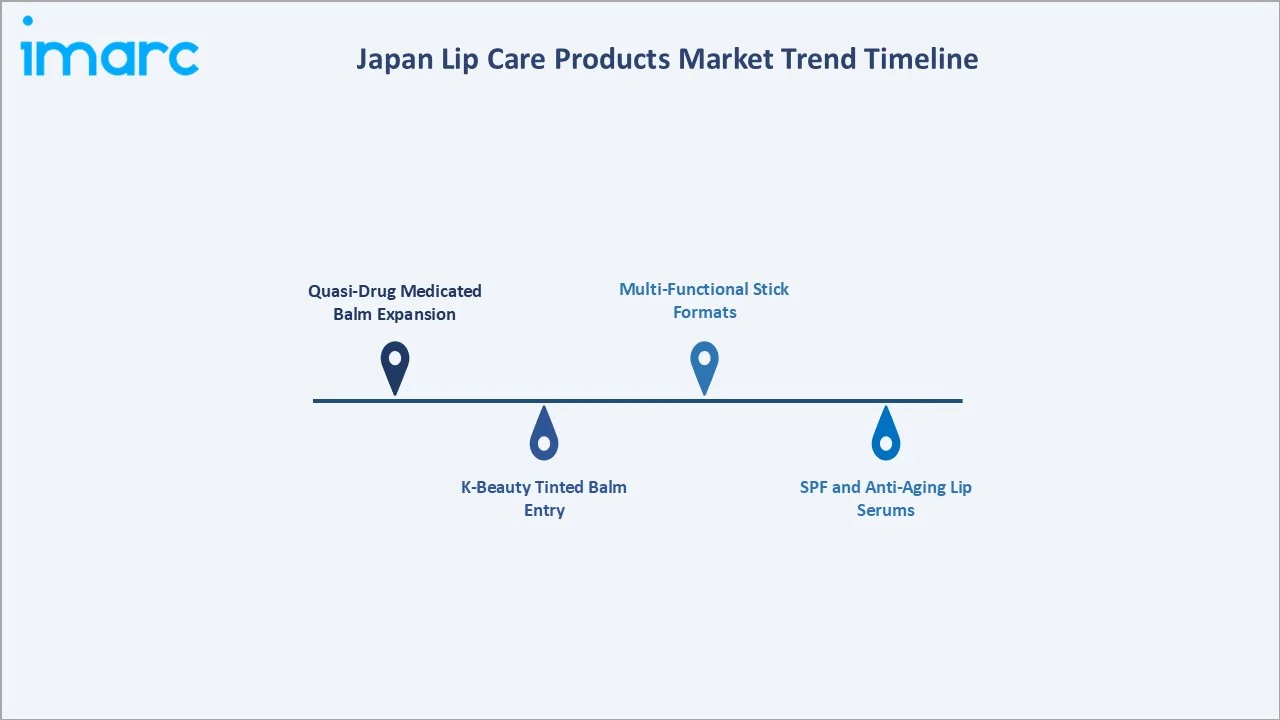
1. Quasi-Drug Medicated Balm Expansion
Since 2020, Japanese manufacturers have increasingly sought MHLW quasi-drug status for lip balms, enabling therapeutic claims around chapping, cracking, and inflammation relief that build consumer trust.
2. K-Beauty Tinted Balm Entry
Korean brands such as rom&nd have gained strong traction in Japan since 2022 through glass-like tinted balms, prompting domestic brands to accelerate their own tinted balm launches.
3. Multi-Functional Stick Formats
Kanebo's 2024 combined balm, base, color, and scrub stick illustrates Japan's shift toward convenience-oriented, all-in-one lip care products for busy urban consumers.
4. SPF and Anti-Aging Lip Serums
Products such as Shiseido's PRIOR Wrinkle Glow Lip and premium peptide-based lip serums are scaling as Japan's aging population seeks visible anti-aging lip treatments.
Industry Value Chain Analysis
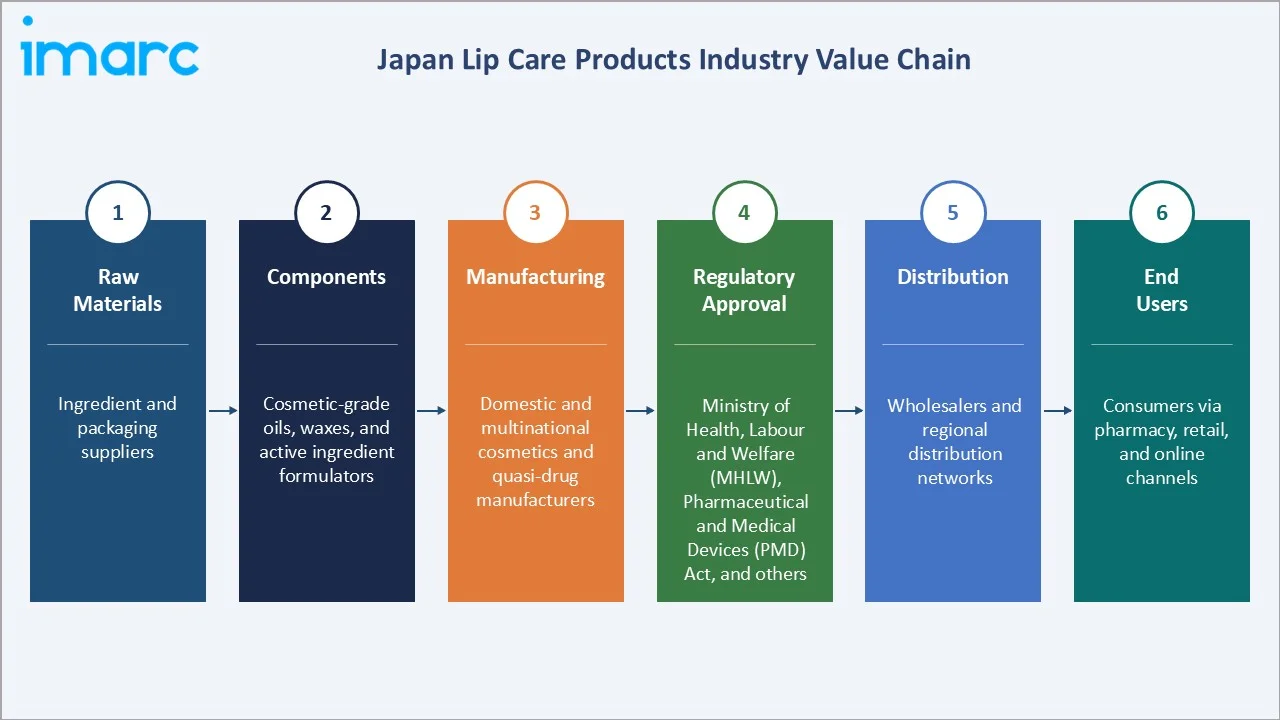
Japan's lip care products value chain integrates ingredient sourcing, cosmetics and quasi-drug manufacturing, MHLW regulatory clearance, wholesale distribution, and multi-channel retail dispensing reaching beauty-conscious consumers nationwide.
|
Stage |
Key Participants |
|
Raw Materials |
Ingredient and packaging suppliers |
|
Components |
Cosmetic-grade oils, waxes, and active ingredient formulators |
|
Manufacturing |
Domestic and multinational cosmetics and quasi-drug manufacturers |
|
Regulatory Approval |
Ministry of Health, Labour and Welfare (MHLW), Pharmaceutical and Medical Devices (PMD) Act, and others |
|
Distribution |
Wholesalers and regional distribution networks |
|
End Users |
Consumers via pharmacy, retail, and online channels |
Japan's cosmetics distribution structure relies on wholesalers and retail networks to move products from manufacturers to pharmacy, hypermarket, specialty, and online retail shelves, with margins concentrated at the manufacturing and brand level.
Technology Landscape in the Japan Lip Care Products Industry
Quasi-Drug Formulation Science
Japanese manufacturers increasingly formulate lip balms with substantiated anti-inflammatory and barrier-repair ingredients to qualify for MHLW quasi-drug status, enabling therapeutic marketing claims unavailable to standard cosmetics.
Multi-Functional Delivery Formats
Innovations such as Kanebo's combined balm-base-color-scrub stick and moisture-lock technologies are reducing the number of separate products consumers need for a complete lip care routine.
Natural and Sustainable Ingredient Sourcing
Brands are incorporating botanical oils, ceramides, and regional ingredients such as Okinawan shell ginger and citrus extracts, alongside growing use of recyclable tube packaging to meet sustainability-conscious consumer expectations.
Market Segmentation Analysis
The report covers the following segments:
|
Segment Category |
Leading Segment |
Market Share |
Year |
|
Product |
Lip Balm |
76.8% |
2025 |
|
Distribution Channel |
Pharmacy and Drug Stores |
36.4% |
2025 |
|
Region |
Kanto Region |
35.1% |
2025 |

By Product
Lip balm leads at 76.8% market share (2025), anchored by Japan's daily-use medicated and moisturizing balm culture spanning all age groups and both drugstore and department store price tiers.
To access detailed market analysis, Request Sample
Others, at 14.7% share, includes tinted balms, lip serums, and treatment gels gaining traction through K-beauty influenced formats. Lip scrub, though smallest at 8.5%, is growing fastest at an estimated 5.8% CAGR as exfoliation becomes integrated into mainstream lip care routines, particularly among younger, social-media-engaged consumers.
By Distribution Channel
Pharmacy and drug stores lead at 36.4% share (2025), anchored by Japan's dense network of drugstore chains including Matsumotokiyoshi, Sugi Holdings, and Welcia, which stock both cosmetic and quasi-drug lip care lines.
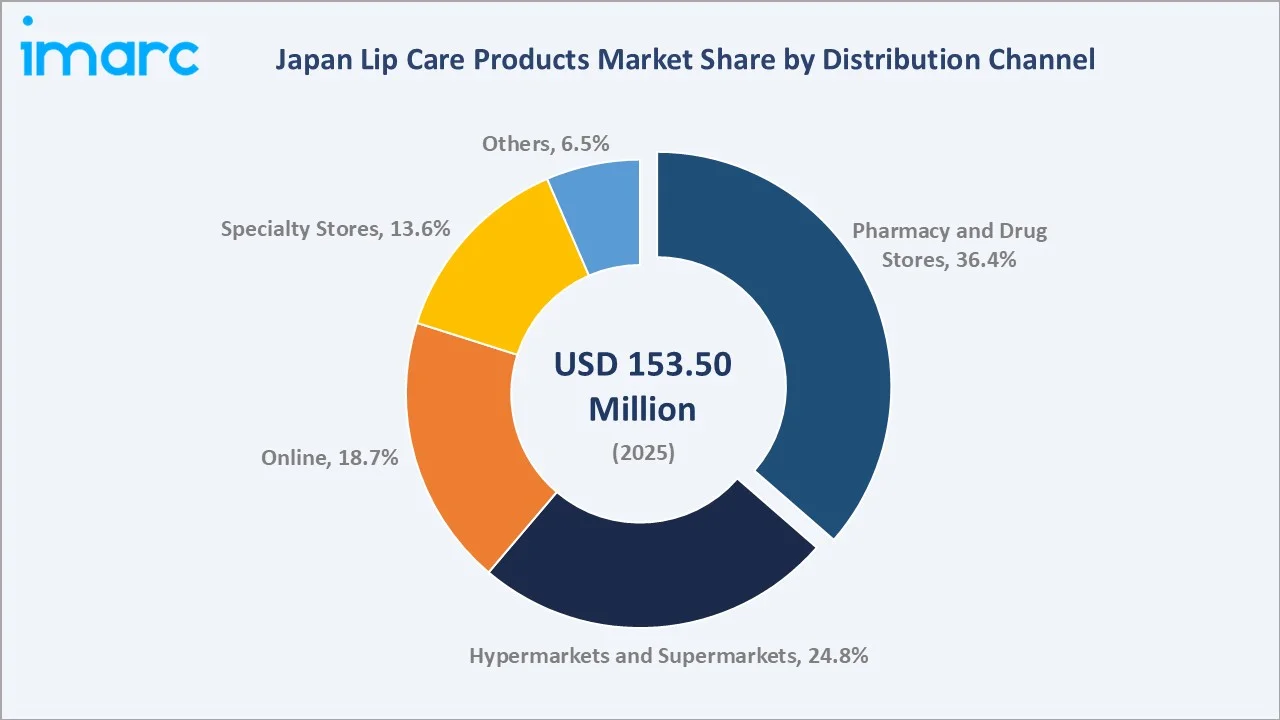
Hypermarkets and supermarkets follow at 24.8%, driven by Aeon and Ito-Yokado's broad grocery-adjacent beauty aisles. Online channels, at 18.7% share, grow fastest at an estimated 6.0% CAGR as Amazon Japan, Rakuten, and @cosme shopping expand access to niche and imported brands. Specialty stores hold 13.6%, led by retailers like Loft, Hands, and PLAZA, while remaining channels account for 6.5%.
Regional Market Insights
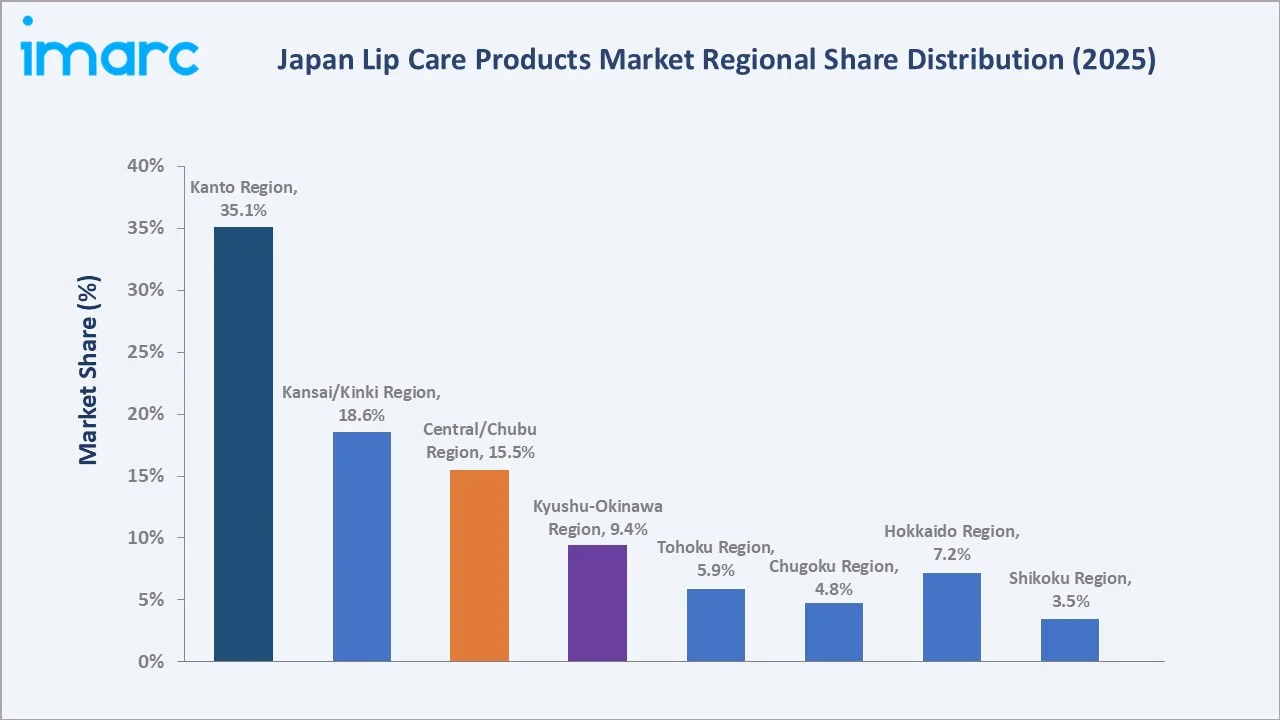
Japan's lip care products market shows meaningful regional variation, shaped by population density, climate severity, and retail infrastructure concentration across the country's eight administrative regions.
|
Region |
Share (2025) |
Key Characteristics |
|
Kanto Region |
35.1% |
Dense urban retail network, highest disposable income concentration |
|
Kansai/Kinki Region |
18.6% |
Strong drugstore and department store presence, major inbound tourism hub |
|
Central/Chubu Region |
15.5% |
Balanced manufacturing base and suburban retail expansion |
|
Kyushu-Okinawa Region |
9.4% |
Rising inbound tourism and duty-free retail growth |
|
Hokkaido Region |
7.2% |
Severe winter climate driving high per-capita balm consumption |
|
Tohoku Region |
5.9% |
Cold-climate demand, developing e-commerce penetration |
|
Chugoku Region |
4.8% |
Moderate demand, growing specialty store presence |
|
Shikoku Region |
3.5% |
Smallest regional base, gradual retail modernization |
Competitive Landscape
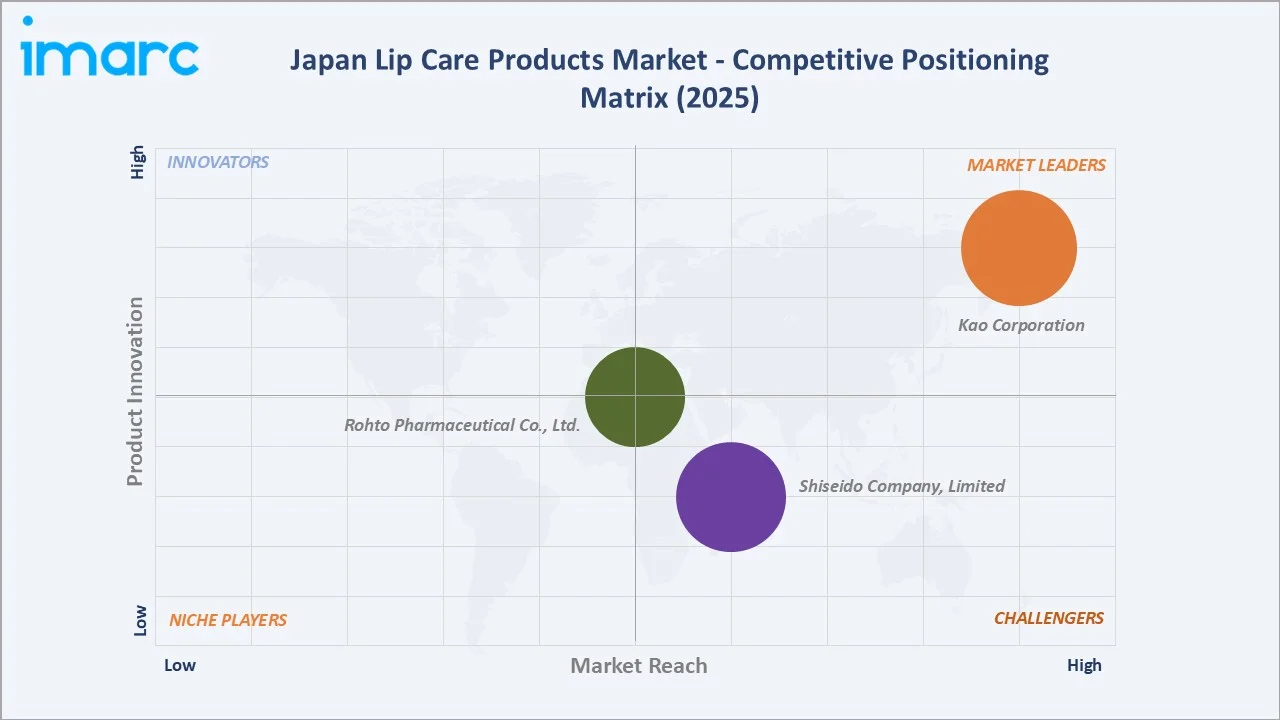
Japan's lip care products market is moderately fragmented, with domestic pharmaceutical-cosmetics companies and multinational personal care brands competing across quasi-drug and standard cosmetic categories.
|
Company Name |
Brand / Product |
Market Position |
Core Strength |
|
Rohto Pharmaceutical Co., Ltd. |
Melty Cream Lip, Water Lip, Mentholatum Medicated Lip Stick |
Established Player |
Operates Rohto Mentholatum, blending pharmaceutical-grade efficacy with everyday cosmetic accessibility |
|
Kao Corporation |
Curél Moisture Lip Care Balm, Curél Lip Care Cream |
Market Leader |
Relies on dermatological science, specifically utilizing advanced ceramide technology, rigorous occlusive formulation research |
|
Shiseido Company, Limited |
Moilip Lip Balm, Water in Lip Balm, Lipliner InkDuo, PRIOR Medicated Wrinkle Beauty Lip |
Strong Challenger |
Pharmaceutical-grade therapeutic formulations and advanced R&D that targets the unique, delicate biology of lip skin |
Beyond the leading three, DHC Corporation, Kose Corporation, and Kobayashi Pharmaceutical Co., Ltd. hold meaningful niche positions, collectively shaping a competitive landscape balanced between quasi-drug efficacy and cosmetic appeal.
Key Company Profiles
Rohto Pharmaceutical Co., Ltd.
Rohto Pharmaceutical Co., Ltd., which operates Rohto Mentholatum, is one of Japan's most established medicated lip care manufacturers, known for its long-running Mentholatum and Water Lip product lines sold across nearly every Japanese drugstore.
- Product Portfolio: Melty Cream Lip, Water Lip, Mentholatum Medicated Lip Stick
- Strategic Focus: Sustaining mass-market quasi-drug leadership through affordable, widely distributed medicated lip balms.
Kao Corporation
Kao Corporation, headquartered in Tokyo, is a diversified consumer goods leader whose Curél brand extends sensitive-skin dermatological expertise into lip care formulations.
- Product Portfolio: Curél Moisture Lip Care Balm, Curél Lip Care Cream
- Strategic Focus: Leveraging dermatological trust and broad retail reach to sustain leadership across sensitive-skin lip care.
Shiseido Company, Limited
Shiseido, Japan's largest cosmetics group, has extended its PRIOR anti-aging brand into the lip care category with a quasi-drug wrinkle-care lip treatment.
- Product Portfolio: Moilip Lip Balm, Water in Lip Balm, Lipliner InkDuo, PRIOR Medicated Wrinkle Beauty Lip
- Strategic Focus: Capturing Japan's aging, beauty-conscious consumer base through regulated anti-aging lip treatment innovation.
Market Concentration Analysis
Japan's lip care products market exhibits moderate fragmentation at the branded level. Rohto Pharmaceutical Co., Ltd., Kao Corporation, and Shiseido Company, Limited together hold a meaningful share of quasi-drug and premium cosmetic lip balm sales, though the broader market remains contested by DHC, Kose, Kobayashi Pharmaceutical, and imported K-beauty brands.
The top companies collectively account for an estimated 45-50% of total market value, reflecting a competitive but not highly consolidated structure. Consolidation trends remain limited, as private-label and international entrants such as rom&nd continue to gain drugstore shelf space, sustaining fragmentation particularly within the tinted balm and lip scrub sub-segments.
Investment & Growth Opportunities
Fastest Growing Segments
Lip scrub (~5.8% CAGR), online distribution (~6.0% CAGR), and Kyushu-Okinawa regional demand (~4.3% CAGR) represent Japan's highest-growth investment vectors through 2034. SPF and anti-aging lip serums represent the highest-value premium growth opportunity within the others category.
Emerging Market Opportunities
Duty-free and inbound tourism retail channels present an underexploited opportunity as international visitors increasingly purchase Japanese quasi-drug lip balms as souvenirs. Subscription-based online lip care bundles also represent an emerging direct-to-consumer opportunity.
Investment Themes
- Quasi-Drug Efficacy Innovation: Investment in MHLW-substantiated anti-aging and barrier-repair lip formulations can command premium pricing versus standard cosmetic balms.
- Sustainable Packaging Redesign: Early investment in recyclable tube technology may position brands favorably as retailer sustainability requirements tighten across Japan's drugstore chains.
Future Market Outlook (2026-2034)
The Japan lip care products market is projected to grow from USD 153.5 Million in 2025 to USD 215.0 Million by 2034, at a steady 3.81% CAGR reflecting Japan's mature but resilient personal care economics. Japan's USD 185.1 Million market in 2030 will consolidate steady mid-cycle growth ahead of the final forecast stretch.
Three structural forces anchor this growth with reasonable predictability: Japan's sustained beauty and grooming culture continuously supporting daily lip care consumption; the quasi-drug innovation pipeline transitioning medicated balms toward premium anti-aging and SPF positioning; and expanding e-commerce and inbound tourism retail channels creating parallel growth streams alongside traditional drugstore distribution.
Research Methodology
Primary Research
Primary research comprised structured interviews with cosmetics industry stakeholders, including brand marketing executives at major Japanese personal care manufacturers, drugstore chain merchandising managers, and MHLW-focused regulatory consultants.
Secondary Research
Secondary research encompassed company annual reports and product disclosures from Rohto Mentholatum, Kao, Shiseido, and DHC, MHLW quasi-drug approval records, Japan Cosmetic Industry Association publications, and e-commerce platform sales data from Amazon Japan and Rakuten.
Forecasting Models
Market forecasts were developed using historical market size trends, segment-level growth penetration modeling, and distribution channel shift analysis, validated against publicly disclosed company revenue data and Japan's retail sales statistics.
Japan Lip Care Products Market Report Coverage:
| Report Features | Details |
|---|---|
| Base Year of the Analysis | 2025 |
| Historical Period | 2020-2025 |
| Forecast Period | 2026-2034 |
| Units | Million USD |
| Scope of the Report |
Exploration of Historical Trends and Market Outlook, Industry Catalysts and Challenges, Segment-Wise Historical and Future Market Assessment:
|
| Products Covered | Lip Balm, Lip Scrub, Others |
| Distribution Channels Covered | Hypermarkets and Supermarkets, Pharmacy and Drug Stores, Specialty Stores, Online, Others |
| Regions Covered | Kanto Region, Kansai/Kinki Region, Central/Chubu Region, Kyushu-Okinawa Region, Tohoku Region, Chugoku Region, Hokkaido Region, Shikoku Region |
| Companies Covered | Rohto Pharmaceutical Co. Ltd., Kao Corporation, Shiseido Company Limited, etc. |
| Customization Scope | 10% Free Customization |
| Post-Sale Analyst Support | 10-12 Weeks |
| Delivery Format | PDF and Excel through Email (We can also provide the editable version of the report in PPT/Word format on special request) |
Key Benefits for Stakeholders:
- IMARC’s industry report offers a comprehensive quantitative analysis of various market segments, historical and current market trends, market forecasts, and dynamics of the Japan lip care products market from 2020-2034.
- The research report provides the latest information on the market drivers, challenges, and opportunities in the Japan lip care products market.
- Porter's five forces analysis assist stakeholders in assessing the impact of new entrants, competitive rivalry, supplier power, buyer power, and the threat of substitution. It helps stakeholders to analyze the level of competition within the Japan lip care products industry and its attractiveness.
- Competitive landscape allows stakeholders to understand their competitive environment and provides an insight into the current positions of key players in the market.
Frequently Asked Questions About the Japan Lip Care Products Market Report
The Japan lip care products market was valued at USD 153.5 Million in 2025, covering lip balms, scrubs, and other treatment products sold across pharmacy, retail, and online channels nationwide.
The market is projected to grow at a CAGR of 3.81% during 2026-2034, reaching USD 215.0 Million by 2034, driven by quasi-drug innovation and e-commerce expansion.
Lip Balm leads at 76.8% market share (2025), anchored by Japan's daily-use medicated balm culture and strong consumer trust in domestic pharmaceutical-cosmetics brands.
Pharmacy and Drug Stores hold the largest share at 36.4% (2025), supported by Japan's dense drugstore chain network stocking both cosmetic and quasi-drug lip products.
Online distribution grows fastest at an estimated 6.0% CAGR (2026-2034), driven by Amazon Japan, Rakuten, and @cosme shopping expanding access to niche brands.
Leading companies include Rohto Pharmaceutical Co., Ltd., Kao Corporation, and Shiseido Company, Limited, among others.
The Kanto Region leads with 35.1% share (2025), reflecting Tokyo's dense retail network and Japan's highest concentration of per-capita cosmetics spending.
Japan's lip care products market is projected to reach approximately USD 185.1 Million by 2030, supported by steady quasi-drug and online channel expansion.
Quasi-drug classification under Japan's Pharmaceutical and Medical Device Act allows medicated lip balms to carry substantiated therapeutic claims, differentiating them from standard cosmetics.
Lip Scrub grows fastest at an estimated 5.8% CAGR (2026-2034), driven by rising exfoliation routine adoption among younger, social-media-influenced Japanese consumers.
Need more help?
- Speak to our experienced analysts for insights on the current market scenarios.
- Include additional segments and countries to customize the report as per your requirement.
- Gain an unparalleled competitive advantage in your domain by understanding how to utilize the report and positively impacting your operations and revenue.
- For further assistance, please connect with our analysts.
 Request Customization
 Speak to an Analyst
 Request Brochure
 Inquire Before Buying
Benefits of Customization
- Personalize this research
- Triangulate with your data
- Get data as per your format and definition
- Gain a deeper dive into a specific application, geography, customer, or competitor
- Any level of personalization
Get in Touch With Us
UNITED STATES
Phone: +1-201-971-6302
INDIA
Phone: +91-120-433-0800
UNITED KINGDOM
Phone: +44-753-714-6104
Email: [email protected]
Client Testimonials




.webp)




.webp)













Related Reports

Choose your plan
*Please note that the prices mentioned below are starting prices for each bundle type. Kindly contact our team for further details.*
Single User License
- 1 User License, Access on 2 Devices
- PDF Report + Excel Dataset (Password Protected)
- Lifetime Access
- No Printing Rights
- 10% Free Report Customization
- 10–12 Weeks of Analyst Support
Five User License
- Access for 5 Users, 2 Devices per User
- PDF Report + Excel Dataset (Password Protected)
- Lifetime Access
- Dedicated Account Manager
- 12–14 Weeks of Analyst Support
- No Printing Rights
- 15% Free Report Customization
- 25% Discount on Your Next Purchase
Corporate User License
- Unlimited User Access (Within Your Organization)
- PDF Report + Excel Dataset
- Lifetime Access
- Dedicated Account Manager
- 14–20 Weeks of Analyst Support
- No Printing Rights
- 20% Free Report Customization
- 30% Discount on Your Next Purchase
Essential Insights
What's included:
3 reports
- Lifetime Access
- PDF Reports
- Excel Datasets
- 2 Weeks of Free Analyst Support
- 2 User Licenses
- Access on 2 Devices
- Printing Rights
- Complimentary PowerPoint (PPT) Version
- Complimentary License Upgrade
Professional Access
What's included:
5 reports
- Lifetime Access
- PDF Reports
- Excel Datasets
- 8 Weeks of Free Analyst Support
- 2 User Licenses
- Access on 2 Devices
- Printing Rights
- Complimentary PowerPoint (PPT) Version
- Complimentary License Upgrade
Business Advantage
What's included:
8 reports
- Lifetime Access
- PDF Reports
- Excel Datasets
- 14 Weeks of Free Analyst Support
- 2 User Licenses
- Access on 2 Devices
- Printing Rights
- Complimentary PowerPoint (PPT) Version
- Complimentary License Upgrade
Enterprise Intelligence
What's included:
10 reports
- Lifetime Access
- PDF Reports
- Excel Datasets
- 20 Weeks of Free Analyst Support
- 2 User Licenses
- Access on 2 Devices
- Printing Rights
- Complimentary PowerPoint (PPT) Version
- Complimentary License Upgrade