
Saudi Arabia Data Center Chip Market Size, Share, Trends and Forecast by Chip Type, Data Center Size, Industry Vertical, and Region, 2026-2034
Saudi Arabia Data Center Chip Market Size, Share, Trends & Forecast (2026-2034)
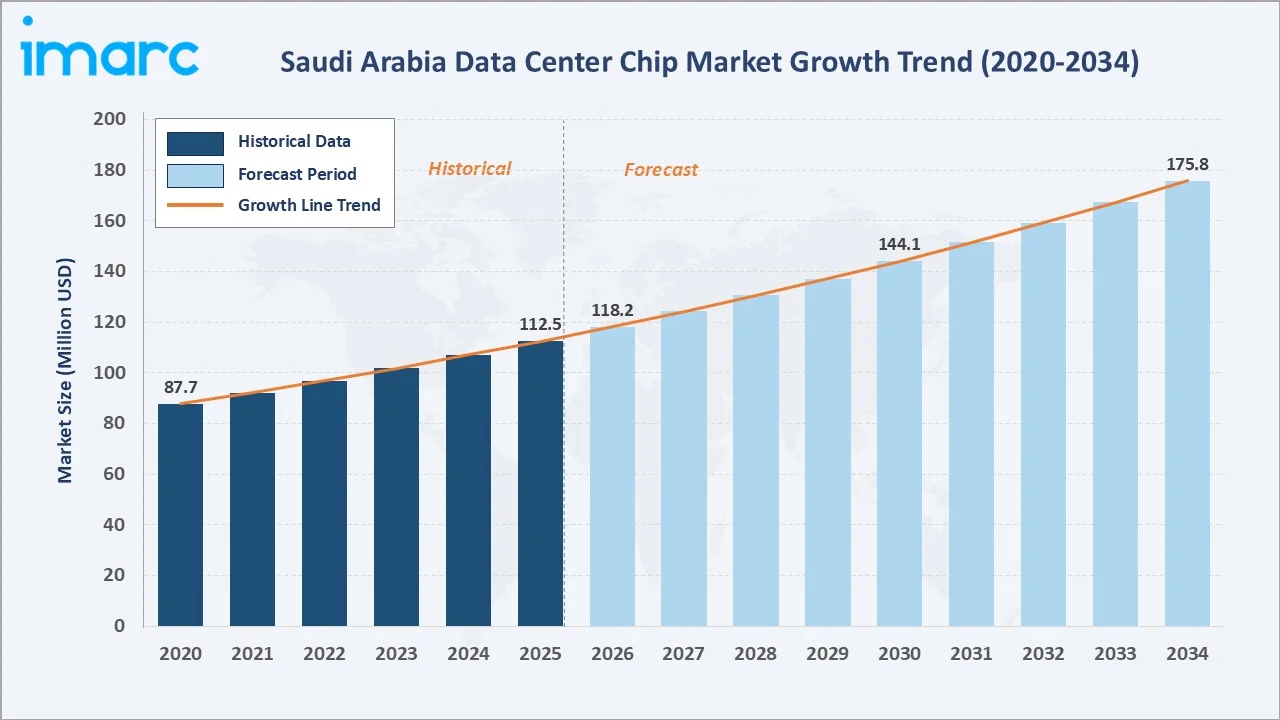
The Saudi Arabia data center chip market grew from USD 112.5 Million in 2025 to USD 118.2 Million in 2026 and is projected to reach USD 175.8 Million by 2034, growing at a CAGR of 5.09% during 2026-2034. The market is driven by Vision 2030's sweeping digital infrastructure mandate, generative AI workload adoption, and rising enterprise cloud migration across Saudi Arabia's largest corporations. Saudi Arabia is home to more than 60 data centers distributed across multiple regions. The growing data center footprint is driving demand for high-performance data center chips, including CPUs, GPUs, AI accelerators, memory chips, and networking processors. GPU leads at 39.4% by chip type, large size data centers dominate at 67.8% by data center size, and the Northern and Central region commands the largest share at 48.2%.
Market Snapshot
|
Metric |
Value |
|
Base Year Market Size (2025) |
USD 112.5 Million |
|
Market Size (2026) |
USD 118.2 Million |
|
Forecast Market Size (2034) |
USD 175.8 Million |
|
CAGR (2026-2034) |
5.09% |
|
Base Year |
2025 |
|
Historical Period |
2020-2025 |
|
Forecast Period |
2026-2034 |
|
Dominant Chip Type |
GPU (39.4%, 2025) |
|
Dominant Data Center Size |
Large Size (67.8%, 2025) |
|
Leading Region |
Northern and Central Region (48.2%, 2025) |
The Saudi Arabia data center chip market size increased from USD 87.7 Million in 2020 to USD 112.5 Million in 2025 and is estimated to reach USD 118.2 Million in 2026, driven by digital transformation across government and enterprise sectors, accelerating cloud adoption, and the emergence of AI infrastructure investment as a national strategic priority. The market is projected to reach USD 144.1 Million by 2030 and USD 175.8 Million by 2034.
To get more information on this market, Request Sample
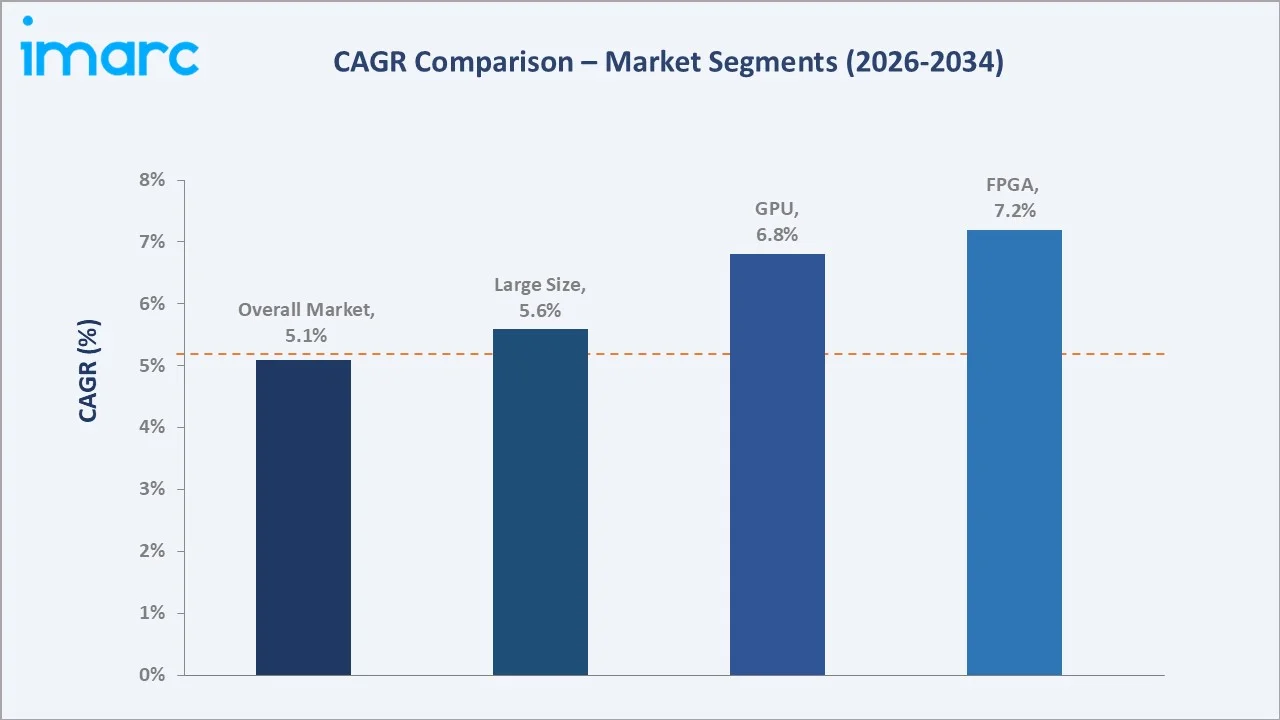
FPGA chips grow at ~7.2% CAGR through edge computing and real-time inference acceleration applications. GPU segment grows at ~6.8% CAGR through generative AI training and inference cluster deployment. Large size data center procurement grows at ~5.6% CAGR through hyperscaler campus build-outs.
Executive Summary
The Saudi Arabia data center chip market is experiencing a structural acceleration driven by converging forces that make the Kingdom one of the most strategically significant emerging data center investment destinations globally. Saudi Arabia's position as the Arab world's largest economy and its ambition to become a regional AI and cloud hub sustain a long-term market growth outlook beyond the Vision 2030 planning horizon. GPU leads at 39.4% by chip type through AI workload training and inference acceleration demand. Large size leads at 67.8% by data center size through hyperscaler and government mega-campus procurement. Northern & Central region leads regionally at 48.2%.
Key Market Insights
|
Insight |
Data |
|
Dominant Chip Type |
GPU - 39.4% share (2025) |
|
Dominant Data Center Size |
Large Size - 67.8% share (2025) |
|
Leading Region |
Northern & Central Region - 48.2% (2025) |
|
Key Market Opportunities |
Expansion of hyperscale and AI-ready data centers, rising cloud adoption, growing demand for GPUs and AI accelerators, increasing edge computing deployment, localization of semiconductor supply chains, and Vision 2030-driven digital infrastructure investments. |
Key Analytical Observations Supporting the Above Data:
- GPU at 39.4%: GPU chips command the largest share through the exponential growth in AI workload requirements across both training (large language models, vision models, and generative AI) and inference (real-time AI application serving).
- Large Size at 67.8%: Large-scale data centers, defined as facilities exceeding 10 MW of IT power capacity, dominate chip procurement because hyperscaler investments and sovereign data center campuses that characterize Saudi Arabia's build-out strategy operate at scales where chip purchases occur in bulk through global enterprise supply chain agreements.
- Northern & Central Region at 48.2%: The Northern and Central region's commanding lead reflects Riyadh's position as the undisputed concentration point for Saudi Arabia's digital infrastructure investment. The region's role as Saudi Arabia's administrative and financial capital ensures its data center infrastructure development remains prioritized throughout the Vision 2030 execution period.
Saudi Arabia Data Center Chip Market Overview
The Saudi Arabia data center chip market encompasses all semiconductor devices deployed within data center server infrastructure across the Kingdom, including general-purpose CPUs, graphics processing units (GPUs) for AI and parallel computing workloads, application-specific integrated circuits (ASICs) for networking and custom inference acceleration, field-programmable gate arrays (FPGAs) for flexible real-time processing, and specialty AI accelerators and network processors classified under others.
These chips are deployed within server platforms, including rack-mount servers, blade servers, high-density GPU clusters, and custom ODM configurations, across Saudi Arabia's public and private data centers serving hyperscale cloud, government cloud, colocation, and enterprise on-premises use cases. The market is structured by data center scale into large-size facilities operated by hyperscalers and sovereign cloud operators, and small and medium-size facilities serving enterprise, financial institution, and regional colocation operator requirements.
Market Dynamics
To evaluate market opportunities, Request Sample
Market Drivers
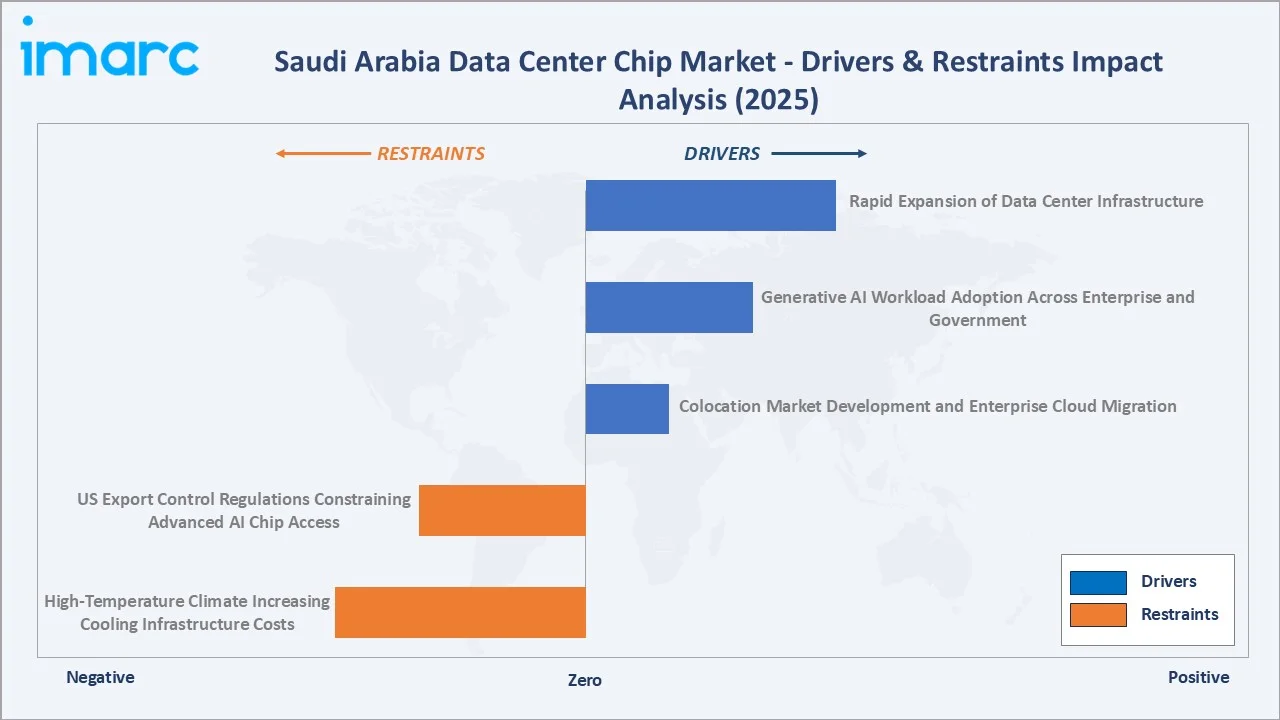
- Rapid Expansion of Data Center Infrastructure: Saudi Arabia’s data center sector is witnessing rapid expansion, with operational capacity increasing from 68 MW in 2021 to approximately 440 MW in 2025, representing nearly sixfold growth within four years. This upward trajectory continued into the first quarter of 2026, as capacity reached around 467 MW, marking an increase of more than 6% since the beginning of the year. The sharp increase in Saudi Arabia’s operational data center capacity is accelerating demand for high-performance CPUs, GPUs, memory, and networking chips to support cloud and AI workloads.
- Generative AI Workload Adoption Across Enterprise and Government: The emergence of ChatGPT-class large language models and generative AI applications has created a step-change in GPU compute requirements that Saudi enterprises and government entities are urgently addressing. This generative AI adoption wave creates a GPU refresh cycle that significantly increases per-server chip value and drives above-market revenue growth.
- Colocation Market Development and Enterprise Cloud Migration: Saudi Arabia's enterprise colocation market is developing rapidly as financial institutions, healthcare providers, and technology companies migrate from on-premises infrastructure toward colocation data center environments that offer superior power, cooling, and connectivity at lower capital commitment.
Market Restraints
- US Export Control Regulations Constraining Advanced AI Chip Access: The US export control framework for advanced semiconductor chips imposes licensing requirements for exports to Saudi Arabia that can create procurement delays, supply uncertainty, and administrative complexity for Saudi data center operators requiring US-origin AI accelerators. The evolving US government policy on AI chip exports to Middle Eastern countries creates market uncertainty that complicates long-term data center infrastructure planning for Saudi operators.
- High-Temperature Climate Increasing Cooling Infrastructure Costs: Saudi Arabia's extreme ambient temperatures impose significantly higher cooling infrastructure requirements on data centers compared to temperate-climate markets. High-density GPU server installations generating 50-100+ kW per rack require liquid cooling or advanced air handling systems that increase capital cost, operating energy consumption, and PUE ratios relative to international benchmarks. These elevated operating costs increase the total cost of ownership for Saudi data center chip deployments, potentially affecting investment timing and scale decisions.
Market Opportunities
- Saudi Arabia as Regional AI Hub for Arab World and Emerging Markets: Saudi Arabia's geographic centrality positions it as a natural hub for regional AI and cloud services serving markets without equivalent local infrastructure. Developing Saudi data center capacity that serves UAE, Kuwait, Bahrain, Egypt, Pakistan, and East Africa creates a demand base significantly larger than the Saudi domestic market alone, justifying chip procurement at scales that generate infrastructure concentration effects exceeding what domestic demand alone would support.
- Growing Demand for Advanced AI Chips: In August 2025, Humain commenced construction of its first data centers in the Kingdom, with planned operations in early 2026. The company sourced advanced semiconductors from leading U.S. chip manufacturers to equip these facilities, including Nvidia’s latest AI chips, following the receipt of the required local regulatory approvals. Humain’s development of AI-focused data centers creates significant opportunities for high-performance GPUs, AI accelerators, and other advanced semiconductors, supporting the expansion of Saudi Arabia’s data center chip market.
Market Challenges
- Technical Talent Shortage for Data Center and AI Chip Operations: Saudi Arabia faces a significant shortage of technical professionals with expertise in data center chip architecture, AI model optimization, GPU cluster management, and high-performance computing infrastructure operations. Building the workforce capable of managing complex multi-thousand GPU data center environments requires sustained investment in technical education programs, international talent attraction, and collaborative research programs with universities and global technology companies.
- Supply Chain Dependency and Lead Time Risk for Premium AI Chips: Premium AI GPU chips face severe global supply constraints driven by orders from US hyperscalers and Asian technology companies that frequently overwhelm production capacity. Saudi data center operators competing with major operators for limited AI GPU supply face multi-quarter lead times and allocation uncertainty that can delay project timelines and infrastructure activation schedules.
Emerging Market Trends
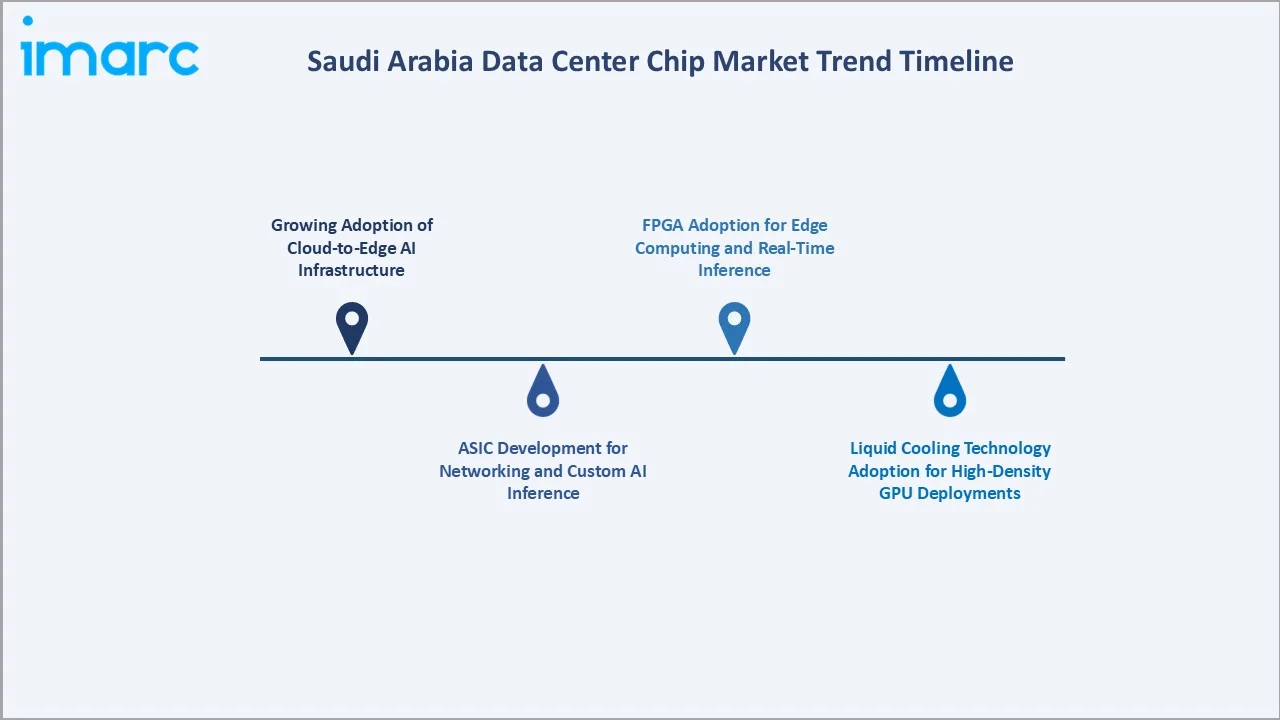
1. Growing Adoption of Cloud-to-Edge AI Infrastructure
In May 2025, Qualcomm and HUMAIN signed an MoU to develop next-generation, energy-efficient AI data centers and cloud-to-edge infrastructure in Saudi Arabia. The partnership will integrate Qualcomm’s AI and CPU technologies into HUMAIN’s cloud infrastructure to support scalable AI inferencing and hybrid AI services. These partnerships highlight a shift toward power-efficient, cloud-to-edge AI architectures, driving the adoption of advanced AI accelerators and CPUs across Saudi Arabia’s data center ecosystem.
2. ASIC Development for Networking and Custom AI Inference
The growing adoption of AI-intensive workloads is accelerating demand for application-specific integrated circuits (ASICs) optimized for networking and AI inference in Saudi Arabia’s data centers. Custom ASICs offer higher processing efficiency, lower latency, and reduced power consumption compared with general-purpose processors for specialized workloads. Increasing investment in AI-ready and cloud-to-edge infrastructure is therefore encouraging the deployment of customized chips, emerging as a key trend in the Saudi Arabia data center chip market.
3. FPGA Adoption for Edge Computing and Real-Time Inference
FPGA chips are gaining adoption in Saudi Arabia's data center market through edge computing deployments associated with Giga-projects and industrial IoT applications where real-time low-latency inference is required without the full power consumption of GPU-class accelerators. NEOM's smart city sensor networks, SABIC's industrial IoT infrastructure, and Saudi Aramco's oilfield automation programs each create FPGA demand at edge compute nodes.
4. Liquid Cooling Technology Adoption for High-Density GPU Deployments
The thermal density of AI GPU clusters is driving mandatory adoption of direct liquid cooling (DLC) and immersion cooling technologies in Saudi Arabia's new data center deployments. Traditional air cooling is insufficient for high-density GPU rack configurations, making liquid cooling not an option but a requirement for AI infrastructure build-outs in Saudi Arabia's climate. This cooling technology requirement creates additional infrastructure complexity that affects data center facility design and increases the technical sophistication threshold for Saudi data center operators.
Industry Value Chain Analysis
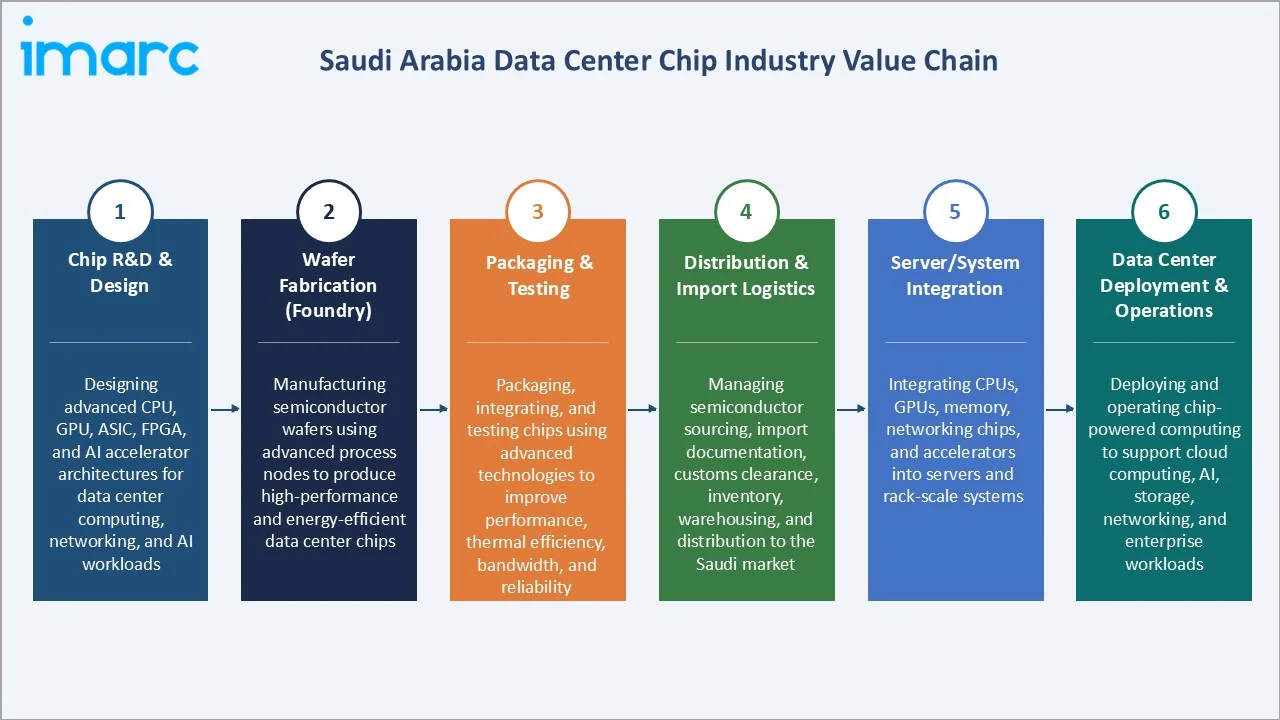
The Saudi Arabia data center chip value chain integrates chip R&D and design, wafer fabrication at global foundries, packaging and testing operations, import distribution and logistics, server and system integration, and data center deployment and operations across large and small-to-medium scale facility categories.
|
Stage |
Key Participants |
|
Chip R&D & Design |
Designing advanced CPU, GPU, ASIC, FPGA, and AI accelerator architectures for data center computing, networking, and AI workloads. |
|
Wafer Fabrication (Foundry) |
Manufacturing semiconductor wafers using advanced process nodes to produce high-performance and energy-efficient data center chips. |
|
Packaging & Testing |
Packaging, integrating, and testing chips using advanced technologies to improve performance, thermal efficiency, bandwidth, and reliability. |
|
Distribution & Import Logistics |
Managing semiconductor sourcing, import documentation, customs clearance, inventory, warehousing, and distribution to the Saudi market. |
|
Server/System Integration |
Integrating CPUs, GPUs, memory, networking chips, and accelerators into servers and rack-scale systems. |
|
Data Center Deployment & Operations |
Deploying and operating chip-powered computing to support cloud computing, AI, storage, networking, and enterprise workloads. |
Chip R&D and design represents the highest value-creating and most strategically important stage in the Saudi Arabia data center chip value chain, as the architectural decisions made by major and emerging AI chip companies determine the performance, power efficiency, and capability of the server platforms deployed in Saudi data centers.
Technology Landscape in the Saudi Arabia Data Center Chip Industry
CXL-Based Memory and Interconnect Technology
Compute Express Link (CXL) enables high-speed, coherent connections among CPUs, accelerators, and memory devices within data center systems. It supports memory expansion, pooling, and more efficient resource utilization across heterogeneous computing environments. The technology can help data centers address growing memory requirements associated with AI and cloud workloads. Its adoption is expected to increase alongside next-generation server and accelerator platforms.
Smart Network Interface Cards (SmartNICs)
SmartNICs combine networking capabilities with programmable processing to accelerate data movement, security, virtualization, and storage functions. They help reduce latency and improve server utilization by processing infrastructure workloads directly at the network interface. Their importance is increasing as AI clusters generate substantial east-west traffic between computing nodes. SmartNICs can also support more scalable and secure cloud data center architectures.
Advanced Semiconductor Packaging
Advanced packaging technologies, including 2.5D integration, 3D stacking, and heterogeneous integration, enable multiple compute and memory components to operate within tightly integrated packages. These technologies improve bandwidth, computing density, and energy efficiency while reducing communication distances between components. They are increasingly important for high-performance GPUs and AI accelerators. Growing AI workloads are strengthening demand for chips incorporating sophisticated packaging architectures.
Market Segmentation Analysis
The report covers the following segments:
|
Segment Category |
Leading Segment |
Market Share |
Year |
|
Chip Type |
GPU |
39.4% |
2025 |
|
Data Center Size |
Large Size |
67.8% |
2025 |
|
Industry Vertical |
🔒 |
🔒 |
2025 |
|
Region |
Northern and Central Region |
48.2% |
2025 |

By Chip Type
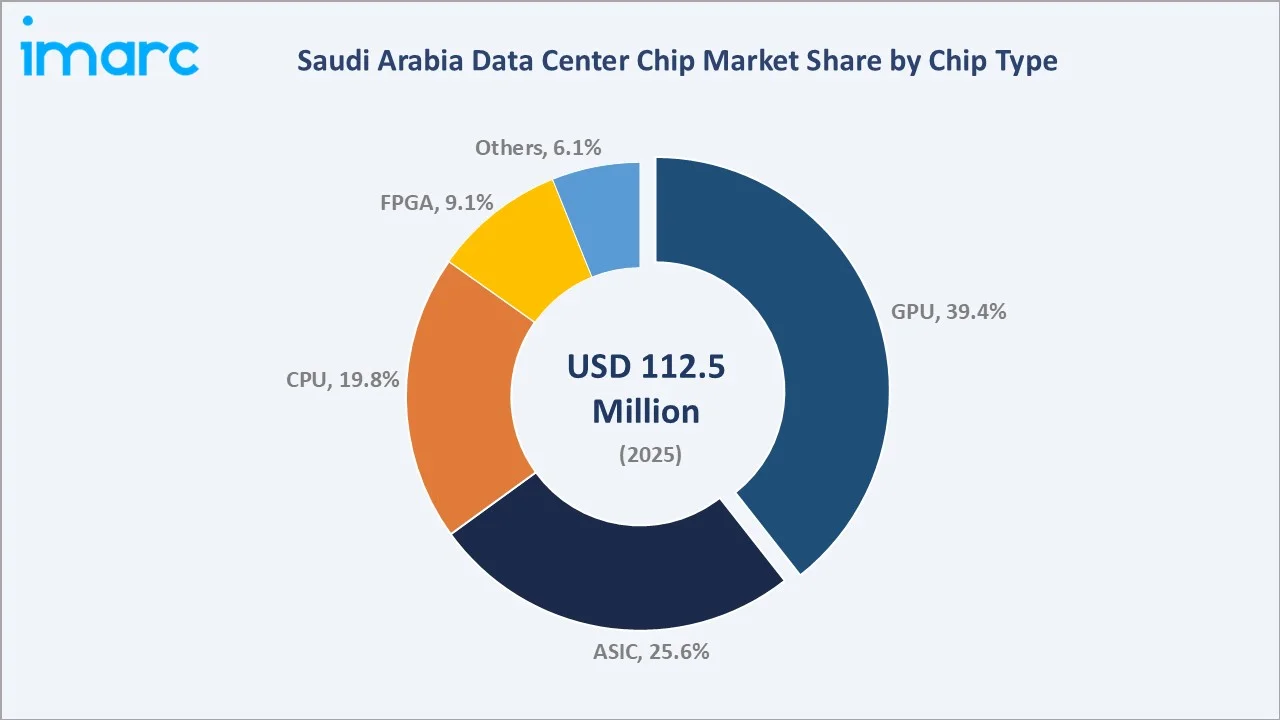
GPU leads at 39.4% (2025), driven by AI training cluster deployments for Saudi Arabia's national AI initiatives, generative AI workload adoption across enterprise data centers, and hyperscaler GPU infrastructure for cloud AI services targeted at the Saudi and GCC markets.
To access detailed market analysis, Request Sample
ASIC at 25.6% encompasses custom networking chips, AI inference accelerators within hyperscaler deployments, and custom silicon for storage controllers in large data centers. CPU at 19.8% reflects the general-purpose compute backbone for virtualized workloads, database servers, and enterprise applications. FPGAs at 9.1% serve real-time processing, network function virtualization, and edge computing. Others at 6.1% include DPUs, IPUs, and emerging AI neural processing units.
By Data Center Size
Large size leads at 67.8% (2025), as hyperscaler campuses and sovereign data centers procure chips at scale through global enterprise supply agreements, with each major facility representing USD 5-50 million in chip procurement across GPU cluster, CPU server, and networking ASIC categories.
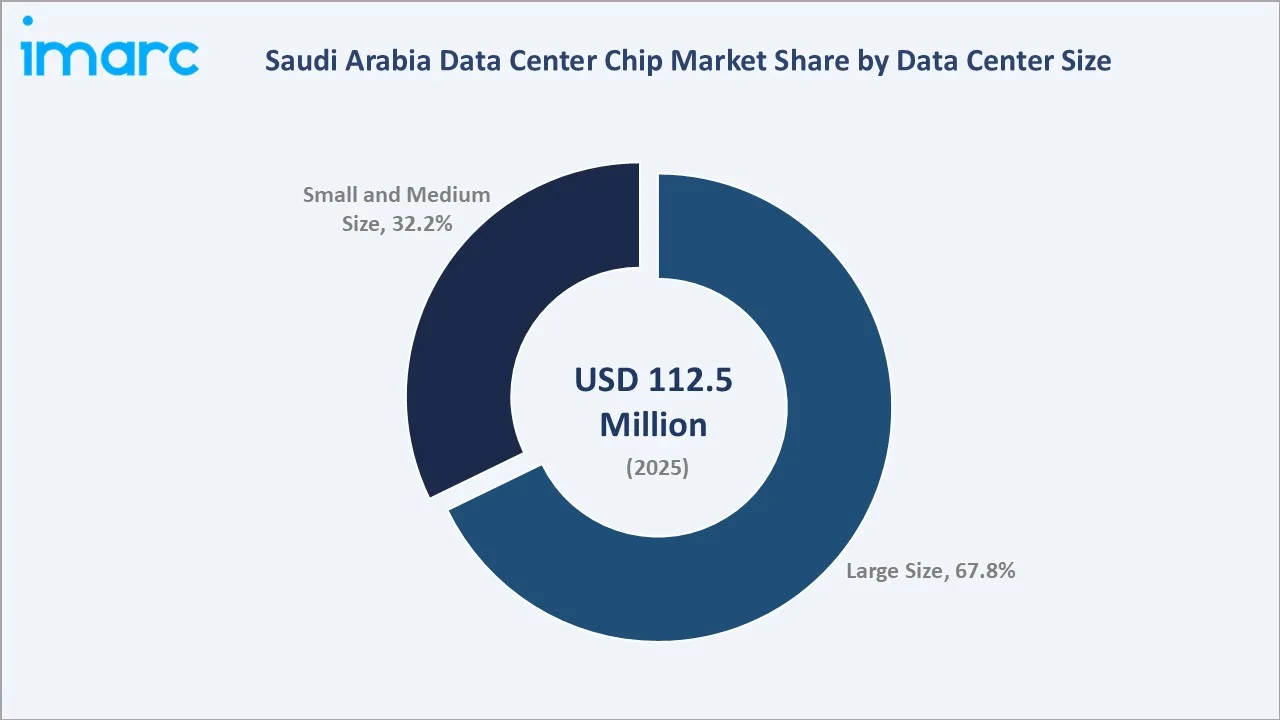
Small and medium size at 32.2% represents enterprise on-premises deployments, regional bank data centers, hospital IT infrastructure, and smaller colocation facility operators in Saudi Arabia's secondary cities. This segment's ~4.3% CAGR reflects the gradual migration of workloads from enterprise-owned small data centers toward colocation and cloud, reducing absolute chip procurement in this category as some workloads shift to large hyperscale facilities.
Regional Market Insights
|
Region |
Share (2025) |
Key Saudi Arabia Data Center Chip Market Drivers & Characteristics |
|
Northern & Central Region |
48.2% |
Reflecting Riyadh's concentration of hyperscaler campuses, national data center infrastructure, financial district data center cluster, and PIF-backed technology entity data centers generating the Kingdom's highest chip procurement volumes. |
|
Western Region |
23.5% |
Reflecting Jeddah's role as Saudi Arabia's second-largest commercial hub with growing colocation facilities, the Red Sea Project's data infrastructure requirements, and hyperscaler availability zone deployments serving Jeddah's large financial and corporate base. |
|
Eastern Region |
18.1% |
Reflecting Saudi Aramco's Eastern Province technology infrastructure as the world's largest oil company running AI for reservoir optimization and seismic analysis, Jubail industrial city data centers, and the Eastern Province's large industrial conglomerate IT infrastructure. |
|
Southern Region |
10.2% |
Reflecting digital transformation infrastructure and growing Vision 2030 regional development programs deploying smart city and government digital services requiring local compute infrastructure. |
The Northern and Central region's 48.2% dominance reflects Riyadh's extraordinary concentration of digital infrastructure investment. The Western region's 23.5% is anchored by Jeddah's large commercial economy and reflects growing hyperscaler deployment as operators establish dual-region architectures covering both Riyadh and Jeddah for national redundancy.
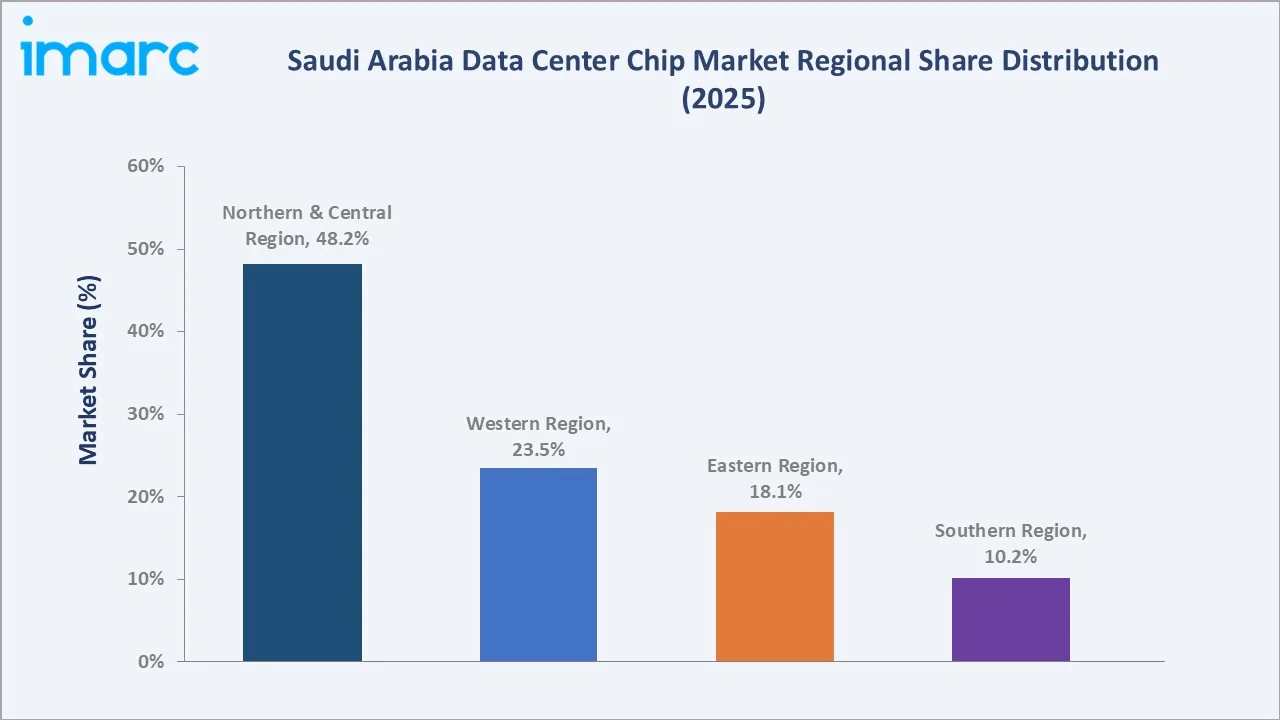
The Eastern region's 18.1% reflects Saudi Aramco's singular scale as a data center chip buyer, operating what is arguably the most sophisticated industrial AI infrastructure in the Middle East for seismic processing, reservoir simulation, and predictive maintenance across its global oil and gas operations. The Southern region at 10.2% is poised for above-average growth as NEOM's data infrastructure build-out progressively advances through its multi-decade construction program.
Competitive Landscape
The Saudi Arabia data center chip market is dominated by global semiconductor companies that design advanced chips manufactured at leading foundries and imported into the Kingdom. Competition is driven by AI compute performance, power efficiency, software ecosystem maturity, and supply allocation capability.
|
Company |
Key Products |
Market Position |
Core Strength |
|
NVIDIA Corporation |
NVIDIA Rubin GPU, NVIDIA Blackwell Ultra GPU, NVIDIA Blackwell GPU, NVIDIA Groq 3 LPX, NVIDIA Vera CPU |
Market Leader |
NVIDIA is supplying hundreds of thousands of advanced AI microchips and helping build massive "AI factories" to power Saudi Arabia's national technology strategy. |
|
Advanced Micro Devices, Inc. |
AMD EPYC Server CPUs, AMD Instinct MI300 Series GPUs |
Market Leader |
Advanced Micro Devices, Inc. (AMD) provides core accelerated computing hardware, specifically AMD Instinct GPUs and AMD EPYC CPUs. |
|
Intel Corporation |
Intel Xeon Processors, Intel Gaudi AI Accelerators |
Market Leader |
Intel Corporation supplies Intel Xeon 6 processors and power-optimized server infrastructure to support Saudi Arabia's local data center manufacturing. |
|
Qualcomm Technologies, Inc. |
Qualcomm Dragonfly C1000 CPU, AI Accelerators |
Established Player |
Qualcomm Technologies, Inc. is supplying its new rack-scale accelerator chips to power advanced AI data centers in Saudi Arabia. |
|
Broadcom |
Application-specific Integrated Circuits (ASICs), RAID Controller Cards, RAID-on-Chip ICs (ROCs) |
Established Player |
Broadcom supplies high-throughput data center networking chips and switching infrastructure that support large-scale computing and artificial intelligence environments in Saudi Arabia Data Center Chip Market. |
Companies across the competitive landscape are investing in Saudi Arabia market development through partner programs with local system integrators, participation in LEAP technology exhibitions, and direct engagement with SDAIA and hyperscaler partners regarding Saudi AI infrastructure programs. The market is expected to see growing competition from Chinese AI chip companies as Saudi Arabia balances geopolitical considerations in technology procurement.
Key Company Profiles
NVIDIA Corporation
NVIDIA Corporation is a leading provider of accelerated computing technologies, offering GPUs, AI accelerators, networking solutions, and data processing units (DPUs) for modern data centers. In Saudi Arabia, the company supports the growing AI and cloud infrastructure ecosystem by supplying high-performance computing technologies for AI training, inference, and large-scale data processing. Its advanced chip portfolio positions NVIDIA as a key technology participant in the Saudi Arabia data center chip market.
- Key Products: NVIDIA Rubin GPU, NVIDIA Blackwell Ultra GPU, NVIDIA Blackwell GPU, NVIDIA Groq 3 LPX, NVIDIA Vera CPU.
- Strategic Focus: Strengthening its position in Saudi Arabia’s expanding AI and data center ecosystem through advanced GPUs, AI accelerators, DPUs, and high-speed networking technologies. The company emphasizes high-performance, energy-efficient computing solutions to support large-scale AI training, inference, cloud computing, and hyperscale data center workloads.
Advanced Micro Devices, Inc.
Advanced Micro Devices, Inc. (AMD) is a semiconductor company offering high-performance CPUs, GPUs, and AI accelerators for data center applications. In Saudi Arabia, AMD’s technologies can support expanding cloud, AI, high-performance computing, and enterprise workloads. Its EPYC server processors and Instinct accelerators position the company as an important technology provider within the Saudi Arabia data center chip market.
- Key Products: AMD EPYC Server CPUs, AMD Instinct MI300 Series GPUs.
- Strategic Focus: Expanding its presence in Saudi Arabia’s data center ecosystem through high-performance EPYC processors and Instinct AI accelerators. The company emphasizes scalable, energy-efficient computing solutions for AI, cloud computing, HPC, and enterprise data center workloads.
Market Concentration Analysis
The Saudi Arabia data center chip market exhibits extremely high concentration, with NVIDIA commanding the dominant share of AI GPU procurement that represents the fastest-growing and highest-value chip segment. Intel and AMD collectively dominate the CPU segment with established hyperscaler and enterprise market positions. The ASIC segment is effectively a hyperscaler-captive market where Broadcom's networking ASICs and major cloud providers' custom inference chips preclude meaningful external competition. Market concentration is expected to remain very high through 2034 as switching costs between chip ecosystems are extremely high.
Investment & Growth Opportunities
Highest Growth Segments
GPU chips for AI training (~6.8% CAGR), FPGA for edge and real-time processing (~7.2% CAGR), large data center GPU cluster procurement, ASIC adoption within hyperscaler Saudi regions, and ARM-based server CPU deployment represent the highest-growth investment vectors in Saudi Arabia's data center chip market through 2034.
Investment Themes
- Saudi sovereign AI chip supply security initiatives: Saudi Arabia's strategic interest in securing reliable supply chains for AI compute infrastructure, mitigating US export control risk and ensuring continuous GPU availability for national AI programs, creates investment opportunity for alternative AI chip suppliers and for Saudi government programs establishing direct semiconductor vendor partnerships that secure preferential allocation for Vision 2030 AI priorities.
- Indigenous chip design capability development: Investments in Saudi chip design capabilities, through international design house partnerships, ARM license acquisition programs, and Saudi engineer training initiatives, create a long-term investment opportunity in the domestic segment of the data center chip value chain that would reduce Saudi Arabia's complete import dependency for strategic compute infrastructure.
Future Market Outlook (2026-2034)
The Saudi Arabia data center chip market is projected to grow from USD 112.5 Million in 2025 to USD 118.2 Million in 2026, reaching USD 175.8 Million by 2034, exhibiting a CAGR of 5.09% during 2026-2034. The market is projected to reach an anchor value of USD 144.1 Million by 2030, representing the mid-period milestone at which Vision 2030's major hyperscaler data center investments achieve full operational scale and NEOM's data infrastructure build-out reaches initial operational phases.
Three structural forces will define Saudi Arabia's data center chip market through 2034. First, the AI infrastructure wave, driven by generative AI adoption across enterprise and government sectors simultaneously, will sustain elevated GPU procurement demand that grows at rates substantially above the overall chip market average. Second, the hyperscaler campus build-out sequence will create procurement concentration events, large single facility openings that generate significant chip purchases within compressed timeframes, that drive above-trend market growth in specific years when major facilities open. Third, Vision 2030's Giga-project digital infrastructure programs each create long-duration data center chip procurement programs that extend across the 2026-2034 forecast period as Giga-project construction progresses through phased delivery.
Research Methodology
Primary Research
Primary research comprised in-depth interviews with Saudi data center operators, SDAIA technology procurement officials, hyperscaler Saudi operations executives, system integrators deploying data center infrastructure, semiconductor vendor regional sales directors, and technology market analysts covering the Saudi Arabia and GCC data center market. These discussions validated market size estimates, assessed chip type and size segment dynamics, evaluated competitive positioning, and provided insights into Vision 2030 digital infrastructure programs and future market evolution.
Secondary Research
Secondary research encompassed SDAIA National AI Strategy publications, Saudi Arabia digital economy sector data, PIF portfolio disclosures related to technology investments, hyperscaler investor presentations covering Saudi market commitments, company annual reports and press releases, and industry publications tracking GCC and Saudi Arabia data center market investments and capacity additions.
Forecasting Models
Forecasting models incorporated historical chip market revenue trends, hyperscaler Saudi data center investment schedules, SDAIA AI infrastructure procurement programs, Giga-project data center specifications, enterprise cloud migration adoption curves, and macroeconomic indicators including Saudi GDP growth, Vision 2030 digital economy spending targets, and FDI inflows into Saudi technology infrastructure.
Saudi Arabia Data Center Chip Market Report Coverage:
| Report Features | Details |
|---|---|
| Base Year of the Analysis | 2025 |
| Historical Period | 2020-2025 |
| Forecast Period | 2026-2034 |
| Units | Million USD |
| Scope of the Report |
Exploration of Historical Trends and Market Outlook, Industry Catalysts and Challenges, Segment-Wise Historical and Future Market Assessment:
|
| Chip Types Covered | GPU, ASIC, FPGA, CPU, Others |
| Data Center Sizes Covered | Small and Medium Size, Large Size |
| Industry Verticals Covered | BFSI, Manufacturing, Government, IT and Telecom, Retail, Transportation, Energy and Utilities, Others |
| Regions Covered | Northern and Central Region, Western Region, Eastern Region, Southern Region |
| Companies Covered | NVIDIA Corporation, Advanced Micro Devices, Inc., Intel Corporation, Qualcomm Technologies, Inc., Broadcom, etc. |
| Customization Scope | 10% Free Customization |
| Post-Sale Analyst Support | 10-12 Weeks |
| Delivery Format | PDF and Excel through Email (We can also provide the editable version of the report in PPT/Word format on special request) |
Key Benefits for Stakeholders:
- IMARC’s industry report offers a comprehensive quantitative analysis of various market segments, historical and current market trends, market forecasts, and dynamics of the Saudi Arabia data center chip market from 2020-2034.
- The research report provides the latest information on the market drivers, challenges, and opportunities in the Saudi Arabia data center chip market.
- Porter's five forces analysis assist stakeholders in assessing the impact of new entrants, competitive rivalry, supplier power, buyer power, and the threat of substitution. It helps stakeholders to analyze the level of competition within the Saudi Arabia data center chip industry and its attractiveness.
- Competitive landscape allows stakeholders to understand their competitive environment and provides an insight into the current positions of key players in the market.
Frequently Asked Questions About the Saudi Arabia Data Center Chip Market Report
The Saudi Arabia data center chip market reached USD 118.2 Million in 2026, driven by Vision 2030's digital infrastructure mandate, hyperscaler mega-investments, the National AI Strategy creating GPU cluster demand, and generative AI workload adoption across government, financial, and energy sectors.
The Saudi Arabia data center chip market is projected to grow at a CAGR of 5.09% during 2026-2034, sustained by hyperscaler campus build-out, SDAIA AI infrastructure expansion, Giga-project data center deployments, enterprise cloud migration chip demand, and progressive GPU cluster refresh cycles from advancing AI model generations.
The market is projected to reach approximately USD 144.1 Million by 2030, representing the mid-period milestone at which Vision 2030's major hyperscaler data center investments achieve full operational scale, NEOM's initial data infrastructure phases open, and the AI cluster refresh cycle from second-generation GPU deployments begins.
The Saudi Arabia data center chip market is projected to reach USD 175.8 Million by 2034, driven by sustained hyperscaler capacity expansion, SDAIA AI infrastructure upgrades, Giga-project digital infrastructure completion, enterprise edge chip deployment, and Saudi Arabia's development as a regional AI and cloud hub generating broader demand.
GPU leads with a 39.4% share in 2025, driven by AI training cluster deployments for national AI programs, generative AI workload adoption across enterprise data centers, and hyperscaler GPU infrastructure for cloud AI services targeted at Saudi and GCC markets.
Large size leads with a 67.8% share in 2025, as hyperscaler campuses and sovereign data centers procure chips at scale through global enterprise supply agreements, where each major facility represents tens of millions in chip procurement across GPU cluster, CPU server, and networking ASIC categories.
The Northern and Central region leads with a 48.2% share in 2025, reflecting Riyadh's extraordinary concentration of hyperscaler campuses, national data center infrastructure, and financial district data center cluster.
Key players include NVIDIA Corporation, Advanced Micro Devices, Inc., Intel Corporation, Qualcomm Technologies, Inc., and Broadcom, among others.
Need more help?
- Speak to our experienced analysts for insights on the current market scenarios.
- Include additional segments and countries to customize the report as per your requirement.
- Gain an unparalleled competitive advantage in your domain by understanding how to utilize the report and positively impacting your operations and revenue.
- For further assistance, please connect with our analysts.
 Request Customization
 Speak to an Analyst
 Request Brochure
 Inquire Before Buying
Benefits of Customization
- Personalize this research
- Triangulate with your data
- Get data as per your format and definition
- Gain a deeper dive into a specific application, geography, customer, or competitor
- Any level of personalization
Get in Touch With Us
UNITED STATES
Phone: +1-201-971-6302
INDIA
Phone: +91-120-433-0800
UNITED KINGDOM
Phone: +44-753-714-6104
Email: [email protected]
Client Testimonials




.webp)




.webp)













Related Reports

Choose your plan
*Please note that the prices mentioned below are starting prices for each bundle type. Kindly contact our team for further details.*
Single User License
- 1 User License, Access on 2 Devices
- PDF Report + Excel Dataset (Password Protected)
- Lifetime Access
- No Printing Rights
- 10% Free Report Customization
- 10–12 Weeks of Analyst Support
Five User License
- Access for 5 Users, 2 Devices per User
- PDF Report + Excel Dataset (Password Protected)
- Lifetime Access
- Dedicated Account Manager
- 12–14 Weeks of Analyst Support
- No Printing Rights
- 15% Free Report Customization
- 25% Discount on Your Next Purchase
Corporate User License
- Unlimited User Access (Within Your Organization)
- PDF Report + Excel Dataset
- Lifetime Access
- Dedicated Account Manager
- 14–20 Weeks of Analyst Support
- No Printing Rights
- 20% Free Report Customization
- 30% Discount on Your Next Purchase
Essential Insights
What's included:
3 reports
- Lifetime Access
- PDF Reports
- Excel Datasets
- 2 Weeks of Free Analyst Support
- 2 User Licenses
- Access on 2 Devices
- Printing Rights
- Complimentary PowerPoint (PPT) Version
- Complimentary License Upgrade
Professional Access
What's included:
5 reports
- Lifetime Access
- PDF Reports
- Excel Datasets
- 8 Weeks of Free Analyst Support
- 2 User Licenses
- Access on 2 Devices
- Printing Rights
- Complimentary PowerPoint (PPT) Version
- Complimentary License Upgrade
Business Advantage
What's included:
8 reports
- Lifetime Access
- PDF Reports
- Excel Datasets
- 14 Weeks of Free Analyst Support
- 2 User Licenses
- Access on 2 Devices
- Printing Rights
- Complimentary PowerPoint (PPT) Version
- Complimentary License Upgrade
Enterprise Intelligence
What's included:
10 reports
- Lifetime Access
- PDF Reports
- Excel Datasets
- 20 Weeks of Free Analyst Support
- 2 User Licenses
- Access on 2 Devices
- Printing Rights
- Complimentary PowerPoint (PPT) Version
- Complimentary License Upgrade