
Saudi Arabia Insulin Pumps Market Size, Share, Trends and Forecast by Product Type, Distribution Channel, and Region, 2026-2034
Saudi Arabia Insulin Pumps Market Size, Share, Trends & Forecast (2026-2034)
The Saudi Arabia insulin pumps market grew from USD 54.62 Million in 2025 to USD 57.27 Million in 2026 and is projected to reach USD 83.62 Million by 2034, growing at a CAGR of 4.85% during 2026-2034. Growth is driven by rising diabetes prevalence, Vision 2030 healthcare investment, expanded reimbursement, and continuous innovation in CGM-integrated and AI-enabled pump systems. Insulin pumps lead product type at 68.5%. Hospital pharmacy leads distribution at 46.7%. The Northern and Central Region commands 41.6% of the national market share.
Market Snapshot
|
Metric |
Value |
|
Base Year Market Size (2025) |
USD 54.62 Million |
| Market Size (2026) | USD 57.27 Million |
|
Forecast Market Size (2034) |
USD 83.62 Million |
|
CAGR (2026-2034) |
4.85% |
|
Base Year |
2025 |
|
Historical Period |
2020-2025 |
|
Forecast Period |
2026-2034 |
|
Dominant Product Type |
Insulin Pumps (68.5%, 2025) |
|
Dominant Distribution Channel |
Hospital Pharmacy (46.7%, 2025) |
|
Leading Region |
Northern and Central Region (41.6%, 2025) |
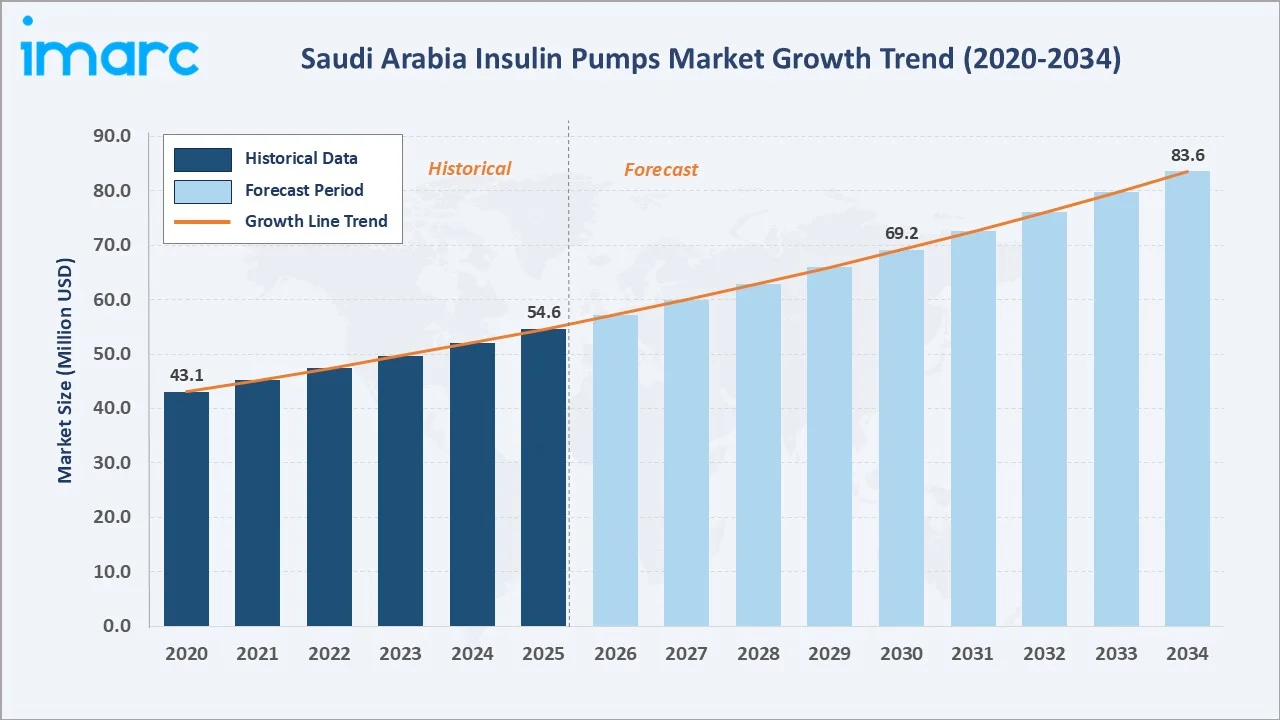
The Saudi Arabia insulin pumps market expanded from USD 43.12 Million in 2020 to USD 54.62 Million in 2025 and an estimated USD 57.27 Million in 2026, anchored at USD 69.20 Million in 2030, and forecast to reach USD 83.62 Million by 2034. Pandemic-era diagnosis gaps slowed early adoption; from 2022 onward, Vision 2030 health cluster expansion and reimbursement reform accelerated pump conversion among newly diagnosed patients.
To get more information on this market, Request Sample
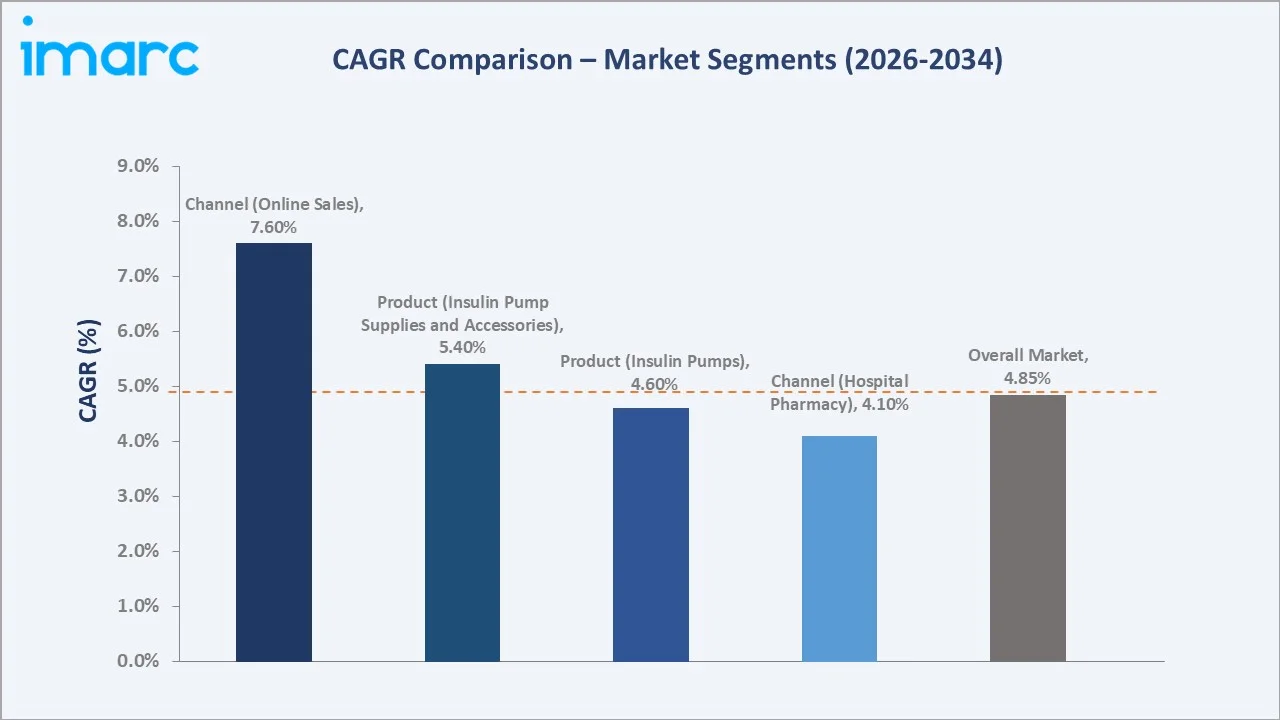
Online sales grows fastest at ~7.6% CAGR as digital pharmacy platforms and telehealth-linked resupply expand consumable access. Insulin pump supplies and accessories grow at ~5.4% CAGR through recurring infusion set and reservoir replacement demand tied to the installed device base.
Executive Summary
The Saudi Arabia insulin pumps market, which increased from USD 54.62 Million in 2025 to an estimated USD 57.27 Million in 2026, reflecting one of the Gulf region's fastest-modernizing diabetes device markets. The market encompasses tethered and disposable/patch insulin pumps alongside infusion set insertion devices and insulin reservoirs and cartridges that sustain continuous device operation.
Insulin pumps lead product type at 68.5% through direct clinical substitution for multiple daily injections. Hospital pharmacy leads distribution at 46.7% given specialist-led pump initiation protocols. The Northern and Central Region, at 41.6%, leads through Riyadh's concentration of tertiary diabetes centers and National Diabetes Centre infrastructure.
Key Market Insights
|
Insight |
Data |
|
Dominant Product Type |
Insulin Pumps - 68.5% share (2025) |
|
Dominant Distribution Channel |
Hospital Pharmacy - 46.7% market share (2025) |
|
Leading Region |
Northern and Central Region - 41.6% market share |
|
Market Opportunity |
CGM-integrated closed-loop systems; AI dosing algorithms; patch pump miniaturization; telehealth remote titration; local insulin manufacturing synergy |
Key Analytical Observations Supporting The Above Data:
- Insulin Pumps at 68.5%: Insulin pumps dominate due to direct substitution for multiple daily injections, hybrid closed-loop functionality, and growing physician confidence in device-based glycaemic control.
- Hospital Pharmacy at 46.7%: Hospital pharmacy leads because pump initiation, calibration, and early titration require specialist endocrinology oversight concentrated at hospital-based diabetes centers.
- Northern and Central Region at 41.6%: The region leads through Riyadh's dense concentration of tertiary hospitals, the National Diabetes Centre, and the highest per-capita specialist endocrinology access nationally.
Saudi Arabia Insulin Pumps Market Overview
The Saudi Arabia insulin pumps market encompasses tethered and disposable/patch insulin pump devices together with the infusion set insertion devices and insulin reservoirs/cartridges that support continuous therapy. The market spans device manufacturing, regulatory approval, clinical integration, and pharmacy-based distribution and resupply.
Saudi Arabia records one of the world's highest adult diabetes prevalence rates, with approximately 23.1% of adults, close to 5.34 million people, living with diabetes in 2024. Vision 2030 has committed over USD 65 billion toward healthcare modernization, e-health expansion, and 21 regional health clusters, structurally improving pump access nationwide.
Market Dynamics
To evaluate market opportunities, Request Sample
Market Drivers
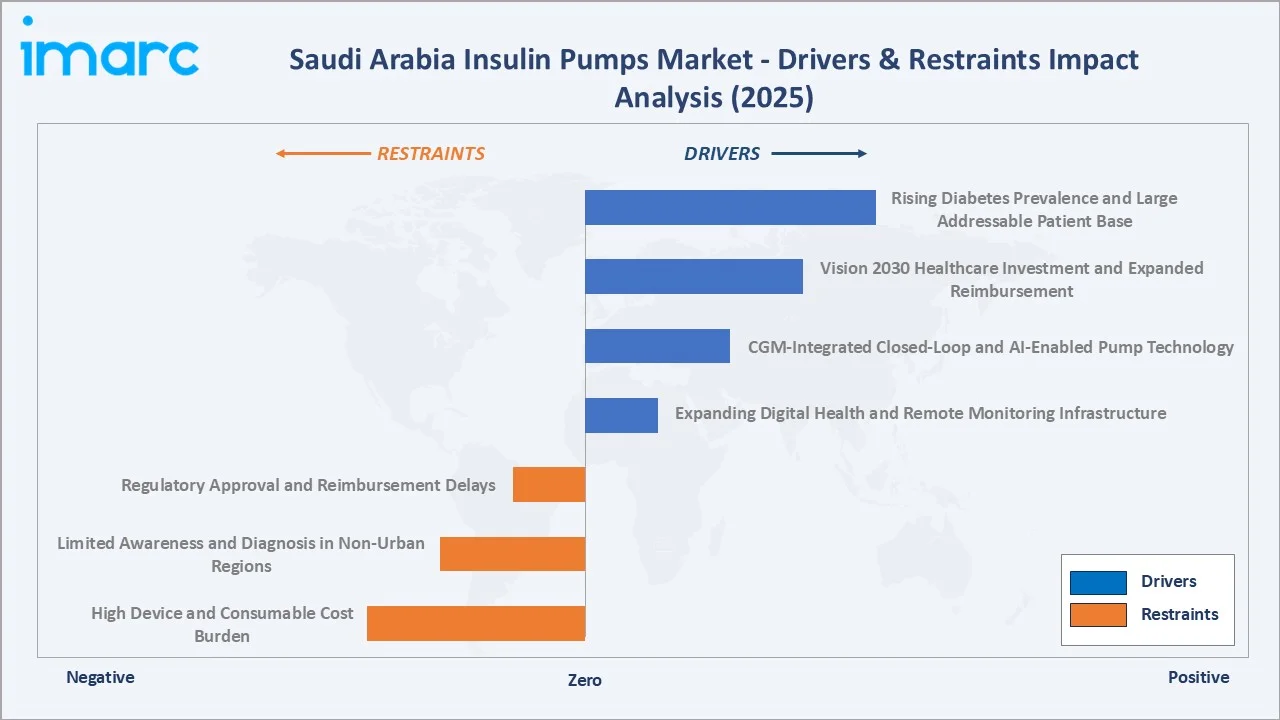
- Rising Diabetes Prevalence and Large Addressable Patient Base: Approximately 5.34 million adults live with diabetes in Saudi Arabia, creating sustained structural demand for advanced insulin-delivery devices across public and private care settings.
- Vision 2030 Healthcare Investment and Expanded Reimbursement: Over USD 65 billion in committed healthcare investment, 21 regional health clusters, and public-private procurement partnerships are lowering out-of-pocket costs and accelerating pump adoption over injection therapy.
- CGM-Integrated Closed-Loop and AI-Enabled Pump Technology: Hybrid closed-loop systems combining continuous glucose monitoring with AI-driven dosing algorithms improve glycaemic control and increasing clinical preference for pump-based therapy.
- Expanding Digital Health and Remote Monitoring Infrastructure: Growing telehealth and remote monitoring platforms extend specialist titration support beyond hospital settings, improving therapy adherence and broadening pump candidacy.
Market Restraints
- High Device and Consumable Cost Burden: Insulin pumps and recurring infusion set or reservoir consumables carry a significant cost burden, limiting adoption among uninsured and lower-income patient segments.
- Limited Awareness and Diagnosis in Non-Urban Regions: A meaningful share of diabetic patients outside major urban centers remain undiagnosed or unaware of pump therapy options, constraining addressable market conversion.
- Regulatory Approval and Reimbursement Delays: SFDA approval and formulary reimbursement review processes can extend access timelines for newly introduced pump technologies, slowing adoption of the latest device generations.
Market Opportunities
- Local Insulin Manufacturing Synergy: The 2025 launch of Saudi Arabia's first local insulin manufacturing facility in Sudair Industrial City is expected to stabilize insulin supply, indirectly supporting continuous pump therapy adoption.
- Patch and Disposable Pump Expansion: Growing preference for tubeless, disposable patch pumps among younger patients and active lifestyle segments is opening a fast-growing device sub-category.
Market Challenges
- Specialist Workforce Constraints: Pump initiation and ongoing titration require trained endocrinology and diabetes-educator capacity that remains concentrated in major cities, limiting scale-up outside urban centers.
- Device Servicing and Technical Support Access: Ensuring consistent technical support, calibration, and replacement part access across all four regions remains an operational challenge for manufacturers and distributors.
Emerging Market Trends
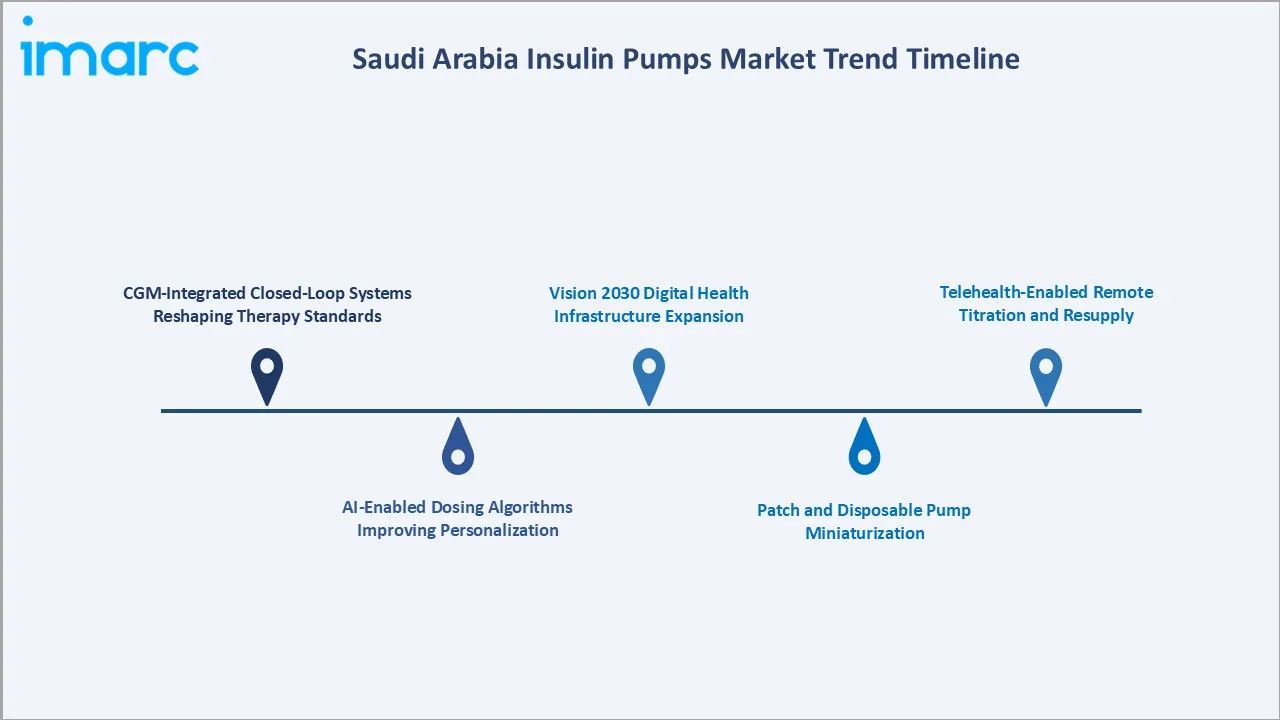
1. CGM-Integrated Closed-Loop Systems Reshaping Therapy Standards
Hybrid closed-loop systems that combine continuous glucose monitoring with automated basal-rate adjustment are becoming the clinical reference standard. These systems reduce hypoglycaemia events and improve time-in-range, driving conversion from standalone pumps to integrated device ecosystems among Saudi endocrinology centers.
2. AI-Enabled Dosing Algorithms Improving Personalization
Manufacturers are embedding machine-learning dosing algorithms that adapt basal and bolus insulin delivery to individual patient patterns. This technology shift is improving glycaemic outcomes and is increasingly cited by Saudi clinicians as a differentiator in device selection.
3. Vision 2030 Digital Health Infrastructure Expansion
National e-health platforms and the 21 regional health cluster model are integrating pump and glucose data into unified patient records, enabling remote specialist oversight and improving early diagnosis-to-therapy conversion rates.
4. Patch and Disposable Pump Miniaturization
Tubeless, disposable patch pump formats are gaining traction for their discretion and simplified wear, particularly among younger and professionally active patients seeking alternatives to tethered systems.
5. Telehealth-Enabled Remote Titration and Resupply
Telehealth platforms linking patients, pharmacies, and specialists are streamlining consumable resupply and remote dose titration, reducing the clinic-visit burden and supporting online sales as the fastest-growing distribution channel.
Industry Value Chain Analysis
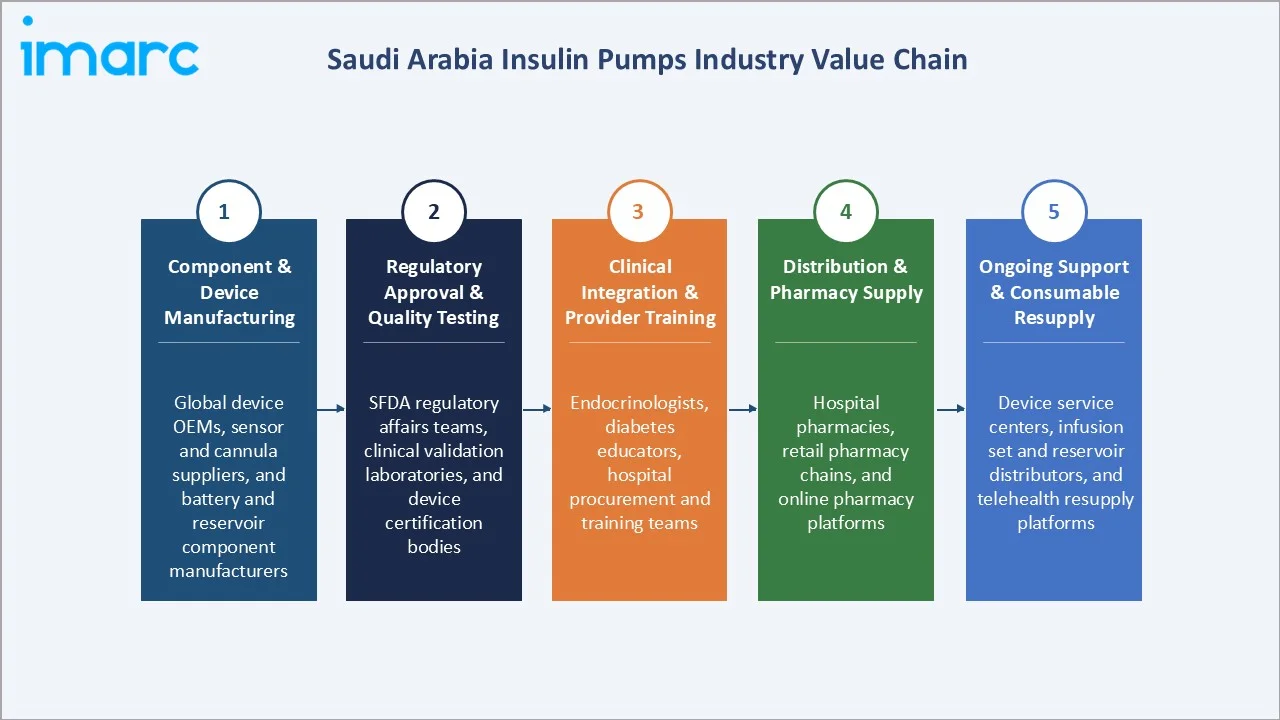
The Saudi Arabia insulin pumps value chain spans component and device manufacturing, regulatory approval and quality testing, clinical integration and provider training, patient onboarding and therapy setup, distribution and pharmacy supply, and ongoing support and consumable resupply.
|
Stage |
Key Participants |
|
Component & Device Manufacturing |
Global device OEMs, sensor and cannula suppliers, battery and reservoir component manufacturers |
|
Regulatory Approval & Quality Testing |
SFDA regulatory affairs teams, clinical validation laboratories, device certification bodies |
|
Clinical Integration & Provider Training |
Endocrinologists, diabetes educators, hospital procurement and training teams |
|
Distribution & Pharmacy Supply |
Hospital pharmacies, retail pharmacy chains, online pharmacy platforms |
|
Ongoing Support & Consumable Resupply |
Device service centers, infusion set and reservoir distributors, telehealth resupply platforms |
The clinical integration and provider training stage is the value chain's most technically demanding phase, directly shaping therapy adherence outcomes. Ongoing consumable resupply sustains recurring revenue and is increasingly digitized through telehealth-linked pharmacy platforms.
Technology Landscape in the Saudi Arabia Insulin Pumps Industry
CGM-Integrated Closed-Loop Pump Technology
CGM-integrated closed-loop technology links continuous glucose monitoring with automated basal insulin adjustment, enabling real-time, algorithm-driven dosing. These systems reduce hypoglycaemia risk and improve time-in-range, and are increasingly positioned as the clinical reference standard among Saudi endocrinology centers adopting advanced diabetes technology.
AI-Based Insulin Dosing Algorithms
AI-based dosing algorithms personalize basal and bolus insulin delivery using individual glucose response patterns. Manufacturers are embedding predictive, machine-learning-driven dosing logic into next-generation pumps, improving glycaemic outcomes and supporting the shift toward fully automated therapy management.
Patch and Disposable Pump Miniaturization Technology
Miniaturized, tubeless patch pump technology enables discreet, catheter-free insulin delivery with simplified wear. Compact reservoir and battery design innovation is expanding this format's appeal among younger, active-lifestyle patients seeking alternatives to tethered pump systems.
.webp)
Market Segmentation Analysis
The report covers the following segments:
|
Segment Category |
Leading Segment |
Market Share |
Year |
|
Product Type |
Insulin Pumps |
68.5% |
2025 |
|
Distribution Channel |
Hospital Pharmacy |
46.7% |
2025 |
|
Region |
Northern and Central Region |
41.6% |
2025 |
By Product Type
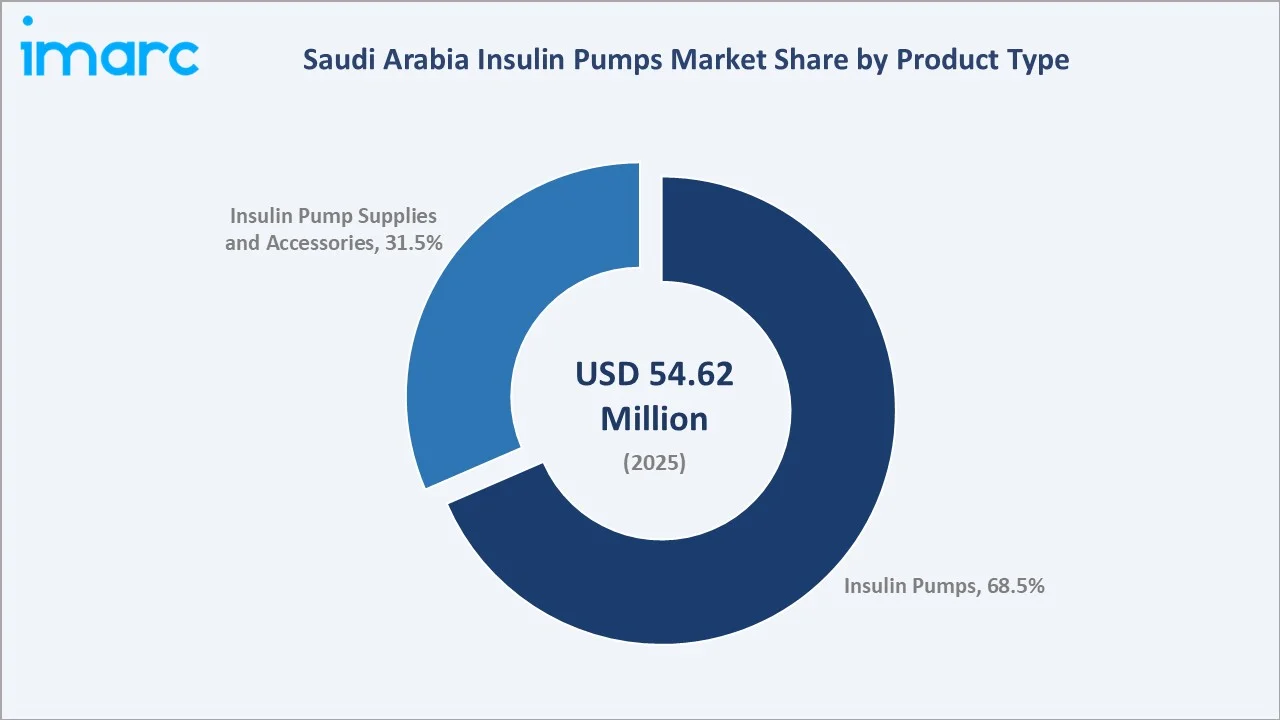
Insulin pumps lead product type at 68.5% (2025), encompassing tethered pumps that dominate specialist-managed complex therapy and disposable/patch insulin pumps gaining share among mobile, active patients.
To access detailed market analysis, Request Sample
Insulin pump supplies and accessories, at 31.5%, comprise infusion set insertion devices and insulin reservoirs/cartridges. This segment grows at ~5.4% CAGR, outpacing the overall market as recurring consumable replacement scales with the expanding installed device base.
By Distribution Channel
Hospital pharmacy leads distribution at 46.7% (2025), reflecting specialist-led pump initiation and clinical calibration protocols concentrated at hospital-based diabetes centers.
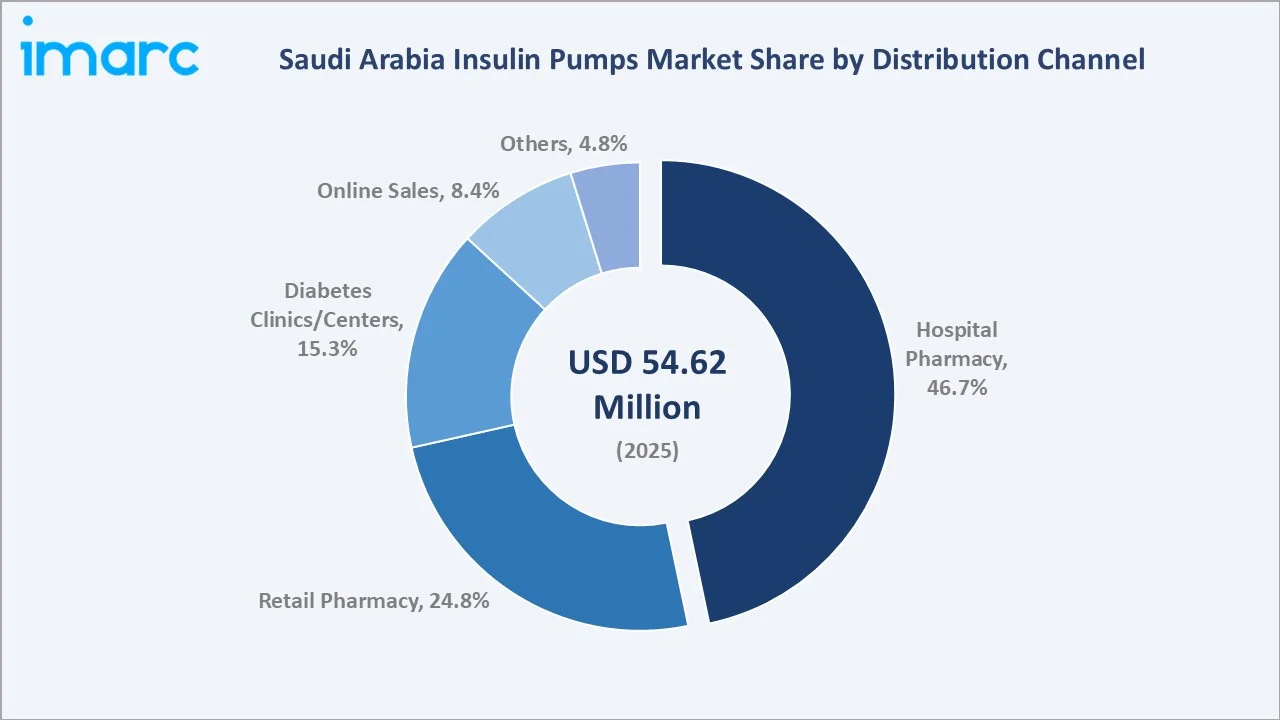
Retail pharmacy follows at 24.8%, diabetes clinics/centers at 15.3%, online sales at 8.4%, and others at 4.8%. Online sales is the fastest-growing channel at ~7.6% CAGR, driven by telehealth-linked consumable resupply and expanding digital pharmacy platforms.
Regional Market Insights
|
Region |
Share (2025) |
Key Market Drivers & Characteristics |
|
Northern and Central Region |
41.6% |
Driven by Riyadh's tertiary hospital density, the National Diabetes Centre, and the highest concentration of specialist endocrinology capacity nationally. |
|
Western Region |
27.0% |
Supported by Jeddah and Makkah's large urban patient base, private healthcare expansion, and growing insured population coverage. |
|
Eastern Region |
20.1% |
Anchored by Dhahran and Dammam's strong employer-insurance penetration and established diabetes clinic infrastructure serving the oil-sector workforce. |
|
Southern Region |
11.3% |
Reflects a smaller urban base and improving healthcare access, with growth supported by expanding regional health cluster investment. |
The Northern and Central Region's 41.6% leadership is anchored by Riyadh's position as the national referral hub for complex diabetes care. The Western Region's 27.0% reflects Jeddah and Makkah's large, growing urban population and expanding private-sector healthcare capacity.
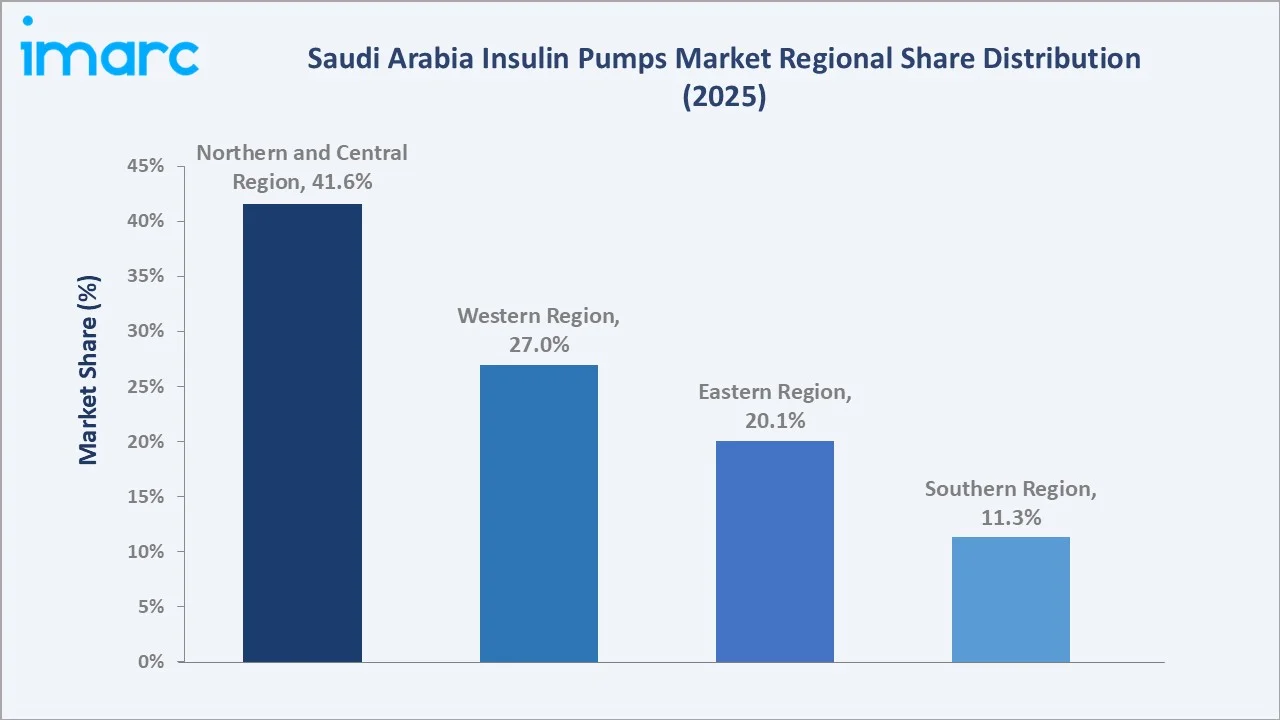
The Eastern Region's 20.1% share is supported by strong employer-sponsored insurance coverage tied to the region's industrial workforce. The Southern Region, at 11.3%, represents the market's principal long-term growth frontier as regional health cluster infrastructure expands.
Competitive Landscape
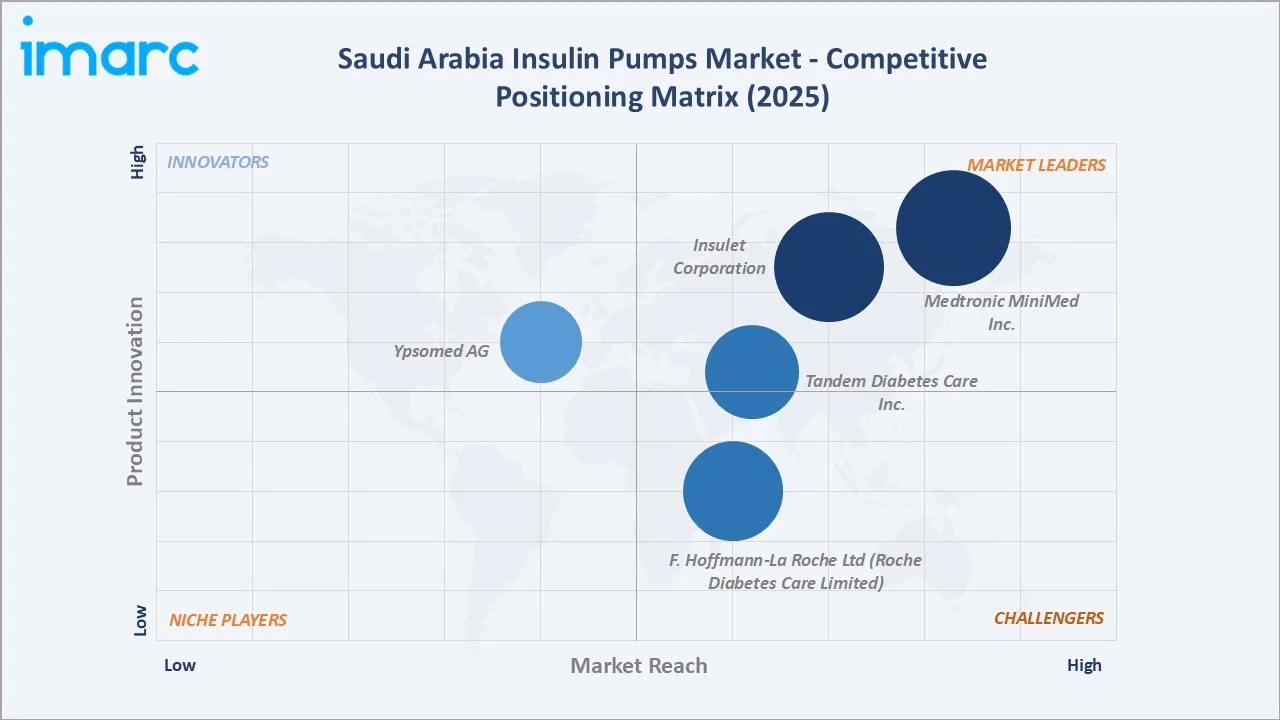
The Saudi Arabia insulin pumps market competitive landscape encompasses global device manufacturers, specialist pump technology providers, and regional distribution partners serving hospital and retail pharmacy networks.
|
Company Name |
Key Products |
Market Position |
Core Strength |
|
Medtronic MiniMed Inc. |
MiniMed 780G, MiniMed Flex |
Market Leader |
MiniMed leads through its hybrid closed-loop platform, deep clinical partnerships, and the broadest installed base across Saudi tertiary diabetes centers. The unit spun off from Medtronic and began independent Nasdaq trading (MMED) in March 2026. |
|
Insulet Corporation |
Omnipod 5, Omnipod DASH |
Market Leader |
Insulet's tubeless Omnipod platform drives strong uptake among younger, active patients seeking discreet, catheter-free wear. |
|
Tandem Diabetes Care Inc. |
t:slim X2, Control-IQ + |
Strong Challenger |
Tandem's Control-IQ algorithm and touchscreen pump interface support growing specialist preference for app-connected therapy management. |
|
F. Hoffmann-La Roche Ltd ( Roche Diabetes Care Limited) |
Accu-Chek Solo |
Strong Challenger |
Roche combines pump hardware with an established regional glucose-monitoring distribution network and clinical training infrastructure. |
|
Ypsomed AG |
mylife YpsoPump, mylife CamAPS FX |
Established Player |
Ypsomed's compact pump design and open ecosystem app integration appeal to technology-forward prescribing centers. |
Global device manufacturers with clinically validated closed-loop platforms sustain leadership through hospital procurement relationships and specialist training investment. Consolidation of CGM and pump technology partnerships is increasingly shaping competitive differentiation.
Key Company Profiles
Medtronic MiniMed Inc.
MiniMed is a global leader in insulin pump and continuous glucose monitoring technology, with a strong installed base across Saudi Arabia's tertiary diabetes centers. The business completed its spin-off from Medtronic plc and began trading independently on Nasdaq (MMED) in March 2026.
- Key Products: MiniMed 780G hybrid closed-loop system, MiniMed Flex, Guardian 4 Sensor.
- Recent Developments: In March 2026, shortly after its spin-off from Medtronic, the company received FDA clearance for MiniMed Flex, its smallest and first smartphone-controlled insulin pump, about half the size of the MiniMed 780G.
- Strategic Focus: Focused on hybrid closed-loop algorithm refinement, its next-generation Flex and Fit pump platforms, and deepening hospital-based specialist partnerships.
Insulet Corporation
Insulet specializes in tubeless, disposable insulin pump technology through its Omnipod platform, targeting patients seeking discreet, catheter-free therapy.
- Key Products: Omnipod 5 automated insulin delivery system, Omnipod DASH.
- Recent Developments: In December 2025, Insulet received FDA 510(k) clearance for Omnipod 5 algorithm enhancements, including a lower target glucose option, with U.S. launch anticipated in the first half of 2026.
- Strategic Focus: Centered on tubeless pump algorithm innovation and expanding access among younger and active-lifestyle patient segments.
Tandem Diabetes Care Inc.
Tandem Diabetes Care provides touchscreen and app-controlled insulin pump systems built around its Control-IQ+ predictive dosing algorithm, emphasizing connected therapy management.
- Key Products: t:slim X2 insulin pump, Tandem Mobi, Control-IQ+ technology.
- Recent Developments: In April 2026, Tandem announced FDA clearance expanding Control-IQ+ to pregnancy complicated by type 1 diabetes, making its t:slim X2 and Tandem Mobi systems the first AID platforms cleared for this use in the United States.
- Strategic Focus: Focused on predictive dosing software innovation and expanding Control-IQ+ indications across broader patient populations.
Market Concentration Analysis
The Saudi Arabia insulin pumps market is moderately concentrated at the device manufacturing tier, with global players holding the majority of installed device share through hospital procurement relationships. Distribution remains fragmented across hospital, retail, and online pharmacy channels, with consolidation increasing as telehealth-linked resupply platforms scale.
Investment & Growth Opportunities
Highest Growth Segments
Online sales (~7.6% CAGR), insulin pump supplies and accessories (~5.4% CAGR), and the Southern Region (from a smaller base) represent the highest-growth investment vectors through 2034 as digital resupply and regional health infrastructure expand.
Emerging Investment Opportunities
Telehealth-linked consumable resupply platforms and patch pump distribution partnerships represent the largest near-term opportunities, as providers seeking preferred-partner status with expanding regional health clusters position for above-market growth.
Investment Themes
- CGM-Pump Interoperability Platform Development: Companies investing in open-ecosystem CGM and pump interoperability are positioned to capture cross-device subscription and data-service revenue as closed-loop adoption scales.
- Telehealth-Enabled Resupply Infrastructure: Building digital resupply and remote titration infrastructure creates recurring, above-hardware-margin revenue as the installed pump base grows nationally.
Future Market Outlook (2026-2034)
The Saudi Arabia insulin pumps market is projected to grow from USD 54.62 Million in 2025 to an estimated USD 57.27 Million in 2026, reaching USD 83.62 Million by 2034, delivering a 4.85% CAGR. The market's anchor value of USD 69.20 Million in 2030 reflects a market in which closed-loop systems will have become the clinical standard of care, patch pump adoption will have scaled among younger patients, and telehealth-enabled resupply will have matured into a mainstream distribution channel.
Three structural forces underpin this outlook: sustained high diabetes prevalence creating a durable patient pipeline, Vision 2030's multi-year, budget-committed healthcare investment programme, and continuous technology innovation lowering the clinical threshold for pump adoption over injection therapy.
Research Methodology
Primary Research
Primary research comprised structured interviews with endocrinologists, hospital procurement directors, pharmacy channel managers, and regional diabetes care specialists across Saudi Arabia.
Secondary Research
Secondary research encompassed SFDA regulatory publications, Ministry of Health statistics, IDF Diabetes Atlas data, company disclosures, and regional healthcare investment reports.
Forecasting Models
Market revenue forecasts were developed using a segment bottom-up model comprising: (i) product type component; (ii) distribution channel component; (iii) regional demand component.
Saudi Arabia Insulin Pumps Market Report Coverage:
| Report Features | Details |
|---|---|
| Base Year of the Analysis | 2025 |
| Historical Period | 2020-2025 |
| Forecast Period | 2026-2034 |
| Units | Million USD |
| Scope of the Report |
Exploration of Historical Trends and Market Outlook, Industry Catalysts and Challenges, Segment-Wise Historical and Future Market Assessment:
|
| Product Types Covered |
|
| Distribution Channels Covered | Hospital Pharmacy, Retail Pharmacy, Online Sales, Diabetes Clinics/Centers, Others |
| Regions Covered | Northern and Central Region, Western Region, Eastern Region, Southern Region |
| Companies Covered | Medtronic MiniMed Inc., Insulet Corporation, Tandem Diabetes Care Inc., F. Hoffmann-La Roche Ltd (Roche Diabetes Care Limited), Ypsomed AG, etc. |
| Customization Scope | 10% Free Customization |
| Post-Sale Analyst Support | 10-12 Weeks |
| Delivery Format | PDF and Excel through Email (We can also provide the editable version of the report in PPT/Word format on special request) |
Key Benefits for Stakeholders:
- IMARC’s industry report offers a comprehensive quantitative analysis of various market segments, historical and current market trends, market forecasts, and dynamics of the Saudi Arabia insulin pumps market from 2020-2034.
- The research report provides the latest information on the market drivers, challenges, and opportunities in the Saudi Arabia insulin pumps market.
- Porter's five forces analysis assist stakeholders in assessing the impact of new entrants, competitive rivalry, supplier power, buyer power, and the threat of substitution. It helps stakeholders to analyze the level of competition within the Saudi Arabia insulin pumps industry and its attractiveness.
- Competitive landscape allows stakeholders to understand their competitive environment and provides an insight into the current positions of key players in the market.
Frequently Asked Questions About the Saudi Arabia Insulin Pumps Market Report
The Saudi Arabia insulin pumps market size is estimated at USD 57.27 Million in 2026, driven by rising diabetes prevalence, Vision 2030 healthcare investment, and growing adoption of CGM-integrated pump technology.
The market grows at 4.85% CAGR during 2026-2034, reaching USD 83.62 Million by 2034. Online sales grows fastest at ~7.6% CAGR through expanding digital pharmacy and telehealth resupply platforms.
Insulin pumps lead at 68.5% through direct clinical substitution for multiple daily injections and growing hybrid closed-loop adoption.
Hospital pharmacy leads at 46.7% through specialist-led pump initiation and clinical calibration protocols concentrated at hospital-based diabetes centers.
The Northern and Central Region leads at 41.6% through Riyadh's tertiary hospital density and National Diabetes Centre infrastructure.
Leading companies include Medtronic MiniMed Inc., Insulet Corporation, Tandem Diabetes Care Inc., F. Hoffmann-La Roche Ltd ( Roche Diabetes Care Limited), and Ypsomed AG, among others.
The market is projected to reach approximately USD 69.20 Million by 2030, with closed-loop systems achieving broader clinical adoption and patch pump uptake scaling among younger patients.
Vision 2030's over USD 65 billion healthcare investment, 21 regional health clusters, and expanded reimbursement schemes are structurally improving insulin pump access and adoption across Saudi Arabia.
Need more help?
- Speak to our experienced analysts for insights on the current market scenarios.
- Include additional segments and countries to customize the report as per your requirement.
- Gain an unparalleled competitive advantage in your domain by understanding how to utilize the report and positively impacting your operations and revenue.
- For further assistance, please connect with our analysts.
 Request Customization
 Speak to an Analyst
 Request Brochure
 Inquire Before Buying
Benefits of Customization
- Personalize this research
- Triangulate with your data
- Get data as per your format and definition
- Gain a deeper dive into a specific application, geography, customer, or competitor
- Any level of personalization
Get in Touch With Us
UNITED STATES
Phone: +1-201-971-6302
INDIA
Phone: +91-120-433-0800
UNITED KINGDOM
Phone: +44-753-714-6104
Email: [email protected]
Client Testimonials




.webp)




.webp)













Related Reports

Choose your plan
*Please note that the prices mentioned below are starting prices for each bundle type. Kindly contact our team for further details.*
Single User License
- 1 User License, Access on 2 Devices
- PDF Report + Excel Dataset (Password Protected)
- Lifetime Access
- No Printing Rights
- 10% Free Report Customization
- 10–12 Weeks of Analyst Support
Five User License
- Access for 5 Users, 2 Devices per User
- PDF Report + Excel Dataset (Password Protected)
- Lifetime Access
- Dedicated Account Manager
- 12–14 Weeks of Analyst Support
- No Printing Rights
- 15% Free Report Customization
- 25% Discount on Your Next Purchase
Corporate User License
- Unlimited User Access (Within Your Organization)
- PDF Report + Excel Dataset
- Lifetime Access
- Dedicated Account Manager
- 14–20 Weeks of Analyst Support
- No Printing Rights
- 20% Free Report Customization
- 30% Discount on Your Next Purchase
Essential Insights
What's included:
3 reports
- Lifetime Access
- PDF Reports
- Excel Datasets
- 2 Weeks of Free Analyst Support
- 2 User Licenses
- Access on 2 Devices
- Printing Rights
- Complimentary PowerPoint (PPT) Version
- Complimentary License Upgrade
Professional Access
What's included:
5 reports
- Lifetime Access
- PDF Reports
- Excel Datasets
- 8 Weeks of Free Analyst Support
- 2 User Licenses
- Access on 2 Devices
- Printing Rights
- Complimentary PowerPoint (PPT) Version
- Complimentary License Upgrade
Business Advantage
What's included:
8 reports
- Lifetime Access
- PDF Reports
- Excel Datasets
- 14 Weeks of Free Analyst Support
- 2 User Licenses
- Access on 2 Devices
- Printing Rights
- Complimentary PowerPoint (PPT) Version
- Complimentary License Upgrade
Enterprise Intelligence
What's included:
10 reports
- Lifetime Access
- PDF Reports
- Excel Datasets
- 20 Weeks of Free Analyst Support
- 2 User Licenses
- Access on 2 Devices
- Printing Rights
- Complimentary PowerPoint (PPT) Version
- Complimentary License Upgrade