
Resorcinol Market Size, Share, Trends and Forecast by Application, Production Method, End-Use Industry, and Region, 2026-2034
Resorcinol Market Size and Share:
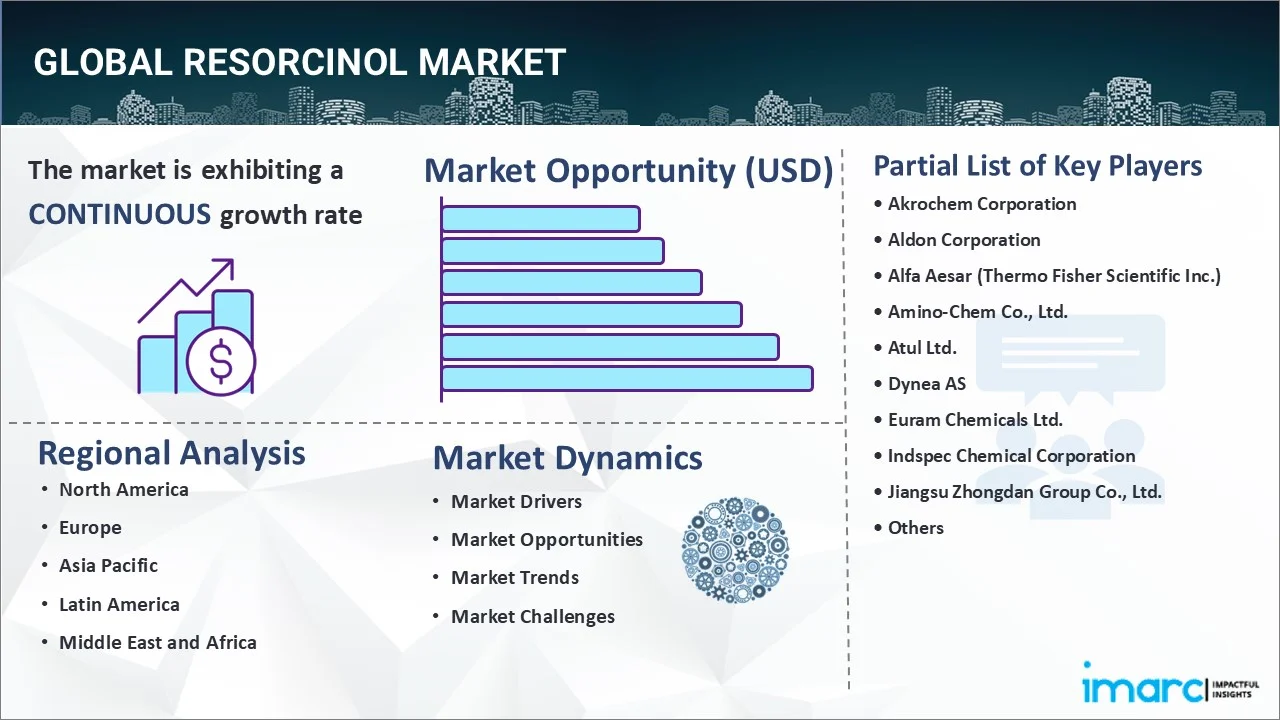
The global resorcinol market size was valued at USD 509.4 Million in 2025. Looking forward, IMARC Group estimates the market to reach USD 617.6 Million by 2034, exhibiting a CAGR of 2.13% from 2026-2034. Asia Pacific currently dominates the market, holding a market share of 39.7% in 2025. The region benefits from a large and rapidly expanding automotive manufacturing base, abundant supply of raw material inputs for rubber processing, and robust demand from tire producers and construction sectors, all of which continuously underpin the resorcinol market share.
The resorcinol market is influenced by a number of factors that are linked to its use in different applications, including pharmaceuticals and construction. First and foremost, the resorcinol market is influenced by the continued expansion of the automotive industry, which ensures a steady market for resorcinol as a binder in tire manufacturing, conveyor belts, and rubber-coated fabrics. Resorcinol's ability to improve adhesion between rubber and reinforcing cords makes it an essential component in the manufacture of modern tires. Resorcinol use in wood adhesives in residential and commercial buildings has created another market driver, particularly as engineered wood products are more frequently used in green buildings. Resorcinol use in UV stabilizers to protect plastics against degradation has created another market driver for this chemical in industry. Resorcinol use as a non-halogenated flame retardant has created another market driver, particularly as there is an increased demand for eco-friendly flame retardants in industry. Resorcinol use in pharmaceutical applications as antiseptics and dermatological agents has created another market driver.
The United States has emerged as a major region in the Resorcinol market owing to many factors. The country hosts a well-established automotive and rubber manufacturing industry that sustains consistent demand for resorcinol-based adhesive systems used in tire cord bonding and industrial rubber products. The presence of large construction and building materials industries further supports demand for wood adhesives and flame-retardant formulations derived from resorcinol. The pharmaceutical and personal care sectors contribute demand for high-purity resorcinol in topical skin treatments and dermatological formulations. Strong research and development (R&D) infrastructure supports the adoption of resorcinol in high-margin specialty applications. IMARC Group predicts that the United States specialty chemicals market reached USD 251.2 Billion by 2033, displaying a growth rate (CAGR) of 3% during 2025-2033, reinforcing the role of specialty chemicals like resorcinol in the country's industrial supply chains.
To get more information on this market Request Sample
Resorcinol Market Trends:
Expanding Automotive Tire Manufacturing Demand
One of the most prominent drivers of demand in the global resorcinol market is the continued expansion of the automotive tire manufacturing sector, where resorcinol-formaldehyde latex adhesives play an irreplaceable role in bonding rubber to reinforcing cord materials. As vehicle production increases globally, especially in rapidly industrializing economies, the need for high-performance tire adhesion systems has grown proportionately. Resorcinol's ability to enhance steel cord bonding in radial tires, combined with its effectiveness in rubber-coated fabrics and conveyor belts, sustains its essential status in the sector. The compound improves the mechanical properties of rubber compounds significantly, including dynamic modulus and static performance, without interfering with vulcanization processes. This expanding production base directly correlates with increased resorcinol consumption, as manufacturers require adhesion-enhancing chemical inputs to meet both domestic and export market quality standards for high-performance radial and tubeless tire designs.
Rising Adoption of Non-Halogenated Flame Retardants
A significant trend reshaping the resorcinol market outlook is the accelerating shift from traditional halogenated flame retardants to safer, non-halogenated alternatives, driven by increasingly stringent environmental regulations worldwide. In 2026, BASF has announced that its Thermoplastic Polyurethane (TPU) facility in Shanghai is now certified to manufacture Elastollan® Flame-Retardant (FR) TPU grade, providing a wide range of flame-retardant options that encompass both FHF and FR grades. This achievement enhances the plant's 2023 adaptation of the Halogen-free Flame-Retardant (FHF) TPU series for clients in the Asia Pacific region. Resorcinol serves as a key precursor in the synthesis of resorcinol bis(diphenylphosphate), a widely used phosphorus-based flame retardant that provides effective fire resistance without generating toxic halogenated byproducts during combustion. This makes resorcinol-derived flame retardants particularly suitable for electronics housings, building insulation panels, automotive interior materials, and textile applications subject to fire safety standards. Regulatory frameworks such as the European Union's REACH have intensified industry demand for halogen-free alternatives. As construction, automotive, and electronics industries increasingly require materials combining thermal stability with reduced toxicity and environmental persistence, demand for resorcinol as a flame retardant intermediate continues to grow steadily across multiple product categories.
Increasing Utilization in Pharmaceutical and Dermatological Products
The resorcinol market forecast is also shaped by growing demand from the pharmaceutical and personal care industries, where the compound's antiseptic, antifungal, and keratolytic properties are valued in topical formulations. Resorcinol is widely incorporated in over-the-counter treatments for acne, psoriasis, eczema, calluses, and warts, and is used in dermatological preparations as a disinfectant and fungicidal agent. Rising global prevalence of skin disorders, combined with increasing consumer awareness of effective topical treatments, is generating sustained demand for pharmaceutical-grade resorcinol. This trend is particularly pronounced in Asia-Pacific, where skincare is deeply embedded in cultural practice and spending on dermatological solutions is rising alongside growing middle-class populations. These figures highlight how expanding health and wellness expenditure is creating a meaningful and diversified demand stream for high-purity resorcinol beyond its traditional industrial applications. In 2025, Alkem Laboratories' share price increased in early trading following the launch of Kojiglo serum in India, designed for treating facial hyperpigmentation and suitable for all skin types. This novel formulation merges advanced components like liposomal azelaic acid, liposomal 4-butyl resorcinol, tranexamic acid, alpha arbutin, and niacinamide, establishing it as a first in India with Duo-Lipo technology, it noted.
Resorcinol Industry Segmentation:
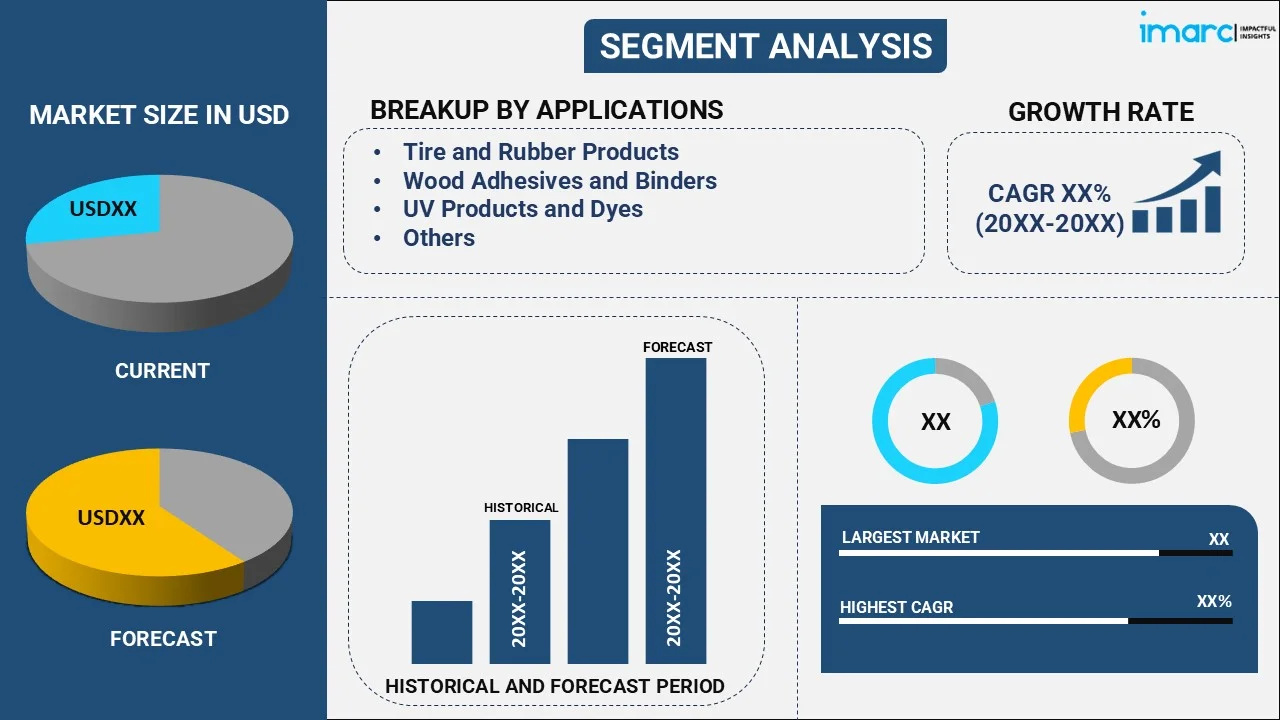
IMARC Group provides an analysis of the key trends in each segment of the global resorcinol market, along with forecast at the global, regional, and country levels from 2026-2034. The market has been categorized based on application, production method, and end-use industry.
Analysis by Application:
To get detailed segment analysis of this market Request Sample
- Tire and Rubber Products
- Wood Adhesives and Binders
- UV Products and Dyes
- Flame Retardants
- Others
Tire and rubber products holds 42.8% of the market share. This segment encompasses resorcinol's use as a critical adhesion promoter in tire cord bonding systems, conveyor belts, and rubber-coated industrial fabrics. Resorcinol-formaldehyde latex, derived from resorcinol, forms the chemical backbone of the resorcinol-formaldehyde-latex adhesive system universally adopted in radial tire manufacturing, where it ensures durable bonding between synthetic fibers or steel cord and the rubber compound. This bonding performance is essential for maintaining tire structural integrity under the mechanical stress, heat, and vibration conditions encountered during vehicle operation. The compound also improves static and dynamic modulus characteristics of the rubber matrix without adversely affecting the vulcanization process, making it the adhesive of choice for high-performance tire producers. The India–United Kingdom Comprehensive Economic and Trade Agreement signed in July 2025 eliminated all import duties on tires and rubber products exported from India to the United Kingdom, boosting the competitiveness of Indian tire manufacturers and indirectly driving demand for resorcinol across their expanded production volumes for export markets.
Analysis by Production Method:
- Benzene Disulfonation
- Hydroperoxidation of Meta-Diisopropylbenzene
- Hydrolysis of Meta-Phenylenediamine
Hydroperoxidation of meta-diisopropylbenzene leads the market with a share of 47.3%. This production process, pioneered and scaled commercially by various companies is distinguished by its minimal generation of salt byproducts compared to traditional benzene disulfonation, delivering both process efficiency advantages and reduced environmental disposal burden. The method begins with alkylation of meta-diisopropylbenzene followed by catalytic oxidation, yielding high-purity resorcinol in a streamlined process well-suited for large-scale industrial manufacturing. The cleaner production profile of this route aligns with tightening environmental compliance requirements in major manufacturing geographies, making it increasingly preferred by producers operating under stringent waste management and effluent treatment regulations. Sumitomo Chemical currently operates with an annual production capacity of approximately 20,000 metric tons of resorcinol at its Oita Works facility in Japan using this proprietary hydroperoxidation process, providing substantial global supply coverage and reinforcing the method's dominance across the international market for tire-grade and pharmaceutical-grade resorcinol.

Analysis by End-Use Industry:
- Automotive
- Building and Construction
- Healthcare
- Electrical and Electronics
- Others
Automotive dominates the market, with a share of 36.4%. The automotive end-use industry's consumption of resorcinol is centered on its indispensable role in tire adhesion chemistry, where resorcinol-based resins enhance the bonding of reinforcing materials within tire casings, ensuring structural integrity across varied temperature ranges and road conditions. Beyond tires, resorcinol is used in rubber-to-metal bonding systems for engine mounts, bushings, and vibration dampers, as well as in surface coatings and flame-retardant applications for interior components. The proliferation of electric vehicles globally is also introducing new requirements for high-performance adhesive and sealing materials, creating incremental demand for resorcinol-derived formulations. The resorcinol market trends in the automotive sector are further influenced by the adoption of lighter, higher-performance materials in next-generation vehicles designed to meet emissions standards. India's tyre exports recorded a turnover of over INR 23,073 crore in financial year 2024, driven by surging OEM and replacement demand domestically and internationally, reflecting the scale of automotive rubber chemical consumption that sustains resorcinol demand across the Asia-Pacific region and globally.
Regional Analysis:
.webp)
To get more information on the regional analysis of this market Request Sample
- Asia Pacific
- China
- Japan
- India
- South Korea
- Australia
- Indonesia
- Others
- Europe
- Germany
- France
- United Kingdom
- Italy
- Spain
- Russia
- Others
- North America
- United States
- Canada
- Middle East and Africa
- Turkey
- Saudi Arabia
- Iran
- United Arab Emirates
- Others
- Latin America
- Brazil
- Mexico
- Argentina
- Colombia
- Others
Asia Pacific, accounting for 39.7% of the share, enjoys the leading position in the market. The region's dominance is underpinned by the concentration of the world's largest tire manufacturing operations in China, Japan, India, and South Korea, all of which consume substantial volumes of resorcinol for adhesive resin systems. China stands as one of the largest producers and consumers of resorcinol globally, supported by a strong domestic automotive and construction sector that sustains massive demand for resorcinol-derived resins and coatings. India, with its rapidly expanding tire market, continues to register growing consumption as domestic vehicle production and exports rise. Japan's sophisticated chemical manufacturing ecosystem, anchored by producers, provides the region with both production capacity and technological excellence in resorcinol applications. The Indian tire industry attained an aggregate production volume in 2025, a figure that directly reflects the magnitude of resorcinol-based adhesive demand across the region's manufacturing sector.
Key Regional Takeaways:
North America Resorcinol Market Analysis
The North American resorcinol market occupies a notable position in the global landscape, driven by well-established demand from the automotive, construction, and specialty chemicals industries across the United States and Canada. North American resorcinol consumption is primarily centered on adhesive applications within the tire and rubber manufacturing sector, alongside wood adhesives for engineered and structural wood products widely used in residential and commercial construction. The region's pharmaceutical and personal care industries also generate consistent demand for high-purity resorcinol in dermatological formulations, skincare products, and antiseptic preparations. Following the closure of domestic production in the United States, the region has transitioned fully to import-dependence, sourcing resorcinol primarily from Asian producers, particularly Japanese and Chinese manufacturers. This supply dynamic has intensified focus on supply chain resilience and quality assurance. The automotive chemicals sector in North America also increasingly adopts resorcinol-based UV stabilizers and flame retardants as environmental and safety compliance standards tighten.
United States Resorcinol Market Analysis
The United States holds a significant share of the North American resorcinol market, supported by a robust and technically sophisticated industrial landscape spanning automotive manufacturing, specialty chemicals, construction, and healthcare. Resorcinol demand in the country is anchored by its use as an adhesive resin component in tire manufacturing, where it enhances the bonding strength between reinforcing cords and rubber compounds in both passenger and commercial vehicle tires. The wood adhesives segment also generates meaningful demand, particularly for construction-grade adhesives used in laminated veneer lumber, cross-laminated timber, and other engineered wood applications that benefit from resorcinol's high chemical resistance and waterproofing properties. The healthcare and personal care sectors drive additional demand for pharmaceutical-grade resorcinol in topical antiseptics and dermatological treatments. The country's chemical manufacturing sector is investing in specialty formulations, including advanced UV stabilizers and halogen-free flame retardants incorporating resorcinol derivatives, aligned with increasingly strict regulatory requirements. Under President Biden’s Investing in America initiative, the U.S. Department of Energy (DOE) announced on March 25, 2024, the allocation of up to US$6 billion for 33 projects spanning over 20 states aimed at decarbonizing energy-heavy industries, lowering industrial greenhouse gas emissions, promoting well-paying union jobs, revitalizing industrial areas, and enhancing the nation’s manufacturing competitiveness.
Europe Resorcinol Market Analysis
Europe represents a mature and technically advanced resorcinol market, characterized by steady demand from the automotive, specialty chemicals, and construction sectors. Countries including Germany, France, and the United Kingdom serve as major consumption centers, driven by the region's prominent tire manufacturing industry and strong demand for resorcinol-based flame retardants and wood adhesives. European regulatory frameworks, particularly REACH and stringent building codes requiring halogen-free flame-retardant materials, have driven the adoption of resorcinol-derived phosphate esters and reactive flame retardants across multiple application segments. The region's advanced pharmaceutical and personal care industries also generate demand for high-purity resorcinol in antiseptic formulations. In 2025, European environmental standards and quality certification requirements intensified manufacturer focus on sourcing high-grade resorcinol from certified suppliers, reinforcing the trend toward premium specialty-grade consumption.
Asia-Pacific Resorcinol Market Analysis
Asia-Pacific dominates global resorcinol consumption, accounting for the majority of demand driven by the region's concentration of tire manufacturing, chemical processing, and construction activity. China leads regional consumption with a large domestic automotive and construction industry sustaining high volumes of resorcinol for adhesives, flame retardants, and UV stabilizers. Japan hosts several of the world's largest and most technologically advanced resorcinol producers, including Sumitomo Chemical, which operates one of the highest-capacity resorcinol facilities globally. India's resorcinol demand is closely aligned with its tire and rubber industry, which attained a production turnover in financial year 2024. Tyre exports from India experienced a significant rebound in the latter half of the 2023-24 fiscal year, increasing by 12% in value compared to the corresponding period in the prior fiscal year, as per data recently published by the Ministry of Commerce.
Latin America Resorcinol Market Analysis
Latin America's resorcinol market is anchored by demand from Brazil and Mexico, where expanding automotive and tire manufacturing sectors are the primary consumption drivers. Brazil's domestic vehicle production industry requires resorcinol as a bonding agent in tire manufacturing, while Mexico's integration into North American automotive supply chains supports demand for adhesive resins and rubber chemicals. The construction industry across the region also drives incremental demand for resorcinol-based wood adhesives. Moreover, Brazil's automotive industry represented one of the largest in Latin America, with growing output reinforcing demand for tire-grade adhesive chemicals, including resorcinol, as production capacity continues to expand across the country.
Middle East and Africa Resorcinol Market Analysis
The Middle East and Africa resorcinol market remains at a relatively early stage of development, with demand concentrated in petrochemical hubs and construction-intensive economies such as Saudi Arabia, the United Arab Emirates, and South Africa. Resorcinol consumption is primarily linked to industrial rubber applications, flame retardants for construction materials, and pharmaceutical formulations. The region's rapid infrastructure development and expanding construction sector are creating demand for wood adhesives and fire-safety materials incorporating resorcinol. Hydroquinone-based products and resorcinol derivatives for use in skincare are also gaining traction across North African markets, with usage increasing by approximately 12% in recent periods, according to industry tracking data.
Competitive Landscape:
Key players in the resorcinol market are focusing on capacity expansion, product innovation, sustainability initiatives, and geographic diversification to strengthen their competitive position. Many manufacturers are increasing production capabilities and upgrading facilities to meet rising demand from automotive, construction, rubber, and adhesive applications. Investments in research and development are driving the introduction of high-performance and specialty grades tailored for advanced bonding solutions and tire manufacturing. Sustainability has become a major priority, with companies adopting greener production processes, improving energy efficiency, and developing bio-based or low-emission alternatives to align with evolving environmental regulations and customer expectations. Strategic collaborations with end-use industries are also helping companies co-develop customized formulations and secure long-term supply agreements. In addition, businesses are expanding into emerging markets to capture new growth opportunities, supported by strengthened distribution networks and localized production. Digital transformation initiatives, including supply chain optimization and process automation, are further enhancing operational efficiency, cost control, and responsiveness to market fluctuations. Collectively, these strategies are enabling market participants to improve profitability, ensure regulatory compliance, and maintain a strong position in a competitive global landscape.
The report provides a comprehensive analysis of the competitive landscape in the resorcinol market with detailed profiles of all major companies, including:
- Akrochem Corporation
- Aldon Corporation
- Alfa Aesar (Thermo Fisher Scientific Inc.)
- Amino-Chem Co., Ltd.
- Atul Ltd.
- Dynea AS
- Euram Chemicals Ltd.
- Indspec Chemical Corporation
- Jiangsu Zhongdan Group Co., Ltd.
- Mitsui Chemicals Inc.
- Napp Technologies LLC
- Sigma-Aldrich Corporation
- Sumitomo Chemicals Co. Ltd.
Resorcinol Market Report Scope:
| Report Features | Details |
|---|---|
| Base Year of the Analysis | 2025 |
| Historical Period | 2020-2025 |
| Forecast Period | 2026-2034 |
| Units | Million USD |
| Scope of the Report |
Exploration of Historical Trends and Market Outlook, Industry Catalysts and Challenges, Segment-Wise Historical and Future Market Assessment:
|
| Applications Covered | Tire and Rubber Products, Wood Adhesives and Binders, UV Products and Dyes, Flame Retardants, Others |
| Production Methods Covered | Benzene Disulfonation, Hydroperoxidation of Meta-Diisopropylbenzene, Hydrolysis of Meta-Phenylenediamine |
| End-Use Industries Covered | Automotive, Building and Construction, Healthcare, Electrical and Electronics, Others |
| Regions Covered | Asia Pacific, Europe, North America, Latin America, Middle East and Africa |
| Countries Covered | United States, Canada, Germany, France, United Kingdom, Italy, Spain, Russia, China, Japan, India, South Korea, Australia, Indonesia, Brazil, Mexico, Turkey, Saudi Arabia, Iran, United Arab Emirates, Argentina, Colombia |
| Companies Covered | Akrochem Corporation, Aldon Corporation, Alfa Aesar (Thermo Fisher Scientific Inc.), Amino-Chem Co. Ltd., Atul Ltd., Dynea AS, Euram Chemicals Ltd., Indspec Chemical Corporation, Jiangsu Zhongdan Group Co. Ltd., Mitsui Chemicals Inc., Napp Technologies LLC, Sigma-Aldrich Corporation, Sumitomo Chemicals Co. Ltd. etc. |
| Customization Scope | 10% Free Customization |
| Post-Sale Analyst Support | 10-12 Weeks |
| Delivery Format | PDF and Excel through Email (We can also provide the editable version of the report in PPT/Word format on special request) |
Key Benefits for Stakeholders:
- IMARC’s report offers a comprehensive quantitative analysis of various market segments, historical and current market trends, market forecasts, and dynamics of the resorcinol market from 2020-2034.
- The research study provides the latest information on the market drivers, challenges, and opportunities in the global resorcinol market.
- The study maps the leading, as well as the fastest-growing, regional markets. It further enables stakeholders to identify the key country-level markets within each region.
- Porter's Five Forces analysis assists stakeholders in assessing the impact of new entrants, competitive rivalry, supplier power, buyer power, and the threat of substitution. It helps stakeholders to analyze the level of competition within the resorcinol industry and its attractiveness.
- Competitive landscape allows stakeholders to understand their competitive environment and provides an insight into the current positions of key players in the market.
Frequently Asked Questions About the Resorcinol Market Report
The resorcinol market was valued at USD 509.4 Million in 2025.
The resorcinol market is projected to exhibit a CAGR of 2.13% during 2026-2034, reaching a value of USD 617.6 Million by 2034.
The resorcinol market is primarily driven by expanding automotive tire manufacturing, rising demand for wood adhesives in residential and commercial construction, growing utilization in non-halogenated flame retardants for electronics and building materials, and increasing pharmaceutical application in topical dermatological treatments. Sustained industrial growth in Asia-Pacific economies and tightening fire-safety regulations globally are also significant contributing factors to market expansion.
Asia Pacific currently dominates the resorcinol market, accounting for a share of 39.7%. The region benefits from its massive tire manufacturing base, robust automotive production, expanding construction sector, and the presence of several large-scale resorcinol producers in China, Japan, and India, supporting consistently high consumption volumes.
Some of the major players in the resorcinol market include Akrochem Corporation, Aldon Corporation, Alfa Aesar (Thermo Fisher Scientific Inc.), Amino-Chem Co. Ltd., Atul Ltd., Dynea AS, Euram Chemicals Ltd., Indspec Chemical Corporation, Jiangsu Zhongdan Group Co. Ltd., Mitsui Chemicals Inc., Napp Technologies LLC, Sigma-Aldrich Corporation, Sumitomo Chemicals Co. Ltd. etc.
Need more help?
- Speak to our experienced analysts for insights on the current market scenarios.
- Include additional segments and countries to customize the report as per your requirement.
- Gain an unparalleled competitive advantage in your domain by understanding how to utilize the report and positively impacting your operations and revenue.
- For further assistance, please connect with our analysts.
 Request Customization
 Speak to an Analyst
 Request Brochure
 Inquire Before Buying
Benefits of Customization
- Personalize this research
- Triangulate with your data
- Get data as per your format and definition
- Gain a deeper dive into a specific application, geography, customer, or competitor
- Any level of personalization
Get in Touch With Us
UNITED STATES
Phone: +1-201-971-6302
INDIA
Phone: +91-120-433-0800
UNITED KINGDOM
Phone: +44-753-714-6104
Email: [email protected]
Client Testimonials




.webp)




.webp)













Related Reports

Choose your plan
*Please note that the prices mentioned below are starting prices for each bundle type. Kindly contact our team for further details.*
Single User License
- 1 User License, Access on 2 Devices
- PDF Report + Excel Dataset (Password Protected)
- Lifetime Access
- No Printing Rights
- 10% Free Report Customization
- 10–12 Weeks of Analyst Support
Five User License
- Access for 5 Users, 2 Devices per User
- PDF Report + Excel Dataset (Password Protected)
- Lifetime Access
- Dedicated Account Manager
- 12–14 Weeks of Analyst Support
- No Printing Rights
- 15% Free Report Customization
- 25% Discount on Your Next Purchase
Corporate User License
- Unlimited User Access (Within Your Organization)
- PDF Report + Excel Dataset
- Lifetime Access
- Dedicated Account Manager
- 14–20 Weeks of Analyst Support
- No Printing Rights
- 20% Free Report Customization
- 30% Discount on Your Next Purchase
Essential Insights
What's included:
3 reports
- Lifetime Access
- PDF Reports
- Excel Datasets
- 2 Weeks of Free Analyst Support
- 2 User Licenses
- Access on 2 Devices
- Printing Rights
- Complimentary PowerPoint (PPT) Version
- Complimentary License Upgrade
Professional Access
What's included:
5 reports
- Lifetime Access
- PDF Reports
- Excel Datasets
- 8 Weeks of Free Analyst Support
- 2 User Licenses
- Access on 2 Devices
- Printing Rights
- Complimentary PowerPoint (PPT) Version
- Complimentary License Upgrade
Business Advantage
What's included:
8 reports
- Lifetime Access
- PDF Reports
- Excel Datasets
- 14 Weeks of Free Analyst Support
- 2 User Licenses
- Access on 2 Devices
- Printing Rights
- Complimentary PowerPoint (PPT) Version
- Complimentary License Upgrade
Enterprise Intelligence
What's included:
10 reports
- Lifetime Access
- PDF Reports
- Excel Datasets
- 20 Weeks of Free Analyst Support
- 2 User Licenses
- Access on 2 Devices
- Printing Rights
- Complimentary PowerPoint (PPT) Version
- Complimentary License Upgrade