
Saudi Arabia Burglar Alarm Market Size, Share, Trends and Forecast by Component, Application, and Region, 2026-2034
Saudi Arabia Burglar Alarm Market Size, Share, Trends & Forecast (2026-2034)
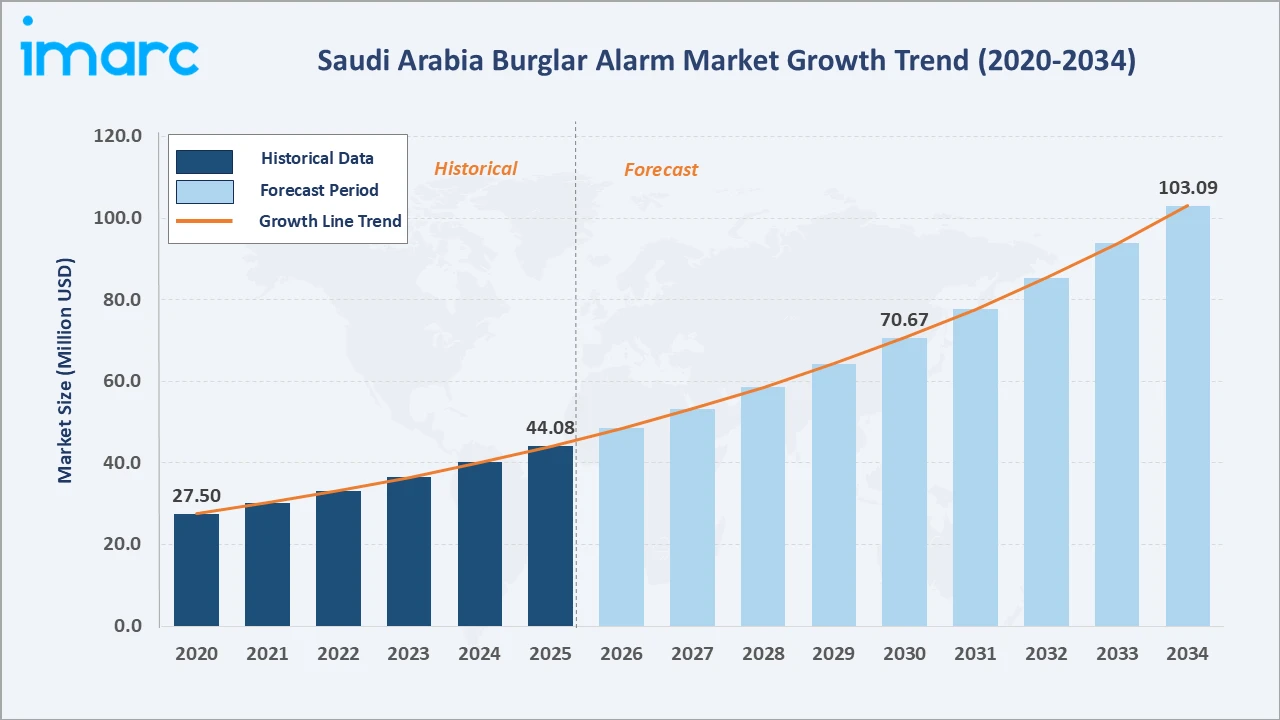
The Saudi Arabia burglar alarm market size increased from USD 44.08 Million in 2025 to USD 48.45 Million in 2026 and is projected to reach USD 103.09 Million by 2034, exhibiting a CAGR of 9.90% during 2026-2034. Saudi Arabia's burglar alarm market growth is driven by rising urban security spending, expanding commercial and residential construction under Vision 2030, and mandatory Civil Defense safety compliance for new buildings. Hardware components dominate at 61.4% of 2025 revenue, while commercial and industrial facilities account for 71.4% of application demand. The Northern and Central Region leads regionally at 41.6% share, while software-based monitoring solutions post the fastest segment growth through 2034.
Market Snapshot
|
Metric |
Value |
|
Base Year Market Size (2025) |
USD 44.08 Million |
| Market Size (2026) | USD 48.45 Million |
|
Forecast Market Size (2034) |
USD 103.09 Million |
|
CAGR (2026-2034) |
9.90% |
|
Base Year |
2025 |
|
Historical Period |
2020-2025 |
|
Forecast Period |
2026-2034 |
|
Largest Component |
Hardware (61.4%, 2025) |
|
Fastest Growing Component |
Software (~13.2% CAGR, 2026-2034) |
|
Dominant Region |
Northern & Central Region (41.6%, 2025) |
The market expanded from USD 27.50 Million in 2020 to USD 44.08 Million in 2025 and an estimated USD 48.45 Million in 2026, reaching an estimated USD 70.67 Million by 2030, and is forecast to touch USD 103.09 Million by 2034. Growth is anchored in Saudi Arabia's Vision 2030 infrastructure build-out, rising commercial real estate completions, and increasing residential adoption of professionally monitored security systems across major metropolitan centers.
To get more information on this market, Request Sample
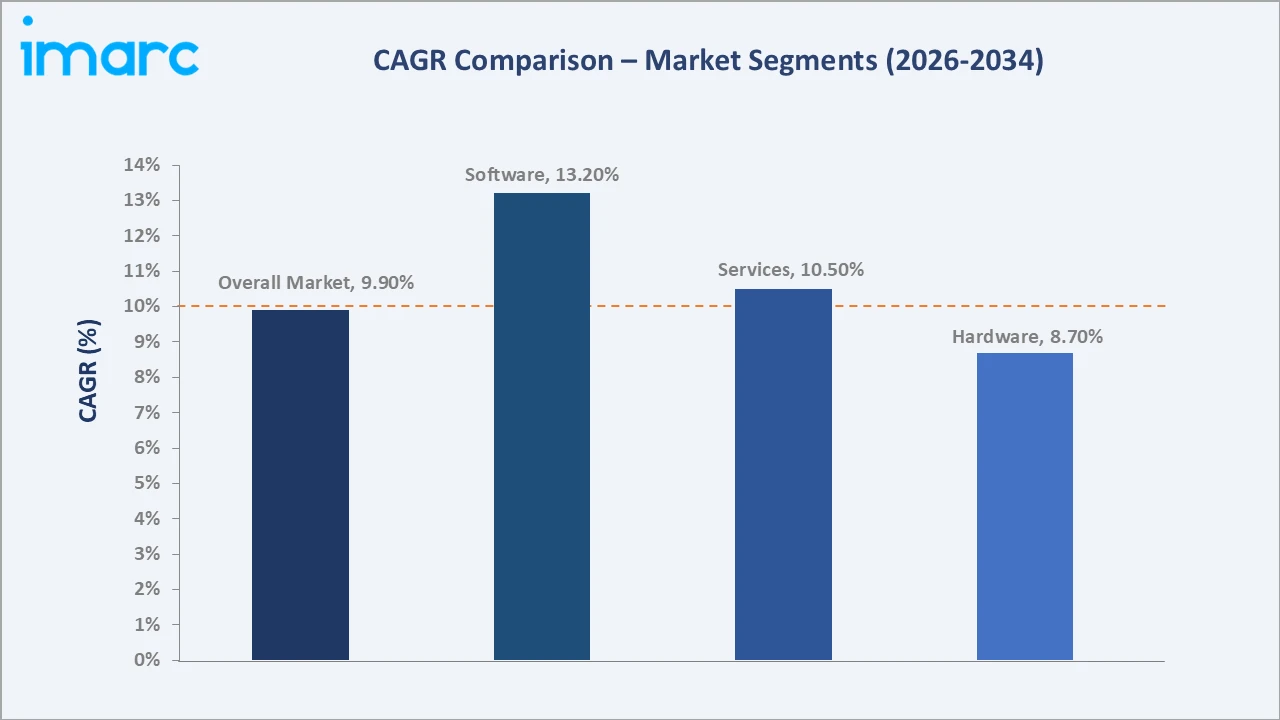
Software-based monitoring platforms are growing fastest at an estimated 13.2% CAGR (2026-2034), driven by cloud-hosted alarm management and subscription-based monitoring applications. Services expand at approximately 10.5% CAGR as system integrators bundle installation with maintenance contracts, while Hardware, though dominant by revenue, grows more moderately at around 8.7% CAGR as the sensor base matures across previously under-penetrated segments.
Executive Summary
The Saudi Arabia burglar alarm market increased from USD 44.08 Million in 2025 to an estimated USD 48.45 Million in 2026, propelled by the Kingdom's rapid urban expansion, an intensifying regulatory focus on facility safety, and heightened awareness of asset protection among commercial property owners. The General Directorate of Civil Defense's licensing framework requires verified safety and security systems for new commercial and industrial facilities, creating structural demand independent of discretionary spending cycles. The market is projected to reach USD 103.09 Million by 2034 at a 9.90% CAGR, supported by Vision 2030's construction pipeline, smart-home adoption, and growing insurance-linked security requirements.
Hardware commands 61.4% of 2025 revenue, reflecting widespread deployment across both new-build and retrofit projects, while commercial and industrial facilities account for the largest application share at 71.4%. Services retain 22.8% share as monitoring and maintenance contracts gain traction, while software, though smallest at 15.8% share, is expanding fastest as operators migrate toward cloud-based and mobile-app-enabled alarm management. The Northern and Central Region dominates at 41.6% share, anchored by Riyadh's commercial and government facility density.
Looking ahead, the market outlook remains constructive, with continued giga-project construction, rising residential security awareness, and the gradual shift toward integrated, AI-enabled monitoring platforms expected to sustain double-digit growth in software and services through 2034.
Key Market Insights
|
Insight |
Data |
|
Largest Component |
Hardware - 61.4% share (2025) |
|
Largest Application |
Commercial and Industrial - 71.4% share (2025) |
|
Dominant Region |
Northern & Central Region - 41.6% share (2025) |
Key Analytical Observations Supporting The Above Data:
- Hardware at 61.4% share (2025) anchored by mandatory Civil Defense compliance: New commercial and industrial facilities in Saudi Arabia must install and certify approved intrusion detection hardware before receiving a safety license, sustaining baseline sensor and panel demand regardless of economic cycles.
- Commercial and Industrial facilities lead application demand at 71.4% share (2025): Mandatory Civil Defense safety licensing for offices, retail establishments, warehouses, and industrial plants anchors sustained hardware and monitoring demand, ahead of the residential segment's 28.6% share.
- Northern & Central Region dominant with 41.6% share (2025): The region benefits from Riyadh's concentration of government buildings, corporate headquarters, and high-value residential compounds, which collectively require certified intrusion detection systems under municipal safety codes.
- Software is the fastest-growing component (~13.2% CAGR, 2026-2034): Rising demand for cloud-hosted monitoring dashboards and mobile alarm management applications is outpacing hardware and services growth as system integrators bundle subscription software with new installations.
Saudi Arabia Burglar Alarm Market Overview
Saudi Arabia's burglar alarm market encompasses intrusion detection hardware, monitoring software, and installation and maintenance services deployed across residential, commercial, and industrial properties within the Kingdom. The market is substantially import-dependent for hardware components, with global manufacturers including KEENFINITY Group, Honeywell, and Hikvision supplying panels and sensors through licensed local distributors and systems integrators. System design, installation, and central monitoring services are largely provided by Saudi-based integrators operating under General Directorate of Civil Defense licensing requirements. Macroeconomic tailwinds include Vision 2030's diversification agenda, rising non-oil GDP contribution, expanding urban commercial real estate completions, and growing household security spending as homeownership targets rise toward 70% by 2030.
Market Dynamics
To evaluate market opportunities, Request Sample
Market Drivers
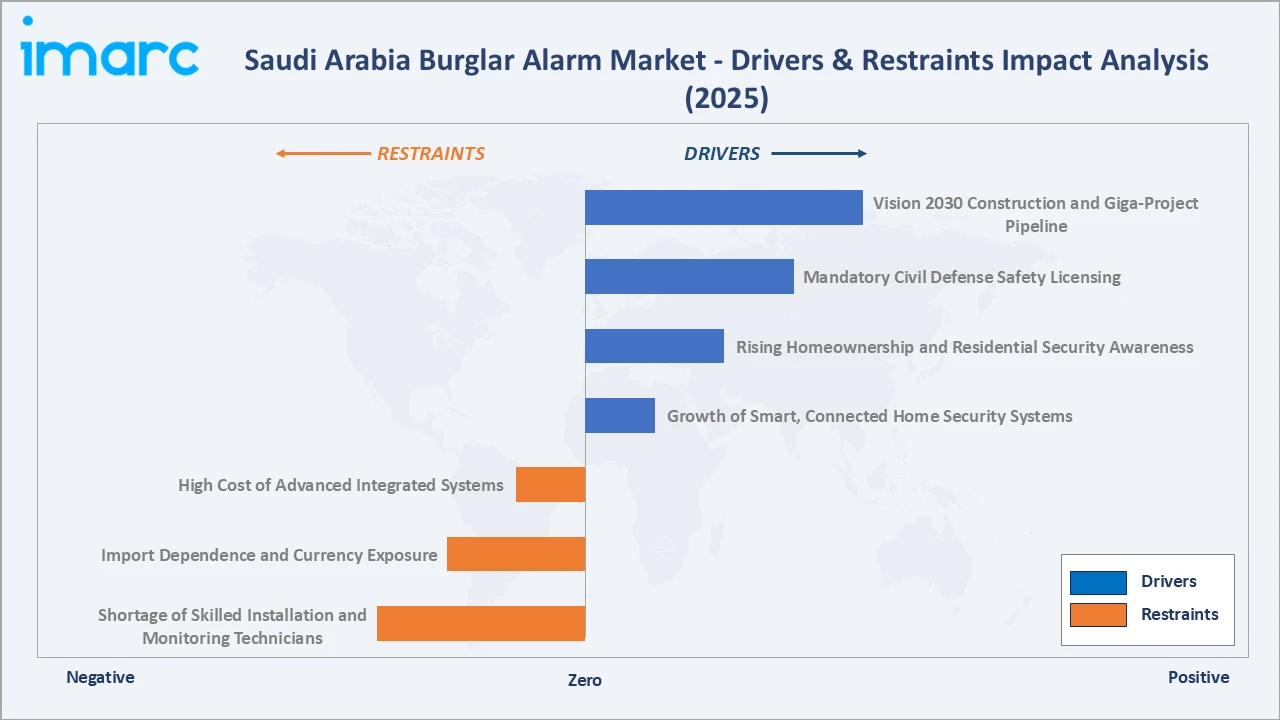
- Vision 2030 Construction and Giga-Project Pipeline: Saudi Arabia's construction industry recorded 4% year-on-year growth in gross fixed capital formation in H1 2025, with giga-projects such as NEOM, Qiddiya, and the Red Sea developments generating sustained demand for integrated security systems in new commercial and hospitality facilities.
- Mandatory Civil Defense Safety Licensing: The General Directorate of Civil Defense requires commercial, industrial, and institutional facilities to obtain certified safety licenses covering intrusion and fire detection systems before commencing operations, creating structural, non-discretionary demand for alarm hardware.
- Rising Homeownership and Residential Security Awareness: Vision 2030 targets an increase in homeownership from 65.4% in 2024 to 70% by 2030, expanding the addressable base of villas and residential units requiring professionally installed intrusion detection systems.
- Growth of Smart, Connected Home Security Systems: Increasing smartphone penetration and rising consumer familiarity with app-based alarm control are accelerating residential adoption of wireless, professionally monitored alarm systems, particularly in Riyadh and Jeddah's expanding suburban developments.
Market Restraints
- High Cost of Advanced Integrated Systems: Fully integrated intrusion detection, video verification, and central monitoring packages carry premium pricing that limits adoption among small and medium-sized commercial establishments and budget-conscious residential buyers.
- Import Dependence and Currency Exposure: Saudi Arabia's near-total reliance on imported hardware components exposes distributors and installers to USD/SAR exchange rate movements and international freight cost volatility.
Market Opportunities
- Cloud-Based and AI-Enabled Monitoring Platforms: Rising demand for remote, mobile-app-based alarm management creates opportunities for software vendors and monitoring service providers to offer subscription-based recurring revenue models.
- Integration with Smart Building and Facility Management Systems: Growing adoption of building management systems in Vision 2030 commercial developments creates cross-selling opportunities for intrusion detection providers to bundle alarm systems with access control and video surveillance.
Market Challenges
- Shortage of Skilled Installation and Monitoring Technicians: Rapid market expansion has outpaced the availability of certified security system installers and monitoring center staff, creating project delays and service quality inconsistencies.
- Price Competition from Lower-Cost Regional Suppliers: Increasing availability of budget-priced alarm hardware from regional distributors is compressing margins for premium international brands in the price-sensitive residential segment.
Emerging Market Trends
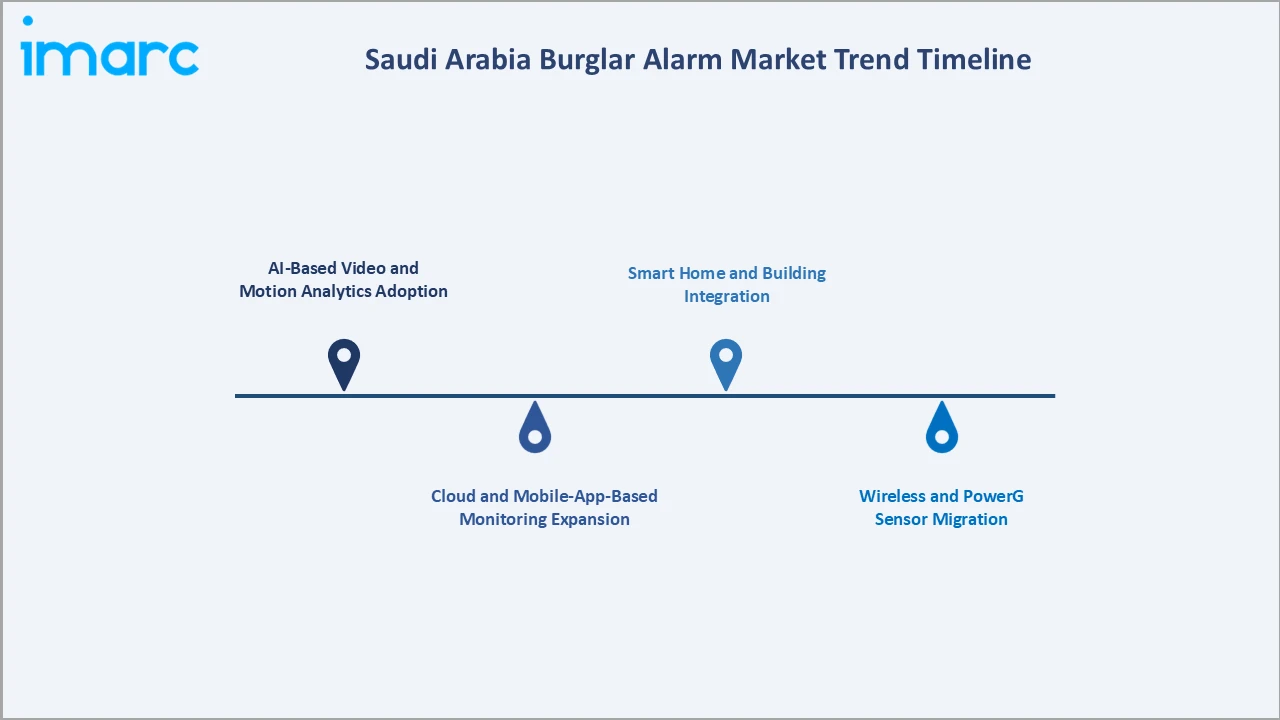
1. AI-Based Video and Motion Analytics Adoption
Alarm systems are increasingly incorporating AI-driven analytics to distinguish genuine intrusion events from false triggers such as pets or environmental movement, reducing false alarm rates and improving monitoring center efficiency.
2. Cloud and Mobile-App-Based Monitoring Expansion
Consumers and facility managers are shifting toward cloud-hosted platforms that allow real-time system arming, disarming, and alert management via smartphone applications, reducing dependence on traditional on-site keypads alone.
3. Smart Home and Building Integration
Intrusion detection is converging with broader smart home and building automation ecosystems, allowing alarm triggers to activate lighting, locks, and notification systems as part of unified property management platforms.
4. Wireless and PowerG Sensor Migration
Installers are increasingly favoring wireless, encrypted sensor technologies such as PowerG (a Johnson Controls wireless technology) over traditional hardwired systems, reducing installation time and enabling easier retrofit deployment in existing residential and commercial buildings.
Industry Value Chain Analysis
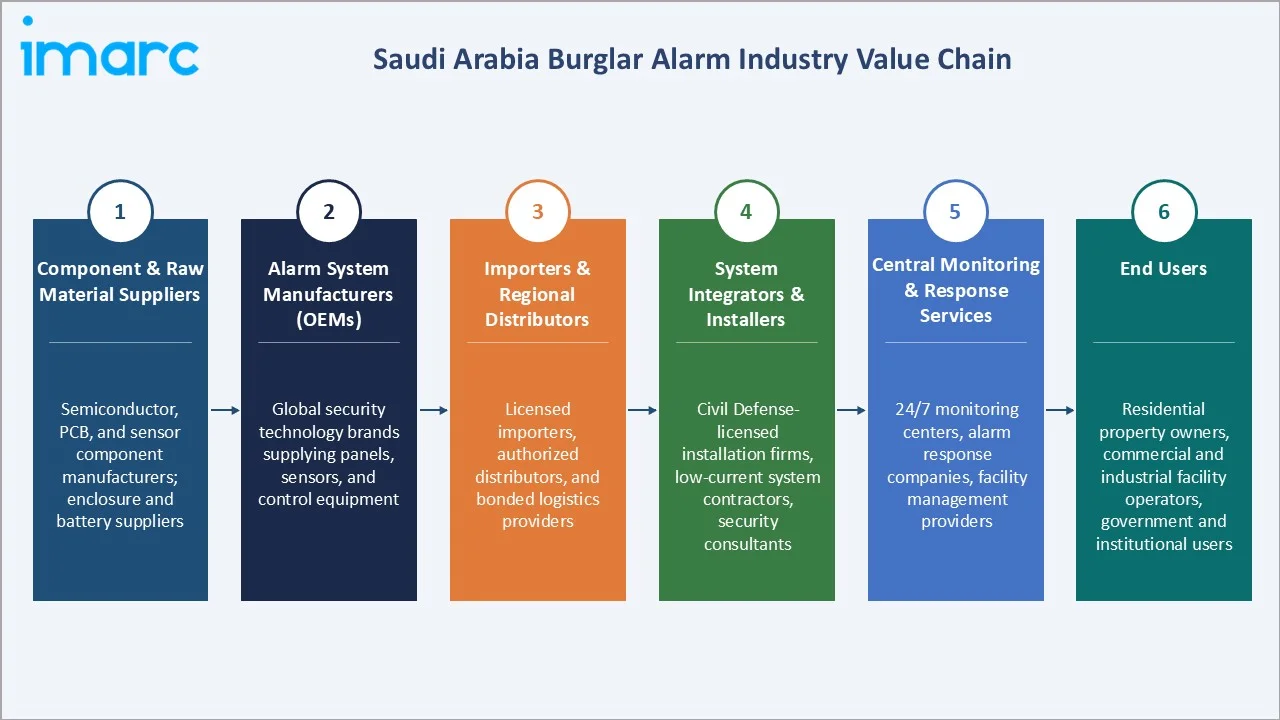
Saudi Arabia's burglar alarm value chain spans component and raw material sourcing, alarm system manufacturing by global OEMs, import and regional distribution, system integration and installation, and central monitoring and response services serving residential, commercial, and industrial end users. Civil Defense and SASO compliance requirements apply across the manufacturing, distribution, and installation stages, ensuring certified equipment and qualified personnel handle safety-critical intrusion detection deployments.
|
Stage |
Key Participants |
|
Component & Raw Material Suppliers |
Semiconductor, PCB, and sensor component manufacturers; enclosure and battery suppliers |
|
Alarm System Manufacturers (OEMs) |
Global security technology brands supplying panels, sensors, and control equipment |
|
Importers & Regional Distributors |
Licensed importers, authorized distributors, and bonded logistics providers |
|
System Integrators & Installers |
Civil Defense-licensed installation firms, low-current system contractors, security consultants |
|
Central Monitoring & Response Services |
24/7 monitoring centers, alarm response companies, facility management providers |
|
End Users |
Residential property owners, commercial and industrial facility operators, government and institutional users |
Distribution in Saudi Arabia typically follows a two-tier structure, with global manufacturers supplying licensed national distributors who in turn serve regional systems integrators and installation contractors. Import duties and SASO conformity assessment add lead time to hardware procurement, encouraging larger integrators to maintain local inventory. The emergence of cloud-native monitoring platforms is beginning to compress traditional monitoring center margins, as some manufacturers offer direct-to-consumer subscription monitoring alongside hardware sales.
Technology Landscape in the Saudi Arabia Burglar Alarm Industry
AI-Enabled Detection and Analytics
Modern intrusion panels increasingly embed on-device AI processing to differentiate between genuine threats and nuisance triggers, reducing false alarm dispatch rates that historically burdened monitoring centers and response services.
Wireless and PowerG Sensor Technology
Encrypted, two-way wireless sensor technology is displacing hardwired installations in retrofit projects, offering multi-channel frequency hopping and extended battery life suited to Saudi Arabia's climate and villa-style residential construction.
Cloud Connectivity and Mobile Applications
Cloud-hosted control panels enable remote arming, disarming, and event notification through mobile applications, supporting the shift toward subscription-based software revenue models among monitoring service providers.
Automation and Smart Building Integration
Intrusion detection systems are increasingly interoperable with access control, video surveillance, and building automation platforms, enabling unified security dashboards for commercial and institutional facility managers pursuing Vision 2030-aligned smart building certifications.
Market Segmentation Analysis
The report covers the following segments:
|
Segment Category |
Leading Segment |
Market Share |
Year |
|
Component |
Hardware |
61.4% |
2025 |
|
Application |
Commercial and Industrial |
71.4% |
2025 |
|
Region |
Northern & Central Region |
41.6% |
2025 |

By Component
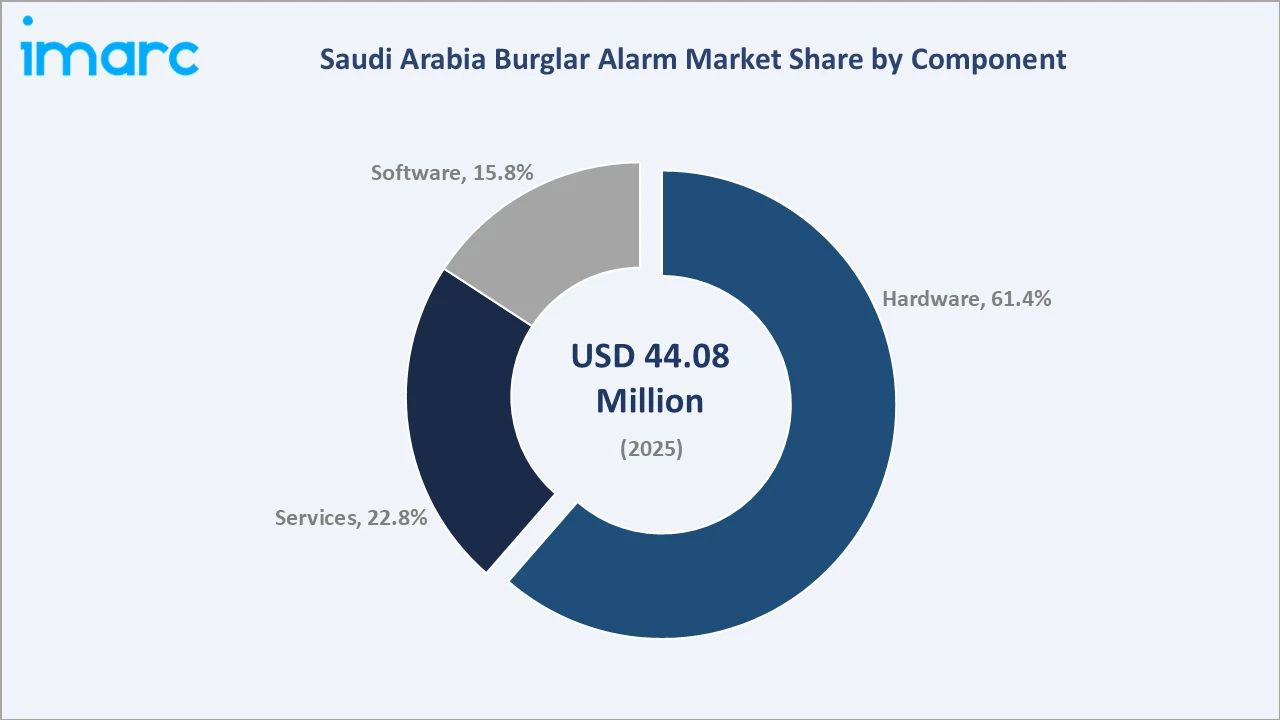
Hardware dominates at 61.4% market share (2025), encompassing alarm control panels, sensors, and monitoring receivers deployed across new-build and retrofit installations. Hardware demand is anchored by Civil Defense licensing requirements that mandate certified intrusion detection equipment for commercial and industrial facility approval, alongside expanding villa and apartment construction under Vision 2030 housing initiatives.
To access detailed market analysis, Request Sample
Services hold 22.8% share, reflecting growing preference for bundled installation, maintenance, and monitoring contracts over standalone hardware purchases. Software, while smallest at 15.8% share, is growing fastest at an estimated 13.2% CAGR (2026-2034) as cloud-based monitoring platforms and mobile alarm management applications gain adoption among both residential and commercial users seeking remote system control.
By Application
Commercial and industrial facilities account for 71.4% of application demand (2025), reflecting mandatory Civil Defense safety licensing requirements for offices, retail establishments, warehouses, and industrial plants. Large-format commercial and institutional properties typically require multi-zone intrusion detection systems with centralized monitoring, supporting higher average order values than residential installations.
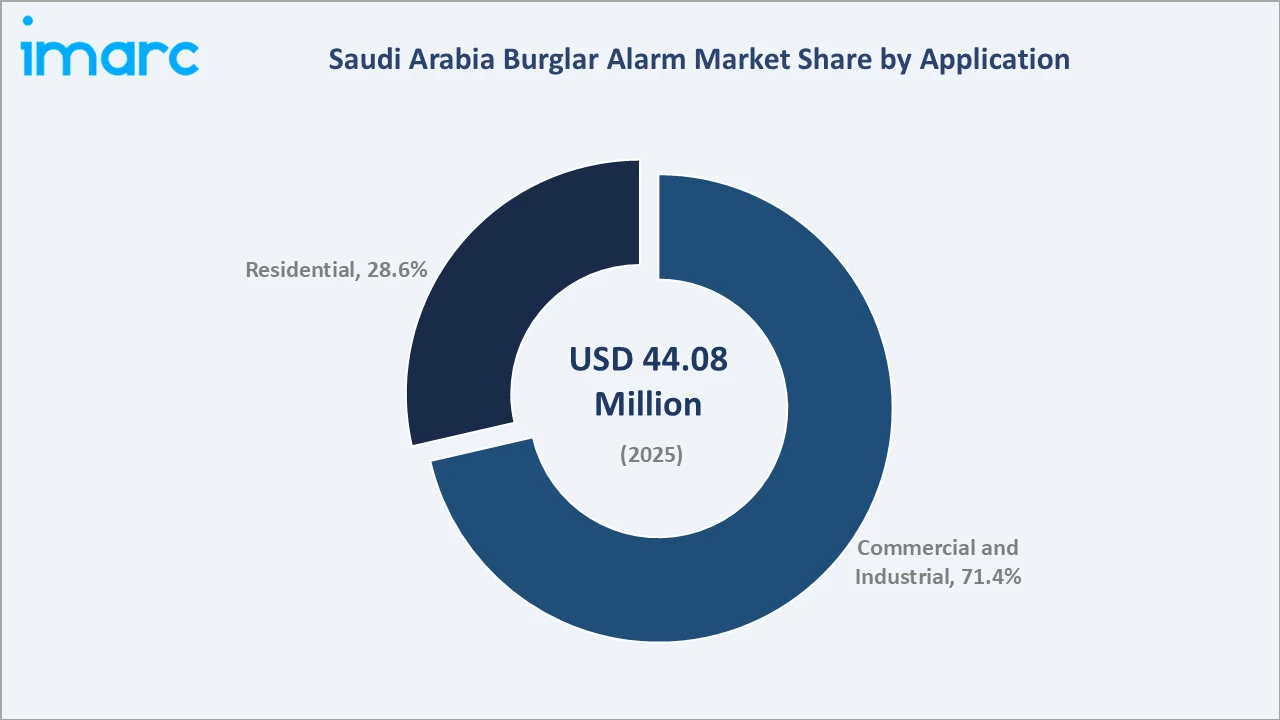
The residential segment holds 28.6% share, driven by rising villa and apartment construction under Vision 2030 housing initiatives and growing consumer awareness of wireless, professionally monitored home security systems. Residential demand is expected to accelerate as homeownership rates rise toward the government's 70% target by 2030, expanding the addressable base for cost-effective, easy-to-install wireless alarm systems.
Regional Market Insights
|
Region |
Share (2025) |
Key Growth Drivers & Characteristics |
|
Northern & Central Region |
41.6% |
Highest concentration of government buildings, corporate headquarters, and high-value residential compounds centered around Riyadh; strong Civil Defense enforcement and commercial construction activity |
|
Western Region |
27.1% |
Jeddah's commercial port and business district driving demand; Makkah and Madinah's hospitality and religious tourism infrastructure requiring certified security systems |
|
Eastern Region |
20.0% |
Concentration of industrial and petrochemical facilities around Dammam and Khobar generating institutional and industrial-grade intrusion detection demand |
|
Southern Region |
11.3% |
Emerging infrastructure and tourism development including Asir and Red Sea coastal projects supporting gradual residential and hospitality security adoption |
The Northern and Central Region's 41.6% dominance reflects Riyadh's status as the Kingdom's administrative and economic capital, hosting the highest density of government facilities, corporate headquarters, and premium residential compounds requiring certified intrusion detection systems. The region's strict enforcement of Civil Defense licensing standards for new commercial construction further reinforces its market lead.
The Western Region's 27.1% share is anchored by Jeddah's commercial and logistics activity as well as Makkah and Madinah's year-round pilgrimage-driven hospitality construction, which requires certified safety and security systems across hotels and residential towers. The Eastern Region's 20.0% share reflects Saudi Aramco's industrial and petrochemical facility density around Dammam and Khobar, generating sustained institutional-grade intrusion detection demand, while the Southern Region's 11.3% share is expanding on the back of Asir and Red Sea coastal tourism development.
Competitive Landscape
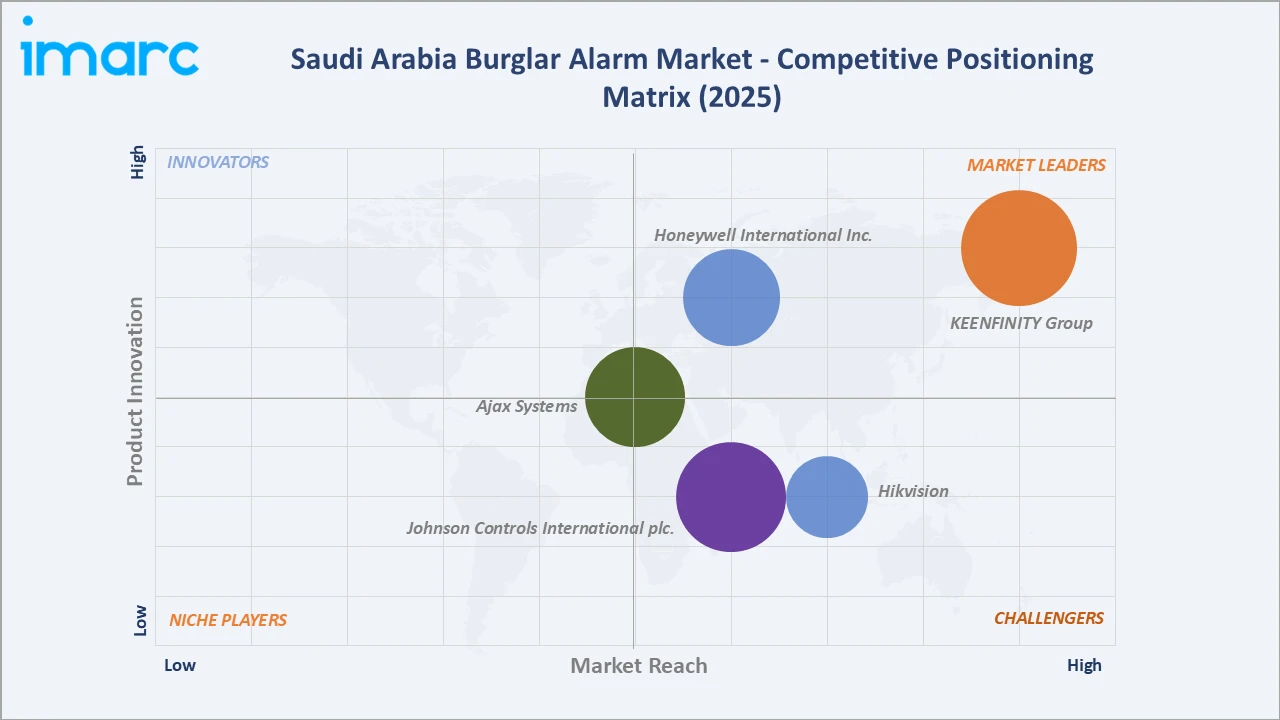
Saudi Arabia's burglar alarm market is moderately fragmented, with global security technology brands supplying hardware through licensed local distributors and systems integrators, while installation and monitoring services remain largely provided by Saudi-based contractors.
|
Company Name |
Brand / Product Line |
Market Position |
Core Strength |
|
KEENFINITY Group |
Radionix Intrusion Alarm Systems, Bosch Intrusion Alarm Panels, Security Detectors, Signaling Devices |
Market Leader |
Extensive Saudi distributor and systems integrator network; broad panel and sensor portfolio |
|
Honeywell International Inc. |
Galaxy Series |
Market Leader |
Global building technology leader with established Saudi dealer and channel partner network |
|
Hikvision |
AX PRO, AX Hybrid PRO Series |
Strong Challenger |
Rapidly expanding wireless and hybrid intrusion portfolio backed by strong regional distribution |
|
Johnson Controls International plc. |
PowerG wireless technology ecosystem, OpenBlue management platform |
Strong Challenger |
Long-standing presence via Johnson Controls Arabia; strong enterprise and banking-sector relationships |
|
Ajax Systems |
Hub 2, MotionProtect, Ajax Alarm Series |
Established Player |
Europe's prominent wireless security manufacturer; official Saudi distribution via City Systems |
The competitive landscape is bifurcated between established global brands serving enterprise, banking, and government clients through certified systems integrators, and newer wireless-first entrants such as Ajax Systems gaining share in the residential and small commercial segments. Distributors increasingly compete on installation speed, monitoring service bundling, and mobile app functionality rather than hardware pricing alone.
Key Company Profiles
KEENFINITY Group
KEENFINITY Group maintains one of the most extensive intrusion detection distribution networks in Saudi Arabia, serving the Kingdom through several certified premium and standard partners across Riyadh, Jeddah, and the Eastern Province. It operates Radionix and supplies selected Bosch-branded intrusion detectors, panels and access-control products under license.
- Product Portfolio: Radionix Intrusion Alarm Systems, Bosch Intrusion Alarm Panels, signaling devices, security detectors, and others.
- Strategic Focus: Deepening systems integrator partnerships for banking, government, and large commercial deployments.
Honeywell International Inc.
Honeywell's security division supplies intrusion detection hardware and building technology solutions across Saudi Arabia through an authorized dealer and channel partner network spanning commercial and residential segments.
- Product Portfolio: Galaxy Series, and others.
- Strategic Focus: Cross-selling intrusion detection alongside Honeywell's broader building automation and safety portfolio in commercial developments.
Market Concentration Analysis
Saudi Arabia's burglar alarm market exhibits moderate concentration at the premium hardware level, with KEENFINITY Group, Honeywell, and Hikvision collectively estimated to account for a significant share of certified commercial and institutional installations, while the residential and small commercial segments remain more fragmented among wireless-first entrants and regional integrators. No single brand holds a dominant share of total installed hardware, reflecting the market's reliance on systems integrators who often carry multiple brand lines to serve diverse client specifications.
Fragmentation is most pronounced at the installation and monitoring services level, where numerous Civil Defense-licensed low-current contractors compete on regional coverage and response times rather than brand exclusivity. Consolidation trends remain limited, though larger integrators are increasingly pursuing multi-brand distribution agreements to reduce reliance on any single manufacturer and to offer clients broader product choice across price tiers.
Investment & Growth Opportunities
Fastest Growing Segments
The software component (~13.2% CAGR), services segment (~10.5% CAGR), and the Northern & Central Region's continued commercial construction pipeline represent Saudi Arabia's highest-growth investment vectors through 2034. Cloud-based monitoring subscriptions offer the most attractive recurring-revenue opportunity given their asset-light delivery model.
Emerging Market Opportunities
Growing Vision 2030 investment in smart city infrastructure, including NEOM and Qiddiya, creates opportunities for integrated security technology providers to establish long-term facility management contracts spanning intrusion detection, access control, and video surveillance across newly constructed urban districts.
Investment Themes
- Cloud-Based Monitoring Platform Development: Saudi Arabia's rising smartphone penetration and consumer familiarity with app-based control create a compelling opportunity for software vendors offering subscription-based remote monitoring services.
- AI-Enabled False Alarm Reduction Technology: Investment in on-device analytics that reduce false alarm dispatch rates offers monitoring companies a path to lower operating costs and improved response prioritization.
- Residential Security Bundling with Smart Home Platforms: Combining intrusion detection with broader smart home automation offerings creates cross-selling opportunities as villa and apartment construction expands under Vision 2030 housing targets.
Future Market Outlook (2026-2034)
The Saudi Arabia burglar alarm market grew from USD 44.08 Million in 2025 to an estimated USD 48.45 Million in 2026 and is projected to reach USD 103.09 Million by 2034, at a 9.90% CAGR, reflecting sustained structural demand tied to Vision 2030's construction pipeline and rising security awareness. By 2030, market size is estimated to reach approximately USD 70.67 Million, with software and services outpacing hardware growth as monitoring platforms shift toward cloud-based, subscription-driven delivery models.
Three structural forces are expected to anchor growth through 2034: continued Civil Defense licensing enforcement across new commercial and industrial construction, rising residential adoption driven by Vision 2030 homeownership targets, and the ongoing shift toward AI-enabled, professionally monitored systems as consumer and institutional buyers prioritize verified response over standalone alarm hardware.
Research Methodology
Primary Research
Primary research comprised structured interviews with industry stakeholders including Civil Defense-licensed systems integrators, regional hardware distributors, monitoring center operators, and commercial facility security managers across Riyadh, Jeddah, and the Eastern Province.
Secondary Research
Secondary research encompassed General Directorate of Civil Defense licensing and regulatory publications, General Authority for Statistics (GASTAT) construction cost index and gross fixed capital formation data, Saudi Standards, Metrology and Quality Organization (SASO) product conformity records, Vision 2030 housing and infrastructure documentation, and company disclosures from major intrusion detection hardware manufacturers.
Forecasting Models
Market forecasts were developed using a component-level bottom-up model incorporating construction pipeline growth, Civil Defense licensing volumes, and residential security adoption rates, validated against historical component share data for 2020-2025 and cross-checked against regional GDP and non-oil economic growth projections.
Saudi Arabia Burglar Alarm Market Report Coverage:
| Report Features | Details |
|---|---|
| Base Year of the Analysis | 2025 |
| Historical Period | 2020-2025 |
| Forecast Period | 2026-2034 |
| Units | Million USD |
| Scope of the Report |
Exploration of Historical Trends and Market Outlook, Industry Catalysts and Challenges, Segment-Wise Historical and Future Market Assessment:
|
| Components Covered |
|
| Applications Covered | Commercial and Industrial, Residential |
| Regions Covered | Northern and Central Region, Western Region, Eastern Region, Southern Region |
| Companies Covered | KEENFINITY Group, Honeywell International Inc., Hikvision, Johnson Controls International plc., Ajax Systems, etc. |
| Customization Scope | 10% Free Customization |
| Post-Sale Analyst Support | 10-12 Weeks |
| Delivery Format | PDF and Excel through Email (We can also provide the editable version of the report in PPT/Word format on special request) |
Key Benefits for Stakeholders:
- IMARC’s industry report offers a comprehensive quantitative analysis of various market segments, historical and current market trends, market forecasts, and dynamics of the Saudi Arabia burglar alarm market from 2020-2034.
- The research report provides the latest information on the market drivers, challenges, and opportunities in the Saudi Arabia burglar alarm market.
- Porter's five forces analysis assist stakeholders in assessing the impact of new entrants, competitive rivalry, supplier power, buyer power, and the threat of substitution. It helps stakeholders to analyze the level of competition within the Saudi Arabia burglar alarm industry and its attractiveness.
- Competitive landscape allows stakeholders to understand their competitive environment and provides an insight into the current positions of key players in the market.
Frequently Asked Questions About the Saudi Arabia Burglar Alarm Market Report
The Saudi Arabia burglar alarm market size is estimated at USD 48.45 Million in 2026, driven by Vision 2030 construction activity, mandatory Civil Defense safety licensing, and rising residential security adoption across the Kingdom.
The market is projected to grow at a CAGR of 9.90% during 2026-2034, reaching USD 103.09 Million by 2034, supported by construction growth, smart home adoption, and expanding monitoring services.
Hardware leads with 61.4% share (2025), encompassing alarm panels, sensors, and monitoring receivers, driven by mandatory installation requirements under Civil Defense safety licensing for new commercial and industrial facilities.
Software is the fastest-growing component at an estimated 13.2% CAGR (2026-2034), driven by rising adoption of cloud-based monitoring platforms and mobile application-based alarm management among residential and commercial users.
Commercial and Industrial facilities lead with 71.4% share (2025), driven by mandatory Civil Defense safety licensing requirements for new commercial, retail, and industrial developments, ahead of the Residential segment's 28.6% share.
The Northern and Central Region leads with 41.6% share (2025), anchored by Riyadh's concentration of government facilities, corporate headquarters, and premium residential compounds requiring certified intrusion detection systems.
Leading companies include KEENFINITY Group, Honeywell International Inc., Hikvision, Johnson Controls International plc., and Ajax Systems, among others, serving the Kingdom through licensed distributors and systems integrators.
Vision 2030 drives demand through giga-project construction, rising homeownership targets, and mandatory Civil Defense licensing for new commercial facilities, creating sustained structural demand for certified intrusion detection systems.
The market is projected to reach approximately USD 70.67 Million by 2030, supported by continued construction activity, rising residential adoption, and accelerating growth in software and monitoring services.
The General Directorate of Civil Defense oversees safety licensing requirements, while the Saudi Standards, Metrology and Quality Organization (SASO) sets product conformity and quality standards for security equipment.
Need more help?
- Speak to our experienced analysts for insights on the current market scenarios.
- Include additional segments and countries to customize the report as per your requirement.
- Gain an unparalleled competitive advantage in your domain by understanding how to utilize the report and positively impacting your operations and revenue.
- For further assistance, please connect with our analysts.
 Request Customization
 Speak to an Analyst
 Request Brochure
 Inquire Before Buying
Benefits of Customization
- Personalize this research
- Triangulate with your data
- Get data as per your format and definition
- Gain a deeper dive into a specific application, geography, customer, or competitor
- Any level of personalization
Get in Touch With Us
UNITED STATES
Phone: +1-201-971-6302
INDIA
Phone: +91-120-433-0800
UNITED KINGDOM
Phone: +44-753-714-6104
Email: [email protected]
Client Testimonials




.webp)




.webp)













Related Reports

Choose your plan
*Please note that the prices mentioned below are starting prices for each bundle type. Kindly contact our team for further details.*
Single User License
- 1 User License, Access on 2 Devices
- PDF Report + Excel Dataset (Password Protected)
- Lifetime Access
- No Printing Rights
- 10% Free Report Customization
- 10–12 Weeks of Analyst Support
Five User License
- Access for 5 Users, 2 Devices per User
- PDF Report + Excel Dataset (Password Protected)
- Lifetime Access
- Dedicated Account Manager
- 12–14 Weeks of Analyst Support
- No Printing Rights
- 15% Free Report Customization
- 25% Discount on Your Next Purchase
Corporate User License
- Unlimited User Access (Within Your Organization)
- PDF Report + Excel Dataset
- Lifetime Access
- Dedicated Account Manager
- 14–20 Weeks of Analyst Support
- No Printing Rights
- 20% Free Report Customization
- 30% Discount on Your Next Purchase
Essential Insights
What's included:
3 reports
- Lifetime Access
- PDF Reports
- Excel Datasets
- 2 Weeks of Free Analyst Support
- 2 User Licenses
- Access on 2 Devices
- Printing Rights
- Complimentary PowerPoint (PPT) Version
- Complimentary License Upgrade
Professional Access
What's included:
5 reports
- Lifetime Access
- PDF Reports
- Excel Datasets
- 8 Weeks of Free Analyst Support
- 2 User Licenses
- Access on 2 Devices
- Printing Rights
- Complimentary PowerPoint (PPT) Version
- Complimentary License Upgrade
Business Advantage
What's included:
8 reports
- Lifetime Access
- PDF Reports
- Excel Datasets
- 14 Weeks of Free Analyst Support
- 2 User Licenses
- Access on 2 Devices
- Printing Rights
- Complimentary PowerPoint (PPT) Version
- Complimentary License Upgrade
Enterprise Intelligence
What's included:
10 reports
- Lifetime Access
- PDF Reports
- Excel Datasets
- 20 Weeks of Free Analyst Support
- 2 User Licenses
- Access on 2 Devices
- Printing Rights
- Complimentary PowerPoint (PPT) Version
- Complimentary License Upgrade