
Saudi Arabia Business Travel Market Size, Share, Trends and Forecast by Type, Purpose Type, Expenditure, Age Group, Service Type, Travel Type, End User, and Region, 2026-2034
Saudi Arabia Business Travel Market Size, Share, Trends & Forecast (2026-2034)
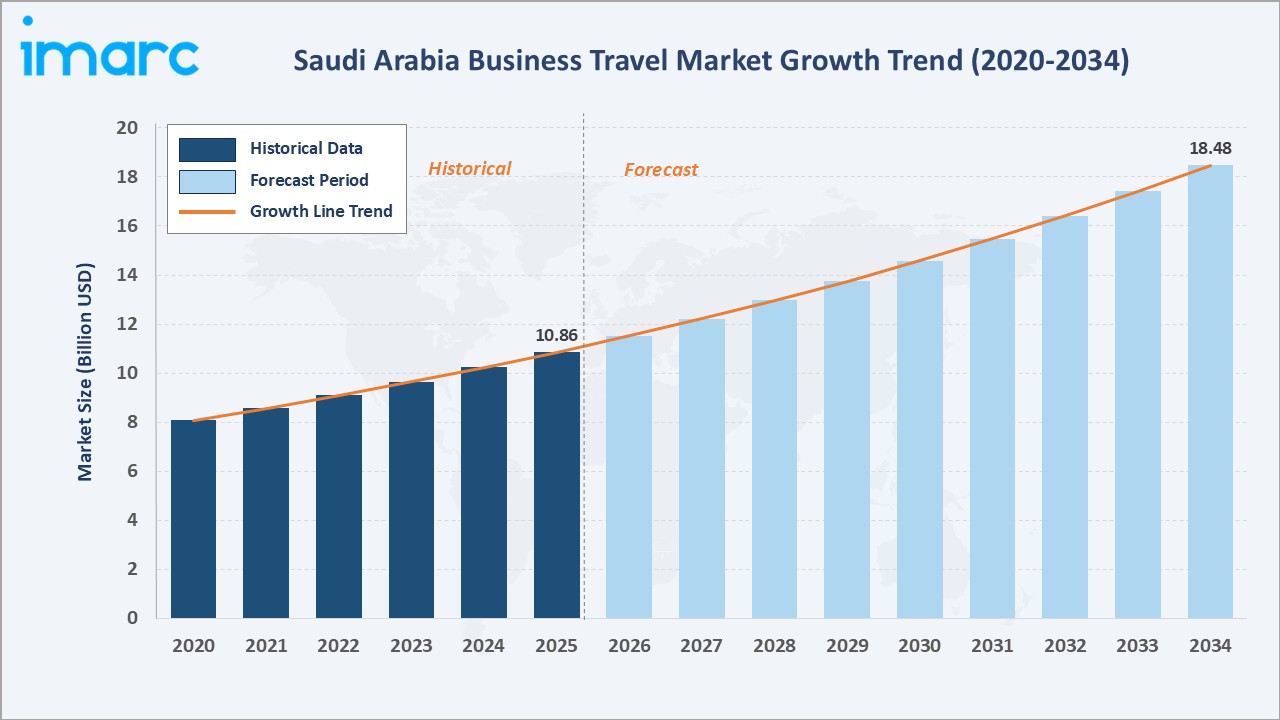
The Saudi Arabia business travel market grew from USD 10.86 Billion in 2025 to USD 11.52 Billion in 2026 and is projected to reach USD 18.48 Billion by 2034, growing at a CAGR of 6.08% during 2026-2034. The market is driven by Vision 2030-led economic diversification, rising foreign direct investment, and a rapidly expanding MICE sector. Managed business travel holds the dominant share at 58.0%, internal meetings lead purpose type at 30.0%, while the Northern and Central region leads regionally at 48.2%, anchored by Riyadh's status as the Kingdom's commercial and administrative hub.
Market Snapshot
|
Metric |
Value |
|
Base Year Market Size (2025) |
USD 10.86 Billion |
|
Market Size (2026) |
USD 11.52 Billion |
|
Forecast Market Size (2034) |
USD 18.48 Billion |
|
CAGR (2026-2034) |
6.08% |
|
Base Year |
2025 |
|
Forecast Period |
2026-2034 |
|
Historical Period |
2020-2025 |
|
Dominant Type |
Managed Business Travel – 58.0% |
|
Dominant Purpose Type |
Internal Meetings – 30.0% |
|
Largest Region |
Northern and Central Region – 48.2% |
The Saudi Arabia business travel market grew from USD 8.09 Billion in 2020 to USD 10.86 Billion in 2025, and further to USD 11.52 Billion in 2026, before reaching USD 18.48 Billion by 2034. The market is primarily driven by Vision 2030 economic diversification initiatives, expanding MICE infrastructure, and rising FDI inflows that necessitate inter-city and cross-border corporate mobility.
To get more information on this market, Request Sample
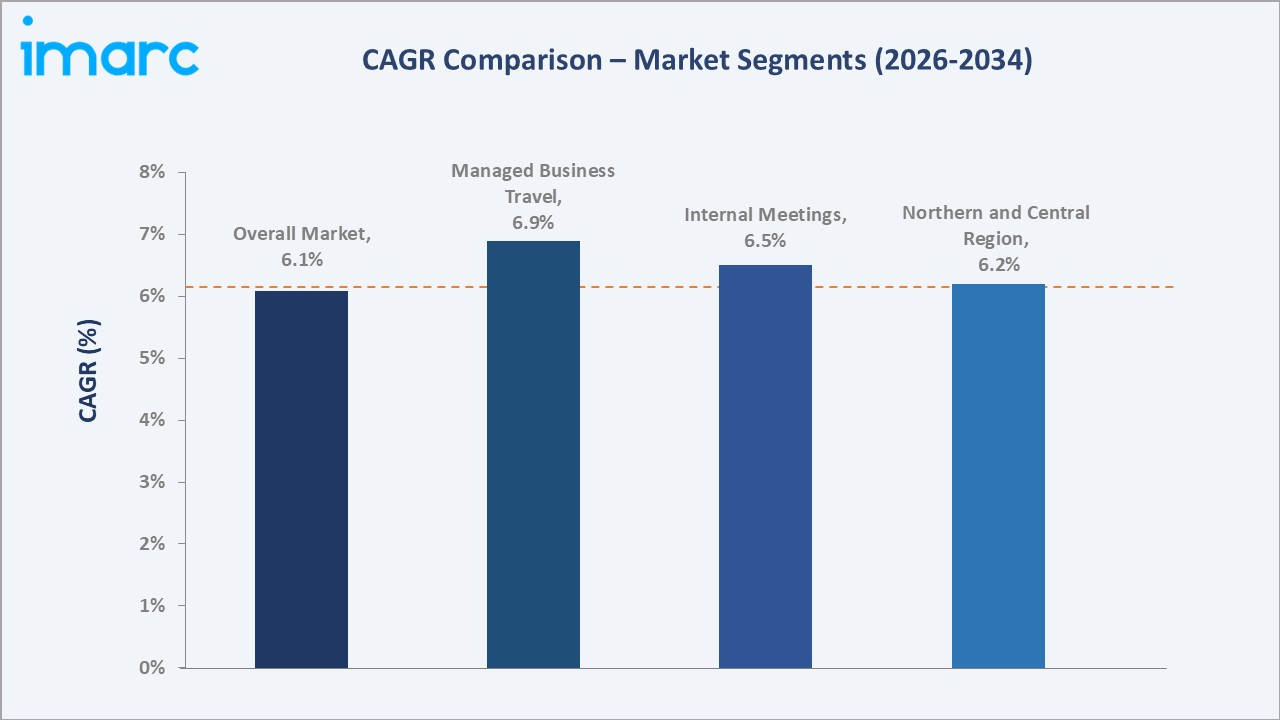
Managed business travel grows at approximately 6.9% CAGR as corporations expand digital travel management platforms and policy-compliant booking tools, maintaining its majority throughout the forecast horizon. Internal meetings represent the largest purpose-type segment at 30.0% in 2025, driven by the rising frequency of cross-functional collaboration across Saudi Arabia's expanding corporate sector.
Executive Summary
The Saudi Arabia business travel market is on a consistent upward trajectory, underpinned by Vision 2030's economic transformation agenda and robust growth in foreign direct investment. Saudi Arabia's FDI inflows increased 33% to SAR 159.1 billion in 2025, up from SAR 119.2 billion in 2024, according to GASTAT, directly translating into elevated corporate mobility requirements across sectors including energy, finance, and technology.
Managed business travel dominates at 58.0% in 2025, reflecting corporate preference for cost-controlled, policy-compliant travel programs. Internal meetings represent the leading purpose type at 30.0%, followed by marketing activities at 24.0% and trade shows at 20.0%. The Northern and Central region accounts for 48.2% of market revenue, anchored by Riyadh's dual role as the Kingdom's administrative capital and primary commercial hub.
Key Market Insights
|
Insight |
Data |
|
Dominant Type |
Managed Business Travel – 58.0% share (2025) |
|
Dominant Purpose Type |
Internal Meetings – 30.0% share (2025) |
|
Leading Region |
Northern and Central Region – 48.2% share (2025) |
|
Key Market Opportunity |
Expansion of MICE infrastructure and regional HQ programs under Vision 2030. |
Key Analytical Observations Supporting the Above Data:
- Managed Business Travel at 58.0%: Managed travel dominates because Saudi corporations and multinationals operating in the Kingdom increasingly mandate travel management companies (TMCs) to control costs, enforce policy compliance, and ensure duty-of-care standards for employees.
- Internal Meetings at 30.0%: Internal meetings lead purpose-type segmentation as Saudi Arabia's expanding corporate sector, particularly in banking, energy, and technology, requires frequent inter-departmental and inter-city coordination. The rise of regional headquarters in Riyadh has amplified cross-border internal travel.
- Northern and Central Region at 48.2%: Regional leadership reflects Riyadh's position as the Kingdom's financial, governmental, and commercial epicenter. Riyadh hosts the majority of Saudi Arabia's corporate headquarters, government ministries, and international business delegations, sustaining consistently high travel volumes.
Saudi Arabia Business Travel Market Overview
The Saudi Arabia business travel market encompasses the full spectrum of corporate-purpose travel services, including managed travel programs, unmanaged individual bookings, MICE event facilitation, and associated hospitality services. The market operates across a broad ecosystem spanning corporate clients, travel management companies (TMCs), airlines, accommodation providers, technology platforms, and government entities.
The market serves diverse end-use segments, including government entities, private-sector corporations, SMEs, and multinational subsidiaries operating across Saudi Arabia's major economic zones. Vision 2030's economic transformation is redefining the demand landscape by attracting new industries, expanding the corporate workforce, and diversifying travel purposes beyond traditional oil-sector business.
Market Dynamics
To evaluate market opportunities, Request Sample
Market Drivers
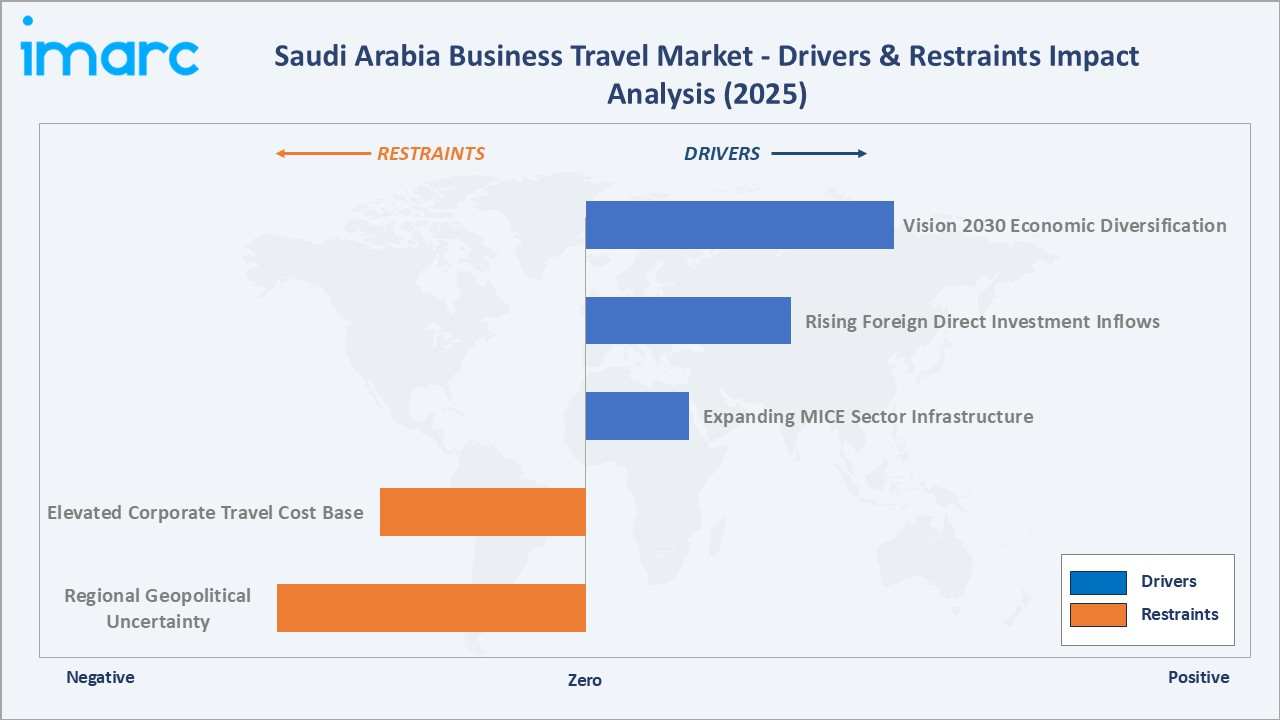
- Vision 2030 Economic Diversification: Saudi Arabia is diversifying its economy, with non-oil GDP rising from 47% to 51%, non-oil exports reaching USD 82 billion, and a target to increase the private sector's GDP contribution to 65%, diversifying the economy beyond hydrocarbons, creating new industries and expanding corporate activity that directly drives business travel demand across all segments.
- Rising Foreign Direct Investment Inflows: Saudi Arabia's FDI inflows grew 33% to SAR 159.1 billion in 2025, up from SAR 119.2 billion in 2024, with capital flowing into energy transition, construction, and technology sectors, each requiring sustained cross-border business travel for investment management, project oversight, and stakeholder engagement.
- Expanding MICE Sector Infrastructure: Saudi Arabia has invested significantly in MICE venues, international exhibition centers, and business event hosting capacity, with Riyadh emerging as one of the top MICE destinations. The MICE sector directly generates trade show and product launch travel demand.
Market Restraints
- Elevated Corporate Travel Cost Base: Business travel in Saudi Arabia carries a premium cost structure relative to comparable markets, reflecting limited airline competition on key routes, high-tier hotel pricing in major business districts, and rigid corporate accommodation standards that constrain travel budget optimization.
- Regional Geopolitical Uncertainty: Broader geopolitical dynamics across the Middle East and North Africa region periodically influence corporate travel risk assessments, leading some multinationals to impose precautionary travel restrictions that temporarily dampen inbound business travel volumes.
Market Opportunities
- NEOM and Giga-Project Business Travel: Saudi Arabia's network of Giga-Projects, including NEOM, the Red Sea Project, Qiddiya, and Diriyah Gate, is generating sustained long-term demand for project-related business travel, covering construction management, technology integration, and international consultant engagement spanning 2026–2034.
- Digital Travel Management Platform Adoption: The transition from manual to AI-powered travel booking and expense management platforms presents a substantial opportunity for TMCs and technology providers to capture market share among Saudi corporations and government entities seeking cost visibility and traveler compliance tools.
Market Challenges
- Policy Compliance and Traveler Adoption: Enforcing consistent travel policy compliance across diverse workforce populations, particularly as remote-work norms and digital booking tools expand individual traveler autonomy, represents an ongoing challenge for corporate travel managers and TMC service providers.
- Data Integration Across Travel Ecosystems: The fragmentation of travel data across airlines, hotels, TMCs, and expense management platforms creates significant reporting and analytics challenges for corporate travel programs seeking consolidated visibility into total travel spend and traveler behavior patterns.
Emerging Market Trends
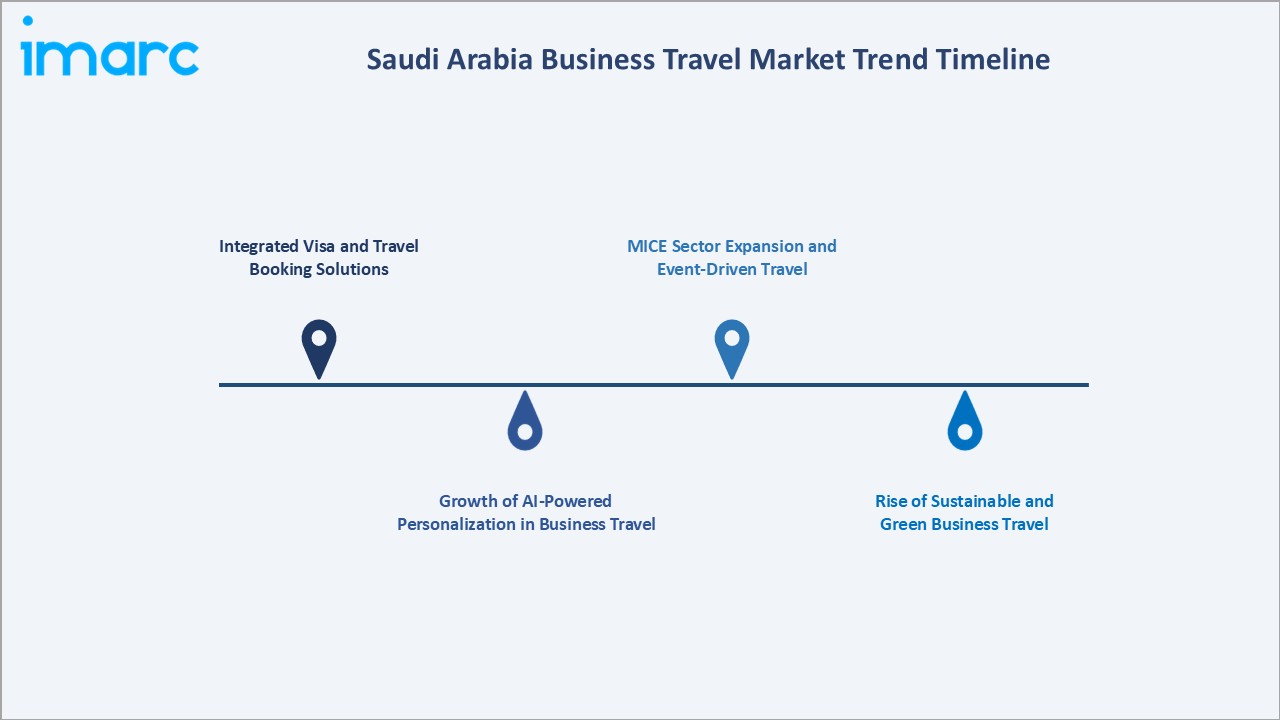
1. Integrated Visa and Travel Booking Solutions
In July 2026, Saudi Arabia launched a pilot Package Visa program that integrates tourist visa applications with flight and hotel bookings through approved travel providers, simplifying entry procedures and enhancing convenience for international visitors. Saudi Arabia's Package Visa initiative is streamlining business travel by integrating visa applications, flights, and accommodation into a single booking process.
2. Growth of AI-Powered Personalization in Business Travel
Artificial intelligence is transforming business travel booking by enabling hyper-personalized itinerary recommendations, dynamic pricing optimization, and predictive disruption management. AI-powered tools are improving on-trip experience metrics in early adopter organizations.
3. MICE Sector Expansion and Event-Driven Travel
Saudi Arabia's strategic hosting of global events is positioning the Kingdom as a Tier-1 MICE destination. Event-driven travel now represents a structurally growing component of total business travel volume.
4. Rise of Sustainable and Green Business Travel
Environmental sustainability is increasingly embedded in corporate travel policies across Saudi Arabia as global ESG mandates filter through multinational supply chains. Green-certified accommodation, carbon offset programs, and sustainable aviation fuel commitments are becoming standard components of managed travel programs.
Industry Value Chain Analysis
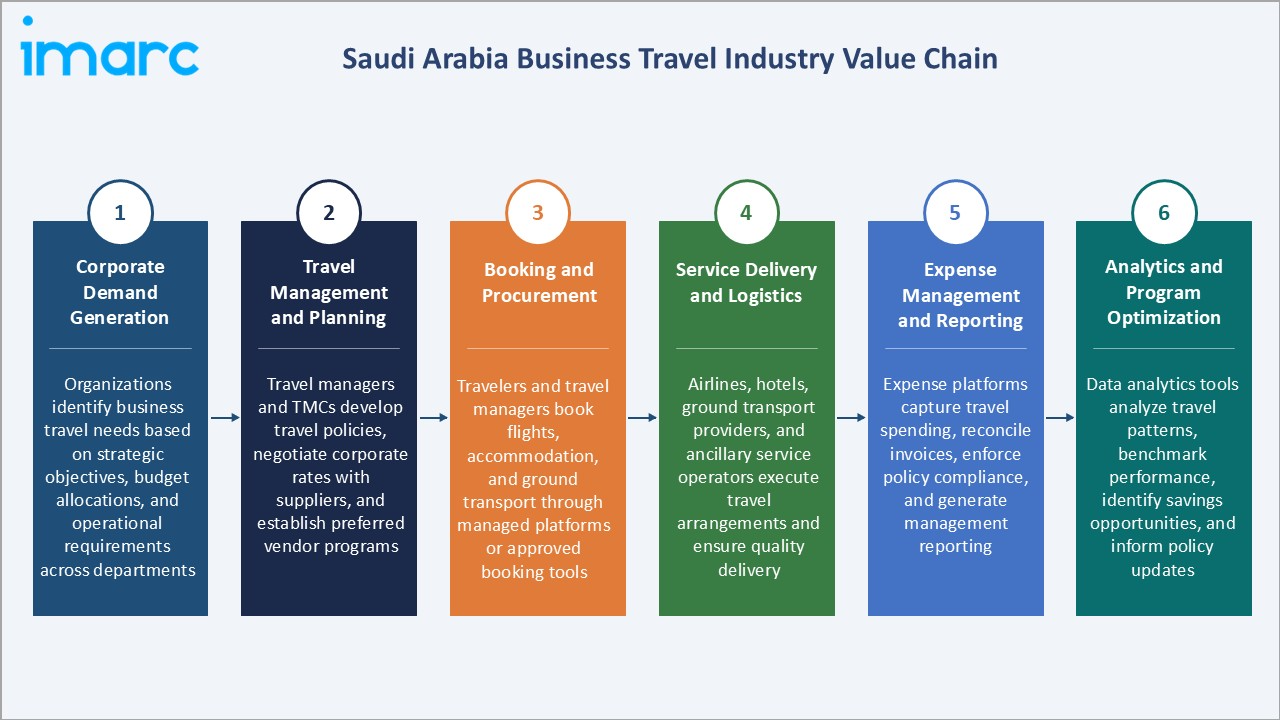
The Saudi Arabia business travel value chain encompasses six integrated stages, from initial corporate demand generation through final analytics and program optimization. Each stage adds incremental value through specialized services, technology platforms, and industry expertise.
|
Stage |
Key Activities |
| Corporate Demand Generation | Organizations identify business travel needs based on strategic objectives, budget allocations, and operational requirements across departments. |
| Travel Management and Planning | Travel managers and TMCs develop travel policies, negotiate corporate rates with suppliers, and establish preferred vendor programs. |
| Booking and Procurement | Travelers and travel managers book flights, accommodation, and ground transport through managed platforms or approved booking tools. |
| Service Delivery and Logistics | Airlines, hotels, ground transport providers, and ancillary service operators execute travel arrangements and ensure quality delivery. |
| Expense Management and Reporting | Expense platforms capture travel spending, reconcile invoices, enforce policy compliance, and generate management reporting. |
| Analytics and Program Optimization | Data analytics tools analyze travel patterns, benchmark performance, identify savings opportunities, and inform policy updates. |
The booking and procurement stage represents the highest strategic significance in the value chain, as it directly determines cost efficiency, policy compliance rates, and traveler experience outcomes. Platforms operating at this stage command the greatest influence over total travel program economics.
Technology Landscape in the Saudi Arabia Business Travel Industry
AI-Powered Travel Management Platforms
Artificial intelligence is fundamentally transforming travel booking, expense management, and policy enforcement across Saudi Arabia's corporate travel ecosystem. AI algorithms optimize itinerary selection, predict pricing windows, and automate expense categorization, reducing manual processing costs in digitally advanced travel programs.
Mobile-First Traveler Applications
Mobile travel management applications are becoming the primary interface for business travelers in Saudi Arabia, enabling real-time itinerary updates, digital boarding passes, hotel check-in, and emergency travel support. Mobile-first platforms report higher traveler compliance rates compared to desktop-only booking tools.
Data Analytics and Spend Intelligence
Advanced travel spend analytics platforms are enabling Saudi corporations to achieve cost reductions through supplier consolidation, preferred vendor utilization, and policy compliance optimization. Real-time dashboards provide travel managers with actionable insights across the entire corporate travel portfolio.
Contactless and Digital Payment Integration
The integration of digital payment solutions, including virtual corporate cards, automated invoice reconciliation, and cross-border payment platforms, is streamlining travel expense management across Saudi Arabia's multinational corporate community, reducing settlement cycles from weeks to days.
Market Segmentation Analysis
The report covers the following segments:
|
Segment Category |
Leading Segment |
Market Share |
Year |
|
Type |
Managed Business Travel |
58.0% |
2025 |
|
Purpose Type |
Internal Meetings |
30.0% |
2025 |
|
Expenditure |
🔒 |
🔒 |
2025 |
|
Age Group |
🔒 |
🔒 |
2025 |
|
Service Type |
🔒 |
🔒 |
2025 |
|
Travel Type |
🔒 |
🔒 |
2025 |
|
End User |
🔒 |
🔒 |
2025 |
|
Region |
Northern and Central Region |
48.2% |
2025 |
.webp)
By Type
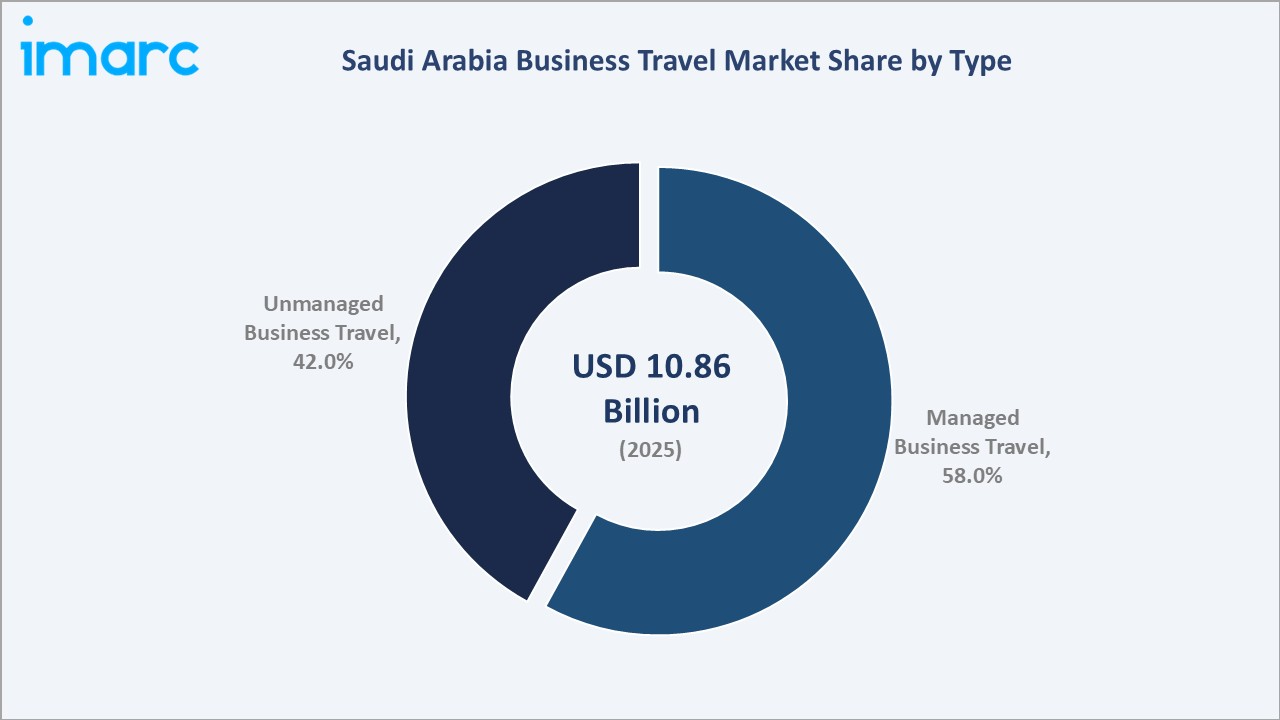
Managed business travel leads at 58.0% in 2025, reflecting the strong preference among Saudi corporations and government entities for structured travel programs administered by professional TMCs. Managed programs deliver cost savings versus unmanaged alternatives through negotiated supplier rates, policy enforcement, and consolidated invoices.
To access detailed market analysis, Request Sample
Unmanaged business travel at 42.0% represents the SME and individual traveler segment, where direct booking through online platforms and consumer travel apps remains prevalent. This segment is gradually transitioning toward managed models as digital TMC platforms lower the complexity and cost of professional travel management for smaller organizations.
By Purpose Type
Internal meetings represent the dominant purpose type at 30.0% in 2025, driven by the operational requirements of Saudi Arabia's expanding corporate sector, where distributed organizational structures and cross-functional project teams necessitate frequent inter-city and cross-border collaboration.
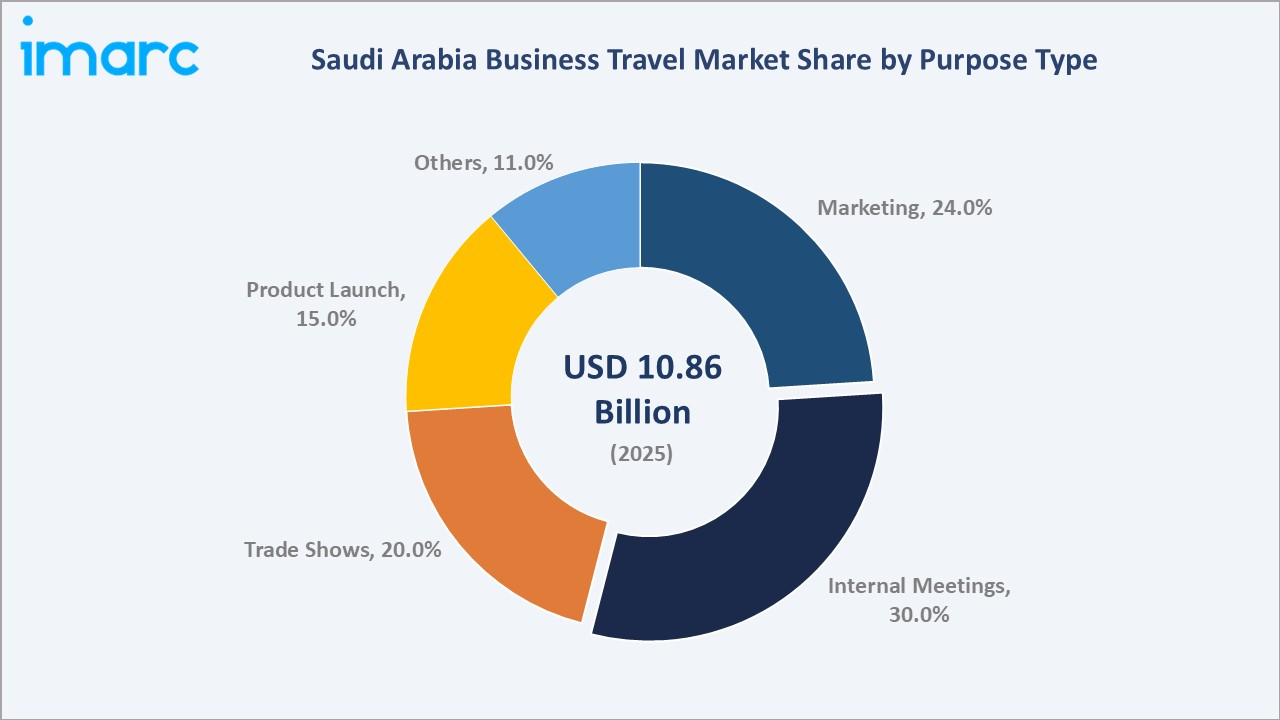
Marketing travel at 24.0% encompasses client meetings, sales calls, and brand development activities that underpin Saudi Arabia's expanding private sector. Trade shows at 20.0% reflect the Kingdom's growing role as a regional exhibition hub, while product launches at 15.0% are increasing as global technology and consumer brands enter the Saudi market through dedicated launch events and others segment accounts for 11.0%.
Regional Market Insights
|
Region |
Share (2025) |
Key Characteristics |
|
Northern and Central Region |
48.2% |
Primary commercial and administrative hub of the Kingdom, with a high concentration of corporate activity. |
|
Western Region |
23.5% |
Anchored by Jeddah as a leading commercial and logistics center with strong trade connectivity. |
|
Eastern Region |
18.1% |
Energy sector-dominated travel demand centered on Dammam and Al Khobar business corridors. |
|
Southern Region |
10.2% |
Emerging growth market benefiting from regional development programs and infrastructure investment. |
The Northern and Central region accounted for 48.2% of total market revenue in 2025, driven by Riyadh's unparalleled concentration of corporate headquarters, government ministries, and international business delegations. The region hosts the majority of Saudi Arabia's Vision 2030 program management offices, sustaining high volumes of internal meeting and stakeholder travel.
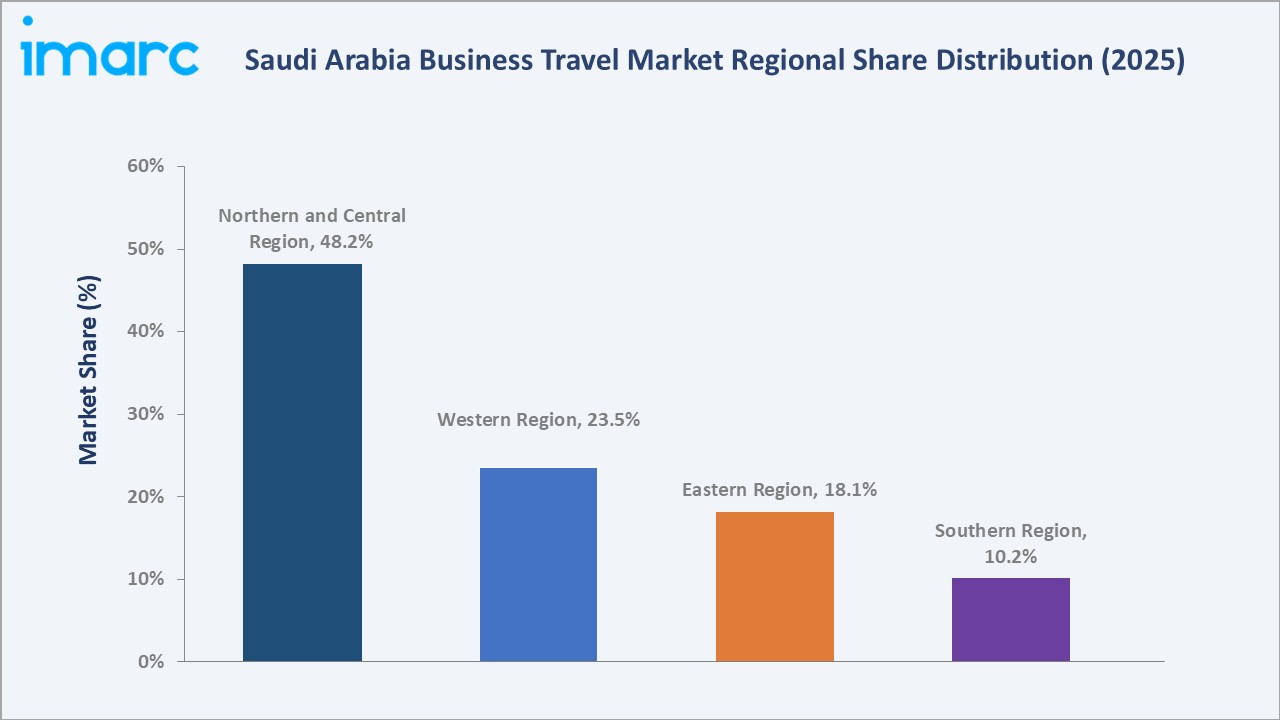
The Western region holds 23.5%, anchored by Jeddah's role as the Kingdom's second-largest commercial center and a major trade and logistics hub with strong connectivity to international markets. The Eastern region at 18.1% is driven by the energy sector's travel requirements, centered on Dammam, Dhahran, and Al Khobar. The Southern region, at 10.2%, represents the fastest-growing sub-market, benefiting from regional development initiatives.
Competitive Landscape
The Saudi Arabia business travel market is moderately concentrated among global TMC leaders. The market is simultaneously fragmented in the unmanaged and SME segments, where regional and local providers compete on price and local knowledge.
| Company | Key Offerings | Market Position | Core Strength |
|---|---|---|---|
| BCD Group | Business Travel Management, Business Travel Consulting, Corporate Travel Service | Market Leader | BCD Group (operating as BCD Travel Saudi Arabia) delivers corporate travel management, cost control, and strategic program solutions. |
| Zahid Group | GoZahid Business Travel | Established Player | The Zahid Group operates in Saudi Arabia's business travel sector through its wholly owned subsidiary, Zahid Travel, via its specialized corporate division, GoZahid Business Travel. |
| FlyAkeed | Corporate Travel | Established Player | FlyAkeed is a corporate travel-tech and SaaS platform that acts as a unified operating system for business and government travel management in Saudi Arabia. |
| Seera Group | Corporate and Government Travel | Innovator | Seera consolidated its corporate, government, and consumer travel operations under its flagship brand Almosafer to form the Middle East's largest travel business. |
Competition is intensifying as global TMCs expand Saudi Arabia-specific service teams, Arabic-language platform capabilities, and Vision 2030-aligned service offerings. Local players are gaining market share by combining regional expertise with technology-driven booking platforms targeting the unmanaged segment.
Key Company Profiles
BCD Group
BCD Group is a travel services company. Through its subsidiary BCD Travel, the company provides corporate travel management, flight and hotel reservations, travel expense management, and traveler support services. In Saudi Arabia, BCD Travel serves corporate clients through its Riyadh operations, offering technology-driven travel solutions, cost optimization, and business travel management services.
- Key Offerings: Business Travel Management, Business Travel Consulting, Corporate Travel Service.
- Strategic Focus: Strengthening its corporate travel management capabilities in Saudi Arabia through technology-driven booking solutions, travel cost optimization, and enhanced traveler safety and support.
Zahid Group
Zahid Group is a Saudi Arabia-based diversified business conglomerate that operates across several sectors, including travel and tourism, construction, commercial vehicles, energy, manufacturing, and logistics. Through its wholly owned subsidiary, Zahid Travel Group, it provides corporate travel management, business travel, tourism, and destination management services across Saudi Arabia.
- Key Offerings: GoZahid Business Travel.
- Strategic Focus: Strengthening its presence in Saudi Arabia's business travel market through its subsidiary, Zahid Travel Group, by offering integrated corporate travel management, digital booking solutions, and customized travel services.
Market Concentration Analysis
The Saudi Arabia business travel market exhibits moderate concentration in the managed travel segment, where leading global travel management companies hold the majority of corporate travel program contracts. The unmanaged segment and SME-focused market remain highly fragmented, with numerous regional and local providers competing across different service tiers and customer categories.
Market consolidation trends are emerging as technology-driven mergers and acquisitions reshape competitive dynamics across the managed travel landscape. Smaller regional providers are facing increasing pressure from digitally advanced global platforms, accelerating consolidation and partnership formation across the Saudi Arabia corporate travel ecosystem.
Investment & Growth Opportunities
Highest Growth Segments
Managed business travel at 58.0% represents the largest and most consistently growing demand segment, sustained by increasing corporate formalization of travel programs and rising demand for TMC-administered cost management services.
Investment Themes
- Corporate Travel Technology Platforms: AI-powered booking tools, expense management platforms, and travel data analytics solutions are attracting significant venture capital interest in the Saudi market, with regional startups demonstrating the viability of locally tailored B2B travel technology.
- MICE Infrastructure and Event Management: Saudi Arabia's ambitious MICE sector expansion, including new convention centers, hotel capacity, and international event hosting, represents a multi-billion-dollar investment opportunity for hospitality, logistics, and event management service providers through 2034.
- Sustainable Travel Program Development: ESG-aligned corporate travel programs, including carbon offset platforms, sustainable aviation fuel supply chains, and green hotel certification networks, are emerging as a high-value service niche as Saudi corporations increasingly adopt international sustainability reporting standards.
Future Market Outlook (2026-2034)
The Saudi Arabia business travel market grew from USD 10.86 Billion in 2025 to USD 11.52 Billion in 2026, reaching USD 18.48 Billion by 2034, growing at a CAGR of 6.08% during 2026-2034. Growth is underpinned by Vision 2030 economic diversification, expanding MICE infrastructure, and the Kingdom's rising role as a regional headquarters destination for multinational corporations.
Three structural forces will define the market through 2034. First, Vision 2030 Giga-Projects will generate sustained long-term business travel demand, with high investment commitments. Second, the regional headquarters program will continue attracting multinationals, multiplying inbound executive travel volumes across the Kingdom. Third, AI-powered travel management technology, including real-time analytics and predictive disruption tools, will reshape competitive dynamics, shifting value creation toward platform and data intelligence providers.
Research Methodology
Primary Research
Primary research comprised structured consultations with corporate travel managers, TMC executives, airline and hotel representatives, government tourism authorities, and technology platform providers operating across Saudi Arabia's major business travel markets. Insights from primary research validated market sizing assumptions and informed segmentation analysis.
Secondary Research
Secondary research drew on published government data including GASTAT economic statistics, Saudi Tourism Authority reports, air travel data, Saudi Vision 2030 program disclosures, industry association publications, and company annual reports from leading TMC operators.
Forecasting Models
Market forecasts were developed using bottom-up and top-down modeling approaches incorporating historical sector growth rates, macroeconomic indicators including GDP growth and FDI inflows, Vision 2030 program milestones, corporate expansion activity, and comparable market benchmarks across the GCC region. Forecasts were validated against consensus analyst estimates.
Saudi Arabia Business Travel Market Report Coverage:
| Report Features | Details |
|---|---|
| Base Year of the Analysis | 2025 |
| Historical Period | 2020-2025 |
| Forecast Period | 2026-2034 |
| Units | Billion USD |
| Scope of the Report |
Exploration of Historical Trends and Market Outlook, Industry Catalysts and Challenges, Segment-Wise Historical and Future Market Assessment:
|
| Types Covered | Managed Business Travel, Unmanaged Business Travel |
| Purpose Types Covered | Marketing, Internal Meetings, Trade Shows, Product Launch, Others |
| Expenditures Covered | Travel Fare, Lodging, Dining, Others |
| Age Groups Covered | Travelers Below 40 Years, Travelers Above 40 Years |
| Service Types Covered | Transportation, Food and Lodging, Recreational Activities, Others |
| Travel Types Covered | Group Travel, Solo Travel |
| End Users Covered | Government, Corporate, Others |
| Regions Covered | Northern and Central Region, Western Region, Eastern Region, Southern Region |
| Companies Covered | BCD Group, Zahid Group, FlyAkeed, Seera Group, etc. |
| Customization Scope | 10% Free Customization |
| Post-Sale Analyst Support | 10-12 Weeks |
| Delivery Format | PDF and Excel through Email (We can also provide the editable version of the report in PPT/Word format on special request) |
Key Benefits for Stakeholders:
- IMARC’s industry report offers a comprehensive quantitative analysis of various market segments, historical and current market trends, market forecasts, and dynamics of the Saudi Arabia business travel market from 2020-2034.
- The research report provides the latest information on the market drivers, challenges, and opportunities in the Saudi Arabia business travel market.
- Porter's five forces analysis assist stakeholders in assessing the impact of new entrants, competitive rivalry, supplier power, buyer power, and the threat of substitution. It helps stakeholders to analyze the level of competition within the Saudi Arabia business travel industry and its attractiveness.
- Competitive landscape allows stakeholders to understand their competitive environment and provides an insight into the current positions of key players in the market.
Frequently Asked Questions About the Saudi Arabia Business Travel Market Report
The Saudi Arabia business travel market reached USD 11.52 Billion in 2026, driven by Vision 2030 economic diversification, rising FDI inflows, and expanding MICE sector infrastructure investment.
The market is projected to grow at a CAGR of 6.08% during 2026-2034, supported by sustained Vision 2030 activity, Giga-Project travel demand, and digital travel management platform adoption.
The market is projected to reach USD 18.48 Billion by 2034, driven by regional headquarters expansion, MICE sector growth, and AI-powered travel management technology adoption.
Managed business travel leads with a 58.0% share in 2025, driven by corporate preference for cost-controlled, policy-compliant travel programs administered by professional TMCs.
Internal meetings lead with a 30.0% share in 2025, reflecting frequent cross-functional and cross-border collaboration requirements across Saudi Arabia's expanding corporate sector.
The Northern and Central region leads with a 48.2% share in 2025, driven by Riyadh's position as the Kingdom's primary commercial, administrative, and financial hub.
Key players include BCD Group, Zahid Group, FlyAkeed, and Seera Group, among others.
AI-powered booking, real-time analytics, mobile-first platforms, and digital expense management are reducing travel program costs while improving traveler experience and compliance.
Need more help?
- Speak to our experienced analysts for insights on the current market scenarios.
- Include additional segments and countries to customize the report as per your requirement.
- Gain an unparalleled competitive advantage in your domain by understanding how to utilize the report and positively impacting your operations and revenue.
- For further assistance, please connect with our analysts.
 Request Customization
 Speak to an Analyst
 Request Brochure
 Inquire Before Buying
Benefits of Customization
- Personalize this research
- Triangulate with your data
- Get data as per your format and definition
- Gain a deeper dive into a specific application, geography, customer, or competitor
- Any level of personalization
Get in Touch With Us
UNITED STATES
Phone: +1-201-971-6302
INDIA
Phone: +91-120-433-0800
UNITED KINGDOM
Phone: +44-753-714-6104
Email: [email protected]
Client Testimonials










Related Reports

Choose your plan
*Please note that the prices mentioned below are starting prices for each bundle type. Kindly contact our team for further details.*
Single User License
- 1 User License, Access on 2 Devices
- PDF Report + Excel Dataset (Password Protected)
- Lifetime Access
- No Printing Rights
- 10% Free Report Customization
- 10–12 Weeks of Analyst Support
Five User License
- Access for 5 Users, 2 Devices per User
- PDF Report + Excel Dataset (Password Protected)
- Lifetime Access
- Dedicated Account Manager
- 12–14 Weeks of Analyst Support
- No Printing Rights
- 15% Free Report Customization
- 25% Discount on Your Next Purchase
Corporate User License
- Unlimited User Access (Within Your Organization)
- PDF Report + Excel Dataset
- Lifetime Access
- Dedicated Account Manager
- 14–20 Weeks of Analyst Support
- No Printing Rights
- 20% Free Report Customization
- 30% Discount on Your Next Purchase
Essential Insights
What's included:
3 reports
- Lifetime Access
- PDF Reports
- Excel Datasets
- 2 Weeks of Free Analyst Support
- 2 User Licenses
- Access on 2 Devices
- Printing Rights
- Complimentary PowerPoint (PPT) Version
- Complimentary License Upgrade
Professional Access
What's included:
5 reports
- Lifetime Access
- PDF Reports
- Excel Datasets
- 8 Weeks of Free Analyst Support
- 2 User Licenses
- Access on 2 Devices
- Printing Rights
- Complimentary PowerPoint (PPT) Version
- Complimentary License Upgrade
Business Advantage
What's included:
8 reports
- Lifetime Access
- PDF Reports
- Excel Datasets
- 14 Weeks of Free Analyst Support
- 2 User Licenses
- Access on 2 Devices
- Printing Rights
- Complimentary PowerPoint (PPT) Version
- Complimentary License Upgrade
Enterprise Intelligence
What's included:
10 reports
- Lifetime Access
- PDF Reports
- Excel Datasets
- 20 Weeks of Free Analyst Support
- 2 User Licenses
- Access on 2 Devices
- Printing Rights
- Complimentary PowerPoint (PPT) Version
- Complimentary License Upgrade