
Saudi Arabia Diaper Market Size, Share, Trends and Forecast by Product Type, Distribution Channel, and Region, 2026-2034
Saudi Arabia Diaper Market Summary:
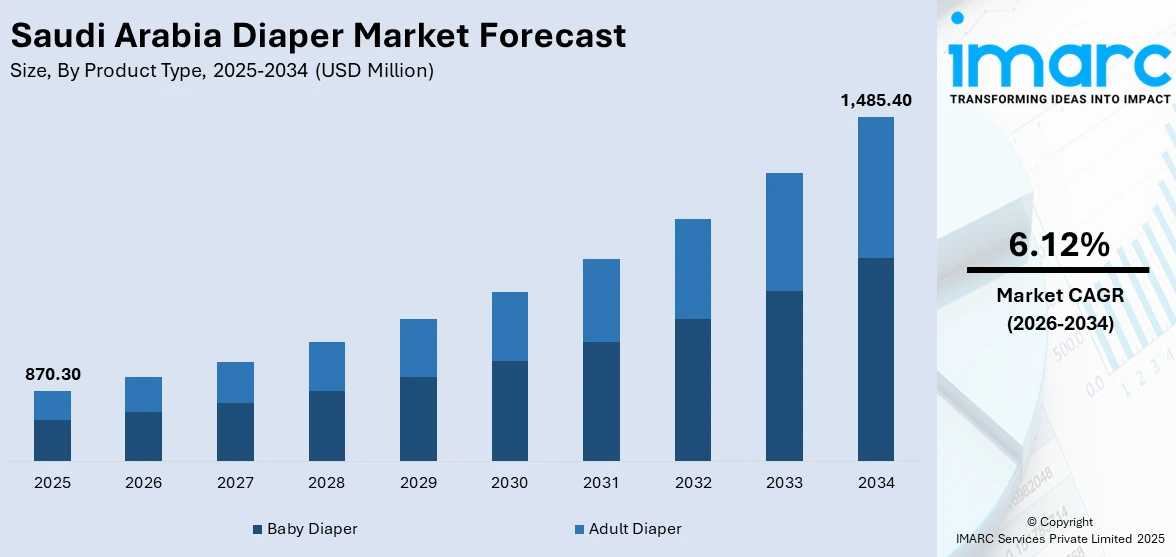
The Saudi Arabia diaper market size was valued at USD 870.30 Million in 2025 and is projected to reach USD 1,485.40 Million by 2034, growing at a compound annual growth rate of 6.12% from 2026-2034.
The Saudi Arabia diaper market is experiencing robust expansion, driven by increasing awareness about infant hygiene, rising disposable incomes, and rapid urbanization across major cities. Surging demand for premium and eco-friendly products, coupled with expanding modern retail channels and e-commerce platforms, continues to fuel market growth. Additionally, the rising adult diaper segment, supported by an aging population and enhanced healthcare infrastructure, contributes significantly to the market share.
Key Takeaways and Insights:
- By Product Type: Baby diaper dominates the market with a share of 80% in 2025, owing to its widespread usage among families with infants and toddlers, cultural preference for larger families, and heightened awareness about infant hygiene. Increasing urbanization and rising birth rates among young Saudi families are fueling the market expansion.
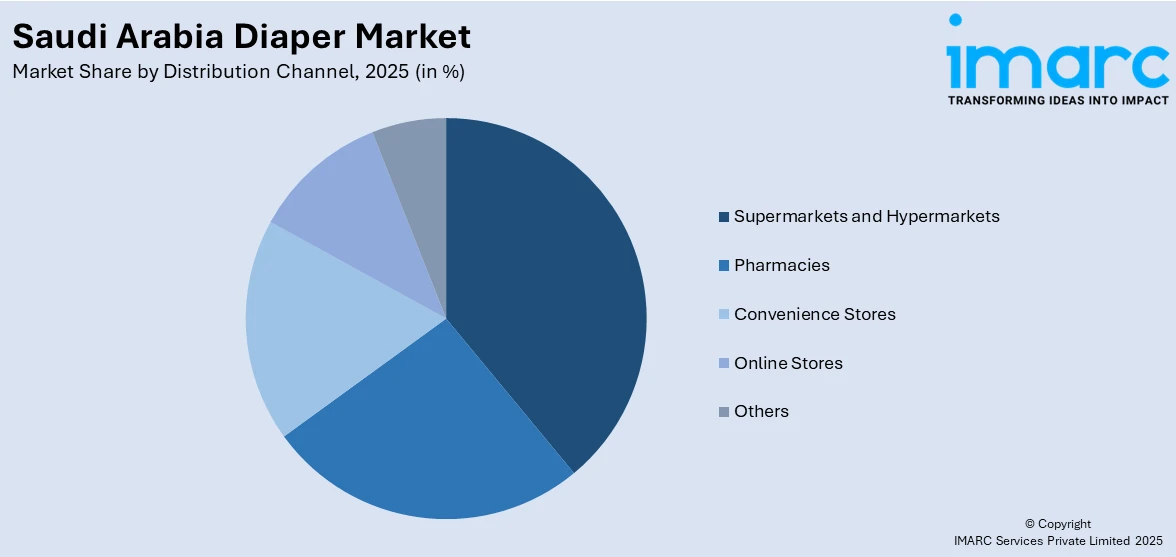
- By Distribution Channel: Supermarkets and hypermarkets lead the market with a share of 38% in 2025. This dominance is driven by the convenience of one-stop shopping experiences, competitive pricing strategies, and the availability of diverse product ranges that cater to varying consumer preferences across different income segments.
- By Region: Northern and Central Region comprises the largest region with 31% share in 2025, driven by the concentration of the Kingdom's population in Riyadh metropolitan area, higher disposable incomes, well-established retail infrastructure, and advanced healthcare facilities supporting premium product adoption.
- Key Players: Key players drive the Saudi Arabia diaper market by expanding product portfolios, improving absorbency technologies, and strengthening nationwide distribution networks. Their investments in marketing, affordability initiatives, and partnerships with healthcare providers boost awareness, accelerate adoption, and ensure consistent product availability across diverse consumer segments.
To get more information on this market Request Sample
The Saudi Arabia diaper market demonstrates robust growth potential, supported by favorable demographic factors, evolving consumer preferences, and expanding retail infrastructure. The relatively young demographic structure, with children aged zero to fourteen years accounting for a significant portion, creates sustained demand for baby care products like diapers. Saudi Arabia has witnessed substantial growth in female workforce participation, reaching 36.2% in the third quarter of 2024, which has enhanced the need for convenient hygiene solutions among working parents. The proliferation of modern retail formats, including hypermarkets and supermarkets, provides extensive product accessibility and drives market penetration. Additionally, the e-commerce sector is experiencing rapid expansion, creating new distribution channels for diaper products. The adult diaper segment continues to gain traction, as awareness regarding incontinence management increases among the aging population and healthcare facilities integrate these products into patient care protocols.
Saudi Arabia Diaper Market Trends:
Growing Preference for Premium and Eco-Friendly Products
Consumer preferences in the Saudi Arabia diaper market are shifting towards premium and environmentally sustainable products. Younger, more educated parents in urban regions increasingly demand biodegradable diapers manufactured from plant-based or compostable materials. Products featuring hypoallergenic properties, chlorine-free compositions, and fragrance-free formulations are gaining significant traction. Smart diaper innovations with enhanced absorbency, moisture indicators, and skin-protection features are also influencing purchasing decisions. In parallel, strong brand trust, pediatric recommendations, and online product reviews are playing a growing role in shaping consumer choice.
Expanding Adult Diaper Adoption Across Demographics
The adult diaper segment is witnessing consistent growth, driven by increasing life expectancy and heightened awareness regarding incontinence management. As per macrotrends, in 2025, Saudi Arabia's life expectancy was 75.97, reflecting a 0.19% rise from 2024. Healthcare facilities, including hospitals and care centers, are integrating adult hygiene products into daily care protocols, providing comfort and dignity to elderly individuals. Cultural transformations are reducing stigma surrounding adult diaper usage, normalizing these products across age and gender segments. Beyond geriatric applications, adult diapers are increasingly utilized by individuals with disabilities and those requiring post-surgical care, expanding the overall addressable market across diverse demographic groups.
Digital Transformation and E-Commerce Expansion
Digital retail platforms are fundamentally transforming consumer purchasing behavior in the Saudi Arabia diaper market. E-commerce channels offer extensive product assortments, competitive pricing comparisons, and convenient doorstep delivery services that appeal to busy caregivers and working parents. As per IMARC Group, the Saudi Arabia e-commerce market size reached USD 222.9 Billion in 2024. Subscription-based models are gaining traction, providing automatic deliveries with attractive discounts and loyalty incentives. The Kingdom's robust digital infrastructure and high smartphone penetration facilitate seamless online purchasing experiences. Brands and retailers are investing in user-friendly mobile applications, targeted digital marketing, and responsive customer service to cultivate long-term consumer loyalty.
How Vision 2030 is Transforming the Saudi Arabia Diaper Market:
Vision 2030 is significantly transforming the Saudi Arabia diaper market by strengthening domestic manufacturing, retail modernization, and consumer-driven product diversification. Government-led industrial localization initiatives are encouraging investments in local hygiene product manufacturing, reducing import dependence and improving supply chain resilience. Rising female workforce participation and urbanization are increasing demand for convenient baby care solutions, supporting higher diaper penetration rates. Vision 2030’s focus on healthcare quality, family well-being, and population growth policies is also driving awareness around infant hygiene standards. Expansion of organized retail, e-commerce platforms, and private-label offerings is improving product accessibility across urban and semi-urban areas. Additionally, income diversification and rising disposable incomes are enabling consumers to shift towards premium, value-added diapers with enhanced comfort, absorption, and skin-care features, sustaining long-term market growth.
Market Outlook 2026-2034:
The Saudi Arabia diaper market is poised for sustained expansion throughout the forecast period, supported by favorable demographic trends, evolving consumer preferences, and strategic government initiatives under Vision 2030. The market generated a revenue of USD 870.30 Million in 2025 and is projected to reach a revenue of USD 1,485.40 Million by 2034, growing at a compound annual growth rate of 6.12% from 2026-2034. Continued urbanization, rising disposable incomes, and expanding retail infrastructure will drive market penetration across diverse consumer segments. Product innovations, focusing on enhanced absorbency, skin-friendly materials, and sustainable compositions, will remain critical differentiators. The broadening adult diaper segment, supported by an aging population and increased healthcare awareness, presents significant growth opportunities.
Saudi Arabia Diaper Market Report Segmentation:
|
Segment Category |
Leading Segment |
Market Share |
|
Product Type |
Baby Diaper |
80% |
|
Distribution Channel |
Supermarkets and Hypermarkets |
38% |
|
Region |
Northern and Central Region |
31% |

Product Type Insights:
- Baby Diaper
- Disposable Diapers
- Training Diapers
- Cloth Diapers
- Swim Pants
- Biodegradable Diapers
- Adult Diaper
- Pad Type
- Flat Type
- Pant Type
Baby diaper dominates with a market share of 80% of the total Saudi Arabia diaper market in 2025.
The baby diaper segment maintains commanding dominance in the Saudi Arabia diaper market, driven by the Kingdom's favorable demographic profile and cultural preferences for larger families. Saudi Arabia's young population structure, with children aged zero to fourteen years comprising a substantial portion of the demographic composition, creates consistent and sustained demand for infant hygiene products. According to the General Authority for Statistics (GASTAT), the fertility rate for the Saudi population reached 2.7 births per thousand women in 2024, demonstrating the continued relevance of baby care products, including baby diapers, in household consumption patterns.
Disposable diapers represent one of the widely utilized product types within the baby diaper segment, preferred by modern parents for their convenience, superior absorbency, and time-saving attributes compared to traditional cloth alternatives. Product innovations featuring advanced absorbent cores, wetness indicators, breathable materials, and skin-friendly compositions continue enhancing consumer experiences and driving premium product adoption across urban households. The expansion of organized retail, private-label offerings, and online sales channels is further strengthening the availability and penetration of baby diapers across the Kingdom.
Distribution Channel Insights:
Access the comprehensive market breakdown Request Sample
- Supermarkets and Hypermarkets
- Pharmacies
- Convenience Stores
- Online Stores
- Others
Supermarkets and hypermarkets lead with a share of 38% of the total Saudi Arabia diaper market in 2025.
Supermarkets and hypermarkets maintain leadership in the Saudi Arabia diaper market distribution landscape, offering consumers comprehensive one-stop shopping experiences with extensive product assortments. Major retail chains operate extensive store networks across the Kingdom, providing convenient access to diverse diaper brands and formats spanning various price points. Strong shelf visibility, in-store promotions, and private-label offerings further enhance consumer engagement and sales volumes. Additionally, partnerships with international diaper brands are strengthening product availability and quality consistency.
The dominance of supermarkets and hypermarkets stems from competitive pricing strategies, promotional activities, and the convenience of purchasing household essentials alongside grocery items during regular shopping trips. Urban consumers particularly favor hypermarket shopping for bulk purchasing options and the ability to compare products across multiple brands. Ongoing expansion of major retail chains into remote areas and secondary cities is broadening market accessibility and driving penetration. Loyalty programs and periodic discount campaigns further reinforce repeat purchases and channel preference.
Regional Insights:
- Northern and Central Region
- Western Region
- Eastern Region
- Southern Region
Northern and Central Region exhibits a clear dominance with a 31% share of the total Saudi Arabia diaper market in 2025.
Northern and Central Region commands the largest market share, driven by the concentration of Saudi Arabia's population and economic activities in Riyadh metropolitan area. Higher disposable incomes, advanced retail infrastructure, and well-developed healthcare facilities support premium product adoption and sustained market demand. Rising awareness about infant hygiene and increasing participation of working parents are further boosting consumption levels. Strong presence of multinational brands and frequent product launches also contribute to market leadership. Additionally, high internet penetration is supporting online diaper sales growth in the region.
The area benefits from the highest concentration of modern retail formats, including hypermarkets and specialized baby care stores. Efficient logistics networks ensure consistent product availability across urban and suburban areas. Expansion of residential communities is generating new consumer bases for baby care products. Government-backed healthcare initiatives further reinforce demand stability. Changing lifestyle patterns and preference for convenience-driven products are supporting steady volume growth. Promotional campaigns, subscription-based purchases, and strong brand loyalty are further strengthening long-term demand across the region.
Market Dynamics:
Growth Drivers:
Why is the Saudi Arabia Diaper Market Growing?
Favorable Demographic Profile and Increasing Infant Population
Saudi Arabia's demographic composition provides a strong foundation for sustained diaper market growth, with a sizeable child population and cultural preferences favoring larger families. The Kingdom's population structure includes a substantial proportion of children and adults of childbearing age, creating consistent demand for infant care products. Rising healthcare awareness among parents has heightened emphasis on infant hygiene practices, driving adoption of modern disposable diaper products. Government initiatives supporting family welfare and maternal health further reinforce market fundamentals. Improved prenatal care and declining infant mortality rates contribute to sustained birth rates that support ongoing demand. The presence of a large expatriate population, many with families, adds additional market demand across diverse consumer segments requiring convenient infant care solutions. Data from the GASTAT indicated that the expat population reached 15.67 Million in 2024, accounting for 44.4% of the total population in Saudi Arabia.
Rapid Urbanization and Expanding Modern Retail Infrastructure
Urbanization across Saudi Arabia is accelerating market accessibility and product penetration through the expansion of modern retail channels. Urban population (% of total population) in Saudi Arabia reached 85.17 % in 2024, as per the World Bank collection of development indicators. Major urban centers, including Riyadh, Jeddah, and Dammam, concentrate significant population masses with established shopping infrastructure and diverse retail options. The proliferation of hypermarkets, supermarkets, and specialized baby care retailers provides consumers with extensive product selections and competitive pricing. Vision 2030 initiatives promoting economic diversification are driving infrastructure development and urban expansion projects that support retail sector growth. The convenience of modern retail formats appeals to busy urban consumers seeking efficient shopping experiences for household essentials. Organized retail's competitive dynamics encourage promotional activities, product innovation, and improved consumer services that stimulate market demand.
Changing Lifestyle Patterns
Evolving lifestyle patterns are playing a key role in driving the Saudi Arabia diaper market, as households increasingly prioritize convenience, hygiene, and time efficiency. Growing urban living, busier daily routines, and higher participation of parents in the workforce are reducing reliance on traditional cloth alternatives and accelerating adoption of disposable diapers. Modern parents prefer products that simplify childcare while maintaining comfort and cleanliness for infants. Rising exposure to global parenting trends through digital media is also influencing expectations around product quality, absorbency, and skin protection. Additionally, higher spending on baby wellness and comfort reflects a shift toward convenience-driven consumption, supporting consistent demand growth across urban and semi-urban households. The increasing preference for bulk purchases, subscription models, and easy-to-use packaging further aligns diaper consumption with modern household lifestyles.
Market Restraints:
What Challenges the Saudi Arabia Diaper Market is Facing?
Environmental Concerns and Waste Management Challenges
Disposable diapers contribute significantly to solid waste generation, creating environmental sustainability concerns that may influence consumer preferences and regulatory scrutiny. The non-biodegradable nature of conventional diaper materials poses challenges for municipal waste management systems. Growing environmental awareness among educated consumers is driving demand for eco-friendly alternatives, requiring manufacturers to invest in sustainable product development while maintaining cost competitiveness across diverse market segments.
Price Sensitivity Among Value-Conscious Consumer Segments
Price sensitivity remains a significant consideration for value-conscious consumers, particularly during periods of economic uncertainty. Premium and eco-friendly diaper products command higher price points that may limit adoption among budget-constrained households. Competition from private label and economy brands intensifies pricing pressures on established manufacturers. Balancing product quality, innovation, and affordability presents ongoing challenges for market participants seeking to address diverse consumer needs across different income levels.
Import Dependency and Supply Chain Vulnerabilities
Reliance on imported raw materials and finished products exposes the market to supply chain disruptions and currency fluctuations. Global logistics challenges and shipping cost variations can impact product availability and pricing stability. Limited domestic manufacturing capacity for specialized diaper components creates dependency on international supply chains. Market participants must navigate these vulnerabilities through strategic sourcing, inventory management, and localization initiatives to ensure consistent product availability and competitive positioning.
Competitive Landscape:
The Saudi Arabia diaper market features a competitive landscape, comprising multinational corporations and regional manufacturers vying for market share through product innovations, marketing strategies, and distribution network expansion. Leading international brands maintain strong market positions through established brand recognition, extensive product portfolios, and continuous investments in research and development (R&D). Regional players leverage local market understanding and competitive pricing to capture market segments. Competition is intensifying as manufacturers focus on product differentiation through enhanced absorbency technologies, skin-friendly materials, and sustainable compositions. Strategic partnerships with retailers, healthcare providers, and e-commerce platforms are becoming increasingly important for market penetration and consumer engagement across diverse demographic segments.
Saudi Arabia Diaper Market Report Coverage:
| Report Features | Details |
|---|---|
| Base Year of the Analysis | 2025 |
| Historical Period | 2020-2025 |
| Forecast Period | 2026-2034 |
| Units | Million USD |
| Scope of the Report |
Exploration of Historical Trends and Market Outlook, Industry Catalysts and Challenges, Segment-Wise Historical and Future Market Assessment:
|
| Product Types Covered |
|
| Distribution Channels Covered | Supermarkets and Hypermarkets, Pharmacies, Convenience Stores, Online Stores, Others |
| Regions Covered | Northern and Central Region, Western Region, Eastern Region, Southern Region |
| Customization Scope | 10% Free Customization |
| Post-Sale Analyst Support | 10-12 Weeks |
| Delivery Format | PDF and Excel through Email (We can also provide the editable version of the report in PPT/Word format on special request) |
Frequently Asked Questions About the Saudi Arabia Diaper Market Report
The Saudi Arabia diaper market size was valued at USD 870.30 Million in 2025.
The Saudi Arabia diaper market is expected to grow at a compound annual growth rate of 6.12% from 2026-2034 to reach USD 1,485.40 Million by 2034.
Baby diaper dominated the market with a share of 80%, driven by favorable demographic factors, cultural preferences for larger families, heightened infant hygiene awareness, and rising disposable incomes among young Saudi families.
Key factors driving the Saudi Arabia diaper market include favorable demographic composition, rapid urbanization, expanding modern retail infrastructure, rising female workforce participation, increasing healthcare awareness, and growing e-commerce penetration.
Major challenges include environmental concerns regarding disposable waste, price sensitivity among value-conscious consumers, regulatory compliance pressures, import dependency and supply chain vulnerabilities, and intensifying competition requiring continuous product innovation.
Need more help?
- Speak to our experienced analysts for insights on the current market scenarios.
- Include additional segments and countries to customize the report as per your requirement.
- Gain an unparalleled competitive advantage in your domain by understanding how to utilize the report and positively impacting your operations and revenue.
- For further assistance, please connect with our analysts.
 Request Customization
 Speak to an Analyst
 Request Brochure
 Inquire Before Buying
Benefits of Customization
- Personalize this research
- Triangulate with your data
- Get data as per your format and definition
- Gain a deeper dive into a specific application, geography, customer, or competitor
- Any level of personalization
Get in Touch With Us
UNITED STATES
Phone: +1-201-971-6302
INDIA
Phone: +91-120-433-0800
UNITED KINGDOM
Phone: +44-753-714-6104
Email: [email protected]
Client Testimonials




.webp)




.webp)













