
Saudi Arabia Frozen Potato Products Market Size, Share, Trends and Forecast by Product Type, Distribution Channel, End-Use, and Region, 2026-2034
Saudi Arabia Frozen Potato Products Market Size, Share, Trends & Forecast (2026-2034)
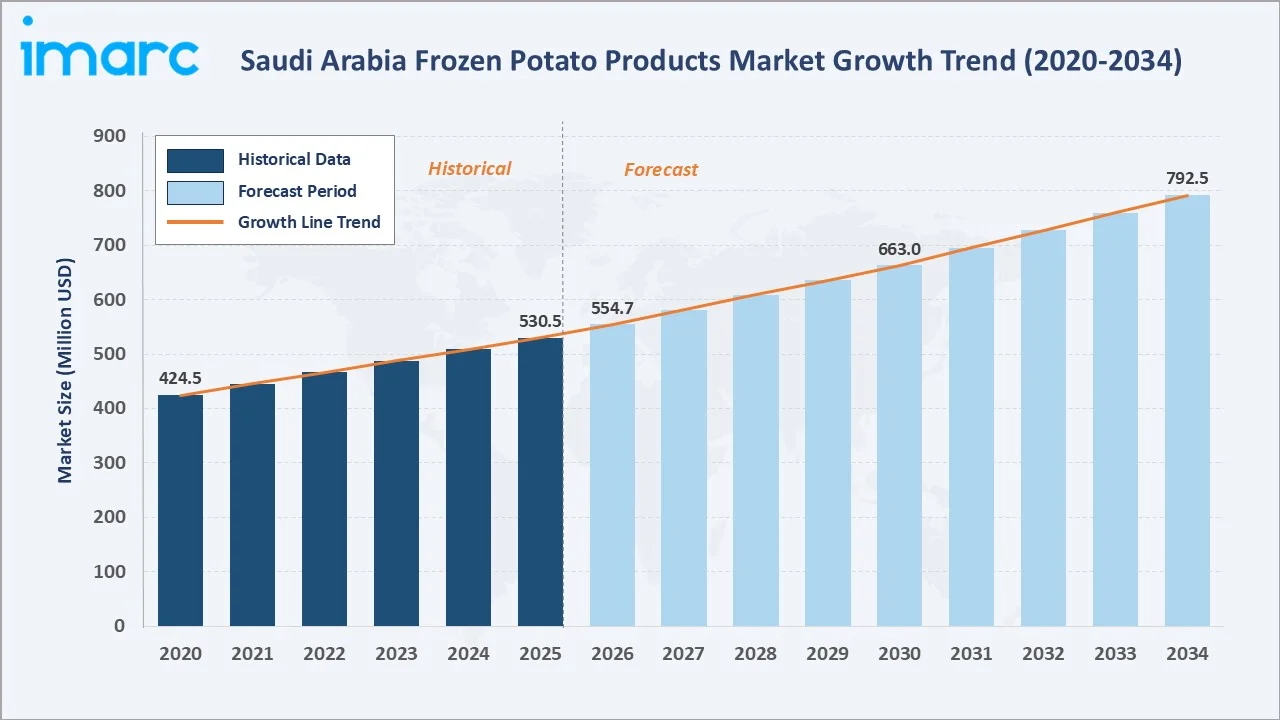
The Saudi Arabia frozen potato products market grew from USD 530.5 Million in 2025 to USD 554.7 Million in 2026 and is projected to reach USD 792.5 Million by 2034, growing at a CAGR of 4.56% during 2026-2034. The market is driven by rapid expansion of quick-service restaurants, rising urbanization, and a youthful high-income population embracing Western dining habits, alongside significant domestic processing investments aligned with Saudi Vision 2030. French Fries leads at 52.6%. Food Services dominates end-use at 68.4%. The Northern & Central Region commands 41.6% of national market share.
Market Snapshot
|
Metric |
Value |
|
Base Year Market Size (2025) |
USD 530.5 Million |
|
Market Size (2026) |
USD 554.7 Million |
|
Forecast Market Size (2034) |
USD 792.5 Million |
|
CAGR (2026-2034) |
4.56% |
|
Base Year |
2025 |
|
Historical Period |
2020-2025 |
|
Forecast Period |
2026-2034 |
|
Dominant Product Type |
French Fries (52.6%, 2025) |
|
Dominant End-Use |
Food Services (68.4%, 2025) |
|
Leading Region |
Northern & Central Region (41.6%, 2025) |
The Saudi Arabia frozen potato products market size increased from USD 424.5 Million in 2020 to USD 530.5 Million in 2025 and is estimated to reach USD 554.7 Million in 2026. The market is further expected to grow to USD 663.0 Million by 2030 and USD 792.5 Million by 2034. The Saudi Arabia frozen potato products market is commercially significant owing to the Kingdom's large expatriate workforce, rapidly growing QSR sector, and Vision 2030-aligned domestic food processing investments that are systematically reducing import dependency.
To get more information on this market, Request Sample
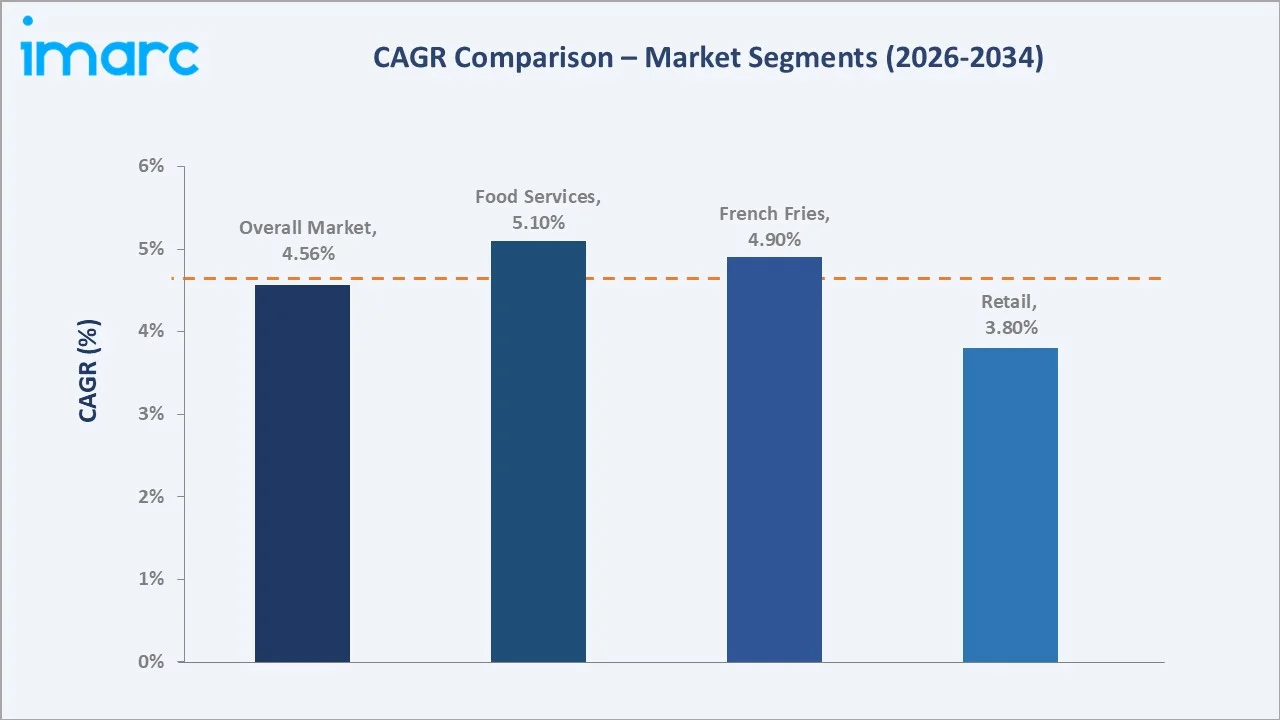
The Food Services segment accounts for the dominant share through institutional bulk procurement by QSR chains and hotel catering. French Fries lead product demand at 52.6% through universal menu integration across all major fast food chains. Vision 2030's food security mandate continues to attract capital into domestic processing, with the Sudair Industrial City facility expected to substantially reduce frozen potato imports from 2026 onward.
Executive Summary
The Saudi Arabia frozen potato products market expanded from USD 530.5 Million in 2025 to an estimated USD 554.7 Million in 2026, positioning it among the leading frozen food markets in the GCC. Market growth is underpinned by QSR proliferation, urban lifestyle convergence, and a young consumer base with strong demand for convenient food formats. The market is projected to reach USD 792.5 Million by 2034. French Fries at 52.6% lead through QSR dominance. Food Services at 68.4% reflects institutional purchasing scale. Northern & Central Region leads regionally at 41.6%.
Key Market Insights
|
Insight |
Data |
|
Dominant Product Type |
French Fries – 52.6% share (2025) |
|
Dominant End-Use |
Food Services – 68.4% market share (2025) |
|
Leading Region |
Northern & Central Region – 41.6% share (2025) |
|
Market Opportunity |
QSR expansion; Vision 2030 food security mandate; domestic processing investment; premium and health-focused product innovation |
Key Analytical Observations Supporting the Above Data:
- French Fries at 52.6%: The French fries segment dominates due to universal adoption across QSR chains, including McDonald's, KFC, Herfy, and Burger King, which standardize fries on all menus. Wide product range, consumer familiarity, and competitive pricing make French fries the most commercially resilient frozen potato format. The segment benefits from consistent institutional procurement volumes that underpin stable supplier revenue streams.
- Food Services at 68.4%: Food services lead through institutional bulk purchasing by QSR operators, hotels, airline catering companies, and institutional food programs. Saudi Arabia's thriving hospitality and tourism sectors create sustained year-round demand. The segment's dominance reflects the QSR sector's structural role as the primary demand engine for the broader frozen potato market.
- Northern & Central Region at 41.6%: The Northern & Central Region dominates due to Riyadh's concentration of QSR outlets, shopping malls, and modern organized retail. The region also hosts the new Sudair Industrial City processing facility, reinforcing its position as the Kingdom's frozen potato supply and distribution hub.
Saudi Arabia Frozen Potato Products Market Overview
Saudi Arabia frozen potato products market is positioned at a commercially dynamic intersection: the GCC's largest economy with a rapidly expanding foodservice sector, a young and growing population with Western food preferences, and a government-backed food security agenda systematically building domestic processing capacity and reducing import dependency.
Saudi Arabia's frozen potato ecosystem integrates imported finished products from major global brands, a nascent but rapidly growing domestic manufacturing base, QSR-driven institutional procurement, modern organized retail, and an expanding e-commerce grocery channel. Macroeconomic factors include Vision 2030 economic diversification, tourism and hospitality growth, rising female workforce participation, and sustained capital investment in food processing infrastructure.
Market Dynamics
To evaluate market opportunities, Request Sample
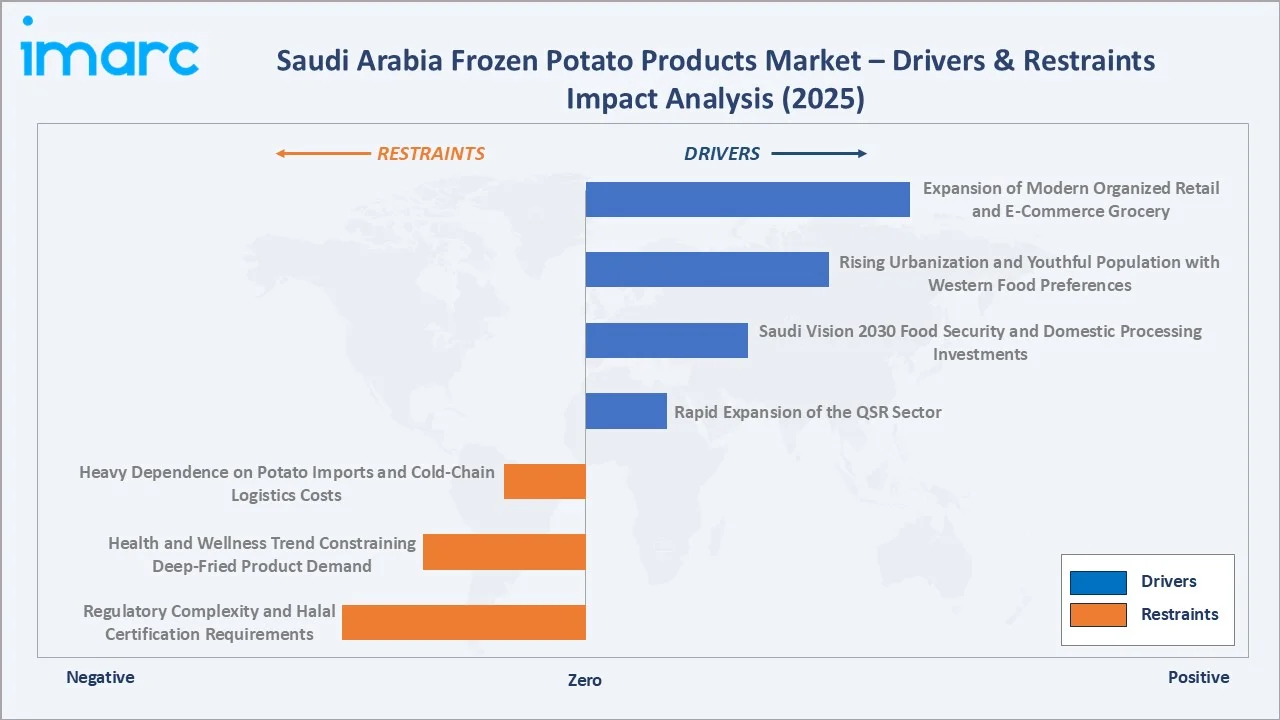
Market Drivers
- Rapid Expansion of the QSR Sector: Saudi Arabia's QSR sector expands at above-regional-average pace, with McDonald's (350+ outlets), Herfy (360+ outlets), KFC, Burger King, and emerging domestic chains driving high-volume frozen fry procurement. QSR growth is the primary institutional demand engine, sustaining above-GDP growth in frozen potato product volumes. The continued proliferation of QSR brands into tier-2 and tier-3 Saudi cities extends the geographic reach of institutional demand. New QSR formats, including drive-throughs, delivery-only kitchens, and mall food courts, are creating additional procurement channels that directly benefit frozen potato suppliers.
- Saudi Vision 2030 Food Security and Domestic Processing Investments: Vision 2030 mandates food security through domestic production capacity expansion, exemplified by the USD 100 million AGPC-Farm Frites facility at Sudair Industrial City with 70,000 MT/yr capacity. These investments reduce import dependency, lower production costs, and build a more resilient domestic supply chain. The government's agricultural development programs have already driven domestic potato production up 47% to 621,750 tons in 2023. Continued state support for agri-food processing is expected to further attract international players to establish Saudi-based manufacturing operations.
- Rising Urbanization and Youthful Population with Western Food Preferences: Saudi Arabia's under-30 population, representing over 60% of the total, has high exposure to international food trends through social media and travel. Urban lifestyle convergence toward convenience food formats and Western dining occasions structurally supports frozen potato product demand. The Kingdom's growing female workforce participation is expanding household consumption of quick-prepare frozen food products. Rising dual-income households with less time for home cooking are accelerating frozen convenience food adoption across all income segments.
- Expansion of Modern Organized Retail and E-Commerce Grocery: Saudi Arabia's hypermarket and supermarket sector, led by Panda, Danube, Carrefour, and Lulu, provides high-visibility cold-chain shelf space for frozen potato products. The growing e-commerce grocery channel extends distribution reach to previously underserved consumer segments and remote geographic areas. Online grocery platforms offer promotional visibility and subscription-based frozen food delivery services that increase purchase frequency. Modern retail expansion into tier-2 and tier-3 cities is opening new geographic markets for branded frozen potato products.
Market Restraints
- Heavy Dependence on Potato Imports and Cold-Chain Logistics Costs: Despite domestic production growth, Saudi Arabia remains significantly import-dependent for processed frozen potato inputs from Europe and North America. Long-distance cold-chain logistics add substantial cost, creating price pressure on manufacturers and limiting margin flexibility for mid-tier products. Port congestion at Jeddah and Dammam during peak periods can extend transit times and increase spoilage risk. These structural cost pressures are particularly acute for smaller distributors that lack scale to negotiate favorable freight rates.
- Health and Wellness Trend Constraining Deep-Fried Product Demand: Growing consumer health consciousness, driven by Vision 2030's public health agenda and rising obesity awareness, creates headwinds for traditional deep-fried frozen potato products. Retail segment growth is constrained as health-conscious consumers shift toward baked, air-fried, or lower-fat alternatives. Saudi Arabia's government has introduced food-related taxes that could extend to high-fat convenience foods, adding regulatory pricing risk. This health trend is accelerating demand for product innovation in the premium segment but constraining volume growth in the mass market.
- Regulatory Complexity and Halal Certification Requirements: Saudi Arabia's SFDA food safety standards, halal certification mandates, and nutrition labeling regulations impose significant compliance costs on international brands. These requirements create market entry barriers for smaller importers and add operational complexity for multinational suppliers managing Saudi-specific formulations. Frequent regulatory updates require ongoing reformulation and re-certification investment. Compliance timelines can delay new product introductions by 6-12 months, limiting suppliers' ability to respond quickly to consumer demand trends.
Market Opportunities
- Development of Domestic Frozen Potato Export Hub under Vision 2030: Saudi Arabia's investment in domestic processing infrastructure and favorable logistics position create the opportunity to develop the Kingdom as a regional exporter of value-added frozen potato products to GCC neighbors, African markets, and South Asian destinations. Vision 2030's food export ambitions provide government support through logistics subsidies, export financing, and trade agreement facilitation. The Sudair facility's 70,000 MT/yr capacity will initially serve domestic demand, with expansion potential targeting regional export markets within 5-7 years. This creates a transformative revenue stream beyond domestic consumption for Saudi-based processors.
- Premium and Health-Oriented Frozen Potato Product Innovation: Rising middle-class and HNI consumer demand for organic, air-fry-ready, sweet potato-based, and nutrition-fortified frozen potato products represents a commercially underdeveloped premium segment. International brands and local manufacturers can capture above-average margins through differentiated product launches aligned with Saudi consumer health trends. The premium segment's growth rate is expected to outpace the broader market, driven by younger, more health-conscious Saudi consumers with higher disposable incomes. Retail channel partners are actively seeking premium frozen food alternatives to improve category margins.
Market Challenges
- Water Scarcity Constraints on Domestic Potato Agriculture: Saudi Arabia's water-scarce environment limits the sustainable expansion of domestic potato cultivation despite recent production growth. Long-term reliance on non-renewable aquifers for irrigation poses agricultural sustainability risks that could cap domestic production below processing capacity requirements. Government water pricing policies are increasingly reflecting the true scarcity cost of agricultural water use, raising input costs for domestic producers. These water constraints create a structural dependency on imported raw potato inputs even as processing capacity grows domestically.
- Competitive Intensity from Global Multinational Brands: The Saudi Arabia frozen potato products market is dominated by established global brands with deep QSR relationships, technology advantages, and scale economies that create high barriers for local and regional competitors. International brands invest heavily in product innovation, QSR tender compliance, and promotional programs that local producers cannot easily match. The entry of Farm Frites as a domestic producer intensifies competitive pressure even within the local manufacturing space. Private-label competition from hypermarket chains further compresses margins for both international and domestic branded suppliers.
Emerging Market Trends
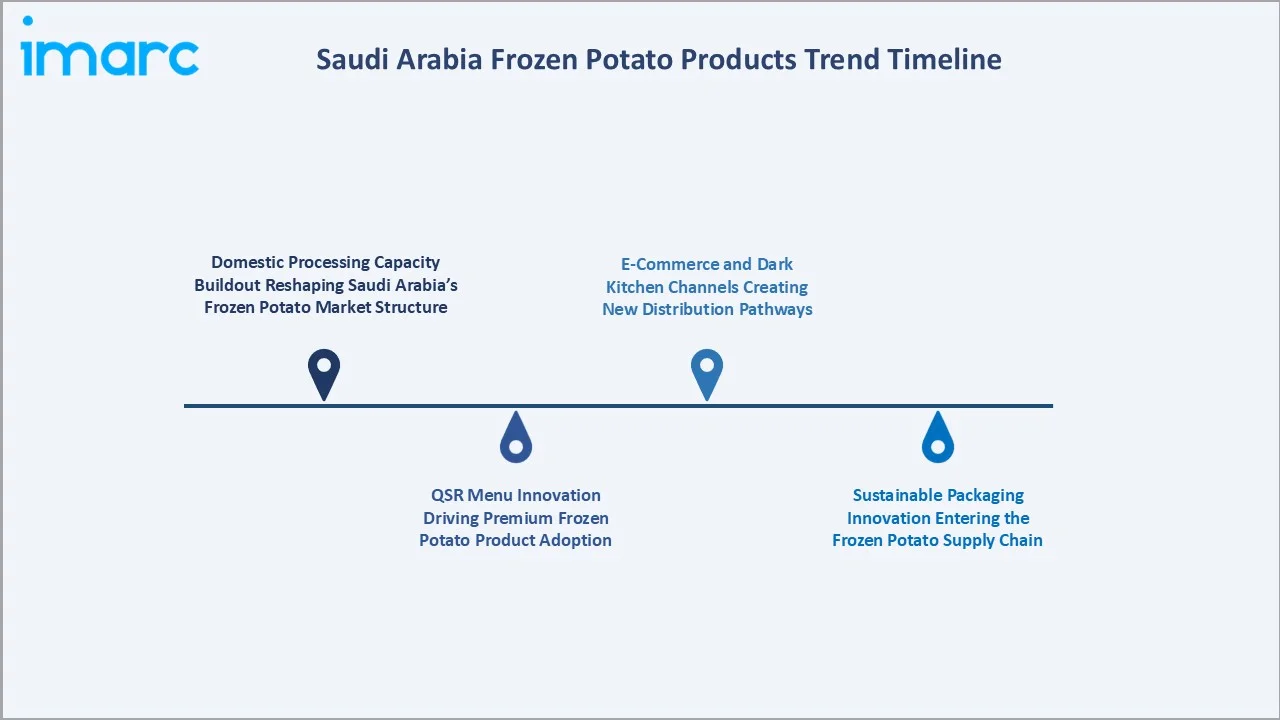
1. Domestic Processing Capacity Buildout Reshaping Saudi Arabia's Frozen Potato Market Structure
Saudi Arabia's investment in domestic frozen potato processing is creating a structural shift from an import-dependent market to a regionally self-sufficient and potentially export-capable producer. This trend fundamentally reshapes competitive dynamics, price discovery, and product customization capabilities. The first large-scale domestic facility is expected to catalyze additional processing investments as the supply ecosystem matures.
2. QSR Menu Innovation Driving Premium Frozen Potato Product Adoption
QSR chains in Saudi Arabia are expanding beyond standard French fries to include loaded fries, seasoned wedges, curly fries, and gourmet potato products as menu differentiation tools. This drives demand for specialty frozen potato SKUs and creates premium pricing opportunities for suppliers. In January 2024, several leading QSR operators launched limited-time premium fry offerings that sold out within days, confirming strong consumer appetite for product variety above standard menu fries.
3. Sustainable Packaging Innovation Entering the Frozen Potato Supply Chain
The SABIC-Lamb Weston-OpackGroup collaboration introduced bio-renewable polyethylene packaging derived from used cooking oil for frozen potato products, reducing carbon footprint by approximately 30%. This ISCC PLUS-certified packaging innovation complies fully with Saudi SFDA food safety standards and signals the entry of ESG considerations into Saudi Arabia's frozen potato supply chain. Sustainable packaging is expected to become a mandatory supplier criterion for Vision 2030-aligned food procurement by 2028.
4. E-Commerce and Dark Kitchen Channels Creating New Distribution Pathways
The growth of cloud kitchens, dark kitchens, and online food delivery in Saudi Arabia is creating new institutional demand centers outside traditional QSR contracts. These channels prioritize convenience, menu flexibility, and cost efficiency, presenting new distribution opportunities for branded and private-label frozen potato suppliers. In November 2024, Americana Foods and Farm Frites announced their USD 100 million Sudair facility investment, expected to reduce domestic frozen fry prices by making local production cost-competitive with imports.
Industry Value Chain Analysis
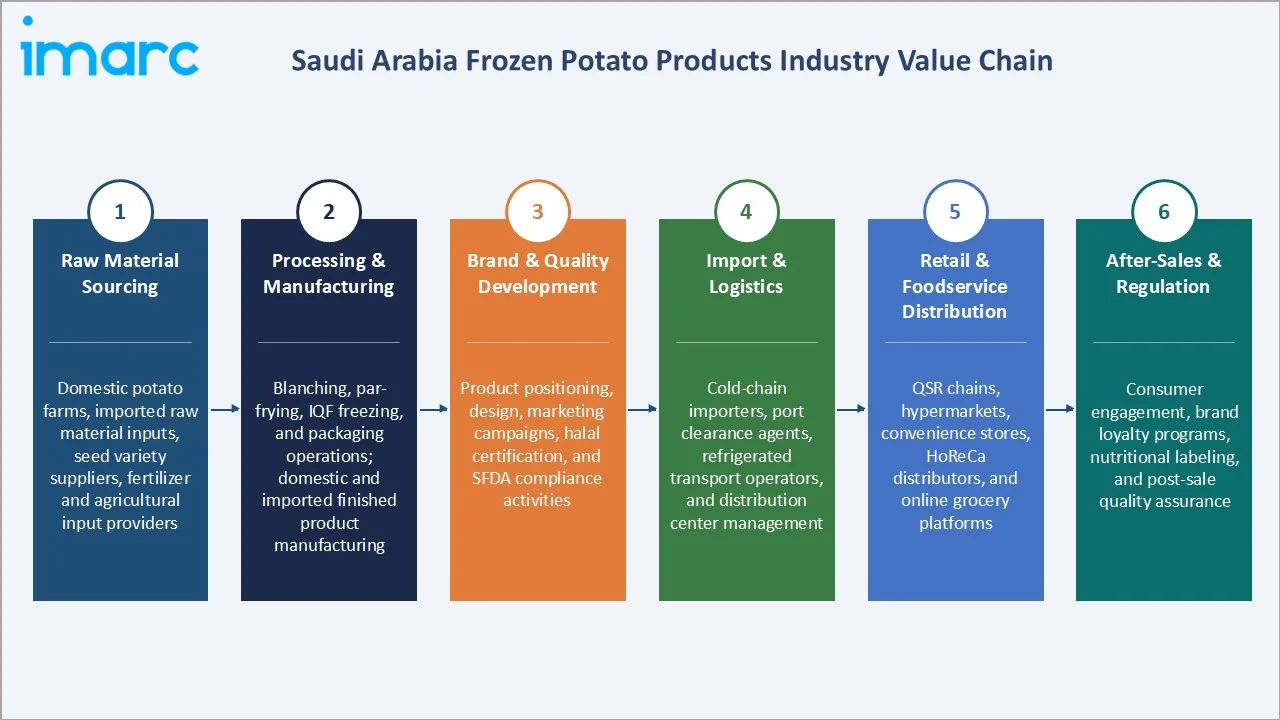
Saudi Arabia frozen potato value chain is increasingly bifurcated between a well-established import corridor for finished products and an emerging domestic processing infrastructure. The value chain's commercial structure is being reshaped by Vision 2030 investments, which are systematically adding value-capture capacity at the processing and manufacturing stage within the Kingdom.
|
Stage |
Key Participants |
|
Raw Material Sourcing |
Domestic potato farms, imported raw material inputs, seed variety suppliers, fertilizer and agricultural input providers |
|
Processing & Manufacturing |
Blanching, par-frying, IQF freezing, and packaging operations; domestic and imported finished product manufacturing |
|
Brand & Quality Development |
Product positioning, design, marketing campaigns, halal certification, and SFDA compliance activities |
|
Import & Logistics |
Cold-chain importers, port clearance agents, refrigerated transport operators, and distribution center management |
|
Retail & Foodservice Distribution |
QSR chains, hypermarkets, convenience stores, HoReCa distributors, and online grocery platforms |
|
After-Sales & Regulation |
Consumer engagement, brand loyalty programs, nutritional labeling, and post-sale quality assurance |
The import and cold-chain logistics stage remains the value chain's most commercially critical operational segment, as frozen product integrity depends on unbroken refrigeration from origin to final consumer. Saudi Arabia's expanding modern retail cold-chain infrastructure—driven by hypermarket and e-commerce grocery investment—is progressively reducing loss rates and enabling broader regional distribution coverage.
Technology Landscape in the Saudi Arabia Frozen Potato Products Industry
Advanced IQF Freezing and Processing Technologies
Individual Quick Freezing (IQF) technology enables rapid, high-quality freezing that preserves texture, taste, and nutritional value of frozen potato products. Saudi Arabia's Sudair processing facility incorporates state-of-the-art blanching, par-frying, and IQF lines, enabling competitive production of restaurant-quality frozen fries at industrial scale. IQF adoption ensures product consistency meeting the stringent quality specifications of global QSR chains. These processing technology investments are enabling Saudi-produced frozen potato products to compete on quality with leading imported brands.
Precision Agriculture and Water-Efficient Irrigation
Saudi Arabia's domestic potato farming relies on precision irrigation technologies—drip systems, soil moisture sensors, and satellite-guided cultivation monitoring—to maximize yield per cubic meter of water. These technologies are critical for sustainable expansion of Saudi potato agriculture under extreme water scarcity conditions. The government's agricultural development agencies are subsidizing adoption of precision agriculture tools to improve productivity and reduce water consumption. Technology-driven yield improvements are enabling domestic production to scale without proportional increases in water use.
Sustainable and Bio-Renewable Packaging Technology
The 2024 SABIC-Lamb Weston-OpackGroup collaboration introduced bio-renewable polyethylene packaging derived from used cooking oil (UCO) for frozen potato products, achieving approximately 30% carbon footprint reduction. This ISCC PLUS-certified packaging innovation complies fully with Saudi SFDA food safety standards and represents the frontier of sustainable packaging adoption in Saudi Arabia's frozen food sector. Growing retailer and QSR operator sustainability mandates are accelerating adoption of such technologies across the frozen potato supply chain.
Market Segmentation Analysis
The report covers the following segments:
|
Segment Category |
Leading Segment |
Market Share |
Year |
|
Product Type |
French Fries |
52.6% |
2025 |
|
End-Use |
Food Services |
68.4% |
2025 |
|
Distribution Channel |
🔒 |
🔒 |
2025 |
|
Region |
N&C Region |
41.6% |
2025 |

By Product Type
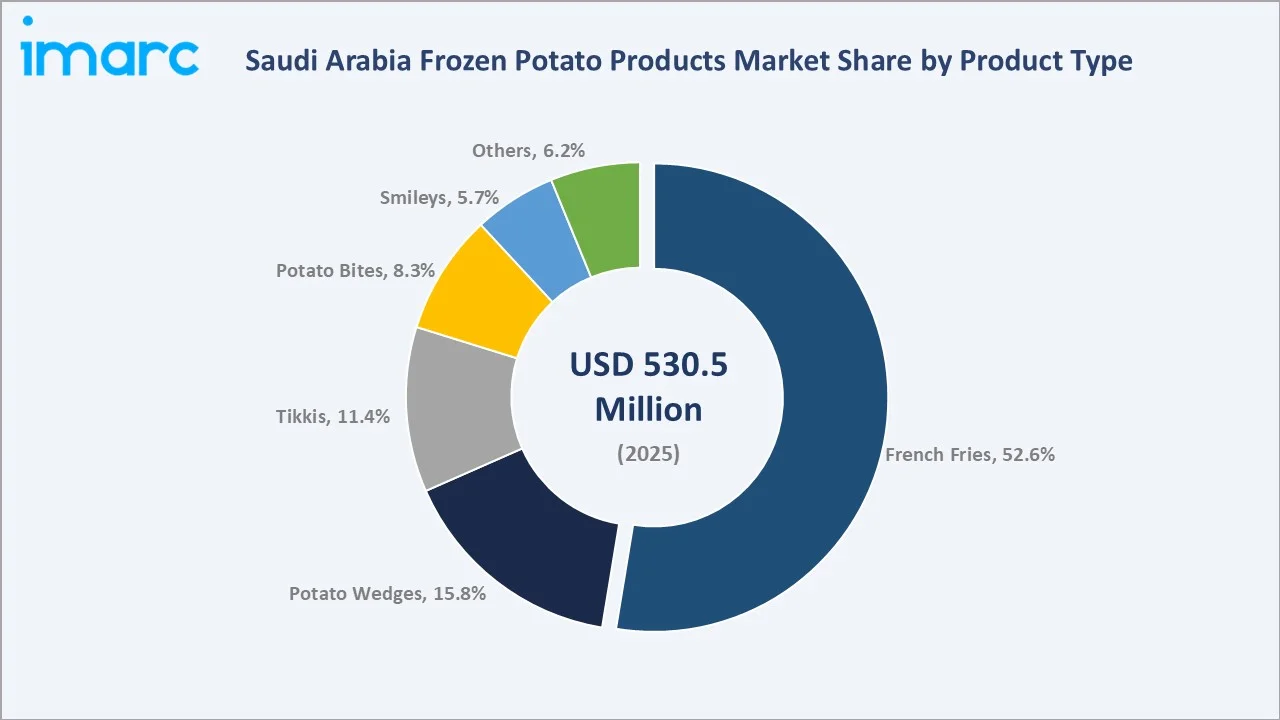
French Fries leads at 52.6% (2025). The French fries segment encompasses Saudi Arabia's most commercially dominant frozen potato format, driven by universal QSR menu penetration and institutional bulk procurement. French fries' commercial dominance reflects the QSR sector's structural role as the primary demand engine for the broader frozen potato market.
To access detailed market analysis, Request Sample
Potato Wedges at 15.8% represent the second-largest product category, growing through foodservice menu diversification and retail meal integration. Tikkis at 11.4% cater to South Asian expatriate communities and gain traction in institutional catering. Potato Bites at 8.3%, Smileys at 5.7%, and Others at 6.2% serve niche consumer occasions, children's meals, and specialty restaurant formats.
By End-Use
Food Services leads at 68.4% (2025). This segment serves Saudi Arabia's dominant institutional procurement channel through QSR chains, hotels, catering companies, airline catering, and institutional food programs. The food services segment's commanding share reflects the QSR sector's scale and the hospitality industry's bulk frozen food procurement model.
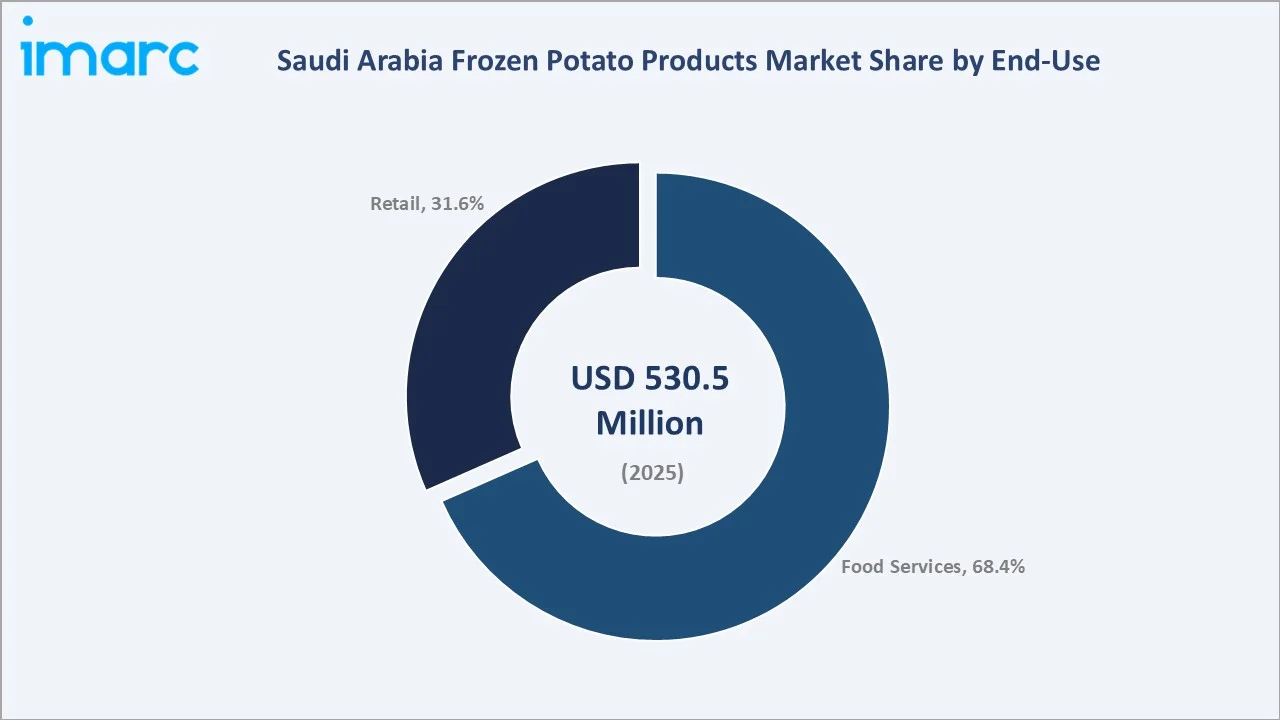
Retail at 31.6% is growing through modern hypermarket expansion, private-label product development, and e-commerce grocery channel growth. Rising consumer preference for at-home frozen convenience food preparation, increasing freezer penetration in Saudi households, and branded frozen potato product marketing by leading multinational suppliers are the key retail growth drivers.
Regional Market Insights
|
Region |
Share (2025) |
Key Saudi Arabia Frozen Potato Products Market Drivers & Characteristics |
|
Northern & Central Region |
41.6% |
Riyadh's QSR density, organized retail dominance, and Sudair processing facility position the region as the Kingdom's frozen potato supply hub. |
|
Western Region |
29.3% |
Jeddah's commercial importance and Makkah and Madinah's year-round hospitality-driven foodservice demand support the region's second-largest share. |
|
Eastern Region |
18.2% |
Expatriate-heavy population, oil industry workforce demand, and growing organized retail penetration in Dammam and Al-Khobar support consistent demand. |
|
Southern Region |
10.9% |
Smaller share reflecting lower urbanization; growing through QSR chain entry into smaller cities and improving cold-chain logistics infrastructure. |
Northern & Central Region's 41.6% market leadership reflects Riyadh's concentration of QSR outlets, the presence of the new Sudair Industrial City processing facility, and the region's dominant role in Saudi Arabia's organized retail and institutional food procurement. Western Region's 29.3% reflects Jeddah's commercial importance and Makkah and Madinah's year-round hospitality-driven demand.
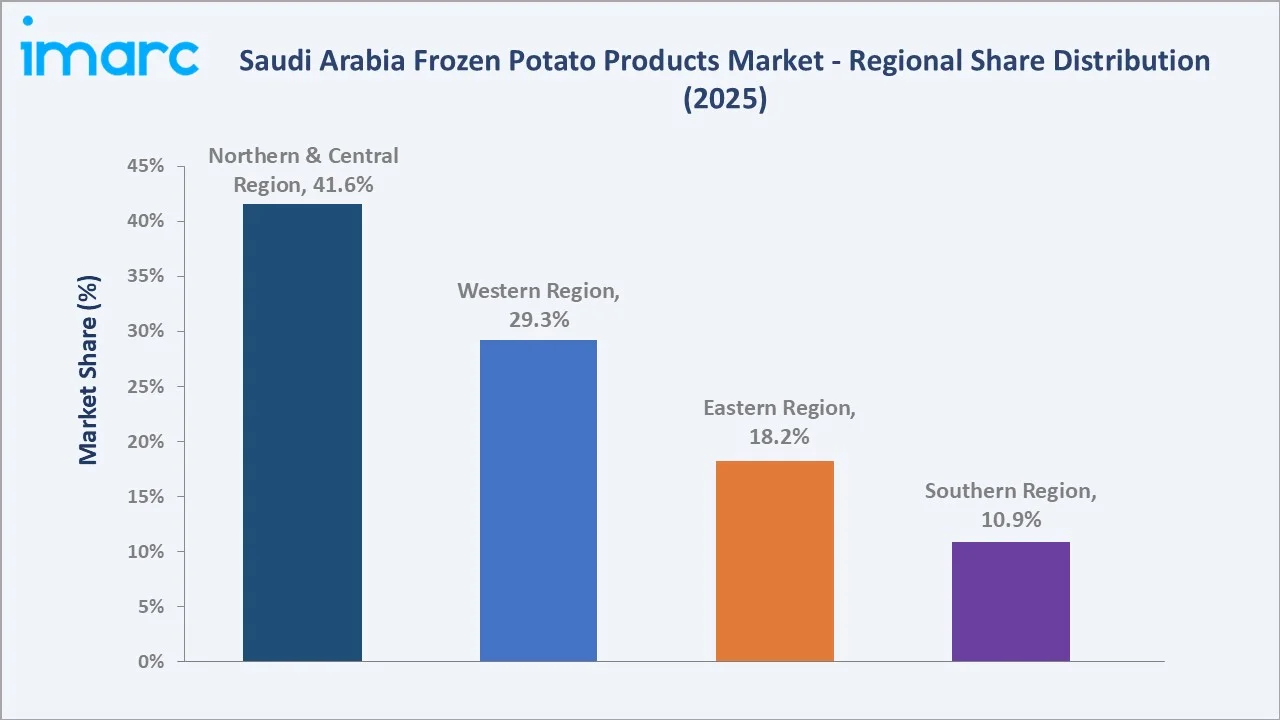
Eastern Region's 18.2% is supported by Dammam and Al-Khobar's expatriate population, oil industry workforce demand, and growing organized retail penetration. Southern Region's 10.9% represents the most nascent regional market, growing through QSR chain entry into smaller cities and improving cold-chain logistics infrastructure connecting southern provinces to national supply chains.
Competitive Landscape
Saudi Arabia frozen potato products market competitive landscape is characterized by dominance of global multinational brands in QSR institutional supply, growing regional player strength through domestic manufacturing investment, and increasing competition from private-label products in organized retail.
|
Company |
Key Brands |
Market Position |
Core Strength |
|
McCain Foods Limited |
McCain |
Market Leader |
A globally recognized leader in frozen potato processing, known for consistent product quality, extensive distribution networks, and strong relationships with major foodservice and retail clients across diverse international markets. |
|
Lamb Weston, Inc. |
Lamb Weston, Grown in Idaho |
Strong Challenger |
A leading frozen potato supplier with a broad product portfolio spanning fries, wedges, and specialty formats, supported by innovation in sustainable packaging and longstanding partnerships with global quick-service restaurant chains. |
|
Farm Frites |
Farm Frites |
Strong Challenger |
A specialized frozen potato processor recognized for premium product quality and expanding manufacturing footprint, with growing investments in regional production capacity to serve foodservice and retail customers across emerging markets. |
Key players include McCain Foods Limited, Lamb Weston, Inc., Farm Frites, and others.
Key Company Profiles
McCain Foods Limited
McCain Foods Limited is the world's largest manufacturer of frozen potato products and a leading supplier to Saudi Arabia's QSR and retail channels, known for its globally standardized fry quality, broad product portfolio, and deep institutional supply relationships across the Kingdom and the broader GCC region.
- Key Brands: McCain, McCain Superfries, McCain Smiles, McCain Wedges, among others.
- Strategic Focus: Maintaining QSR supply leadership through product quality consistency and innovation pipeline. McCain's strategic focus centers on deepening institutional supply relationships with global QSR chains operating in Saudi Arabia, while simultaneously investing in retail channel development through premium and health-oriented product lines. The company also aims to strengthen its cold-chain logistics infrastructure to ensure consistent product quality across all regions of the Kingdom.
Lamb Weston, Inc.
Lamb Weston, Inc. is a leading global supplier of frozen potato products and a major institutional supplier to Saudi Arabia's QSR sector, recognized for product quality, supply chain reliability, and sustainability innovation including the development of bio-renewable packaging with SABIC and OpackGroup.
- Key Brands: Lamb Weston, Grown in Idaho, Alexia, among others.
- Recent Developments: In October 2024, Lamb Weston collaborated with SABIC and OpackGroup to develop sustainable bio-renewable polyethylene packaging for frozen potato products, achieving approximately 30% carbon footprint reduction. This ISCC PLUS-certified packaging innovation is fully compliant with Saudi SFDA food safety standards and represents a significant sustainability milestone for the Saudi market.
- Strategic Focus: Strengthening QSR supply relationships and advancing sustainable packaging leadership in Saudi Arabia and the GCC. Lamb Weston's strategic priorities include expanding product innovation in premium and health-focused frozen potato formats, reinforcing cold-chain logistics reliability for Saudi operations, and leveraging its sustainability credentials to win preferred supplier status with retailers and QSR chains that are increasingly incorporating ESG criteria into procurement decisions.
Market Concentration Analysis
Saudi Arabia frozen potato products market is moderately concentrated in the QSR institutional supply segment, with the key players collectively commanding an estimated 55-65% of total frozen potato product imports by volume. The retail segment shows higher fragmentation, with multiple international and private-label brands competing through hypermarket shelf placement and promotional pricing.
Market concentration is evolving as domestic production capacity comes online at the various facility, creating a new dynamic by giving various companies a domestic cost advantage. The continued growth of organized retail and e-commerce channels is fragmenting the retail segment by enabling more brands to reach Saudi consumers through digital distribution.
Investment & Growth Opportunities
Highest Growth Segments
Food Services segment (~5.1% CAGR through QSR proliferation), French Fries premium formats (~4.9% CAGR through menu innovation), domestic processing expansion (above-market CAGR through import substitution), e-commerce grocery frozen food (~15-20% CAGR from small base), and Western Region hospitality-driven demand (~4.4% CAGR through tourism growth) represent Saudi Arabia's highest-growth frozen potato investment vectors through 2034.
Emerging Investment Opportunities
Saudi Arabia's domestic frozen potato processing sector, catalyzed by the Sudair facility investment, represents the most commercially transformative emerging investment opportunity. Investors can access this through supply chain partnerships, agricultural input provision, cold-chain logistics infrastructure, and co-investment in planned capacity expansions beyond the initial 70,000 MT/yr plant.
Investment Themes
- Domestic processing capacity expansion beyond the Sudair facility: Saudi Arabia's growing domestic demand and Vision 2030 food export ambitions support investment in additional frozen potato processing capacity, potentially extending from Riyadh's industrial zone to Jeddah and the Eastern Province to serve regional market clusters.
- Premium and health-oriented frozen potato product development for Saudi retail: Saudi consumers' rising health consciousness and premiumization trend create a commercially underserved opportunity for organic, low-fat, air-fry-ready, and nutrition-fortified frozen potato products targeting the retail segment's fastest-growing consumer subsegment.
Future Market Outlook (2026-2034)
The Saudi Arabia frozen potato products market is projected to grow from USD 530.5 Million in 2025 to USD 554.7 Million in 2026, reaching USD 792.5 Million by 2034, registering a CAGR of 4.56% during 2026-2034. The market's anchor value of USD 663.0 Million in 2030 represents a structural inflection driven by QSR proliferation, domestic processing capacity coming online, and rising retail frozen food consumption.
Three structural forces define Saudi Arabia frozen potato products market growth through 2034: Vision 2030's food security investments creating domestic production capacity; Saudi Arabia's young, urbanizing consumer base generating structural demand growth; and the QSR sector's continued expansion sustaining institutional frozen potato procurement at above-GDP-growth rates through 2034.
Research Methodology
Primary Research
Primary research comprised structured interviews with Saudi Arabia frozen potato products industry stakeholders, including QSR procurement managers, food service distributors, cold-chain logistics operators, retail category managers, and domestic processor executives. Consumer survey data from Saudi Arabia's urban food consumers across all four regions was also incorporated.
Secondary Research
Secondary research encompassed Saudi Arabia food import-export data from GASTAT, Saudi Vision 2030 food security policy documents, company annual reports, SFDA regulatory publications, GCC frozen food market reports, investor presentations, and trade press analysis. Over 50 secondary sources reviewed.
Forecasting Models
Market revenue forecasts were developed using a demand-side consumer expenditure model: Saudi Arabia's urban and semi-urban population segmented by income level multiplied by per-capita frozen potato product consumption and average price per kilogram, aggregated by channel and region. QSR institutional demand was modeled separately through outlet count growth and per-outlet procurement volume trajectories.
Saudi Arabia Frozen Potato Products Market Report Coverage:
| Report Features | Details |
|---|---|
| Base Year of the Analysis | 2025 |
| Historical Period | 2020-2025 |
| Forecast Period | 2026-2034 |
| Units | Million USD |
| Scope of the Report |
Exploration of Historical Trends and Market Outlook, Industry Catalysts and Challenges, Segment-Wise Historical and Future Market Assessment:
|
| Product Types Covered | French Fries, Tikkis, Potato Wedges, Potato Bites, Smileys, Others |
| Distribution Channels Covered | Business to Business, Supermarkets and Hypermarkets, Convenience Stores, Departmental Stores, Online, Others |
| End-Uses Covered | Food Services, Retail |
| Regions Covered | Northern and Central Region, Western Region, Eastern Region, Southern Region |
| Companies Covered | McCain Foods Limited, Lamb Weston Inc., Farm Frites , etc. |
| Customization Scope | 10% Free Customization |
| Post-Sale Analyst Support | 10-12 Weeks |
| Delivery Format | PDF and Excel through Email (We can also provide the editable version of the report in PPT/Word format on special request) |
Key Benefits for Stakeholders:
- IMARC’s industry report offers a comprehensive quantitative analysis of various market segments, historical and current market trends, market forecasts, and dynamics of the Saudi Arabia frozen potato products market from 2020-2034.
- The research report provides the latest information on the market drivers, challenges, and opportunities in the Saudi Arabia frozen potato products market.
- Porter's five forces analysis assist stakeholders in assessing the impact of new entrants, competitive rivalry, supplier power, buyer power, and the threat of substitution. It helps stakeholders to analyze the level of competition within the Saudi Arabia frozen potato products industry and its attractiveness.
- Competitive landscape allows stakeholders to understand their competitive environment and provides an insight into the current positions of key players in the market.
Frequently Asked Questions About the Saudi Arabia Frozen Potato Products Market Report
Saudi Arabia frozen potato products market size is estimated at USD 554.7 Million in 2026, driven by QSR expansion, Vision 2030 food security investments, and rising consumer demand for convenience food formats across urban Saudi Arabia.
Saudi Arabia frozen potato products market grows at 4.56% CAGR during 2026-2034, reaching USD 792.5 Million by 2034. Overall growth is sustained by QSR sector proliferation, domestic processing capacity buildout, rising urbanization, and Vision 2030's food diversification mandate sustaining above-average market expansion.
French Fries leads at 52.6% through universal QSR menu integration and institutional bulk procurement by Saudi Arabia's rapidly expanding fast food sector, including global chains and growing domestic QSR brands.
Food Services leads at 68.4% through Saudi Arabia's dominant QSR sector, hotel and hospitality institutional procurement, catering companies, and growing demand from cloud kitchen and dark kitchen channels.
Northern & Central Region leads at 41.6% through Riyadh's QSR concentration, organized retail dominance, and the strategic location of the new Sudair Industrial City processing facility, which positions the region as the Kingdom's frozen potato supply hub.
Leading companies include McCain Foods Limited, Lamb Weston, Inc., Farm Frites, and others.
Need more help?
- Speak to our experienced analysts for insights on the current market scenarios.
- Include additional segments and countries to customize the report as per your requirement.
- Gain an unparalleled competitive advantage in your domain by understanding how to utilize the report and positively impacting your operations and revenue.
- For further assistance, please connect with our analysts.
 Request Customization
 Speak to an Analyst
 Request Brochure
 Inquire Before Buying
Benefits of Customization
- Personalize this research
- Triangulate with your data
- Get data as per your format and definition
- Gain a deeper dive into a specific application, geography, customer, or competitor
- Any level of personalization
Get in Touch With Us
UNITED STATES
Phone: +1-201-971-6302
INDIA
Phone: +91-120-433-0800
UNITED KINGDOM
Phone: +44-753-714-6104
Email: [email protected]
Client Testimonials




.webp)




.webp)













Related Reports

Choose your plan
*Please note that the prices mentioned below are starting prices for each bundle type. Kindly contact our team for further details.*
Single User License
- 1 User License, Access on 2 Devices
- PDF Report + Excel Dataset (Password Protected)
- Lifetime Access
- No Printing Rights
- 10% Free Report Customization
- 10–12 Weeks of Analyst Support
Five User License
- Access for 5 Users, 2 Devices per User
- PDF Report + Excel Dataset (Password Protected)
- Lifetime Access
- Dedicated Account Manager
- 12–14 Weeks of Analyst Support
- No Printing Rights
- 15% Free Report Customization
- 25% Discount on Your Next Purchase
Corporate User License
- Unlimited User Access (Within Your Organization)
- PDF Report + Excel Dataset
- Lifetime Access
- Dedicated Account Manager
- 14–20 Weeks of Analyst Support
- No Printing Rights
- 20% Free Report Customization
- 30% Discount on Your Next Purchase
Essential Insights
What's included:
3 reports
- Lifetime Access
- PDF Reports
- Excel Datasets
- 2 Weeks of Free Analyst Support
- 2 User Licenses
- Access on 2 Devices
- Printing Rights
- Complimentary PowerPoint (PPT) Version
- Complimentary License Upgrade
Professional Access
What's included:
5 reports
- Lifetime Access
- PDF Reports
- Excel Datasets
- 8 Weeks of Free Analyst Support
- 2 User Licenses
- Access on 2 Devices
- Printing Rights
- Complimentary PowerPoint (PPT) Version
- Complimentary License Upgrade
Business Advantage
What's included:
8 reports
- Lifetime Access
- PDF Reports
- Excel Datasets
- 14 Weeks of Free Analyst Support
- 2 User Licenses
- Access on 2 Devices
- Printing Rights
- Complimentary PowerPoint (PPT) Version
- Complimentary License Upgrade
Enterprise Intelligence
What's included:
10 reports
- Lifetime Access
- PDF Reports
- Excel Datasets
- 20 Weeks of Free Analyst Support
- 2 User Licenses
- Access on 2 Devices
- Printing Rights
- Complimentary PowerPoint (PPT) Version
- Complimentary License Upgrade