
Saudi Arabia Green Tea Market Size, Share, Trends and Forecast by Type, Flavor, Distribution Channel, and Region, 2026-2034
Saudi Arabia Green Tea Market Size, Share, Trends & Forecast (2026-2034)
The Saudi Arabia green tea market reached USD 148.0 Million in 2025 and is projected to reach USD 236.4 Million by 2034, growing at a CAGR of 5.34% during 2026-2034. Growth is driven by rising health consciousness, expanding organized retail, and Vision 2030's wellness-oriented diversification agenda. Green tea bags dominate at 38.6% type share, reflecting convenience-led consumption habits. Lemon leads flavour preference at 26.4%, supported by its refreshing, low-calorie profile suited to Saudi Arabia's climate. The Northern and Central Region leads regionally at 39.7%, anchored by Riyadh's dense modern-retail network and high disposable incomes across the capital's expanding population.
Market Snapshot
|
Metric |
Value |
|
Market Size (2025) |
USD 148.0 Million |
|
Forecast Market Size (2034) |
USD 236.4 Million |
|
CAGR (2026-2034) |
5.34% |
|
Base Year |
2025 |
|
Historical Period |
2020-2025 |
|
Forecast Period |
2026-2034 |
|
Largest Type |
Green Tea Bags (38.6%, 2025) |
|
Largest Flavour |
Lemon (26.4%, 2025) |
|
Dominant Region |
Northern & Central Region (39.7%, 2025) |
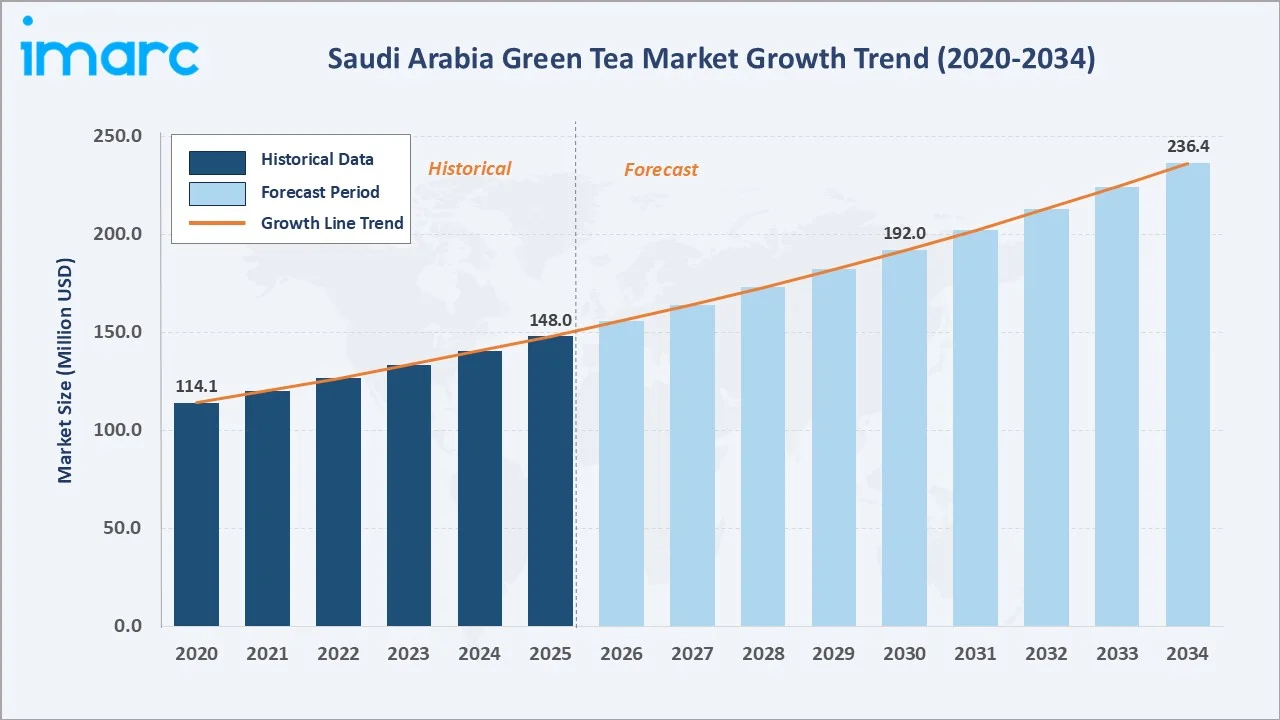
The market expanded from USD 114.1 Million in 2020 to USD 148.0 Million in 2025, anchored at USD 192.0 Million in 2030, and forecast to reach USD 236.4 Million by 2034. Growth is supported by rising urban health awareness, expanding modern-retail footprints, and government-backed wellness campaigns under Saudi Arabia's Vision 2030 National Transformation Program.
To get more information on this market, Request Sample
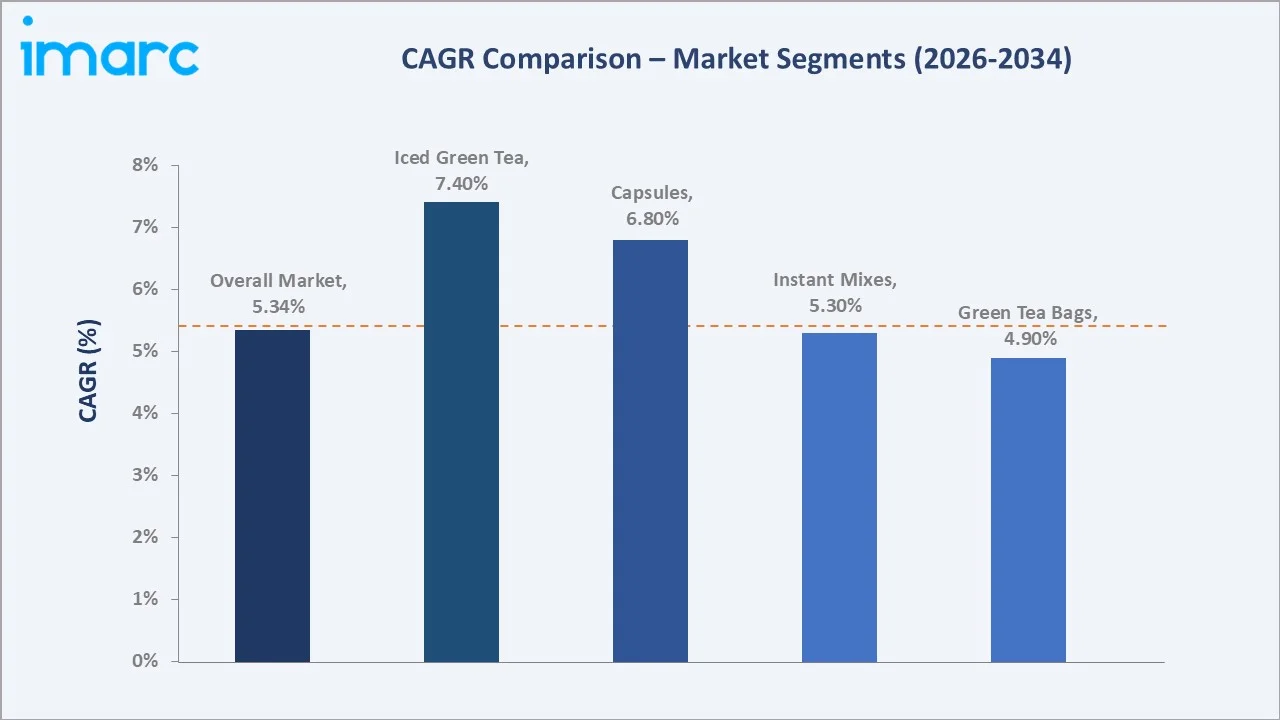
Iced green tea posts the fastest type-level growth at an estimated 7.4% CAGR (2026-2034), driven by convenience-led cold-beverage demand suited to Saudi Arabia's hot climate. Green tea bags retain the largest base but grow more moderately near 4.9% CAGR, reflecting category maturity relative to emerging ready-to-drink formats gaining traction among younger consumers.
Executive Summary
The Saudi Arabia green tea market reached USD 148.0 Million in 2025, propelled by a young, increasingly health-conscious population and one of the Gulf's most rapidly modernizing retail sectors. Rising awareness of green tea's antioxidant and low-calorie benefits is gradually reshaping beverage preferences long dominated by black tea and Arabic qahwa. The market is forecast to reach USD 236.4 Million by 2034 at a 5.34% CAGR, reflecting sustained demand from Vision 2030's wellness-focused diversification and expanding hypermarket and e-commerce distribution networks across the Kingdom.
Green tea bags command 38.6% of 2025 volume, favored for convenience and consistent brewing quality across households and offices. Lemon leads flavour preference at 26.4%, followed by Jasmin at 18.7%, reflecting consumer appetite for citrus-forward and floral profiles well suited to Saudi Arabia's warm climate. The Northern and Central Region dominates at 39.7%, anchored by Riyadh's concentration of modern retail infrastructure and affluent, urban consumers.
Looking ahead, premiumization, flavoured variants, and functional or organic positioning are expected to widen the market's addressable base, while growing online retail penetration accelerates access to imported specialty brands. The overall market outlook remains positive through the 2026-2034 forecast period.
Key Market Insights
|
Insight |
Data |
|
Largest Type |
Green Tea Bags - 38.6% share (2025) |
|
Largest Flavour |
Lemon - 26.4% share (2025) |
|
Dominant Region |
Northern & Central Region - 39.7% share (2025) |
|
Fastest Growing Type |
Iced Green Tea - ~7.4% CAGR (2026-2034) |
|
Top Companies |
Al Kbous Group, Associated British Foods, Tata Group, and Ahmed Mohamed Saleh Baeshen & Co. |
Key Analytical Observations Supporting The Above Data:
- Green tea bags at 38.6% share (2025) led by convenience and portion consistency: Tea bags eliminate measuring and straining, making them the default choice for busy households, offices, and hospitality outlets across Saudi Arabia's fast-urbanizing cities.
- Lemon flavour at 26.4% share (2025) driven by refreshing, low-calorie appeal: Citrus-forward green tea aligns with Saudi consumers' preference for light, cooling beverages during the Kingdom's long, hot summer months.
- Northern & Central Region dominant with 39.7% share (2025): The region benefits from Riyadh's concentration of hypermarkets, specialty tea retailers, and the Kingdom's highest average household disposable income.
- Iced green tea is the fastest-growing type at an estimated 7.4% CAGR (2026-2034): Ready-to-drink formats capitalize on Saudi Arabia's high year-round temperatures and growing on-the-go consumption occasions.
- Jasmin flavour ranks second at 18.7% share (2025): Its aromatic profile appeals strongly to younger, wellness-oriented consumers seeking variety beyond traditional lemon blends.
- Online retail is expanding access to premium and organic green tea imports: E-commerce and quick-commerce platforms are shortening the path between global specialty brands and Saudi Arabia's more than 35 million residents.
Saudi Arabia Green Tea Market Overview
Saudi Arabia's green tea market encompasses tea bags, loose leaf, iced or ready-to-drink formats, instant mixes, and capsules sold through supermarkets, specialty stores, and online platforms. The market is highly import-driven, as the Kingdom has no domestic tea cultivation, relying on processed green tea leaf sourced primarily from China, Sri Lanka, Kenya, and Vietnam through licensed importers and multinational distributors. Regulatory oversight falls under the Saudi Food and Drug Authority (SFDA), which mandates food-safety compliance and, effective July 1, 2025, requires caffeine-content disclosure on beverages offered on physical and electronic menus. Vision 2030's diversification agenda and rising urban health consciousness continue to expand green tea's addressable consumer base.
Market Dynamics
To evaluate market opportunities, Request Sample
Market Drivers
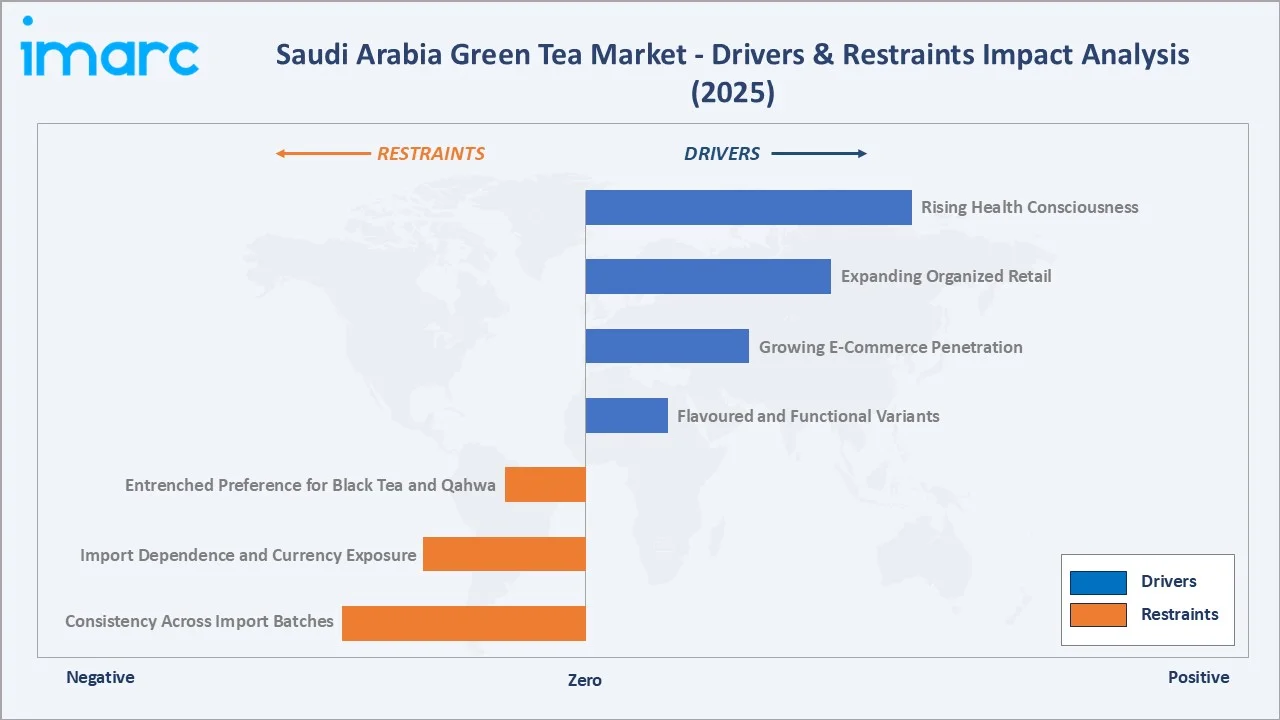
- Rising Health Consciousness: Vision 2030's National Transformation Program promotes preventive health, lifting demand for low-calorie, antioxidant-rich beverages such as green tea across all income segments.
- Expanding Organized Retail: Hypermarket and supermarket chains are widening green tea's shelf presence beyond traditional grocery formats, improving product visibility and trial.
- Growing E-Commerce Penetration: Online grocery and quick-commerce platforms are shortening delivery times for imported and specialty green tea brands across major Saudi cities.
- Flavoured and Functional Variants: Lemon, Jasmin, and wellness-oriented blends are broadening green tea's appeal beyond traditional tea-drinking households.
Market Restraints
- Entrenched Preference for Black Tea and Qahwa: Traditional hospitality customs continue to favor black tea and Arabic coffee, limiting green tea's penetration in older and rural households.
- Import Dependence and Currency Exposure: Near-total reliance on imported leaf exposes pricing to global freight costs and USD-pegged SAR exchange dynamics amid tea commodity cycles.
Market Opportunities
- Premium and Organic Launches: Affluent, health-focused consumers in Riyadh and Jeddah present a growing addressable base for certified-organic and single-origin green tea.
- Quick-Commerce Expansion: Direct-to-consumer online tea retail is widening access to specialty and imported brands beyond traditional hypermarket footprints.
Market Challenges
- Consistency Across Import Batches: Maintaining uniform flavour and quality across leaf sourced from multiple origin countries remains an operational challenge for distributors.
- Regulatory Compliance Costs: SFDA's caffeine-disclosure and nutrition-labeling requirements, effective from July 2025, add packaging and reformulation costs for brand owners.
Emerging Market Trends
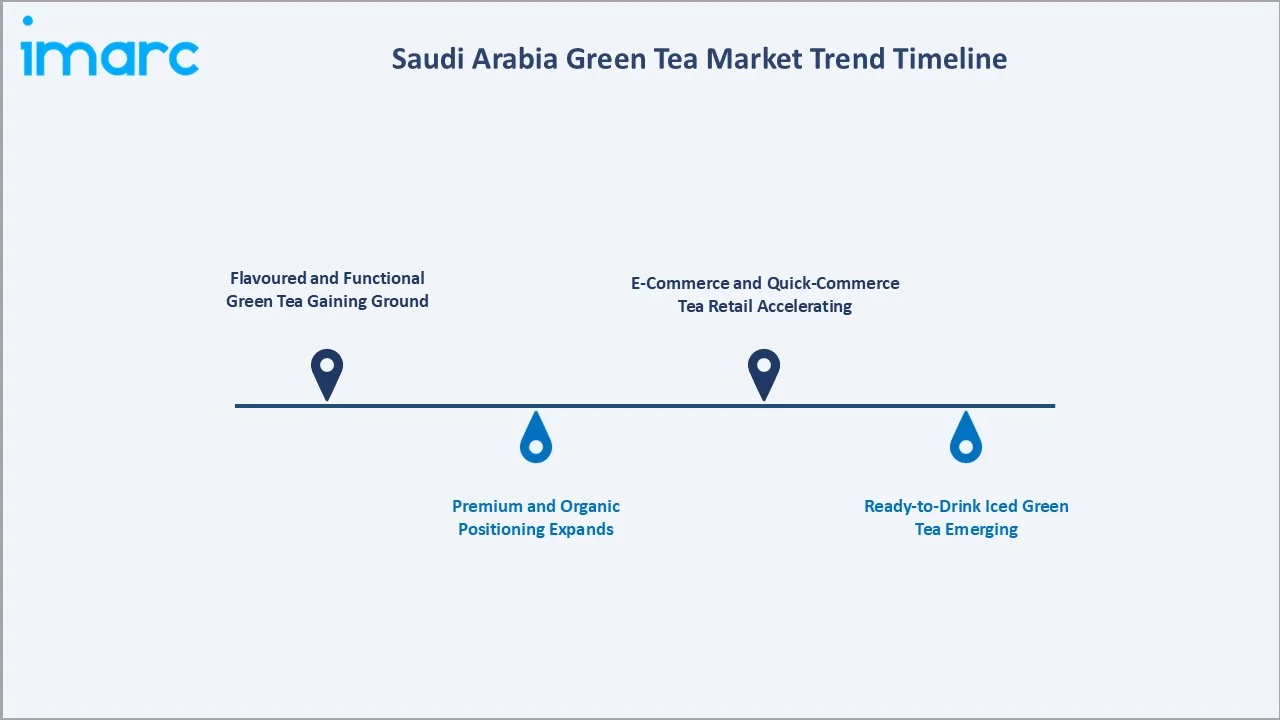
1. Flavoured and Functional Green Tea Gaining Ground
Lemon and Jasmin variants collectively hold over 45% of 2025 flavour share, as consumers increasingly seek digestive, immunity, and relaxation benefits alongside taste.
2. Premium and Organic Positioning Expands
Specialty importers are introducing single-origin and certified-organic green tea lines targeting Riyadh and Jeddah's growing affluent, wellness-oriented consumer segment.
3. E-Commerce and Quick-Commerce Tea Retail Accelerating
Online grocery platforms and rapid-delivery apps are shortening the path between global tea brands and Saudi households, particularly in Riyadh, Jeddah, and Dammam.
4. Ready-to-Drink Iced Green Tea Emerging
Iced green tea, growing near 7.4% CAGR (2026-2034), is capitalizing on Saudi Arabia's high year-round temperatures and rising on-the-go consumption occasions.
Industry Value Chain Analysis
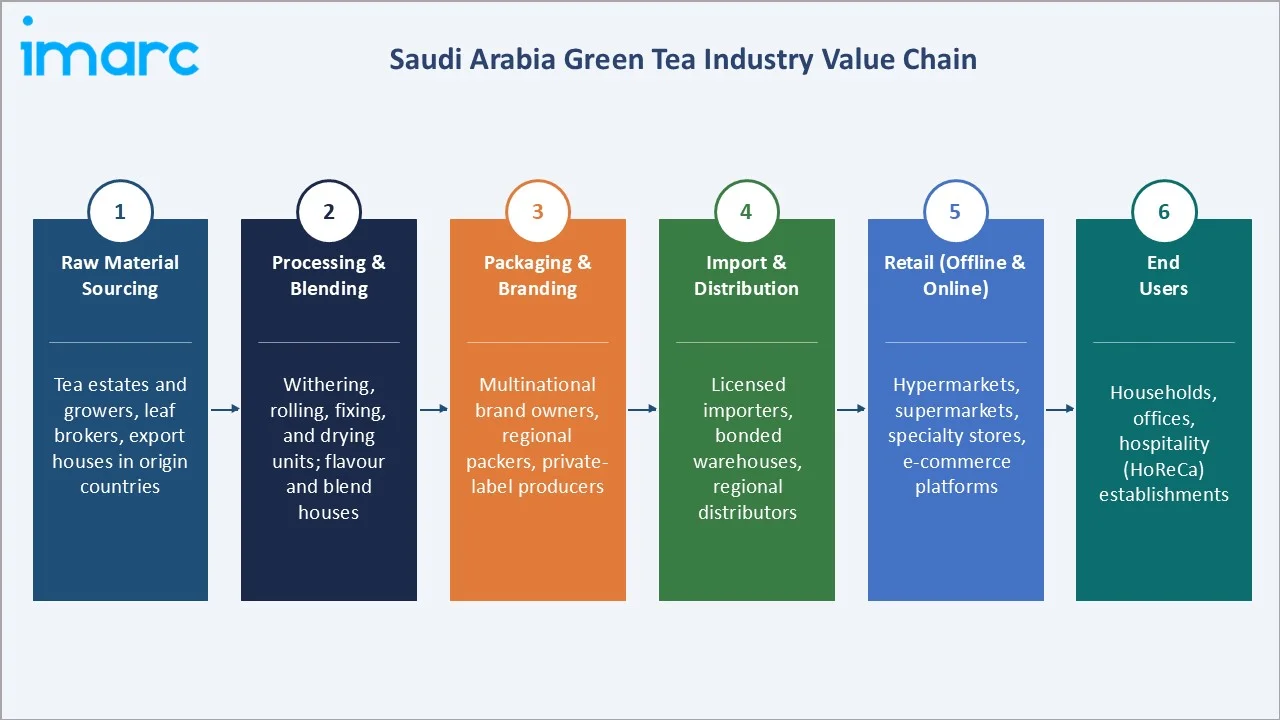
Saudi Arabia's green tea value chain spans raw-leaf sourcing from origin countries, processing and blending, brand packaging, licensed import and distribution, and multi-channel retail reaching end consumers across the Kingdom.
|
Stage |
Key Participants |
|
Raw Material Sourcing |
Tea estates and growers, leaf brokers, export houses in origin countries |
|
Processing & Blending |
Withering, rolling, fixing, and drying units; flavour and blend houses |
|
Packaging & Branding |
Multinational brand owners, regional packers, private-label producers |
|
Import & Distribution |
Licensed importers, bonded warehouses, regional distributors |
|
Retail (Offline & Online) |
Hypermarkets, supermarkets, specialty stores, e-commerce platforms |
|
End Users |
Households, offices, hospitality (HoReCa) establishments |
Saudi Arabia's tea distribution follows a two-tier model: global brand owners sell to licensed importers, who supply regional sub-distributors and retail outlets. Importers typically earn 12-18% margins, while specialty tea retailers earn 20-30% markup on unit pricing, with online channels gradually compressing traditional distributor margins.
Technology Landscape in the Saudi Arabia Green Tea Industry
Processing and Flavouring Technology
Modern withering and low-temperature drying techniques preserve catechin content and delicate aromatics, supporting premium green tea positioning versus mass-market black tea alternatives.
Packaging Innovation
Pyramid tea bags, biodegradable sachets, and resealable pouches are gaining share as brands respond to Saudi consumers' rising sustainability expectations and premium-format preferences.
Digital Retail and Traceability
QR-enabled packaging and e-commerce product pages increasingly disclose origin, caffeine content, and brewing guidance, aligning with SFDA's 2025 labeling-transparency requirements.
Sustainability in Sourcing
Rainforest Alliance and similar third-party certifications are appearing on premium green tea SKUs, reflecting growing retailer and consumer emphasis on ethical sourcing practices.
Market Segmentation Analysis
The report covers the following segments:
|
Segment Category |
Leading Segment |
Market Share |
Year |
|
Type |
Green Tea Bags |
38.6% |
2025 |
|
Flavour |
Lemon |
26.4% |
2025 |
|
Distribution Channel |
🔒 |
🔒 |
2025 |
|
Region |
Northern & Central Region |
39.7% |
2025 |

By Type
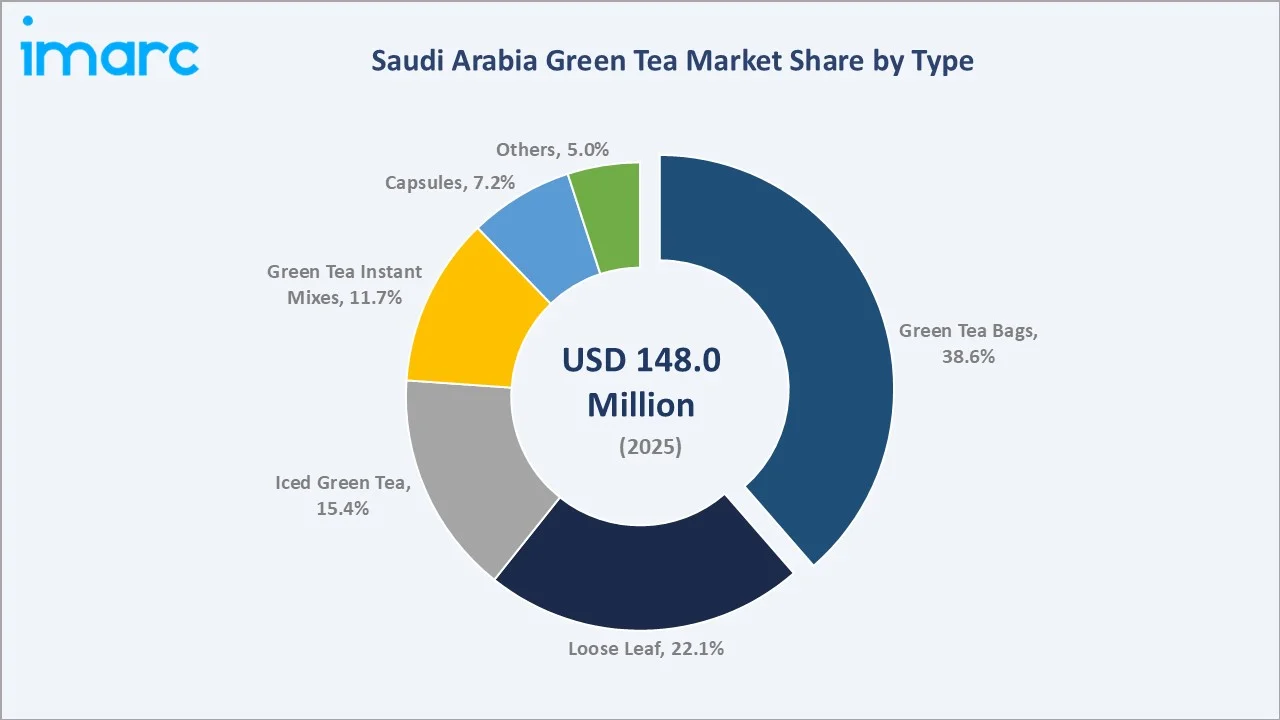
Green tea bags lead with 38.6% share (2025), driven by convenience, portion consistency, and broad availability across hypermarkets and convenience formats. Growth is supported by steady household replenishment demand, though the segment's forecast CAGR of approximately 4.9% (2026-2034) trails newer ready-to-drink formats.
To access detailed market analysis, Request Sample
Loose leaf holds the second-largest share at 22.1%, favored by traditional and premium consumers, while iced green tea at 15.4% is the fastest-growing format at an estimated 7.4% CAGR, reflecting rising cold-beverage demand. Instant mixes (11.7%) and capsules (7.2%) serve convenience-focused office and single-serve occasions. Others hold around 5.0% of the market share (2025).
By Flavour
Lemon dominates flavour preference at 26.4% share (2025), reflecting consumer demand for refreshing, low-calorie profiles suited to Saudi Arabia's warm climate. Its outlook remains favorable, supported by continued product line extensions across both hot and iced formats.
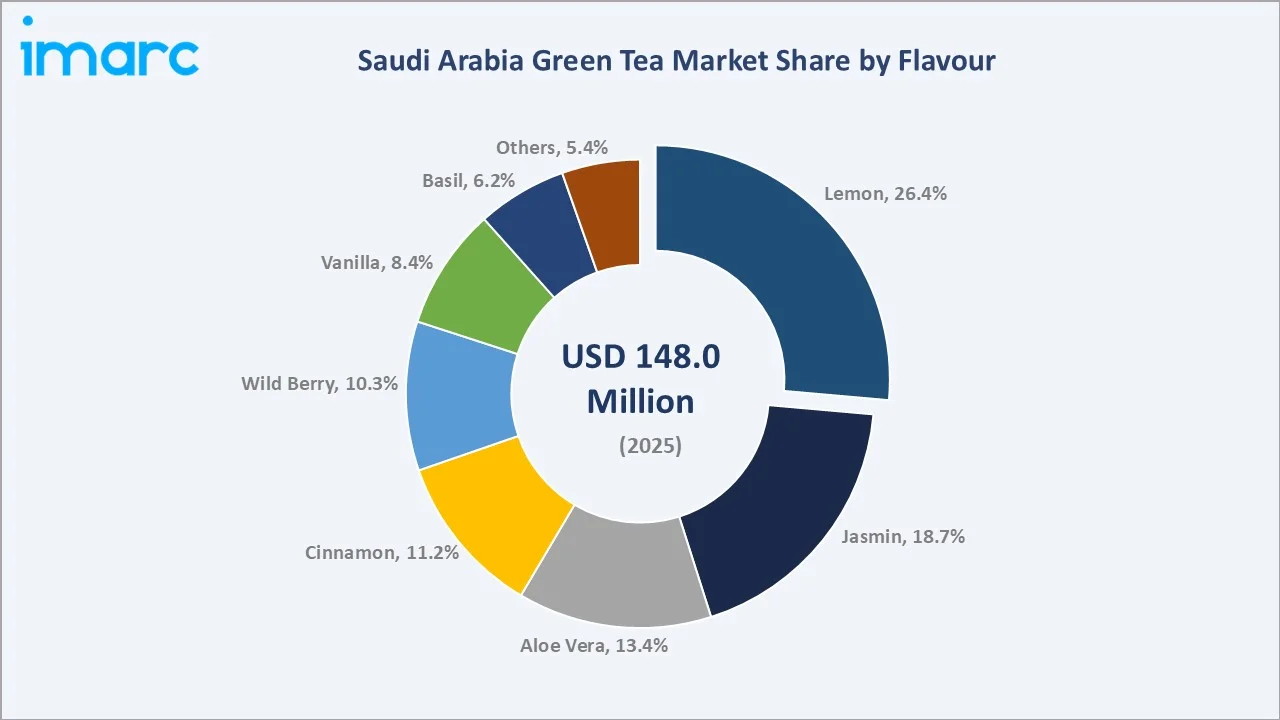
Jasmin follows at 18.7%, popular among younger consumers for its aromatic profile, while Aloe Vera (13.4%) and Cinnamon (11.2%) cater to functional-wellness positioning. Wild Berry (10.3%), Vanilla (8.4%), and Basil (6.2%) round out a diversifying flavour portfolio expected to broaden further through 2034.
Regional Market Insights
|
Region |
Shares (2025) |
Key Growth Drivers & Characteristics |
|
Northern & Central Region |
39.7% |
Highest population density and disposable income concentrated around Riyadh; strong hypermarket and specialty retail penetration; growing corporate and office tea consumption |
|
Western Region |
27.4% |
High tourism and religious travel around Makkah and Madinah lifting hospitality-sector tea demand; strong port-city logistics supporting import distribution |
|
Eastern Region |
20.3% |
Established expatriate professional communities and industrial hubs supporting modern retail and imported beverage demand |
|
Southern Region |
12.6% |
Emerging retail infrastructure and rising urbanization gradually expanding organized tea distribution reach |
The Northern and Central Region's 39.7% share (2025) reflects Riyadh's status as Saudi Arabia's economic and administrative capital, home to the highest concentration of modern retail and affluent, health-conscious consumers.
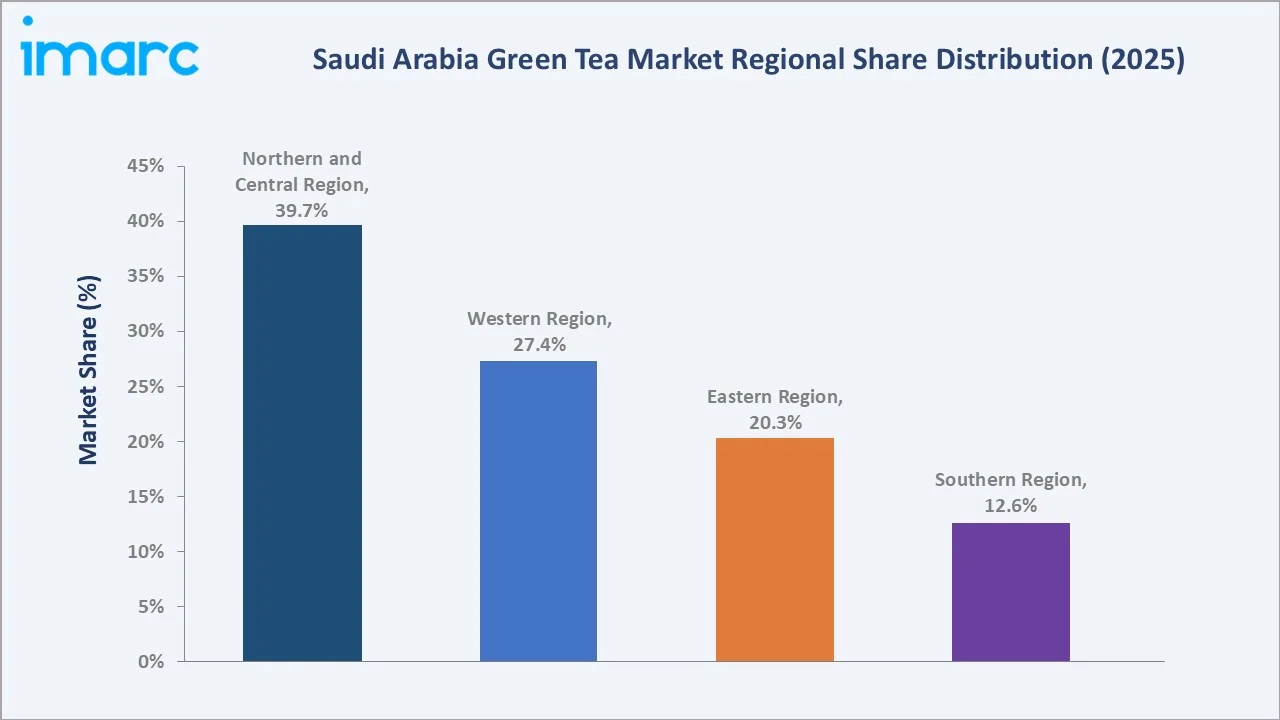
The Western Region's 27.4% share is anchored by Jeddah's commercial port role and Makkah and Madinah's year-round pilgrimage traffic, which sustains elevated hospitality-sector tea consumption. The Eastern Region's 20.3% share reflects industrial and expatriate-driven modern retail demand, while the Southern Region's 12.6% share continues to expand as retail infrastructure gradually develops.
Competitive Landscape
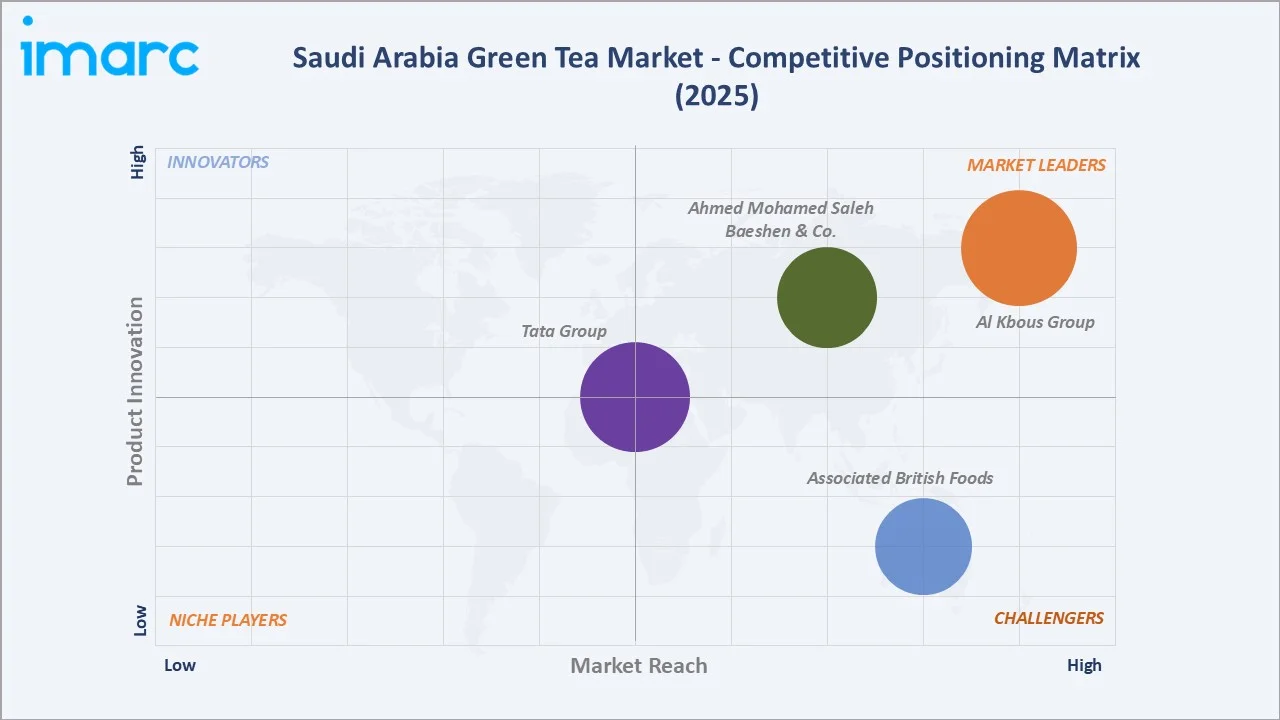
Saudi Arabia's green tea market is moderately concentrated among multinational brand owners, Associated British Foods' Twinings, and Tata Group’s Tetley collectively holding an estimated 50-60% of branded volume, alongside strong local competition from Al Kbous Group and Ahmed Mohamed Saleh Baeshen & Co.
|
Company Name |
Brand / Product Line |
Market Position |
Core Strength |
|
Al Kbous Group |
Green Tea Bags, Green Tea with Mint Bags |
Market Leader |
Deep-rooted local heritage and affordable pricing across mainstream retail channels |
|
Associated British Foods |
Twinings Pure Green Tea, Green Tea & Mint, Flavoured Green Teas |
Strong Challenger |
Premium positioning and broad specialty-flavour portfolio |
|
Tata Group |
Tetley Pure Green Tea |
Established Player |
Global sourcing scale and consistent quality across bag and loose-leaf formats |
|
Ahmed Mohamed Saleh Baeshen & Co. |
Rabea Natural Green Tea, Rabea Green Tea with Mint |
Market Leader |
Owns one of the largest tea production facilities and a dedicated tea lab in Saudi Arabia |
Key Company Profiles
Al Kbous Group
Al Kbous Group is a leading heritage brand offering a wide tea portfolio, including green tea with mint, distributed extensively across major Saudi grocery and hypermarket chains.
- Product Portfolio: Green Tea Bags, Green Tea with Mint Bags.
- Strategic Focus: Affordable pricing and deep local retail penetration built on decades of brand heritage.
Associated British Foods
Associated British Foods occupies a premium niche in Saudi Arabia's green tea market, offering a broad specialty-flavour range distributed through supermarkets and specialty retailers.
- Product Portfolio: Twinings Pure Green Tea, Green Tea & Mint, Flavoured Green Teas.
- Strategic Focus: Premium brand positioning anchored by specialty and flavoured tea innovation.
Market Concentration Analysis
Saudi Arabia's green tea market exhibits moderate concentration at the branded level. Associated British Foods' Twinings, and Tata Group's Tetley collectively hold an estimated 50-60% of branded volume (2025), reflecting strong multinational distribution scale.
Below this tier, the market fragments considerably. Rabea Tea and other local heritage brands compete strongly on price and distribution depth, while a growing number of specialty and organic importers serve Saudi Arabia's premium, health-focused consumer segment.
Consolidation trends remain limited, though global tea brands are increasingly pursuing direct Saudi distribution agreements to reduce importer margin layers, a shift gradually reshaping the Kingdom's tea distribution landscape.
Investment & Growth Opportunities
Fastest Growing Segments
Iced green tea (~7.4% CAGR), capsule formats (~6.8% CAGR), and instant mixes (~5.3% CAGR) represent Saudi Arabia's highest-growth green tea investment vectors through 2034, outpacing the overall market's 5.34% CAGR.
Emerging Market Opportunities
Saudi Arabia's expanding e-commerce infrastructure and Vision 2030 wellness agenda create a viable pathway for premium, organic, and functional green tea brands to scale distribution beyond traditional hypermarket channels.
Investment Themes
- Premium and organic tea portfolio development: Affluent Riyadh and Jeddah consumers present a first-mover opportunity for certified-organic, single-origin green tea positioning.
- Digital tea retail platform investment: Saudi Arabia's e-commerce growth supports online and quick-commerce tea platforms offering subscription and curated-flavour models.
- Ready-to-drink format expansion: Iced and functional green tea beverages present a compelling opportunity given the Kingdom's high year-round temperatures.
Future Market Outlook (2026-2034)
The Saudi Arabia green tea market is projected to grow from USD 148.0 Million in 2025 to USD 236.4 Million by 2034, at a 5.34% CAGR, reflecting steady, structurally supported growth underpinned by Vision 2030's wellness transformation.
The Kingdom's USD 192.0 Million market in 2030 will be shaped by continued urbanization, rising female workforce participation, and flavoured and functional product innovation that broadens green tea's consumer base beyond early adopters.
Three structural forces anchor this growth trajectory through 2034: Vision 2030's sustained wellness and diversification agenda, expanding organized and online retail infrastructure, and Saudi Arabia's demographic profile of a young, increasingly health-conscious population.
Research Methodology
Primary Research
Primary research comprised structured interviews with regional tea importers and distributors, hypermarket and specialty-retail category managers from Riyadh and Jeddah, and SFDA regulatory affairs specialists covering beverage labeling requirements.
Secondary Research
Secondary research encompassed Saudi Food and Drug Authority regulatory publications, General Authority for Statistics (GASTAT) demographic data, Saudi Vision 2030 program documentation, and company disclosures from major tea brand owners operating in the Kingdom.
Forecasting Models
Market forecasts were developed using demand-side models segmented by type, flavour, and region, validated against retail-channel trends and cross-checked with historical 2020-2025 growth patterns to project the 2026-2034 outlook.
Saudi Arabia Green Tea Market Report Coverage:
| Report Features | Details |
|---|---|
| Base Year of the Analysis | 2025 |
| Historical Period | 2020-2025 |
| Forecast Period | 2026-2034 |
| Units | Million USD |
| Scope of the Report |
Exploration of Historical Trends and Market Outlook, Industry Catalysts and Challenges, Segment-Wise Historical and Future Market Assessment:
|
| Types Covered | Green Tea Bags, Instant Mixes, Iced Green Tea, Loose Leaf, Capsules, Others |
| Flavors Covered | Lemon, Aloe Vera, Cinnamon, Vanilla, Wild Berry, Jasmine, Basil, Others |
| Distribution Channels Covered | Supermarkets/Hypermarkets, Specialty Stores, Convenience Stores, Online Stores, Others |
| Regions Covered | Northern and Central Region, Western Region, Eastern Region, Southern Region |
| Companies Covered | Al Kbous Group, Associated British Foods, Tata Group, Ahmed Mohamed Saleh Baeshen & Co., etc. |
| Customization Scope | 10% Free Customization |
| Post-Sale Analyst Support | 10-12 Weeks |
| Delivery Format | PDF and Excel through Email (We can also provide the editable version of the report in PPT/Word format on special request) |
Key Benefits for Stakeholders:
- IMARC’s industry report offers a comprehensive quantitative analysis of various market segments, historical and current market trends, market forecasts, and dynamics of the Saudi Arabia green tea market from 2020-2034.
- The research report provides the latest information on the market drivers, challenges, and opportunities in the Saudi Arabia green tea market.
- Porter's five forces analysis assist stakeholders in assessing the impact of new entrants, competitive rivalry, supplier power, buyer power, and the threat of substitution. It helps stakeholders to analyze the level of competition within the Saudi Arabia green tea industry and its attractiveness.
- Competitive landscape allows stakeholders to understand their competitive environment and provides an insight into the current positions of key players in the market.
Frequently Asked Questions About the Saudi Arabia Green Tea Market Report
The Saudi Arabia green tea market reached USD 148.0 Million in 2025, driven by rising health consciousness, expanding organized retail, and Vision 2030's wellness-focused diversification agenda.
The market is projected to grow at a 5.34% CAGR during 2026-2034, reaching USD 236.4 Million by 2034, supported by flavoured variants and expanding e-commerce distribution.
Green tea bags lead at 38.6% share (2025), driven by convenience, portion consistency, and wide availability across hypermarkets and supermarkets nationwide.
Lemon leads flavour preference at 26.4% share (2025), reflecting demand for refreshing, low-calorie profiles suited to Saudi Arabia's warm climate.
Iced green tea grows fastest at an estimated 7.4% CAGR (2026-2034), driven by rising cold-beverage demand and on-the-go consumption occasions.
The Northern and Central Region leads with 39.7% share (2025), anchored by Riyadh's dense modern-retail network and high disposable incomes.
Leading companies include Al Kbous Group, Associated British Foods, Tata Group, and Ahmed Mohamed Saleh Baeshen & Co., among others.
Vision 2030's wellness and diversification agenda is boosting demand for low-calorie, antioxidant-rich beverages, supporting sustained green tea category growth.
The market is projected to reach approximately USD 192.0 Million by 2030, supported by expanding organized retail and rising flavoured-variant adoption.
SFDA's July 2025 rule mandates caffeine-content disclosure on beverages, raising compliance costs but improving consumer transparency.
Need more help?
- Speak to our experienced analysts for insights on the current market scenarios.
- Include additional segments and countries to customize the report as per your requirement.
- Gain an unparalleled competitive advantage in your domain by understanding how to utilize the report and positively impacting your operations and revenue.
- For further assistance, please connect with our analysts.
 Request Customization
 Speak to an Analyst
 Request Brochure
 Inquire Before Buying
Benefits of Customization
- Personalize this research
- Triangulate with your data
- Get data as per your format and definition
- Gain a deeper dive into a specific application, geography, customer, or competitor
- Any level of personalization
Get in Touch With Us
UNITED STATES
Phone: +1-201-971-6302
INDIA
Phone: +91-120-433-0800
UNITED KINGDOM
Phone: +44-753-714-6104
Email: [email protected]
Client Testimonials




.webp)




.webp)













Related Reports

Choose your plan
*Please note that the prices mentioned below are starting prices for each bundle type. Kindly contact our team for further details.*
Single User License
- 1 User License, Access on 2 Devices
- PDF Report + Excel Dataset (Password Protected)
- Lifetime Access
- No Printing Rights
- 10% Free Report Customization
- 10–12 Weeks of Analyst Support
Five User License
- Access for 5 Users, 2 Devices per User
- PDF Report + Excel Dataset (Password Protected)
- Lifetime Access
- Dedicated Account Manager
- 12–14 Weeks of Analyst Support
- No Printing Rights
- 15% Free Report Customization
- 25% Discount on Your Next Purchase
Corporate User License
- Unlimited User Access (Within Your Organization)
- PDF Report + Excel Dataset
- Lifetime Access
- Dedicated Account Manager
- 14–20 Weeks of Analyst Support
- No Printing Rights
- 20% Free Report Customization
- 30% Discount on Your Next Purchase
Essential Insights
What's included:
3 reports
- Lifetime Access
- PDF Reports
- Excel Datasets
- 2 Weeks of Free Analyst Support
- 2 User Licenses
- Access on 2 Devices
- Printing Rights
- Complimentary PowerPoint (PPT) Version
- Complimentary License Upgrade
Professional Access
What's included:
5 reports
- Lifetime Access
- PDF Reports
- Excel Datasets
- 8 Weeks of Free Analyst Support
- 2 User Licenses
- Access on 2 Devices
- Printing Rights
- Complimentary PowerPoint (PPT) Version
- Complimentary License Upgrade
Business Advantage
What's included:
8 reports
- Lifetime Access
- PDF Reports
- Excel Datasets
- 14 Weeks of Free Analyst Support
- 2 User Licenses
- Access on 2 Devices
- Printing Rights
- Complimentary PowerPoint (PPT) Version
- Complimentary License Upgrade
Enterprise Intelligence
What's included:
10 reports
- Lifetime Access
- PDF Reports
- Excel Datasets
- 20 Weeks of Free Analyst Support
- 2 User Licenses
- Access on 2 Devices
- Printing Rights
- Complimentary PowerPoint (PPT) Version
- Complimentary License Upgrade