
Saudi Arabia Leisure Travel Market Size, Share, Trends and Forecast by Traveler Type, Age Group, Expenditure Type, Sales Channel, and Region, 2026-2034
Saudi Arabia Leisure Travel Market Size, Share, Trends & Forecast (2026-2034)
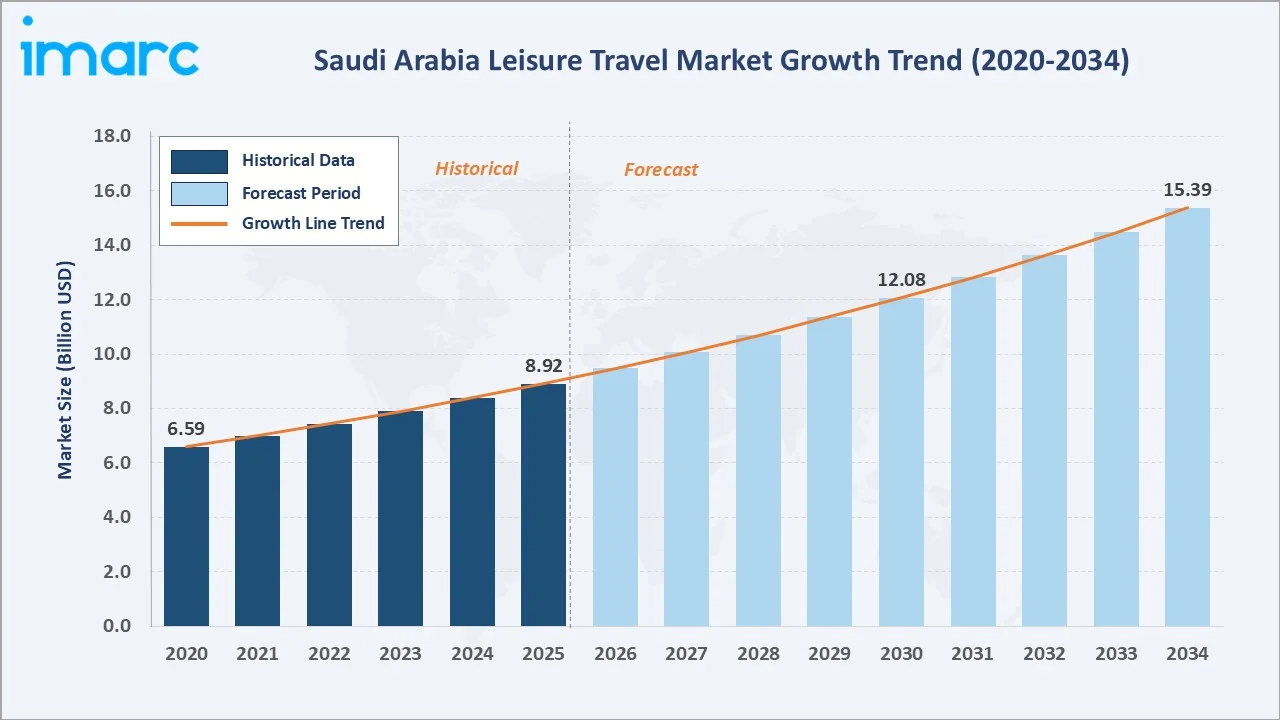
The Saudi Arabia leisure travel market size increased from USD 8.92 Billion in 2025 to USD 9.48 Billion in 2026. It is projected to reach USD 15.39 Billion by 2034, exhibiting a CAGR of 6.25% during 2026-2034. Growth is anchored by Vision 2030, which repositions tourism as a core pillar of economic diversification. The Kingdom welcomed around 120 million tourists in 2025, supported by a young, digital-first population and a wave of Public Investment Fund (PIF) giga-projects such as Red Sea Global, Diriyah, and Qiddiya. Group travel dominates with a 62.8% share (2025), while millennials lead by age at 39.7%. The Northern and Central Region is the largest regional market at 36.9% (2025).
Market Snapshot
|
Metric |
Value |
|
Base Year Market Size (2025) |
USD 8.92 Billion |
| Market Size (2026) | USD 9.48 Billion |
|
Forecast Market Size (2034) |
USD 15.39 Billion |
|
CAGR (2026-2034) |
6.25% |
|
Base Year |
2025 |
|
Historical Period |
2020-2025 |
|
Forecast Period |
2026-2034 |
|
Largest Traveler Type |
Group (62.8%, 2025) |
|
Largest Age Group |
Millennial (39.7%, 2025) |
|
Dominant Region |
Northern & Central Region (36.9%, 2025) |
The market expanded from USD 6.59 Billion in 2020 to USD 8.92 Billion in 2025 and an estimated USD 9.48 Billion in 2026. It is anchored at USD 12.08 Billion in 2030 and forecast to reach USD 15.39 Billion by 2034. This trajectory reflects rising leisure and holiday spending.
To get more information on this market, Request Sample
Online booking channels are expanding fastest across the forecast period. App bookings held a 76% share of Almosafer volumes in 2024. Among cohorts, Generation Z grows quickest at an estimated 7.6% CAGR (2026-2034). Group travel outpaces solo, aided by strong family and group demand.
.webp)
Executive Summary
The Saudi Arabia leisure travel market, which increased from USD 8.92 Billion in 2025 to an estimated USD 9.48 Billion in 2026. Momentum is driven by Vision 2030, record visitor volumes, and a fast-maturing domestic tourism culture. The Kingdom drew around 120 million tourists in 2025.
The market is projected to reach USD 15.39 Billion by 2034 at a 6.25% CAGR. Growth is supported by PIF giga-projects, expanding air connectivity, and a young, mobile-first population. Group travel commands 62.8% of the market in 2025, reflecting strong family and multi-generational trip demand. Millennials lead by age at 39.7%, followed by Generation Z at 27.8%.
Regionally, the Northern and Central Region dominates at 36.9% (2025), anchored by Riyadh and its entertainment, sports, and event calendar. The Western Region follows at 29.4%, supported by Jeddah, coastal tourism, and Red Sea destinations. The outlook remains robust as the Kingdom targets 150 million annual visitors by 2030.
Key Market Insights
|
Insight |
Data |
|
Largest Traveler Type |
Group - 62.8% share (2025) |
|
Largest Age Group |
Millennial - 39.7% share (2025) |
|
Fastest-Growing Cohort |
Generation Z - ~7.6% CAGR (2026-2034) |
|
Dominant Region |
Northern & Central Region - 36.9% (2025) |
|
Top Companies |
Seera Group Holding, Red Sea Global, Diriyah Company, and Qiddiya Investment Co. |
Key Analytical Observations Supporting The Above Data:
- Group travel leads at 62.8% (2025): Family and multi-generational trips anchor Saudi leisure demand. Almosafer reported over 70% growth in family and group bookings in 2024, reflecting a strong preference for shared experiences.
- Millennials dominate by age at 39.7% (2025): This cohort combines rising disposable income with high travel frequency. Their appetite for experience-led trips supports premium accommodation and in-destination activities.
- Generation Z grows fastest at ~7.6% CAGR: Younger travelers adopt mobile-first booking early. Their demand for events, entertainment, and social experiences aligns with Qiddiya and Riyadh Season offerings.
- Northern and Central Region leads at 36.9% (2025): Riyadh concentrates population, income, and a dense events calendar. Government and business-linked leisure trips reinforce its regional dominance.
- Online channels scale rapidly: App bookings reached a 76% share of Almosafer volumes in 2024, up from 67% in 2023. Digital platforms are becoming the default gateway for leisure planning.
Saudi Arabia Leisure Travel Market Overview
Saudi Arabia's leisure travel market covers holiday, recreational, cultural, and experience-led trips taken by domestic and inbound travelers. It spans transport, lodging, food and beverage, events, and entertainment spending. The Kingdom opened to international tourists in 2019, marking a structural shift in its travel economy.
The market operates under the Ministry of Tourism and the Saudi Tourism Authority (STA), which set strategy, licensing, and destination promotion. Macroeconomic drivers include Vision 2030 diversification, non-oil GDP growth, rising household incomes, and large-scale PIF investment. Travel and tourism capital investment reached roughly SAR 172 Billion in 2024.
Market Dynamics
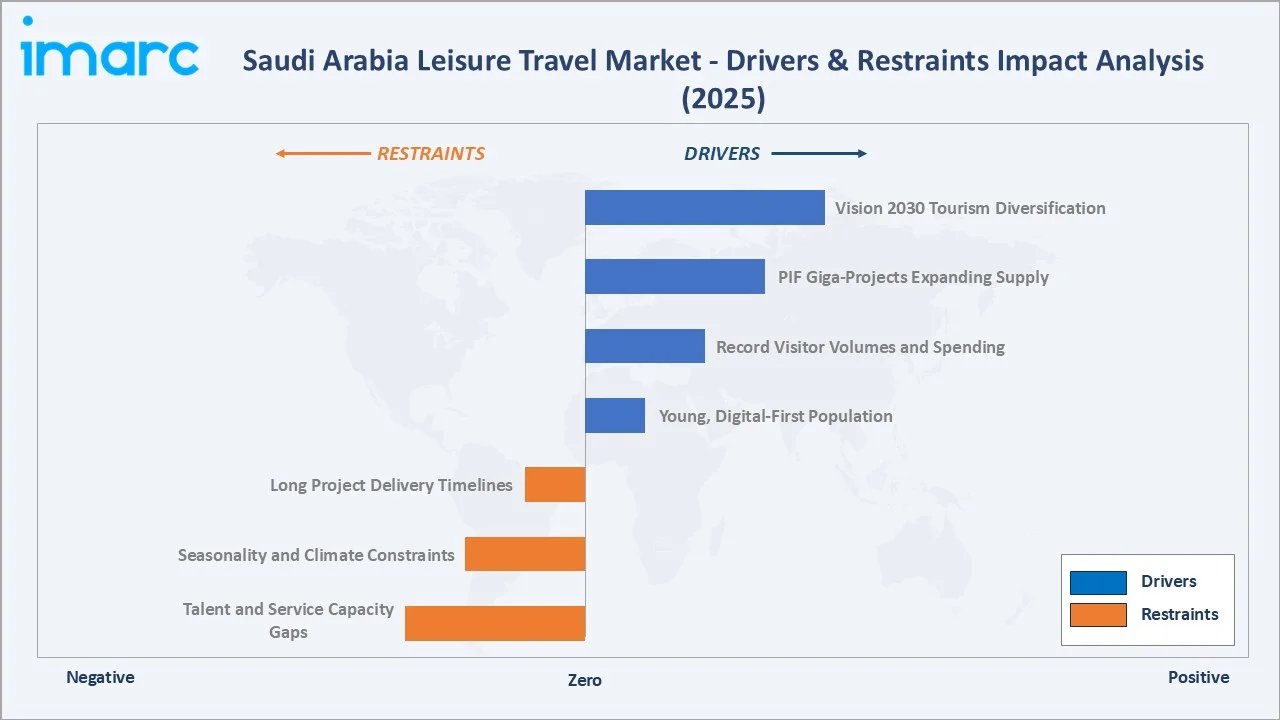
The market's direction is shaped by powerful policy tailwinds and a few structural constraints. The visual below summarizes the leading drivers and restraints as of 2025.
To evaluate market opportunities, Request Sample
Market Drivers
- Vision 2030 Tourism Diversification: Tourism is a central pillar of economic reform. The Kingdom targets 150 million annual visitors by 2030, split into 70 million international and 80 million domestic trips.
- PIF Giga-Projects Expanding Supply: Red Sea Global, Diriyah, Qiddiya, AlUla, and NEOM add world-class destinations. Red Sea Global alone plans 50 resorts and 8,000 rooms across 22 islands by 2030.
- Record Visitor Volumes and Spending: Saudi Arabia welcomed around 120 million tourists in 2025. Total tourism spending reached SAR 304 Billion, an 7% year-on-year rise, lifting leisure-linked demand.
- Young, Digital-First Population: A large youth base fuels experience-led travel. Domestic bookings surged 44% in 2024, per Almosafer, with mobile apps handling most transactions.
Market Restraints
- Long Project Delivery Timelines: Several flagship destinations open in phases through 2030. Delayed or staggered launches can temporarily limit inventory and cap near-term leisure capacity.
- Seasonality and Climate Constraints: Summer heat restricts outdoor tourism in many regions. Demand concentrates in cooler months and highland or coastal destinations, creating uneven utilization.
Market Opportunities
- Domestic Leisure Deepening: Residents increasingly choose local trips. Domestic tourists reached 86.2 million in 2024, spending SAR 115.3 Billion, opening scope for mid-market and premium experiences.
- Luxury and Regenerative Tourism: High-end coastal and wellness assets command premium pricing. AMAALA is expected to contribute around USD 3 Billion to GDP and create up to 50,000 jobs on completion.
Market Challenges
- Talent and Service Capacity Gaps: Rapid supply growth strains skilled hospitality staffing. New destinations must recruit and train quickly to sustain service quality and guest satisfaction.
- Global Demand Volatility: Leisure travel is sensitive to economic and geopolitical shocks. External demand swings can pressure inbound arrivals and forward bookings across source markets.
Emerging Market Trends
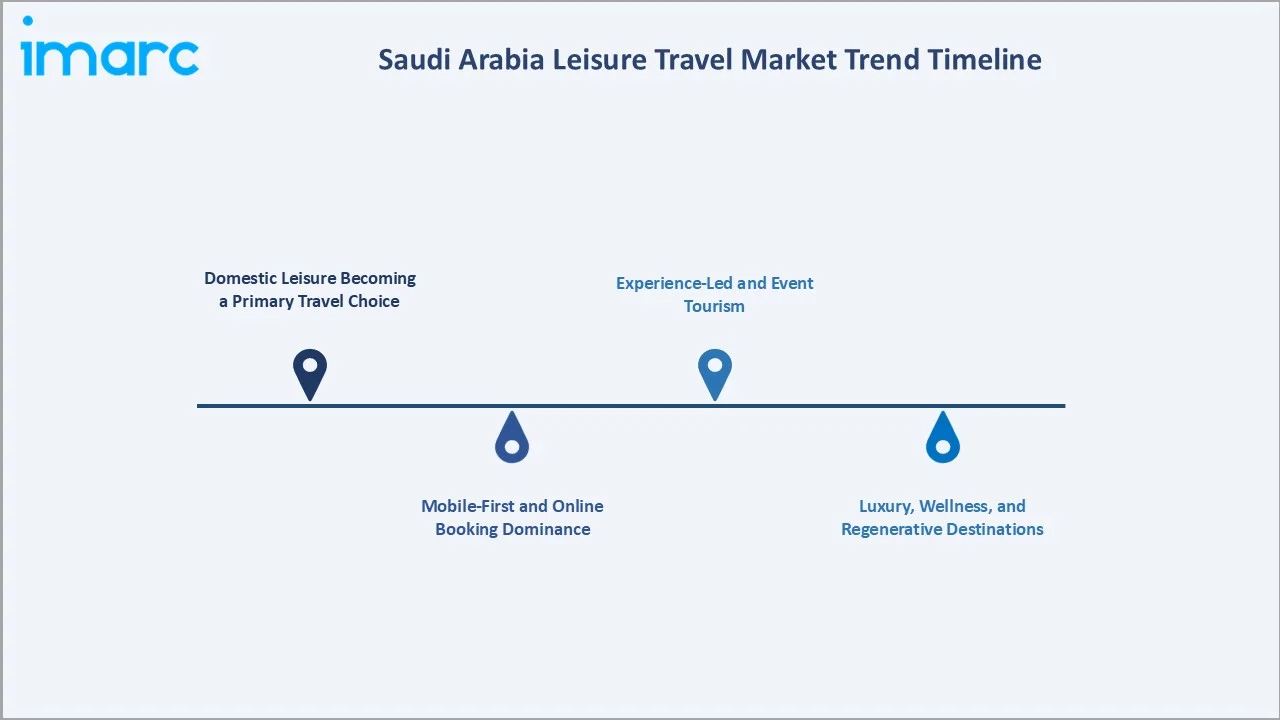
1. Domestic Leisure Becoming a Primary Travel Choice
Local travel has shifted from a fallback to a first choice. Domestic tourists spent SAR 115.3 Billion in 2024. Emerging destinations such as AlUla, Abha, and the Red Sea coast are drawing rising resident demand.
2. Mobile-First and Online Booking Dominance
Digital platforms now lead trip planning and purchase. App bookings held a 76% share of Almosafer volumes in 2024, up from 67% in 2023. Buys4-now-pay-later and flexible fares support younger, price-aware travelers.
3. Experience-Led and Event Tourism
Travelers increasingly prioritize events, entertainment, and culture. Riyadh Season, sports, and festivals lift trip frequency. Group and family segments favor experience-rich, activity-based itineraries over passive stays.
4. Luxury, Wellness, and Regenerative Destinations
Premium coastal and wellness assets are scaling. Red Sea and AMAALA resorts target high-value travelers. Regenerative tourism blends luxury stays with environmental restoration, differentiating Saudi Arabia's proposition.
Industry Value Chain Analysis
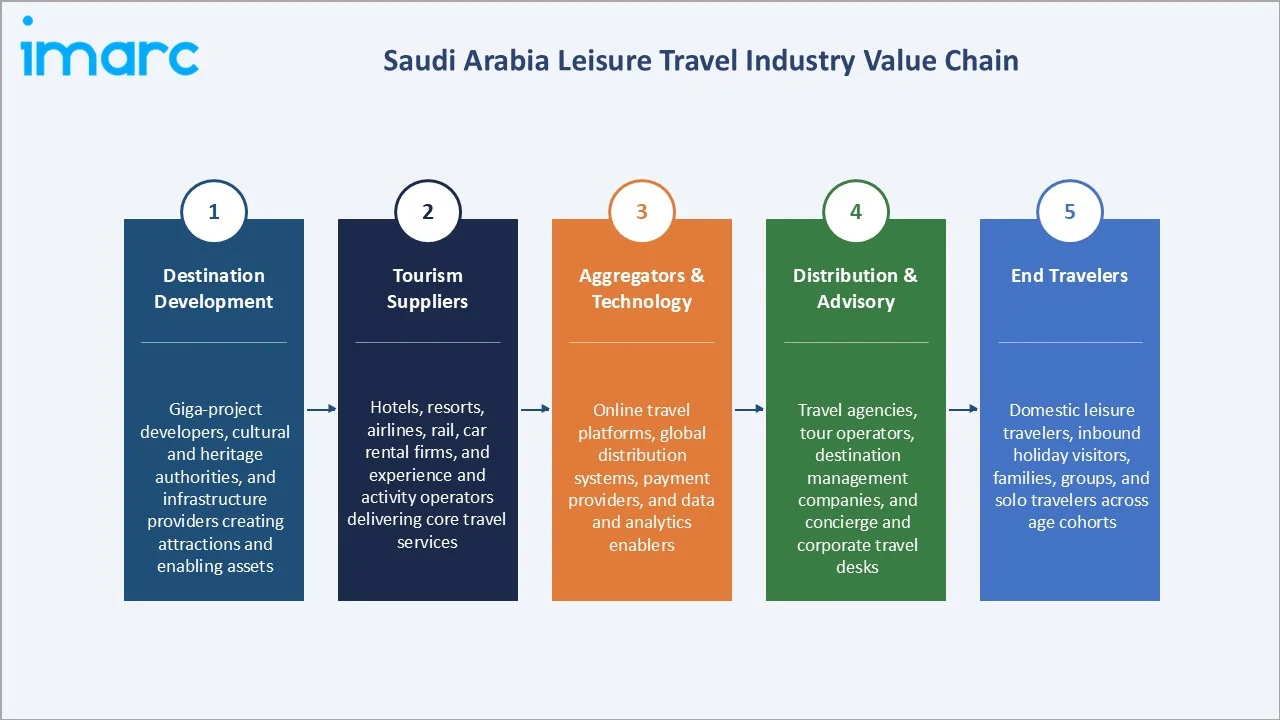
The Saudi leisure travel value chain links destination developers, tourism suppliers, technology aggregators, and distribution partners to the end traveler. Each stage adds service, access, or experience value along the journey.
|
Stage |
Key Participants |
|
Destination Development |
Giga-project developers, cultural and heritage authorities, and infrastructure providers creating attractions and enabling assets |
|
Tourism Suppliers |
Hotels, resorts, airlines, rail, car rental firms, and experience and activity operators delivering core travel services |
|
Aggregators & Technology |
Online travel platforms, global distribution systems, payment providers, and data and analytics enablers |
|
Distribution & Advisory |
Travel agencies, tour operators, destination management companies, and concierge and corporate travel desks |
|
End Travelers |
Domestic leisure travelers, inbound holiday visitors, families, groups, and solo travelers across age cohorts |
Value increasingly shifts toward digital aggregators and direct-to-traveler platforms. This compresses traditional agency margins. It also pushes suppliers to invest in owned booking channels, loyalty programs, and richer in-destination experiences.
Technology Landscape in the Saudi Arabia Leisure Travel Industry
Digital Booking and OTA Platforms
Online travel platforms now anchor the customer journey. Almosafer processed the majority of its 2024 bookings via mobile apps, which held a 76% share. Seamless search, pricing, and payment tools are standard expectations for Saudi leisure travelers.
AI, Personalization, and Payments
Providers are deploying AI-driven recommendations and dynamic pricing. Flexible payments, including buy-now-pay-later, reached about 25% of regional bookings in early 2025. Cloud infrastructure investment is strengthening platform scale and reliability across the Kingdom.
Smart Tourism and Immersive Experiences
Destinations are adopting smart-tourism tools, digital ticketing, and immersive attractions. Giga-projects integrate connected guest services and data-led operations. These technologies enhance visitor experience and support higher-value, experience-led leisure travel.
Market Segmentation Analysis
The report covers following segments:
|
Segment Category |
Leading Segment |
Market Share |
Year |
|
Traveler Type |
Group |
62.8% |
2025 |
|
Age Group |
Millennial |
39.7% |
2025 |
|
Expenditure Type |
🔒 |
🔒 |
2025 |
|
Sales Channel |
🔒 |
🔒 |
2025 |
|
Region |
Northern and Central Region |
36.9% |
2025 |

By Traveler Type
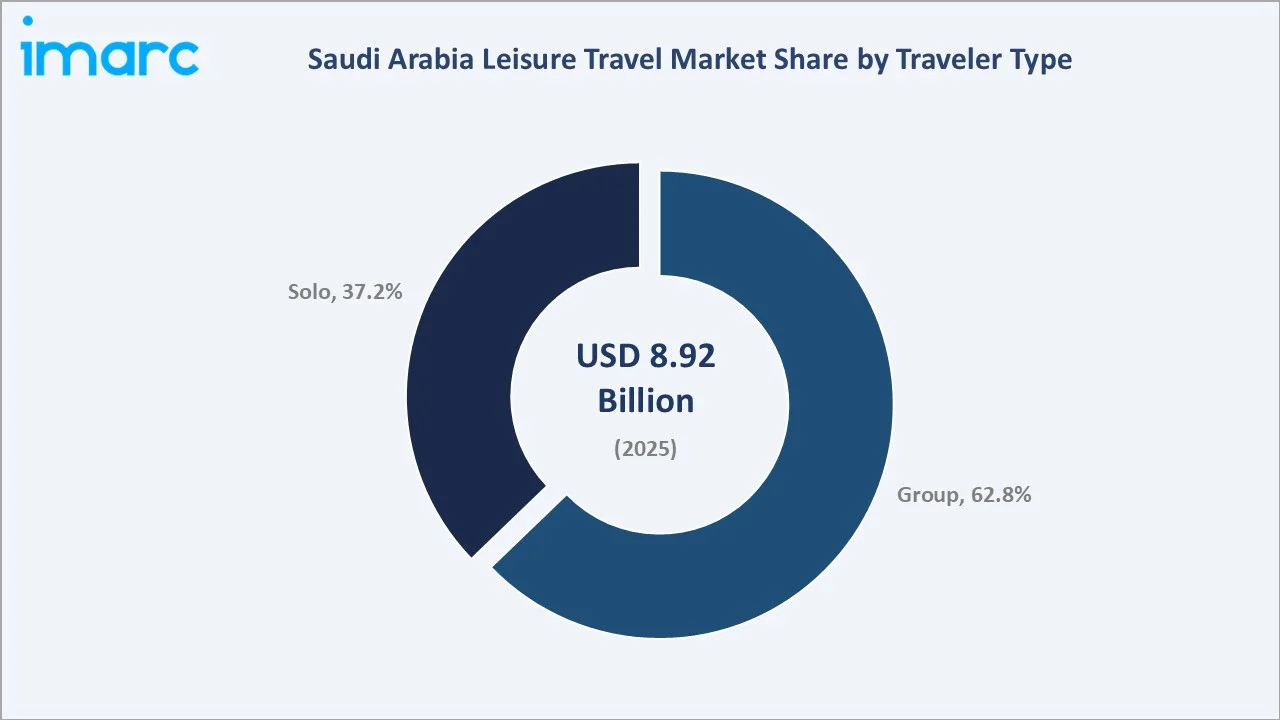
Group travel leads at 62.8% market share (2025). Saudi leisure demand skews toward families, extended relatives, and friend groups. Multi-generational trips are common, driven by cultural preference for shared travel and larger household sizes.
To access detailed market analysis, Request Sample
Solo travel holds 37.2% (2025) and is rising among younger, independent travelers. Growth is supported by safer, more accessible destinations and flexible online booking. Group travel, however, retains scale advantages in accommodation and activity spending.
By Age Group
Millennials dominate at 39.7% market share (2025). This cohort blends higher incomes with frequent, experience-led travel. It supports premium stays, curated activities, and strong online engagement across domestic and inbound leisure trips.
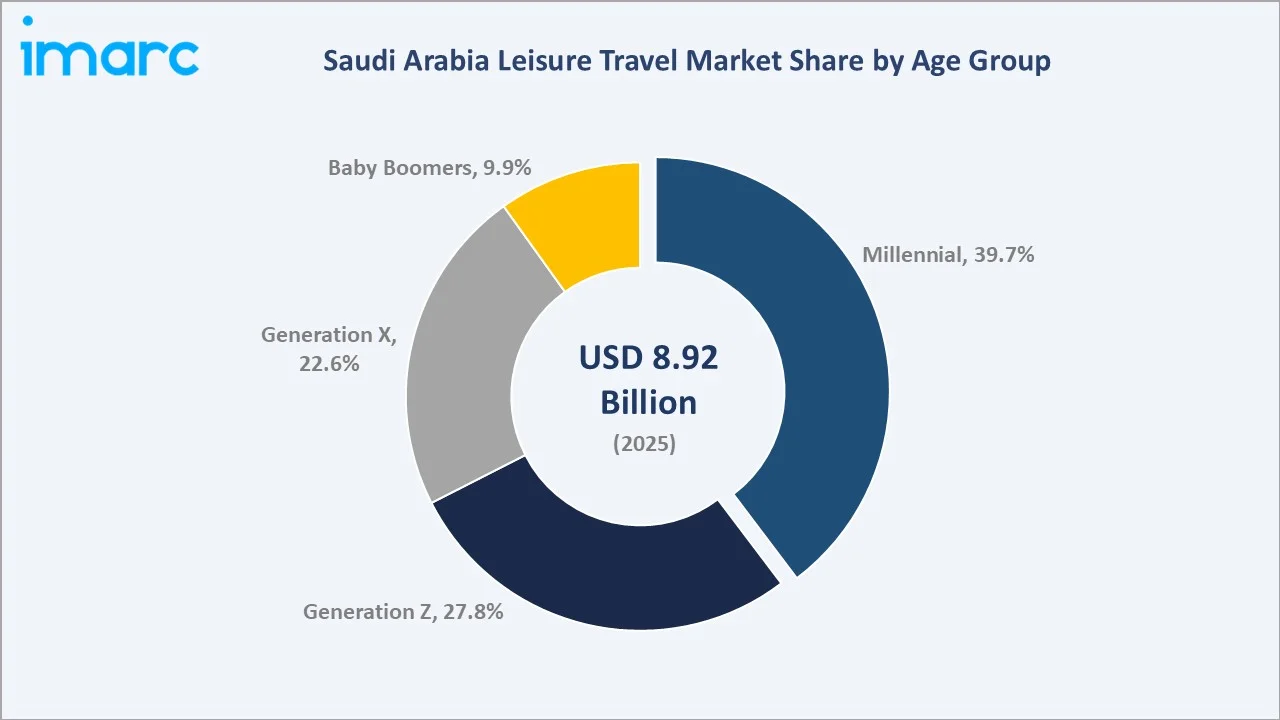
Generation Z follows at 27.8% and grows fastest at an estimated 7.6% CAGR. Generation X holds 22.6%, favoring family trips and comfort. Baby Boomers account for 9.9%, leaning toward cultural, heritage, and wellness travel.
Regional Market Insights
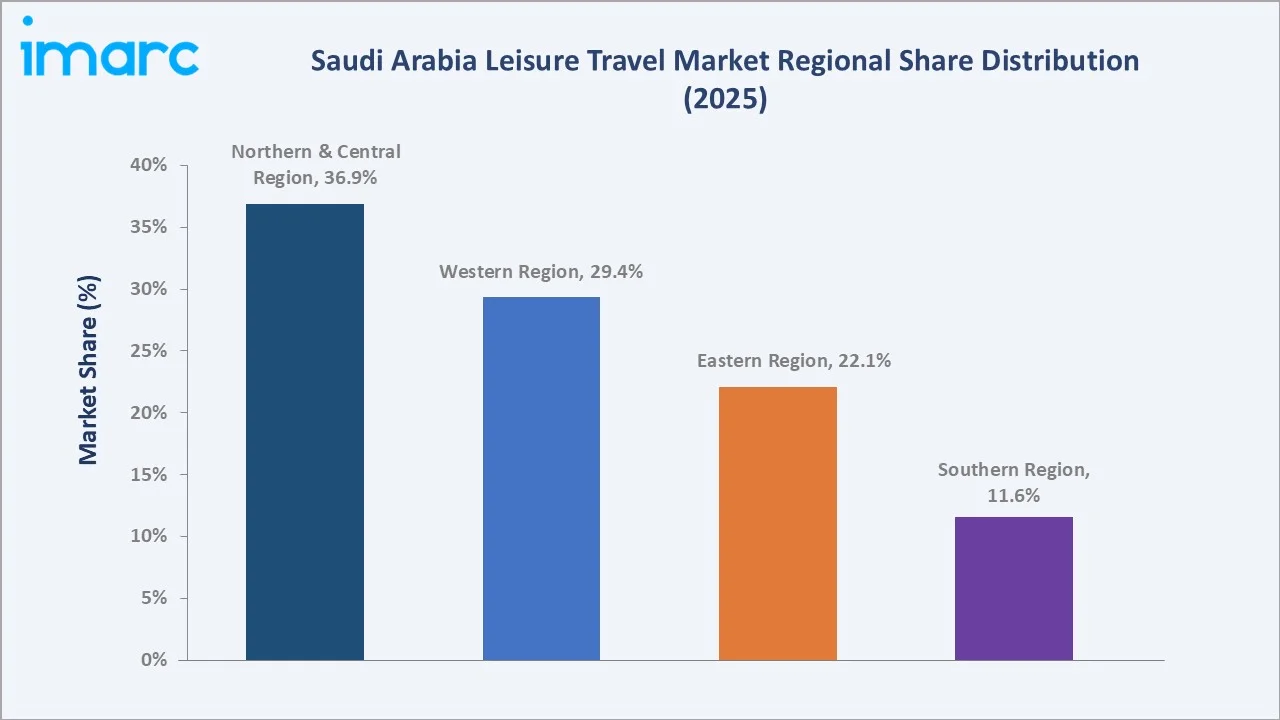
Leisure demand is distributed across four regions, each with distinct destinations and drivers. The table below outlines their qualitative characteristics; the figure that follows details the 2025 share split.
|
Region |
Share 2025 |
Key Characteristics |
|
Northern & Central Region |
36.9% |
High population and income concentration around Riyadh; dense events, sports, and entertainment calendar; strong government and business-linked leisure demand |
|
Western Region |
29.4% |
Jeddah gateway and coastal tourism; proximity to Red Sea destinations and heritage sites; strong hospitality base and international connectivity |
|
Eastern Region |
22.1% |
Coastal and corniche leisure; cross-border Gulf travel flows; growing entertainment and family-attraction offerings supporting weekend tourism |
|
Southern Region |
11.6% |
Highland and cool-climate escapes; nature, adventure, and heritage tourism; emerging infrastructure and rising domestic-visitor interest |
The Northern and Central Region leads on the strength of Riyadh's scale, its events economy, and concentrated purchasing power. The Western Region benefits from Jeddah and Red Sea coastal assets. Together they account for the majority of national leisure demand in 2025.
Competitive Landscape
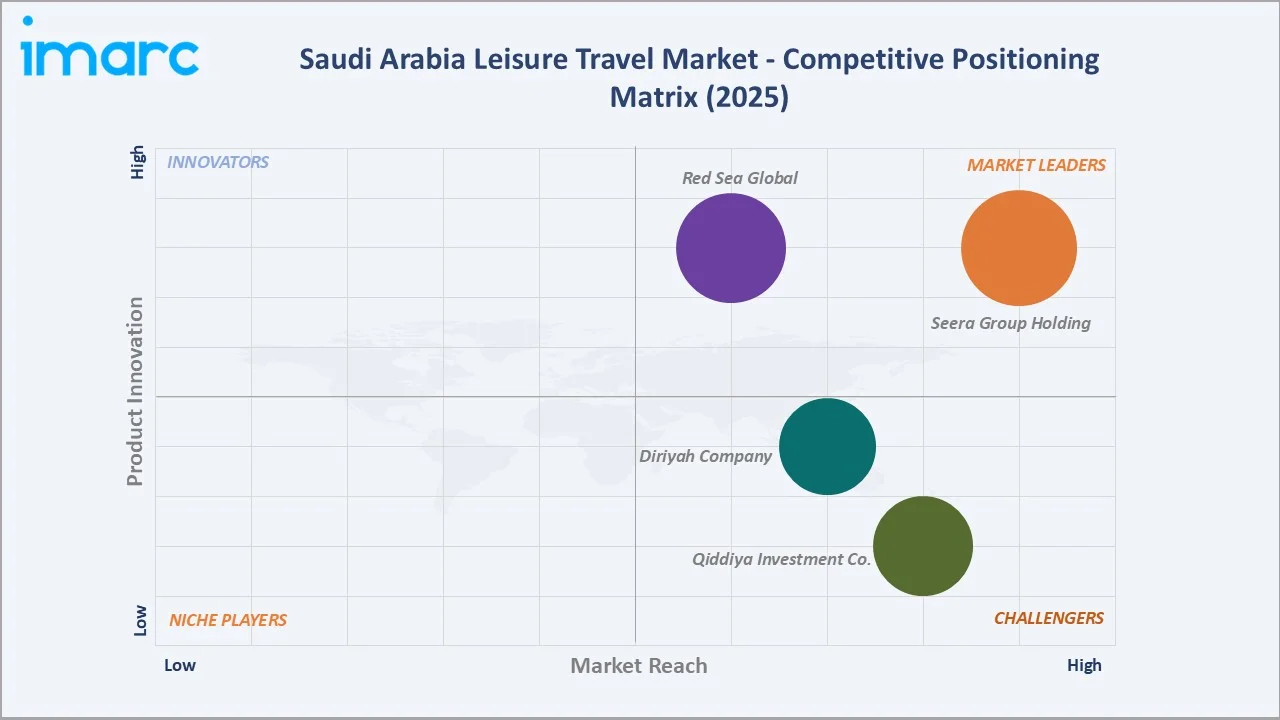
The Saudi leisure travel landscape blends travel-service leaders with PIF-backed destination developers and a national tourism enabler. Competition centers on scale, experience differentiation, and digital capability.
|
Company Name |
Brand / Service Line |
Market Position |
Core Strength |
|
Seera Group Holding |
Almosafer, Discover Saudi, Mawasim |
Market Leader |
Largest travel platform in the Middle East; digital-first booking and DMC scale |
|
Red Sea Global |
The Red Sea, AMAALA |
Market Leader |
Flagship regenerative luxury tourism destinations on the west coast |
|
Diriyah Company |
Diriyah, At-Turaif, Bab Samhan |
Strong Challenger |
Heritage and cultural tourism anchored in 300 years of Saudi history |
|
Qiddiya Investment Co. |
Six Flags Qiddiya City, Aquarabia |
Strong Challenger |
Entertainment, sports, and theme-park led leisure destination near Riyadh |
The market is moderately concentrated. Travel-service demand is led by Seera through Almosafer, while destination supply is dominated by PIF developers. Global OTAs and international hotel brands compete actively in distribution and accommodation.
Key Company Profiles
Seera Group Holding
Seera Group is one of Saudi Arabia's largest travel companies. Founded in 1979 as Al Tayyar Travel Group, it rebranded to Seera in 2019. Its Almosafer platform is positioned as the Kingdom's national champion for tourism.
- Key Brands: Almosafer, Discover Saudi, Mawasim, and others.
- Strategic Focus: Digital-first, omni-channel travel services scaling domestic and inbound leisure demand across consumer, corporate, and government segments.
Red Sea Global
Red Sea Global (RSG) is a PIF developer of regenerative luxury tourism. Launched in 2017, it delivers The Red Sea and AMAALA destinations. It is a flagship of Vision 2030's tourism diversification agenda.
- Key Brands: The Red Sea, AMAALA
- Strategic Focus: Regenerative, high-value tourism balancing luxury hospitality with environmental restoration and long-term destination growth.
Market Concentration Analysis
The Saudi leisure travel market shows moderate concentration. Travel-service distribution is led by Seera's Almosafer, the largest platform in the Middle East. Destination development is dominated by a small set of PIF giga-project companies.
Fragmentation is higher in accommodation and activities. Numerous domestic operators, international hotel brands, and global OTAs compete for share. No single brand controls the broader experience layer, keeping the mid-market competitive and dynamic.
Consolidation is advancing at the platform and hospitality level. PIF anchors supply-side scale, while national champions integrate booking, distribution, and content. This structure supports Vision 2030's 150 million-visitor ambition for 2030.
Investment & Growth Opportunities
Fastest-Growing Segments
Online booking channels, Generation Z travel, and experience-led group tourism represent the highest-growth vectors through 2034. Digital platforms and events tourism offer the strongest scaling potential, aligned with a young, connected population.
Emerging Market Opportunities
Domestic leisure deepening is a major opportunity. Residents took 86.2 million domestic trips in 2024. Luxury coastal, wellness, and heritage destinations can capture premium, high-yield demand as giga-projects reach operational scale.
Investment Themes
- Digital travel platforms: Mobile-first booking, AI personalization, and flexible payments create room for platform investment as online adoption accelerates across leisure segments.
- Experience and events assets: Entertainment, sports, and cultural venues capture rising youth demand. Qiddiya and Riyadh Season illustrate the scale of the events opportunity.
- Premium and regenerative hospitality: Red Sea and AMAALA-style assets target high-value travelers, offering strong per-visitor economics and differentiated global positioning.
Future Market Outlook (2026-2034)
The Saudi Arabia leisure travel market is projected to grow from USD 8.92 Billion in 2025 to USD 9.48 Billion in 2026, reaching USD 15.39 Billion by 2034, at a 6.25% CAGR. The 2030 milestone of USD 12.08 Billion aligns with peak giga-project openings and the Kingdom's 150 million-visitor ambition.
Three forces anchor the outlook. First, Vision 2030 creates durable, policy-backed tourism supply. Second, a young, digital population sustains frequent, experience-led travel. Third, deepening domestic leisure culture cushions demand against external shocks and seasonality.
By 2034, the market is expected to be broader, more digital, and more experience-driven. Group and youth segments will lead volume. Premium coastal and cultural destinations will lift value, positioning Saudi Arabia as a leading global leisure destination.
Research Methodology
Primary Research
Primary research comprised structured interviews with travel and tourism stakeholders across Saudi Arabia. Inputs included travel agencies, online platform operators, hospitality and destination executives, tour operators, and tourism-authority officials, validating demand patterns and segment dynamics.
Secondary Research
Secondary research drew on Ministry of Tourism annual statistical reports, Saudi Tourism Authority data, PIF and giga-project disclosures, and General Authority for Statistics (GASTAT) indicators. Company reports from Seera, Almosafer, and Red Sea Global supported supply-side analysis. Over 100 secondary sources were reviewed.
Forecasting Models
Market forecasts used a combination of bottom-up and top-down approaches. Inputs included visitor-volume and spending trends, segment shares, giga-project pipelines, and digital-adoption rates. Estimates were triangulated against government tourism statistics and validated through primary interviews.
Saudi Arabia Leisure Travel Market Report Coverage:
| Report Features | Details |
|---|---|
| Base Year of the Analysis | 2025 |
| Historical Period | 2020-2025 |
| Forecast Period | 2026-2034 |
| Units | Billion USD |
| Scope of the Report |
Exploration of Historical Trends and Market Outlook, Industry Catalysts and Challenges, Segment-Wise Historical and Future Market Assessment:
|
| Traveler Types Covered | Solo, Group |
| Age Groups Covered | Baby Boomers, Generation X, Millennial, Generation Z |
| Expenditure Types Covered | Lodging, Transportation, Food and Beverage, Events and Entertainment, Others |
| Sales Channels Covered | Conventional Channel, Online Channel |
| Regions Covered | Northern and Central Region, Western Region, Eastern Region, Southern Region |
| Companies Covered | Seera Group Holding, Red Sea Global, Diriyah Company, Qiddiya Investment Co., etc. |
| Customization Scope | 10% Free Customization |
| Post-Sale Analyst Support | 10-12 Weeks |
| Delivery Format | PDF and Excel through Email (We can also provide the editable version of the report in PPT/Word format on special request) |
Key Benefits for Stakeholders:
- IMARC’s industry report offers a comprehensive quantitative analysis of various market segments, historical and current market trends, market forecasts, and dynamics of the Saudi Arabia leisure travel market from 2020-2034.
- The research report provides the latest information on the market drivers, challenges, and opportunities in the Saudi Arabia leisure travel market.
- Porter's five forces analysis assist stakeholders in assessing the impact of new entrants, competitive rivalry, supplier power, buyer power, and the threat of substitution. It helps stakeholders to analyze the level of competition within the Saudi Arabia leisure travel industry and its attractiveness.
- Competitive landscape allows stakeholders to understand their competitive environment and provides an insight into the current positions of key players in the market.
Frequently Asked Questions About the Saudi Arabia Leisure Travel Market Report
The Saudi Arabia leisure travel market size is estimated at USD 9.48 Billion in 2026, driven by Vision 2030, record visitor volumes of around 120 million tourists in 2025, and rising leisure spending.
The market is projected to grow at a 6.25% CAGR during 2026-2034, reaching USD 15.39 Billion by 2034, supported by giga-projects, digital adoption, and deepening domestic tourism.
Group travel leads at 62.8% share (2025), reflecting strong family and multi-generational trip demand. Almosafer reported over 70% growth in family and group bookings in 2024.
Millennials dominate at 39.7% share (2025), combining higher incomes with frequent, experience-led travel. Generation Z follows at 27.8% and grows fastest across the forecast period.
Generation Z grows fastest at an estimated 7.6% CAGR (2026-2034), driven by mobile-first booking, events and entertainment demand, and rising independent travel among younger Saudis.
The Northern and Central Region leads at 36.9% share (2025), anchored by Riyadh's population, income concentration, and a dense events, sports, and entertainment calendar.
Leading players include Seera Group Holding, Red Sea Global, Diriyah Company, and Qiddiya Investment Co., among others across services and destinations.
Vision 2030 positions tourism as a core pillar of diversification. It targets 150 million annual visitors by 2030 and funds giga-projects such as Red Sea Global, Diriyah, and Qiddiya.
The market is projected to reach around USD 12.08 Billion by 2030, supported by peak giga-project openings, expanding air connectivity, and the Kingdom's 150 million-visitor ambition.
Online channels are the fastest-growing route to market. App bookings held a 76% share of Almosafer volumes in 2024, up from 67% in 2023, reflecting a mobile-first traveler base.
Need more help?
- Speak to our experienced analysts for insights on the current market scenarios.
- Include additional segments and countries to customize the report as per your requirement.
- Gain an unparalleled competitive advantage in your domain by understanding how to utilize the report and positively impacting your operations and revenue.
- For further assistance, please connect with our analysts.
 Request Customization
 Speak to an Analyst
 Request Brochure
 Inquire Before Buying
Benefits of Customization
- Personalize this research
- Triangulate with your data
- Get data as per your format and definition
- Gain a deeper dive into a specific application, geography, customer, or competitor
- Any level of personalization
Get in Touch With Us
UNITED STATES
Phone: +1-201-971-6302
INDIA
Phone: +91-120-433-0800
UNITED KINGDOM
Phone: +44-753-714-6104
Email: [email protected]
Client Testimonials




.webp)




.webp)













Related Reports

Choose your plan
*Please note that the prices mentioned below are starting prices for each bundle type. Kindly contact our team for further details.*
Single User License
- 1 User License, Access on 2 Devices
- PDF Report + Excel Dataset (Password Protected)
- Lifetime Access
- No Printing Rights
- 10% Free Report Customization
- 10–12 Weeks of Analyst Support
Five User License
- Access for 5 Users, 2 Devices per User
- PDF Report + Excel Dataset (Password Protected)
- Lifetime Access
- Dedicated Account Manager
- 12–14 Weeks of Analyst Support
- No Printing Rights
- 15% Free Report Customization
- 25% Discount on Your Next Purchase
Corporate User License
- Unlimited User Access (Within Your Organization)
- PDF Report + Excel Dataset
- Lifetime Access
- Dedicated Account Manager
- 14–20 Weeks of Analyst Support
- No Printing Rights
- 20% Free Report Customization
- 30% Discount on Your Next Purchase
Essential Insights
What's included:
3 reports
- Lifetime Access
- PDF Reports
- Excel Datasets
- 2 Weeks of Free Analyst Support
- 2 User Licenses
- Access on 2 Devices
- Printing Rights
- Complimentary PowerPoint (PPT) Version
- Complimentary License Upgrade
Professional Access
What's included:
5 reports
- Lifetime Access
- PDF Reports
- Excel Datasets
- 8 Weeks of Free Analyst Support
- 2 User Licenses
- Access on 2 Devices
- Printing Rights
- Complimentary PowerPoint (PPT) Version
- Complimentary License Upgrade
Business Advantage
What's included:
8 reports
- Lifetime Access
- PDF Reports
- Excel Datasets
- 14 Weeks of Free Analyst Support
- 2 User Licenses
- Access on 2 Devices
- Printing Rights
- Complimentary PowerPoint (PPT) Version
- Complimentary License Upgrade
Enterprise Intelligence
What's included:
10 reports
- Lifetime Access
- PDF Reports
- Excel Datasets
- 20 Weeks of Free Analyst Support
- 2 User Licenses
- Access on 2 Devices
- Printing Rights
- Complimentary PowerPoint (PPT) Version
- Complimentary License Upgrade