
Saudi Arabia Magnet Market Size, Share, Trends and Forecast by Magnet Type, End Use Industry, and Region, 2026-2034
Saudi Arabia Magnet Market Size, Share, Trends & Forecast (2026-2034)
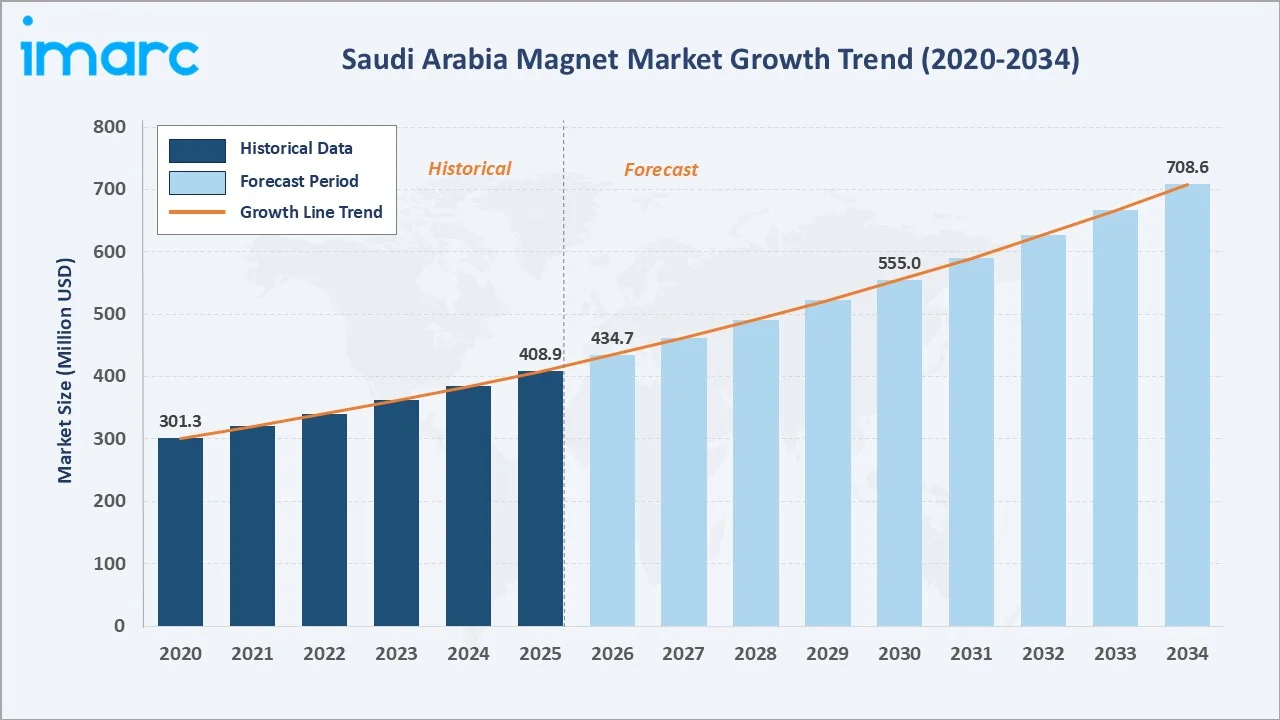
The Saudi Arabia magnet market grew from USD 408.9 Million in 2025 to USD 434.7 Million in 2026 and is projected to reach USD 708.6 Million by 2034, growing at a CAGR of 6.30% during 2026-2034. Saudi Arabia’s National Renewable Energy Program aims to develop 58.7 GW of renewable energy capacity by 2030, including around 40 GW of solar PV, 16 GW of wind power, and 2.7 GW of concentrated solar power (CSP). This large-scale renewable energy expansion is supporting the Saudi Arabia magnet market by increasing demand for permanent magnets and magnetic components used in wind turbine generators, power conversion systems, electric motors, transformers, and other renewable energy equipment. Ferrite dominates at 48.6% by magnet type, general industrial leads at 29.7% by end use, and the Northern & Central region commands the largest regional share at 48.2%.
Market Snapshot
|
Metric |
Value |
|
Base Year Market Size (2025) |
USD 408.9 Million |
|
Market Size (2026) |
USD 434.7 Million |
|
Forecast Market Size (2034) |
USD 708.6 Million |
|
CAGR (2026-2034) |
6.30% |
|
Base Year |
2025 |
|
Historical Period |
2020-2025 |
|
Forecast Period |
2026-2034 |
|
Dominant Magnet Type |
Ferrite (48.6%, 2025) |
|
Dominant End Use Industry |
General Industrial (29.7%, 2025) |
|
Leading Region |
Northern & Central Region (48.2%, 2025) |
The Saudi Arabia magnet market grew from USD 301.3 Million in 2020 to USD 408.9 Million by 2025 and is estimated to reach USD 434.7 Million in 2026. The market is projected to reach USD 555.0 Million by 2030 and USD 708.6 Million by 2034.
To get more information on this market, Request Sample
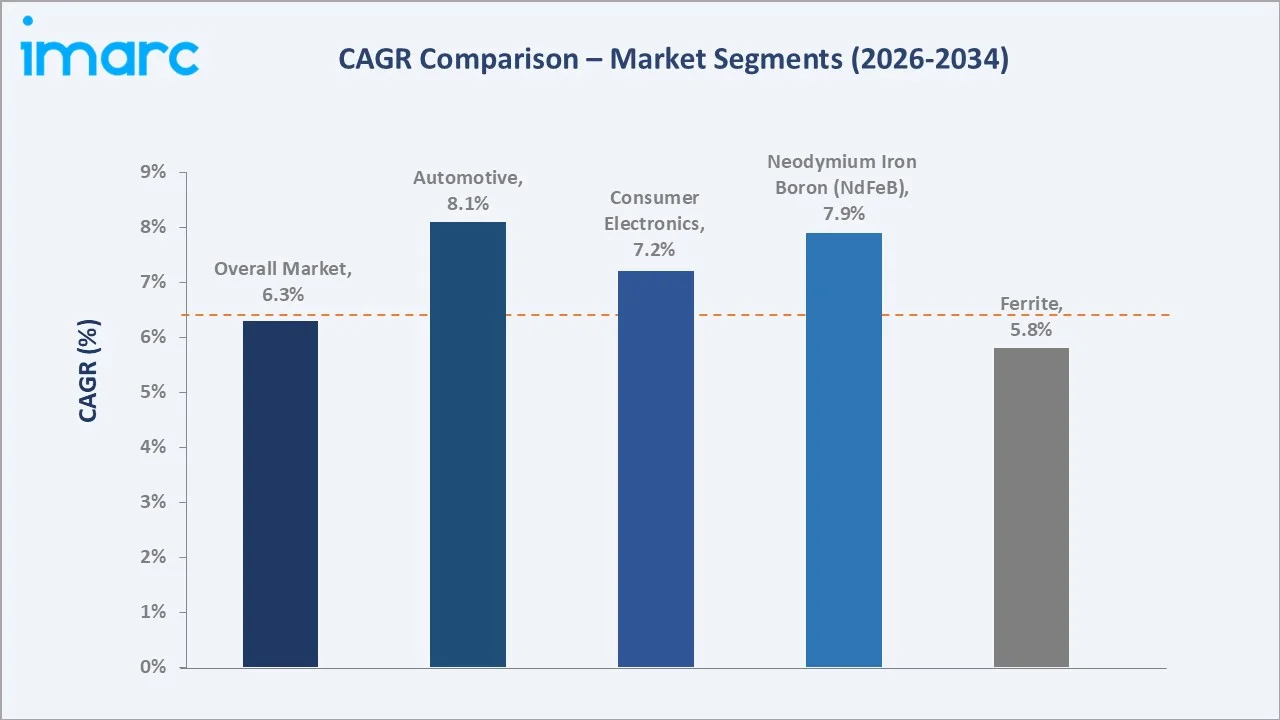
NdFeB magnets grow at ~7.9% CAGR through rising EV motor and wind turbine demand. Automotive end use expands at ~8.1% CAGR through Saudi Arabia's electrification agenda. Consumer electronics grows at ~7.2% CAGR through rising smart device penetration.
Executive Summary
The Saudi Arabia magnet market is experiencing sustained growth, anchored by Vision 2030's industrial diversification agenda and the Kingdom's ambitious transition toward renewable energy and electromobility. The market is driven by giga-project construction, electric vehicle adoption, and growing defense and aerospace procurement.
Ferrite magnets dominate at 48.6% due to cost efficiency in general industrial and consumer electronics applications, while NdFeB is the fastest-growing type at ~7.9% CAGR through superior performance in motors and generators. General industrial leads end-use demand at 29.7%, followed by automotive at 22.8%. The Northern & Central region holds 48.2% of market share, anchored by Riyadh's concentration of manufacturing and industrial activity.
Key Market Insights
|
Insight |
Data |
|
Dominant Magnet Type |
Ferrite - 48.6% share (2025) |
|
Dominant End Use Industry |
General Industrial - 29.7% share (2025) |
|
Leading Region |
Northern & Central Region - 48.2% (2025) |
|
Key Market Opportunity |
EV and renewable energy deployment under Vision 2030 driving high-performance NdFeB magnet demand. |
Key Analytical Observations Supporting the Above Data:
- Ferrite at 48.6%: Ferrite magnets dominate due to their cost-effectiveness, corrosion resistance, and versatility across motors, loudspeakers, and magnetic assemblies widely used in Saudi Arabia's industrial and consumer electronics sectors. Domestic pricing advantages versus rare earth alternatives sustain ferrite's commanding share across all regions.
- General Industrial at 29.7%: The Kingdom's Vision 2030 industrial output expansion, covering petrochemicals, metals processing, food manufacturing, and construction equipment, generates consistent high-volume ferrite and AlNiCo magnet demand for motors, pumps, conveyors, and magnetic separation systems.
- Northern & Central Region at 48.2%: Riyadh's role as the administrative and industrial capital, combined with NEOM, Qiddiya, and Red Sea Project giga-project proximity, positions the region as Saudi Arabia's primary magnet demand center across automotive, construction, and defense procurement channels.
Saudi Arabia Magnet Market Overview
The Saudi Arabia magnet market encompasses permanent magnets and temporary magnets used across industrial motors, electric vehicles, consumer electronics, aerospace and defense systems, medical devices, and renewable energy equipment. The market includes ferrite, neodymium iron boron (NdFeB), aluminium nickel cobalt (AlNiCo), and samarium cobalt (SmCo) magnet types supplied through import channels from global manufacturers and a growing local distribution network. The Kingdom's transition from hydrocarbon-dependent industry toward advanced manufacturing, clean energy, and smart city infrastructure creates durable secular demand tailwinds for both commodity ferrite and premium rare earth magnets.
Market Dynamics
To evaluate market opportunities, Request Sample
Market Drivers
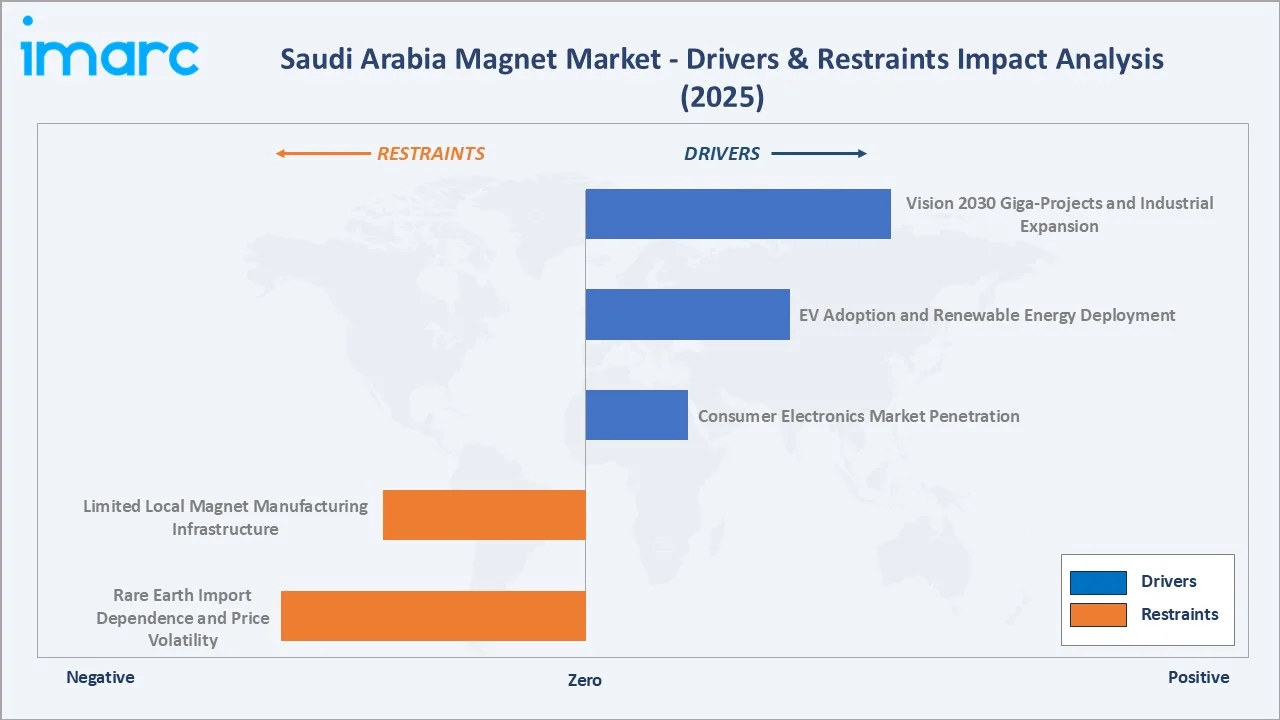
- Vision 2030 Giga-Projects and Industrial Expansion: Saudi Arabia's giga-project pipeline collectively incorporates millions of magnet-dependent components across HVAC systems, elevators, conveyor belts, security sensors, and smart city infrastructure. Saudi Arabia’s manufacturing sector accounts for around 13% of GDP, with plans to increase its contribution to 18–20% by 2030 under the NIDLP. The sector generates more than SAR 400 billion annually, comprises over 10,000 industrial facilities, sustaining broad-based ferrite and rare earth magnet demand across production facilities and assembly operations.
- EV Adoption and Renewable Energy Deployment: Saudi Arabia's National Renewable Energy Program targets 58.7 GW of installed renewable capacity by 2030, with wind energy requiring NdFeB magnets in direct-drive generators. The 30% EV adoption target for Riyadh by 2030 creates substantial traction motor magnet demand, with each EV requiring 1-3 kg of NdFeB magnets across drive motor and auxiliary systems.
- Consumer Electronics Market Penetration: Saudi Arabia's consumer electronics market, supported by 98% smartphone penetration and growing smart home adoption, generates consistent demand for miniaturized ferrite and NdFeB magnets in speakers, hard drives, cameras, and wireless charging systems across a young digital-native population.
Market Restraints
- Rare Earth Import Dependence and Price Volatility: Saudi Arabia imports virtually all rare earth raw materials, exposing NdFeB and SmCo magnet supply chains to geopolitical pricing pressure. Rare earth oxide price volatility creates procurement uncertainty for Saudi industrial buyers dependent on high-performance magnet grades.
- Limited Local Magnet Manufacturing Infrastructure: Saudi Arabia lacks an established domestic magnet manufacturing base, making the market almost entirely dependent on imports from Asia and Europe. High import logistics costs and lead times of 8-16 weeks create supply chain resilience risks for Saudi manufacturers requiring just-in-time magnet component delivery.
Market Opportunities
- Medical Technology and MRI Equipment Demand: Saudi Arabia's healthcare expansion drives demand for SmCo and NdFeB magnets in MRI machines, surgical robots, and implantable medical devices. Medical magnet applications command premium pricing and offer high-margin growth potential for specialty suppliers.
- Magnetic Separation in Food and Water Processing: Saudi Arabia's food security agenda and water desalination expansion create demand for industrial magnetic separation systems in food processing lines, water treatment plants, and pharmaceutical manufacturing, representing a growing application for high-gradient magnetic separators incorporating ferrite and rare earth magnets.
Market Challenges
- Complex Regulatory Compliance and Regulatory Standards: Saudi magnet imports are subject to certification requirements, regulatory compliance for electronics applications, and specific magnetic performance standards for defense procurement. Compliance processes add cost and time to market entry for new suppliers targeting Saudi Arabia's regulated industrial and defense segments.
- Competition from Low-Cost Asian Imports: Chinese magnet manufacturers, benefiting from integrated rare earth supply chains and government subsidies, supply commodity ferrite and bonded NdFeB magnets at prices 25-40% below Western competitors. Saudi industrial buyers' price sensitivity in commodity magnet segments creates margin pressure for higher-cost global suppliers.
Emerging Market Trends
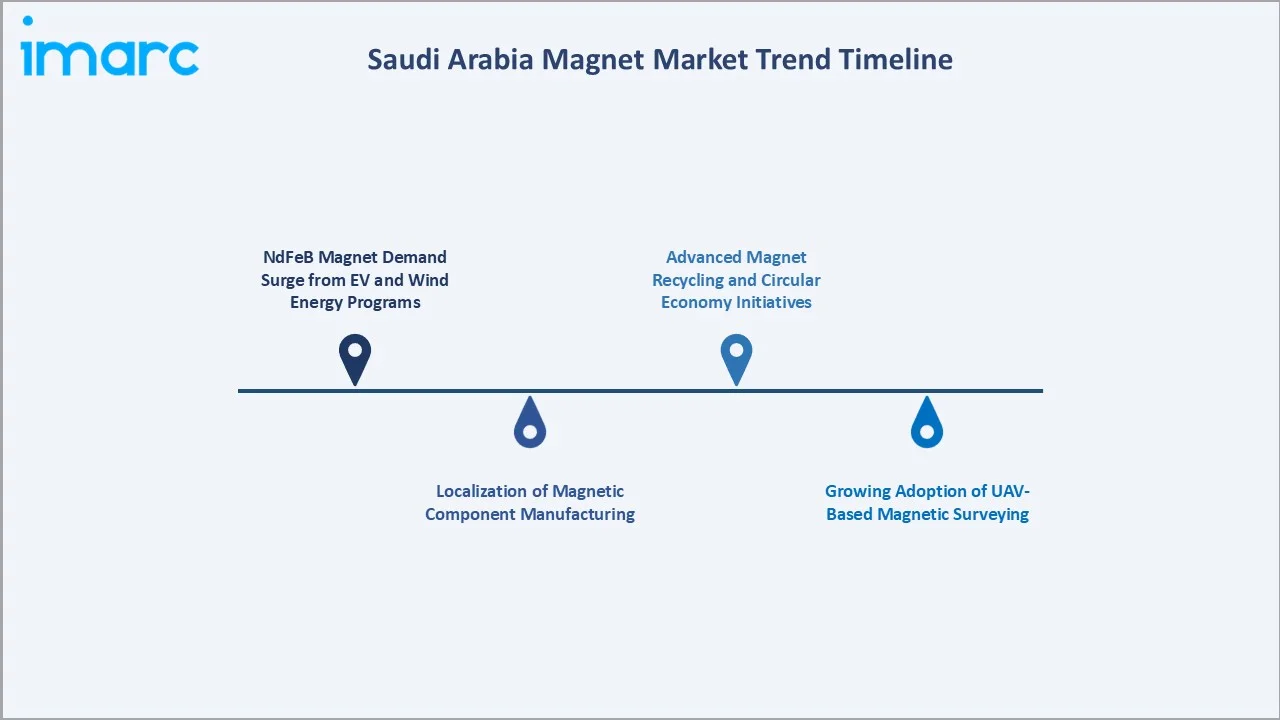
1. NdFeB Magnet Demand Surge from EV and Wind Energy Programs
Saudi Arabia's Vision 2030 renewable energy pipeline is creating a structural shift toward high-performance NdFeB magnets, with wind farm developments requiring direct-drive generator magnets. The national target of 30% of electric passenger vehicles in Riyadh by 2030 accompanies fleet electrification mandates for government vehicles, creating predictable NdFeB procurement volumes for automotive tier-1 suppliers operating in Saudi Arabia.
2. Localization of Magnetic Component Manufacturing
Vision 2030's Saudization and localization targets are incentivizing global magnet manufacturers to establish Saudi Arabia-based assembly, coating, and distribution operations. Local content requirements in defense and energy tenders increasingly mandate minimum Saudi manufacturing value addition, creating competitive advantage for suppliers with established Kingdom-based operations over pure import distributors.
3. Advanced Magnet Recycling and Circular Economy Initiatives
Saudi Arabia's alignment with the Saudi Green Initiative (SGI) targets is driving interest in rare earth magnet recycling programs, particularly for NdFeB magnets recovered from end-of-life electronics and EV batteries. Circular economy approaches to magnet material recovery reduce rare earth import dependence while supporting sustainability reporting requirements for Saudi industrial companies and giga-project operators.
4. Growing Adoption of UAV-Based Magnetic Surveying
The deployment of high-resolution drone-based magnetic surveys reflects increasing adoption of advanced, automated geophysical technologies in Saudi Arabia, enabling faster and more precise mineral exploration while expanding applications for magnetic sensing systems. In August 2026, Peako is preparing to conduct high-resolution UAV-based magnetic surveys across five exploration targets in Saudi Arabia, covering approximately 54 km² and 1,400 line km. The surveys, flown at low altitude and close spacing for enhanced geological detail, will support the company’s planned drilling programs scheduled to commence in October.
Industry Value Chain Analysis
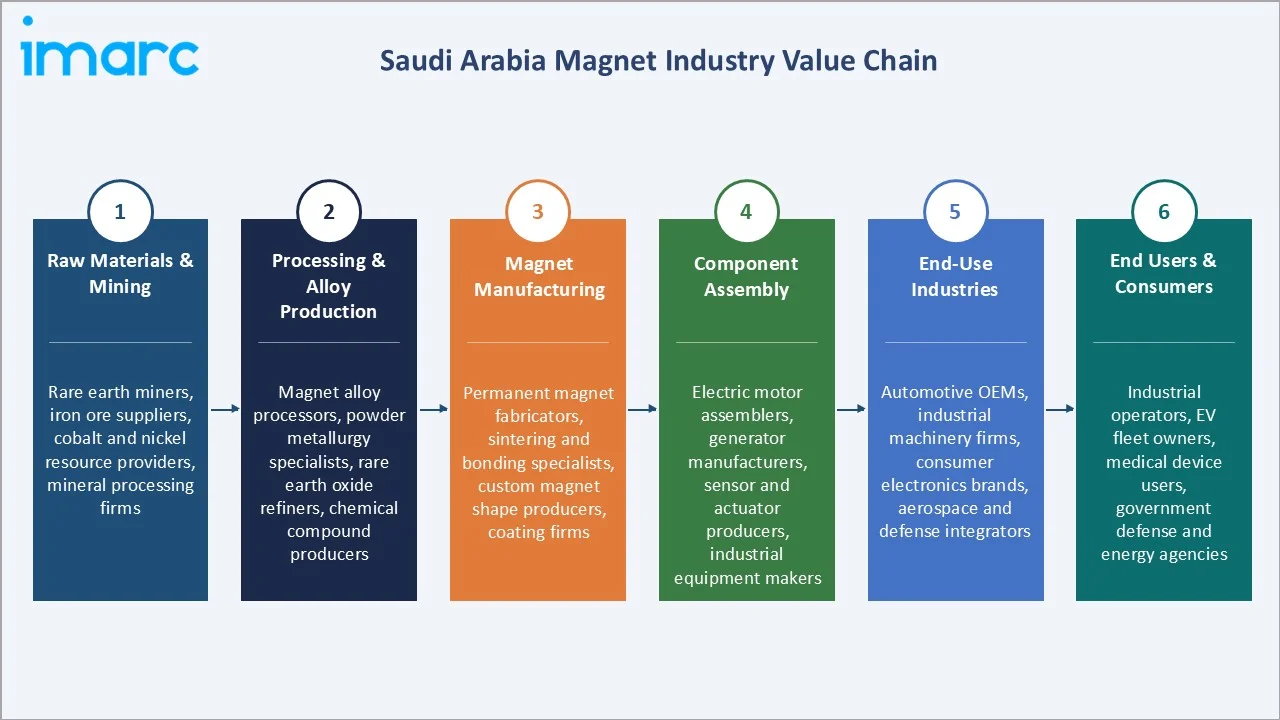
The Saudi Arabia magnet market value chain spans raw material sourcing, alloy processing, magnet manufacturing, component assembly, and end-use industry applications, with the Kingdom currently participating primarily at the distribution and end-use stages with limited upstream manufacturing presence.
|
Stage |
Key Players |
|
Raw Materials & Mining |
Rare earth miners, iron ore suppliers, cobalt and nickel resource providers, mineral processing firms. |
|
Processing & Alloy Production |
Magnet alloy processors, powder metallurgy specialists, rare earth oxide refiners, chemical compound producers. |
|
Magnet Manufacturing |
Permanent magnet fabricators, sintering and bonding specialists, custom magnet shape producers, coating firms. |
|
Component Assembly |
Electric motor assemblers, generator manufacturers, sensor and actuator producers, industrial equipment makers. |
|
End-Use Industries |
Automotive OEMs, industrial machinery firms, consumer electronics brands, aerospace and defense integrators. |
|
End Users & Consumers |
Industrial operators, EV fleet owners, medical device users, government defense and energy agencies. |
Magnet manufacturing and component assembly represent the highest value-added stages in the chain, where Saudi Arabia's current import dependence creates both a supply chain vulnerability and a localization investment opportunity under Vision 2030. Establishing domestic sintering or bonding facilities could enable Saudi Arabia to capture higher margins versus commodity magnet imports while supporting national industrial development targets.
Technology Landscape in the Saudi Arabia Magnet Industry
Advanced NdFeB Sintering and Grain Boundary Diffusion
Grain boundary diffusion (GBD) technology enables significant coercivity improvement in NdFeB magnets with reduced heavy rare earth content (dysprosium and terbium), reducing raw material cost while maintaining high-temperature performance required for EV motors and wind generators. Saudi Arabia's EV and renewable energy programs are driving demand for GBD-processed magnets capable of operating at 150-200°C ambient temperatures common in Arabian Peninsula industrial environments.
Bonded Magnet Technology for Miniaturization
Injection-molded and compression-bonded magnets enable complex near-net-shape geometries required for miniaturized sensors, actuators, and motors in consumer electronics and medical devices. Saudi Arabia's growing medical technology imports and consumer electronics assembly activities are expanding bonded magnet demand, particularly for isotropic NdFeB and ferrite grades used in precision instruments and smart home devices.
High-Temperature SmCo Magnets for Defense and Aerospace
Samarium Cobalt magnets, capable of operating at temperatures up to 350°C with superior corrosion resistance versus NdFeB, remain the preferred choice for Saudi Arabia's aerospace, defense, and oil and gas sector applications where thermal stability and chemical resistance are critical. Saudi Aramco's equipment specifications and Saudi Air Force procurement standards are key drivers of SmCo magnet demand in the Eastern Region and defense industrial cities.
Market Segmentation Analysis
The report covers the following segments:
|
Segment Category |
Leading Segment |
Market Share |
Year |
|
Magnet Type |
Ferrite |
48.6% |
2025 |
|
End Use Industry |
General Industrial |
29.7% |
2025 |
|
Region |
Northern and Central Region |
48.2% |
2025 |

By Magnet Type
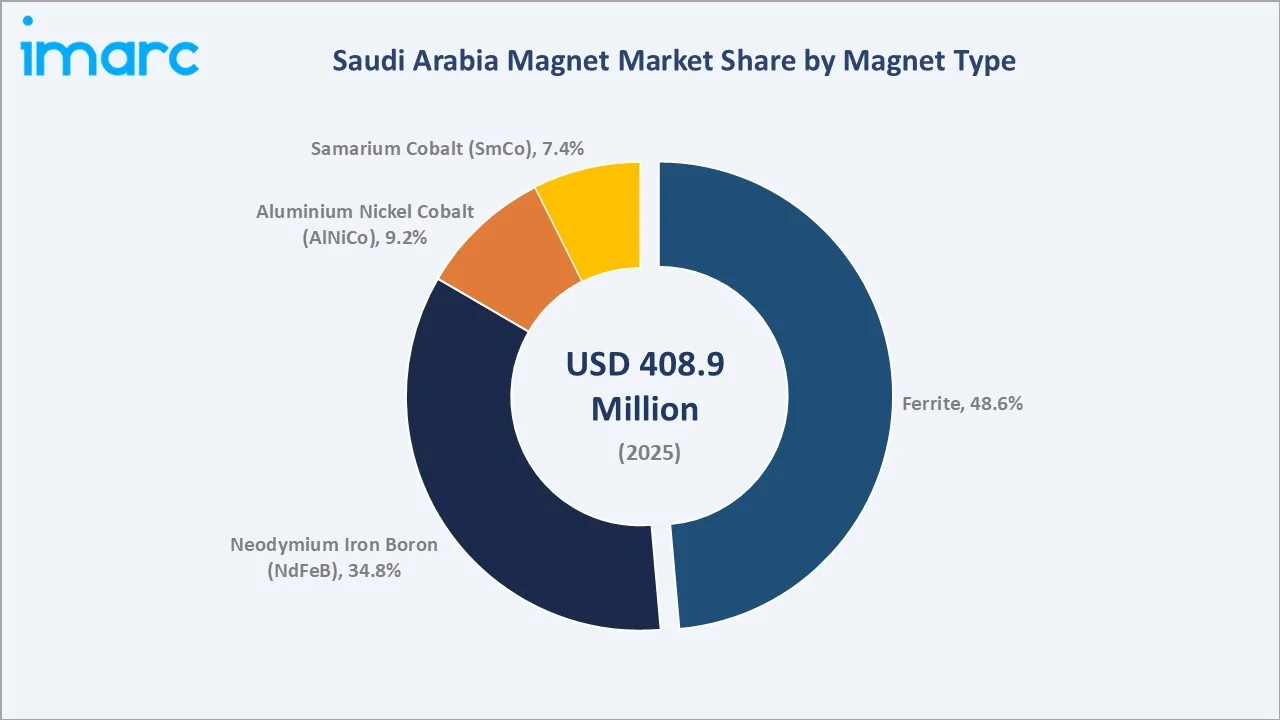
Ferrite commands 48.6%, driven by its dominant cost advantage, chemical stability in humid coastal environments, and broad applicability across motors, loudspeakers, sensors, and magnetic assemblies throughout Saudi Arabia's industrial and consumer electronics sectors.
To access detailed market analysis, Request Sample
Neodymium Iron Boron (NdFeB) holds 34.8% and is the fastest-growing segment at ~7.9% CAGR, driven by EV motors, wind generators, and high-efficiency industrial motors being adopted. Aluminium Nickel Cobalt (AlNiCo) at 9.2% serves precision instruments, sensors, and legacy industrial equipment where stable flux density over temperature is essential. Samarium Cobalt (SmCo) at 7.4% addresses premium defense, aerospace, and high-temperature oil and gas applications.
By End Use Industry
General industrial leads at 29.7% in 2025, encompassing Saudi Arabia's manufacturing, petrochemical processing, food production, and construction equipment sectors which collectively consume ferrite and AlNiCo magnets in pumps, compressors, conveyor systems, and magnetic separation equipment.
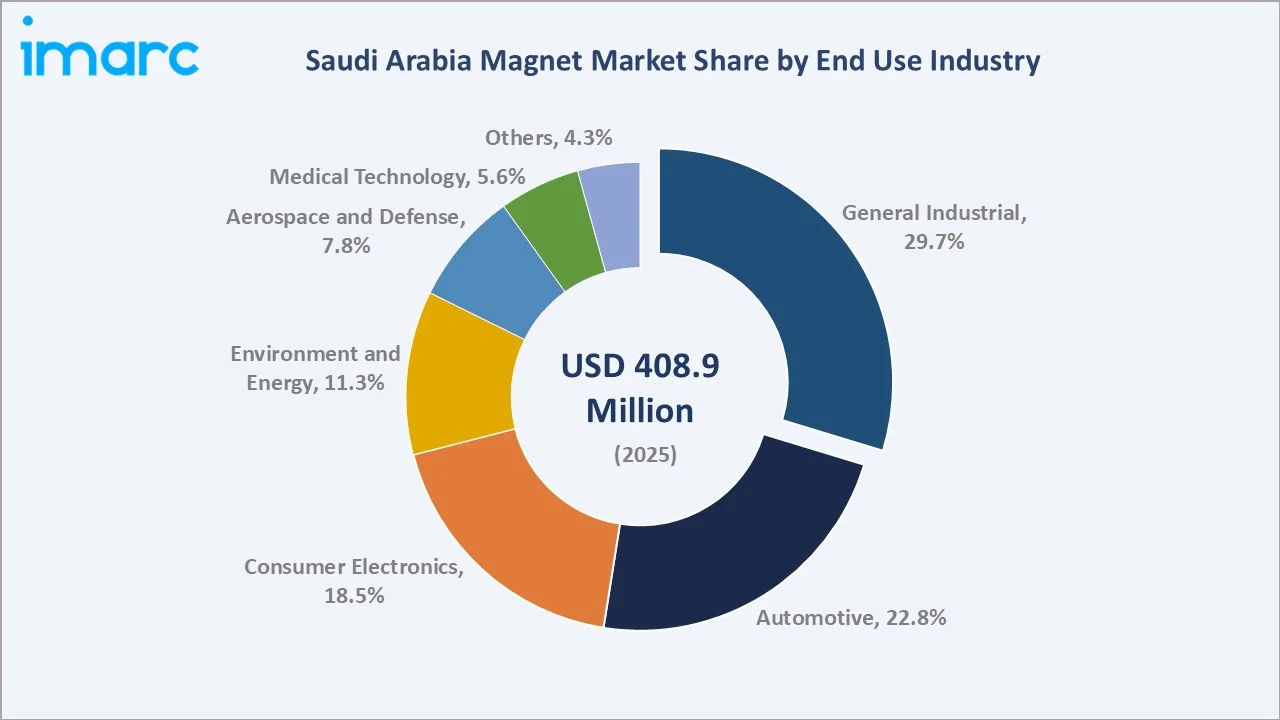
Automotive at 22.8% is growing at ~8.1% CAGR, the fastest among end-use segments, driven by EV motor adoption and conventional vehicle component electrification. Consumer electronics at 18.5% benefits from high smartphone and smart device penetration. Environment & energy at 11.3% is driven by renewable energy installations. Aerospace & defense at 7.8% reflects Saudi Arabia's military modernization. Medical technology at 5.6% grows with hospital infrastructure expansion.
Regional Market Insights
|
Region |
Share (2025) |
Key Saudi Arabia Magnet Market Drivers & Characteristics |
|
Northern & Central Region |
48.2% |
Reflecting Riyadh's concentration of heavy industry, defense procurement, and manufacturing expansion under Vision 2030 NIDLP, housing the majority of Saudi Arabia's industrial base. |
|
Western Region |
23.5% |
Reflecting Jeddah's industrial zones, consumer electronics assembly, and port-proximate logistics supporting magnet imports and component manufacturing activities. |
|
Eastern Region |
18.1% |
Reflecting the oil and gas sector's industrial magnet demand, petrochemical plant equipment requirements, and growing electronics manufacturing in Dammam and Jubail industrial cities. |
|
Southern Region |
10.2% |
Reflecting emerging industrial development in Jizan Economic City, government-led infrastructure projects, and growing demand from Vision 2030 regional development programs. |
The Northern & Central region's 48.2% share reflects Riyadh's role as Saudi Arabia's administrative, industrial, and defense procurement capital. The Western region's 23.5% is anchored by Jeddah's port logistics and growing renewable energy coastal installations.
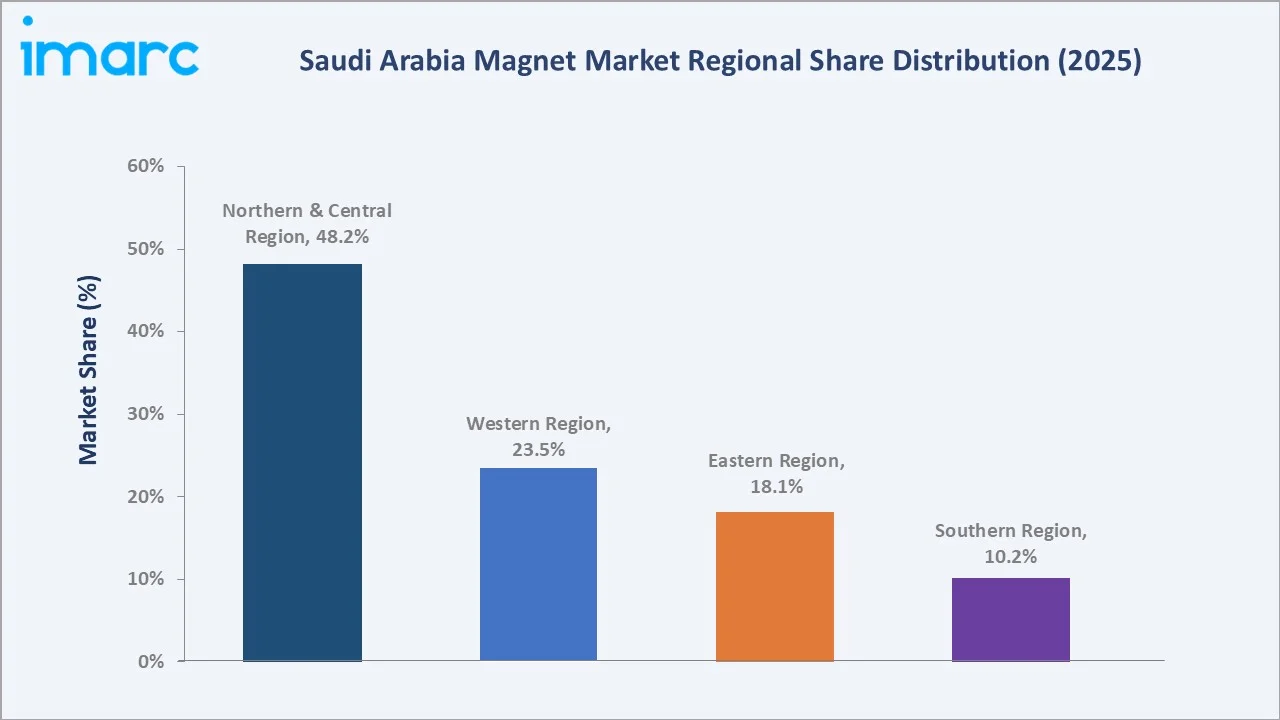
The Eastern region's 18.1% is driven by Saudi Aramco's extensive equipment base and Jubail Industrial City's petrochemical complex, which represent the Kingdom's highest concentration of industrial magnet applications in pumps, compressors, and magnetic flow meters. The Southern region at 10.2% is positioned for above-average growth as industrial tenants and expanded manufacturing capacity, supported by Vision 2030 regional economic development priorities.
Competitive Landscape
The Saudi Arabia magnet market features a competitive landscape dominated by global permanent magnet manufacturers supplying through regional distributors and direct procurement channels. International leaders compete alongside specialty rare earth magnet suppliers serving defense and medical applications, with a small but growing segment of local Saudi-based distributors providing inventory and customization services.
|
Company |
Key Products |
Market Position |
Core Strength |
|
Shin-Etsu Chemical Co., Ltd. |
Neodymium magnet |
Innovator |
Shin-Etsu Chemical Co., Ltd. operates as a premier strategic technology provider and potential downstream partner within Saudi Arabia's rapidly accelerating rare earth magnet and industrial sectors. |
|
TDK Corporation |
Ferrite Magnets, Neodymium Magnets |
Market Leader |
TDK Corporation plays an important supplier and market-shaping role in Saudi Arabia's industrial transformation. |
|
Goudsmit Magnetics |
Hard ferrite (ceramic) magnets, SmCo magnets, AlNiCo magnets, Neodymium NdFeB |
Challenger |
Goudsmit Magnetics plays a critical role in Saudi Arabia's industrial sector as a global supplier and manufacturer of high-performance magnetic assemblies, separation systems, and handling equipment. |
|
Daido Steel Co., Ltd. |
Neodymium-based Sintered Magnets, Neodymium-based Rare-earth Bonded Magnets, Neodymium-based Hot-working Magnets |
Established Player |
Daido Steel Co., Ltd. operates as one of the dominant global suppliers in the Middle East and Africa permanent magnet market, serving as a critical cornerstone technology provider for Saudi Arabia’s expanding industrial and clean energy initiatives. |
Global magnet manufacturers are investing in regional distribution partnerships, certification, and local inventory to capture Vision 2030-driven industrial growth. Companies with Saudi Arabia-based operations, local content capabilities, and defense procurement track records hold competitive advantages in government and giga-project tenders, where localization and supply chain reliability are increasingly weighted alongside price in supplier evaluation.
Key Company Profiles
Shin-Etsu Chemical Co., Ltd.
Shin-Etsu Chemical Co., Ltd. is one of the largest producers of sintered NdFeB magnets and a leading supplier to automotive, electronics, and energy customers globally. The company's magnets serve premium applications requiring superior magnetic properties and tight dimensional tolerances critical for EV motors and wind generator systems being deployed in Saudi Arabia.
- Key Products: Neodymium magnets.
- Strategic Focus: Positioning as the preferred NdFeB magnet supplier for Saudi Arabia's EV and renewable energy programs; expanding GCC distribution capabilities; investing in grain boundary diffusion technology reducing heavy rare earth dependence.
TDK Corporation
TDK Corporation is an electronics component manufacturer with one of the broadest permanent magnet portfolios spanning ferrite and NdFeB types. TDK's ferrite magnets are widely used in Saudi Arabia's consumer electronics, automotive, and industrial motor applications through established regional distribution channels.
- Key Products: Ferrite Magnets, Neodymium Magnets.
- Strategic Focus: Leveraging broad product portfolio to serve multiple Saudi market segments simultaneously; expanding ferrite magnet share in growing consumer electronics and industrial motor segments; building NdFeB position in EV and energy applications through technical application support.
Market Concentration Analysis
The Saudi Arabia magnet market is moderately fragmented, with the top four global manufacturers Shin-Etsu Chemical Co., Ltd., TDK Corporation, Goudsmit Magnetics, and Daido Steel Co., Ltd., collectively supplying an estimated 45-55% of total market volume through direct and distributor channels. The commodity ferrite segment is more fragmented due to competitive Asian imports, while premium NdFeB and SmCo segments are more concentrated around global specialty manufacturers with established Saudi Arabia procurement relationships.
Market consolidation is expected to progress through 2034 as Vision 2030 localization requirements incentivize global manufacturers to establish Saudi Arabia joint ventures or distribution subsidiaries, reducing reliance on third-party importers. Defense and energy sector procurement, where supplier qualification and track record are weighted alongside price, will remain concentrated among a smaller group of certified global suppliers throughout the forecast period.
Investment & Growth Opportunities
Highest Growth Segments
NdFeB magnets for EV and renewable energy (~7.9% CAGR), automotive magnet applications (~8.1% CAGR), consumer electronics miniaturized magnets (~7.2% CAGR), medical technology SmCo magnets (~6.8% CAGR), and defense-grade specialty magnets represent the highest-return investment segments in the Saudi Arabia magnet market through 2034, all benefiting from Vision 2030's structural demand creation.
Investment Themes
- Domestic Magnet Manufacturing Joint Ventures: NIDLP incentives including land grants, utility subsidies, and Saudization support create attractive economics for joint venture magnet manufacturing facilities. A dedicated NdFeB or ferrite sintering plant serving GCC markets from Saudi Arabia could capture high regional import displacement value annually by 2030.
- Rare Earth Supply Chain Diversification: Investing in alternative rare earth sourcing agreements from Australia, Canada, and emerging African producers reduces Saudi Arabia's supply chain vulnerability to Chinese export controls, positioning suppliers for preferential consideration in government procurement programs explicitly targeting supply chain security.
- Magnetic Systems Integration for Giga-Projects: Packaging magnet components into complete magnetic system solutions, HVAC drive motors, conveyor magnetic separators, access control systems, for NEOM, Qiddiya, and other giga-projects generates higher-margin system integration revenue versus commodity component supply.
Future Market Outlook (2026-2034)
The Saudi Arabia magnet market is projected to grow from USD 408.9 Million in 2025 to USD 434.7 Million in 2026, reaching USD 708.6 Million by 2034, exhibiting a CAGR of 6.30% during 2026-2034. The market is projected to reach an anchor value of USD 555.0 Million by 2030, representing the mid-period milestone at which Vision 2030 giga-project completions begin generating sustained operational magnet replacement demand and the Kingdom's renewable energy and EV transition achieves scale.
Three structural forces will define the Saudi Arabia magnet market through 2034. First, Vision 2030's industrial diversification, targeting a fourfold increase in manufacturing GDP contribution, creates durable demand for ferrite and rare earth magnets across motors, sensors, and precision assemblies used throughout modern industrial infrastructure. Second, the energy transition toward 58.7 GW of renewable capacity and widespread EV adoption structurally shifts the magnet mix toward high-performance NdFeB, driving premium segment growth at a rate nearly 2x the overall market CAGR. Third, Saudi Arabia's defense modernization and healthcare infrastructure expansion sustain demand for specialty SmCo and high-grade NdFeB magnets commanding premium pricing and offering stable long-term supply relationships for qualified global manufacturers committed to the Kingdom's market.
Research Methodology
Primary Research
Primary research comprised in-depth interviews with Saudi industrial procurement managers, magnet distributors, automotive component suppliers, defense equipment integrators, and Vision 2030 project procurement officers. These discussions validated market size estimates, magnet type demand dynamics, regional consumption patterns, and technology adoption trajectory for the 2026-2034 forecast period.
Secondary Research
Secondary research encompassed manufacturing sector statistics, equipment procurement publications, regulatory certification records, IMARC Group proprietary advanced materials databases, annual reports of key market participants, and industry publications covering GCC magnet and advanced materials market developments through 2025.
Forecasting Models
Forecasting models incorporated historical magnet demand correlations with industrial output and energy sector investment, Vision 2030 industrial expansion trajectories, EV adoption curves and renewable energy capacity addition schedules, rare earth price trends, and macroeconomic indicators. Both bottom-up end-use industry demand modeling and top-down market value approaches were cross-validated for forecast consistency across all segments and regions.
Saudi Arabia Magnet Market Report Coverage:
| Report Features | Details |
|---|---|
| Base Year of the Analysis | 2025 |
| Historical Period | 2020-2025 |
| Forecast Period | 2026-2034 |
| Units | Million USD |
| Scope of the Report | Exploration of Historical and Forecast Trends, Industry Catalysts and Challenges, Segment-Wise Historical and Predictive Market Assessment:
|
| Magnet Types Covered | Ferrite, Neodymium Iron Boron (NdFeB), Aluminium Nickel Cobalt (AlNiCo), Samarium Cobalt (SmCo) |
| End Use Industries Covered | Consumer Electronics, General Industrial, Automotive, Medical Technology, Environment and Energy, Aerospace and Defense, Others |
| Regions Covered | Northern and Central Region, Western Region, Eastern Region, Southern Region |
| Companies Covered | Shin-Etsu Chemical Co., Ltd., TDK Corporation, Goudsmit Magnetics, Daido Steel Co., Ltd., etc. |
| Customization Scope | 10% Free Customization |
| Post-Sale Analyst Support | 10-12 Weeks |
| Delivery Format | PDF and Excel through Email (We can also provide the editable version of the report in PPT/Word format on special request) |
Key Benefits for Stakeholders:
- IMARC’s industry report offers a comprehensive quantitative analysis of various market segments, historical and current market trends, market forecasts, and dynamics of the Saudi Arabia magnet market from 2020-2034.
- The research report provides the latest information on the market drivers, challenges, and opportunities in the Saudi Arabia magnet market.
- Porter's five forces analysis assist stakeholders in assessing the impact of new entrants, competitive rivalry, supplier power, buyer power, and the threat of substitution. It helps stakeholders to analyze the level of competition within the Saudi Arabia magnet industry and its attractiveness.
- Competitive landscape allows stakeholders to understand their competitive environment and provides an insight into the current positions of key players in the market.
Frequently Asked Questions About the Saudi Arabia Magnet Market Report
The Saudi Arabia magnet market reached USD 434.7 Million in 2026, driven by Vision 2030 industrial expansion, giga-project construction, and growing EV and renewable energy magnet procurement.
The Saudi Arabia magnet market is projected to grow at a CAGR of 6.30% during 2026-2034, sustained by Vision 2030 industrial diversification, EV adoption, renewable energy deployment, and defense modernization driving sustained permanent magnet demand.
The market is projected to reach USD 555.0 Million by 2030, representing the mid-period milestone where Vision 2030 giga-project completions, renewable energy scaling, and EV fleet growth collectively drive accelerating magnet consumption across all end-use segments.
Ferrite leads with a 48.6% share in 2025, through its cost advantage, chemical stability, and broad applicability across industrial motors, consumer electronics, and sensors in Saudi Arabia's diverse manufacturing and commercial sectors.
General industrial leads with a 29.7% share in 2025, encompassing Saudi Arabia's petrochemical, food, metals processing, and construction equipment sectors, which generate high-volume ferrite magnet demand for motors, pumps, and magnetic separation systems.
The Northern & Central region leads with a 48.2% share in 2025, anchored by Riyadh's concentration of manufacturing facilities, defense procurement, and giga-project construction activity generating the Kingdom's highest magnet demand volumes.
Key players include Shin-Etsu Chemical Co., Ltd., TDK Corporation, Goudsmit Magnetics, and Daido Steel Co., Ltd., among others.
The Saudi Arabia magnet market is projected to reach USD 708.6 Million by 2034, driven by completed Vision 2030 industrial capacity, mature EV and renewable energy adoption, expanded defense procurement, and growing medical technology magnet demand.
Key opportunities include domestic NdFeB or ferrite manufacturing joint ventures supported by NIDLP incentives, rare earth supply chain diversification, magnetic system integration for giga-projects, medical technology specialty magnets, and defense procurement qualification for SmCo suppliers.
Need more help?
- Speak to our experienced analysts for insights on the current market scenarios.
- Include additional segments and countries to customize the report as per your requirement.
- Gain an unparalleled competitive advantage in your domain by understanding how to utilize the report and positively impacting your operations and revenue.
- For further assistance, please connect with our analysts.
 Request Customization
 Speak to an Analyst
 Request Brochure
 Inquire Before Buying
Benefits of Customization
- Personalize this research
- Triangulate with your data
- Get data as per your format and definition
- Gain a deeper dive into a specific application, geography, customer, or competitor
- Any level of personalization
Get in Touch With Us
UNITED STATES
Phone: +1-201-971-6302
INDIA
Phone: +91-120-433-0800
UNITED KINGDOM
Phone: +44-753-714-6104
Email: [email protected]
Client Testimonials























Related Reports

Choose your plan
*Please note that the prices mentioned below are starting prices for each bundle type. Kindly contact our team for further details.*
Single User License
- 1 User License, Access on 2 Devices
- PDF Report + Excel Dataset (Password Protected)
- Lifetime Access
- No Printing Rights
- 10% Free Report Customization
- 10–12 Weeks of Analyst Support
Five User License
- Access for 5 Users, 2 Devices per User
- PDF Report + Excel Dataset (Password Protected)
- Lifetime Access
- Dedicated Account Manager
- 12–14 Weeks of Analyst Support
- No Printing Rights
- 15% Free Report Customization
- 25% Discount on Your Next Purchase
Corporate User License
- Unlimited User Access (Within Your Organization)
- PDF Report + Excel Dataset
- Lifetime Access
- Dedicated Account Manager
- 14–20 Weeks of Analyst Support
- No Printing Rights
- 20% Free Report Customization
- 30% Discount on Your Next Purchase
Essential Insights
What's included:
3 reports
- Lifetime Access
- PDF Reports
- Excel Datasets
- 2 Weeks of Free Analyst Support
- 2 User Licenses
- Access on 2 Devices
- Printing Rights
- Complimentary PowerPoint (PPT) Version
- Complimentary License Upgrade
Professional Access
What's included:
5 reports
- Lifetime Access
- PDF Reports
- Excel Datasets
- 8 Weeks of Free Analyst Support
- 2 User Licenses
- Access on 2 Devices
- Printing Rights
- Complimentary PowerPoint (PPT) Version
- Complimentary License Upgrade
Business Advantage
What's included:
8 reports
- Lifetime Access
- PDF Reports
- Excel Datasets
- 14 Weeks of Free Analyst Support
- 2 User Licenses
- Access on 2 Devices
- Printing Rights
- Complimentary PowerPoint (PPT) Version
- Complimentary License Upgrade
Enterprise Intelligence
What's included:
10 reports
- Lifetime Access
- PDF Reports
- Excel Datasets
- 20 Weeks of Free Analyst Support
- 2 User Licenses
- Access on 2 Devices
- Printing Rights
- Complimentary PowerPoint (PPT) Version
- Complimentary License Upgrade