
Saudi Arabia Medium Density Fiberboard Market Size, Share, Trends and Forecast by Application, Sector, and Region, 2026-2034
Saudi Arabia Medium Density Fiberboard Market Size, Share, Trends & Forecast (2026-2034)
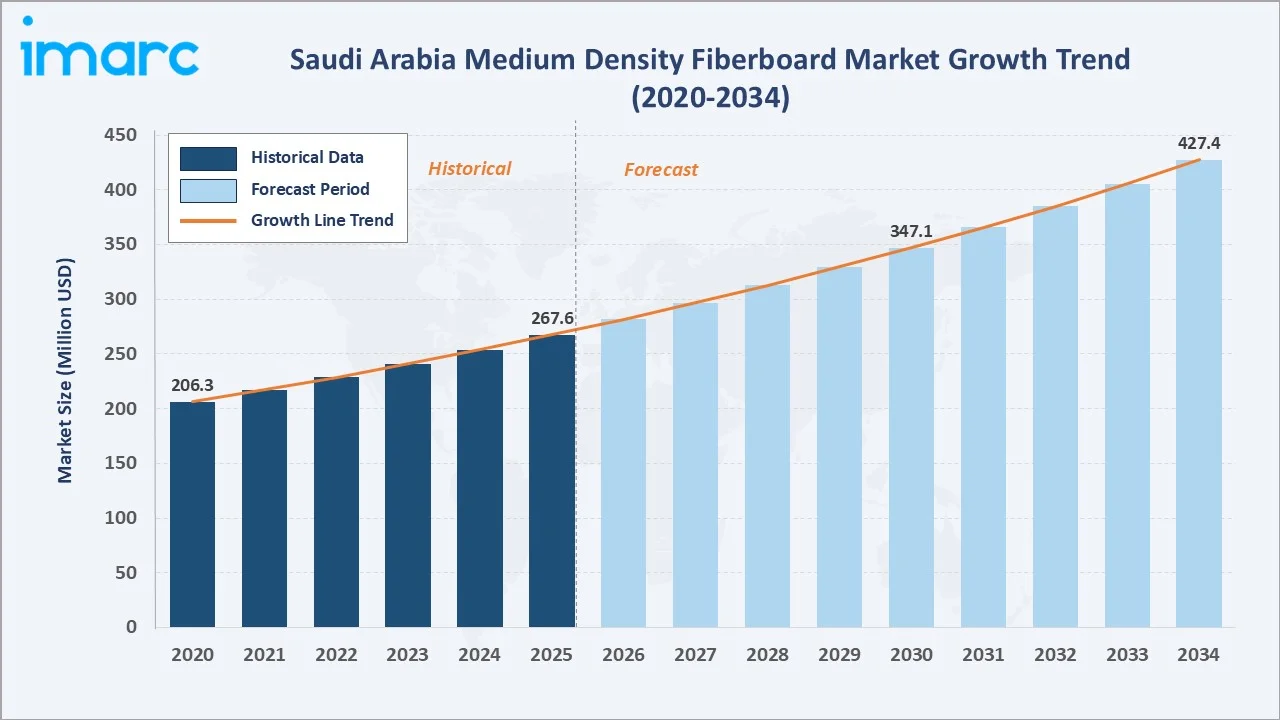
The Saudi Arabia medium density fiberboard market reached USD 267.6 Million in 2025 and is projected to reach USD 427.4 Million by 2034, growing at a CAGR of 5.34% during 2026-2034. The market is fueled by Saudi Arabia's Vision 2030 initiative accelerating construction and infrastructure development, increasing demand for sustainable green materials, and rising urbanization and housing demand. Under Saudi Vision 2030, the Public Investment Fund (PIF) expanded significantly, rising from about USD 152 billion in 2015 to more than USD 1 trillion by mid-2025, with assets expected to approach USD 2 trillion by 2030, although this may remain below the revised USD 2.67 trillion stretch target. This strong investment capacity is accelerating spending on housing, tourism, hospitality, commercial developments, and major infrastructure projects across Saudi Arabia. Residential applications lead at 64.8%, new construction dominates the sector segment at 69.3%, and the Northern and Central Region holds the largest regional share at 36.8%.
Market Snapshot
|
Metric |
Value |
|
Market Size (2025) |
USD 267.6 Million |
|
Forecast Market Size (2034) |
USD 427.4 Million |
|
CAGR (2026-2034) |
5.34% |
|
Base Year |
2025 |
|
Historical Period |
2020-2025 |
|
Forecast Period |
2026-2034 |
|
Dominant Application |
Residential (64.8%, 2025) |
|
Dominant Sector |
New Construction (69.3%, 2025) |
|
Leading Region |
Northern and Central Region (36.8%, 2025) |
The Saudi Arabia medium density fiberboard market has grown from USD 206.3 million in 2020 to USD 267.6 million in 2025, reflecting sustained expansion underpinned by government-led construction acceleration and diversifying end-use applications. The market is projected to reach USD 347.1 million by 2030 and USD 427.4 million by 2034.
To get more information on this market, Request Sample
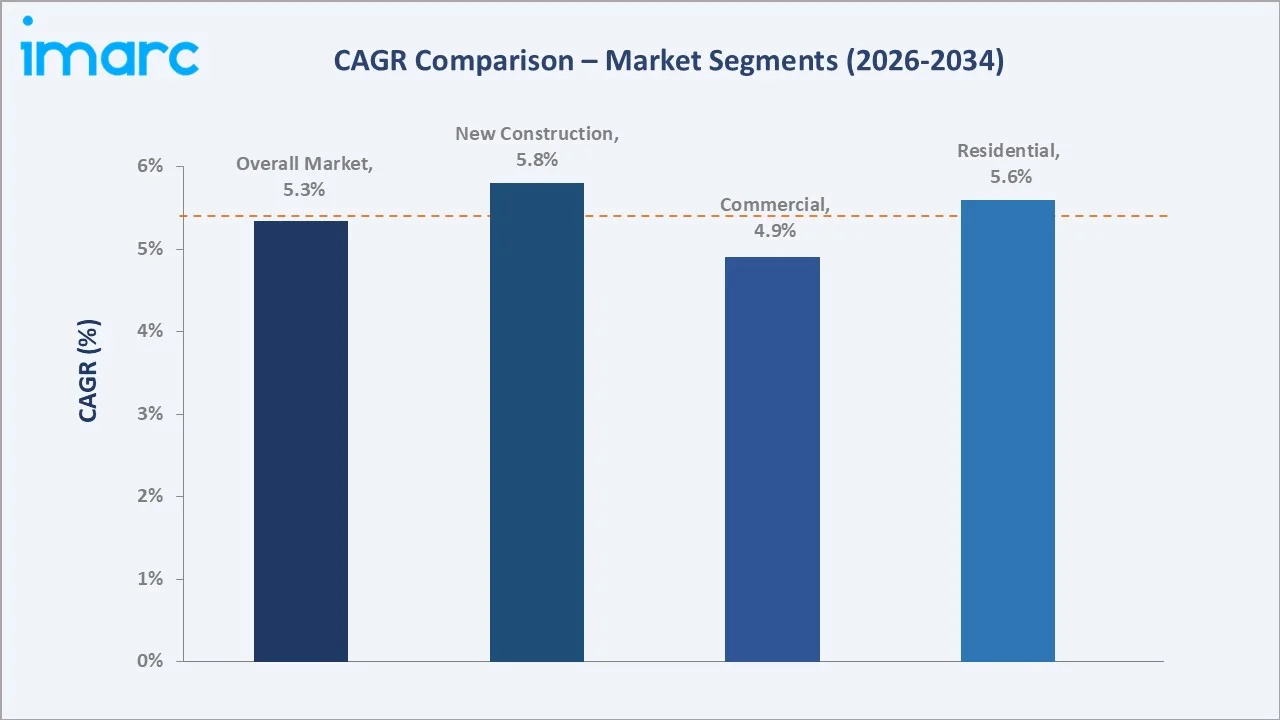
Residential applications grow at ~5.6% CAGR through 2034, driven by Saudi housing programs and Vision 2030 urban expansion. New construction grows at ~5.8% CAGR through giga-project developments. The commercial segment grows at ~4.9% CAGR through retail, hospitality, and office interior demand.
Executive Summary
The Saudi Arabia medium density fiberboard market is positioned for sustained growth, driven by one of the most ambitious construction programs under Vision 2030. The Kingdom's transformation agenda has catalyzed unprecedented demand for interior construction materials, with MDF serving as a foundational material for residential housing, commercial fit-outs, hospitality projects, and furniture manufacturing. Residential leads at 64.8% through housing program-driven cabinetry and furniture demand. New construction leads at 69.3% through giga-project and housing development volumes. Northern and Central Region leads regionally at 36.8%.
Key Market Insights
|
Insight |
Data |
|
Dominant Application |
Residential - 64.8% share (2025) |
|
Dominant Sector |
New Construction - 69.3% share (2025) |
|
Leading Region |
Northern and Central Region- 36.8% share (2025) |
|
Key Market Opportunity |
Vision 2030 construction and infrastructure acceleration |
|
Key Sustainability Trend |
Low-formaldehyde and moisture-resistant MDF adoption |
Key Analytical Observations:
- Residential at 64.8%: Residential applications driven by Saudi Arabia's large-scale housing programs, including the National Housing Program. MDF is extensively used in residential interiors for kitchen cabinetry, wardrobe systems, door skins, wall paneling, and skirting boards.
- New Construction at 69.3%: New construction reflecting the unprecedented pace of development across Saudi Arabia. NEOM's THE LINE, the Red Sea Project, Qiddiya, and Diriyah Gate are creating massive demand for quality interior finishing materials. New construction projects typically specify larger MDF volumes per unit compared to replacement projects, sustaining the dominant sector position through 2034.
- Northern and Central Region at 36.8%: The Northern and Central Region, encompassing Riyadh and surrounding provinces, commands the largest regional share due to its concentration of the national capital, highest population density, largest number of construction projects, and the majority of government and commercial real estate development.
Saudi Arabia Medium Density Fiberboard Market Overview
Medium density fiberboard (MDF) is an engineered wood product manufactured from wood fibers bonded with synthetic resin adhesives and formed under heat and pressure into flat panels. In the Saudi Arabian market, MDF serves as a versatile, cost-effective alternative to solid wood and plywood, widely used in furniture manufacturing, kitchen cabinetry, flooring underlayment, wall paneling, door cores, and decorative molding. MDF's homogeneous composition enables precise routing, cutting, and finishing operations that produce superior results compared to natural wood. The Saudi MDF market is shaped by three macroeconomic factors, including the Vision 2030 construction acceleration, urbanization and population growth driving housing demand, and increasing consumer preference for sustainable and aesthetically refined interior solutions.
Market Dynamics
To evaluate market opportunities, Request Sample
Market Drivers
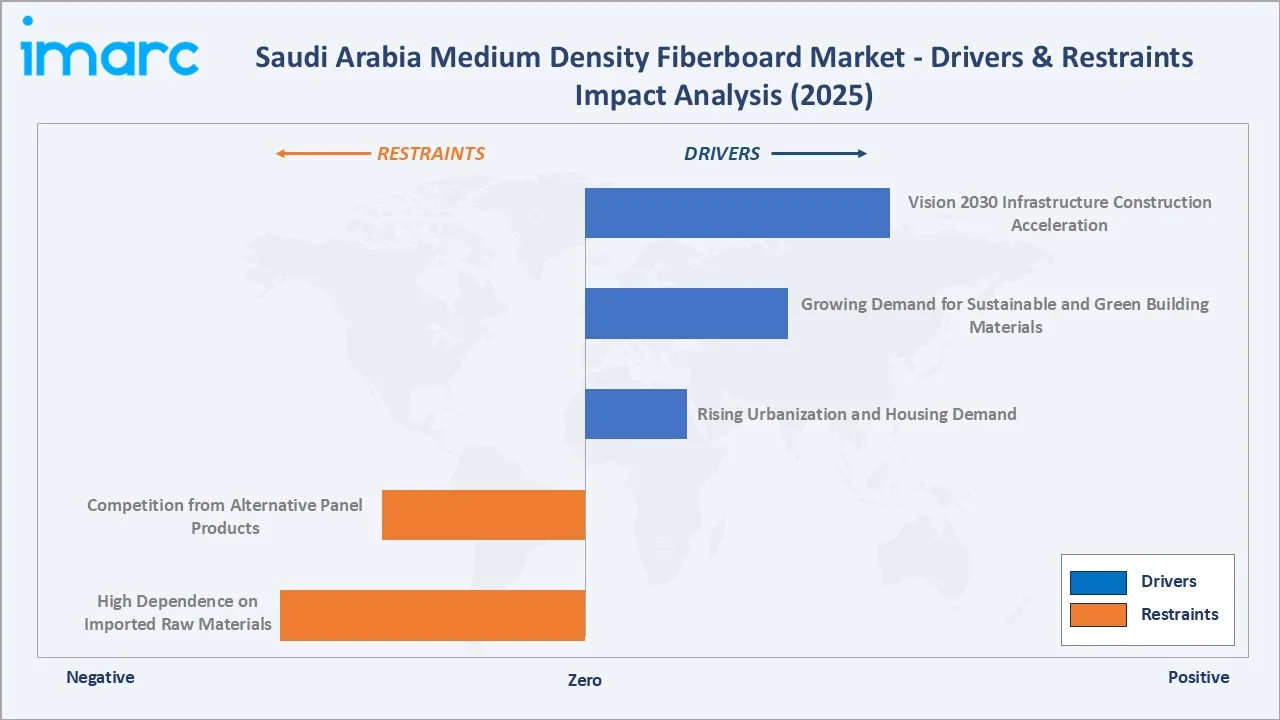
- Vision 2030 Infrastructure Construction Acceleration: Under Saudi Arabia’s Vision 2030, more than 1.2 million new residential units are expected to be developed to support the Kingdom’s targeted homeownership levels. Saudi Arabia's Vision 2030 has radically accelerated construction activity, generating exceptionally high demand for MDF across flooring, wall paneling, and cabinetry applications. Mega-projects including NEOM, the Red Sea Project, Diriyah Gate, and Qiddiya alone represent over USD 1.3 trillion in combined investment, creating a sustained multi-decade demand pipeline for interior finishing materials including MDF.
- Growing Demand for Sustainable and Green Building Materials: Saudi Arabia achieved the highest sustainability score in the region at 76.31 points, with more than 1.03 million square meters of building space receiving sustainability certification. The results also highlight measurable improvements in resource and operational efficiency across 6,662 projects completed since 2010. Environmental consciousness and the Saudi government's commitment to sustainability under Vision 2030 are increasing demand for eco-certified MDF products. MDF's production from wood fibers and its potential for incorporation of recycled content position it as a responsible alternative to solid wood.
- Rising Urbanization and Housing Demand: Saudi Arabia's urbanization rate exceeds 84%, with Riyadh, Jeddah, and Eastern Province continuing to expand through both government housing programs and private real estate development. The National Housing Program, combined with rising household formation among Saudi nationals and the influx of skilled workers supporting mega-projects, creates structural residential MDF demand that underpins the 5.34% market CAGR.
Market Restraints
- High Dependence on Imported Raw Materials: Saudi Arabia lacks domestic timber resources, requiring manufacturers to import wood fibers, wood chips, and raw logs. This import dependency creates supply chain vulnerability to freight cost fluctuations, port congestion, and global wood commodity price volatility. The SAR exchange rate sensitivity adds further cost management complexity, which can compress manufacturer margins during periods of currency weakness and global timber price increases.
- Competition from Alternative Panel Products: MDF competes with plywood, particleboard, oriented strand board (OSB), and solid wood in various construction and furniture applications. Plywood's superior moisture resistance and structural strength maintain its preference in certain exterior and load-bearing applications, while particleboard's lower cost can compete in budget furniture manufacturing. Managing product positioning and communicating MDF's specific performance advantages relative to these alternatives remains a persistent market challenge.
Market Opportunities
- NEOM and Giga-Project Interior Specification Opportunity: NEOM's THE LINE project represents an unprecedented MDF demand opportunity for wall systems, modular furniture, and interior paneling. Premium project specifications and international design standards create demand for high-performance, eco-certified MDF grades that command premium pricing and position suppliers for long-term supply agreements.
- Local Manufacturing Capacity Expansion Under Vision 2030: The Saudi Industrial Development Fund (SIDF) and Vision 2030's National Industrial Development and Logistics Program (NIDLP) provide financial incentives for local manufacturing establishment. Developing domestic MDF production capacity would reduce import dependency, improve supply chain resilience, and qualify for government procurement preferences under the local content requirement framework, representing a strategic long-term investment opportunity.
Market Challenges
- Skilled Labor Shortage for Specialized MDF Manufacturing: Operating modern MDF production facilities requires specialized technical knowledge in fiber processing, press operation, and quality control. The Saudi manufacturing sector faces competition for skilled technical workers from petrochemical and other industrial sectors offering higher compensation, while the Saudization program creates additional workforce composition requirements that must be balanced with maintaining production quality and efficiency.
- Formaldehyde Emission Compliance and Regulatory Requirements: Tightening Saudi and international formaldehyde emission standards require continuous investment in low-emission resin systems and quality control infrastructure. Compliance with various standards requires additional manufacturing investment that smaller producers may struggle to absorb, creating a compliance cost barrier that could consolidate the competitive landscape.
Emerging Market Trends
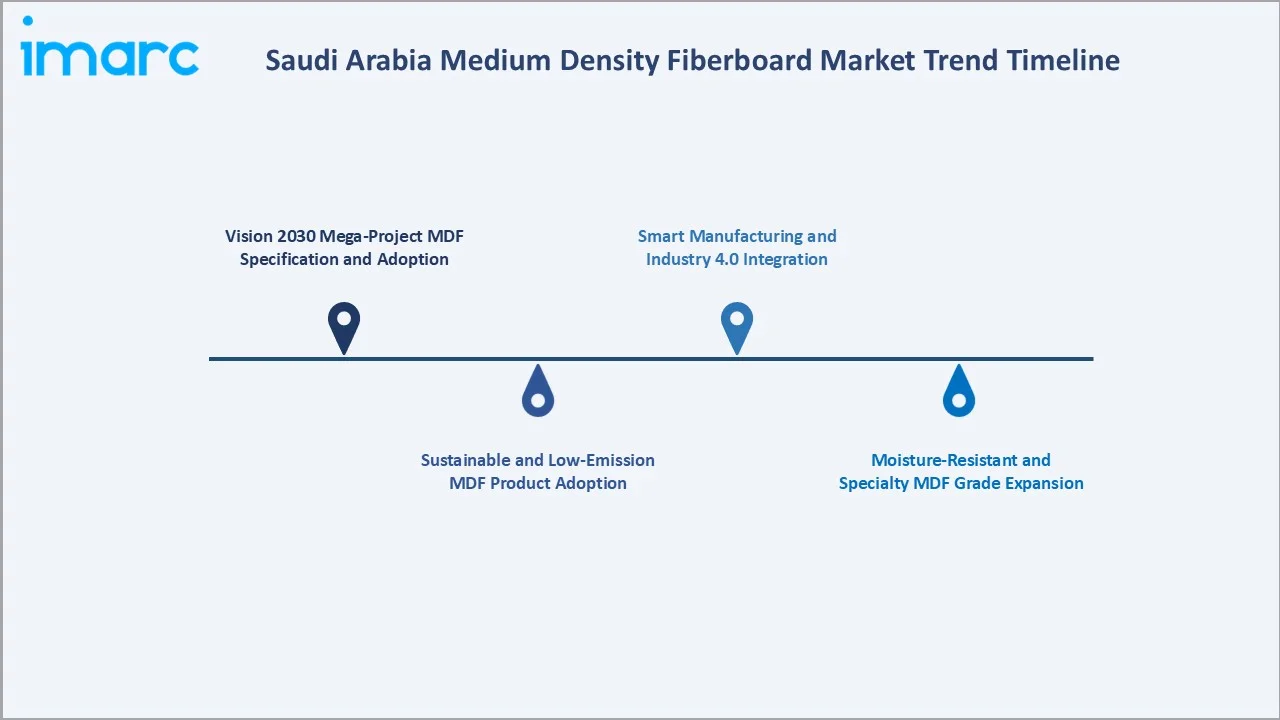
1. Vision 2030 Mega-Project MDF Specification and Adoption
The scale of Vision 2030 construction projects is driving unprecedented adoption of engineered wood products, including MDF, in Saudi Arabia's construction sector. NEOM, the Red Sea Project, and Diriyah Gate are setting new specification standards for interior materials, favoring MDF's design flexibility, surface quality, and consistent panel dimensions. These projects create template specifications that cascade down to subsequent commercial and residential construction, broadening the MDF market beyond premium developments into standard construction practice across Saudi Arabia.
2. Sustainable and Low-Emission MDF Product Adoption
Growing environmental awareness among Saudi consumers, architects, and government procurement agencies is accelerating the adoption of eco-certified MDF products. Low-formaldehyde MDF panels, along with products certified under international sustainability standards, are gaining specification preference in government buildings, schools, and LEED-certified commercial projects. Saudi Arabia's commitment to 2060 carbon neutrality is creating additional regulatory momentum for green building material specifications that favor certified low-emission MDF.
3. Smart Manufacturing and Industry 4.0 Integration
Advanced manufacturing technologies including automated press systems, real-time quality monitoring, predictive maintenance, and digital inventory management are being adopted by MDF manufacturers serving the Saudi market. These Industry 4.0 capabilities improve product consistency, reduce waste, and enable customized production runs for specialty panel requirements. Smart manufacturing integration also supports local content objectives by demonstrating technological sophistication that meets Saudi industrial development standards.
4. Moisture-Resistant and Specialty MDF Grade Expansion
Saudi Arabia's hot and humid coastal climate in Jeddah and the Eastern Province, combined with the extensive use of MDF in kitchen and bathroom applications, is driving strong growth in moisture-resistant MDF (MR-MDF) and medium-density overlay (MDO) panel grades. Fire-retardant MDF is gaining adoption in commercial and hospitality applications requiring compliance with Saudi civil defense fire safety codes. These specialty grades command significant price premiums over standard MDF, creating value migration opportunity for technically advanced suppliers.
Industry Value Chain Analysis
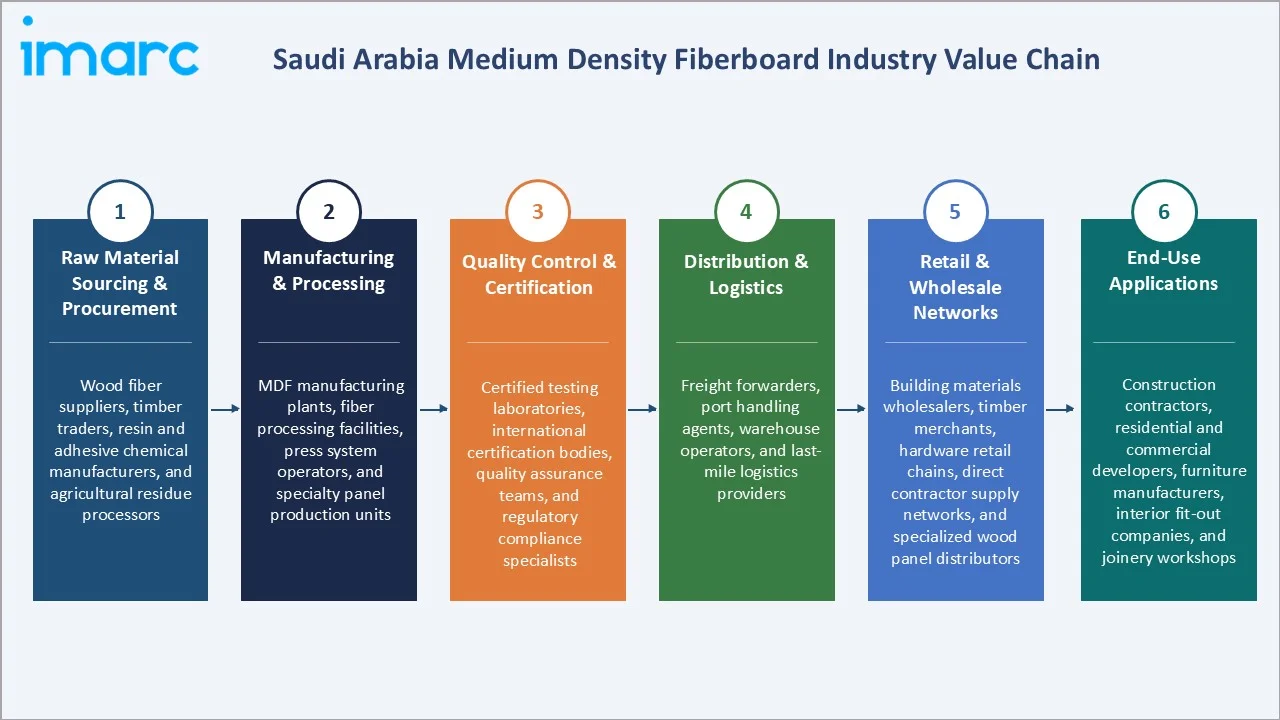
The Saudi Arabia MDF value chain integrates raw material sourcing and procurement, manufacturing and fiber processing, quality control and certification, distribution and logistics, retail and wholesale networks, and end-use applications across construction and furniture manufacturing sectors.
|
Stage |
Key Participants |
|
Raw Material Sourcing & Procurement |
Wood fiber suppliers, timber traders, resin and adhesive chemical manufacturers, and agricultural residue processors. |
|
Manufacturing & Processing |
MDF manufacturing plants, fiber processing facilities, press system operators, and specialty panel production units. |
|
Quality Control & Certification |
Certified testing laboratories, international certification bodies, quality assurance teams, and regulatory compliance specialists. |
|
Distribution & Logistics |
Freight forwarders, port handling agents, warehouse operators, and last-mile logistics providers. |
|
Retail & Wholesale Networks |
Building materials wholesalers, timber merchants, hardware retail chains, direct contractor supply networks, and specialized wood panel distributors. |
|
End-Use Applications |
Construction contractors, residential and commercial developers, furniture manufacturers, interior fit-out companies, and joinery workshops. |
Manufacturing and processing represent the most technically demanding and value-intensive stage in the Saudi Arabia MDF value chain, as the quality of fiber preparation, resin formulation, and pressing conditions directly determines product density, surface quality, and emission performance. Leading manufacturers invest in continuous press technology, real-time quality monitoring, and precision fiber blending to deliver consistent panel specifications that command premium pricing and secure preferred supplier status with major contractors and developers.
Technology Landscape in the Saudi Arabia MDF Industry
Advanced Press and Fiber Processing Technology
Modern continuous press technology enables high-throughput, consistent-density MDF production with precise thickness control across long panel lengths. These systems offer significant productivity advantages over multi-opening press technology and enable the production of large-format panels required for contemporary architectural applications. Fiber refining technology improvements have enhanced wood fiber quality and consistency, reduced adhesive consumption and improved panel homogeneity.
Low-Emission Resin and Binder Technology
The development of low-formaldehyde urea-formaldehyde (UF) resins and the commercial adoption of methylene diphenyl diisocyanate (MDI) binders enable production of super grade MDF that meets the most stringent emission standards without compromising mechanical performance. Saudi Arabia's adoption of international green building certifications is creating market pull for these advanced binder technologies. Melamine-faced MDF using formaldehyde-free overlay systems is gaining specification preference in premium residential and hospitality projects across Riyadh and Jeddah.
Digital Inventory Management and Supply Chain Technology
Digital supply chain management platforms are improving MDF inventory visibility, order fulfillment accuracy, and working capital efficiency across the Saudi distribution network. Real-time stock monitoring, demand forecasting algorithms, and integrated logistics management are enabling distributors to maintain optimal panel inventory levels during construction project peak demand periods. These digital capabilities are particularly important in managing the diverse product range of MDF grades, thicknesses, and surface finishes required by Saudi Arabia's varied construction project specifications.
Market Segmentation Analysis
The report covers the following segments:
|
Segment Category |
Leading Segment |
Market Share |
Year |
|
Application |
Residential |
64.8% |
2025 |
|
Sector |
New Construction |
69.3% |
2025 |
|
Region |
Northern and Central Region |
36.8% |
2025 |

By Application
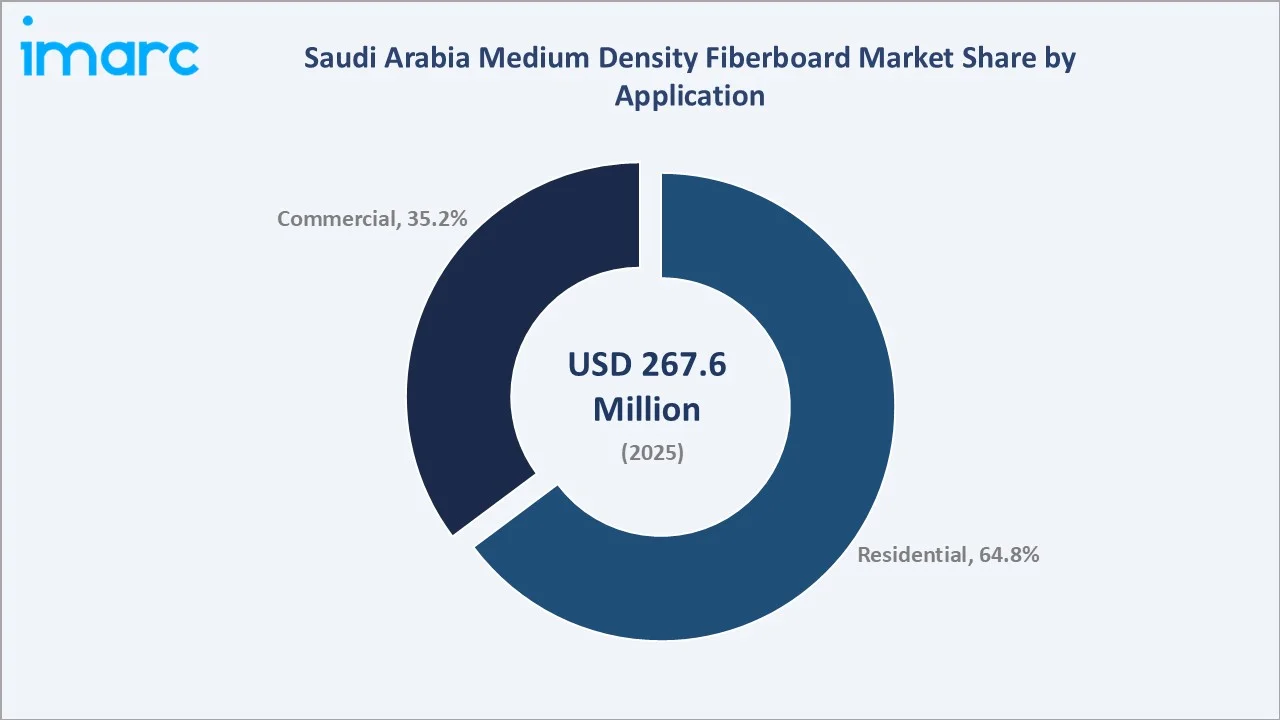
Residential applications lead at 64.8% (2025), driven by Saudi housing programs, rising homeownership rates, and extensive use of MDF in kitchen cabinetry, bedroom furniture, door cores, wall paneling, and decorative molding across new residential developments.
To access detailed market analysis, Request Sample
Commercial applications at 35.2% reflect growing demand from retail fit-outs, hospitality interior projects, office furniture, and education sector construction. Saudi Arabia's tourism strategy under Vision 2030 is driving significant hotel and resort development, generating substantial commercial MDF demand for room furniture, wall paneling, and reception area fit-outs.
By Sector
New construction dominates at 69.3% (2025), directly aligned with Saudi Arabia's construction boom and the unprecedented volume of new residential, commercial, and hospitality projects under Vision 2030 development programs.
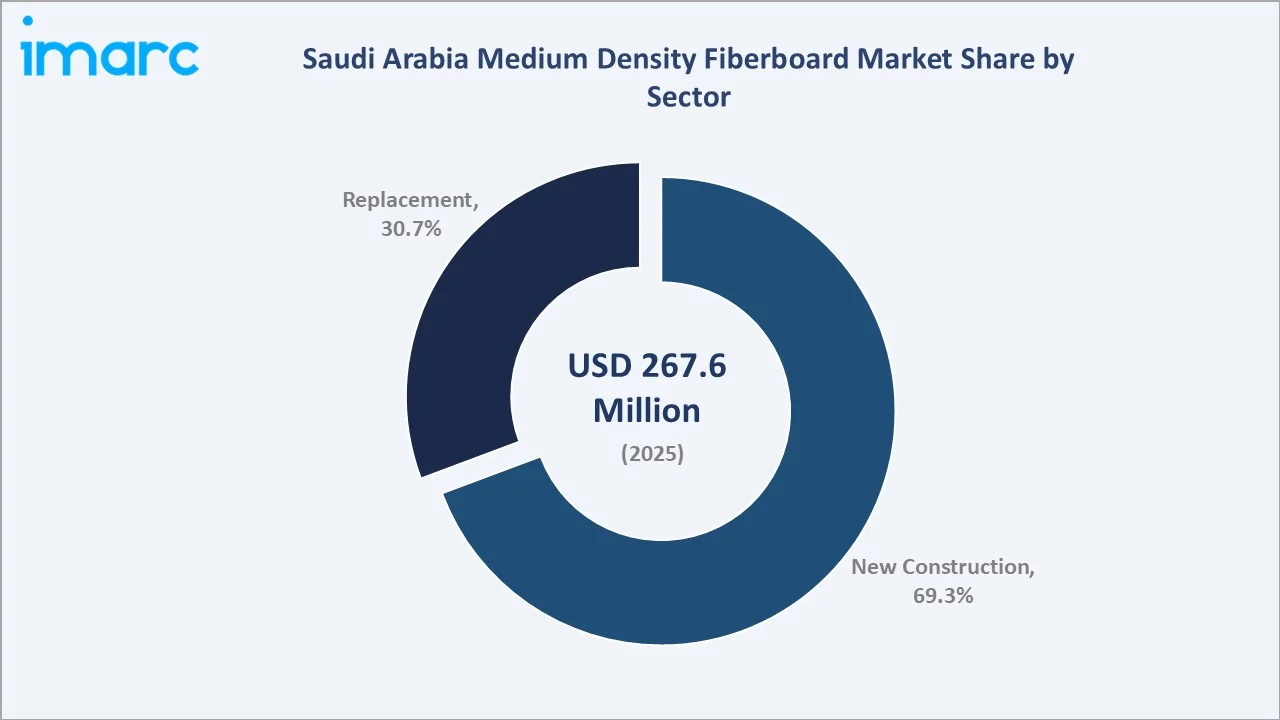
The replacement sector at 30.7% reflects renovation and refurbishment activity in existing residential and commercial properties. As Vision 2030 developments from the early 2020s mature, renovation cycles will increase the replacement segment's contribution through 2034.
Regional Market Insights
|
Region |
Share (2025) |
Key Saudi Arabia MDF Market Drivers & Characteristics |
|
Northern and Central Region |
36.8% |
Reflecting the concentration of the national capital, the highest population density, and the largest volume of government and private construction projects. |
|
Western Region |
28.4% |
Reflecting the strong commercial and hospitality construction activity in Jeddah, and the tourism and pilgrimage infrastructure investment in Makkah and Madinah. |
|
Eastern Region |
23.7% |
Reflecting the robust industrial and commercial construction activity linked to the energy sector and growing residential projects serving the region's large expatriate and Saudi workforce population. |
|
Southern Region |
11.1% |
Reflecting the relatively smaller population base and construction activity compared to northern regions, with growing residential development and infrastructure investments. |
The Northern and Central Regions' 36.8% dominance is driven by Riyadh's transformation under Vision 2030. The Western region's 28.4% reflects Jeddah's extensive commercial and residential development, combined with major hospitality infrastructure investment supporting Saudi Arabia's growing religious tourism and Red Sea coastal resort development.
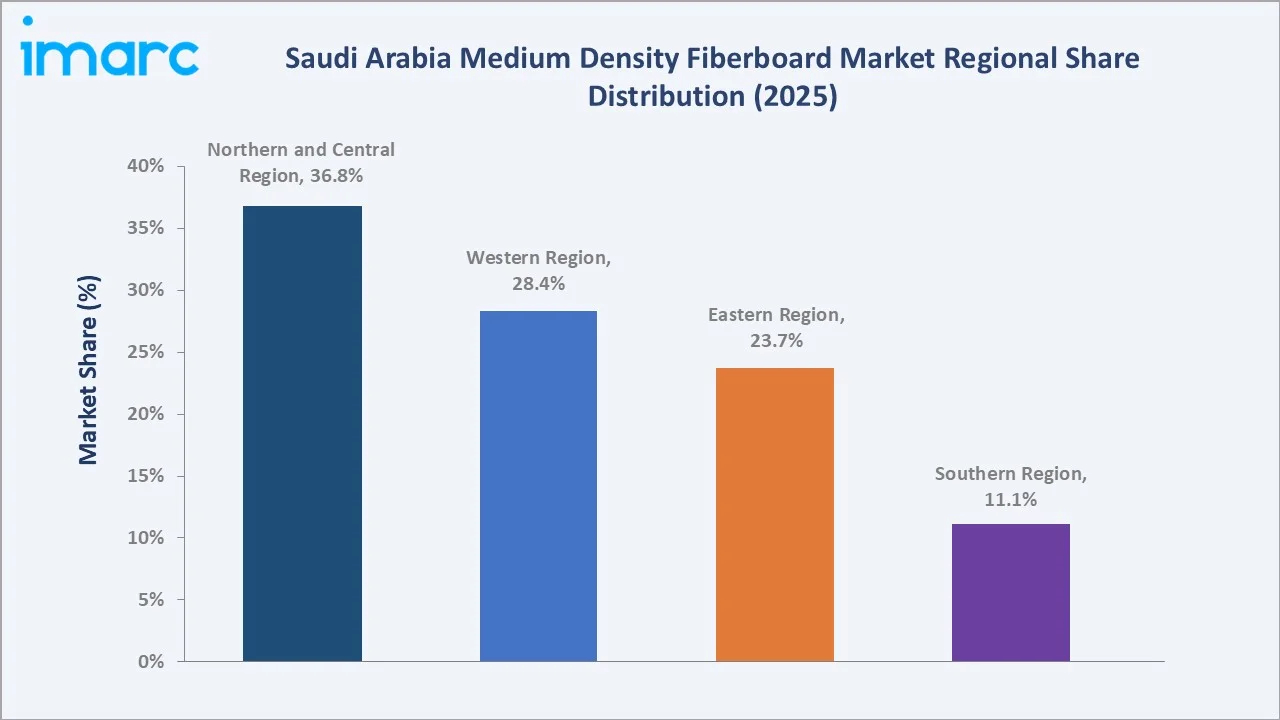
The Eastern region's 23.7% reflects the region's ongoing industrial diversification and residential expansion around Dammam, Al Khobar, and Dhahran. The Southern region, while the smallest at 11.1%, is expected to grow as Vision 2030 regional development investments in tourism and infrastructure generate new construction activity in previously underserved provinces.
Competitive Landscape
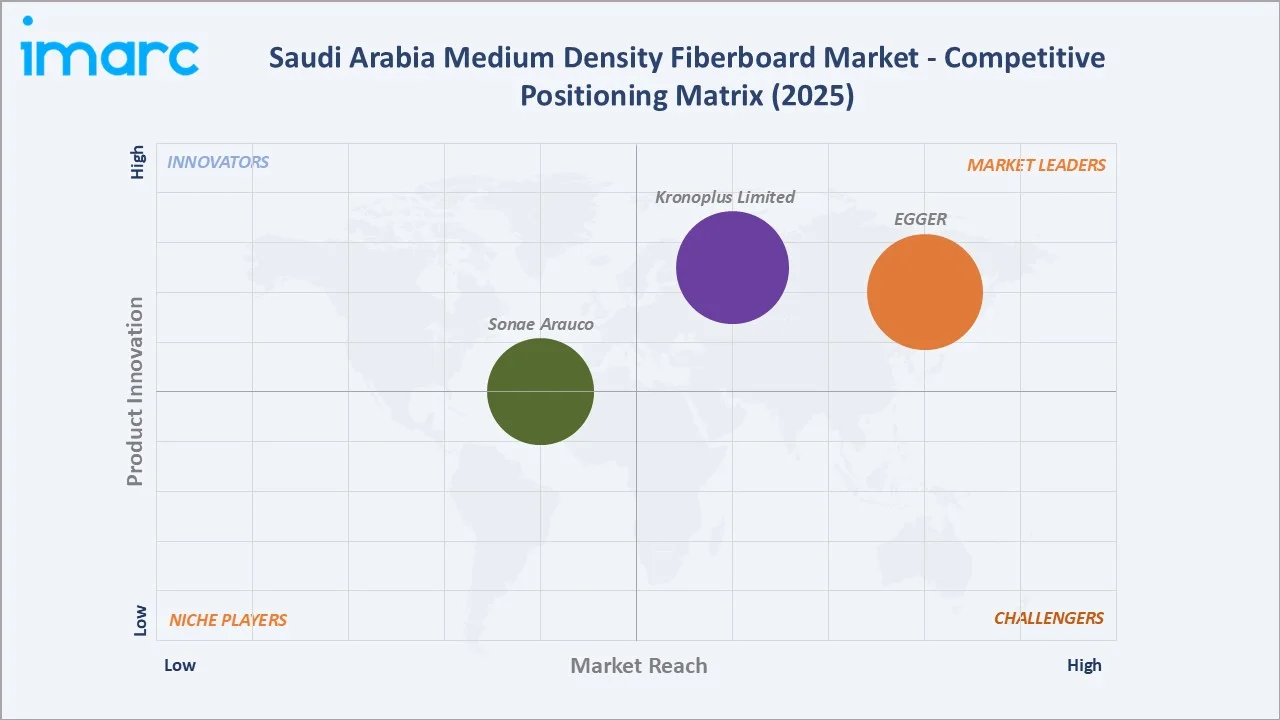
The Saudi Arabia MDF market is characterized by a mix of international manufacturers with local distribution partnerships and emerging domestic manufacturing operations. Market competition is driven by product quality consistency, price competitiveness, distribution efficiency, technical support capabilities, and compliance with Saudi standards.
|
Company |
Key Products |
Market Position |
Core Strength |
|
Kronoplus Limited |
Medium Density Fiberboard (MDF), Moisture Resistant MDF, Fire Retardant MDF, MDF Deep Black |
Market Leader |
Kronoplus Limited, operating under its prominent brand name Kronospan, plays a vital role as a leading international supplier and market benchmark for Medium Density Fiberboard (MDF) products in Saudi Arabia. |
|
EGGER |
EGGER Decorative MDF E1E05 TSCA ST |
Market Leader |
EGGER acts as a major international key player in the Saudi Arabian Medium Density Fiberboard (MDF) and wood-based panel market. |
|
Sonae Arauco |
Innovus Coloured MDF |
Established Player |
Sonae Arauco supplies engineered wood solutions, including Medium Density Fiberboard (MDF), to the Saudi Arabian market through its international export and regional distribution networks. |
Companies across the competitive landscape are investing in product range expansion, sustainability certifications, technical sales support, and digital order management capabilities. The market is expected to attract additional investment in local manufacturing as Vision 2030's localization incentives and sustained construction demand strengthen the business case for Saudi-based MDF production.
Key Company Profiles
Kronoplus Limited
Kronoplus Limited is a manufacturer of wood-based panels and related products, with a portfolio that includes medium-density fiberboard (MDF), particleboard, laminate flooring, and decorative panels. In the Saudi Arabia MDF market, the company can serve furniture, interior fit-out, construction, and cabinetry applications through its broad panel product range. Its market positioning is supported by large-scale manufacturing capabilities, product diversification, and a focus on quality and sustainable wood-based solutions.
- Key Products: Medium Density Fiberboard (MDF), Moisture Resistant MDF, Fire Retardant MDF, MDF Deep Black.
- Strategic Focus: Supplying high-quality, application-specific wood-based panels for furniture, interiors, and construction uses. The company also emphasizes product innovation, sustainable manufacturing, and broadening its presence across growing regional end-use sectors.
EGGER
EGGER is a manufacturer of wood-based materials, offering products such as medium-density fiberboard (MDF), particleboard, laminates, and decorative surface solutions. In the Saudi Arabia MDF market, the company serves applications across furniture, interior design, cabinetry, and construction. Its market presence is supported by a broad product portfolio, established manufacturing capabilities, and a strong emphasis on design, quality, and sustainable wood-based solutions.
- Key Products: EGGER Decorative MDF E1E05 TSCA ST.
- Strategic Focus: Expanding its presence in furniture, interiors, and construction applications through high-quality and design-oriented wood-based panels. The company also emphasizes product innovation, resource efficiency, and sustainable material solutions to strengthen its competitive position.
Market Concentration Analysis
The Saudi Arabia MDF market exhibits moderate concentration, with international manufacturers commanding significant market share through their product quality, brand recognition, and established distribution networks. Local and regional players serve important market segments, particularly in price-sensitive applications and regions where import logistics add cost disadvantages for European-manufactured panels.
Market concentration is expected to remain moderate through 2034, with Vision 2030's localization incentives potentially strengthening local manufacturing's market position as new domestic MDF production capacity is established under financing programs. The long-term structural demand created by mega-project development provides sufficient market volume to support multiple competitive players while simultaneously incentivizing new capacity investment.
Investment & Growth Opportunities
Highest Growth Segments
Moisture-resistant and specialty grade MDF, fire-retardant panels for commercial applications, ultra-light MDF for furniture optimization, and low-emission E0 certified panels represent the highest-margin investment vectors in the Saudi Arabia MDF market through 2034. These specialty grades typically command price premiums over standard MDF.
Investment Themes
- Domestic MDF manufacturing establishment: Vision 2030's localization program provides financial incentives for establishing domestic wood panel manufacturing. A Saudi-based MDF plant would benefit from local content procurement preferences in government-funded construction, reduced logistics costs, and shorter supply lead times to Saudi construction projects.
- Specialty grade MDF distribution: Establishing dedicated distribution of specialty MDF grades including fire-retardant, moisture-resistant, and ultra-light panels that are currently undersupplied relative to market demand creates opportunity for premium market positioning. Saudi Arabia's growing hospitality and commercial construction sectors represent natural demand centers for these value-added products.
Future Market Outlook (2026-2034)
The Saudi Arabia medium density fiberboard market is projected to grow from USD 267.6 Million in 2025 to USD 427.4 Million by 2034, exhibiting a CAGR of 5.34% during 2026-2034. The market is projected to reach an anchor value of USD 347.1 Million by 2030, representing the mid-period milestone at which Vision 2030 construction activity reaches peak delivery and the giga-project interior fit-out phase generates maximum MDF demand.
Three structural forces will define the Saudi Arabia MDF market through 2034. First, the progressive delivery of Vision 2030 mega-projects will sustain construction activity and interior fit-out demand through the forecast period. Second, the evolution of Saudi building standards toward green building certification requirements will shift market demand toward higher-specification, certified MDF grades that command premium pricing. Third, Vision 2030's localization program is expected to catalyze new domestic MDF manufacturing capacity through the forecast period.
Research Methodology
Primary Research
Primary research comprised in-depth interviews with MDF distributors, construction contractors, furniture manufacturers, interior designers, and industry analysts operating in the Saudi Arabian market. These discussions validated market size estimates, assessed Vision 2030 project MDF specification requirements, evaluated competitive positioning, and provided insights into regulatory developments, technology adoption priorities, and future market evolution in the Saudi Arabia MDF market.
Secondary Research
Secondary research encompassed company annual reports, construction statistics, product certification databases, housing data, Vision 2030 project announcements, international MDF manufacturer financial reports, and industry publications focused on the Middle East building materials and wood panel markets.
Forecasting Models
Forecasting models incorporated historical MDF market revenue trends, Saudi construction activity growth projections, Vision 2030 project implementation timelines, residential housing program targets, and macroeconomic indicators including Saudi GDP growth and construction sector investment. Both top-down and bottom-up approaches were applied and cross-validated to ensure forecast consistency with sector-specific demand drivers.
Saudi Arabia Medium Density Fiberboard Market Report Coverage:
| Report Features | Details |
|---|---|
| Base Year of the Analysis | 2025 |
| Historical Period | 2020-2025 |
| Forecast Period | 2026-2034 |
| Units | Million USD |
| Scope of the Report |
Exploration of Historical Trends and Market Outlook, Industry Catalysts and Challenges, Segment-Wise Historical and Future Market Assessment:
|
| Applications Covered | Residential, Commercial |
| Sectors Covered | New Construction, Replacement |
| Regions Covered | Northern and Central Region, Western Region, Eastern Region, Southern Region |
| Companies Covered | Kronoplus Limited, EGGER, Sonae Arauco, etc, |
| Customization Scope | 10% Free Customization |
| Post-Sale Analyst Support | 10-12 Weeks |
| Delivery Format | PDF and Excel through Email (We can also provide the editable version of the report in PPT/Word format on special request) |
Key Benefits for Stakeholders:
- IMARC’s industry report offers a comprehensive quantitative analysis of various market segments, historical and current market trends, market forecasts, and dynamics of the Saudi Arabia medium density fiberboard market from 2020-2034.
- The research report provides the latest information on the market drivers, challenges, and opportunities in the Saudi Arabia medium density fiberboard market.
- Porter's five forces analysis assist stakeholders in assessing the impact of new entrants, competitive rivalry, supplier power, buyer power, and the threat of substitution. It helps stakeholders to analyze the level of competition within the Saudi Arabia medium density fiberboard industry and its attractiveness.
- Competitive landscape allows stakeholders to understand their competitive environment and provides an insight into the current positions of key players in the market.
Frequently Asked Questions About the Saudi Arabia Medium Density Fiberboard Market Report
The Saudi Arabia medium density fiberboard market reached USD 267.6 Million in 2025, driven by Vision 2030 construction acceleration, rising urbanization and housing demand, growing preference for sustainable building materials, and technological improvements in MDF manufacturing quality and performance.
The Saudi Arabia medium density fiberboard market is projected to grow at a CAGR of 5.34% during 2026-2034, sustained by Vision 2030 mega-project development, residential housing program implementation, green building material adoption, and specialty MDF grade penetration across construction and furniture applications.
The Saudi Arabia medium density fiberboard market is projected to reach approximately USD 347.1 Million by 2030, representing the mid-period milestone at which Vision 2030 giga-project interior fit-out phases drive maximum MDF demand across NEOM, Red Sea Project, Qiddiya, and Diriyah Gate developments.
Residential applications lead with a 64.8% share in 2025, driven by Saudi Arabia's large-scale National Housing Program, rising homeownership among Saudi nationals, and extensive use of MDF in kitchen cabinetry, bedroom furniture, door skins, wall paneling, and decorative molding across new residential developments.
New construction dominates with a 69.3% share in 2025, directly aligned with the unprecedented pace of construction activity across Saudi Arabia under Vision 2030, including mega-projects, residential housing programs, and commercial real estate development across all major Saudi cities and regions.
The Northern and Central Region leads with a 36.8% share in 2025, driven by Riyadh's concentration of government and private construction projects, the highest population density and housing demand, and the headquarters of major contractors and furniture manufacturers serving the Saudi market.
Key players include Kronoplus Limited, EGGER, and Sonae Arauco, among others.
The Saudi Arabia medium density fiberboard market is projected to reach USD 427.4 Million by 2034, sustained by ongoing residential construction, commercial sector expansion, specialty MDF grade growth, and potential contribution from domestically established MDF manufacturing capacity under Vision 2030 localization programs.
Need more help?
- Speak to our experienced analysts for insights on the current market scenarios.
- Include additional segments and countries to customize the report as per your requirement.
- Gain an unparalleled competitive advantage in your domain by understanding how to utilize the report and positively impacting your operations and revenue.
- For further assistance, please connect with our analysts.
 Request Customization
 Speak to an Analyst
 Request Brochure
 Inquire Before Buying
Benefits of Customization
- Personalize this research
- Triangulate with your data
- Get data as per your format and definition
- Gain a deeper dive into a specific application, geography, customer, or competitor
- Any level of personalization
Get in Touch With Us
UNITED STATES
Phone: +1-201-971-6302
INDIA
Phone: +91-120-433-0800
UNITED KINGDOM
Phone: +44-753-714-6104
Email: [email protected]
Client Testimonials




.webp)




.webp)













Related Reports

Choose your plan
*Please note that the prices mentioned below are starting prices for each bundle type. Kindly contact our team for further details.*
Single User License
- 1 User License, Access on 2 Devices
- PDF Report + Excel Dataset (Password Protected)
- Lifetime Access
- No Printing Rights
- 10% Free Report Customization
- 10–12 Weeks of Analyst Support
Five User License
- Access for 5 Users, 2 Devices per User
- PDF Report + Excel Dataset (Password Protected)
- Lifetime Access
- Dedicated Account Manager
- 12–14 Weeks of Analyst Support
- No Printing Rights
- 15% Free Report Customization
- 25% Discount on Your Next Purchase
Corporate User License
- Unlimited User Access (Within Your Organization)
- PDF Report + Excel Dataset
- Lifetime Access
- Dedicated Account Manager
- 14–20 Weeks of Analyst Support
- No Printing Rights
- 20% Free Report Customization
- 30% Discount on Your Next Purchase
Essential Insights
What's included:
3 reports
- Lifetime Access
- PDF Reports
- Excel Datasets
- 2 Weeks of Free Analyst Support
- 2 User Licenses
- Access on 2 Devices
- Printing Rights
- Complimentary PowerPoint (PPT) Version
- Complimentary License Upgrade
Professional Access
What's included:
5 reports
- Lifetime Access
- PDF Reports
- Excel Datasets
- 8 Weeks of Free Analyst Support
- 2 User Licenses
- Access on 2 Devices
- Printing Rights
- Complimentary PowerPoint (PPT) Version
- Complimentary License Upgrade
Business Advantage
What's included:
8 reports
- Lifetime Access
- PDF Reports
- Excel Datasets
- 14 Weeks of Free Analyst Support
- 2 User Licenses
- Access on 2 Devices
- Printing Rights
- Complimentary PowerPoint (PPT) Version
- Complimentary License Upgrade
Enterprise Intelligence
What's included:
10 reports
- Lifetime Access
- PDF Reports
- Excel Datasets
- 20 Weeks of Free Analyst Support
- 2 User Licenses
- Access on 2 Devices
- Printing Rights
- Complimentary PowerPoint (PPT) Version
- Complimentary License Upgrade