
Saudi Arabia Nuclear Power Equipment Market Size, Share, Trends and Forecast by Reactor Type, Equipment Type, and Region, 2026-2034
Saudi Arabia Nuclear Power Equipment Market Size, Share, Trends & Forecast (2026-2034)
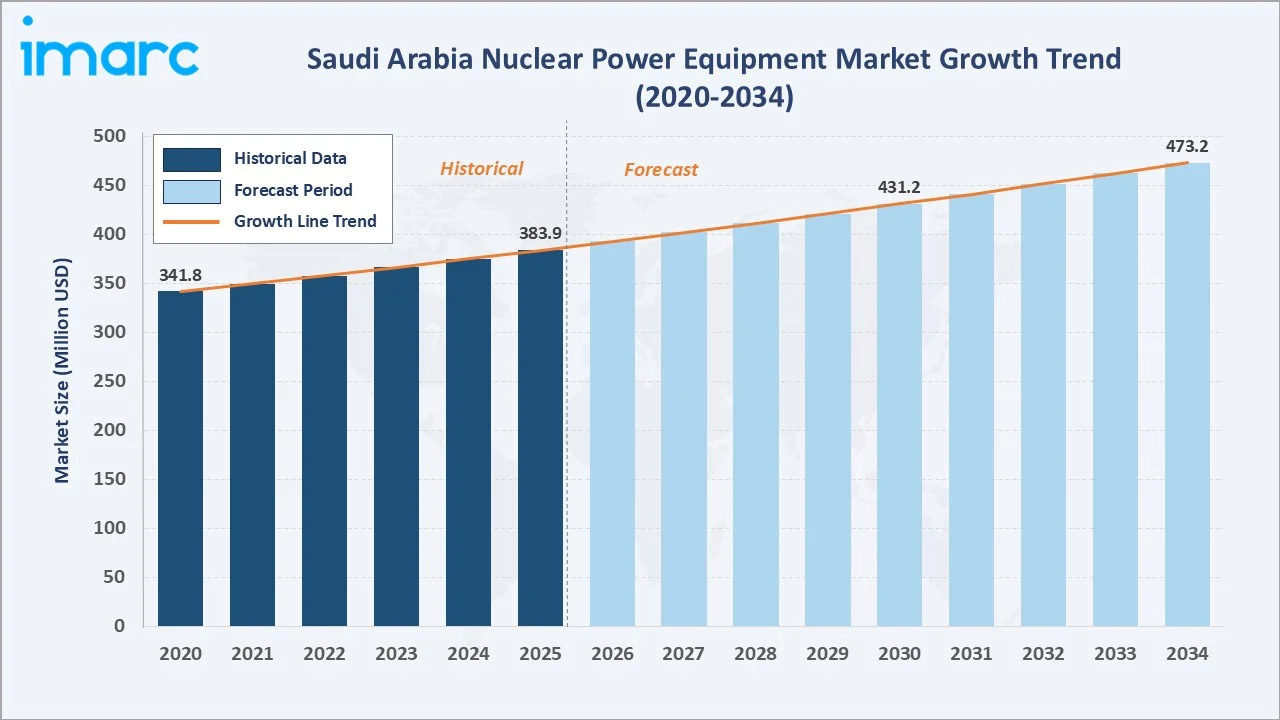
The Saudi Arabia nuclear power equipment market was valued at USD 383.9 Million in 2025 and is projected to reach USD 473.2 Million by 2034, exhibiting a CAGR of 2.35% during 2026-2034. The market is supported by Saudi Arabia’s long-term plans to diversify its energy mix, strengthen energy security, and develop domestic nuclear infrastructure through strategic investments and international partnerships.
Pressurized water reactor (PWR) commands the leading reactor type segment at 48.6%, island equipment leads the equipment type segment at 68.3%, and Eastern Region commands 38.4% regional share.
Market Snapshot
|
Metric |
Value |
|
Market Size (2025) |
USD 383.9 Million |
|
Forecast Market Size (2034) |
USD 473.2 Million |
|
CAGR (2026-2034) |
2.35% |
|
Base Year |
2025 |
|
Historical Period |
2020-2025 |
|
Forecast Period |
2026-2034 |
|
Largest Region |
Eastern Region (38.4%, 2025) |
|
Second Largest Region |
Northern and Central Region (29.6%, 2025) |
|
Leading Reactor Type |
Pressurized Water Reactor (PWR) (48.6%, 2025) |
|
Leading Equipment Type |
Island Equipment (68.3%, 2025) |
The Saudi Arabia nuclear power equipment market expanded from USD 341.8 Million in 2020 to USD 383.9 Million in 2025, supported by strategic government investments in nuclear infrastructure planning, growing domestic electricity demand, and bilateral agreements with leading nuclear technology providers. Anchored at USD 431.2 Million in 2030, the forecast to USD 473.2 Million by 2034 reflects steady advancement of reactor construction schedules, increasing procurement of island and auxiliary equipment, and continued alignment with Vision 2030 energy diversification targets.
To get more information on this market, Request Sample
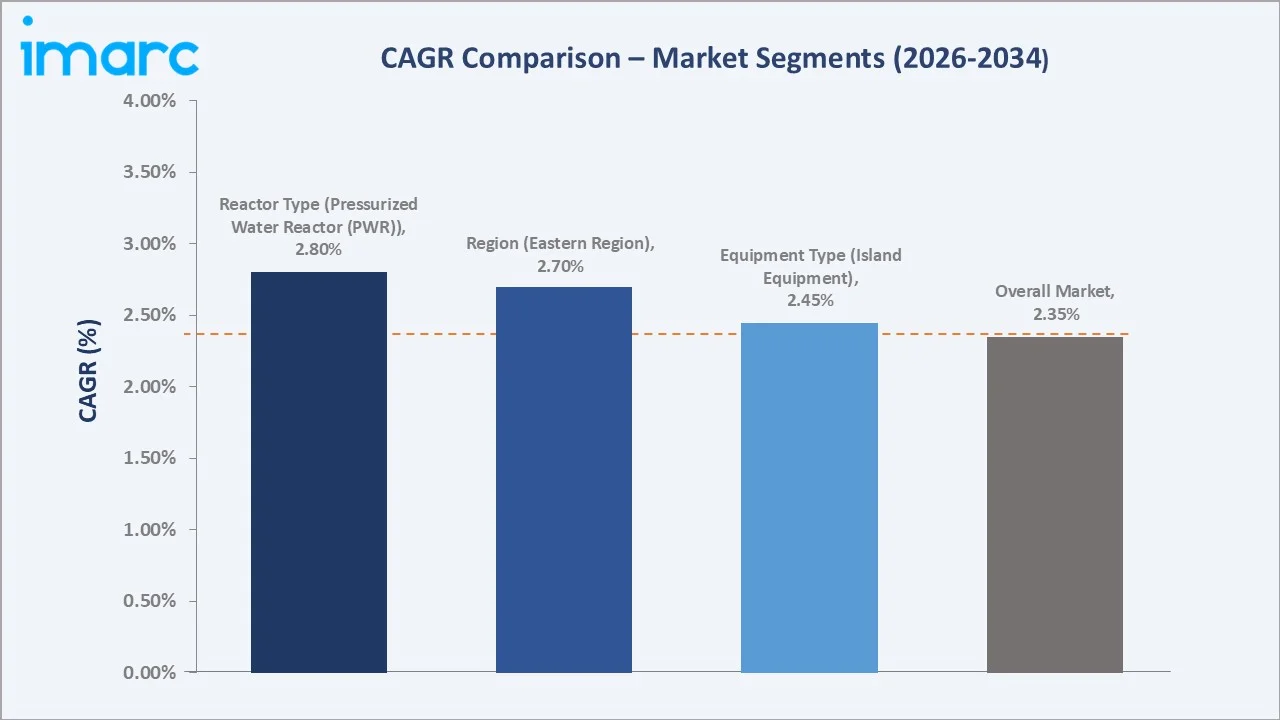
CAGR trajectories across reactor type and equipment type sub-segments, together with regional patterns, show pressurized water reactor (PWR) and Eastern Region expanding faster than the overall 2.35% market CAGR, driven by planned reactor site selection in eastern provinces, rising procurement of high-capacity turbine generators, and increasing investment in nuclear-grade auxiliary systems.
Executive Summary
The Saudi Arabia nuclear power equipment market is on a measured yet strategically significant growth trajectory, rising from USD 341.8 Million in 2020 to USD 473.2 Million by 2034. The Kingdom has embarked on an ambitious nuclear energy program anchored in its Vision 2030 agenda, seeking to diversify electricity generation, reduce domestic oil consumption for power production, and establish a domestic nuclear technology sector.
Pressurized water reactor (PWR) dominates the reactor type segment at 48.6% in 2025, underpinned by its proven commercial track record and suitability for large-scale baseload generation. Island equipment leads the equipment type segment at 68.3%, encompassing reactor pressure vessels, steam generators, turbine-generators, and primary loop components that constitute the core of nuclear generation infrastructure. Eastern Region commands 38.4% of the regional share, anchored by planned reactor sites in proximity to industrial demand centers.
Key Market Insights
|
Insight |
Data |
|
Leading Reactor Type |
Pressurized Water Reactor (PWR) - 48.6% share (2025) |
|
Second Largest Reactor Type |
Pressurized Heavy Water Reactor (PHWR) - 17.4% share (2025) |
|
Leading Equipment Type |
Island Equipment - 68.3% share (2025) |
|
Second Largest Equipment Type |
Auxiliary Equipment - 31.7% share (2025) |
|
Leading Region |
Eastern Region - 38.4% share (2025) |
|
Second Largest Region |
Northern and Central Region - 29.6% share (2025) |
|
Top Companies |
Korea Hydro & Nuclear Power Co., Ltd. (KHNP), EDF Group, Westinghouse Electric Company LLC |
Key Analytical Observations Expanding On the Data Above:
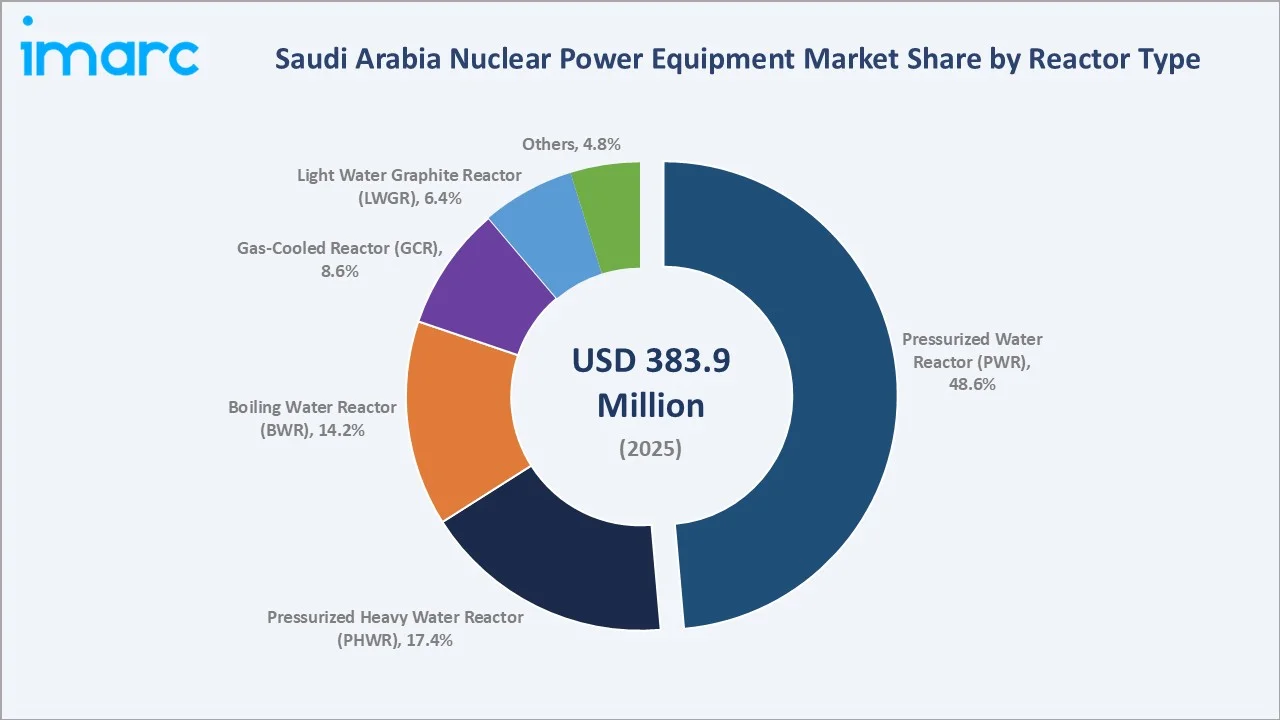
- Pressurized water reactor (PWR) dominance at 48.6% is driven by its proven commercial deployment record, broad vendor ecosystem, and compatibility with Saudi Arabia's planned large-scale baseload reactor program.
- Pressurized heavy water reactor (PHWR) share at 17.4% reflects interest in its natural uranium fuel cycle and lower enrichment dependency, aligned with Saudi Arabia's long-term fuel security goals.
- Island equipment leadership at 68.3% encompasses reactor pressure vessels, steam generators, turbine-generator sets, and primary loop components that represent the highest-value procurement categories in nuclear plant construction.
- Auxiliary equipment share at 31.7% includes cooling systems, electrical infrastructure, instrumentation, and control systems that are increasingly procured in parallel with core island equipment during construction phases.
- Eastern Region at 38.4% leads regional share, supported by proximity to industrial load centers, existing energy infrastructure corridors, and planned reactor site selection across the region.
Saudi Arabia Nuclear Power Equipment Market Overview
Nuclear power equipment encompasses the full range of engineered systems required for reactor construction, commissioning, and operation, spanning reactor pressure vessels and primary coolant systems through turbine-generators, control instrumentation, safety systems, and auxiliary plant infrastructure.
The ecosystem integrates international reactor vendors and technology providers, specialized engineering and procurement contractors, national project oversight authorities, regulatory bodies, and fuel cycle suppliers. Together, they support the Kingdom's ambition to deploy nuclear capacity as part of a diversified, low-carbon electricity generation portfolio.
Market Dynamics
To evaluate market opportunities, Request Sample
Market Drivers
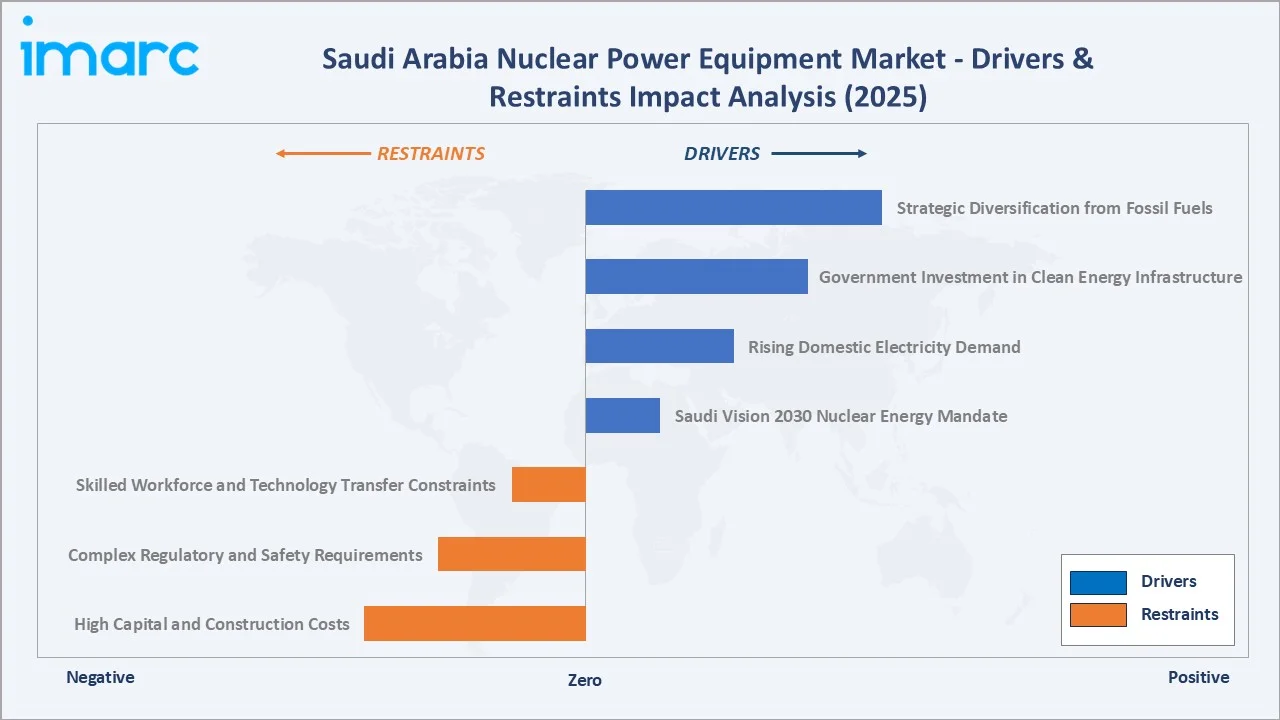
- Saudi Vision 2030 Nuclear Energy Mandate: Saudi Arabia’s Vision 2030 supports the development of nuclear energy as part of its broader efforts to diversify the energy mix, strengthen energy security, and expand domestic power generation capacity.
- Rising Domestic Electricity Demand: Growing industrial activity, urbanization, and residential air conditioning loads are driving sustained increases in electricity consumption, reinforcing the strategic case for large-scale baseload nuclear generation to reduce dependence on gas and oil in the power mix. The urban population, as a percentage of the total population in Saudi Arabia, was reported to be 85.17% in 2024, according to the World Bank collection of development indicators.
- Government Investment in Clean Energy Infrastructure: Active state funding for nuclear program development, including feasibility studies, site assessment, and international vendor engagement, is creating direct demand for pre-construction and early engineering equipment procurement.
- Strategic Diversification from Fossil Fuels: Saudi Arabia's long-term energy policy aims to reduce the share of hydrocarbons in domestic power generation to free up oil and gas for export, positioning nuclear power as a strategic pillar of the generation mix through 2040 and beyond.
Market Restraints
- High Capital and Construction Costs: Nuclear power plant construction involves significant upfront equipment procurement, extended lead times for specialized components, and multi-year construction schedules, creating cost management and financing challenges across project phases.
- Complex Regulatory and Safety Requirements: Nuclear equipment procurement is subject to stringent quality assurance standards, regulatory approvals, and international safety protocols, extending procurement lead times and increasing compliance costs for equipment suppliers and project developers.
- Skilled Workforce and Technology Transfer Constraints: Building domestic nuclear engineering and operational capacity requires sustained investment in human capital, knowledge transfer programs, and vendor partnerships, creating potential bottlenecks in equipment commissioning and plant operation timelines.
Market Opportunities
- Small Modular Reactor (SMR) Deployment Potential: Growing global interest in SMR technology presents Saudi Arabia with an opportunity to deploy modular nuclear units for industrial applications, desalination, and remote power supply, opening new equipment procurement pathways beyond conventional large-scale reactor programs.
- Domestic Nuclear Supply Chain Development: Government support for localizing nuclear component manufacturing and engineering services creates long-term opportunity for domestic manufacturers and international partners to establish in-Kingdom production capacity aligned with Vision 2030 industrialization goals.
Market Challenges
- Extended Project Timelines and Procurement Complexity: Large-scale nuclear projects involve complex multi-vendor equipment packages with long manufacturing and delivery lead times, requiring sophisticated procurement management and supply chain coordination across international boundaries.
- Geopolitical and Fuel Cycle Considerations: Questions around uranium enrichment policy, fuel supply arrangements, and used fuel management introduce strategic complexity that can influence project timelines and international vendor participation in Saudi nuclear programs.
Emerging Market Trends
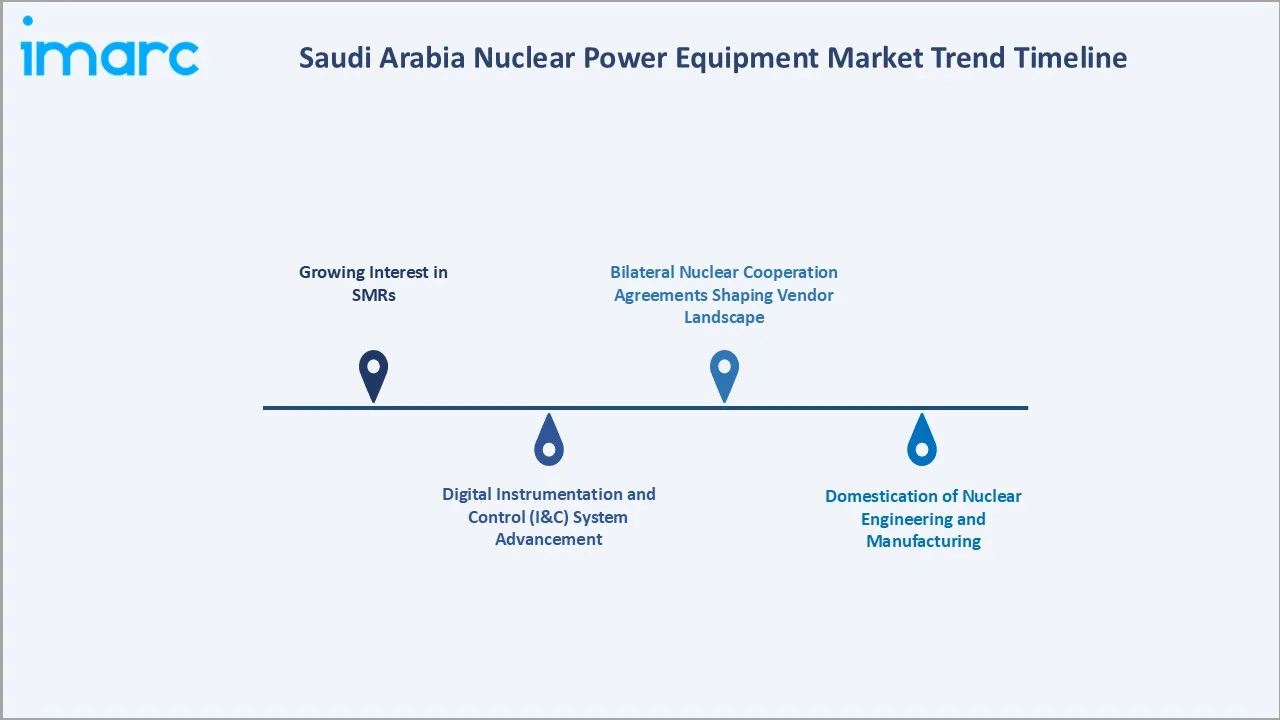
1. Growing Interest in SMRs
Saudi Arabia is actively evaluating SMR technologies as a complement to large scale reactor programs, with potential applications in industrial zones, desalination plants, and off grid locations. The modular procurement model for SMR equipment, including factory fabricated reactor modules, compact turbine systems, and integrated safety systems, represents a differentiated procurement pathway from conventional gigawatt scale reactor equipment.
2. Digital Instrumentation and Control (I&C) System Advancement
Modern nuclear plant procurement increasingly incorporates advanced digital I&C systems for reactor monitoring, safety actuation, and plant operations management. Modern digital I&C solutions also improve operational efficiency, enable real time data monitoring, and support more reliable coordination of critical plant systems.
3. Domestication of Nuclear Engineering and Manufacturing
The Kingdom's Vision 2030 industrial strategy prioritizes technology transfer and domestic manufacturing development across strategic industries, including nuclear. International nuclear vendors are increasingly required to incorporate local content commitments, joint venture arrangements, and knowledge transfer programs into equipment supply agreements, supporting the gradual development of a domestic nuclear supply base.
4. Bilateral Nuclear Cooperation Agreements Shaping Vendor Landscape
Saudi Arabia has established bilateral nuclear cooperation agreements with South Korea, Russia, France, and the United States, among others. These government-to-government frameworks directly influence equipment procurement by creating preferred vendor pathways, financing arrangements, and technology transfer obligations that shape competitive dynamics across reactor type and equipment type segments.
Industry Value Chain Analysis
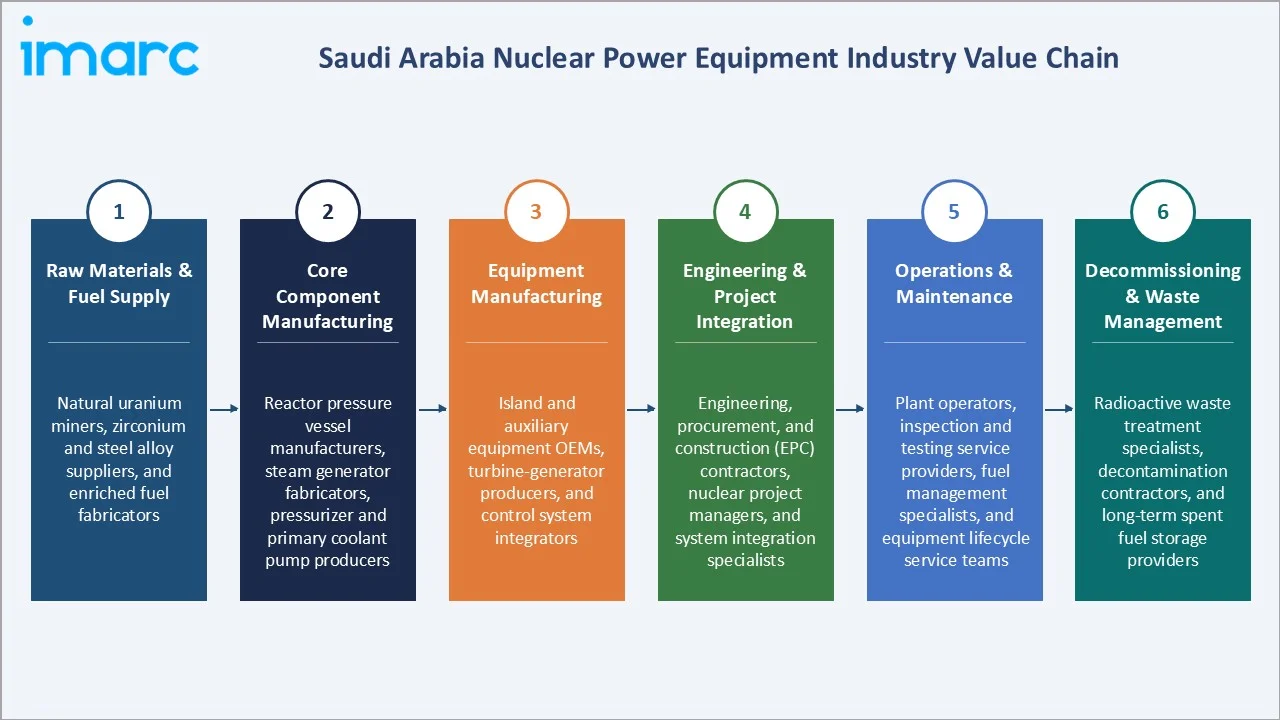
The Saudi Arabia nuclear power equipment value chain spans six stages, from raw material and fuel supply through decommissioning and waste management. Equipment manufacturing and engineering integration capture the highest value-add, while regulatory compliance, safety qualification, and operational services increasingly determine sustainable competitive positioning within this closely governed sector.
|
Stage |
Key Players / Examples |
|
Raw Materials & Fuel Supply |
Natural uranium miners, zirconium and steel alloy suppliers, and enriched fuel fabricators supplying nuclear-grade materials |
|
Core Component Manufacturing |
Reactor pressure vessel manufacturers, steam generator fabricators, pressurizer and primary coolant pump producers |
|
Equipment Manufacturing |
Island and auxiliary equipment original equipment manufacturers (OEMs), turbine-generator producers, and control system integrators |
|
Engineering & Project Integration |
Engineering, procurement, and construction (EPC) contractors, nuclear project managers, and system integration specialists |
|
Operations & Maintenance |
Plant operators, inspection and testing service providers, fuel management specialists, and equipment lifecycle service teams |
|
Decommissioning & Waste Management |
Radioactive waste treatment specialists, decontamination contractors, and long-term spent fuel storage and management providers |
Vertically integrated nuclear vendors, including those who are controlling reactor design, key component manufacturing, and fuel supply partnerships, are positioned to capture greater value than equipment suppliers dependent on third-party technology licenses or single-segment specialization.
Technology Landscape in the Saudi Arabia Nuclear Power Equipment Industry
Reactor Design and Advanced Nuclear Technologies
Pressurized water reactor (PWR) technology remains the dominant design platform in Saudi Arabia's nuclear planning, supported by a mature global supply chain and demonstrated commercial track record. Advanced reactor designs incorporating passive safety features, higher thermal efficiency, and enhanced fuel utilization are shaping next-generation equipment specifications, influencing procurement criteria for pressure vessels, heat exchangers, and primary cooling systems.
Digital I&C Systems
Modern nuclear plant I&C systems are transitioning from analog to fully digital architectures, incorporating programmable logic controllers, real-time monitoring platforms, and cybersecurity safeguards validated against international nuclear safety standards.
SMR Technologies
SMR designs, ranging from light water to high-temperature gas and molten salt concepts, offer factory-fabricated, modular equipment packages suited to Saudi Arabia's industrial and remote energy applications. SMR technology introduces a fundamentally different equipment supply model characterized by standardized factory production, shorter on-site construction schedules, and modular scalability.
Advanced Materials and Manufacturing
Nuclear equipment manufacturing is incorporating advanced alloys, corrosion-resistant cladding materials, and precision manufacturing techniques to meet demanding performance and longevity requirements. Additive manufacturing and digital quality assurance are being introduced for selected nuclear-grade component production, reducing lead times and improving dimensional accuracy for complex pressure-retaining components.
Market Segmentation Analysis
The report covers the following segments:
|
Segment Category |
Leading Segment |
Market Share |
Year |
|
Reactor Type |
Pressurized Water Reactor (PWR) |
48.6% |
2025 |
|
Equipment Type |
Island Equipment |
68.3% |
2025 |
|
Region |
Eastern Region |
38.4% |
2025 |

By Reactor Type
Pressurized water reactor (PWR) commands a 48.6% majority share in 2025, underpinned by its commercial maturity, broad international vendor support, and proven performance across large-scale baseload generation applications.
To access detailed market analysis, Request Sample
Pressurized heavy water reactor (PHWR) at 17.4% in 2025 attracts consideration for its natural uranium fuel compatibility, reducing dependence on enrichment services.
By Equipment Type
Island equipment leads with 68.3% share in 2025 and covers major nuclear island components, such as the reactor pressure vessel, steam generators, pressurizer, primary coolant pumps, and reactor internals, along with turbine island components like turbine generator sets, condensers, and feedwater heaters. It represents the highest value procurement category in nuclear plant construction and is subject to the most stringent quality assurance requirements.
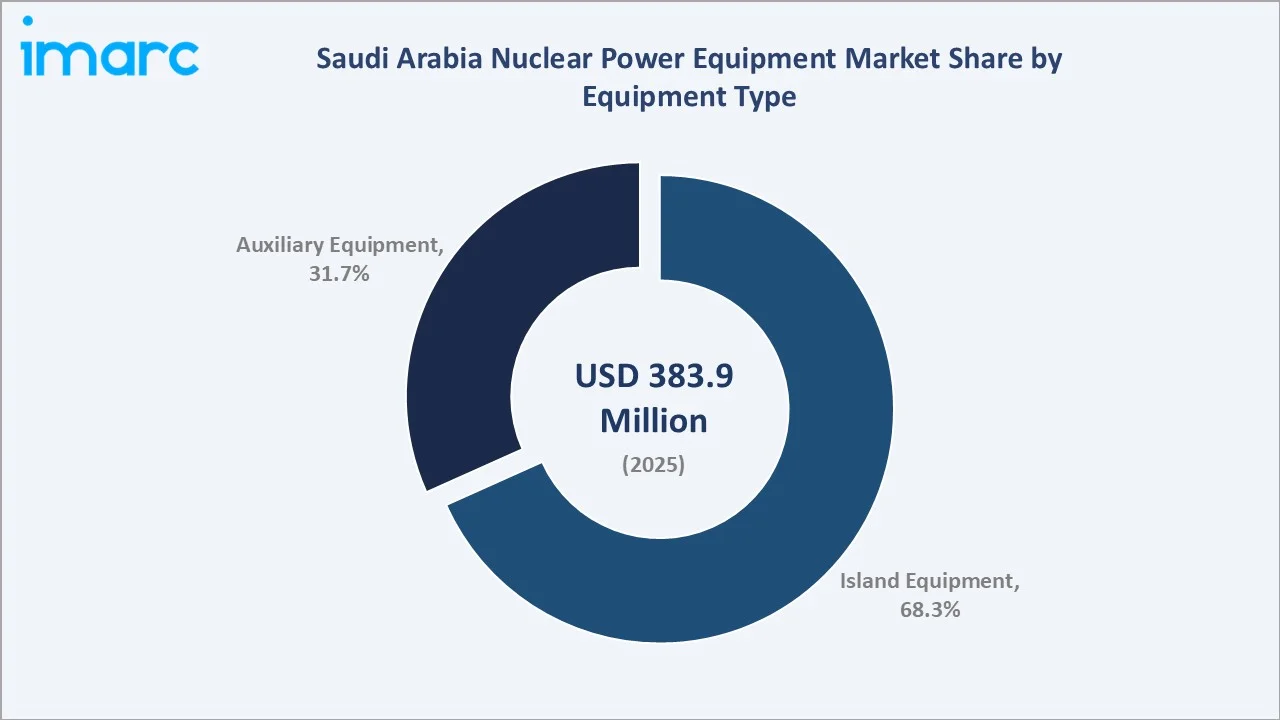
Auxiliary equipment at 31.7% in 2025 covers cooling water systems, electrical switchgear and transformers, diesel generators, waste processing systems, and plant service infrastructure. As nuclear projects advance from planning to construction phases, auxiliary equipment procurement accelerates, supporting steady demand growth for this segment through the forecast period.
Regional Market Insights
|
Region |
Share (2025) |
Key Growth Drivers |
|
Eastern Region |
38.4% |
Proximity to planned reactor sites, existing energy infrastructure, strong industrial demand base, and concentration of oil and gas industrial complex creating adjacent power demand |
|
Northern and Central Region |
29.6% |
Large population base, administrative center concentration, growing urbanization-driven electricity demand, and proximity to planned industrial zones supporting energy infrastructure investment |
|
Western Region |
21.2% |
Coastal industrial development, desalination plant integration potential, growing manufacturing and logistics sector power demand, and expanding urban energy infrastructure requirements |
|
Southern Region |
10.8% |
Emerging industrial development, cross-border energy cooperation potential, growing domestic demand in underserved areas, and long-term SMR deployment feasibility for distributed generation |
Eastern Region at 38.4% in 2025 leads the regional landscape, anchored by its strategic position as Saudi Arabia's primary energy production zone and proximity to planned nuclear reactor site locations in the eastern provinces. A mature energy infrastructure network and dense concentration of industrial power consumers support sustained regional leadership in equipment procurement and project development activity.
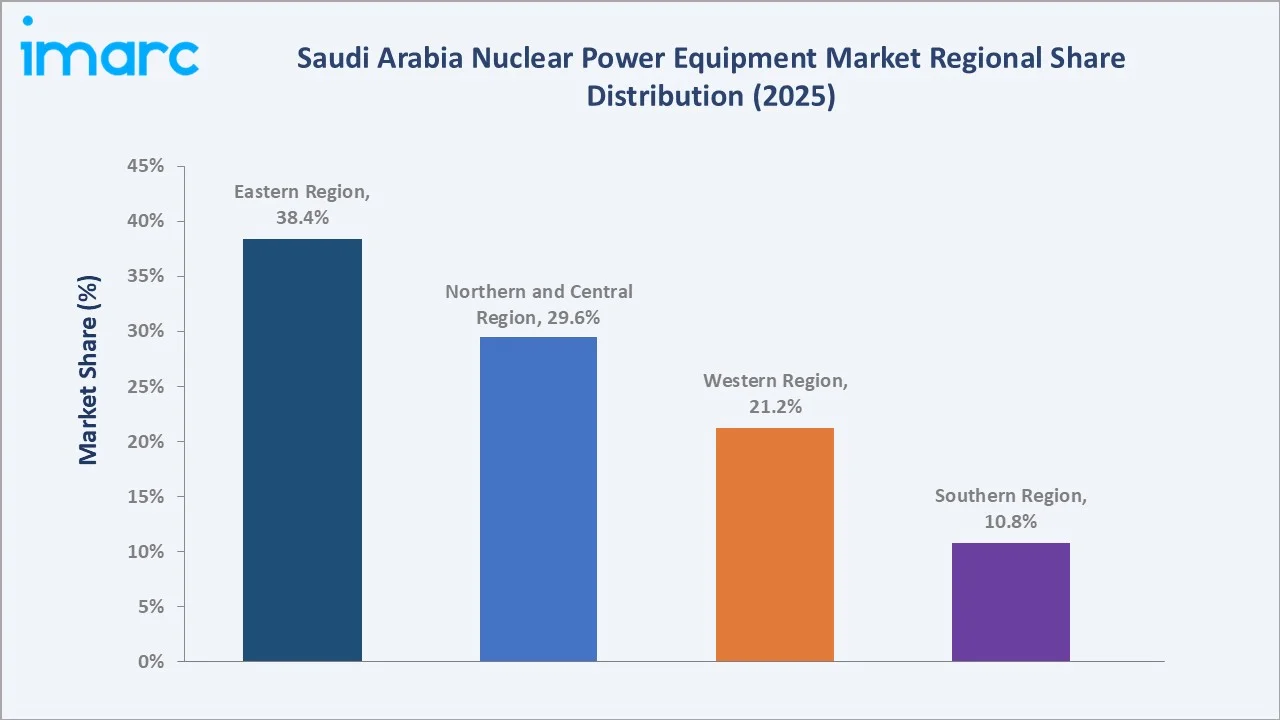
Southern Region, while currently the smallest regional contributor at 10.8%, represents emerging long-term potential for distributed nuclear generation, particularly through SMR deployment for remote industrial and agricultural applications, supporting incremental regional growth through 2034.
Competitive Landscape
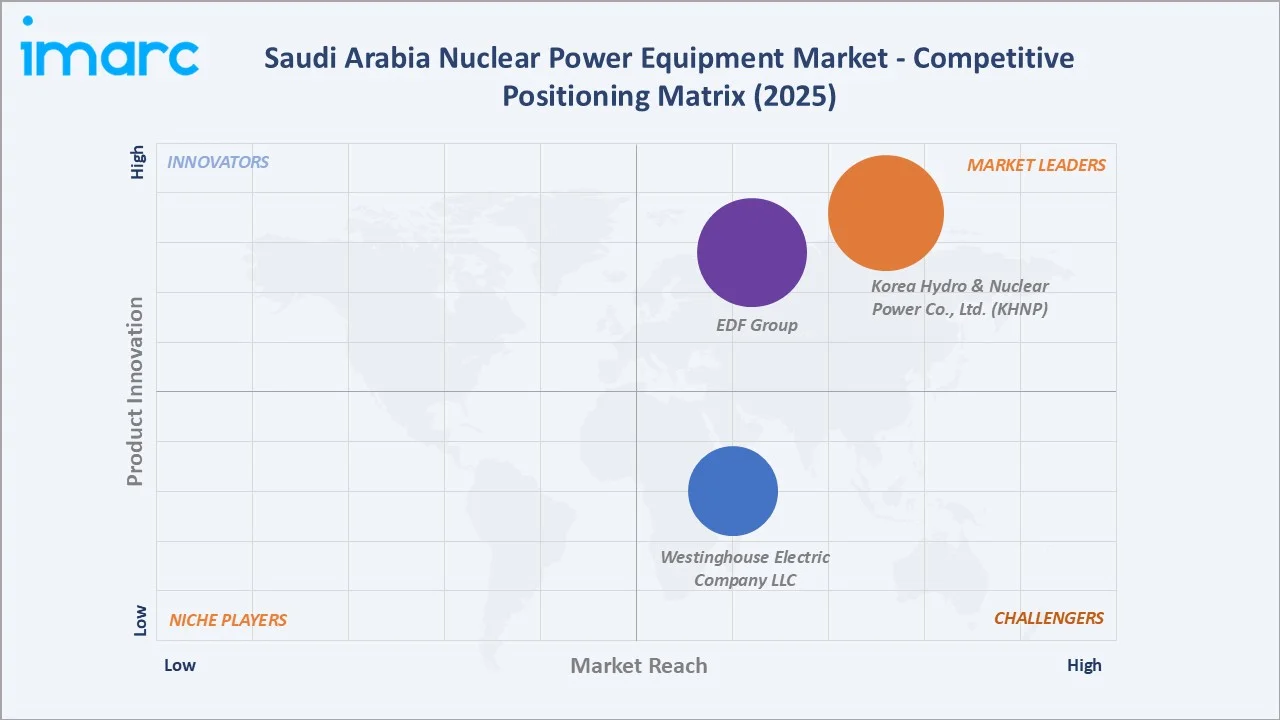
The Saudi Arabia nuclear power equipment market is moderately concentrated, with established global nuclear vendors competing for large-scale reactor and equipment supply contracts through bilateral government partnerships and competitive procurement processes. Technology depth, reactor design heritage, supply chain integration, and government-to-government relationship strength form the key competitive differentiators across the industry.
|
Company Name |
Brand / Key Product |
Position |
Strategic Focus |
|
Korea Hydro & Nuclear Power Co., Ltd. (KHNP) |
APR-1400 |
Leader |
Expanding international nuclear project delivery capabilities and deepening bilateral technology cooperation with regional partners |
|
EDF Group |
EPR / EPR2 |
Leader |
Expanding nuclear island equipment and fuel supply capabilities with growing engagement in new-build markets |
|
Westinghouse Electric Company LLC |
AP1000 |
Challenger |
Broadening passive safety reactor technology adoption and growing equipment supply partnerships in Middle East markets |
Key players include Korea Hydro & Nuclear Power Co., Ltd. (KHNP), EDF Group, and Westinghouse Electric Company LLC, among others.
Key Company Profiles
Korea Hydro & Nuclear Power Co., Ltd. (KHNP)
Korea Hydro & Nuclear Power Co., Ltd. (KHNP) is a South Korean state-owned nuclear energy company. It is responsible for the operation and management of nuclear power plants in South Korea and the international deployment of Korean nuclear reactor technology.
- Product Portfolio: APR-1400 advanced pressurized water reactor systems, nuclear island and turbine island equipment, operation and maintenance services, and nuclear engineering and construction support.
- Recent Developments: The firm continues to advance its nuclear power business through plant development, technology enhancement, operational improvements, and collaboration with industry partners.
- Strategic Focus: Strengthening its global footprint in nuclear plant construction while building long-term technology partnerships with governments across key export markets.
EDF Group
EDF Group is a French multinational electric utility company. The group owns 80.5% of Framatome, its nuclear equipment manufacturing subsidiary, and develops the EPR and EPR2 reactor technologies for both domestic and international markets.
- Product Portfolio: EPR and EPR2 advanced pressurized water reactor systems, nuclear island components manufactured through Framatome, nuclear fuel supply, plant operation and maintenance services, and decommissioning solutions.
- Recent Developments: EDF Group continues to strengthen its nuclear business through reactor development, manufacturing capacity expansion, fuel activities, and long term nuclear power projects.
- Strategic Focus: Broadening its nuclear manufacturing and fuel supply base to support an increasing pipeline of new reactor construction projects across international markets.
Westinghouse Electric Company LLC
Westinghouse Electric Company LLC is a United States-based nuclear technology and services company specializing in the design, manufacturing, and servicing of nuclear power plants and related equipment. It is a leading global supplier of nuclear fuel, plant services, instrumentation and control systems, and advanced reactor designs.
- Product Portfolio: AP1000 pressurized water reactor with passive safety systems, nuclear fuel assemblies, digital instrumentation and control platforms, plant maintenance and lifecycle services, and the AP300 SMR under development.
- Recent Developments: The company continues to expand its nuclear technology and services portfolio through reactor development, fuel supply, digital solutions, and lifecycle support for nuclear power plants.
- Strategic Focus: Driving wider deployment of its passive safety reactor platform and cultivating equipment supply relationships across the Middle East's emerging nuclear programs.
Market Concentration Analysis
The Saudi Arabia nuclear power equipment market is moderately concentrated, with a small number of established international nuclear vendors holding dominant positions in reactor technology provision and associated island equipment supply.
Barriers to entry include substantial capital investment in nuclear-grade manufacturing facilities, regulatory qualification under international safety standards, decades-long vendor relationship histories with national nuclear programs, and the technical complexity of nuclear pressure-retaining component fabrication. These factors strongly favor established vendors with proven nuclear supply chain track records.
Consolidation in the nuclear equipment sector is gradually advancing through vendor mergers, licensing arrangements, and supply chain partnerships. Strategic alliances between major reactor vendors and specialized component manufacturers further concentrate equipment procurement within established supply ecosystems.
Investment & Growth Opportunities
Fastest-Growing Segments
Pressurized water reactor (PWR) is expanding fastest among reactor type categories, driven by its selection as the technology platform for Saudi Arabia's planned large-scale reactor program and the broad commercial ecosystem supporting PWR component supply. Island equipment is also growing at a premium rate as reactor construction phases advance from planning to procurement, accelerating demand for high-value nuclear island components.
Emerging Markets
Eastern Region is the fastest growing regional contributor, supported by planned reactor site development in eastern provinces, proximity to industrial power demand centers, and ongoing investment in energy infrastructure. Southern Region represents another emerging market, supported by expanding industrial activity, growing electricity requirements, and potential investments in future nuclear and associated energy infrastructure.
Venture & Investment Trends
Investment activity is concentrated in large-scale PWR reactor program development, domestic nuclear supply chain localization, and early-stage SMR technology evaluation. Government procurement programs are expected to drive equipment ordering across all major categories through the forecast period. International vendors are increasingly exploring joint venture and local manufacturing arrangements to capture Vision 2030 localization requirements embedded in equipment supply agreements.
Future Market Outlook (2026-2034)
The Saudi Arabia nuclear power equipment market is forecast to expand from USD 383.9 Million in 2025 to USD 473.2 Million by 2034 at a CAGR of 2.35%, adding approximately USD 89.3 Million in incremental market value over the forecast period.
Four forces will shape the market through 2034: progression of Saudi Arabia's large-scale reactor program from planning through procurement and construction; growing domestic nuclear engineering capacity supporting localized equipment specification and integration; expansion of SMR technology evaluation toward potential deployment decisions; and deepening bilateral nuclear cooperation arrangements influencing vendor selection and equipment supply frameworks.
By 2034, the Saudi Arabia nuclear power equipment market is expected to be defined by active construction-phase procurement across multiple reactor units, growing island equipment demand as plant systems enter commissioning, and an expanding auxiliary equipment base supporting operational readiness. Continued government commitment under Vision 2030 energy policy is expected to sustain equipment procurement activity throughout the forecast horizon.
Research Methodology
Primary Research
Primary research included structured interviews with nuclear equipment procurement executives, reactor technology vendors, EPC contractors, and Saudi Arabian energy sector stakeholders, validating market sizing, segment mix, and regional demand patterns across the nuclear power equipment value chain.
Secondary Research
Secondary sources included Saudi Vision 2030 energy policy documents, National Center for Nuclear and Radiological Control (NRRC) publications, International Atomic Energy Agency (IAEA) country nuclear power profiles, World Nuclear Association market data, and annual reports and investor presentations from leading nuclear equipment vendors.
Forecasting Models
Market forecasts used top-down and bottom-up models combining nuclear plant development pipeline analysis, equipment procurement timeline estimation, regional electricity demand projections, and macroeconomic variables. Scenario analysis addressed program execution pace, technology selection outcomes, and government investment trajectory.
Saudi Arabia Nuclear Power Equipment Market Report Coverage:
| Report Features | Details |
|---|---|
| Base Year of the Analysis | 2025 |
| Historical Period | 2020-2025 |
| Forecast Period | 2026-2034 |
| Units | Million USD |
| Scope of the Report |
Exploration of Historical Trends and Market Outlook, Industry Catalysts and Challenges, Segment-Wise Historical and Future Market Assessment:
|
| Reactor Types Covered | Pressurized Water Reactor (PWR), Pressurized Heavy Water Reactor (PHWR), Boiling Water Reactor (BWR), Light Water Graphite Reactor (LWGR), Gas-Cooled Reactor (GCR), Others |
| Equipment Types Covered | Island Equipment, Auxiliary Equipment |
| Regions Covered | Northern and Central Region, Western Region, Eastern Region, Southern Region |
| Companies Covered | Korea Hydro & Nuclear Power Co., Ltd. (KHNP), EDF Group, Westinghouse Electric Company LLC, etc. |
| Customization Scope | 10% Free Customization |
| Post-Sale Analyst Support | 10-12 Weeks |
| Delivery Format | PDF and Excel through Email (We can also provide the editable version of the report in PPT/Word format on special request) |
Key Benefits for Stakeholders:
- IMARC’s industry report offers a comprehensive quantitative analysis of various market segments, historical and current market trends, market forecasts, and dynamics of the Saudi Arabia nuclear power equipment market from 2020-2034.
- The research report provides the latest information on the market drivers, challenges, and opportunities in the Saudi Arabia nuclear power equipment market.
- Porter's five forces analysis assist stakeholders in assessing the impact of new entrants, competitive rivalry, supplier power, buyer power, and the threat of substitution. It helps stakeholders to analyze the level of competition within the Saudi Arabia nuclear power equipment industry and its attractiveness.
- Competitive landscape allows stakeholders to understand their competitive environment and provides an insight into the current positions of key players in the market.
Frequently Asked Questions About the Saudi Arabia Nuclear Power Equipment Market Report
The Saudi Arabia nuclear power equipment market was valued at USD 383.9 Million in 2025, driven by government nuclear infrastructure planning, growing electricity demand, and bilateral technology cooperation agreements with leading international reactor vendors.
The market is projected to grow at a CAGR of 2.35% from 2026 to 2034, reaching USD 473.2 Million, supported by progression of reactor construction programs and sustained government investment in nuclear energy infrastructure.
Pressurized water reactor (PWR) leads the reactor type segment at 48.6% in 2025, driven by its commercial maturity, broad international vendor ecosystem, and selection as the primary technology platform for Saudi Arabia's planned large-scale reactor program.
Island equipment dominates the equipment type segment at 68.3% in 2025, reflecting the high procurement value of nuclear island and turbine island components in nuclear plant construction.
Eastern Region commands 38.4% share in 2025, supported by proximity to planned reactor sites, existing energy infrastructure, and high concentration of industrial power demand from the Kingdom's oil and gas sector.
Leading players include Korea Hydro & Nuclear Power Co., Ltd. (KHNP), EDF Group, and Westinghouse Electric Company LLC, among others.
Growth is primarily driven by Saudi Arabia's Vision 2030 nuclear energy mandate, rising domestic electricity demand, strategic diversification away from fossil fuel-based power generation, and active government investment in nuclear infrastructure planning and vendor engagement.
Key challenges include high capital and construction costs associated with nuclear plant development, complex regulatory and quality assurance requirements for equipment procurement, and the need to develop domestic nuclear engineering and operational capacity through sustained workforce development.
SMR technology is being evaluated as a complementary generation option for industrial, desalination, and remote power applications, potentially opening new equipment procurement pathways beyond conventional large-scale reactor programs through the forecast period.
Need more help?
- Speak to our experienced analysts for insights on the current market scenarios.
- Include additional segments and countries to customize the report as per your requirement.
- Gain an unparalleled competitive advantage in your domain by understanding how to utilize the report and positively impacting your operations and revenue.
- For further assistance, please connect with our analysts.
 Request Customization
 Speak to an Analyst
 Request Brochure
 Inquire Before Buying
Benefits of Customization
- Personalize this research
- Triangulate with your data
- Get data as per your format and definition
- Gain a deeper dive into a specific application, geography, customer, or competitor
- Any level of personalization
Get in Touch With Us
UNITED STATES
Phone: +1-201-971-6302
INDIA
Phone: +91-120-433-0800
UNITED KINGDOM
Phone: +44-753-714-6104
Email: [email protected]
Client Testimonials




.webp)




.webp)













Related Reports

Choose your plan
*Please note that the prices mentioned below are starting prices for each bundle type. Kindly contact our team for further details.*
Single User License
- 1 User License, Access on 2 Devices
- PDF Report + Excel Dataset (Password Protected)
- Lifetime Access
- No Printing Rights
- 10% Free Report Customization
- 10–12 Weeks of Analyst Support
Five User License
- Access for 5 Users, 2 Devices per User
- PDF Report + Excel Dataset (Password Protected)
- Lifetime Access
- Dedicated Account Manager
- 12–14 Weeks of Analyst Support
- No Printing Rights
- 15% Free Report Customization
- 25% Discount on Your Next Purchase
Corporate User License
- Unlimited User Access (Within Your Organization)
- PDF Report + Excel Dataset
- Lifetime Access
- Dedicated Account Manager
- 14–20 Weeks of Analyst Support
- No Printing Rights
- 20% Free Report Customization
- 30% Discount on Your Next Purchase
Essential Insights
What's included:
3 reports
- Lifetime Access
- PDF Reports
- Excel Datasets
- 2 Weeks of Free Analyst Support
- 2 User Licenses
- Access on 2 Devices
- Printing Rights
- Complimentary PowerPoint (PPT) Version
- Complimentary License Upgrade
Professional Access
What's included:
5 reports
- Lifetime Access
- PDF Reports
- Excel Datasets
- 8 Weeks of Free Analyst Support
- 2 User Licenses
- Access on 2 Devices
- Printing Rights
- Complimentary PowerPoint (PPT) Version
- Complimentary License Upgrade
Business Advantage
What's included:
8 reports
- Lifetime Access
- PDF Reports
- Excel Datasets
- 14 Weeks of Free Analyst Support
- 2 User Licenses
- Access on 2 Devices
- Printing Rights
- Complimentary PowerPoint (PPT) Version
- Complimentary License Upgrade
Enterprise Intelligence
What's included:
10 reports
- Lifetime Access
- PDF Reports
- Excel Datasets
- 20 Weeks of Free Analyst Support
- 2 User Licenses
- Access on 2 Devices
- Printing Rights
- Complimentary PowerPoint (PPT) Version
- Complimentary License Upgrade