
Saudi Arabia Overhead Cranes Market Size, Share, Trends and Forecast by Type, Lifting Capacity, End Use, and Region, 2026-2034
Saudi Arabia Overhead Cranes Market Size, Share, Trends & Forecast (2026-2034)
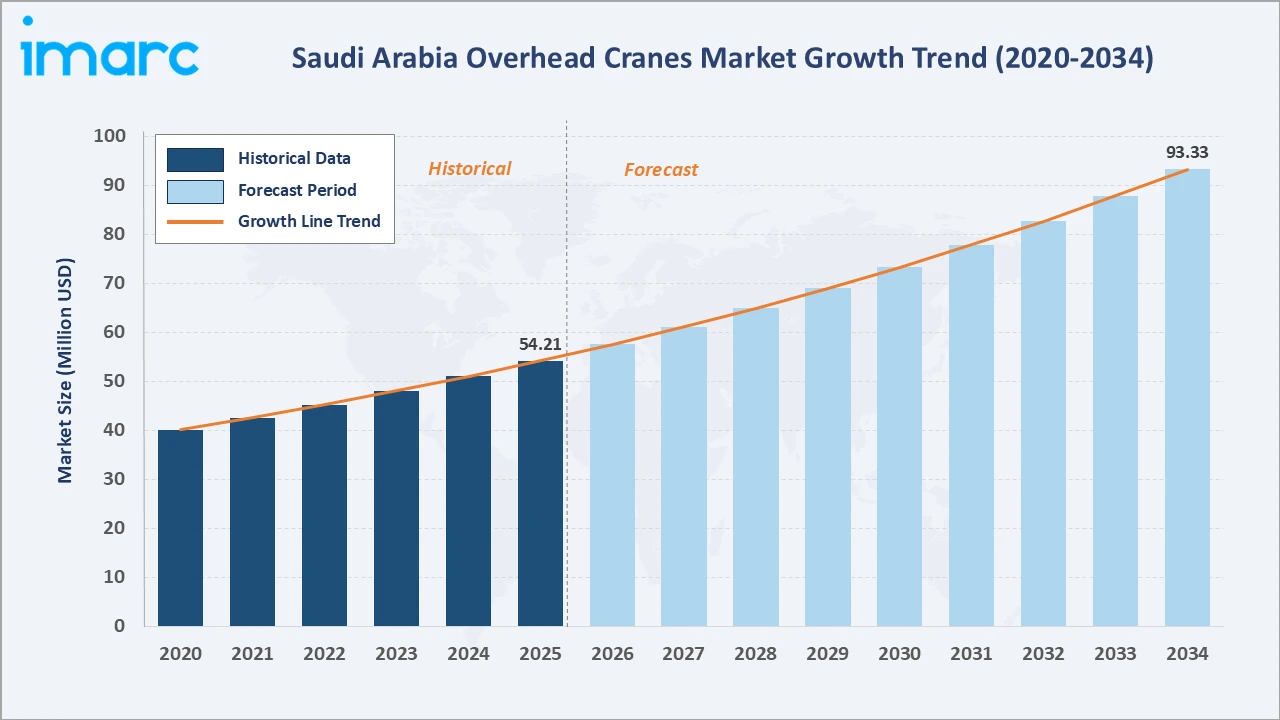
The Saudi Arabia overhead cranes market grew from USD 54.21 Million in 2025 to USD 57.58 Million in 2026 and is projected to reach USD 93.33 Million by 2034, growing at a CAGR of 6.22% during 2026-2034. Industrial expansion, infrastructure projects, and logistics growth under Vision 2030 are driving steady demand. In April 2025, Cranes and Steel supplied custom single- and double-girder overhead cranes from 3 to 30 tons to Arabian Transformers Co., using Verlinde EUROBLOC VT hoists.
Rising investment in manufacturing, metals, energy, and ports, along with automation in material handling, continues to broaden demand. Bridge cranes dominate at 45.0%. The 11-50 ton category leads lifting capacity at 40.0%. The Northern and Central Region commands 42.0% of national market share.
Market Snapshot
|
Metric |
Value |
|
Base Year Market Size (2025) |
USD 54.21 Million |
|
Market Size (2026) |
USD 57.58 Million |
|
Forecast Market Size (2034) |
USD 93.33 Million |
|
CAGR (2026-2034) |
6.22% |
|
Base Year |
2025 |
|
Historical Period |
2020-2025 |
|
Forecast Period |
2026-2034 |
|
Dominant Type |
Bridge Cranes (45.0%, 2025) |
|
Dominant Lifting Capacity |
11-50 Ton (40.0%, 2025) |
|
Leading Region |
Northern and Central Region (42.0%, 2025) |
The Saudi Arabia overhead cranes market size increased from USD 40.09 Million in 2020 to USD 54.21 Million in 2025 and is estimated to reach USD 57.58 Million in 2026. The market is further expected to grow to USD 73.31 Million by 2030 and USD 93.33 Million by 2034. Growth reflects new factories, warehouses, and industrial projects.
To get more information on this market, Request Sample
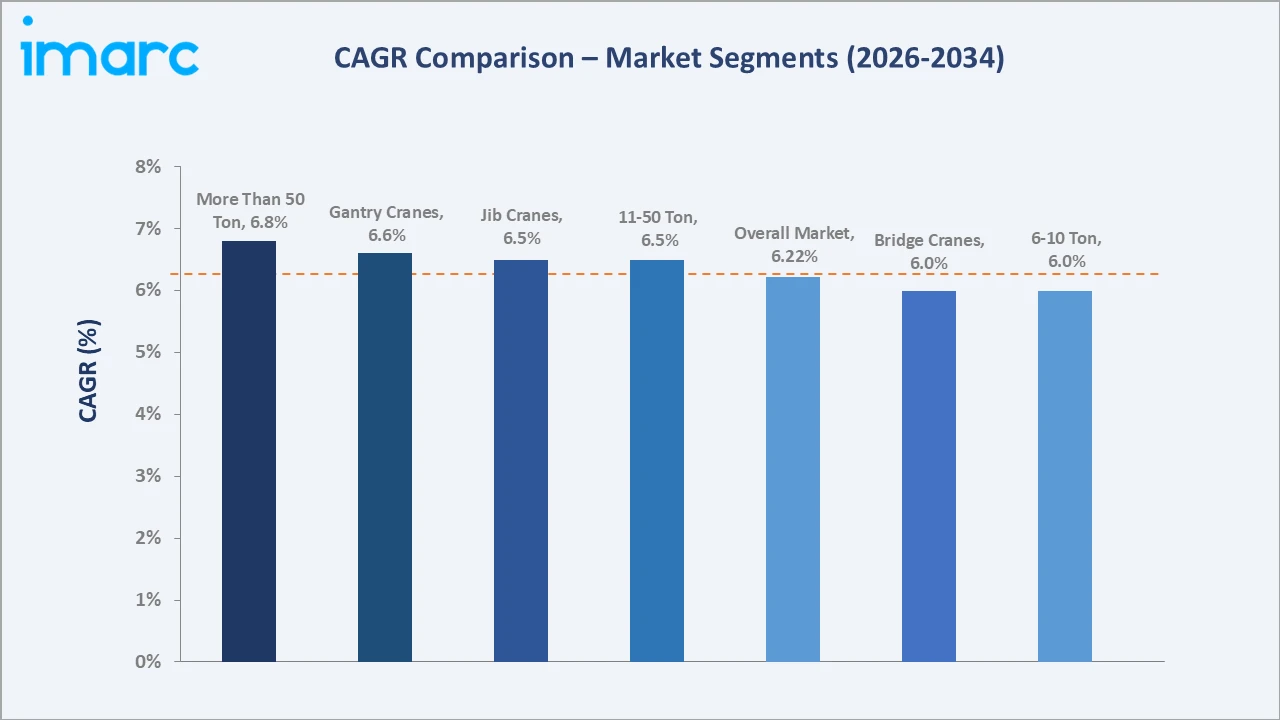
More than 50 ton cranes are expected to grow fastest at ~6.8% CAGR, supported by steel, power, shipbuilding, and heavy industrial projects. Gantry cranes follow at ~6.6% CAGR as ports, precast yards, and outdoor storage facilities expand.
Executive Summary
The Saudi Arabia overhead cranes market expanded from USD 54.21 Million in 2025 to an estimated USD 57.58 Million in 2026. Overhead cranes are essential for lifting and moving heavy materials in factories, warehouses, workshops, power plants, and ports. Vision 2030 industrial programs, giga-projects, and localization policies are creating new demand, while global manufacturers and local fabricators expand services. The market is projected to reach USD 93.33 Million by 2034. Bridge cranes at 45.0% lead types. The 11-50 ton category at 40.0% leads lifting capacity. The Northern and Central Region leads at 42.0%.
Key Market Insights
|
Insight |
Data |
|
Dominant Type |
Bridge Cranes - 45.0% share (2025) |
|
Dominant Lifting Capacity |
11-50 Ton - 40.0% market share (2025) |
|
Leading Region |
Northern and Central Region - 42.0% share (2025) |
|
Market Opportunity |
Smart and automated cranes; heavy-duty cranes for metals and energy; local fabrication and service; modernization of existing fleets |
Key Analytical Observations Supporting the Above Data:
- Bridge Cranes at 45.0%: Bridge cranes dominate because they efficiently cover large indoor areas in factories, warehouses, and workshops, offering high capacity, flexibility, and reliable performance for daily material handling.
- 11-50 Ton at 40.0%: The 11-50 ton category leads because it covers most heavy industrial applications, including steel fabrication, equipment assembly, and power plant maintenance.
- Northern and Central Region at 42.0%: The Northern and Central Region leads due to Riyadh’s industrial cities, logistics zones, and large construction and manufacturing projects.
Saudi Arabia Overhead Cranes Market Overview
Overhead cranes include bridge, gantry, jib, and monorail cranes used to lift and move heavy loads. They are used in manufacturing, metals and mining, construction, energy, ports, and warehouses, improving safety and productivity. They range from small workstation cranes to heavy-duty process cranes lifting hundreds of tons. Cranes are typically designed for specific buildings, spans, and duty cycles. Proper selection ensures safety, efficiency, and long service life.
The industry ecosystem links component suppliers, crane manufacturers, local fabricators, distributors, installers, service providers, regulators, and end users. Macroeconomic factors include industrial investment, construction activity, oil and gas spending, and localization policies, all of which shape demand. Safety regulations and client standards also influence crane specifications and supplier selection. Oil and gas, petrochemical, and utility companies apply strict standards that shape crane design and supplier qualification.
Market Dynamics
To evaluate market opportunities, Request Sample
Market Drivers
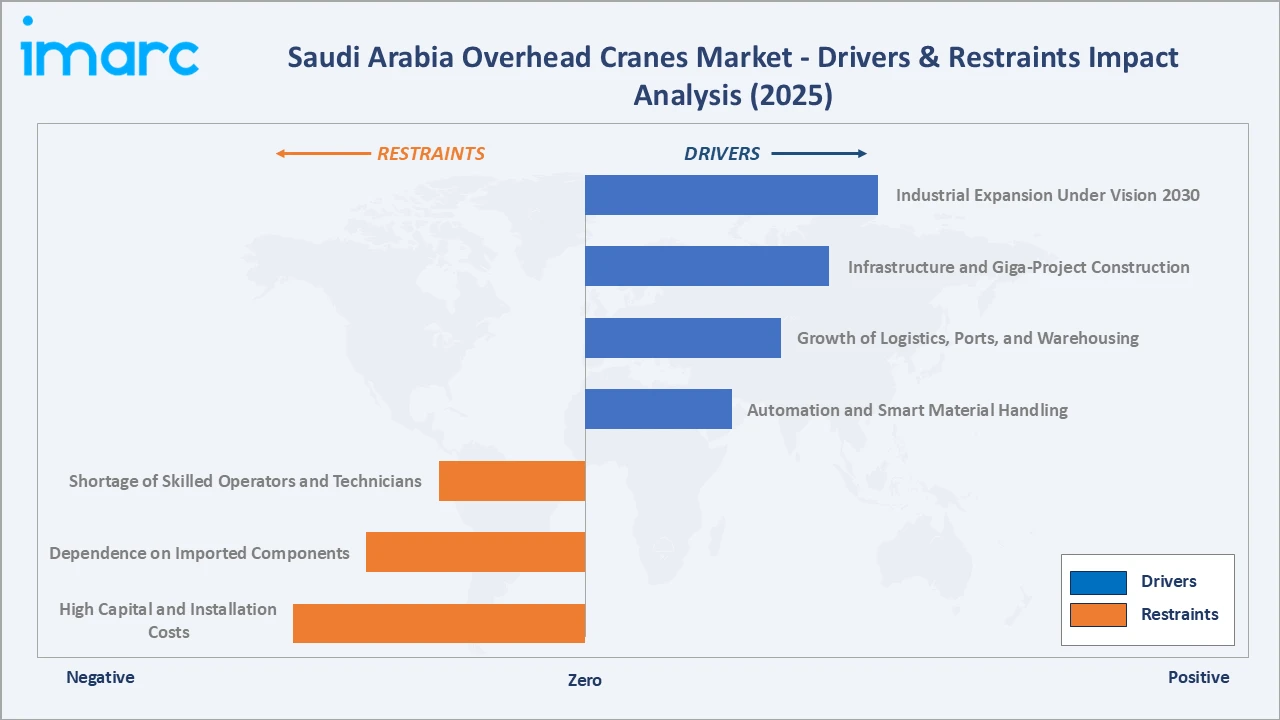
- Industrial Expansion Under Vision 2030: The National Industrial Development and Logistics Program is driving investment in new factories, industrial cities, and special economic zones. Manufacturing facilities for metals, chemicals, automotive, and equipment require overhead cranes for production and maintenance. New industrial cities such as Sudair, Jubail, Yanbu, and Ras Al Khair are attracting domestic and foreign investment, and each new plant typically requires several cranes of different capacities. Localization programs for defense, automotive, and renewable energy equipment are also adding demand for heavy-lift and precision handling systems in assembly halls and workshops. Expansion of aluminum, steel, and mining operations under the Kingdom’s mining strategy is creating additional demand for heavy-duty process cranes. Renewable energy projects, including solar and wind component manufacturing, also need cranes for handling large parts. Automotive assembly plants planned under Vision 2030 will also require overhead cranes for body shops, engine lines, and maintenance areas.
- Infrastructure and Giga-Project Construction: Large projects such as NEOM, Red Sea, and Qiddiya require precast plants, steel fabrication yards, and equipment workshops that rely heavily on overhead and gantry cranes. Construction material plants producing steel structures, precast concrete, and modular buildings depend on cranes to move heavy components safely. As projects progress, demand also grows for maintenance workshops and equipment depots that need reliable lifting systems. Large housing and infrastructure programs further support steady demand from steel and precast manufacturers. Desalination and power plants require cranes for installation and maintenance of turbines and pumps. Water and wastewater treatment plants are another steady source of demand for jib and monorail cranes.
- Growth of Logistics, Ports, and Warehousing: Expanding ports, logistics parks, and warehouses are increasing demand for cranes that handle heavy goods and containers efficiently. Modern warehouses for e-commerce, cold storage, and industrial supplies increasingly use cranes for storing and loading heavy items, while ports need gantry and workshop cranes for maintenance and cargo handling. New logistics zones near airports and seaports are also adding warehouse capacity that requires lifting equipment. Shipyards and ship repair facilities are also expanding, adding demand for heavy gantry cranes. Airport cargo terminals also use cranes for handling heavy freight and maintenance tasks.
- Automation and Smart Material Handling: Companies are adopting cranes with variable speed drives, remote controls, anti-sway systems, and remote monitoring to improve safety and productivity. These features reduce accidents, protect loads, and help operators handle materials more precisely in busy industrial environments. Smart cranes also provide usage data that helps plan maintenance and avoid breakdowns. Integration with factory systems allows cranes to support automated production lines. Wireless controls allow operators to work from safer positions.
Market Restraints
- High Capital and Installation Costs: Overhead cranes require significant investment in equipment, runway structures, and installation, which can delay purchases for small and medium enterprises. Buyers often compare offers mainly on price, which can lead to lower-quality installations that increase long-term costs. Financing options for capital equipment remain limited for some smaller buyers. Long project approval cycles can also delay crane orders. Building modifications needed for crane runways can add to project costs.
- Dependence on Imported Components: Key components such as hoists, motors, and control systems are largely imported, exposing buyers to longer lead times and price fluctuations. Currency movements and shipping costs can also affect project budgets and delivery schedules. Local assembly of hoists and components could help reduce this dependence over time. Supply chain disruptions can extend delivery times for specialized components. Buyers often keep spare parts inventories to reduce downtime risk.
- Shortage of Skilled Operators and Technicians: Safe operation and maintenance require trained personnel, and shortages can affect productivity and safety. Training programs and certification are needed to build a skilled local workforce. Saudization requirements also encourage investment in local technical talent. Turnover of skilled technicians can affect service quality. Competition for technical staff from other industries adds to labor costs.
Market Opportunities
- Modernization of Existing Crane Fleets: Upgrading older cranes with new hoists, drives, and controls offers opportunities for manufacturers and service providers. Modernization improves safety, energy efficiency, and reliability at a lower cost than full replacement. Many cranes installed during earlier industrial expansions are now due for upgrades. Retrofit packages allow older cranes to meet new safety standards. Upgrades can also add smart features to older equipment.
- Local Fabrication and Service Networks: Localization policies favor suppliers with Saudi manufacturing, fabrication, and service capabilities. Local content scoring in government and Aramco tenders gives an advantage to suppliers with domestic operations. Joint ventures with Saudi partners can help global brands meet these requirements. Local service centers also improve response times for customers. Saudi fabrication also reduces shipping costs for large girders and structures.
Market Challenges
- Price Competition from Low-Cost Imports: Lower-priced imported cranes compete strongly with established brands, putting pressure on margins. Established brands differentiate through quality, safety, and service support. Total cost of ownership is increasingly considered by large industrial buyers. After-sales service and spare parts availability are key decision factors. Suppliers with strong references from major industrial clients often win repeat orders. Long-term relationships with EPC contractors are also valuable. EPC contractors frequently specify preferred crane brands during the design phase of large industrial projects, which gives established suppliers an early advantage in winning orders.
- Safety and Compliance Requirements: Meeting national and client-specific safety standards requires inspection, certification, and documentation. Regular third-party inspections are required for many industrial facilities. Non-compliance can lead to project delays and safety risks. Suppliers must maintain documentation and certified personnel. Compliance requirements are particularly strict for oil, gas, and petrochemical facilities. Third-party certification bodies play an important role in these sectors. Regular audits ensure cranes remain safe throughout their service life.
Emerging Market Trends
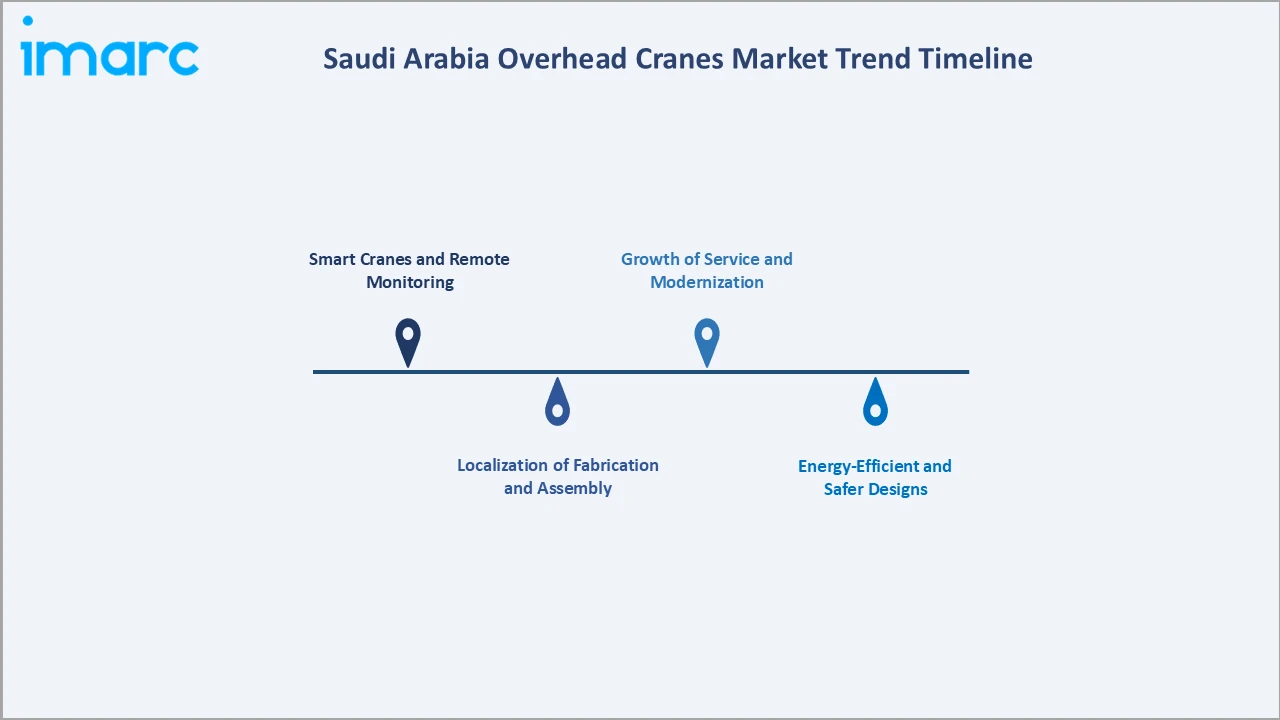
1. Smart Cranes and Remote Monitoring
Cranes equipped with sensors, connectivity, and remote diagnostics help operators monitor usage, predict maintenance, and reduce downtime. Data from connected cranes also helps managers plan maintenance and optimize utilization. Remote support from OEM experts reduces the need for on-site visits. Smart features are increasingly specified in new industrial projects. Digital twins and simulation tools are emerging for crane design and planning. Such tools help optimize layouts and improve safety before installation. They also support training of operators using virtual environments. Virtual training reduces risks during operator onboarding. It also allows operators to practice complex lifts before working with real heavy loads on busy industrial project sites today.
2. Localization of Fabrication and Assembly
Global manufacturers and local companies are expanding fabrication and assembly in Saudi Arabia to meet local content requirements and shorten delivery times. Local production also improves access to spare parts and service. Local fabrication of girders and structures is already common across the Kingdom. Local production of hoists and end carriages is gradually increasing. Partnerships with local steel suppliers support fabrication growth. These partnerships reduce lead times and support local content goals. Local fabrication also creates jobs and builds engineering expertise in the Kingdom. This supports the national goal of developing a strong domestic industrial base.
3. Growth of Service and Modernization
Inspection, maintenance, and modernization services are growing as the installed base of cranes expands and ages. Service contracts provide predictable costs and improved uptime for crane owners. OEMs are expanding service teams across major industrial cities. Long-term service agreements are becoming common among large industrial clients. Spare parts availability is a major factor in service quality. Many crane owners prefer suppliers with local warehouses for critical parts. Fast response times are critical for plants operating continuously. Service level agreements with guaranteed response times are increasingly requested by large industrial clients in Jubail, Yanbu, and Riyadh.
4. Energy-Efficient and Safer Designs
Variable frequency drives, regenerative braking, and advanced safety features are improving energy efficiency and protecting workers. Ergonomic controls and better visibility also improve operator comfort and productivity. Energy savings are increasingly important for large industrial facilities. Explosion-proof designs are important for oil, gas, and chemical plants. Corrosion-resistant designs are important for coastal facilities. Dust-proof and heat-resistant components are also needed for desert conditions. Proper cooling of motors and electrical panels improves reliability in summer. Suppliers often recommend shaded or enclosed designs for outdoor gantry cranes in harsh environments.
Industry Value Chain Analysis
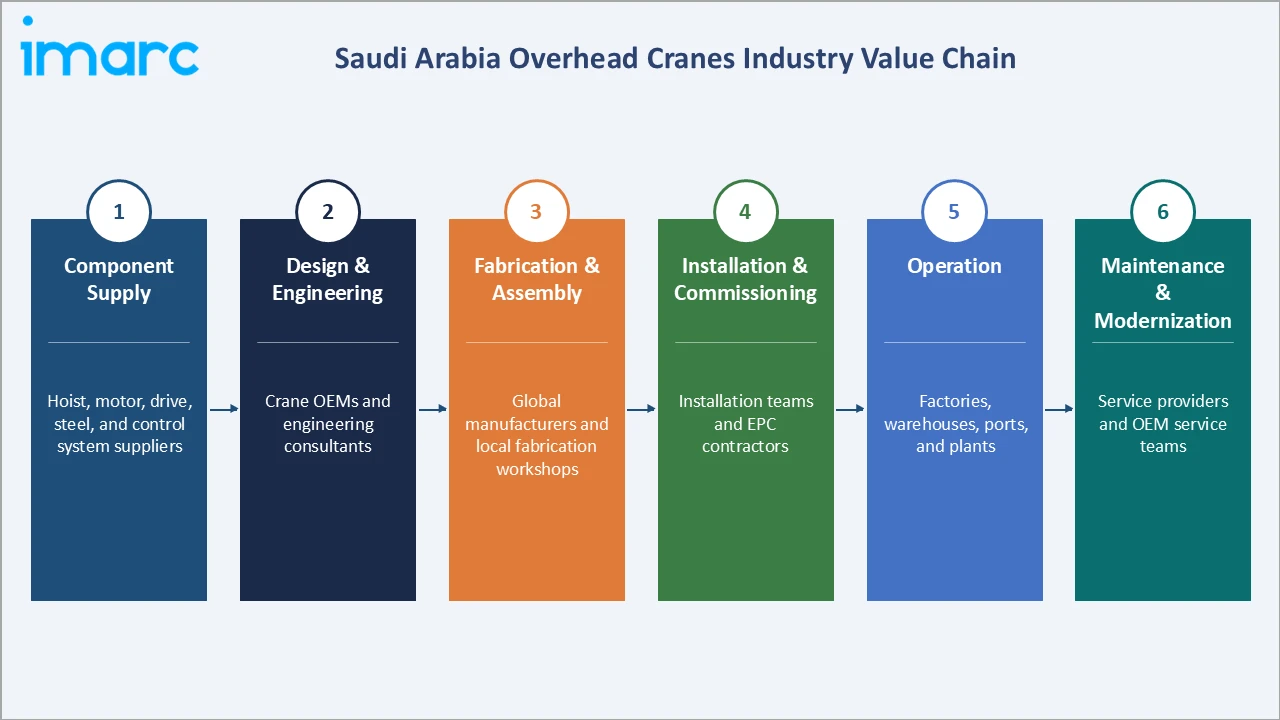
The Saudi Arabia overhead cranes value chain spans component supply, design and engineering, fabrication and assembly, installation and commissioning, operation, and maintenance and modernization. Value is shifting toward engineering, local fabrication, and lifecycle services. Design and engineering determine whether cranes meet load, span, and duty requirements. Installation and commissioning ensure safe integration with building structures and power systems. Operation and maintenance account for a large share of lifecycle costs. Efficient maintenance practices extend crane life and protect investments. Planned shutdown maintenance is common in large industrial plants.
|
Stage |
Key Participants |
|
Component Supply |
Hoist, motor, drive, steel, and control system suppliers |
|
Design & Engineering |
Crane OEMs and engineering consultants |
|
Fabrication & Assembly |
Global manufacturers and local fabrication workshops |
|
Installation & Commissioning |
Installation teams and EPC contractors |
|
Operation |
Factories, warehouses, ports, and plants |
|
Maintenance & Modernization |
Service providers and OEM service teams |
Maintenance and modernization is the most consequential stage of the chain. Regular inspection and upgrades ensure safety, reliability, and long service life, creating recurring revenue for suppliers. Fabrication and installation quality also strongly influence long-term performance. Operators benefit from training and safety programs provided by suppliers. Strong after-sales support is essential for customer retention. Training services help clients operate cranes safely and efficiently. Many suppliers also offer operator certification programs.
Technology Landscape in the Saudi Arabia Overhead Cranes Industry
Advanced Hoists and Variable Speed Drives
Modern wire rope and chain hoists with variable speed drives provide smooth, precise lifting and reduce wear on equipment. Compact hoist designs also allow higher hook heights in limited building spaces. Wire rope hoists remain the standard for heavy-duty applications.
Remote Control, Automation, and Anti-Sway Systems
Radio remote controls, semi-automated operation, and anti-sway technology improve safety and handling accuracy. These systems are especially valuable for handling fragile or high-value loads. Automation is gaining interest in warehouses and repetitive production processes. Collision avoidance systems are also gaining adoption.
Remote Monitoring and Predictive Maintenance
Connected sensors track loads, usage, and component condition, enabling predictive maintenance and reducing unplanned downtime. Digital service platforms provide real-time alerts and service histories. These tools help maintenance teams prioritize work and reduce costs.
Market Segmentation Analysis
The report covers the following segments:
| Segment Category | Leading Segment | Market Share | Year |
|---|---|---|---|
| Type | Bridge Cranes | 45.0% | 2025 |
| Lifting Capacity | 11-50 Ton | 40.0% | 2025 |
| End Use | 🔒 | 🔒 | 2025 |
| Region | Northern and Central Region | 42.0% | 2025 |

By Type
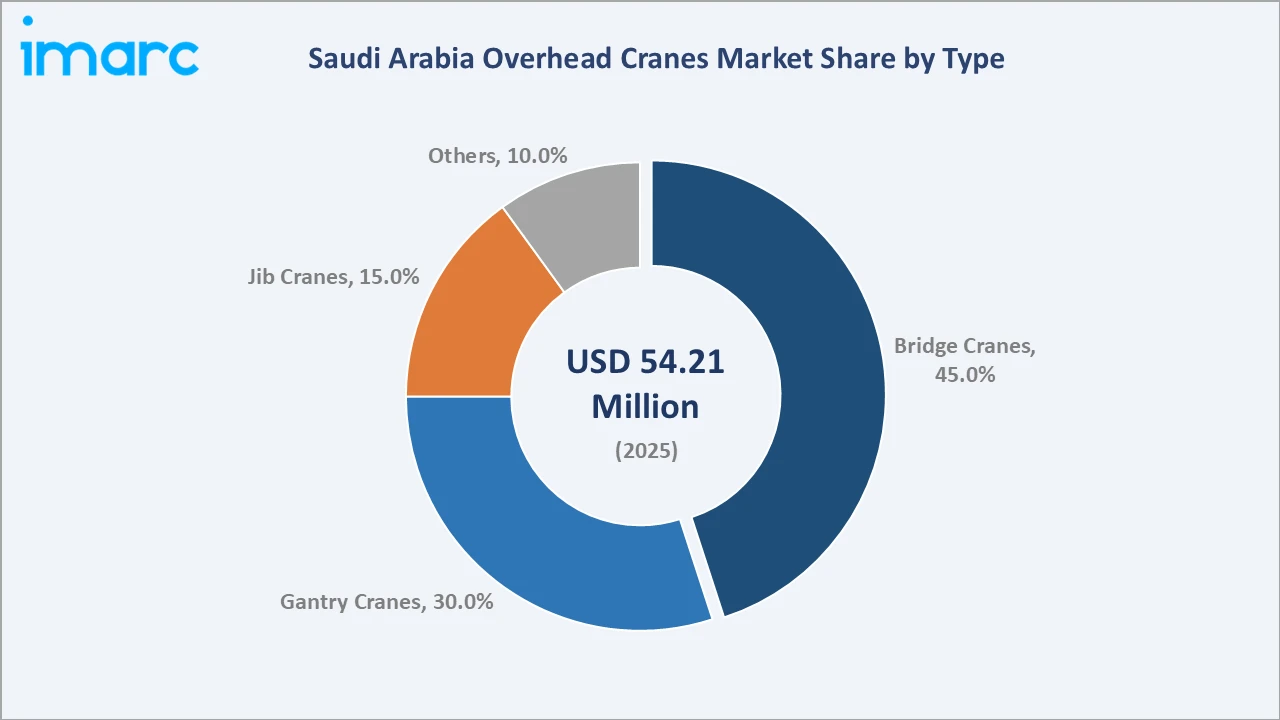
Bridge cranes lead at 45.0% (2025). They cover large indoor areas efficiently and are widely used in factories, workshops, and warehouses. Single and double girder designs serve light to heavy-duty applications. Bridge cranes are often integrated into new factory designs from the outset. Customized designs are common for special industrial applications. Crane sizing depends on building dimensions, loads, and duty requirements. Early involvement of crane suppliers in plant design helps avoid costly modifications later.
To access detailed market analysis, Request Sample
Gantry cranes at 30.0% grow fastest at ~6.6% CAGR, supported by ports and outdoor yards. Jib cranes at 15.0% grow at ~6.5%, and others at 10.0% grow at ~5.8%. Gantry cranes are particularly useful where building structures cannot support runway beams. Jib cranes are popular for workstations and loading areas. Others include monorail and workstation cranes used in light assembly. These smaller cranes are increasingly adopted by small manufacturers. Their lower cost and easy installation make them popular for workshops and service centers.
By Lifting Capacity
The 11-50 ton category leads at 40.0% (2025). It covers most heavy industrial applications in steel, equipment, and power sectors. These cranes are commonly installed in fabrication shops and maintenance facilities. Demand in this segment is closely tied to industrial investment. These cranes are also used in warehouses handling heavy goods. Medium and heavy cranes often require double girder designs. Higher-capacity cranes typically need stronger building structures and specialized installation teams.
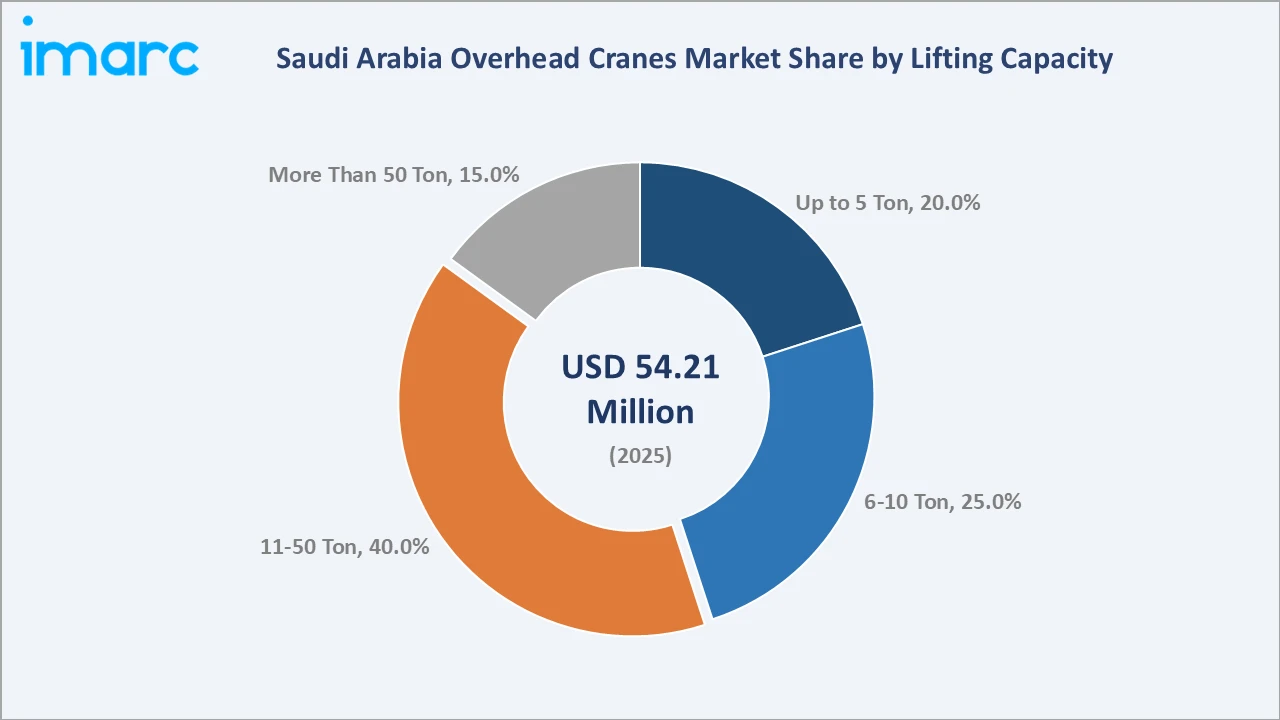
6-10 ton cranes at 25.0% grow at ~6.0% CAGR. Up to 5 ton at 20.0% grow at ~5.6%, and more than 50 ton at 15.0% grow fastest at ~6.8%. Heavy-duty cranes are used in steel mills, power plants, and shipyards. Light-duty cranes up to 5 tons are widely used in workshops and assembly lines. Medium-capacity cranes are common in manufacturing and maintenance workshops.
Regional Market Insights
|
Region |
Share (2025) |
Key Saudi Arabia Overhead Cranes Market Drivers & Characteristics |
|
Northern and Central Region |
42.0% |
Riyadh industrial cities, logistics zones, and construction projects. |
|
Eastern Region |
25.0% |
Petrochemical, oil and gas, and heavy industry in Jubail and Dammam. |
|
Western Region |
23.0% |
Jeddah port, manufacturing, and Red Sea projects. |
|
Southern Region |
10.0% |
Emerging industrial zones and infrastructure projects. |
The Northern and Central Region's 42.0% market leadership reflects Riyadh's industrial cities, logistics hubs, and large construction projects. The Eastern Region's 25.0% reflects petrochemical, oil and gas, and heavy industrial activity in Jubail and Dammam.
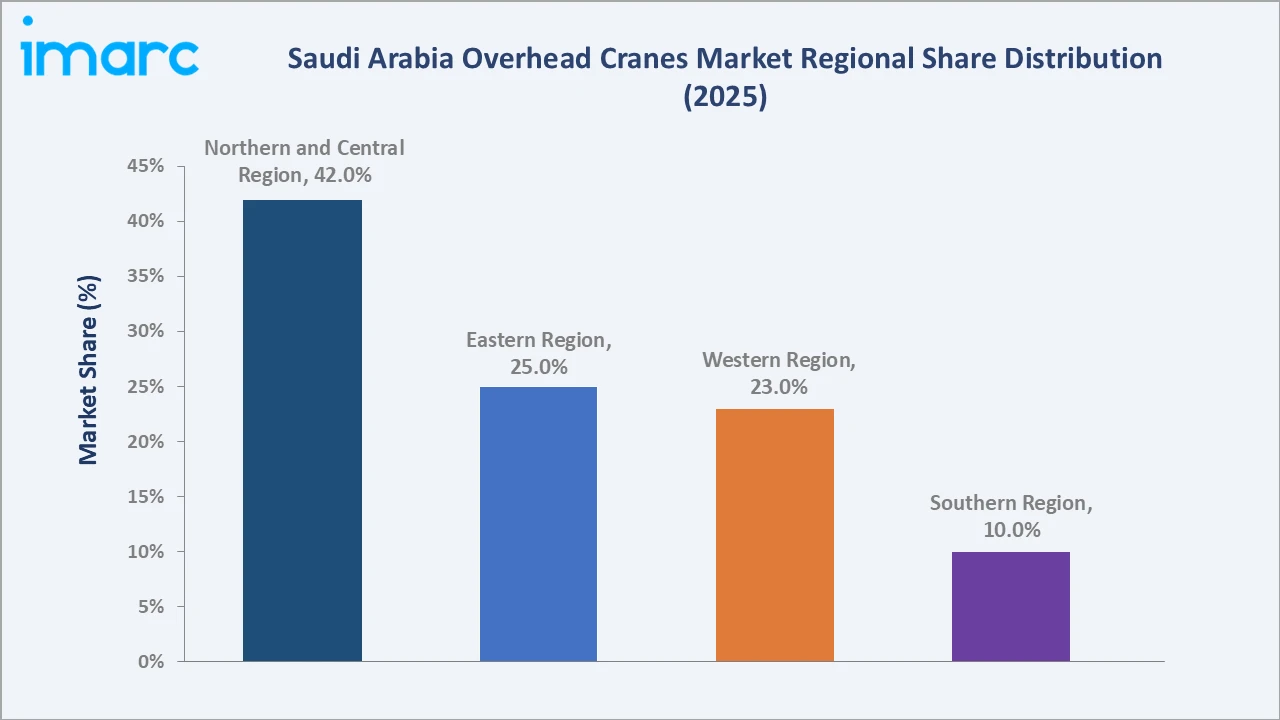
The Western Region's 23.0% reflects Jeddah's port and manufacturing base and Red Sea projects. The Southern Region's 10.0% is the smallest share, but new industrial zones support steady growth. Infrastructure improvements in Jazan and Asir are expected to create new demand. Ports and logistics facilities in the region are also expanding. Tourism and infrastructure projects are expected to add demand for construction support equipment. Regional industrial clusters are planned under national development programs. Improving road connectivity is also making it easier for suppliers to deliver and service cranes across southern provinces and new economic zones.
Competitive Landscape
The Saudi Arabia overhead cranes market includes global crane manufacturers, regional suppliers, local fabricators, and service companies. Competition centers on quality, safety, delivery time, local presence, and after-sales service.
| Company | Key Brands | Market Position | Core Strength |
|---|---|---|---|
| Konecranes | Konecranes CXT, S-Series | Market Leader | Global leader with local manufacturing in Jubail. |
| Demag Cranes & Components GmbH | EKKE | Market Leader | Strong industrial crane portfolio and service base. |
| ABUS Kransysteme GmbH | ABUS | Strong Challenger | Standardized cranes and hoists. |
| GH Cranes & Components | GH Overhead Cranes | Strong Challenger | Heavy-duty and special cranes. |
| Verlinde | EUROBLOC VT hoists | Innovator | Hoists used by local crane builders. |
| CMCO | Kito Overhead Cranes | Niche Player | Chain hoists and lifting solutions. |
| Eastern Morris Cranes Co. Ltd | EOT Cranes | Strong Challenger | Local manufacturer approved by Saudi Aramco. |
The most important competitive dynamic is local presence. Suppliers with Saudi manufacturing, fabrication, and service networks are best placed to win industrial and government projects. Strong engineering capabilities and compliance with Aramco and SABIC standards are also important differentiators. Price competition is particularly strong for standard single-girder cranes. Delivery reliability is another key factor in supplier selection.
Key Company Profiles
Konecranes
Konecranes acquired Saudi Cranes & Steel Works Factory Company Limited in 2011 to strengthen its position in the Saudi overhead crane market.
- Key Brands: Konecranes CXT, S-series, SMARTON.
- Recent Developments: In January 2026, Konecranes received an order from Alba to upgrade five auxiliary cranes with new heavy-duty trolley units and electrical systems.
- Strategic Focus: Manufacturing overhead, gantry, and jib cranes and monorail hoists in Jubail, with maintenance and modernization services.
Demag Cranes & Components GmbH
Demag crane technology has been present in the Middle East since 1998, with a branch office and production facility in Al Khobar.
- Key Brands: Demag process cranes, industrial cranes, and hoists.
- Recent Developments: Demag supplied two 120-tonne double-girder casting cranes for a new ilmenite smelter in Jazan Economic City.
- Strategic Focus: Expanding local crane production and service capabilities in Saudi Arabia.
Verlinde
Verlinde is a European manufacturer of hoists and lifting equipment used by crane builders across the Middle East.
- Key Brands: EUROBLOC VT, Stagemaker.
- Recent Developments: In April 2025, Verlinde EUROBLOC VT hoists were selected for custom overhead cranes supplied to Arabian Transformers Co.
- Strategic Focus: Supporting local crane builders with reliable hoist technology.
Market Concentration Analysis
The Saudi Arabia overhead cranes market is moderately fragmented, with global brands leading heavy-duty and process cranes, while local fabricators compete in standard cranes.
Market concentration is evolving as global players expand local manufacturing, while low-cost imports increase competition in standard segments. Partnerships between global brands and local fabricators are also common. New entrants from China and Turkey are increasing competition in standard cranes.
Investment & Growth Opportunities
Highest Growth Segments
More than 50 ton cranes (~6.8% CAGR through heavy industry), gantry cranes (~6.6% CAGR through ports), jib cranes (~6.5% CAGR through workshops), and the Eastern Region (~6.4% CAGR through petrochemicals) represent the highest-growth investment areas through 2034.
Emerging Investment Opportunities
Crane modernization and smart monitoring services are among the most promising opportunities, extending equipment life and improving safety. Investment in local component assembly and training centers also offers attractive returns. Digital service platforms offer additional growth potential. Rental and leasing of cranes may also grow for project-based applications.
Investment Themes
- Local fabrication: Saudi production supports localization goals.
- Service networks: Maintenance and inspection create recurring revenue.
Future Market Outlook (2026-2034)
The Saudi Arabia overhead cranes market is projected to grow from USD 54.21 Million in 2025 to USD 57.58 Million in 2026, reaching USD 93.33 Million by 2034, registering a CAGR of 6.22% during 2026-2034. The anchor value of USD 73.31 Million in 2030 marks a point at which smart cranes should be widely adopted. By then, service and modernization should account for a larger share of market revenue. Local fabrication capacity should also expand significantly. Demand for heavy-duty and smart cranes should remain strong.
Three structural forces define Saudi Arabia overhead cranes market growth through 2034 industrial expansion; infrastructure and logistics growth; and automation.
Research Methodology
Primary Research
Primary research comprised structured interviews with industry stakeholders, including crane manufacturers, fabricators, distributors, EPC contractors, and end users across Saudi Arabia.
Secondary Research
Secondary research covered company press releases, trade data, industrial reports, and government publications. Over 50 credible secondary sources were reviewed, compared, and cross-checked for accuracy and consistency across datasets.
Forecasting Models
Market revenue forecasts were developed using a demand-based model: crane installations by type, capacity, and region multiplied by average prices, with segment results aggregated to total market value. Assumptions were validated through detailed discussions with experienced industry experts, crane suppliers, and industrial buyers across Saudi Arabia.
Saudi Arabia Overhead Cranes Market Report Coverage:
| Report Features | Details |
|---|---|
| Base Year of the Analysis | 2025 |
| Historical Period | 2020-2025 |
| Forecast Period | 2026-2034 |
| Units | Million USD |
| Scope of the Report |
Exploration of Historical Trends and Market Outlook, Industry Catalysts and Challenges, Segment-Wise Historical and Future Market Assessment:
|
| Types Covered | Gantry Cranes, Jib Cranes, Bridge Cranes, Others |
| Lifting Capacities Covered | Up to 5 Ton, 6-10 Ton, 11-50 Ton, More Than 50 Ton |
| End Uses Covered | Manufacturing, Automotive and Transportation, Construction, Metal and Mining, Power and Utilities, Ports and Shipyards, Others |
| Regions Covered | Northern and Central Region, Western Region, Eastern Region, Southern Region |
| Companies Covered | Konecranes, Demag Cranes & Components GmbH, ABUS Kransysteme GmbH, GH Cranes & Components, Verlinde, CMCO, Eastern Morris Cranes Co. Ltd, etc. |
| Customization Scope | 10% Free Customization |
| Post-Sale Analyst Support | 10-12 Weeks |
| Delivery Format | PDF and Excel through Email (We can also provide the editable version of the report in PPT/Word format on special request) |
Key Benefits for Stakeholders:
- IMARC’s industry report offers a comprehensive quantitative analysis of various market segments, historical and current market trends, market forecasts, and dynamics of the Saudi Arabia overhead cranes market from 2020-2034.
- The research report provides the latest information on the market drivers, challenges, and opportunities in the Saudi Arabia overhead cranes market.
- Porter's five forces analysis assist stakeholders in assessing the impact of new entrants, competitive rivalry, supplier power, buyer power, and the threat of substitution. It helps stakeholders to analyze the level of competition within the Saudi Arabia overhead cranes industry and its attractiveness.
- Competitive landscape allows stakeholders to understand their competitive environment and provides an insight into the current positions of key players in the market.
Frequently Asked Questions About the Saudi Arabia Overhead Cranes Market Report
The market size is estimated at USD 57.58 Million in 2026, supported by industrial and infrastructure investment.
The market grows at 6.22% CAGR during 2026-2034, reaching USD 93.33 Million by 2034.
Bridge cranes lead at 45.0%, owing to wide use in factories and warehouses.
The 11-50 ton category leads at 40.0%, serving heavy industrial applications.
The Northern and Central Region leads at 42.0%, driven by Riyadh’s industrial base.
Leading companies include Konecranes, Demag Cranes & Components GmbH, ABUS Kransysteme GmbH, GH Cranes & Components, Verlinde, CMCO, and Eastern Morris Cranes Co. Ltd, among others.
The market is projected to reach approximately USD 73.31 Million by 2030.
Key trends include smart cranes, local fabrication, service growth, and energy-efficient designs.
Need more help?
- Speak to our experienced analysts for insights on the current market scenarios.
- Include additional segments and countries to customize the report as per your requirement.
- Gain an unparalleled competitive advantage in your domain by understanding how to utilize the report and positively impacting your operations and revenue.
- For further assistance, please connect with our analysts.
 Request Customization
 Speak to an Analyst
 Request Brochure
 Inquire Before Buying
Benefits of Customization
- Personalize this research
- Triangulate with your data
- Get data as per your format and definition
- Gain a deeper dive into a specific application, geography, customer, or competitor
- Any level of personalization
Get in Touch With Us
UNITED STATES
Phone: +1-201-971-6302
INDIA
Phone: +91-120-433-0800
UNITED KINGDOM
Phone: +44-753-714-6104
Email: [email protected]
Client Testimonials



















Related Reports

Choose your plan
*Please note that the prices mentioned below are starting prices for each bundle type. Kindly contact our team for further details.*
Single User License
- 1 User License, Access on 2 Devices
- PDF Report + Excel Dataset (Password Protected)
- Lifetime Access
- No Printing Rights
- 10% Free Report Customization
- 10–12 Weeks of Analyst Support
Five User License
- Access for 5 Users, 2 Devices per User
- PDF Report + Excel Dataset (Password Protected)
- Lifetime Access
- Dedicated Account Manager
- 12–14 Weeks of Analyst Support
- No Printing Rights
- 15% Free Report Customization
- 25% Discount on Your Next Purchase
Corporate User License
- Unlimited User Access (Within Your Organization)
- PDF Report + Excel Dataset
- Lifetime Access
- Dedicated Account Manager
- 14–20 Weeks of Analyst Support
- No Printing Rights
- 20% Free Report Customization
- 30% Discount on Your Next Purchase
Essential Insights
What's included:
3 reports
- Lifetime Access
- PDF Reports
- Excel Datasets
- 2 Weeks of Free Analyst Support
- 2 User Licenses
- Access on 2 Devices
- Printing Rights
- Complimentary PowerPoint (PPT) Version
- Complimentary License Upgrade
Professional Access
What's included:
5 reports
- Lifetime Access
- PDF Reports
- Excel Datasets
- 8 Weeks of Free Analyst Support
- 2 User Licenses
- Access on 2 Devices
- Printing Rights
- Complimentary PowerPoint (PPT) Version
- Complimentary License Upgrade
Business Advantage
What's included:
8 reports
- Lifetime Access
- PDF Reports
- Excel Datasets
- 14 Weeks of Free Analyst Support
- 2 User Licenses
- Access on 2 Devices
- Printing Rights
- Complimentary PowerPoint (PPT) Version
- Complimentary License Upgrade
Enterprise Intelligence
What's included:
10 reports
- Lifetime Access
- PDF Reports
- Excel Datasets
- 20 Weeks of Free Analyst Support
- 2 User Licenses
- Access on 2 Devices
- Printing Rights
- Complimentary PowerPoint (PPT) Version
- Complimentary License Upgrade