
Saudi Arabia Paints and Coatings Market Size, Share, Trends and Forecast by Resin Type, Technology, End Use Industry, and Region, 2026-2034
Saudi Arabia Paints and Coatings Market Size, Share, Trends & Forecast (2026-2034)
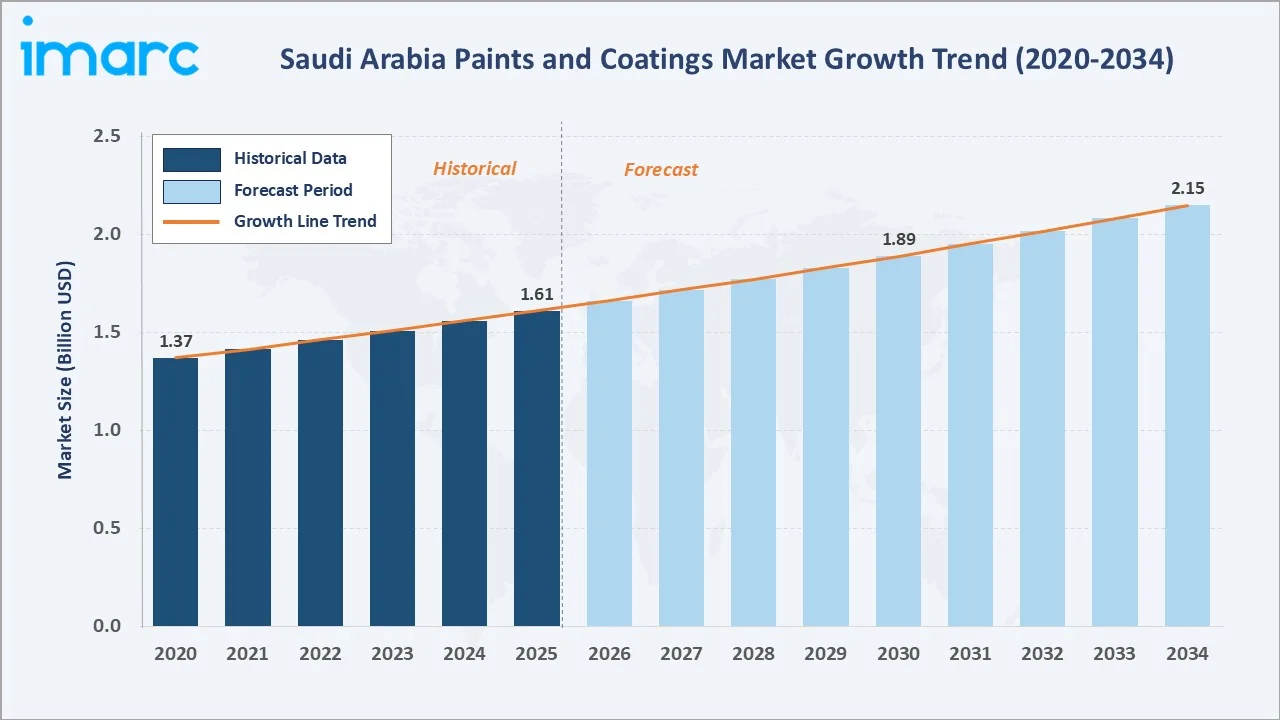
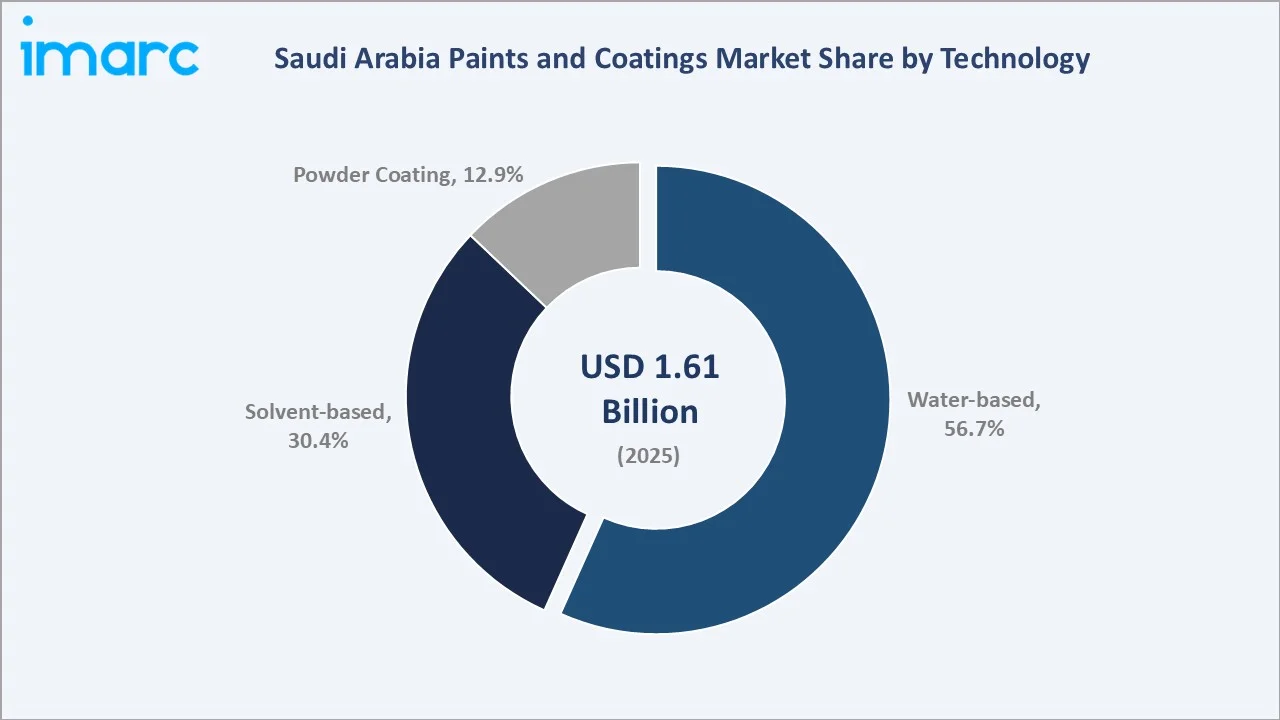
The Saudi Arabia paints and coatings market grew from USD 1.61 Billion in 2025 to USD 1.66 Billion in 2026 and is projected to reach USD 2.15 Billion by 2034, growing at a CAGR of 3.23% during 2026-2034. The market is driven by Vision 2030's construction boom, rising demand for eco-friendly low-VOC coatings, and expanding oil and gas sector maintenance. Water-based technology leads at 56.7%; architectural end use dominates at 48.6%; the Northern and Central Region commands 39.4% share.
Market Snapshot
|
Metric |
Value |
|
Base Year Market Size (2025) |
USD 1.61 Billion |
| Market Size (2026) | USD 1.66 Billion |
|
Forecast Market Size (2034) |
USD 2.15 Billion |
|
CAGR (2026-2034) |
3.23% |
|
Base Year |
2025 |
|
Historical Period |
2020-2025 |
|
Forecast Period |
2026-2034 |
|
Dominant Technology |
Water-based (56.7%, 2025) |
|
Dominant End Use Industry |
Architectural (48.6%, 2025) |
|
Leading Region |
Northern and Central Region (39.4%, 2025) |
The market expanded from USD 1.37 Billion in 2020 to USD 1.61 Billion in 2025 and an estimated USD 1.66 Billion in 2026, anchored at USD 1.89 Billion in 2030 and forecast to reach USD 2.15 Billion by 2034. Vision 2030 mega-project pipelines, government housing programmes, and sustained oil and gas infrastructure maintenance drove consistent market expansion through the historical period.
To get more information on this market, Request Sample
Architectural end use grows fastest at ~3.6% CAGR as Vision 2030 residential and commercial construction pipelines create compounding paint volume demand, with each new housing unit and giga-project development contributing incremental architectural coating requirements across interior and exterior surfaces.
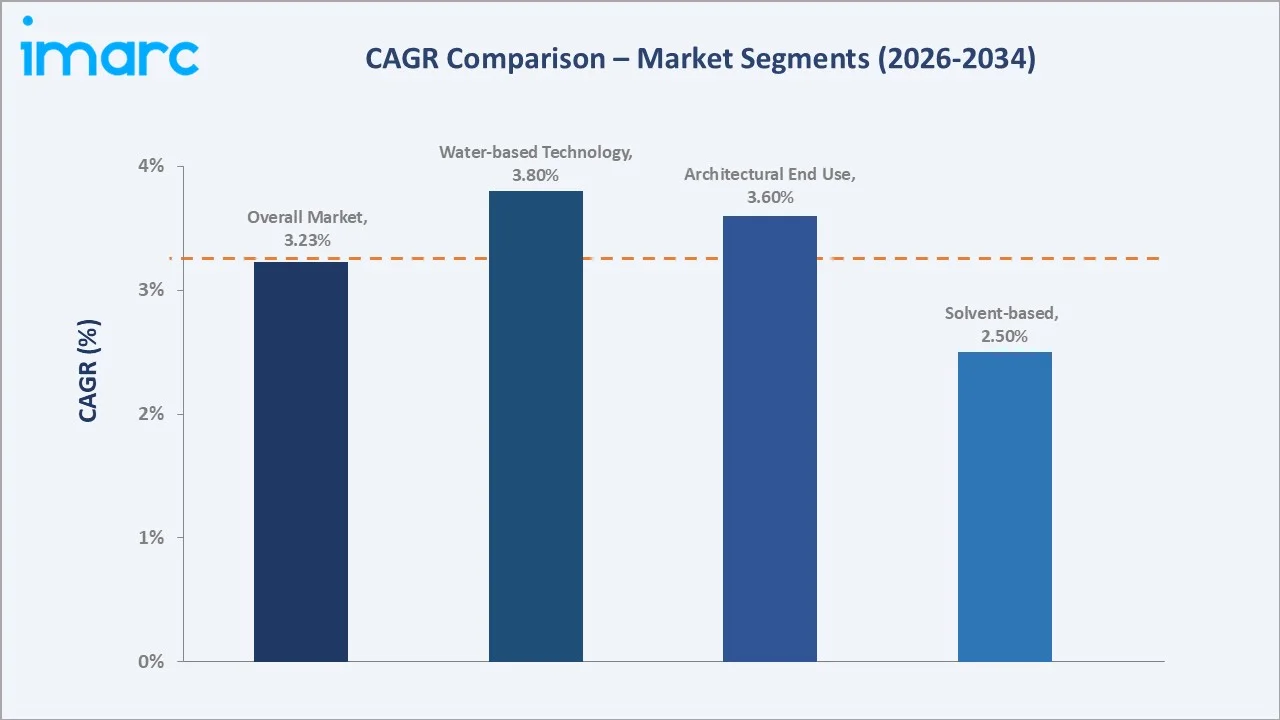
Water-based technology grows at ~3.8% CAGR as the mainstream architectural and general industrial coating technology, driven by SASO VOC compliance mandates and consumer preference for safer, low-odour indoor formulations that increasingly displace solvent-based alternatives across the Kingdom.
Executive Summary
The Saudi Arabia paints and coatings market, which increased from USD 1.61 Billion in 2025 to an estimated USD 1.66 Billion in 2026, positioning it as the Gulf region's most strategically important coatings market, driven by active infrastructure development and regulatory-driven product transformation toward eco-friendly formulations. The market is projected to reach USD 2.15 Billion by 2034.
Water-based technology at 56.7% dominates through alignment with Saudi Arabia's VOC emission standards. The architectural segment at 48.6% leads through Vision 2030's large-scale residential and commercial construction. The Northern and Central Region at 39.4% commands the highest share through concentrated government capital spending.
Key Market Insights
|
Insight |
Data |
|
Dominant Technology |
Water-based – 56.7% share (2025) |
|
Dominant End Use Industry |
Architectural – 48.6% market share (2025) |
|
Leading Region |
Northern and Central Region – 39.4% market share (2025) |
|
Market Opportunity |
Low-VOC coatings, smart coatings, Vision 2030 infrastructure projects, powder coatings expansion |
Key Analytical Observations Supporting the Above Data:
- Water-based at 56.7%: Government-mandated VOC reduction targets and consumer preference for odour-free, faster-drying formulations are driving water-based technology adoption across both decorative and protective applications throughout the Kingdom. Manufacturers investing in water-based formulation capabilities are gaining competitive advantages as SASO enforcement strengthens.
- Architectural at 48.6%: Saudi Arabia's National Housing Programme and Vision 2030 mega-projects such as NEOM, Red Sea Project, and Diriyah Gate continuously generate large-scale architectural paint volumes across residential, commercial, and hospitality construction. Each new development contributes incremental architectural coating volume.
- Northern and Central Region at 39.4%: Riyadh's rapid urban expansion, the NEOM development corridor, and concentrated government capital investment in central Saudi Arabia drive disproportionate architectural and protective coatings demand. The region's outsized project activity and government spending concentration create structural volume advantages.
Saudi Arabia Paints and Coatings Market Overview
The Saudi Arabia paints and coatings market encompasses the manufacturing, distribution, and application of decorative, protective, and functional coating products across residential, commercial, industrial, and infrastructure end-use segments throughout the Kingdom.
The ecosystem integrates global resin and pigment producers, multinational and domestic paint manufacturers, multi-channel distribution networks, and end-use contractors. Macroeconomic drivers include oil revenues funding public infrastructure, Vision 2030's diversification mandate, rapid urbanisation, and growing private sector investment in manufacturing and tourism.
Market Dynamics
To evaluate market opportunities, Request Sample
Market Drivers
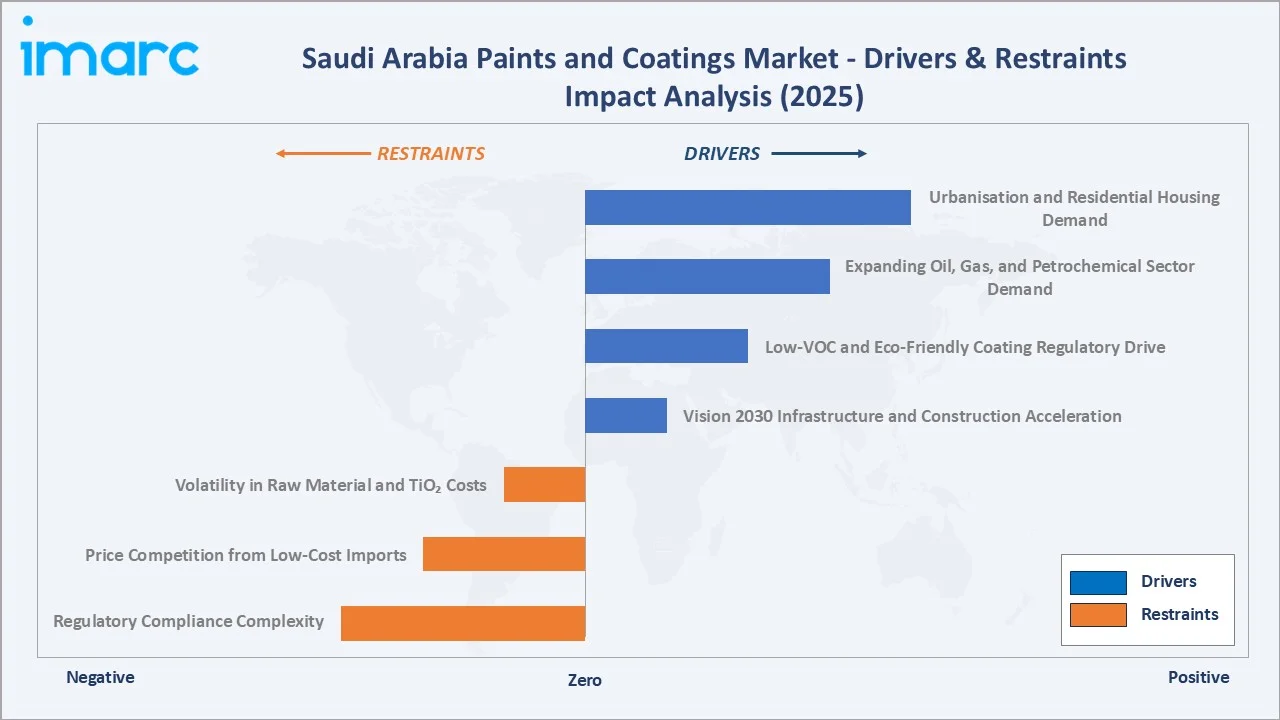
- Vision 2030 Infrastructure and Construction Acceleration: Saudi Arabia's Vision 2030 programme drives unprecedented paint demand through giga-projects including NEOM, The Red Sea Project, Qiddiya, and Diriyah Gate, alongside the National Housing Programme targeting 70% home ownership. Each construction phase requires multiple paint and coating applications across structural, finishing, and protective surfaces. Rising government budget allocations to Vision 2030 are sustaining large-scale construction activity, directly expanding architectural and protective coatings demand across all end-use segments.
- Low-VOC and Eco-Friendly Coating Regulatory Drive: Saudi Arabia's adoption of stricter VOC emission standards aligned with GCC environmental frameworks is accelerating the transition from solvent-based to water-based and powder-based formulations. This regulatory push expands the addressable market for premium eco-friendly products at higher per-litre values. Manufacturers investing in compliant formulation capabilities are gaining competitive advantages as regulatory enforcement strengthens across architectural and industrial application segments.
- Expanding Oil, Gas, and Petrochemical Sector Demand: Saudi Aramco's capital expenditure programme and SABIC's continuous plant operations sustain high-volume structural demand for protective coatings, anti-corrosion systems, and fireproofing coatings across the Eastern Region's industrial corridor. Each facility maintenance cycle and capacity expansion requires large-volume protective coating applications with stringent performance specifications.
- Urbanisation and Residential Housing Demand: Saudi Arabia's urban population growth and government-subsidised Sakani mortgage programmes continuously expand the residential construction pipeline. Each housing unit requires decorative and protective coating across multiple interior and exterior surfaces. The Kingdom's young and rapidly urbanising population base ensures structural demand continuity for architectural coatings throughout the forecast horizon.
Market Restraints
- Volatility in Raw Material and TiO₂ Costs: TiO₂ pigment and petrochemical-derived resin prices are highly correlated with crude oil feedstock costs and global supply chain disruptions, creating margin pressure for manufacturers. Manufacturers dependent on imported specialty inputs is particularly exposed to currency and logistics cost volatility that amplifies raw material cost uncertainty across the production cycle. This cost pressure is most acute during periods of simultaneous demand growth and input cost escalation.
- Price Competition from Low-Cost Imports: Imported paints and coatings from Asia-Pacific manufacturing hubs compete aggressively on price in the commodity decorative segment, limiting pricing power for domestically manufactured and premium imported products. Import price competition compresses margins across the distribution chain, making it difficult for premium manufacturers to recover regulatory compliance and quality investment costs. Continued trade liberalisation may further intensify competitive pressure from low-cost import sources.
- Regulatory Compliance Complexity: Evolving SASO requirements for coating formulations, combined with increasingly stringent VOC and hazardous substance regulations, add compliance cost burdens disproportionately affecting smaller regional manufacturers with limited R&D capabilities. Multi-jurisdiction compliance requirements for manufacturers serving both Saudi and broader GCC markets create additional administrative and product reformulation costs. The pace of regulatory change introduces uncertainty into product development timelines.
Market Opportunities
- Smart Coatings and Nanotechnology Applications: Smart coatings incorporating nanotechnology offer high-value growth vectors for thermal management, antimicrobial, and self-cleaning surface properties aligned with Saudi Arabia's premium construction, healthcare, and hospitality sectors. These advanced formulations command significant price premiums and are gaining traction in Vision 2030 showcase projects where building performance is a priority specification. Manufacturers establishing early presence in smart coatings can capture premium positioning above commodity competition.
- Powder Coating Adoption in Industrial Manufacturing: Powder coating adoption in the Kingdom's growing metalwork, furniture, and industrial manufacturing sectors provides a structurally expanding segment driven by regulatory preference for VOC-free application and lower total cost of ownership. Saudi Arabia's expanding industrial manufacturing base under Vision 2030's diversification agenda is creating new addressable markets across consumer electronics, automotive components, and architectural aluminium systems. Investment in powder coating capacity positions suppliers for above-market growth through the forecast period.
Market Challenges
- Distribution Channel Fragmentation in Secondary Cities: Distribution channel fragmentation in secondary cities constrains market penetration for premium branded products, requiring significant investment in dealer networks to reach the Kingdom's geographically dispersed population. Building effective distribution coverage in smaller urban centres requires sustained investment in dealer relationships, logistics infrastructure, and technical support that many manufacturers find difficult to justify against uncertain volume returns. Secondary market opportunities remain consistently underserved.
- Skilled Applicator Availability Constraints: Skilled applicator availability remains a persistent constraint for technically demanding protective and specialty coatings, where incorrect application negates performance advantages and creates liability risks that slow adoption. The Kingdom's reliance on expatriate labour for skilled trades creates workforce availability uncertainty tied to immigration policy and bilateral labour agreements. Manufacturers investing in applicator training programmes and certification systems can differentiate their market positions over time.
Emerging Market Trends
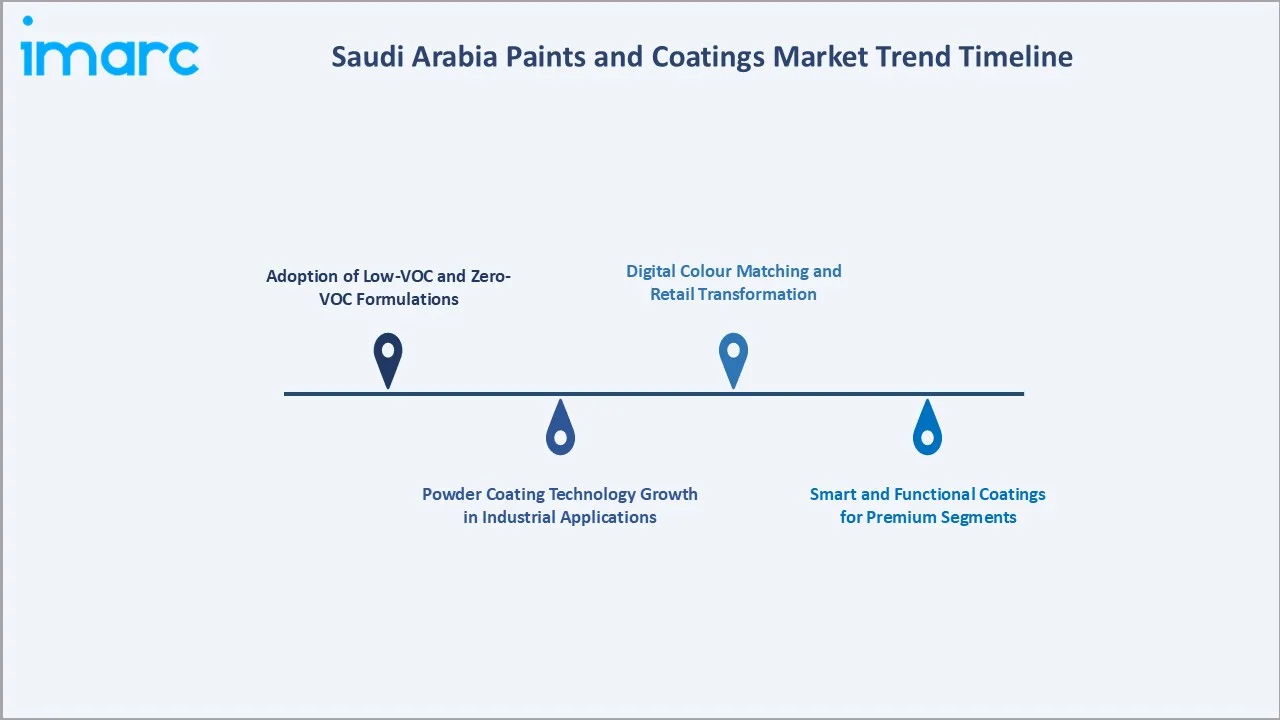
1. Adoption of Low-VOC and Zero-VOC Formulations
Saudi Arabia's alignment with global environmental standards is accelerating demand for water-based, low-VOC architectural paints. Major manufacturers are systematically reformulating product lines to lead-free, low-solvent compositions meeting SASO and GSO standards, with premium pricing reflecting the technical investment in compliant formulations that deliver equivalent performance across all application conditions.
2. Powder Coating Technology Growth in Industrial Applications
Powder coating adoption is expanding beyond metalwork into furniture, automotive components, and architectural aluminium systems. The technology's zero-VOC application, superior corrosion resistance, and lower total operational cost align with Saudi Arabia's regulatory and industrial cost drivers, positioning powder coating for above-market growth through the forecast period as new manufacturing capacity comes online.
3. Smart and Functional Coatings for Premium Segments
Thermal barrier coatings, antimicrobial coatings for healthcare and hospitality, and photocatalytic self-cleaning coatings are gaining commercial traction in Saudi Arabia's premium construction segment. Vision 2030 showcase projects requiring high-performance building solutions are accelerating adoption of smart coatings technologies that deliver measurable performance benefits beyond conventional aesthetic and protective functions.
4. Digital Colour Matching and Retail Transformation
Jazeera Paints and other regional players are investing in digital colour matching systems, in-store tinting machines, and online customization tools to drive retail traffic and premiumize the customer experience. This digital retail transformation aligns with the Kingdom's broader digital economy agenda and creates clear differentiation for brands delivering seamless omnichannel purchasing experiences to consumers and contractors.
Industry Value Chain Analysis
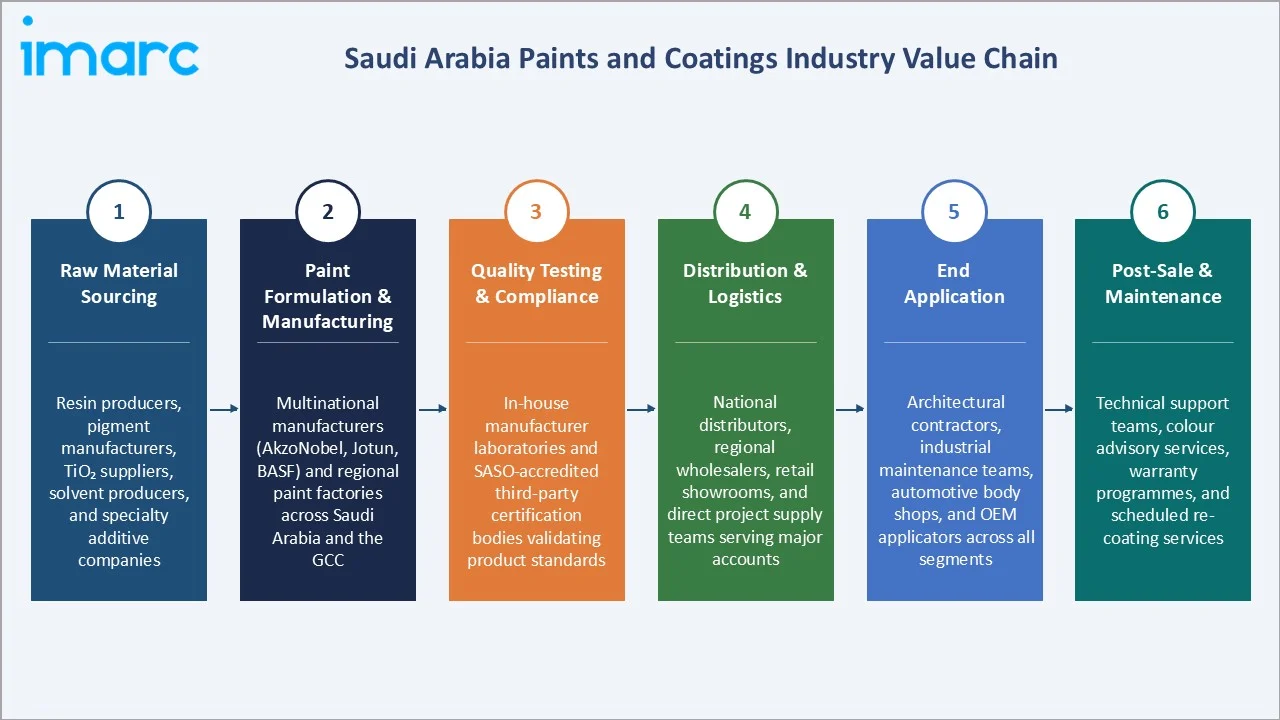
The Saudi Arabia paints and coatings value chain integrates global raw material supply, domestic formulation and manufacturing, quality certification, multi-channel distribution, project-level application, and post-sale support. The commercial structure is evolving toward direct project supply and omnichannel retail as manufacturers invest in showroom networks and digital capabilities.
|
Stage |
Key Participants |
|
Raw Material Sourcing |
Resin producers, pigment manufacturers, TiO₂ suppliers, solvent producers, specialty additive companies |
|
Paint Formulation & Manufacturing |
Multinational manufacturers (AkzoNobel, Jotun, BASF) and regional paint factories across Saudi Arabia and the GCC |
|
Quality Testing & Compliance |
In-house manufacturer laboratories and SASO-accredited third-party certification bodies validating product standards |
|
Distribution & Logistics |
National distributors, regional wholesalers, retail showrooms, and direct project supply teams serving major accounts |
|
End Application |
Architectural contractors, industrial maintenance teams, automotive body shops, and OEM applicators across all segments |
|
Post-Sale & Maintenance |
Technical support teams, colour advisory services, warranty programmes, and scheduled re-coating services |
The raw material sourcing tier remains commercially most sensitive given Saudi Arabia's dependence on imported TiO₂ and specialty chemical inputs. The distribution and retail tier is experiencing the fastest transformation as brands invest in customer experience and digital engagement capabilities to capture evolving purchasing behaviours.
Technology Landscape in the Saudi Arabia Paints and Coatings Industry
Water-Based Technology
Water-based coatings at 56.7% represent the dominant and fastest-growing segment, driven by VOC regulations, improved formulation performance, and consumer preference for low-odour indoor products. Advanced acrylic dispersions now deliver performance comparable to solvent-based counterparts for most architectural applications, enabling broad substitution across formerly solvent-based segments throughout the Kingdom.
Solvent-Based Technology
Solvent-based coatings at 30.4% retain significant share through their indispensable role in demanding industrial and marine applications where water-based alternatives cannot match performance under extreme temperature, chemical exposure, or high-humidity conditions prevalent in Saudi Arabia's industrial facilities and offshore installations.
Powder Coating Technology
Powder coating at 12.9% offers zero-VOC application, superior corrosion resistance, and lower total operational cost for applicable metal substrates. Growth is driven by expanding aluminium architectural systems, metal furniture manufacturing, and industrial component coating across the Kingdom's developing manufacturing sector under Vision 2030's economic diversification programme.
Market Segmentation Analysis
The report covers the following segments:
|
Segment Category |
Leading Segment |
Market Share |
Year |
|
Resin Type |
🔒 |
🔒 |
2025 |
|
Technology |
Water-based |
56.7% |
2025 |
|
End Use Industry |
Architectural |
48.6% |
2025 |
|
Region |
Northern and Central Region |
39.4% |
2025 |

By Technology
Water-based technology leads at 56.7% in 2025, capturing mainstream architectural and general industrial segments aligned with environmental compliance requirements and consumer preference for safer, lower-odour indoor painting products across residential and commercial applications throughout the Kingdom.
To access detailed market analysis, Request Sample
Solvent-based technology at 30.4% retains share through its indispensable role in industrial protective, marine, and high-performance coatings where water-based alternatives have not yet achieved full performance parity. Powder-based technology at 12.9% is the fastest-growing sub-segment driven by industrial manufacturing expansion and its regulatory-compliant zero-VOC application profile.
By End Use Industry
Architectural end use leads at 48.6% through the highest paint consumption intensity per project from Saudi Arabia's large-scale residential and commercial construction pipeline continuously generated under Vision 2030 programmes and government housing support schemes across all regions.
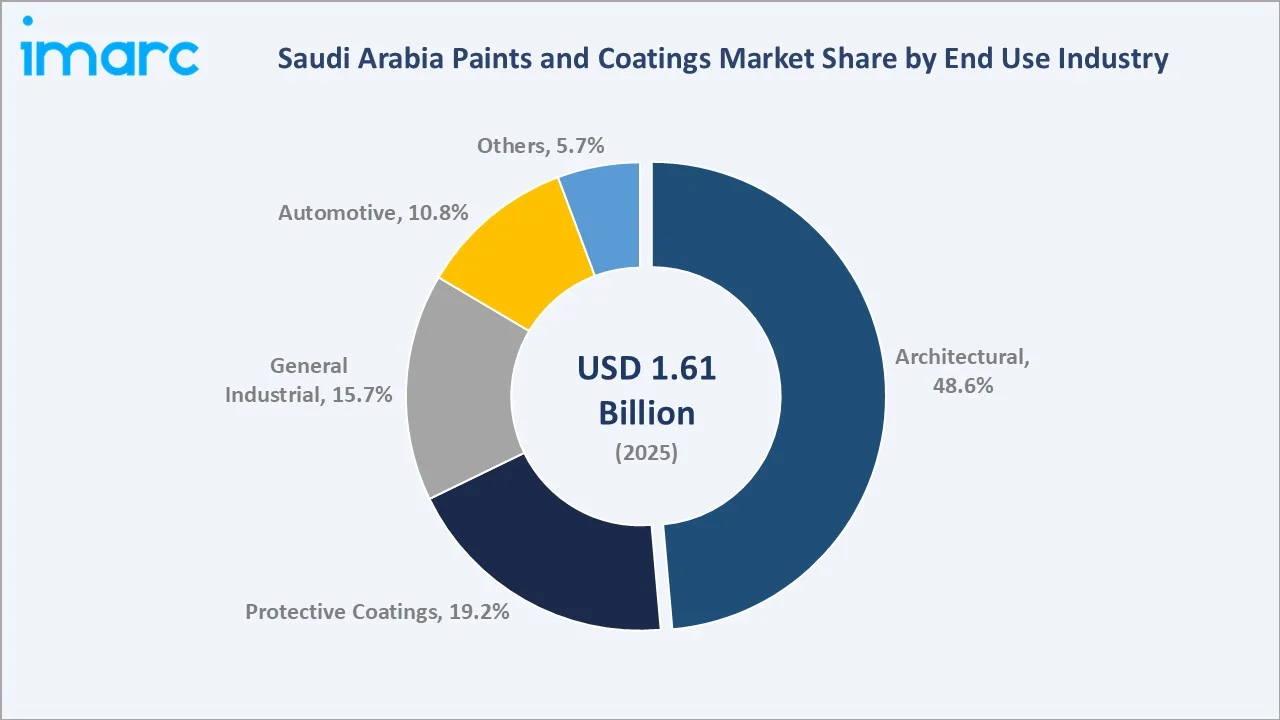
Protective coatings at 19.2% serve the critical oil, gas, and industrial infrastructure maintenance market generating structural non-discretionary demand. General industrial at 15.7% captures manufacturing facility and equipment coating demand. Automotive at 10.8% reflects vehicle refinish and OEM coating demand from the expanding local automotive services sector.
Regional Market Insights
|
Region |
Share (2025) |
Key Market Drivers & Characteristics |
|
Northern and Central Region |
39.4% |
Driven by Riyadh's rapid urban expansion, Vision 2030 mega-projects including NEOM, and concentrated government capital spending across residential, commercial, and infrastructure construction |
|
Western Region |
29.1% |
Driven by Makkah and Madinah religious tourism infrastructure investments, Jeddah's commercial real estate growth, and expanding hospitality sector construction activity |
|
Eastern Region |
19.9% |
Driven by strong oil and gas industrial base, with Saudi Aramco and SABIC facilities generating sustained demand for protective and anti-corrosion coatings throughout the region |
|
Southern Region |
11.6% |
Emerging with growing residential and infrastructure construction supported by regional development programmes and government investment in southern province development |
The Northern and Central Region at 39.4% leads through Riyadh's rapid urban expansion, the NEOM mega-project corridor, and concentrated government capital spending.
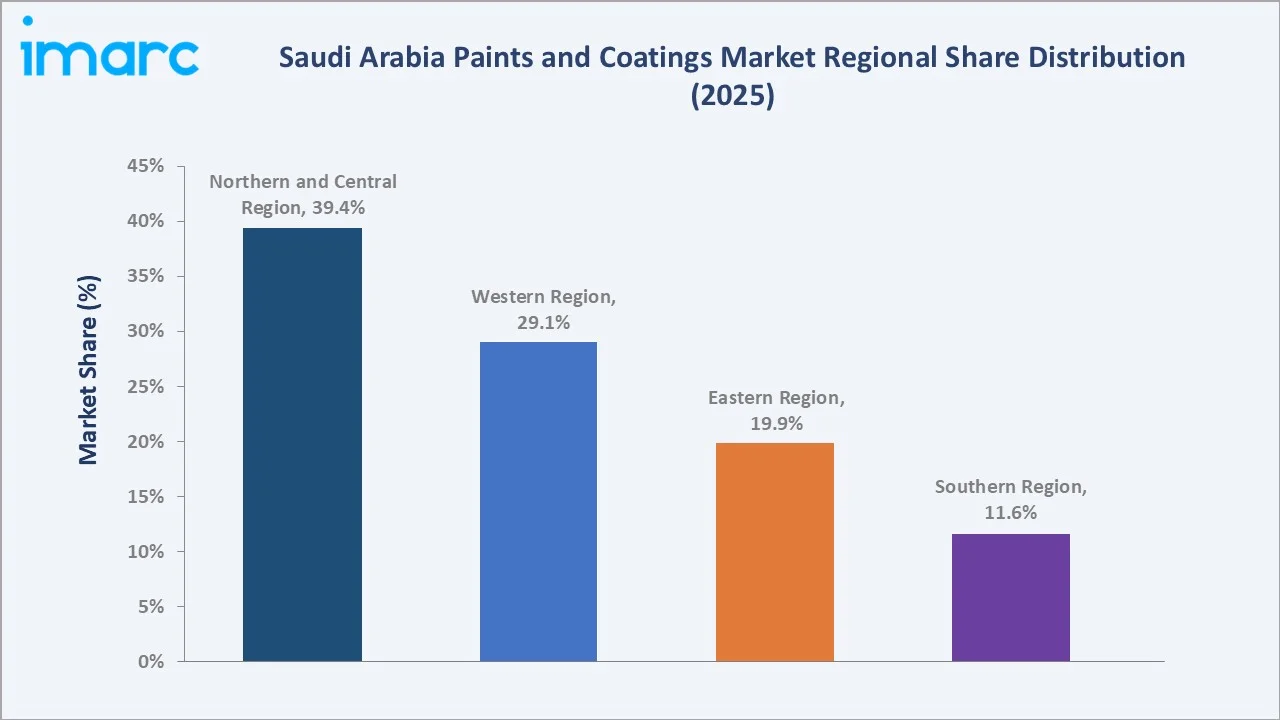
The Western Region at 29.1% benefits from Makkah and Madinah religious tourism infrastructure investments and Jeddah's commercial development.
The Eastern Region at 19.9% is anchored by non-discretionary protective and industrial coatings demand from Saudi Aramco and SABIC operations. The Southern Region at 11.6% is a developing market with growing residential construction supported by government regional development investment programmes.
Competitive Landscape
The Saudi Arabia paints and coatings competitive landscape is moderately concentrated, with global Tier-1 manufacturers holding leadership in premium architectural and protective coatings, while established regional and local players capture significant share in mid-market and commodity decorative segments throughout the Kingdom.
|
Company Name |
Key Products |
Market Position |
Core Strength |
|
Akzo Nobel N.V. |
Dulux, Sikkens, International Paints |
Market Leader |
Global innovation leadership in eco-friendly decorative and protective coatings with strong GCC regional presence |
|
BASF |
MasterProtect, Master Builders Solutions |
Strong Challenger |
Leading chemical expertise enabling high-performance industrial and construction coatings solutions for demanding applications |
|
Hempel A/S |
Hempel Coatings, Galvosil, Hempadur |
Niche Player |
Proven expertise in protective and marine coatings for heavy industrial, oil and gas, and offshore coating applications |
Key players include Akzo Nobel N.V., BASF, Hempel A/S, and others.
Key Company Profiles
Akzo Nobel N.V.
Akzo Nobel N.V. is a Netherlands-based global coatings leader with a strong Saudi Arabia presence through its Dulux, Sikkens, and International marine and protective coatings brands across architectural, automotive refinish, and industrial coating segments.
- Key Products: Dulux Trade (architectural), Sikkens (automotive refinish), International Paints (marine and protective coatings), AkzoNobel Powder Coatings range.
- Strategic Focus: Expanding premium decorative and protective coatings portfolio aligned with Saudi Arabia's Vision 2030 luxury residential and commercial construction demand, while investing in sustainability-driven product innovation including water-based and powder coating technologies. The company targets leadership in the premium architectural segment by leveraging its global colour innovation capabilities, Dulux brand equity, and expanding technical service team presence across major Saudi project markets.
Hempel A/S
Hempel A/S is a Denmark-based global coatings manufacturer, operating through Hempel Paints Saudi Arabia, its local manufacturing and distribution entity, serving protective, marine, and decorative coatings segments with a certified track record supplying Saudi Aramco, SABIC, and major infrastructure projects across the Kingdom.
- Key Products: Hempadur (high-build epoxy protective coatings), Galvosil (zinc silicate anti-corrosion primers), Hempaguard (marine antifouling hull coatings), Hempafire (intumescent fire protection coatings), Hempel Decorative range (interior and exterior architectural coatings).
- Strategic Focus: Hempel Paints Saudi Arabia opened its flagship showroom in Al Jubail, targeting the Kingdom's largest industrial city and its concentration of petrochemical companies including Saudi Aramco and SABIC partners.
Market Concentration Analysis
The Saudi Arabia paints and coatings market is moderately concentrated at the premium and protective tiers, with AkzoNobel, Jotun, and Sherwin-Williams collectively accounting for an estimated 35–45% of architectural premium segment revenue. The mid-market decorative segment is more fragmented, with regional manufacturers including Jazeera Paints and National Paints holding significant shares.
Investment & Growth Opportunities
Highest Growth Segments
Powder coating technology (~4–5% CAGR), protective coatings for infrastructure (~4% CAGR), low-VOC architectural coatings (~3.8% CAGR), and smart coatings for premium construction represent the highest-growth investment vectors through 2034, each driven by structural demand catalysts extending beyond cyclical construction activity.
Emerging Investment Opportunities
Vision 2030 mega-project supply qualification presents the market's most significant revenue concentration opportunity, with large-scale project supply contracts requiring certified suppliers with local technical service capability, reliable logistics infrastructure, and demonstrated track record that creates durable competitive barriers for established players.
Investment Themes
- Local manufacturing investment to qualify for Vision 2030 project supply mandates and benefit from Saudi industrial policy incentives, including reduced import duties on locally manufactured products and preferential treatment in public sector procurement processes prioritising Kingdom-sourced goods and services.
- Digital retail transformation investment in tinting systems, colour matching technology, and e-commerce platform capabilities to capture the growing DIY and small contractor segment's progressive shift toward self-serve purchasing channels and digital-first customer experience expectations across the Kingdom.
Future Market Outlook (2026-2034)
The Saudi Arabia paints and coatings market is projected to grow from USD 1.61 Billion in 2025 to USD 1.66 Billion in 2026, reaching USD 2.15 Billion by 2034, delivering a 3.23% CAGR. Vision 2030's construction pipeline, the Kingdom's expanding manufacturing sector, and the structural shift toward eco-friendly formulations will anchor market growth through the forecast horizon.
Three structural forces define market growth through 2034. Vision 2030's giga-project pipeline creates a structurally elevated architectural and protective coatings demand pool beyond any single project cycle. Environmental regulatory convergence drives sustained premiumisation toward water-based and powder-based products at higher per-unit values. The Kingdom's expanding industrial base under Vision 2030's diversification agenda creates new specialty coatings demand across food processing, pharmaceuticals, and electronics manufacturing sectors.
Research Methodology
Primary Research
Primary research comprised structured interviews with 40+ industry stakeholders (2025), including paint manufacturing executives, project procurement managers, architectural contractors, and industrial maintenance engineers across Saudi Arabia's key demand regions, supplemented by site visits to major project supply points and retail showrooms.
Secondary Research
Secondary research encompassed company annual reports, Vision 2030 programme documentation, SASO regulatory publications, Saudi Aramco supplier requirements, GCC construction industry databases, Saudi General Authority for Statistics data, and over 50 secondary sources systematically reviewed and cross-referenced.
Forecasting Models
Market revenue forecasts developed using a construction output-based bottom-up model: (i) Saudi Arabia construction output forecast by sector and region; (ii) paint consumption intensity per construction category; (iii) average price per litre by technology and end-use segment; (iv) regulatory-driven technology mix shift adjustment from solvent-based toward water-based and powder-based formulations throughout the forecast period.
| Report Features | Details |
|---|---|
| Base Year of the Analysis | 2025 |
| Historical Period | 2020-2025 |
| Forecast Period | 2026-2034 |
| Units | Billion USD |
| Scope of the Report |
Exploration of Historical Trends and Market Outlook, Industry Catalysts and Challenges, Segment-Wise Historical and Future Market Assessment:
|
| Resin Types Covered | Acrylic Resin, Alkyd Resin, Polyurethane Resin, Epoxy Resin, Polyester Resin, Others |
| Technologies Covered | Water-based, Solvent-based, Powder-based |
| End Use Industries Covered | Architectural, Automotive, Protective Coatings, General Industrial, Others |
| Regions Covered | Northern and Central Region, Western Region, Eastern Region, Southern Region |
| Companies Covered | Akzo Nobel N.V., BASF, Hempel A/S, etc. |
| Customization Scope | 10% Free Customization |
| Post-Sale Analyst Support | 10-12 Weeks |
| Delivery Format | PDF and Excel through Email (We can also provide the editable version of the report in PPT/Word format on special request) |
Key Benefits for Stakeholders:
- IMARC’s industry report offers a comprehensive quantitative analysis of various market segments, historical and current market trends, market forecasts, and dynamics of the Saudi Arabia paints and coatings market from 2020-2034.
- The research report provides the latest information on the market drivers, challenges, and opportunities in the Saudi Arabia paints and coatings market.
- Porter's five forces analysis assist stakeholders in assessing the impact of new entrants, competitive rivalry, supplier power, buyer power, and the threat of substitution. It helps stakeholders to analyze the level of competition within the Saudi Arabia paints and coatings industry and its attractiveness.
- Competitive landscape allows stakeholders to understand their competitive environment and provides an insight into the current positions of key players in the market.
Frequently Asked Questions About the Saudi Arabia Paints and Coatings Market Report
The Saudi Arabia paints and coatings market size is estimated at USD 1.66 Billion in 2026, driven by water-based technology leading at 56.7%, architectural end use dominating at 48.6%, the Northern and Central Region commanding 39.4% through Vision 2030 construction acceleration, and structural protective coatings demand from the oil and gas sector across the Eastern Region.
The market grows at a CAGR of 3.23% during 2026-2034, reaching USD 2.15 Billion by 2034. This growth reflects Vision 2030 construction pipeline activity, eco-friendly formulation adoption driven by VOC regulations, expanding industrial maintenance demand, and progressive powder coating penetration across industrial manufacturing.
Water-based technology leads at 56.7% in 2025, driven by SASO and GCC VOC emission regulations, consumer preference for safer low-odour indoor formulations, and broad applicability across architectural and general industrial segments. Water-based technology is growing at the fastest rate through regulatory and consumer-driven substitution of solvent-based alternatives.
Architectural end use leads at 48.6% in 2025, driven by Vision 2030's residential and commercial construction pipeline including the National Housing Programme and multiple giga-project developments. The segment's dominant share reflects the Kingdom's large-scale housing production and commercial real estate development activity sustained across the forecast period.
The Northern and Central Region leads at 39.4% in 2025, anchored by Riyadh's rapid urban expansion, concentrated government capital spending, and the NEOM mega-project corridor driving architectural and protective coating demand at scale across residential, commercial, and infrastructure construction categories.
Leading companies include Akzo Nobel N.V., BASF, Hempel A/S, and others.
Need more help?
- Speak to our experienced analysts for insights on the current market scenarios.
- Include additional segments and countries to customize the report as per your requirement.
- Gain an unparalleled competitive advantage in your domain by understanding how to utilize the report and positively impacting your operations and revenue.
- For further assistance, please connect with our analysts.
 Request Customization
 Speak to an Analyst
 Request Brochure
 Inquire Before Buying
Benefits of Customization
- Personalize this research
- Triangulate with your data
- Get data as per your format and definition
- Gain a deeper dive into a specific application, geography, customer, or competitor
- Any level of personalization
Get in Touch With Us
UNITED STATES
Phone: +1-201-971-6302
INDIA
Phone: +91-120-433-0800
UNITED KINGDOM
Phone: +44-753-714-6104
Email: [email protected]
Client Testimonials







Related Reports
Choose your plan
*Please note that the prices mentioned below are starting prices for each bundle type. Kindly contact our team for further details.*
Single User License
- 1 User License, Access on 2 Devices
- PDF Report + Excel Dataset (Password Protected)
- Lifetime Access
- No Printing Rights
- 10% Free Report Customization
- 10–12 Weeks of Analyst Support
Five User License
- Access for 5 Users, 2 Devices per User
- PDF Report + Excel Dataset (Password Protected)
- Lifetime Access
- Dedicated Account Manager
- 12–14 Weeks of Analyst Support
- No Printing Rights
- 15% Free Report Customization
- 25% Discount on Your Next Purchase
Corporate User License
- Unlimited User Access (Within Your Organization)
- PDF Report + Excel Dataset
- Lifetime Access
- Dedicated Account Manager
- 14–20 Weeks of Analyst Support
- No Printing Rights
- 20% Free Report Customization
- 30% Discount on Your Next Purchase
Essential Insights
What's included:
3 reports
- Lifetime Access
- PDF Reports
- Excel Datasets
- 2 Weeks of Free Analyst Support
- 2 User Licenses
- Access on 2 Devices
- Printing Rights
- Complimentary PowerPoint (PPT) Version
- Complimentary License Upgrade
Professional Access
What's included:
5 reports
- Lifetime Access
- PDF Reports
- Excel Datasets
- 8 Weeks of Free Analyst Support
- 2 User Licenses
- Access on 2 Devices
- Printing Rights
- Complimentary PowerPoint (PPT) Version
- Complimentary License Upgrade
Business Advantage
What's included:
8 reports
- Lifetime Access
- PDF Reports
- Excel Datasets
- 14 Weeks of Free Analyst Support
- 2 User Licenses
- Access on 2 Devices
- Printing Rights
- Complimentary PowerPoint (PPT) Version
- Complimentary License Upgrade
Enterprise Intelligence
What's included:
10 reports
- Lifetime Access
- PDF Reports
- Excel Datasets
- 20 Weeks of Free Analyst Support
- 2 User Licenses
- Access on 2 Devices
- Printing Rights
- Complimentary PowerPoint (PPT) Version
- Complimentary License Upgrade