
Saudi Arabia Pet Food Market Size, Share, Trends and Forecast by Pet Type, Product Type, Ingredient, Distribution Channel, 2026-2034
Saudi Arabia Pet Food Market Size, Share, Trends & Forecast (2026-2034)
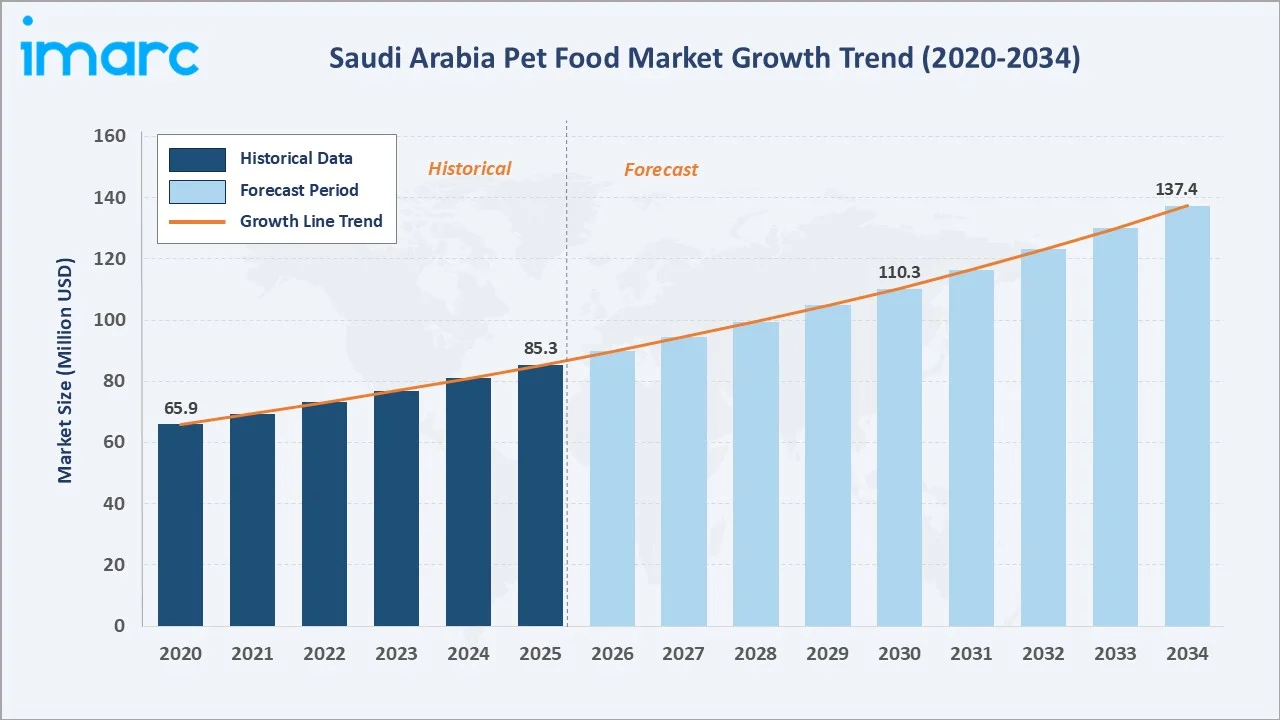
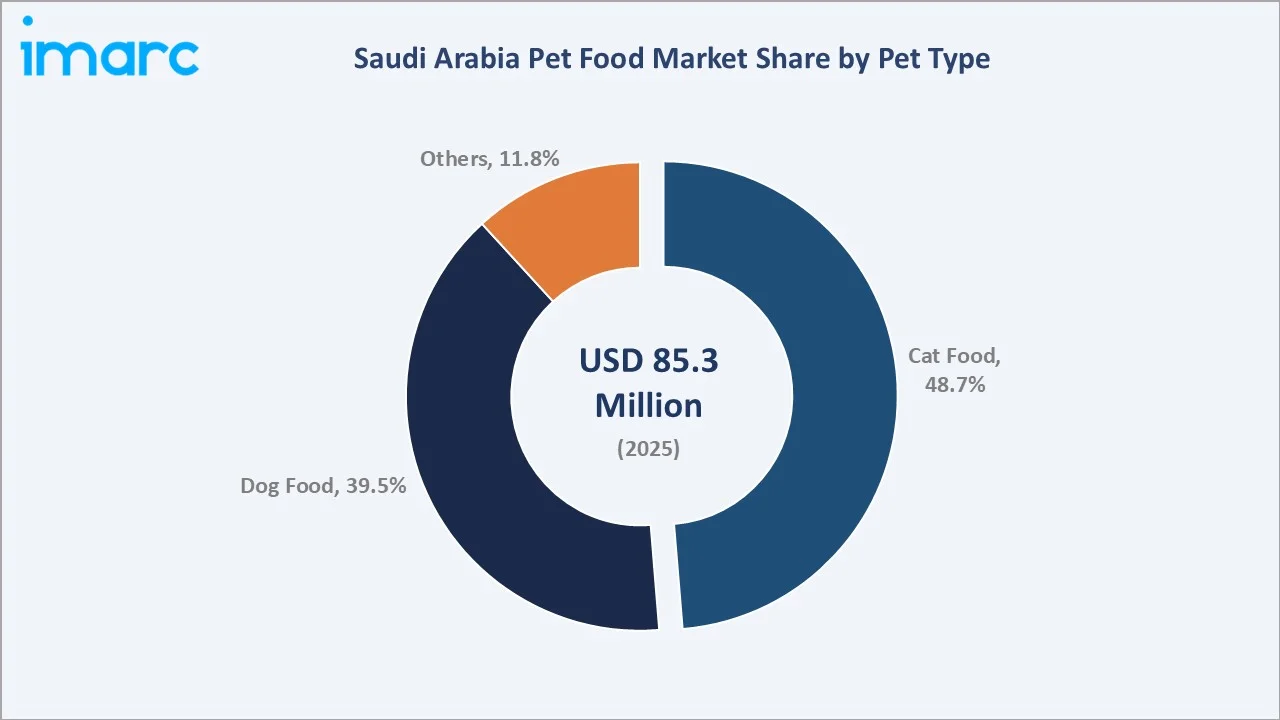
The Saudi Arabia pet food market size increased from USD 85.3 Million in 2025 to USD 91.0 Million in 2026 and is projected to reach USD 137.4 Million by 2034, expanding at a CAGR of 5.29% during 2026-2034. Growth is anchored by a fast-growing, youthful population that GASTAT placed at 35.3 million in 2024. Rising pet humanization and urban living are lifting demand for packaged nutrition. Cat food leads with 48.7% share in 2025, while convenience stores dominate distribution at 38.6%. Online stores are the fastest-growing channel.
Market Snapshot
|
Metric |
Value |
|
Base Year Market Size (2025) |
USD 85.3 Million |
| Market Size (2026) | USD 91.0 Million |
|
Forecast Market Size (2034) |
USD 137.4 Million |
|
CAGR (2026-2034) |
5.29% |
|
Base Year |
2025 |
|
Historical Period |
2020-2025 |
|
Forecast Period |
2026-2034 |
|
Largest Pet Type |
Cat Food (48.7%, 2025) |
|
Largest Distribution Channel |
Convenience Stores (38.6%, 2025) |
The market expanded from USD 65.9 Million in 2020 to USD 85.3 Million in 2025 and an estimated USD 91.0 Million in 2026. It is anchored at USD 110.3 Million in 2030 and forecast to reach USD 137.4 Million by 2034. Growth is broad-based rather than concentrated. Rising disposable incomes and Vision 2030-linked urbanization are lifting per-household spend on packaged pet nutrition across Saudi cities.
To get more information on this market, Request Sample
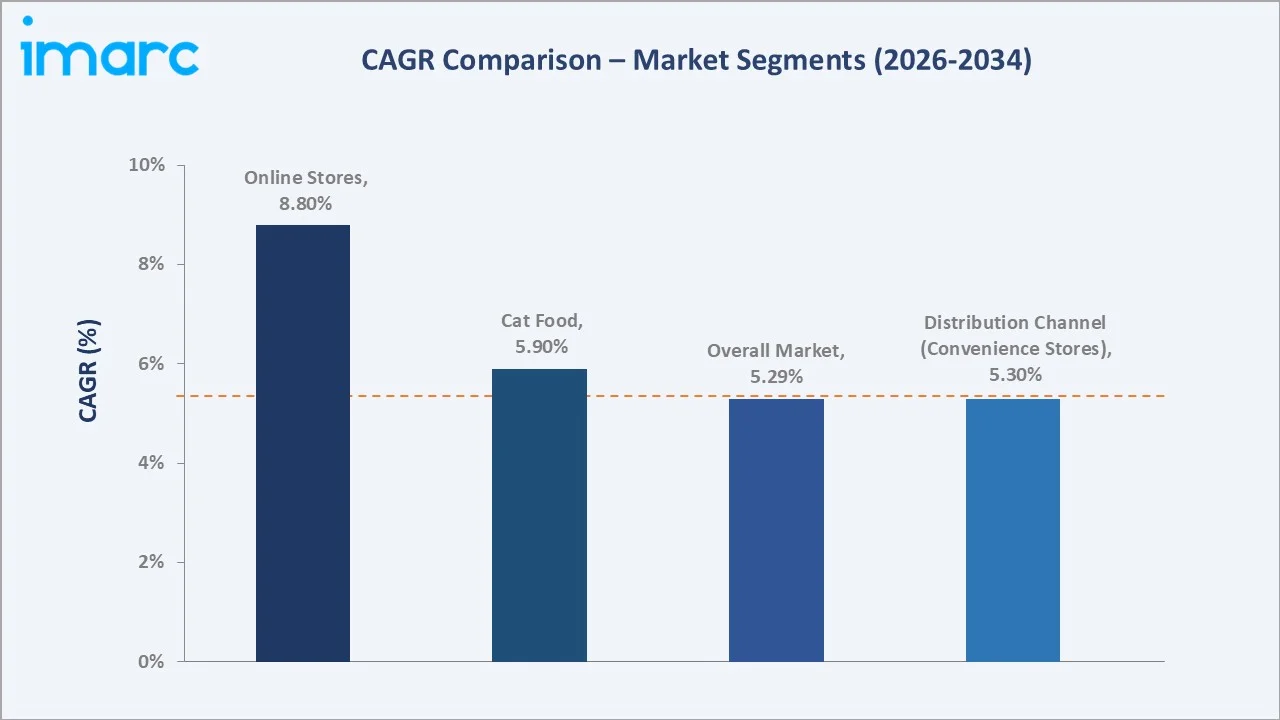
Online stores grow fastest at roughly 8.80% CAGR (2026-2034), supported by a widening base of licensed e-commerce merchants. Monsha'at recorded 40,953 e-commerce commercial records issued by the end of Q4 2024. Cat food advances at about 5.90% CAGR against 4.50% for dog food, reflecting a clear pet-ownership mix shift in the Kingdom.
Executive Summary
The Saudi Arabia pet food market, which increased from USD 85.3 Million in 2025 to an estimated USD 91.0 Million in 2026. Demand is underpinned by a large, young population: GASTAT estimated 35.3 million residents in 2024, with 74.7% aged between 15 and 64. Rising urban dual-income households are treating pets as family members, a shift that supports steady, resilient purchasing even through broader economic cycles. The market is projected to reach USD 137.4 Million by 2034 at a 5.29% CAGR, with premium and functional formats outpacing basic staples in value terms.
Cat food commands 48.7% of the 2025 market. Saudi urban households increasingly keep cats as low-maintenance companions suited to apartment living, and owners are willing to pay a premium for breed-specific and health-focused formulas. Convenience stores retain 38.6% of distribution, anchored by frequent, small-basket top-up purchases near residential areas.
Looking ahead, online retail and domestic manufacturing capacity are set to reshape the competitive landscape. Local production initiatives, including a large new pet food facility near Riyadh, are reducing import dependence and improving price competitiveness against established multinational brands.
Key Market Insights
|
Insight |
Data |
|
Largest Pet Type |
Cat Food - 48.7% value share (2025) |
|
Dominant Distribution Channel |
Convenience Stores - 38.6% share (2025) |
|
Fastest Growing Channel |
Online Stores - ~8.80% CAGR (2026-2034) |
|
Fastest Growing Pet Type |
Cat Food - ~5.90% CAGR (2026-2034) |
|
Market Opportunity |
Premium, functional and locally manufactured formats lifting realisation per unit |
Key Analytical Observations Supporting the Above Data:
- Cat food leads at 48.7% share (2025) on urban lifestyle fit: Cats suit smaller Riyadh and Jeddah apartments better than larger dog breeds, and owners increasingly select premium, breed-specific formulas over generic feed.
- Dog food holds 39.5% as the established volume format: Dog ownership remains concentrated among villa households and expatriate families, sustaining stable demand for both dry kibble and treat categories.
- Convenience stores at 38.6% reflect proximity-driven purchasing: Frequent small-basket top-ups near residential compounds keep this channel dominant, though supermarkets and hypermarkets remain close behind at 31.8%.
- Online stores at 18.9% are the clear growth engine: Monsha'at data shows 40,953 e-commerce commercial records by Q4 2024, with Riyadh (16,834) and Makkah (10,314) leading registrations. Subscription models are expanding fastest here.
- Regulatory compliance shapes market entry: Imported pet food must be registered through the SFDA's Food Import and Registration System (FIRS) before customs clearance, favouring established importers with compliance depth.
Saudi Arabia Pet Food Market Overview
The Saudi Arabia pet food market covers dry kibble, wet and canned formats, treats and functional nutrition sold across the Kingdom. Supply is largely import-driven from Europe, the United States and Thailand through licensed distributors, though local manufacturing is scaling quickly. End use spans household cats and dogs, with a smaller base of birds, fish and small mammals. Products fall under SFDA oversight, requiring FIRS registration before customs clearance. Macroeconomic tailwinds include Vision 2030 diversification, rising household incomes and a resident population GASTAT estimated at 35.3 million in 2024.
Market Dynamics
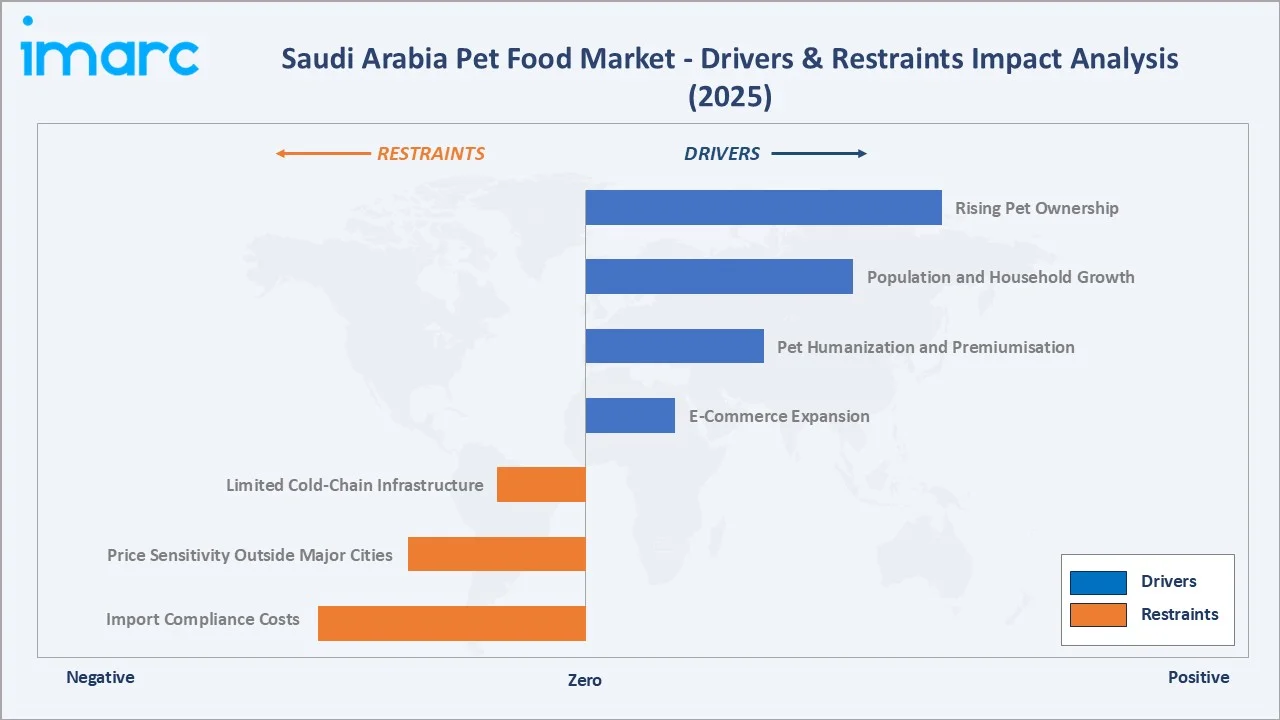
Growth in the Saudi Arabia pet food industry is shaped by rising pet ownership and expanding retail access, offset by import compliance costs and price sensitivity outside major cities.
To evaluate market opportunities, Request Sample
Market Drivers
- Rising Pet Ownership: Industry estimates put pet ownership at close to 60% of Saudi households, translating into a large and habitual base of repeat pet food buyers across the Kingdom.
- Population and Household Growth: GASTAT recorded 4.7% annual population growth to 35.3 million in 2024, with 74.7% of residents in the working-age bracket that drives discretionary pet spend.
- Pet Humanization and Premiumisation: Urban owners increasingly treat pets as family members, lifting demand for breed-specific, grain-conscious and health-focused formulas that carry higher realisation per unit.
- E-Commerce Expansion: Monsha'at reported 40,953 e-commerce commercial records issued by the end of Q4 2024. Online stores hold 18.9% channel share in 2025 and grow at roughly 8.80% CAGR, the fastest of any channel through 2034.
Market Restraints
- Import Compliance Costs: FIRS registration and SFDA conformity checks add documentation time and cost per shipment, which weighs most heavily on smaller importers and new entrants.
- Price Sensitivity Outside Major Cities: Budget-conscious households in smaller urban centres often default to unbranded or bulk feed, capping premium format penetration at the national level.
- Limited Cold-Chain Infrastructure: Fresh and wet formats require temperature-controlled logistics that remain concentrated in Riyadh, Jeddah and Dammam, constraining nationwide rollout.
Market Opportunities
- Local Manufacturing Expansion: Delicious Food Factory's planned 55,000 square metre facility north of Riyadh, targeting 100,000 tons of annual dry and wet pet food output by late 2026, signals a structural shift toward domestic supply.
- Subscription and Direct-to-Consumer Models: Recurring online delivery of staple kibble and litter builds customer retention and smooths demand for both multinational and local brands.
Market Challenges
- Import Dependence for Premium Inputs: Specialised proteins and additives for premium formulas are still largely imported, exposing manufacturers to currency and freight volatility.
- Fragmented Veterinary and Retail Awareness: Nutrition education varies widely across regions, slowing the shift from generic to condition-specific pet food outside major metropolitan areas.
Emerging Market Trends
Four trends define the Saudi Arabia pet food market outlook through 2034: local manufacturing, digital retail, premiumisation and functional nutrition.
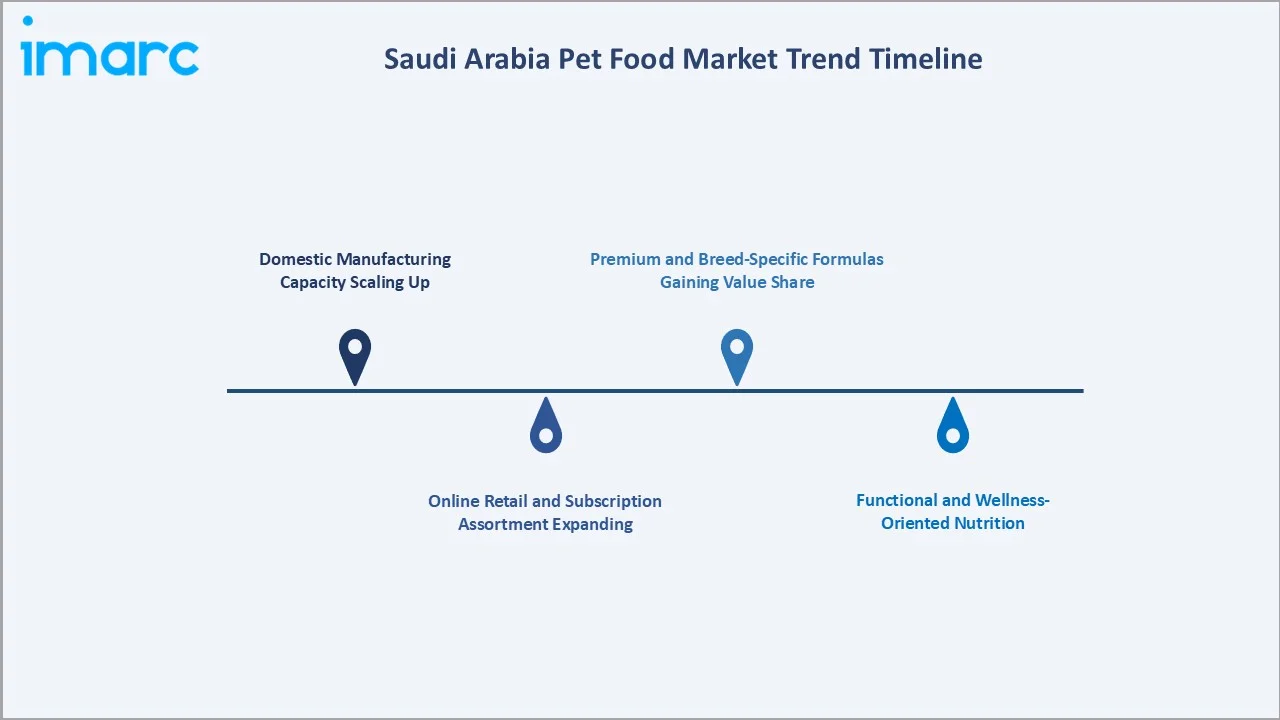
1. Domestic Manufacturing Capacity Scaling Up
Delicious Food Factory's new facility near Riyadh will be among the largest pet food plants in the Middle East. Local production shortens supply chains and improves price competitiveness against imported staples.
2. Online Retail and Subscription Assortment Expanding
Online stores hold 18.9% share in 2025 and grow fastest at roughly 8.80% CAGR. Monsha'at recorded 40,953 e-commerce commercial records by Q4 2024, widening consumer access to imported and niche brands.
3. Premium and Breed-Specific Formulas Gaining Value Share
Owners increasingly select formulas tailored to breed, age and health condition. Mars Petcare's Royal Canin and Nestlé Purina's Pro Plan ranges anchor this premium tier across Saudi retail.
4. Functional and Wellness-Oriented Nutrition
Formulas addressing weight management, skin health and digestive wellness are moving from specialty clinics into mainstream retail, mirroring the pet humanization trend seen across the GCC.
Industry Value Chain Analysis
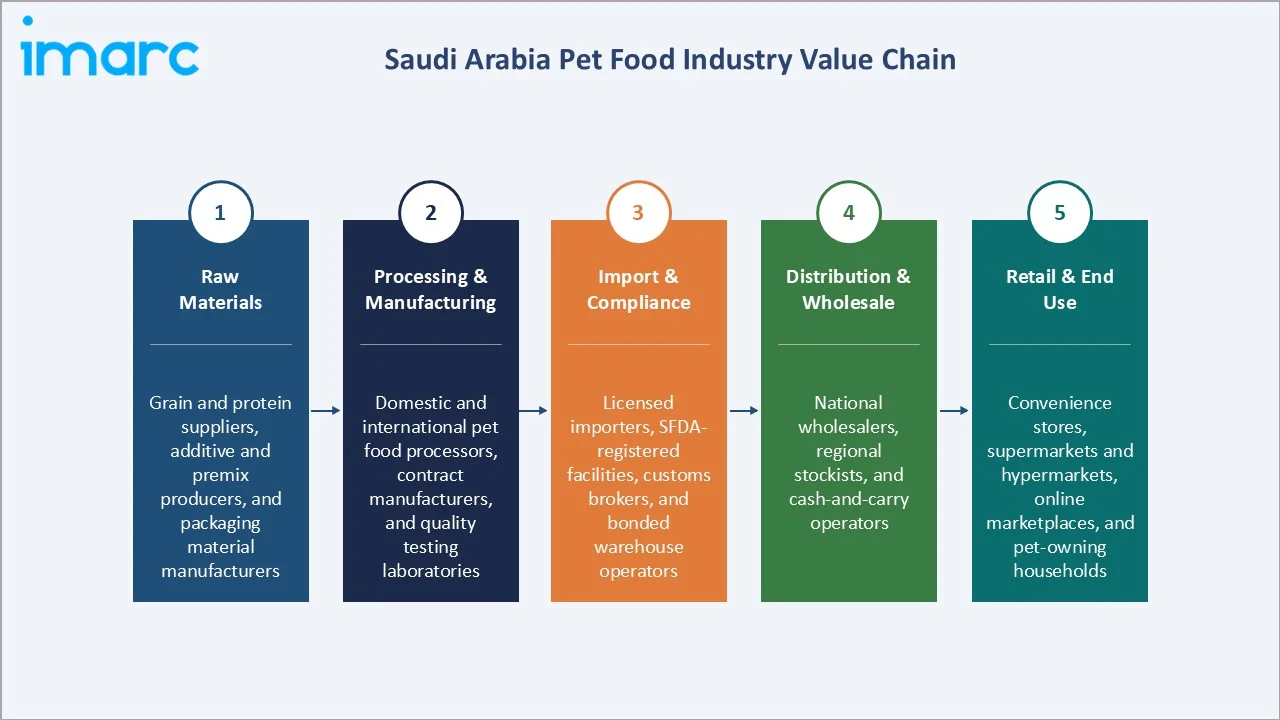
The Saudi Arabia pet food value chain runs from imported and domestically sourced raw ingredients, through processing and quality testing, into multi-tier distribution and a retail base spanning convenience stores, supermarkets and online platforms.
|
Stage |
Key Participants |
|
Raw Materials |
Grain and protein suppliers, additive and premix producers, packaging material manufacturers |
|
Processing & Manufacturing |
Domestic and international pet food processors, contract manufacturers, quality testing laboratories |
|
Import & Compliance |
Licensed importers, SFDA-registered facilities, customs brokers, bonded warehouse operators |
|
Distribution & Wholesale |
National wholesalers, regional stockists, cash-and-carry operators |
|
Retail & End Use |
Convenience stores, supermarkets and hypermarkets, online marketplaces, pet-owning households |
Margin is concentrated at the manufacturing and retail stages. Domestic processors are beginning to capture value once held by importers, while retailers retain impulse-driven mark-up at the point of sale.
Technology Landscape in the Saudi Arabia Pet Food Industry
Cold-Chain and Fresh Processing
Temperature-controlled logistics are extending the shelf reach of fresh and wet formats beyond Riyadh, Jeddah and Dammam, supporting premium format growth in secondary cities.
Ingredient Traceability and Quality Testing
SFDA-accredited laboratories verify nutritional claims and ingredient compliance, reinforcing consumer trust in both imported and domestically manufactured pet food.
Digital Retail and Subscription Platforms
E-commerce platforms are integrating subscription and auto-replenishment features for staple kibble, reducing churn and improving forecast accuracy for online-first brands.
Sustainable Packaging Innovation
Recyclable and resealable packaging formats are gaining traction as manufacturers respond to Vision 2030 sustainability priorities and rising retailer packaging standards.
Market Segmentation Analysis
The report covers the following segments:
|
Segment Category |
Leading Segment |
Market Share |
Year |
|
Pet Type |
Cat Food |
48.7% |
2025 |
|
Product Type |
🔒 |
🔒 |
2025 |
|
Distribution Channel |
Convenience Stores |
38.6% |
2025 |
|
Ingredient |
🔒 |
🔒 |
2025 |

By Pet Type
Cat food dominates at 48.7% market share in 2025 and grows at about 5.90% CAGR through 2034. Compact apartment living across Riyadh and Jeddah favours cats over larger dog breeds, and owners increasingly select premium, breed-specific formulas.
To access detailed market analysis, Request Sample
Dog food accounts for 39.5% and grows at roughly 4.50% CAGR, anchored by villa households and expatriate families. Other pet types, including birds, fish and small mammals, hold 11.8% and advance at about 4.90% CAGR as niche categories widen.
By Distribution Channel
Convenience stores lead with 38.6% share in 2025. Proximity to residential compounds and frequent small-basket purchasing sustain the channel's position despite moderate growth of roughly 5.30% CAGR.
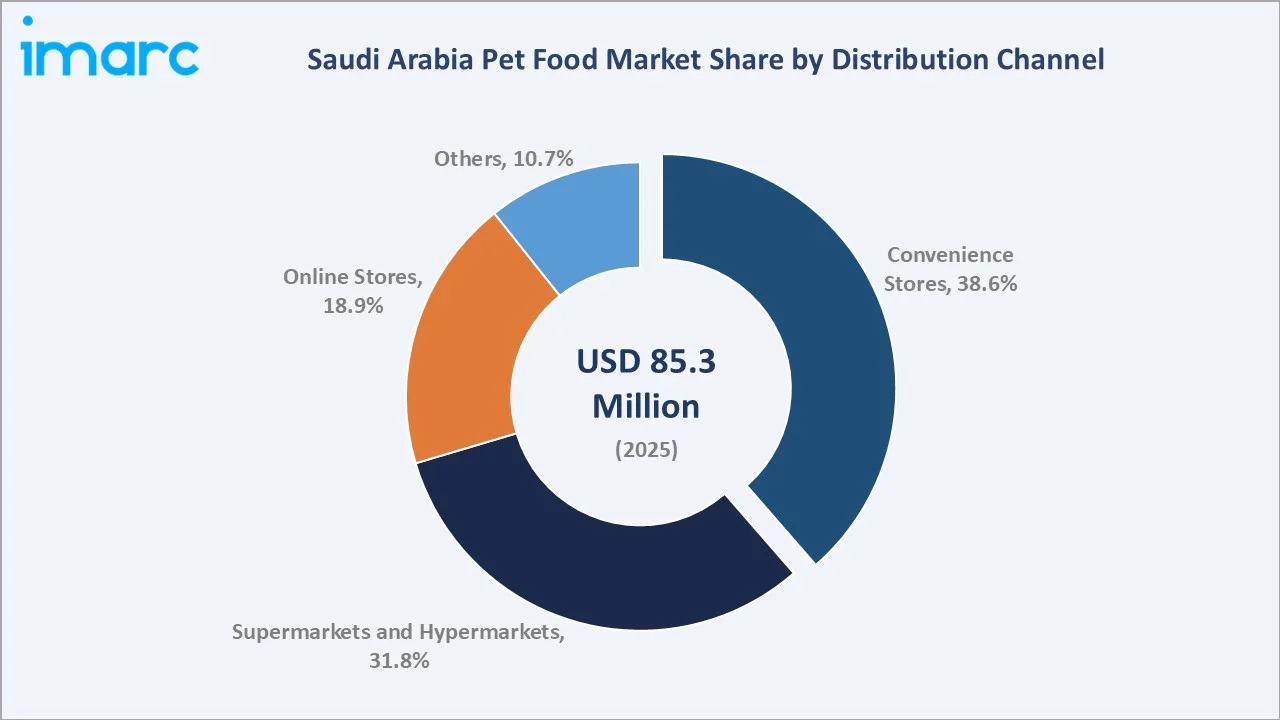
Supermarkets and hypermarkets hold 31.8%, growing at about 4.00% CAGR on the strength of weekly basket-add purchases. Online stores at 18.9% expand fastest at roughly 8.80% CAGR, while other channels, including pet specialty and veterinary outlets, account for 10.7%.
Competitive Landscape
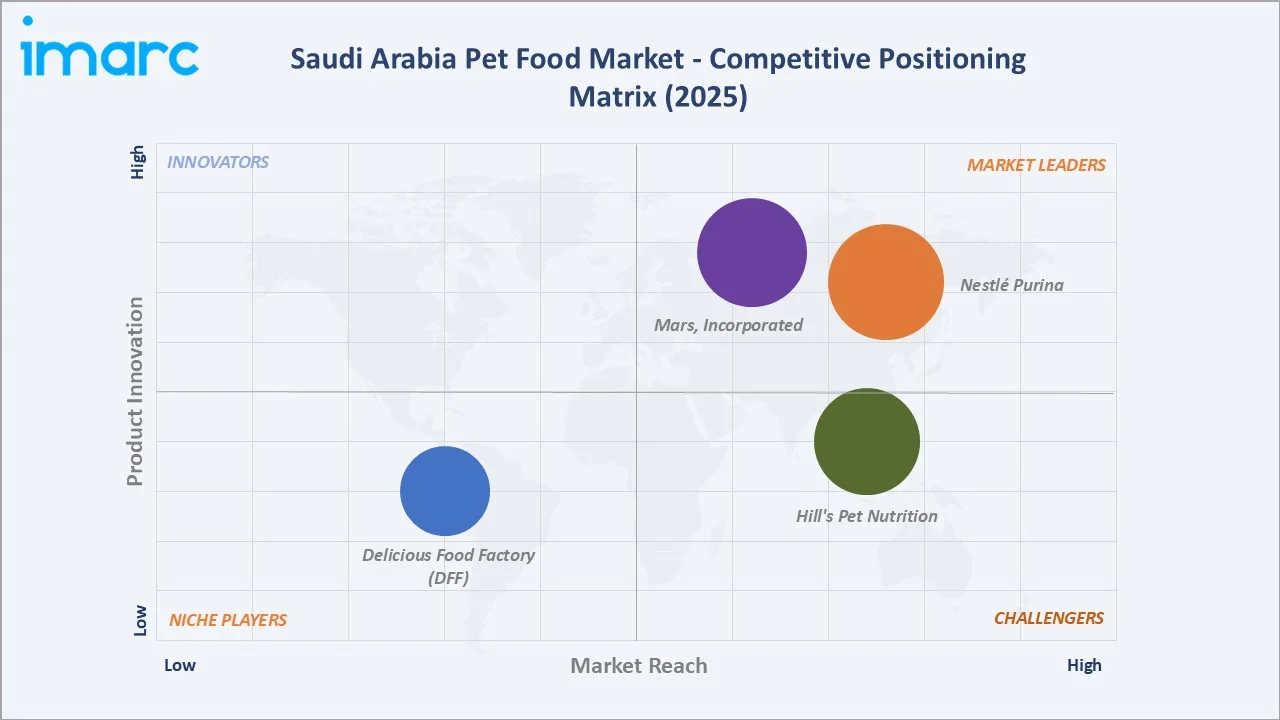
The Saudi Arabia pet food market is moderately consolidated at the branded tier, led by global multinationals, while domestic manufacturing is emerging as a distinct and fast-growing competitive layer.
|
Company Name |
Brand / Product Line |
Market Position |
Core Strength |
|
Mars, Incorporated |
Pedigree, Whiskas, Royal Canin |
Market Leader |
Global pet care leader with a 100,000-strong Petcare workforce serving pets in more than 130 countries |
|
Nestlé Purina |
Purina Pro Plan, Friskies |
Market Leader |
Deep R&D backing from Nestlé's global nutrition science base and broad Gulf distribution network |
|
Hill's Pet Nutrition |
Science Diet, Prescription Diet |
Strong Challenger |
Veterinary-endorsed clinical nutrition positioning trusted by specialty and prescription channels |
|
Delicious Food Factory (DFF) |
Horayra, PUREVET |
Emerging Local Leader |
Largest planned pet food manufacturing footprint in the Middle East, based north of Riyadh |
Positioning splits along two axes. Mars and Nestlé Purina combine broad distribution with recognised global brand equity, Hill's defends the clinical and veterinary-recommended niche, and DFF together with regional processors is building the domestic value tier.
Key Company Profiles
Mars, Incorporated
Mars, Incorporated operates its pet care business through the Petcare segment, home to Pedigree, Whiskas and Royal Canin. The division employs around 100,000 Petcare Associates serving pets across more than 130 countries, including a long-standing Gulf distribution presence.
- Product Portfolio: Pedigree dog food, Whiskas cat food, Royal Canin breed-specific nutrition, and others.
- Recent Development: In March 2026, Mars-owned Champion Petfoods expanded its ORIJEN brand into fresh pet food with the launch of FRESHPREY. The product uses fresh or raw animal ingredients, including meat, organs, and bones, among its first five ingredients, responding to demand for fresh, high-quality and protein-rich pet nutrition.
- Strategic Focus: Breadth across mass and premium tiers, supported by continuous nutrition science investment.
Nestlé Purina
Nestlé Purina brings Nestlé's global nutrition research base to the Saudi market through its Pro Plan and Friskies ranges, distributed via both modern trade and expanding online channels.
- Product Portfolio: Purina Pro Plan, Friskies, Purina ONE, and others.
- Recent Development: In July 2026, Nestlé Purina announced an investment of CHF 520 million to build a new integrated pet food manufacturing and logistics facility in Mantova, Italy. The facility will produce superpremium wet pet food for cats and dogs under key Purina brands and is intended to meet continued growth in European pet-food demand. The project will combine production with a logistics platform serving Purina and other Nestlé brands, strengthening the company's European pet-food manufacturing network.
- Strategic Focus: Science-led premiumisation and expansion of digital retail partnerships across the GCC.
Hill's Pet Nutrition
Hill's Pet Nutrition occupies the clinical and veterinary-recommended tier of the Saudi Arabia pet food market. Its Science Diet and Prescription Diet ranges are distributed through veterinary clinics and specialty pet retailers.
- Product Portfolio: Science Diet, Prescription Diet, and others.
- Recent Latest Development: In June, 2026, Hill’s launches new therapeutic pet-food formulas: Hill’s introduced Prescription Diet k/d + Derm Complete for dogs and k/d + z/d Hydrolyzed for cats, combining nutritional support for kidney function with formulas addressing skin, gastrointestinal, and food-sensitivity needs. The products highlight Hill’s focus on specialized therapeutic pet nutrition and multi-condition dietary solutions.
- Strategic Focus: Veterinary channel partnerships and condition-specific nutrition science.
Market Concentration Analysis
The Saudi Arabia pet food market shows moderate concentration in the branded segment and greater fragmentation below it. Mars, Incorporated and Nestlé Purina together account for a substantial share of branded value, while no single company approaches a dominant share of total market volume.
Fragmentation is heaviest in the unbranded and bulk feed tier, where imports enter through independent wholesalers at prices below branded equivalents. This keeps competitive intensity high and limits pricing power for mid-tier brands.
Consolidation pressure is emerging at the manufacturing layer as domestic producers like DFF scale capacity. Importers are simultaneously broadening multi-brand portfolios to spread SFDA compliance cost across more SKUs, while online marketplaces enable smaller specialist sellers to reach national demand without physical retail footprint.
Investment & Growth Opportunities
Fastest Growing Segments
Online stores (~8.80% CAGR), cat food (~5.90% CAGR) and convenience stores (~5.30% CAGR) represent the highest-growth vectors through 2034. Online distribution combines the fastest growth rate with the strongest premium mix effect.
Emerging Market Opportunities
Domestic manufacturing capacity, led by DFF's planned Riyadh-area facility, offers underexploited import-substitution potential. Regional export to neighbouring GCC markets is a plausible longer-term extension once local capacity scale.
Investment Themes
- Digital-first premium distribution: Building direct and marketplace storefronts for breed-specific and functional ranges captures the 8.80% CAGR online channel while protecting brand price integrity.
- Local manufacturing partnerships: Co-manufacturing and private-label agreements with scaling domestic processors reduce landed cost versus fully imported supply chains.
- Subscription and retention ecosystems: Recurring delivery of staple kibble and litter builds customer lifetime value across both multinational and local brands.
Future Market Outlook (2026-2034)
The Saudi Arabia pet food market is projected to grow from USD 85.3 Million in 2025 to USD 91.0 Million in 2026, reaching USD 137.4 Million by 2034 at a 5.29% CAGR, passing USD 110.3 Million in 2030. Growth will be led by both volume expansion and a mix shift toward premium and functional formats.
Three forces anchor the trajectory. First, sustained population and urban household growth expand the addressable pet-owning base. Second, digital retail continues to widen assortment and normalise premium purchasing, with online share rising from 18.9% in 2025. Third, domestic manufacturing capacity improves price competitiveness and supply resilience against import volatility.
Research Methodology
Primary Research
Primary research comprised structured interviews with industry stakeholders during 2025, including pet food importers and licensed distributors, retail category buyers in Riyadh, Jeddah and Dammam, online marketplace sellers, and SFDA-registration specialists handling food import compliance.
Secondary Research
Secondary research drew on GASTAT publications covering population estimates, Monsha'at e-commerce registration data, SFDA and FIRS food import regulations, and company disclosures from Mars, Incorporated, Nestlé Purina, Colgate-Palmolive and Delicious Food Factory.
Forecasting Models
Value forecasts were built bottom-up from pet-owning household estimates, average spend per pet by type and channel-level retail growth. Segment outputs were cross-checked and reconciled to a top-down market total, yielding a blended 5.29% CAGR for 2026-2034.
Report Coverage:
| Report Features | Details |
|---|---|
| Base Year of the Analysis | 2025 |
| Historical Period | 2020-2025 |
| Forecast Period | 2026-2034 |
| Units | Million USD |
| Scope of the Report | Exploration of Historical Trends and Market Outlook, Industry Catalysts and Challenges, Segment-Wise Historical and Future Market Assessment:
|
| Pet Types Covered | Dog Food, Cat Food, Others |
| Product Types Covered | Dry Food, Wet and Canned Pet Food, Snacks and Treats |
| Ingredients Covered | Animal Derivates, Plant Derivates, Cereals Derivative, Others |
| Distribution Channels Covered | Supermarkets and Hypermarkets, Convenience Stores, Online Stores, Others |
| Companies Covered | Mars, Incorporated, Nestlé Purina, Hill's Pet Nutrition, Delicious Food Factory (DFF), etc. |
| Customization Scope | 10% Free Customization |
| Post-Sale Analyst Support | 10-12 Weeks |
| Delivery Format | PDF and Excel through Email (We can also provide the editable version of the report in PPT/Word format on special request) |
Frequently Asked Questions About the Saudi Arabia Pet Food Market Report
The Saudi Arabia pet food market size increased from USD 85.3 Million in 2025 to USD 91.0 Million in 2026, supported by rising pet ownership, population growth to 35.3 million and increasing demand for premium formulas.
The market is projected to grow at a 5.29% CAGR during 2026-2034, reaching USD 137.4 Million by 2034, driven by premiumisation, e-commerce expansion and local manufacturing.
Cat food leads with 48.7% share in 2025. Compact urban living favours cats, and owners increasingly choose breed-specific and health-focused formulas across Saudi retail.
Convenience stores hold the largest share at 38.6% in 2025, benefiting from proximity to residential areas, frequent purchasing patterns and wide neighbourhood coverage.
Online stores grow fastest at roughly 8.80% CAGR through 2034, supported by 40,953 e-commerce commercial records issued in the Kingdom by the end of Q4 2024.
Leading companies include Mars, Incorporated, Nestlé Purina, Hill's Pet Nutrition and Delicious Food Factory, among others.
GASTAT reported 35.3 million residents in 2024 with 4.7% annual growth. This expanding, youthful population underpins a growing base of pet-owning households.
Pet food imports fall under SFDA oversight. Products must be registered through the Food Import and Registration System (FIRS) before customs clearance.
The market is projected to reach approximately USD 110.3 Million by 2030, supported by rising online penetration, premium format adoption and expanding local manufacturing capacity.
Need more help?
- Speak to our experienced analysts for insights on the current market scenarios.
- Include additional segments and countries to customize the report as per your requirement.
- Gain an unparalleled competitive advantage in your domain by understanding how to utilize the report and positively impacting your operations and revenue.
- For further assistance, please connect with our analysts.
 Request Customization
 Speak to an Analyst
 Request Brochure
 Inquire Before Buying
Benefits of Customization
- Personalize this research
- Triangulate with your data
- Get data as per your format and definition
- Gain a deeper dive into a specific application, geography, customer, or competitor
- Any level of personalization
Get in Touch With Us
UNITED STATES
Phone: +1-201-971-6302
INDIA
Phone: +91-120-433-0800
UNITED KINGDOM
Phone: +44-753-714-6104
Email: [email protected]
Client Testimonials




.webp)




.webp)













Related Reports

Choose your plan
*Please note that the prices mentioned below are starting prices for each bundle type. Kindly contact our team for further details.*
Single User License
- 1 User License, Access on 2 Devices
- PDF Report + Excel Dataset (Password Protected)
- Lifetime Access
- No Printing Rights
- 10% Free Report Customization
- 10–12 Weeks of Analyst Support
Five User License
- Access for 5 Users, 2 Devices per User
- PDF Report + Excel Dataset (Password Protected)
- Lifetime Access
- Dedicated Account Manager
- 12–14 Weeks of Analyst Support
- No Printing Rights
- 15% Free Report Customization
- 25% Discount on Your Next Purchase
Corporate User License
- Unlimited User Access (Within Your Organization)
- PDF Report + Excel Dataset
- Lifetime Access
- Dedicated Account Manager
- 14–20 Weeks of Analyst Support
- No Printing Rights
- 20% Free Report Customization
- 30% Discount on Your Next Purchase
Essential Insights
What's included:
3 reports
- Lifetime Access
- PDF Reports
- Excel Datasets
- 2 Weeks of Free Analyst Support
- 2 User Licenses
- Access on 2 Devices
- Printing Rights
- Complimentary PowerPoint (PPT) Version
- Complimentary License Upgrade
Professional Access
What's included:
5 reports
- Lifetime Access
- PDF Reports
- Excel Datasets
- 8 Weeks of Free Analyst Support
- 2 User Licenses
- Access on 2 Devices
- Printing Rights
- Complimentary PowerPoint (PPT) Version
- Complimentary License Upgrade
Business Advantage
What's included:
8 reports
- Lifetime Access
- PDF Reports
- Excel Datasets
- 14 Weeks of Free Analyst Support
- 2 User Licenses
- Access on 2 Devices
- Printing Rights
- Complimentary PowerPoint (PPT) Version
- Complimentary License Upgrade
Enterprise Intelligence
What's included:
10 reports
- Lifetime Access
- PDF Reports
- Excel Datasets
- 20 Weeks of Free Analyst Support
- 2 User Licenses
- Access on 2 Devices
- Printing Rights
- Complimentary PowerPoint (PPT) Version
- Complimentary License Upgrade