
Saudi Arabia Pipes and Fittings Market Size, Share, Trends and Forecast by Type, Technology, Application, Vertical, and Region, 2026-2034
Saudi Arabia Pipes and Fittings Market Size, Share, Trends & Forecast (2026-2034)
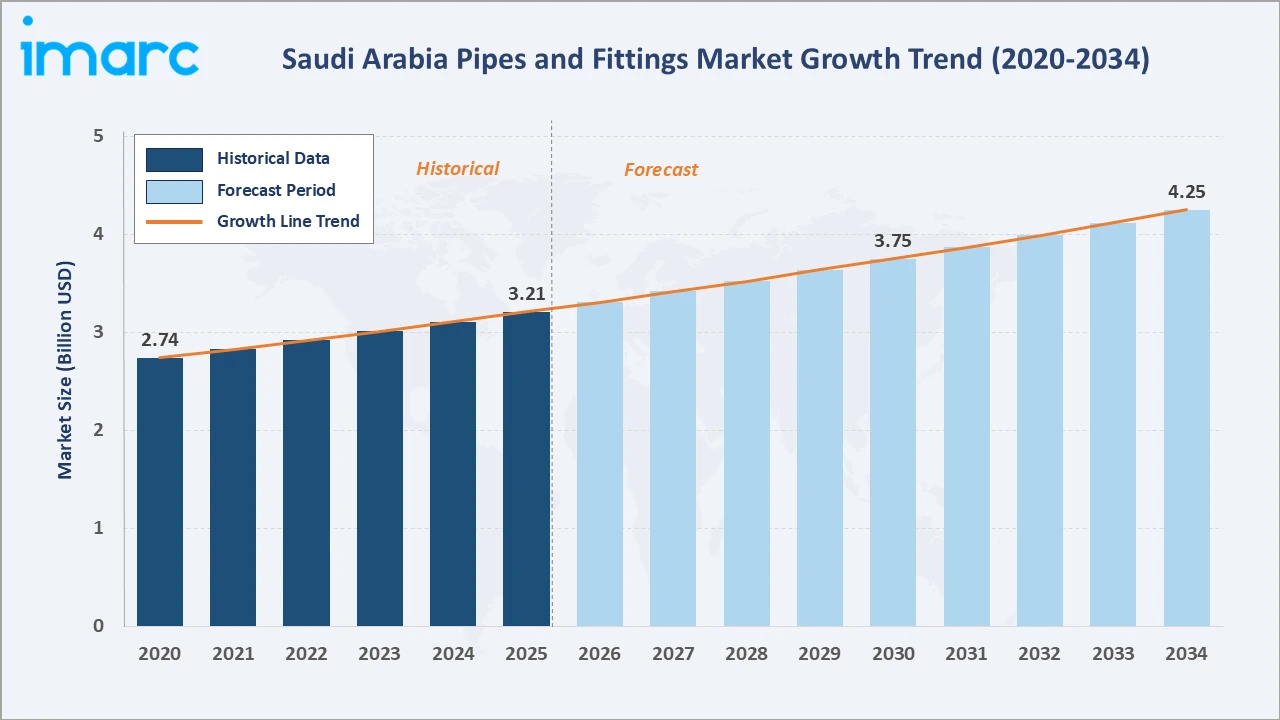
The Saudi Arabia pipes and fittings market reached USD 3.21 Billion in 2025 and is projected to reach USD 4.25 Billion by 2034, exhibiting a CAGR of 3.17% during 2026-2034. The sustained flow of capital investment into Saudi Arabia's water infrastructure programs and Vision 2030 giga-project construction requiring comprehensive utility piping networks for water supply, sewerage, district cooling, and gas distribution in new-build urban environments are the primary growth catalysts. Saudi Arabia’s water demand is increasing by approximately 7% annually. MEWA aims to supply 90% of national water demand through desalination and the remaining 10% through groundwater and surface water by 2030. This is driving investment in desalination plants, water transmission pipelines, distribution networks, and wastewater infrastructure, significantly increasing demand for durable pipes and fittings used in large-scale water conveyance and municipal utility projects. Pipes lead type at 71.8%, water supply leads application at 33.5%, and the Northern and Central region accounts for the largest regional share at 39.4%.
Market Snapshot
|
Metric |
Value |
|
Market Size (2025) |
USD 3.21 Billion |
|
Forecast Market Size (2034) |
USD 4.25 Billion |
|
CAGR (2026-2034) |
3.17% |
|
Base Year |
2025 |
|
Historical Period |
2020-2025 |
|
Forecast Period |
2026-2034 |
|
Dominant Type |
Pipes – 71.8% (2025) |
|
Dominant Application |
Water Supply – 33.5% (2025) |
|
Leading Region |
Northern and Central Region – 39.4% (2025) |
The Saudi Arabia pipes and fittings market grew from USD 2.74 Billion in 2020 to USD 3.21 Billion in 2025, driven by Vision 2030 infrastructure program activation that released significant project pipeline backlogs into active procurement, the desalination plant expansion and associated product water transmission pipeline programs, and NWC water network rehabilitation programs reducing non-revenue water (NRW) losses through district metering area (DMA) pipe replacement and new service connections. The market is projected to reach USD 3.75 Billion by 2030 and USD 4.25 Billion by 2034.
To get more information on this market, Request Sample
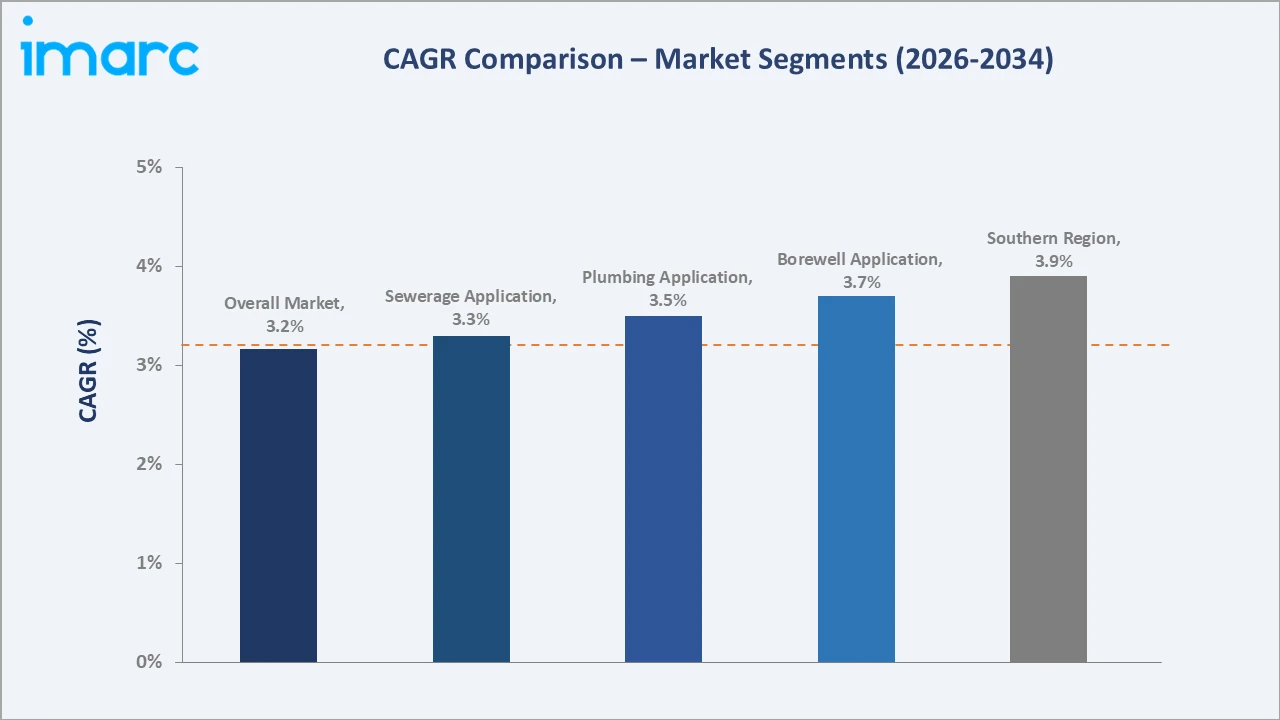
The Southern region grows at ~3.90% CAGR through Vision 2030 southern development programs requiring new utility piping networks. Borewell application grows at ~3.70% CAGR through agricultural groundwater access programs and MEWA borewell development. Plumbing application grows at ~3.50% CAGR through Vision 2030 residential and hospitality construction. Sewerage applications grow at ~3.30% CAGR through municipal sewer expansion programs.
Executive Summary
The Saudi Arabia pipes and fittings market is the foundational materials segment of the Kingdom's construction and infrastructure economy, where the physical pipes and fittings that convey water, wastewater, oil, gas, chemicals, and utility fluids across Saudi Arabia's vast geography are procured in quantities and specifications determined by the most ambitious sovereign infrastructure development program. The market spans a comprehensive material spectrum: steel pipes, HDPE pipes, GRP/FRP pipes, uPVC pipes, CPVC and PPR pipes, and ductile iron pipes. The fittings segment encompasses the full range of pipe joining, directional change, and branch connection hardware in matching materials across all pipe types.
Pipes lead at 71.8% (2025) through the volume dominance of linear pipe over fittings in any pipeline system. Water supply leads application at 33.5% through the structural, government-mandated demand from NWC network programs, desalination transmission, and NEOM water infrastructure that collectively represent the largest single piping category in the Saudi market. Northern and Central region leads at 39.4% through Riyadh's position as the administrative capital, largest urban population, and center of Vision 2030 mega-project procurement.
Key Market Insights
|
Insight |
Data |
|
Dominant Type |
Pipes – 71.8% share (2025) |
|
Dominant Application |
Water Supply – 33.5% share (2025) |
|
Leading Region |
Northern and Central Region – 39.4% share (2025) |
|
Market Opportunity |
NEOM and giga-project utility piping systems; gas field gathering pipeline network; desalination plant piping; agricultural irrigation pipe expansion; PE 100 RC trenchless installation for urban rehabilitation |
Key Analytical Observations:
- Pipes at 71.8% (2025): Pipes represent the highest-value single product category in any pipeline system due to the simple arithmetic of piping system value distribution. The Saudi market encompasses three principal pipe material categories: plastic pipes representing the largest volume category due to cost competitiveness, corrosion resistance, and suitability for Saudi Arabia's aggressive soil and water chemistry; steel pipes serving the oil and gas, high-pressure water, and structural applications where plastic pipes cannot achieve required pressure or temperature performance; and ductile iron pipes.
- Water Supply at 33.5% (2025): Water supply application dominates through the combination of the multi-year capital investment program, continuous desalination plant capacity expansion requiring product water transmission pipelines from plant to distribution system, and Vision 2030 giga-project new city water infrastructure requirements.
- Northern and Central Region at 39.4% (2025): The Northern and Central region leads due to the high concentration of large-scale residential, commercial, industrial, and water infrastructure projects in Riyadh and surrounding areas. Strong government investment under Vision 2030 and expanding utility networks continue to drive demand for pipes and fittings across the region.
Saudi Arabia Pipes and Fittings Market Overview
The Saudi Arabia pipes and fittings market encompasses the manufacture, import, and sale of piping systems and associated fittings, valves, and specialties for water supply, sewerage, oil and gas, petrochemical, plumbing, HVAC, irrigation, and industrial applications across the Kingdom's construction, infrastructure, and industrial sectors. Macroeconomic factors include Saudi Arabia’s economic diversification initiatives under Vision 2030, rising infrastructure investments, and urban development projects.
Market Dynamics
To evaluate market opportunities, Request Sample
Market Drivers
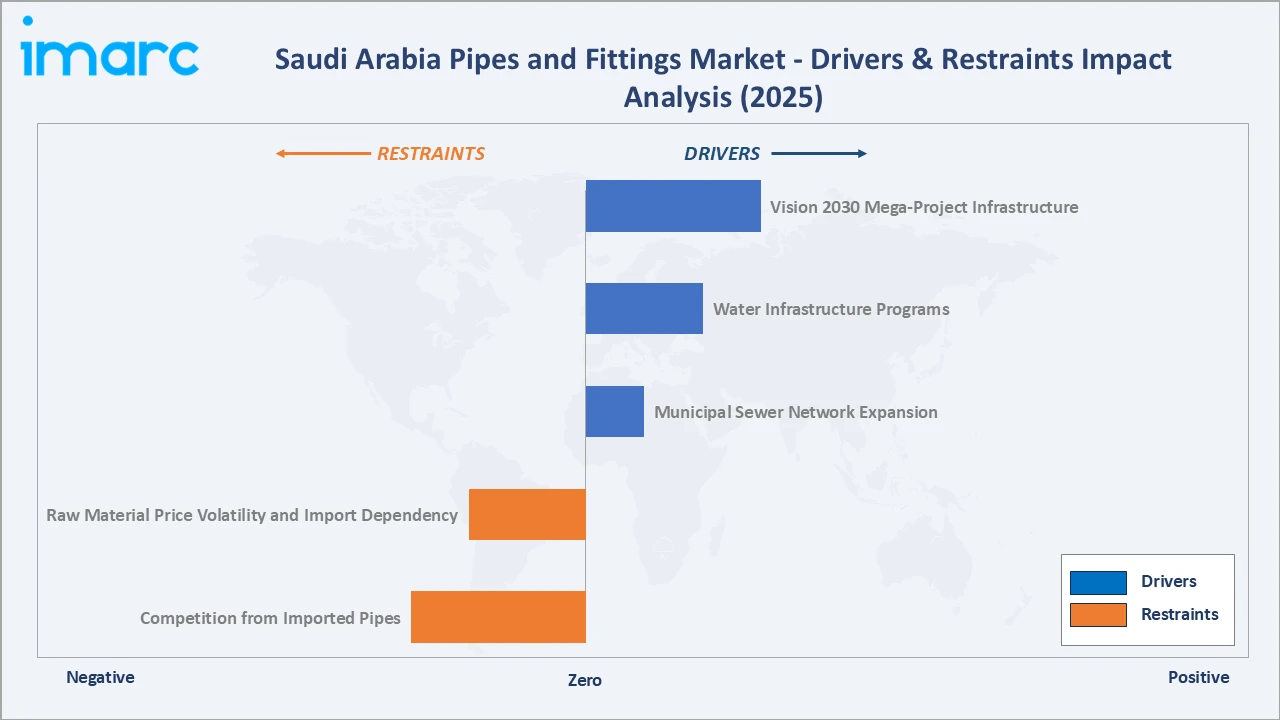
- Vision 2030 Mega-Project Infrastructure: Saudi Arabia’s giga projects, including NEOM, Red Sea Global, Qiddiya, ROSHN, Diriyah Gate, The Rig, Jeddah Central, King Salman Park, and New Murabba, are key initiatives under Vision 2030. As of May 2026, government-backed investments in these developments exceed US$50 billion, supporting large-scale infrastructure and urban development. The scale of Vision 2030 infrastructure investment creates piping system requirements at a scale that Saudi Arabia has not previously experienced in any equivalent period. Each giga-project requires complete utility piping networks: NEOM's THE LINE alone requires tens of thousands of kilometers of water supply, sewerage, gas distribution, district cooling, and industrial service pipe systems.
- Water Infrastructure Programs: Saudi Arabia’s water sector attracted more than SR60 billion (US$16 billion) in investments as the Kingdom expands private-sector participation and strengthens water security. Desalination capacity increased significantly, rising from 9 million cubic meters per day in 2016 to 16 million cubic meters per day in 2025. Expansion of water infrastructure programs under Saudi Arabia’s water security initiatives is creating opportunities for durable pipeline systems used in distribution, treatment, and storage networks.
- Municipal Sewer Network Expansion: Saudi Arabia's sanitation coverage improvement target requires new sewer network construction in previously unsewered residential and commercial areas of existing cities, and completely new sewer infrastructure in new city developments. MOMRA's approved contractor lists and annual capital project tender programs create regular sewer pipe procurement cycles at the regional municipality level that sustain above-GDP demand growth for sewerage pipes through the forecast period.
Market Restraints
- Raw Material Price Volatility and Import Dependency: The Saudi pipes and fittings market's raw material cost structure, where HDPE resin, steel, and GRP resin components represent most of the pipe manufacturing cost, is inherently exposed to global commodity price cycles. Domestic HDPE resin pricing provides domestic HDPE pipe manufacturers, including NPC, with a feedstock cost advantage, but international steel price volatility creates significant per-unit manufacturing cost variation for SSP's steel pipe products that complicates long-term project price commitments for large infrastructure contracts.
- Competition from Imported Pipes: Saudi Arabia's pipes and fittings market faces persistent import competition from Chinese, Turkish, Indian, and European pipe manufacturers whose landed costs for standard specification pipes can undercut domestic manufacturers in competitive tender processes for private sector construction projects. Ensuring that all domestic manufacturers maintain current certification while managing competitive pricing creates operational compliance costs that smaller domestic manufacturers find challenging.
Market Opportunities
- NEOM Comprehensive Utility Piping System Contracts: NEOM's utility infrastructure piping requirements, spanning water supply transmission from NEOM's dedicated reverse osmosis desalination plants to THE LINE distribution network, sewerage collection from 9 million residents to centralized treatment facilities, gas distribution for residential and commercial cooking and heating, district cooling water circuits for THE LINE's climate-controlled environment, and industrial process piping for NEOM's manufacturing and industrial zones, represent a comprehensive piping procurement opportunity.
- Non-Revenue Water Reduction and Pipe Rehabilitation Programs: Saudi Arabia's NRW (Non-Revenue Water) challenge creates a specific piping rehabilitation procurement program as NWC executes its DMA-based leak detection and pipe replacement strategy. The systematic replacement of pre-1990 asbestos cement pipes with HDPE PE 100 provides ongoing pipe procurement demand in urban areas where network rehabilitation progresses independently of new construction activity, sustaining piping market demand through periods of reduced new construction project activity.
Market Challenges
- Skilled Labor Shortage for Specialized Pipe Installation: The installation quality of complex piping systems depends on certified and experienced installation tradespeople whose availability in Saudi Arabia is constrained by requirements for Saudi national labor content combined with the Kingdom's overall skilled construction labor market tightness. Installation quality failures generate project delays, rework costs, and warranty claims that affect both pipe supplier and installer reputations.
- Project Payment Cycle and Working Capital Management: Saudi government infrastructure projects are characterized by extended payment cycles where progress payments may be 60-180 days delayed from invoice submission due to government treasury processing requirements, project variation order resolution, and certification approval processes.
Emerging Market Trends
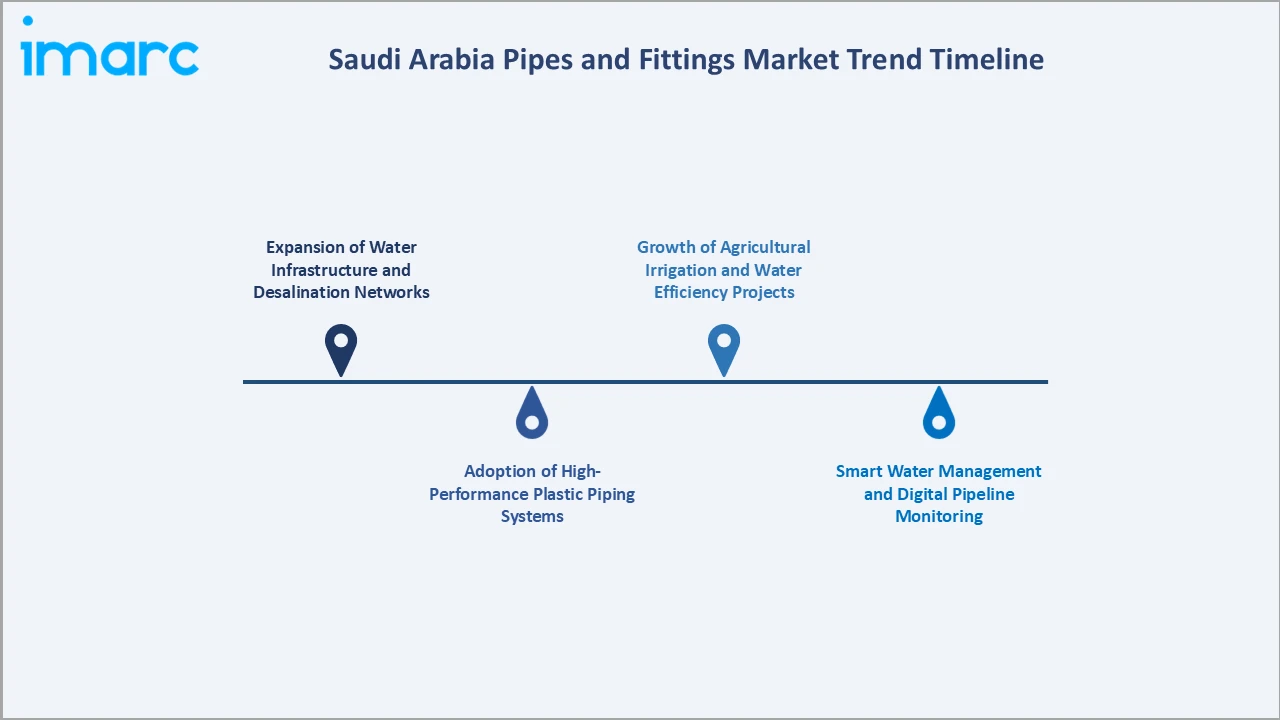
1. Expansion of Water Infrastructure and Desalination Networks
Saudi Arabia is increasing investments in desalination plants, water transmission pipelines, and distribution networks to strengthen national water security. According to ScienceDirect, Saudi Arabia’s water consumption is approximately 7 billion m³ annually, with desalination accounting for around 60% of total water supply, followed by groundwater at 30% and surface water at 10%. The country’s desalination infrastructure includes both private and government-operated facilities, with approximately 20% of plants managed by private operators and 40% owned by government entities. The expansion of large-scale water projects is driving demand for durable pipes and fittings used in water transportation and utility applications.
2. Adoption of High-Performance Plastic Piping Systems
The market is witnessing increased adoption of HDPE, PVC, PPR, and other advanced plastic piping systems due to their durability, lightweight properties, and resistance to corrosion. These materials are increasingly replacing traditional metal pipes in water supply, irrigation, and industrial applications. Demand is supported by infrastructure projects requiring cost-effective and low-maintenance pipeline solutions. Manufacturers are focusing on producing higher-grade pipes that meet international quality and performance standards.
3. Smart Water Management and Digital Pipeline Monitoring
The integration of smart technologies into water infrastructure is emerging as a key trend in Saudi Arabia. IoT-enabled monitoring systems, smart meters, and digital leak detection solutions are being deployed to improve water efficiency and reduce losses. These technologies require advanced pipeline networks capable of supporting real-time monitoring and automated management. The trend aligns with national initiatives focused on resource optimization and sustainable water management.
4. Growth of Agricultural Irrigation and Water Efficiency Projects
Increasing focus on agricultural productivity and water conservation is driving demand for efficient irrigation piping systems. Drip irrigation, greenhouse farming, and controlled-environment agriculture projects are encouraging the use of specialized pipes and fittings. Government initiatives supporting sustainable agriculture are further increasing adoption of advanced irrigation solutions. HDPE and other flexible piping materials are gaining preference due to their durability and installation efficiency.
Industry Value Chain Analysis
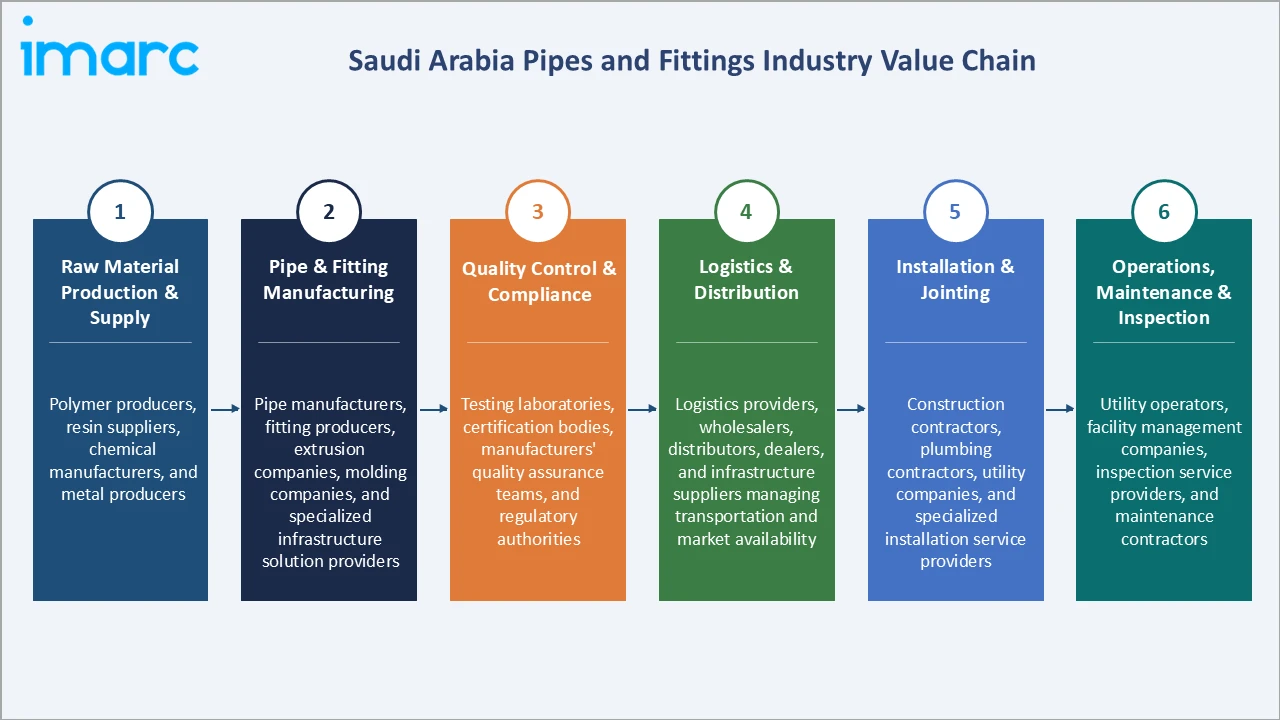
The Saudi Arabia pipes and fittings value chain integrates raw material production & supply, pipe & fitting manufacturing, quality control & compliance, logistics & distribution, installation & jointing, and operations, maintenance & inspection.
|
Stage |
Key Participants |
|
Raw Material Production & Supply |
Polymer producers, resin suppliers, chemical manufacturers, and metal producers. |
|
Pipe & Fitting Manufacturing |
Pipe manufacturers, fitting producers, extrusion companies, molding companies, and specialized infrastructure solution providers. |
|
Quality Control & Compliance |
Testing laboratories, certification bodies, manufacturers' quality assurance teams, and regulatory authorities. |
|
Logistics & Distribution |
Logistics providers, wholesalers, distributors, dealers, and infrastructure suppliers managing transportation and market availability. |
|
Installation & Jointing |
Construction contractors, plumbing contractors, utility companies, and specialized installation service providers. |
|
Operations, Maintenance & Inspection |
Utility operators, facility management companies, inspection service providers, and maintenance contractors. |
Pipe and fitting manufacturing is the most value-added stage in the value chain, as it involves material processing, product design, extrusion, molding, and technology integration to deliver application-specific solutions. Manufacturers differentiate through product quality, durability, advanced materials, and compliance with infrastructure standards. Innovation in high-performance piping systems, such as HDPE, PPR, and smart pipeline solutions, further enhances value creation at this stage.
Technology Landscape in the Saudi Arabia Pipes and Fittings Industry
PE 100 RC and Trenchless Installation Technologies
PE 100 RC, an enhanced HDPE pipe specification providing superior resistance to slow crack growth and rapid crack propagation under notch stress conditions, is progressively replacing conventional PE 100 in Saudi Arabia's urban pipe installation programs where horizontal directional drilling (HDD), pipe bursting, and other trenchless rehabilitation methods impose higher mechanical stress on pipe during installation than conventional open-cut trenching.
GRP/FRP Pipe Technology for Large-Diameter Applications
Glass-reinforced plastic (GRP) pipe, manufactured by filament winding or centrifugal casting of glass fiber reinforcement with thermosetting resin onto a mandrel, provides the combination of corrosion resistance, high pressure rating, and large-diameter capability that makes it the preferred material for Saudi Arabia's most challenging large-diameter water infrastructure applications: desalination plant product water transmission, large-diameter gravity sewers, and agricultural irrigation mains.
Smart Pipeline Technologies and Digital Monitoring
The progressive integration of digital monitoring technology into Saudi pipeline systems, including pressure and flow sensors with IoT connectivity for real-time monitoring, acoustic leak detection sensors providing continuous distribution network monitoring, fiber optic distributed acoustic sensing for oil and gas pipeline third-party interference detection, and drone-based aerial thermal imaging for hot-spot detection on buried insulated district heating and cooling pipelines, represents the technology frontier that Saudi pipeline operators are investing in as part of their digital transformation programs.
Market Segmentation Analysis
The report covers the following segments:
|
Segment Category |
Leading Segment |
Market Share |
Year |
|
Type |
Pipes |
71.8% |
2025 |
|
Technology |
🔒 |
🔒 |
2025 |
|
Application |
Water Supply |
33.5% |
2025 |
|
Vertical |
🔒 |
🔒 |
2025 |
|
Region |
Northern and Central Region |
39.4% |
2025 |

By Type
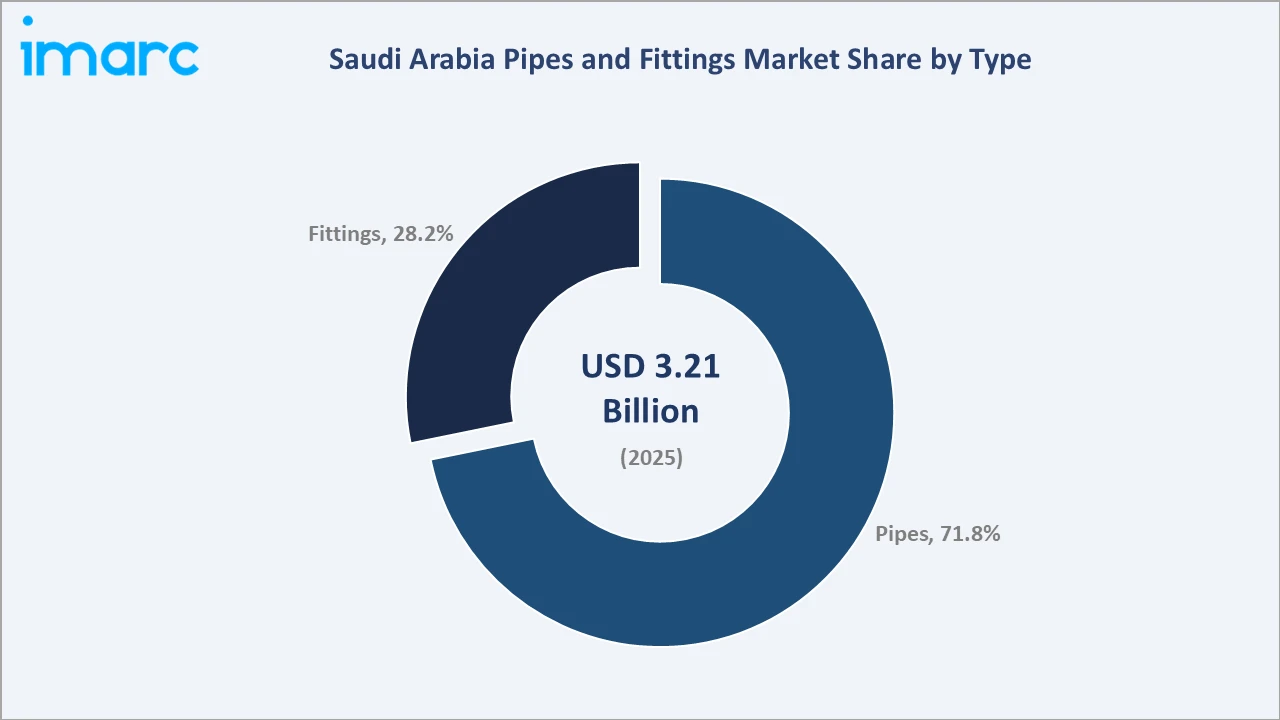
Pipes lead at 71.8% (2025) through volume dominance in all pipeline systems across water, oil and gas, sewerage, and building applications. Within the pipes segment, HDPE plastic pipes represent the largest sub-category by volume, followed by metallic pipes, GRP, and other plastic pipes.
To access detailed market analysis, Request Sample
Fittings at 28.2% serve the connection, direction change, and branch requirements of all piping systems, with elbow, tee, reducer, and valve categories representing the highest-value individual fitting items.
By Application
Water supply leads at 33.5% (2025) through NWC, SWCC, and giga-project infrastructure demand. Sewerage at 25.2% serves municipal expansion and new city wastewater networks. Plumbing at 20.7% serves Vision 2030 residential and hospitality construction.
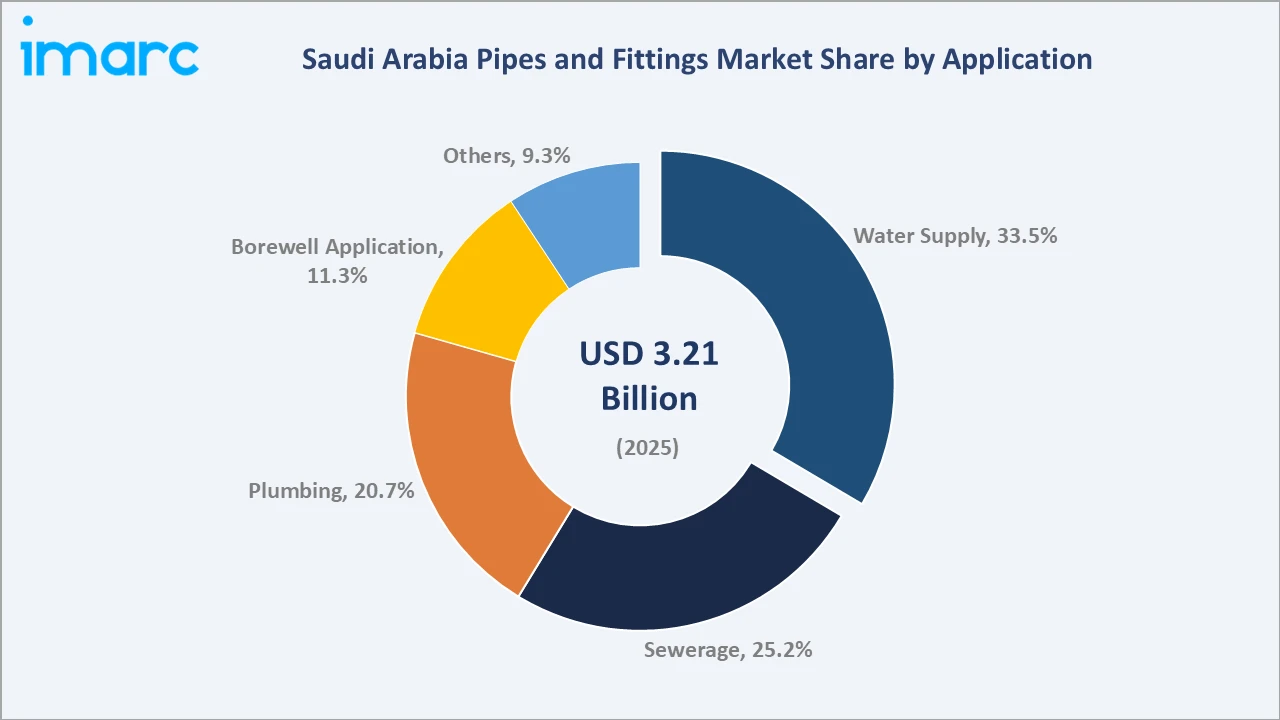
Borewell application at 11.3%, growing at ~3.70% CAGR, serves agricultural and water access development. Others at 9.3% encompass oil and gas gathering, petrochemical industrial, HVAC, and irrigation applications within the application taxonomy.
Regional Market Insights
|
Region |
Share (2025) |
Key Pipes and Fittings Market Drivers & Characteristics |
|
Northern & Central Region |
39.4% |
Leads the market due to extensive urban development, residential construction, government infrastructure projects, and water utility investments, particularly across Riyadh and surrounding areas. |
|
Eastern Region |
29.8% |
Demand is supported by industrial activities, oil and gas facilities, petrochemical projects, and expanding water and utility infrastructure requiring reliable piping systems. |
|
Western Region |
21.5% |
Growth is driven by tourism developments, religious infrastructure projects, urban expansion, and increasing demand for water supply and building applications in major cities. |
|
Southern Region |
9.3% |
The market is supported by gradual infrastructure development, agricultural irrigation projects, and increasing adoption of modern piping solutions across residential and utility applications. |
The Northern and Central region's 39.4% market dominance is driven by large-scale construction, urban expansion, and government infrastructure investments. The region benefits from Riyadh’s growing residential, commercial, and utility development activities under Vision 2030. The Eastern region, with a 29.8% share, is supported by industrial expansion, oil and gas projects, petrochemical facilities, and water infrastructure development.
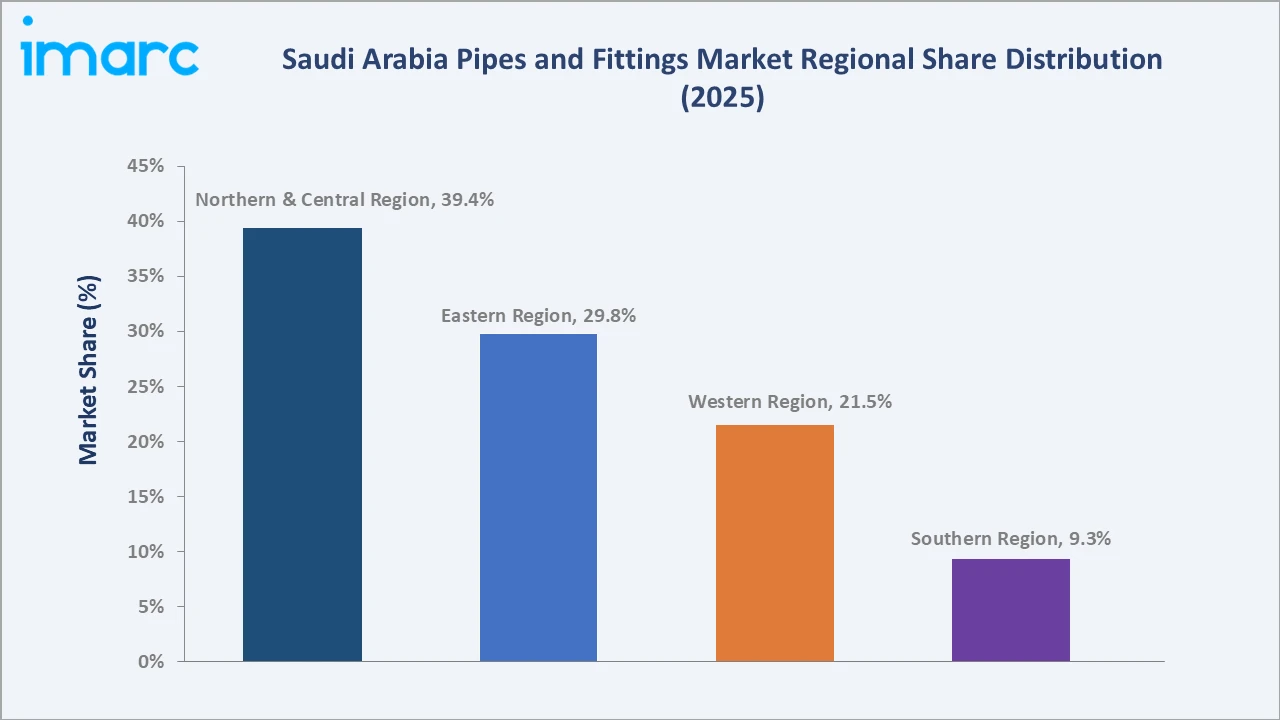
The Western region holds 21.5% of the market, driven by tourism projects, religious infrastructure, and urban development in cities such as Jeddah, Makkah, and Madinah. The Southern region, accounting for 9.3%, is an emerging market supported by agricultural irrigation, residential projects, and public infrastructure upgrades.
Competitive Landscape
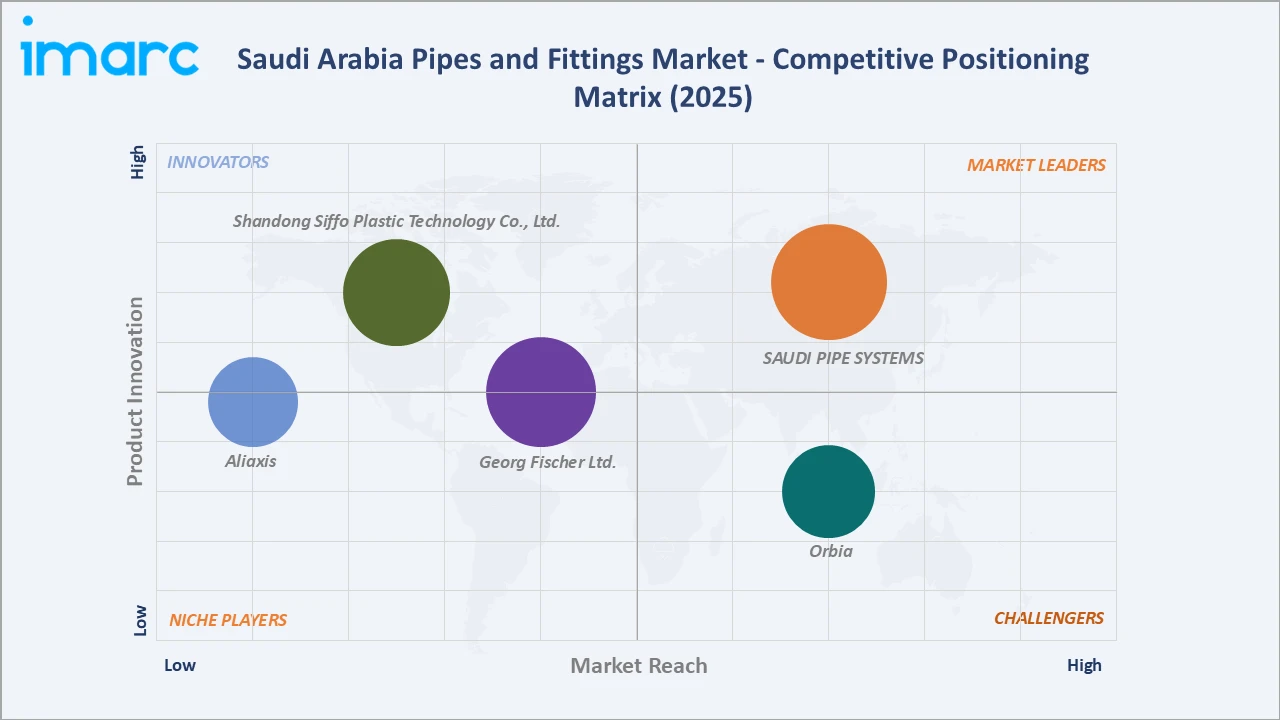
The Saudi Arabia pipes and fittings market is moderately concentrated, while a competitive landscape of specialist domestic manufacturers, imported European technical systems, GCC regional suppliers, and Asian commodity pipe importers serves the balance.
|
Company |
Key Products |
Market Position |
Core Strength |
|
SAUDI PIPE SYSTEMS |
HDPE Pipes, GRP Pipes, Ductile Iron Fittings |
Market Leader |
SAUDI PIPE SYSTEMS (SPS) is a premier manufacturer in Saudi Arabia's infrastructure sector. Operating out of Jeddah, SPS produces a wide array of industrial pipes, fittings, and valves. |
|
Georg Fischer Ltd. |
Double Containment Pipes, Multilayer Pipes, Plastic Pipes, Pre-insulated Pipes |
Established Player |
Georg Fischer Ltd. is a key player in Saudi Arabia's water, industrial, and infrastructure sectors, supplying advanced thermoplastic piping systems and fittings. |
|
Orbia |
Smoothwall, Smooth Out/Ribbed In, Tornado Plus |
Challenger |
Orbia operates in Saudi Arabia primarily through its subsidiary, Dura-Line, playing a critical role by supplying high-density polyethylene (HDPE) conduits and cable pathways. |
|
Shandong Siffo Plastic Technology Co., Ltd. |
HDPE Pipe System, PVC Pipe System, Steel Wire Reinforce Composite Pressure HDPE Pipe System, Drainage & Sewerage Pipe System, PPR Pipe System, Pipe Jointing Fittings |
Innovator |
Shandong Siffo Plastic Technology Co., Ltd. functions as an export-driven manufacturer and strategic supplier of HDPE, PVC, and steel-reinforced composite pipes in Saudi Arabia. They export to the Middle East while utilizing raw materials sourced directly from Saudi producers. |
|
Aliaxis |
FIP PVC-U Fittings, Valves & Pipes |
Established Player |
Aliaxis plays a major role in supplying high-performance pipes, fittings, and accessories for the nation's rapid urbanization, large-scale mega-projects, and complex industrial developments. |
The competitive landscape is progressively shaped by increasing infrastructure investments, technological advancements, and the growing demand for high-performance piping solutions across water, construction, industrial, and utility applications. Market participants are focusing on expanding production capacity, improving product quality, and adopting advanced materials such as HDPE, PVC, and PPR pipes. Competition is also influenced by sustainability initiatives, compliance with international standards, and the ability to provide customized solutions for large-scale projects.
Key Company Profiles
SAUDI PIPE SYSTEMS
SAUDI PIPE SYSTEMS is a Saudi Arabia-based manufacturer of plastic piping solutions serving infrastructure, construction, water distribution, irrigation, and industrial applications. The company provides a range of pipe and fitting products designed to meet the requirements of utility networks, building projects, and water management systems. It focuses on delivering reliable and durable piping solutions through quality manufacturing practices and compliance with industry standards. In the Saudi Arabia pipes and fittings market, SAUDI PIPE SYSTEMS benefits from rising demand driven by Vision 2030 infrastructure projects, desalination investments, urban development, and expanding water and utility networks across the Kingdom.
- Key Products: HDPE Pipes, GRP Pipes, Ductile Iron Fittings.
- Strategic Focus: Strengthening its position in the Saudi pipes and fittings market by providing high-quality plastic piping solutions for water distribution, infrastructure, irrigation, and construction applications. The company aims to capitalize on growing demand from desalination projects, municipal water networks, and Vision 2030-driven infrastructure developments.
Georg Fischer Ltd.
Georg Fischer Ltd. is a provider of advanced piping systems, flow solutions, and industrial components, serving water infrastructure, building technology, industrial processing, and utility applications. The company offers a wide portfolio of plastic piping systems, fittings, valves, and jointing technologies designed for safe and efficient fluid management. In the Saudi Arabia pipes and fittings market, the company supports infrastructure and industrial projects through high-performance piping solutions used in water distribution, desalination, chemical processing, and commercial applications. The company benefits from growing demand for reliable pipeline systems driven by Vision 2030 infrastructure development, water security initiatives, and expanding industrial activities across the Kingdom.
- Key Products: Double Containment Pipes, Multilayer Pipes, Plastic Pipes, Pre-insulated Pipes.
- Strategic Focus: Expanding its advanced piping solutions portfolio to support Saudi Arabia’s growing water, industrial, and infrastructure sectors. The company emphasizes high-performance plastic piping systems, leak-resistant technologies, and sustainable flow solutions for applications such as desalination, water distribution, and industrial processing.
Market Concentration Analysis
The Saudi Arabia pipes and fittings market is moderately concentrated, with participation from both local manufacturers and international players offering diverse piping solutions. Leading companies compete through product quality, manufacturing capacity, technical expertise, and compliance with regional and international standards. Local manufacturers benefit from proximity to major infrastructure projects, while global players contribute advanced materials, technologies, and specialized solutions. Competition is intensifying due to rising demand from water infrastructure, construction, industrial, and Vision 2030 development projects. Market players are increasingly focusing on strategic partnerships, capacity expansion, and sustainable piping solutions to strengthen their position.
Investment & Growth Opportunities
Highest Growth Segments
Southern region (~3.90% CAGR), borewell application (~3.70% CAGR), plumbing application (~3.50% CAGR), sewerage application (~3.30% CAGR), and NEOM giga-project utility piping represent the Saudi Arabia pipes and fittings market's highest-growth investment vectors through 2034.
Investment Themes
- PE 100 RC Domestic Manufacturing Capacity for NEOM Trenchless Programs: Investment in domestic PE 100 RC pipe manufacturing capacity can support NEOM and other mega projects requiring trenchless installation solutions. These high-performance pipes offer enhanced durability, crack resistance, and reduced maintenance requirements, creating opportunities for local manufacturers to supply advanced water and utility networks.
- GRP Large-Diameter Pipe Capacity Expansion for Desalination and Water Transmission: Expanding GRP pipe production capacity presents opportunities to meet rising demand from desalination plants, water transmission pipelines, and large-scale utility projects. Large-diameter GRP pipes provide corrosion resistance, lightweight installation, and long service life, making them suitable for Saudi Arabia’s growing water infrastructure investments.
Future Market Outlook (2026-2034)
The Saudi Arabia pipes and fittings market is projected to grow from USD 3.21 Billion in 2025 to USD 4.25 Billion by 2034, delivering a 3.17% CAGR that reflects the steady, infrastructure-investment-driven expansion characteristic of a mature industrial materials market where demand is anchored by government-committed capital programs rather than volatile consumer spending cycles. The anchor value of USD 3.75 Billion in 2030 is consistent with the moderate but highly predictable growth trajectory that Saudi Arabia's infrastructure commitment and oil production mandate provide.
Three structural forces define this market's trajectory through 2034. First, the Vision 2030 giga-project construction timeline creates the highest-value concentrated piping procurement cycle in Saudi Arabia's infrastructure history. Second, Saudi’s long-term production capacity maintenance and the unconventional gas field development represent a structural oil and gas infrastructure investment driver that sustains demand for steel and HDPE pipeline systems in the Eastern Region regardless of global oil price cycles. Third, the Saudi water infrastructure investment baseline ensures that even in periods of reduced giga-project construction activity, the market maintains a structural floor demand sustained by the Kingdom's most fundamental infrastructure obligation: ensuring water supply and sanitation for a growing population in one of the world's driest countries.
Research Methodology
Primary Research
Primary research comprised in-depth interviews with Saudi pipe manufacturing executives, Saudi procurement and engineering officers, NWC and SWCC infrastructure directors, municipal infrastructure planners, EPC contractor procurement managers, NEOM infrastructure engineering team, local content compliance officers, and Middle East regional management. Discussions validated market size estimates, type and application segment dynamics, regional demand patterns, competitive positioning, and giga-project piping procurement pipeline assessment.
Secondary Research
Secondary research encompassed Saudi engineering standards, pipe quality standards, municipal infrastructure specifications, Vision 2030 giga-project announced investment, and company annual reports and press releases.
Forecasting Models
Forecasting models developed using historical Saudi Arabia pipes and fittings market data, Vision 2030 project timeline and pipe value intensity estimation, Saudi Aramco CapEx trajectory and pipe content ratio modeling, NWC capital program disbursement schedule, sewer network expansion program timeline, regional market growth differential analysis, competitive market share trajectory, material type specification upgrade modeling, and domestic vs. import share evolution. Both top-down and bottom-up approaches were validated through primary research.
Saudi Arabia Pipes and Fittings Market Report Coverage:
| Report Features | Details |
|---|---|
| Base Year of the Analysis | 2025 |
| Historical Period | 2020-2025 |
| Forecast Period | 2026-2034 |
| Units | Billion USD |
| Scope of the Report |
Exploration of Historical Trends and Market Outlook, Industry Catalysts and Challenges, Segment-Wise Historical and Future Market Assessment:
|
| Types Covered |
|
| Technologies Covered | Compression Molding, Injection Molding, Thermoforming, Extrusion, Electro Fusion, Fabricated, Others |
| Applications Covered | Sewerage, Water Supply, Plumbing, Borewell Application, Others |
| Verticals Covered | Chemical and Petrochemical, Residential, Commercial, Transportation, Municipal, Food and Beverage, Oil and Gas, Power, Process Instrumentation, Semiconductor, Irrigation, HVAC, Others |
| Regions Covered | Northern and Central Region, Western Region, Eastern Region, Southern Region |
| Companies Covered | SAUDI PIPE SYSTEMS, Georg Fischer Ltd., Orbia, Shandong Siffo Plastic Technology Co. Ltd., Aliaxis, etc. |
| Customization Scope | 10% Free Customization |
| Post-Sale Analyst Support | 10-12 Weeks |
| Delivery Format | PDF and Excel through Email (We can also provide the editable version of the report in PPT/Word format on special request) |
Key Benefits for Stakeholders:
- IMARC’s industry report offers a comprehensive quantitative analysis of various market segments, historical and current market trends, market forecasts, and dynamics of the Saudi Arabia pipes and fittings market from 2020-2034.
- The research report provides the latest information on the market drivers, challenges, and opportunities in the Saudi Arabia pipes and fittings market.
- Porter's five forces analysis assist stakeholders in assessing the impact of new entrants, competitive rivalry, supplier power, buyer power, and the threat of substitution. It helps stakeholders to analyze the level of competition within the Saudi Arabia pipes and fittings industry and its attractiveness.
- Competitive landscape allows stakeholders to understand their competitive environment and provides an insight into the current positions of key players in the market.
Frequently Asked Questions About the Saudi Arabia Pipes and Fittings Market Report
The Saudi Arabia pipes and fittings market reached USD 3.21 Billion in 2025, driven by water network capital investment, desalination plant expansion, GRP pipe procurement, NEOM Phase I utility piping activation, national sewer network expansion, and MEWA agricultural water access program borewell pipe requirements.
The market grows at 3.17% CAGR, reaching USD 4.25 Billion by 2034. Growth will be driven by expanding water infrastructure, construction activities, industrial development, and Vision 2030-led investments in utility networks.
Pipes lead at 71.8% (2025) through volume dominance in all piping systems, where HDPE plastic pipes, GRP pipes, and steel pipes collectively represent the largest material value in any piping system.
Water supply leads at 33.5% (2025) through NWC network expansion, SWCC desalination plant product water transmission, and Vision 2030 new city water infrastructure.
Northern and Central region leads at 39.4%, with Riyadh's population generating the largest urban water, sewerage, and plumbing demand; NWC Riyadh Operations managing Saudi Arabia's largest urban pipe network; NEOM and Qiddiya procurement headquartered in Riyadh; Riyadh municipality sewer expansion; Vision 2030 residential development in Riyadh's new districts.
Leading companies include SAUDI PIPE SYSTEMS, Georg Fischer Ltd., Orbia, Shandong Siffo Plastic Technology Co., Ltd., and Aliaxis, among others.
The market is projected to reach USD 3.75 Billion by 2030, driven by NEOM Phase I peak construction utility piping procurement, Red Sea Project Phase I resort properties utility piping completion, gas field gathering and transmission pipeline construction peak, and NPC PE 100 RC production at full expanded capacity serving NEOM and NWC trenchless programs.
Top opportunities include PE 100 RC manufacturing expansion, GRP large-diameter pipe capacity expansion, HDPE fitting manufacturing expansion, PPR building plumbing pipe manufacturing, concrete pipe domestic manufacturing, and smart pipe accessories and IoT monitoring integration.
Need more help?
- Speak to our experienced analysts for insights on the current market scenarios.
- Include additional segments and countries to customize the report as per your requirement.
- Gain an unparalleled competitive advantage in your domain by understanding how to utilize the report and positively impacting your operations and revenue.
- For further assistance, please connect with our analysts.
 Request Customization
 Speak to an Analyst
 Request Brochure
 Inquire Before Buying
Benefits of Customization
- Personalize this research
- Triangulate with your data
- Get data as per your format and definition
- Gain a deeper dive into a specific application, geography, customer, or competitor
- Any level of personalization
Get in Touch With Us
UNITED STATES
Phone: +1-201-971-6302
INDIA
Phone: +91-120-433-0800
UNITED KINGDOM
Phone: +44-753-714-6104
Email: [email protected]
Client Testimonials




.webp)




.webp)













Related Reports

Choose your plan
*Please note that the prices mentioned below are starting prices for each bundle type. Kindly contact our team for further details.*
Single User License
- 1 User License, Access on 2 Devices
- PDF Report + Excel Dataset (Password Protected)
- Lifetime Access
- No Printing Rights
- 10% Free Report Customization
- 10–12 Weeks of Analyst Support
Five User License
- Access for 5 Users, 2 Devices per User
- PDF Report + Excel Dataset (Password Protected)
- Lifetime Access
- Dedicated Account Manager
- 12–14 Weeks of Analyst Support
- No Printing Rights
- 15% Free Report Customization
- 25% Discount on Your Next Purchase
Corporate User License
- Unlimited User Access (Within Your Organization)
- PDF Report + Excel Dataset
- Lifetime Access
- Dedicated Account Manager
- 14–20 Weeks of Analyst Support
- No Printing Rights
- 20% Free Report Customization
- 30% Discount on Your Next Purchase
Essential Insights
What's included:
3 reports
- Lifetime Access
- PDF Reports
- Excel Datasets
- 2 Weeks of Free Analyst Support
- 2 User Licenses
- Access on 2 Devices
- Printing Rights
- Complimentary PowerPoint (PPT) Version
- Complimentary License Upgrade
Professional Access
What's included:
5 reports
- Lifetime Access
- PDF Reports
- Excel Datasets
- 8 Weeks of Free Analyst Support
- 2 User Licenses
- Access on 2 Devices
- Printing Rights
- Complimentary PowerPoint (PPT) Version
- Complimentary License Upgrade
Business Advantage
What's included:
8 reports
- Lifetime Access
- PDF Reports
- Excel Datasets
- 14 Weeks of Free Analyst Support
- 2 User Licenses
- Access on 2 Devices
- Printing Rights
- Complimentary PowerPoint (PPT) Version
- Complimentary License Upgrade
Enterprise Intelligence
What's included:
10 reports
- Lifetime Access
- PDF Reports
- Excel Datasets
- 20 Weeks of Free Analyst Support
- 2 User Licenses
- Access on 2 Devices
- Printing Rights
- Complimentary PowerPoint (PPT) Version
- Complimentary License Upgrade