
Saudi Arabia Population Health Management Market Size, Share, Trends and Forecast by Component, Mode of Delivery, End User, and Region, 2026-2034
Saudi Arabia Population Health Management Market Size, Share, Trends & Forecast (2026-2034)
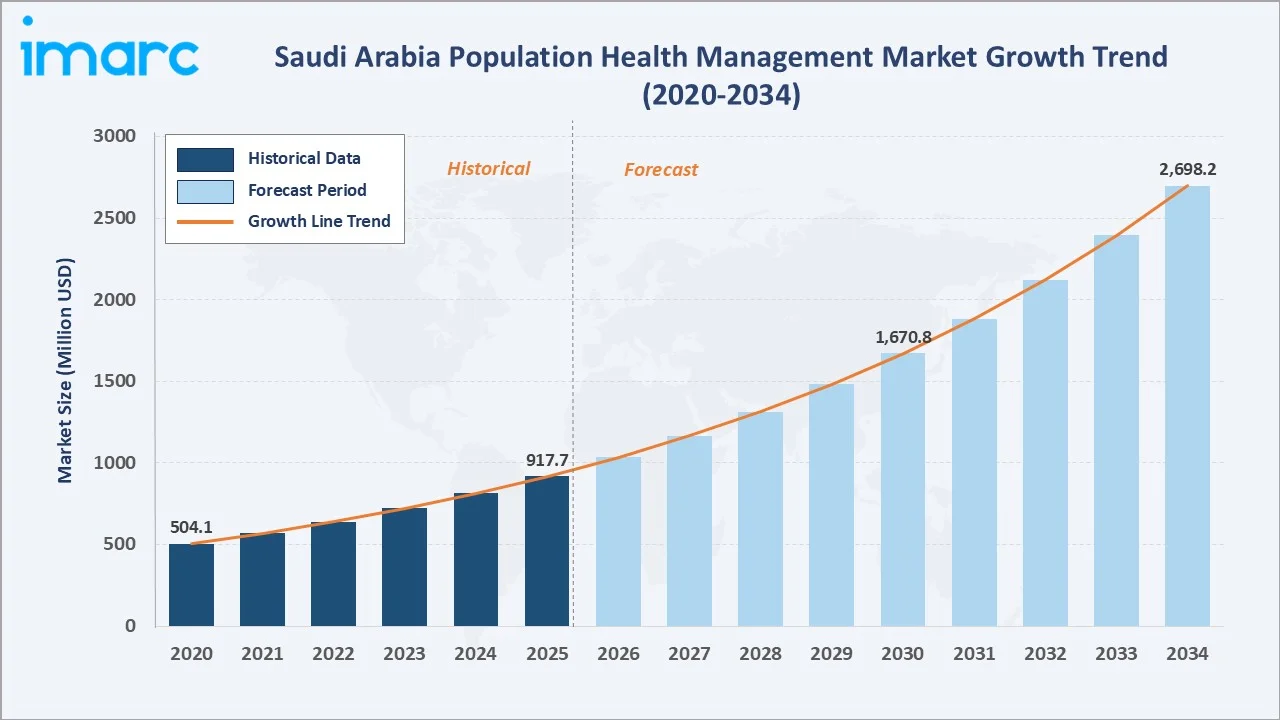
The Saudi Arabia population health management market grew from USD 917.7 Million in 2025 to USD 1,034.6 Million in 2026 and is projected to reach USD 2,698.2 Million by 2034, exhibiting a CAGR of 12.73% during 2026-2034. The market is driven by the rising burden of non-communicable diseases (NCDs), accelerating adoption of digital health solutions, and growing demand for value-based and preventive care across public and private healthcare networks.
Software leads the component segment with 57.8% market share, cloud-based dominates the mode of delivery segment at 54.6% share, and Northern and Central Region commands 43.6% of the total market in 2025.
Market Snapshot
|
Metric |
Value |
|
Base Year Market Size (2025) |
USD 917.7 Million |
|
Market Size (2026) |
USD 1,034.6 Million |
|
Forecast Market Size (2034) |
USD 2,698.2 Million |
|
CAGR (2026-2034) |
12.73% |
|
Base Year |
2025 |
|
Historical Period |
2020-2025 |
|
Forecast Period |
2026-2034 |
|
Largest Region |
Northern and Central Region (43.6%, 2025) |
|
Second Largest Region |
Western Region (29.8%, 2025) |
|
Leading Component |
Software (57.8%, 2025) |
|
Leading Mode of Delivery |
Cloud-based (54.6%, 2025) |
The Saudi Arabia population health management market size increased from USD 504.1 Million in 2020 to USD 917.7 Million in 2025 and is estimated to reach USD 1,034.6 Million in 2026. The market is further expected to reach USD 1,670.8 Million by 2030 and USD 2,698.2 Million by 2034, supported by accelerating digital health adoption, expanding chronic disease management programs, and government-led primary healthcare transformation initiatives across the Kingdom.
To get more information on this market, Request Sample
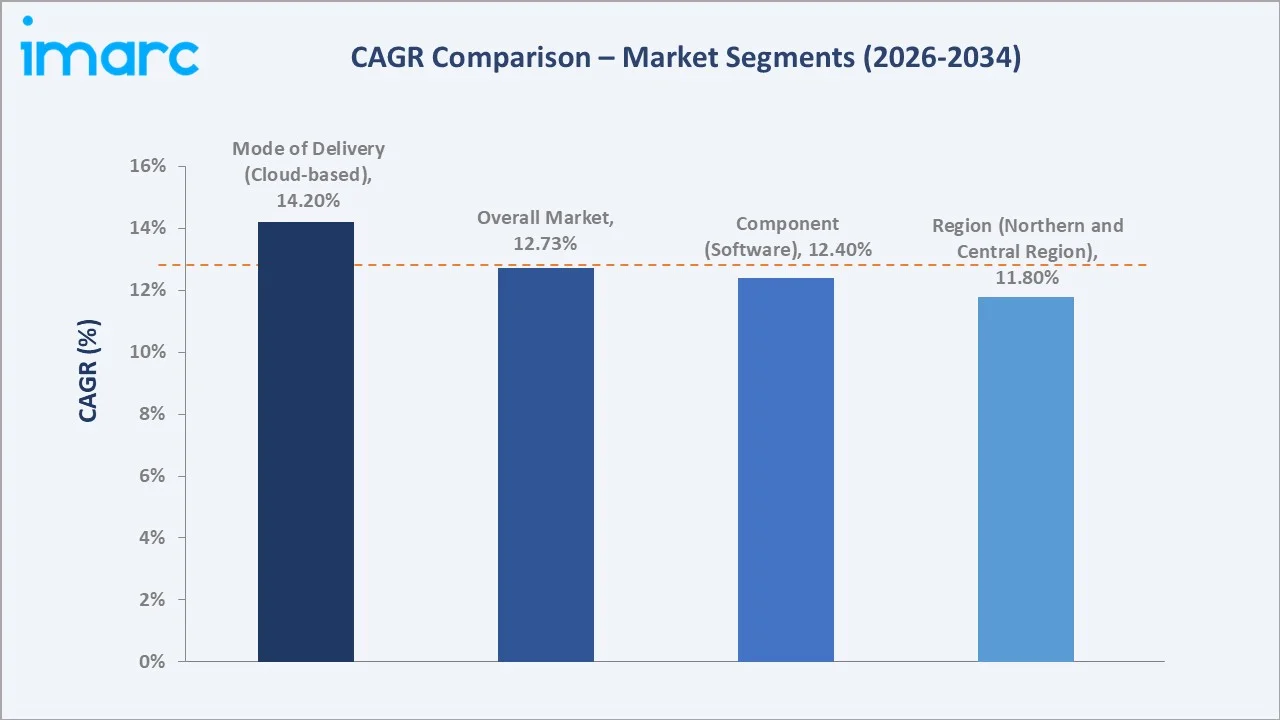
CAGR trajectories across component, mode of delivery, and regional sub-segments show services, cloud-based, and Southern Region expanding faster than the overall 12.73% market CAGR, driven by rising demand for managed care coordination services, accelerating cloud platform adoption, and emerging healthcare infrastructure development.
Executive Summary
The Saudi Arabia population health management market expanded from USD 917.7 Million in 2025 to an estimated USD 1,034.6 Million in 2026, establishing itself as one of the most rapidly growing digital health segments in the Middle East. Population health management encompasses a suite of technologies, platforms, and services that aggregate patient data, identify at-risk populations, coordinate care delivery, and measure health outcomes at the population level.
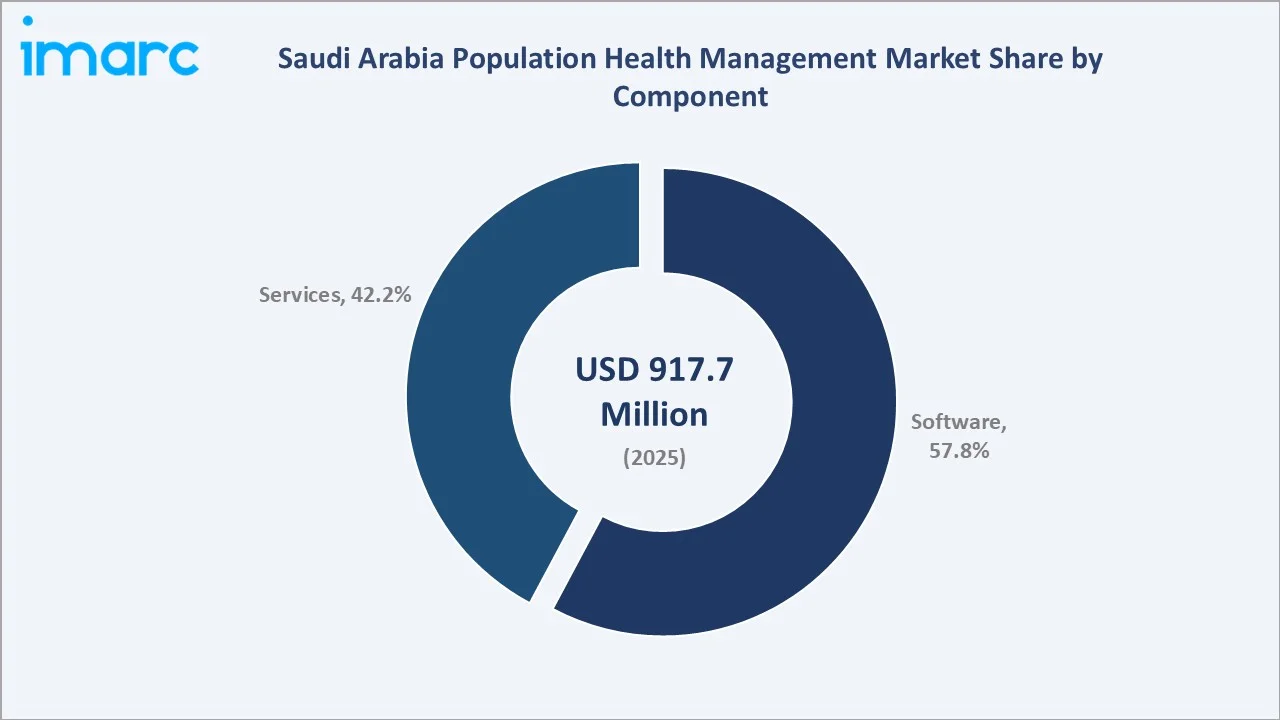
Software dominates the component segment with 57.8% share in 2025, reflecting the high demand for EHR-integrated population health management platforms, predictive analytics tools, and population risk stratification systems. Based on mode of delivery, cloud-based leads at 54.6%, driven by the need for scalable healthcare IT infrastructure, seamless data integration, and remote access to patient information across healthcare networks. Northern and Central Region retains the largest market share at 43.6%, driven by Riyadh's concentration of healthcare institutions, government agencies, and technology providers.
Key Market Insights
|
Insight |
Data |
|
Leading Component |
Software – 57.8% share (2025) |
|
Second Largest Component |
Services – 42.2% share (2025) |
|
Leading Mode of Delivery |
Cloud-based – 54.6% share (2025) |
|
Second Largest Mode of Delivery |
Web-based – 27.3% share (2025) |
|
Leading Region |
Northern and Central Region – 43.6% share (2025) |
|
Second Largest Region |
Western Region – 29.8% share (2025) |
|
Top Companies |
Oracle Corporation, Koninklijke Philips N.V., Epic Systems Corporation, InterSystems Corporation |
Key Analytical Observations Expanding On the Data Above:
- Software dominance at 57.8% reflects the widespread adoption of EHR-integrated population health management platforms, AI-driven risk stratification tools, and population analytics dashboards across Saudi Arabia's public and private healthcare systems, underpinned by strong government digital health mandates.
- Services at 42.2% are anchored by growing demand for population health management implementation, consulting, training, and managed care coordination services as healthcare providers in the Kingdom scale up their population health capabilities.
- Cloud-based leadership at 54.6% is driven by the need for scalable healthcare IT infrastructure, centralized patient data management, and seamless information sharing across hospitals and healthcare networks, alongside investments in digital health transformation.
- Web-based at 27.3% serves a substantial share of mid-tier hospitals and outpatient clinics that require browser-accessible population health management tools without full cloud infrastructure commitments associated with enterprise-grade migration programs.
- Northern and Central Region at 43.6% leads the national landscape, anchored by Riyadh's concentration of Ministry of Health headquarters, tertiary hospitals, health technology companies, and a high density of population health management-oriented academic medical centers.
Saudi Arabia Population Health Management Market Overview
Population health management refers to the systematic use of health data, technology, and coordinated care interventions to improve health outcomes across defined patient groups, reduce avoidable hospitalizations, and lower the overall cost of care.
The Saudi Arabia population health management ecosystem spans software platforms, analytics engines, care management services, and interoperability solutions deployed across hospitals, primary healthcare centers, insurance organizations, and government health authorities. The market is influenced by Saudi Arabia's evolving regulatory framework for digital health, the expanding burden of lifestyle-related NCDs, macroeconomic reforms tied to Vision 2030, and growing private sector participation in healthcare delivery.
Market Dynamics
To evaluate market opportunities, Request Sample
Market Drivers
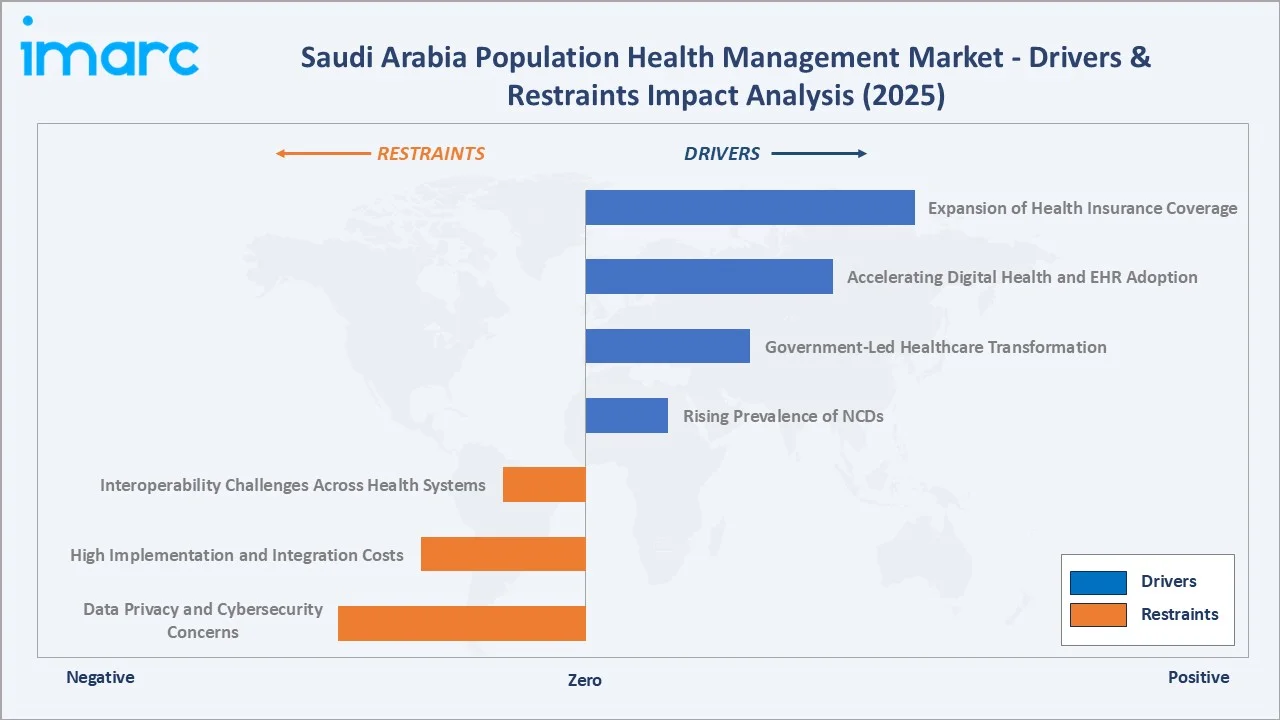
- Rising Prevalence of NCDs: The growing burden of NCDs in Saudi Arabia increases demand for population-level risk stratification, chronic disease registries, and proactive care coordination platforms. Population health management solutions help healthcare providers monitor and manage diabetes, cardiovascular conditions, and obesity-related complications, supporting early intervention and improved long-term patient outcomes.
- Government-Led Healthcare Transformation: Ongoing healthcare reforms in Saudi Arabia prioritize preventive care, digital health infrastructure, and outcome-based care delivery. Investments in telemedicine networks and population analytics capabilities are accelerating the adoption of population health management platforms across healthcare settings.
- Accelerating Digital Health and EHR Adoption: As per IMARC Group, the Saudi Arabia digital health market grew from USD 5.01 Billion in 2025. The proliferation of EHR systems across Saudi hospitals and primary care centers is generating large-scale patient data that feeds directly into population health management analytics and risk management workflows. Growing interoperability between hospital information systems, laboratory networks, and insurance databases is enabling more comprehensive population health monitoring capabilities nationwide.
- Expansion of Health Insurance Coverage: Expanding mandatory health insurance requirements for the workforce and growing coverage of nationals is intensifying pressure on payers and providers to implement cost-effective disease management and preventive health programs, directly driving investment in population health management platforms and care coordination services.
Market Restraints
- Data Privacy and Cybersecurity Concerns: The aggregation of sensitive patient data within centralized population health management platforms raises substantial data governance and cybersecurity challenges.
- High Implementation and Integration Costs: Deploying enterprise-grade population health management platforms requires significant upfront investment in system integration, workflow redesign, staff training, and ongoing technical support, presenting financial barriers for smaller healthcare providers and creating budget constraints for government-funded facilities.
- Interoperability Challenges Across Health Systems: Saudi Arabia's healthcare ecosystem spans a diverse mix of government hospitals, military facilities, university hospitals, and private networks, each operating on different information systems and data standards. The lack of universal interoperability frameworks complicates the seamless exchange of patient data essential for effective population-level health management.
Market Opportunities
- AI and Predictive Analytics Integration: The growing availability of large-scale patient datasets and advancing AI capabilities present significant opportunities for the development of predictive risk models, automated care gap identification, and personalized preventive care protocols.
- Growing Private Sector Healthcare Investment: The progressive privatization of Saudi healthcare delivery is generating new demand for commercially operated population health management services and population analytics platforms that support performance-based contracting and outcomes measurement.
Market Challenges
- Shortage of Qualified Health Informatics Talent: Effective population health management implementation requires skilled professionals capable of managing health data analytics, EHR integration, and care coordination workflows. Saudi Arabia faces a relative shortage of qualified health informaticists and clinical data scientists, constraining deployment pace and program effectiveness.
- Change Management and Clinical Adoption Barriers: Successful population health management deployment depends on broad clinical buy-in from physicians, nurses, and care coordinators who must adapt established workflows around new data-driven care protocols. Insufficient training infrastructure can significantly limit the operational effectiveness of population health management programs after platform deployment.
Emerging Market Trends
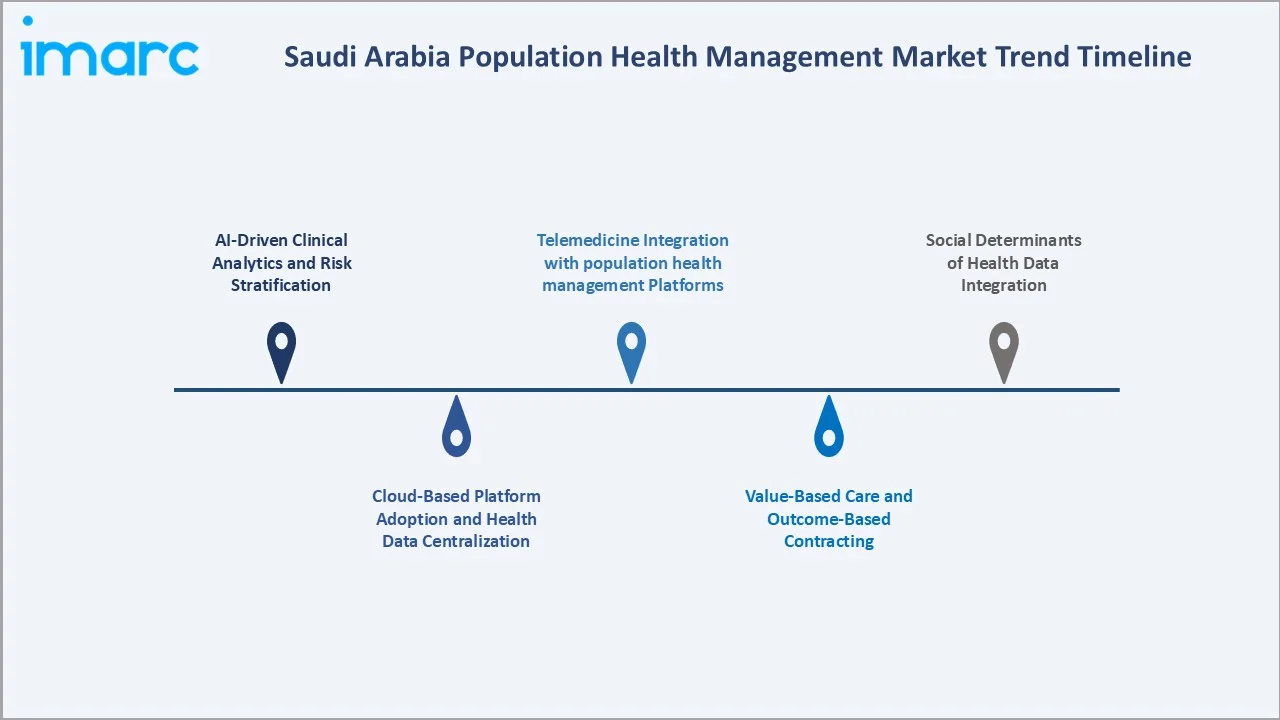
1. AI-Driven Clinical Analytics and Risk Stratification
AI and ML are being rapidly integrated into population health management platforms to automate patient risk stratification, predict disease progression, and identify care gaps at scale. Saudi healthcare providers and government health agencies are increasingly investing in AI-powered analytics tools to prioritize high-risk populations for proactive intervention, reducing preventable hospitalizations and improving chronic disease outcomes.
2. Cloud-Based Platform Adoption and Health Data Centralization
The shift toward cloud-hosted population health management infrastructure is enabling Saudi healthcare organizations to centralize patient data, scale analytics capabilities, and deploy real-time care coordination tools without the capital expenditure burden of on-premises systems.
3. Value-Based Care and Outcome-Based Contracting
Saudi Arabia's healthcare payer and provider landscape is progressively transitioning toward value-based reimbursement models that tie financial incentives to measurable population health outcomes rather than volume-based service delivery. This shift is creating sustained demand for population health management platforms capable of tracking quality metrics, measuring care outcomes, and supporting performance reporting frameworks aligned with national health quality standards.
4. Telemedicine Integration with Population Health Management Platforms
The rapid growth of telemedicine services across Saudi Arabia is increasingly being integrated with population health management workflows. Connecting virtual care encounters with population health analytics enables continuous monitoring of chronic disease patients, automated follow-up protocols, and more responsive care coordination between patients and clinical teams.
5. Social Determinants of Health Data Integration
Advanced population health management programs are expanding beyond clinical data to incorporate social determinants of health including socioeconomic status, housing conditions, nutrition access, and physical activity levels. Saudi health authorities are beginning to integrate community health data into population health platforms to develop more holistic, culturally responsive health management strategies aligned with the Kingdom's health equity objectives.
Industry Value Chain Analysis
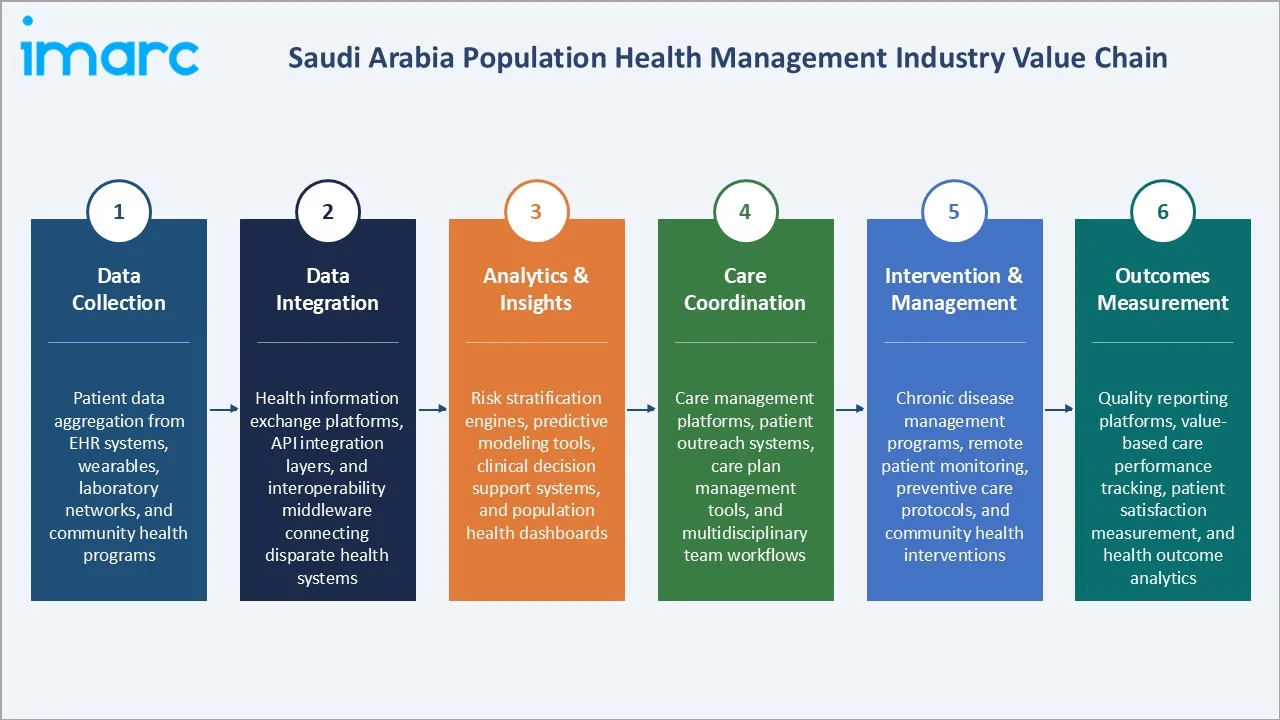
The Saudi Arabia population health management value chain spans six key stages, from data collection and integration through analytics, care coordination, clinical intervention, and outcomes measurement. Software platform vendors and analytics solution providers capture the highest value-add, while the growing importance of care management services creates significant opportunity for service-oriented market participants.
|
Stage |
Key Players / Examples |
|
Data Collection |
Patient data aggregation from EHR systems, wearables, laboratory networks, and community health programs |
|
Data Integration |
Health information exchange platforms, API integration layers, and interoperability middleware connecting disparate health systems |
|
Analytics & Insights |
Risk stratification engines, predictive modeling tools, clinical decision support systems, and population health dashboards |
|
Care Coordination |
Care management platforms, patient outreach systems, care plan management tools, and multidisciplinary team workflows |
|
Intervention & Management |
Chronic disease management programs, remote patient monitoring, preventive care protocols, and community health interventions |
|
Outcomes Measurement |
Quality reporting platforms, value-based care performance tracking, patient satisfaction measurement, and health outcome analytics |
Integrated population health management platform vendors that control both software and service delivery are positioned to capture greater value than point-solution providers. The growing complexity of population health workflows is creating increasing demand for end-to-end population health management partners capable of supporting the full value chain from data integration through clinical outcomes management.
Technology Landscape in the Saudi Arabia Population Health Management Industry
AI and ML-Driven Risk Analytics
AI-powered analytics engines are central to modern population health management platforms, enabling automated identification of high-risk patient cohorts, predictive modeling of disease progression, and intelligent care gap detection. Saudi Arabian population health management vendors are embedding ML models directly into clinical workflows, allowing care teams to prioritize interventions based on real-time population risk scores generated from multi-source patient data streams.
Cloud Infrastructure and Health Data Platforms
Scalable cloud infrastructure underpins the majority of new population health management deployments in Saudi Arabia, supporting centralized data storage, real-time analytics processing, and seamless platform access across geographically distributed care networks. Government-grade cloud security certifications and national data residency requirements are shaping cloud architecture decisions for population health management vendors operating in the Saudi Arabia market.
Remote Patient Monitoring and IoT Integration
The integration of IoT-enabled wearables, connected diagnostic devices, and remote patient monitoring tools into population health management platforms is enabling continuous tracking of chronic disease patients outside hospital settings. This capability supports earlier detection of clinical deterioration, reduces unnecessary emergency visits, and extends the reach of population health management to home and community settings across the Kingdom.
Market Segmentation Analysis
The report covers the following segments:
|
Segment Category |
Leading Segment |
Market Share |
Year |
|
Component |
Software |
57.8% |
2025 |
|
Mode of Delivery |
Cloud-based |
54.6% |
2025 |
|
End User |
🔒 |
🔒 |
2025 |
|
Region |
Northern and Central Region |
43.6% |
2025 |

By Component
Software commands a 57.8% majority share in 2025, driven by broad deployment of EHR-integrated population health management platforms, risk stratification tools, care gap analytics dashboards, and population health monitoring systems across Saudi public and private healthcare networks. The segment benefits from strong government digital health procurement programs and rising demand for AI-powered clinical analytics among hospital networks seeking to improve chronic disease outcomes.
To evaluate market opportunities, Request Sample
Services at 42.2% in 2025 reflect growing demand for population health management implementation consulting, managed care coordination, clinical training, and ongoing technical support. As Saudi healthcare organizations move beyond initial platform deployment toward sustained population health program management, the services segment is positioned for accelerating growth through the forecast period.
By Mode of Delivery
Cloud-based leads with 54.6% share in 2025, supported by scalability, remote accessibility, lower upfront infrastructure requirements, and ease of integration with existing healthcare systems. These solutions enable healthcare organizations to manage patient data, coordinate care, and access population health analytics across multiple facilities.
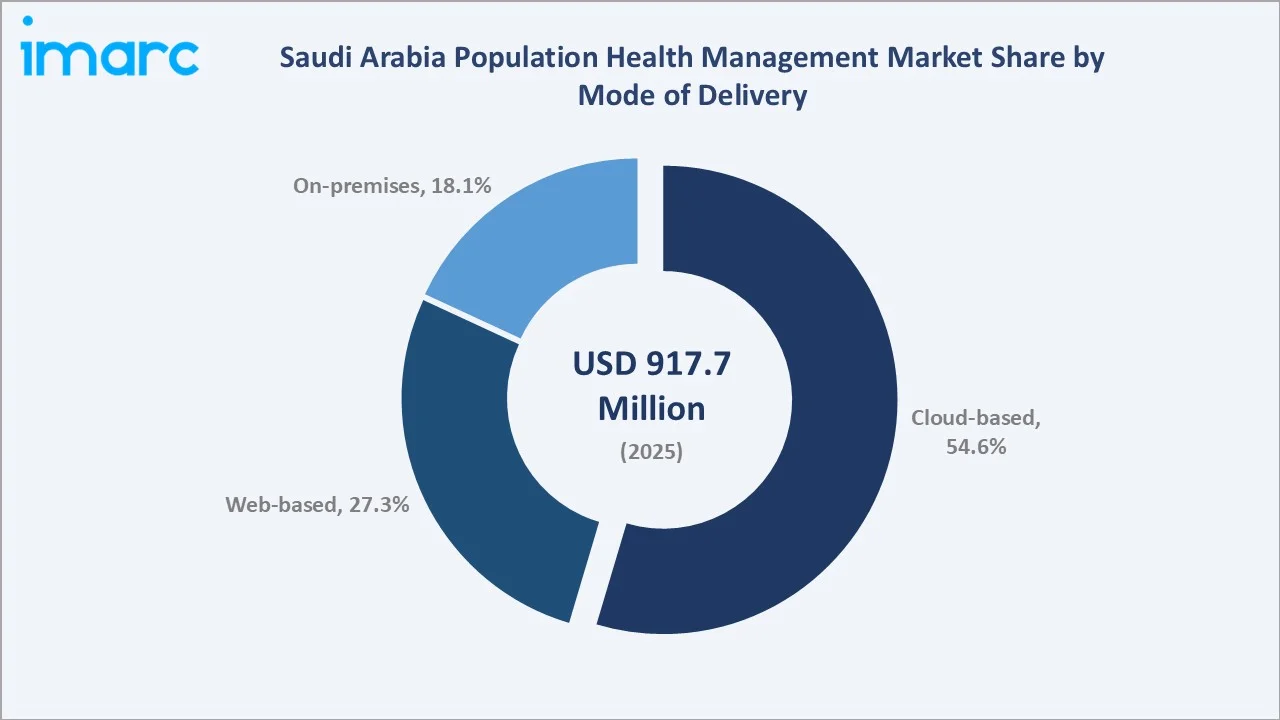
Web-based at 27.3% in 2025 serves a significant portion of mid-tier hospitals and specialized clinics requiring browser-accessible population health management tools.
Regional Market Insights
|
Region |
Share (2025) |
Key Growth Drivers |
|
Northern and Central Region |
43.6% |
High concentration of Ministry of Health facilities, government health agencies, tertiary hospitals, and health technology companies; Riyadh's dense healthcare ecosystem drives strong population health management adoption |
|
Western Region |
29.8% |
Growing private healthcare infrastructure, expanding health insurance coverage, and increasing NCD management program adoption across the region's large urban population centers |
|
Eastern Region |
16.4% |
Strong corporate healthcare programs from the energy sector, rising demand for occupational health and population health management services, and growing private hospital investment in major Eastern Province cities |
|
Southern Region |
10.2% |
Expanding primary healthcare network development, growing public health management initiatives, and increasing adoption of community-based population health programs across rural and semi-urban areas |
Northern and Central Region at 43.6% in 2025 leads the national population health management landscape, anchored by Riyadh's concentration of Ministry of Health headquarters, flagship public hospital networks, and a mature ecosystem of population health management technology providers and health informatics specialists. The region benefits from strong government program alignment and high institutional readiness for advanced population health initiatives.
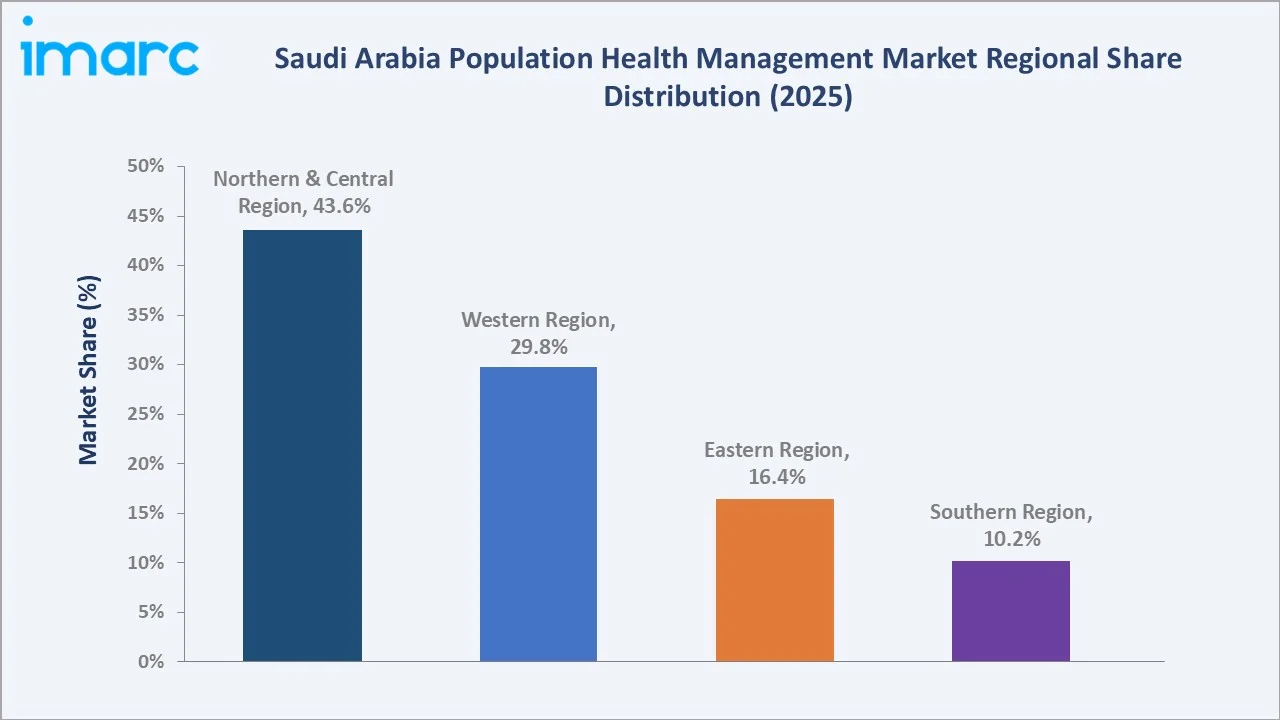
Western Region at 29.8% maintains a significant share, supported by Jeddah's large urban population, a growing private hospital sector, and active health insurance market expansion.
Competitive Landscape
The Saudi Arabia population health management market features a mix of globally established health IT enterprises and specialized analytics vendors. Competitive differentiation is driven by depth of EHR integration capabilities, AI analytics sophistication, cloud platform scalability, regulatory compliance, and ability to support Arabic-language clinical workflows and Saudi-specific health data standards.
| Company Name | Brand / Key Product | Position | Strategic Focus |
|---|---|---|---|
| Oracle Corporation | Oracle Health | Leader | Expanding cloud-based population health management platform capabilities and deepening health system integration across global markets |
| Koninklijke Philips N.V. | Philips HealthSuite | Leader | Advancing AI-powered population health analytics and remote patient monitoring integration |
| Epic Systems Corporation | Epic Healthy Planet | Leader | Strengthening EHR-integrated care management tools and population analytics capabilities |
| InterSystems Corporation | InterSystems HealthShare | Challenger | Strengthening interoperability-driven population health management solutions and health information exchange platforms |
Key players include Oracle Corporation, Koninklijke Philips N.V., Epic Systems Corporation, and InterSystems Corporation, among others.
Key Company Profiles
Oracle Corporation
Oracle Corporation is a United States-based multinational technology corporation headquartered in Austin, Texas. Oracle Health operates as the dedicated health division of Oracle Corporation, delivering clinical, administrative, and population health management solutions to large integrated health systems and public health organizations globally.
- Product Portfolio: Oracle Health population health management platform, EHR-integrated care gap identification tools, chronic disease registries, AI-powered clinical analytics, population risk stratification modules, and cloud-based health system interoperability solutions.
- Recent Developments: Oracle Corporation continues to advance its health technology operations through ongoing investment in platform development and capability expansion, maintaining its focus on delivering integrated health information technology solutions to health system clients worldwide.
- Strategic Focus: Scaling cloud-native health data infrastructure and embedding AI-powered analytics across its EHR-integrated population health management platform to deepen health system capabilities and expand its global digital health footprint.
Koninklijke Philips N.V.
Koninklijke Philips N.V. is a Netherlands-based multinational health technology corporation headquartered in Amsterdam, Netherlands. It operates as a focused health technology company delivering clinical imaging, patient monitoring, health informatics, and connected care solutions to hospitals, primary care centers, and integrated care organizations worldwide.
- Product Portfolio: Philips HealthSuite digital platform, remote patient monitoring systems, AI-powered population health analytics tools, chronic disease management solutions, clinical decision support systems, and connected care program management capabilities.
- Recent Developments: Koninklijke Philips N.V. continues to maintain and develop its health technology portfolio, with ongoing investment directed toward advancing its connected care solution capabilities and refining its clinical analytics and population health management offerings for health system clients.
- Strategic Focus: Integrating connected care and remote patient monitoring capabilities with AI-powered clinical analytics platforms to extend population health management reach across hospital, primary care, and community health settings.
Epic Systems Corporation
Epic Systems Corporation is a United States-based private health information technology company headquartered in Verona, Wisconsin. The firm is one of the world's most widely deployed HER vendors and provides integrated population health management tools used by academic medical centers, health systems, and large hospital networks globally, including growing adoption across the Kingdom of Saudi Arabia.
- Product Portfolio: Epic Healthy Planet population health management module, care gap analytics tools, chronic disease registries, predictive population risk models, patient outreach management tools, and care coordination workflow capabilities embedded within the Epic EHR platform.
- Recent Developments: Epic Systems Corporation continues to invest in the ongoing development of its health information technology platform, advancing population health management, analytics, and care coordination functionality across its integrated product suite for health system and hospital clients.
- Strategic Focus: Broadening value-based care enablement and predictive population risk management capabilities within its native EHR platform to support coordinated care delivery and chronic disease program management at scale across health system clients.
Market Concentration Analysis
The Saudi Arabia population health management market is moderately concentrated, with Oracle Corporation, Koninklijke Philips N.V., and Epic Systems Corporation collectively holding significant market share anchored by their large enterprise health system client bases, deep EHR integration capabilities, and established regulatory compliance track records.
Barriers to entry remain substantial in the Saudi Arabia population health management market, encompassing regulatory approval requirements for health software, the cost of achieving Arabic-language clinical workflow support, the need for local data residency compliance, and the long sales cycles associated with large hospital system procurement processes. These factors reinforce the competitive advantage of established vendors with existing Saudi Arabia market presence and government health authority relationships.
The market is witnessing progressive consolidation through strategic partnerships and platform integrations, as population health management vendors seek to offer end-to-end population health capabilities spanning data integration, analytics, care management, and outcomes measurement. Cross-sector alliances between population health management software providers and healthcare consulting firms are emerging as a key competitive strategy.
Investment & Growth Opportunities
Fastest-Growing Segments
Cloud-based is the fastest-growing mode of delivery segment, driven by national health cloud infrastructure investment and growing provider preference for scalable, subscription-based population health management access. Services represent the fastest-growing component segment, reflecting rising demand for population health management implementation, consulting, training, and managed care coordination services as healthcare organizations across Saudi Arabia scale and mature their population health programs beyond initial platform deployment.
Emerging Markets
Southern Region is the fastest-growing regional market, driven by accelerating primary healthcare infrastructure development, expanding community health programs, and increasing population health management adoption across underserved and semi-urban areas.
Venture & Investment Trends
Investment activity in the Saudi Arabia population health management sector is concentrated in AI analytics platform development, cloud health infrastructure, and integrated care management solutions. Saudi government-backed health technology funds and Vision 2030 program financing are channeling capital into domestic digital health ecosystem development. International population health management vendors entering the market are increasingly pursuing joint venture structures and local partnership models to accelerate regulatory approvals and government contract access.
Future Market Outlook (2026-2034)
The Saudi Arabia population health management market is projected to grow from USD 917.7 Million in 2025 to USD 1,034.6 Million in 2026, reaching USD 2,698.2 Million by 2034, registering a CAGR of 12.73% during 2026-2034.
Four structural forces will shape the market through 2034: continued government investment in digital health infrastructure under Vision 2030; the progressive shift toward value-based and outcome-driven care reimbursement models; accelerating AI and predictive analytics integration into population health management platforms; and expanding population health program coverage across primary healthcare networks nationwide.
By 2034, the Saudi Arabia population health management landscape is expected to be characterized by highly integrated, AI-powered population health ecosystems that connect hospital systems, primary care networks, community health programs, and insurance platforms through interoperable data exchange architectures. The transition toward preventive, proactive, and personalized population health management will have substantially advanced, supported by universal EHR adoption, expanding real-world health data availability, and a maturing value-based care contracting environment.
Research Methodology
Primary Research
Primary research included structured interviews with population health management industry executives, healthcare IT solution architects, hospital network administrators, and health insurance sector specialists operating in the Saudi Arabia market. These interviews validated market sizing assumptions, segment mix dynamics, and regional adoption patterns across public and private healthcare sectors.
Secondary Research
Secondary sources included Saudi Ministry of Health digital health strategy publications, Saudi Vision 2030 healthcare reform documentation, Saudi Central Department of Statistics & Information health data, Saudi Food and Drug Authority digital health regulatory frameworks, World Health Organization NCD burden assessments for Saudi Arabia, and vendor annual reports and investor presentations.
Forecasting Models
Market forecasts combined top-down and bottom-up modeling incorporating government health IT procurement data, vendor revenue growth trajectories, digital health adoption rate analysis, chronic disease burden projections, and macroeconomic variables including healthcare expenditure growth rates and insurance market expansion dynamics. Scenario analysis addressed regulatory developments, AI adoption acceleration, and interoperability framework implementation timelines.
Saudi Arabia Population Health Management Market Report Coverage:
| Report Features | Details |
|---|---|
| Base Year of the Analysis | 2025 |
| Historical Period | 2020-2025 |
| Forecast Period | 2026-2034 |
| Units | Million USD |
| Scope of the Report |
Exploration of Historical and Forecast Trends, Industry Catalysts and Challenges, Segment-Wise Historical and Predictive Market Assessment:
|
| Components Covered | Software, Services |
| Modes of Delivery Covered | Cloud-based, Web-based, On-premises |
| End Users Covered | Healthcare Providers, Healthcare Payers, Employer Groups, Government Bodies |
| Regions Covered | Northern and Central Region, Western Region, Eastern Region, Southern Region |
| Companies Covered | Oracle Corporation, Koninklijke Philips N.V., Epic Systems Corporation, InterSystems Corporation, etc. |
| Customization Scope | 10% Free Customization |
| Post-Sale Analyst Support | 10-12 Weeks |
| Delivery Format | PDF and Excel through Email (We can also provide the editable version of the report in PPT/Word format on special request) |
Key Benefits for Stakeholders:
- IMARC’s industry report offers a comprehensive quantitative analysis of various market segments, historical and current market trends, market forecasts, and dynamics of the Saudi Arabia population health management market from 2020-2034.
- The research report provides the latest information on the market drivers, challenges, and opportunities in the Saudi Arabia population health management market.
- Porter's five forces analysis assist stakeholders in assessing the impact of new entrants, competitive rivalry, supplier power, buyer power, and the threat of substitution. It helps stakeholders to analyze the level of competition within the Saudi Arabia population health management industry and its attractiveness.
- Competitive landscape allows stakeholders to understand their competitive environment and provides an insight into the current positions of key players in the market.
Frequently Asked Questions About the Saudi Arabia Population Health Management Market Report
The Saudi Arabia population health management market size is estimated at USD 1,034.6 Million in 2026, driven by the growing focus on preventive care, digital health adoption, chronic disease management, and improved care coordination across healthcare settings.
The market is projected to grow at a CAGR of 12.73% during 2026-2034, reaching USD 2,698.2 Million, driven by Vision 2030 health reforms, rising NCD burden, and digital health adoption.
Software is the dominant component segment, commanding 57.8% share in 2025, driven by broad adoption of EHR-integrated population health management platforms and AI-powered risk analytics tools.
Cloud-based is the leading mode of delivery with 54.6% share in 2025, driven by scalability, cost efficiency, remote accessibility, and seamless integration with existing healthcare systems.
Northern and Central Region commands 43.6% share in 2025, led by Riyadh's concentration of government health agencies, tertiary hospitals, and health technology providers.
Leading players include Oracle Corporation, Koninklijke Philips N.V., Epic Systems Corporation, and InterSystems Corporation, among others.
Key drivers include Vision 2030 health reform investment, rising NCD prevalence, accelerating digital health adoption, expanding health insurance coverage, and EHR infrastructure proliferation.
Key trends include AI-driven risk analytics, cloud-based platform expansion, value-based care adoption, telemedicine integration, and social determinants of health data incorporation.
Key challenges include data privacy concerns, high implementation costs, interoperability barriers across diverse health systems, and a shortage of qualified health informatics professionals.
Key opportunities include AI analytics integration, primary healthcare transformation programs, private sector healthcare expansion, and Vision 2030 digital health infrastructure investment.
Need more help?
- Speak to our experienced analysts for insights on the current market scenarios.
- Include additional segments and countries to customize the report as per your requirement.
- Gain an unparalleled competitive advantage in your domain by understanding how to utilize the report and positively impacting your operations and revenue.
- For further assistance, please connect with our analysts.
 Request Customization
 Speak to an Analyst
 Request Brochure
 Inquire Before Buying
Benefits of Customization
- Personalize this research
- Triangulate with your data
- Get data as per your format and definition
- Gain a deeper dive into a specific application, geography, customer, or competitor
- Any level of personalization
Get in Touch With Us
UNITED STATES
Phone: +1-201-971-6302
INDIA
Phone: +91-120-433-0800
UNITED KINGDOM
Phone: +44-753-714-6104
Email: [email protected]
Client Testimonials





















Related Reports

Choose your plan
*Please note that the prices mentioned below are starting prices for each bundle type. Kindly contact our team for further details.*
Single User License
- 1 User License, Access on 2 Devices
- PDF Report + Excel Dataset (Password Protected)
- Lifetime Access
- No Printing Rights
- 10% Free Report Customization
- 10–12 Weeks of Analyst Support
Five User License
- Access for 5 Users, 2 Devices per User
- PDF Report + Excel Dataset (Password Protected)
- Lifetime Access
- Dedicated Account Manager
- 12–14 Weeks of Analyst Support
- No Printing Rights
- 15% Free Report Customization
- 25% Discount on Your Next Purchase
Corporate User License
- Unlimited User Access (Within Your Organization)
- PDF Report + Excel Dataset
- Lifetime Access
- Dedicated Account Manager
- 14–20 Weeks of Analyst Support
- No Printing Rights
- 20% Free Report Customization
- 30% Discount on Your Next Purchase
Essential Insights
What's included:
3 reports
- Lifetime Access
- PDF Reports
- Excel Datasets
- 2 Weeks of Free Analyst Support
- 2 User Licenses
- Access on 2 Devices
- Printing Rights
- Complimentary PowerPoint (PPT) Version
- Complimentary License Upgrade
Professional Access
What's included:
5 reports
- Lifetime Access
- PDF Reports
- Excel Datasets
- 8 Weeks of Free Analyst Support
- 2 User Licenses
- Access on 2 Devices
- Printing Rights
- Complimentary PowerPoint (PPT) Version
- Complimentary License Upgrade
Business Advantage
What's included:
8 reports
- Lifetime Access
- PDF Reports
- Excel Datasets
- 14 Weeks of Free Analyst Support
- 2 User Licenses
- Access on 2 Devices
- Printing Rights
- Complimentary PowerPoint (PPT) Version
- Complimentary License Upgrade
Enterprise Intelligence
What's included:
10 reports
- Lifetime Access
- PDF Reports
- Excel Datasets
- 20 Weeks of Free Analyst Support
- 2 User Licenses
- Access on 2 Devices
- Printing Rights
- Complimentary PowerPoint (PPT) Version
- Complimentary License Upgrade