
Saudi Arabia Sanitaryware Market Size, Share, Trends by Product, Material, End User, Distribution Channel, and Region, 2026-2034
Saudi Arabia Sanitaryware Market Size, Share, Trends & Forecast (2026-2034)
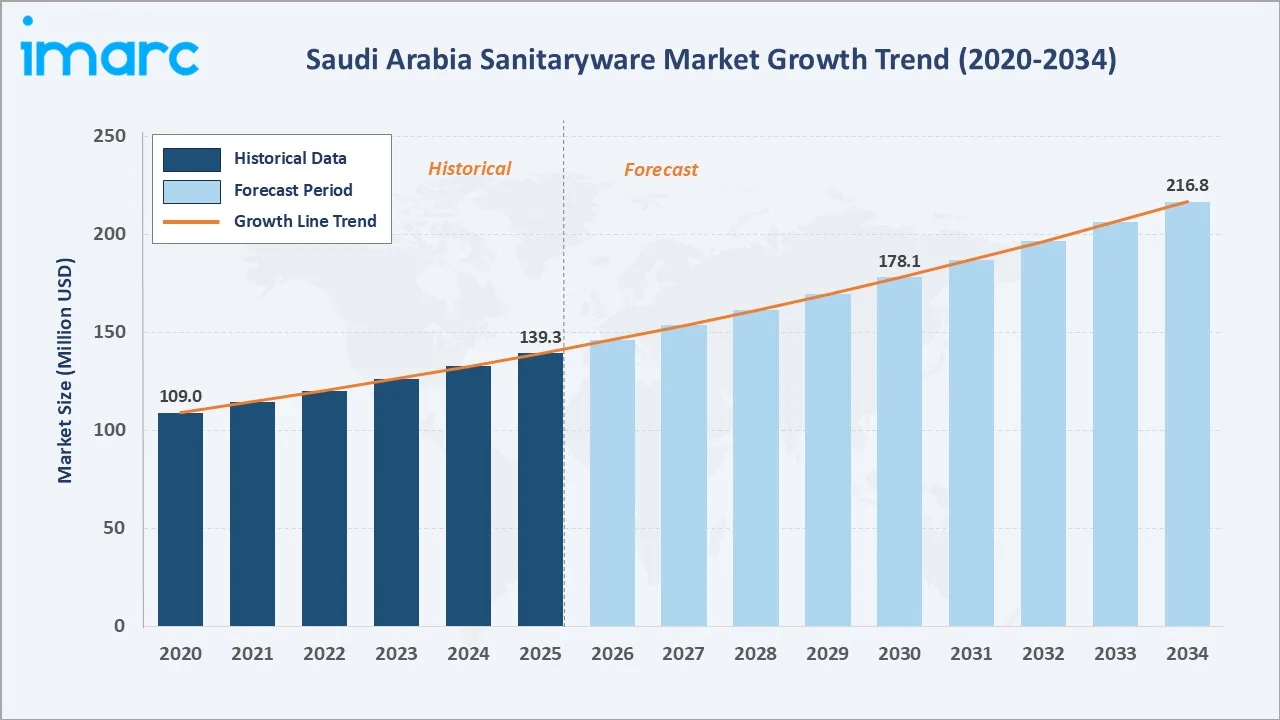
The Saudi Arabia sanitaryware market grew from USD 139.3 Million in 2025 to USD 146.3 Million in 2026 and is projected to reach USD 216.8 Million by 2034, exhibiting a CAGR of 5.04% during 2026-2034. The market is supported by ongoing residential construction, infrastructure development, and rising demand for modern bathroom fixtures across the Kingdom.
Water closets lead at 36.8% product share, ceramic commands 71.6% material share, and Northern and Central Region holds 39.3% regional dominance.
Market Snapshot
|
Metric |
Value |
|
Base Year Market Size (2025) |
USD 139.3 Million |
| Market Size (2026) | USD 146.3 Million |
|
Forecast Market Size (2034) |
USD 216.8 Million |
|
CAGR (2026-2034) |
5.04% |
|
Base Year |
2025 |
|
Historical Period |
2020-2025 |
|
Forecast Period |
2026-2034 |
|
Largest Region |
Northern and Central Region (39.3%, 2025) |
|
Second Largest Region |
Western Region (29.0%, 2025) |
|
Leading Product |
Water Closets (36.8%, 2025) |
|
Leading Material |
Ceramic (71.6%, 2025) |
The Saudi Arabia sanitaryware market expanded from USD 109.0 Million in 2020 to USD 139.3 Million in 2025 and an estimated USD 146.3 Million in 2026, driven by accelerating construction activity, rising urbanization, and growing demand from residential and hospitality projects under Vision 2030. Anchored at USD 178.1 Million in 2030, the forecast to USD 216.8 Million by 2034 is supported by expanding smart sanitaryware adoption, continued mega-project delivery, and a more structured regulatory environment for building standards and water efficiency.
To get more information on this market, Request Sample
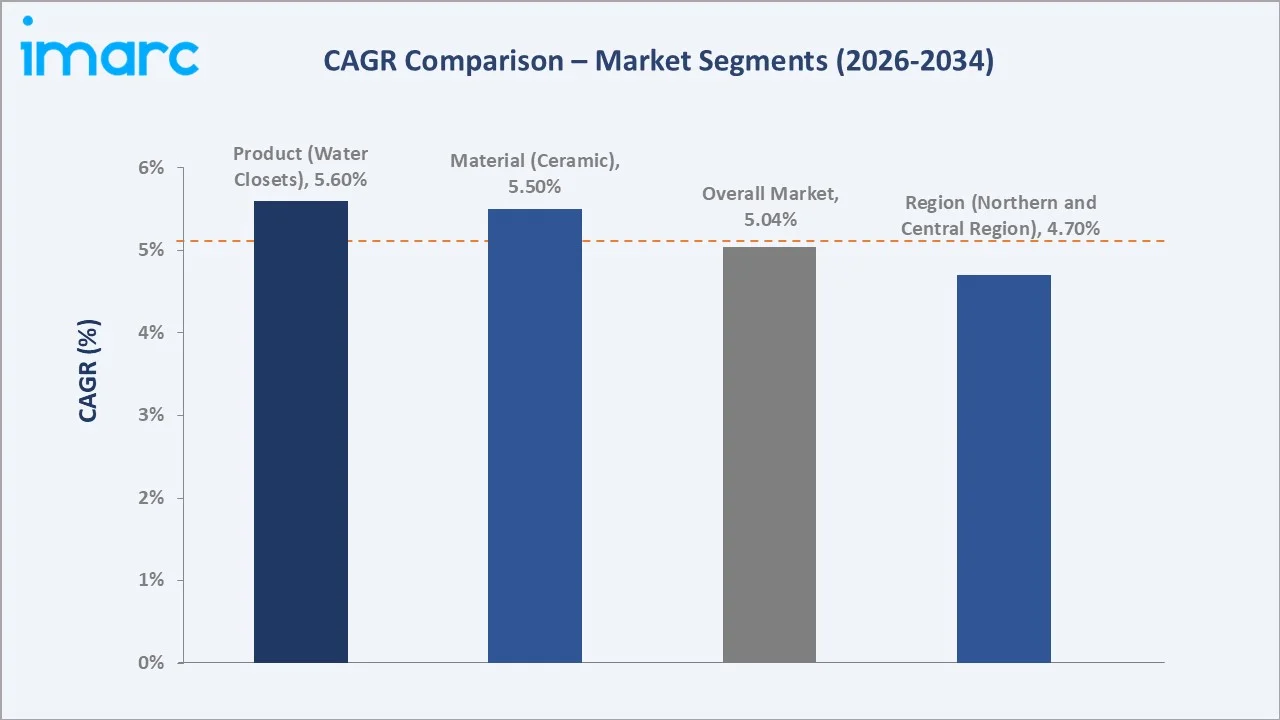
CAGR trajectories across product and material sub-segments, together with regional patterns, show the Western Region and water closets expanding faster than the overall 5.04% market CAGR, supported by rising construction activity, renovation demand, and consumer preference for modern bathroom solutions.
Executive Summary
The Saudi Arabia sanitaryware market is on a steady growth trajectory, rising from USD 109.0 Million in 2020 to USD 139.3 Million in 2025 and an estimated USD 146.3 Million in 2026, reaching USD 216.8 Million by 2034. The industry has been consistently supported by large-scale public and private investment in residential housing, commercial real estate, and hospitality infrastructure, all of which require substantial sanitaryware installation across new and retrofit projects.
Water closets represent the largest product segment at 36.8% in 2025, driven by rising residential and commercial construction, bathroom renovation activity, and replacement demand. Ceramic leads the material segment at 71.6% in 2025, anchored by its durability, wide availability, and competitive pricing. Northern and Central Region commands 39.3% regional share in 2025, driven by Riyadh's status as the administrative and economic capital and a dense base of housing and commercial development projects.
Key Market Insights
|
Insight |
Data |
|
Largest Product |
Water Closets - 36.8% share (2025) |
|
Second Largest Product |
Wash Basins - 28.4% share (2025) |
|
Leading Material |
Ceramic - 71.6% share (2025) |
|
Second Largest Material |
Metal - 12.8% share (2025) |
|
Leading Region |
Northern and Central Region - 39.3% share (2025) |
|
Second Largest Region |
Western Region - 29.0% share (2025) |
|
Top Companies |
ROCA Group, Geberit AG, Kohler Co., Villeroy & Boch AG, LIXIL Corporation |
Key Analytical Observations Expanding On the Data Above:
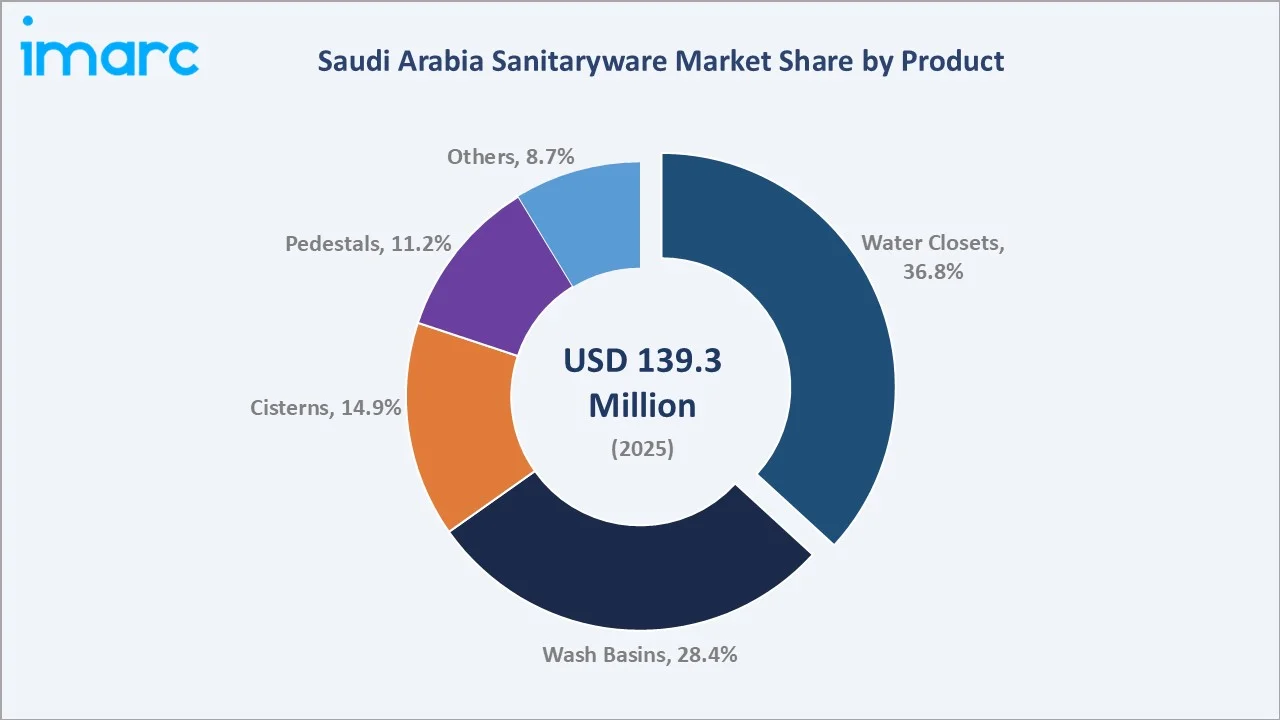
- Water closets at 36.8% dominate the product mix in 2025, reflecting their mandatory presence in every bathroom unit across residential, commercial, and hospitality installations. The demand is further supported by replacement cycles in older buildings undergoing renovation.
- Wash basins at 28.4% represent the second-largest product segment, driven by their dual-installation requirement in both bathroom and kitchen configurations across residential and commercial construction projects.
- Ceramic dominance at 71.6% is supported by its durability, ease of maintenance, broad availability, and suitability for both residential and commercial applications.
- Metal share at 12.8% reflects its strength, corrosion resistance, and use in commercial, hospitality, and premium sanitaryware applications.
- Northern and Central Region at 39.3% is anchored by Riyadh's role as the Kingdom's leading construction market and the hub of Vision 2030-aligned mega-projects and government-delivered housing programs.
Saudi Arabia Sanitaryware Market Overview
Sanitaryware refers to plumbing fixtures and fittings designed for personal hygiene and sanitation, including water closets, wash basins, cisterns, pedestals, and associated accessories. These products form an essential component of any residential, commercial, institutional, or hospitality facility and are installed during both new construction and renovation projects.
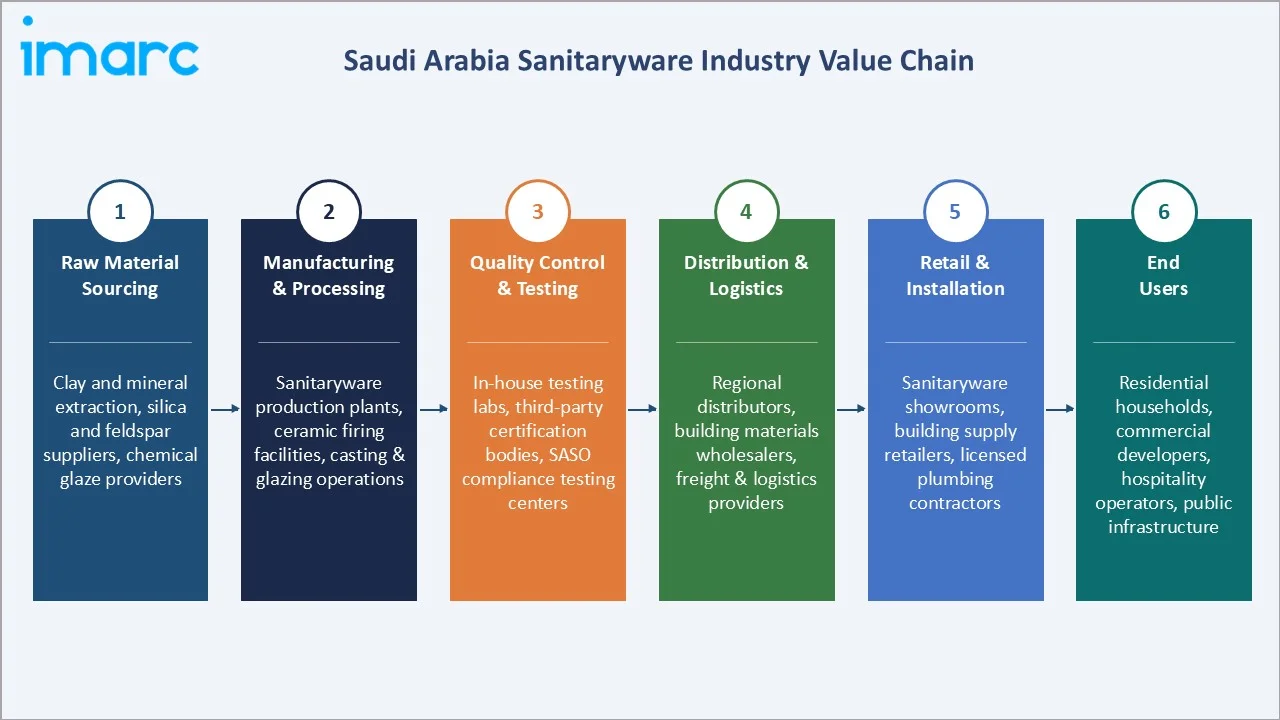
The Saudi Arabia sanitaryware ecosystem integrates raw material suppliers of clay, silica, and glazing chemicals, domestic and international manufacturers, regional distributors and wholesalers, specialist retailers and showrooms, plumbing installation contractors, and end user segments spanning residential households, commercial developers, hospitality operators, and government infrastructure projects.
Market Dynamics
To evaluate market opportunities, Request Sample
Market Drivers
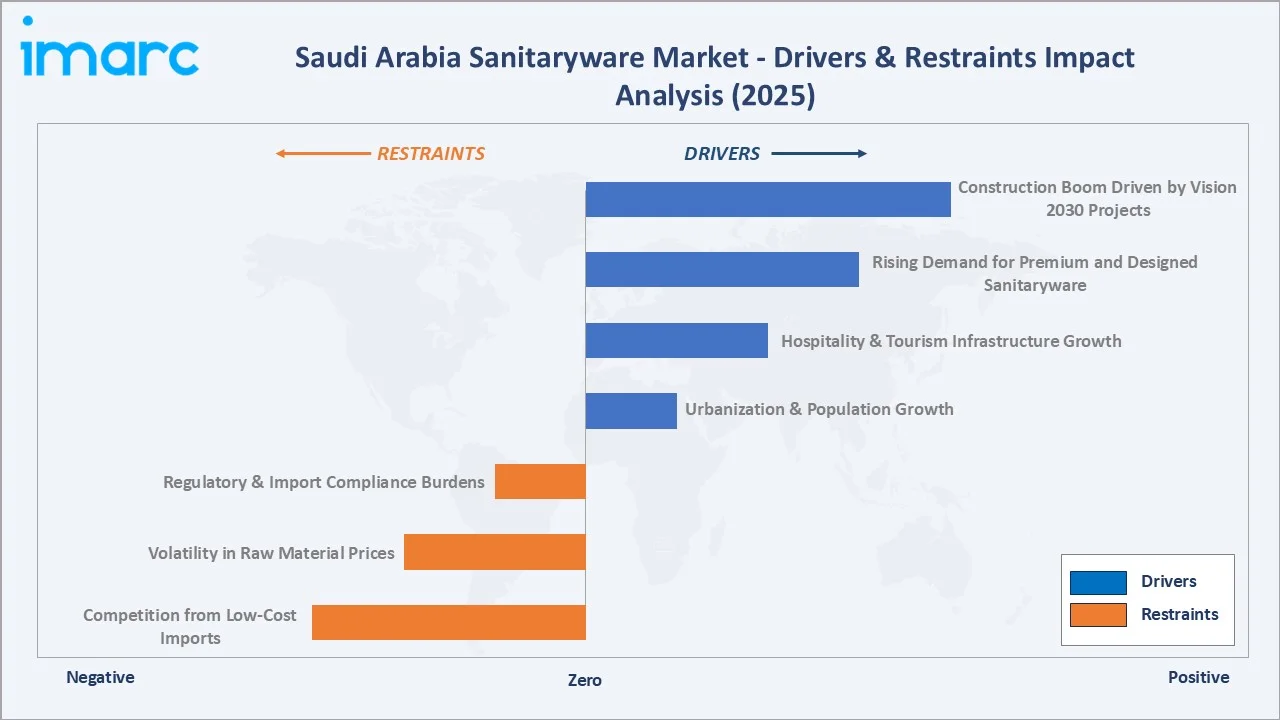
- Construction Boom Driven by Vision 2030 Projects: Saudi Arabia's Vision 2030 is the single largest structural demand driver for the sanitaryware market. Mega-projects, such as NEOM, The Red Sea Project, Diriyah, and Qiddiya, require hundreds of thousands of bathroom and sanitation units across their hospitality, residential, and commercial components.
- Rising Demand for Premium and Designed Sanitaryware: Increasing disposable incomes among Saudi nationals, combined with a strong aesthetic preference for premium and European-designed bathroom products, is driving steady upgrading in sanitaryware choices. Developers targeting higher-income segments increasingly specify international branded fixtures, and premium product adoption is particularly visible in Riyadh's residential and hospitality sectors.
- Hospitality and Tourism Infrastructure Growth: Saudi Arabia's targeted expansion of tourism, aiming for 150 Million visitors annually by 2030, has generated a multi-billion-dollar hotel and resort construction pipeline. Each hotel project requires extensive sanitaryware installations across guest rooms, public washrooms, and back-of-house facilities.
- Urbanization and Population Growth: Saudi Arabia's urban population, which hit 85.17% of total residents in 2024, is growing steadily due to both natural demographic increase and continued rural-to-urban migration. New urban settlements and city expansions require corresponding investment in housing and sanitation infrastructure.
Market Restraints
- Competition from Low-Cost Imports: A significant volume of low-cost sanitaryware enters the Saudi Arabia market through imports from Asia, particularly from manufacturers offering products at price points that domestic and premium international players find difficult to match on cost alone. This import pressure limits margin expansion for established suppliers in the mass-market tier.
- Volatility in Raw Material Prices: The production of ceramic sanitaryware is energy-intensive and requires consistent supply of clay, feldspar, and silica. Global fluctuations in energy prices and periodic supply disruptions in raw mineral markets can compress manufacturer margins and create pricing uncertainty for downstream distributors and contractors.
- Regulatory and Import Compliance Burdens: Products sold in Saudi Arabia must meet SASO certification requirements, and the compliance process can add lead times and administrative costs, particularly for smaller importers and new market entrants seeking to access the Saudi sanitaryware market for the first time.
Market Opportunities
- Expansion of Smart and Water-Efficient Sanitaryware: Water scarcity is a structural constraint in Saudi Arabia, and regulatory bodies have progressively tightened water consumption standards for plumbing fixtures. Dual-flush cisterns, sensor-activated faucets, and low-flow fixtures are increasingly specified in new construction projects to meet these evolving efficiency benchmarks, creating a growing premium demand segment.
- Affordable Housing Segment Growth: The Saudi government's sustained investment in affordable housing creates a large-volume, lower-price-point demand segment that domestic manufacturers and cost-competitive importers are well positioned to serve. This segment offers scale-based growth opportunities for suppliers with efficient supply chains.
Market Challenges
- Dependence on Oil-Linked Government Spending: A significant proportion of Saudi Arabia's construction pipeline is either directly funded or incentivized by government spending, which in turn is influenced by oil revenue cycles. Periods of lower oil prices historically correlate with slowdowns in public infrastructure spending, which can moderate sanitaryware demand in the short term.
- Supply Chain Complexity for International Brands: International sanitaryware brands serving the Saudi Arabia market must navigate complex import logistics, port handling, in-country distribution, and after-sales service requirements. Managing these supply chain layers while maintaining competitive pricing and product availability at point of sale remains an ongoing operational challenge.
Emerging Market Trends
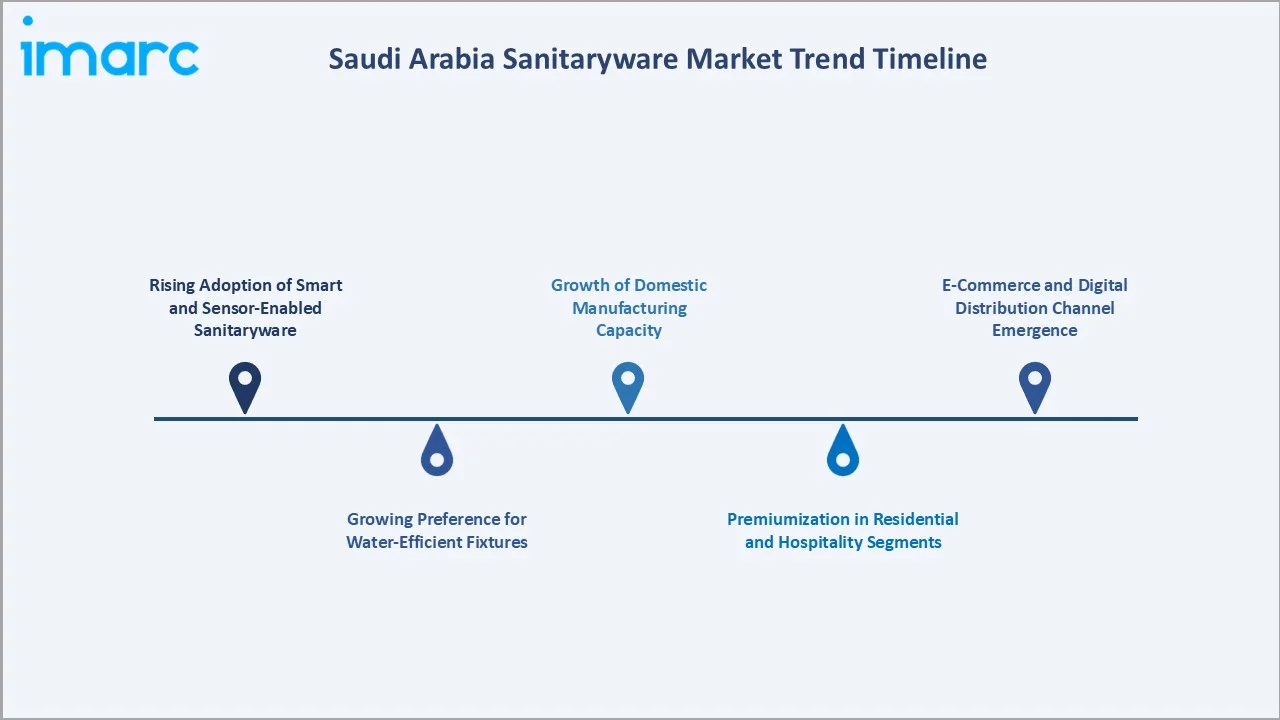
1. Rising Adoption of Smart and Sensor-Enabled Sanitaryware
Smart bathroom fixtures, including touchless faucets, sensor-flush systems, and electronically controlled bidet seats, are gaining traction in Saudi Arabia's premium residential and hospitality segments. This trend is further supported by increasing demand for convenient, hygienic, and technology-integrated bathroom solutions across modern developments.
2. Growing Preference for Water-Efficient Fixtures
Water scarcity is a structural constraint in Saudi Arabia, and regulatory bodies have progressively tightened water consumption standards for plumbing fixtures. Dual-flush water closets and low-flow wash basin faucets are increasingly specified in new construction projects.
3. Premiumization in Residential and Hospitality Segments
A distinct shift toward branded, design-led, and premium sanitaryware is visible across Saudi Arabia's upper-income residential and five-star hospitality segments. Developers and project owners are increasingly willing to invest in imported European brands to differentiate their properties, driving higher average transaction values and expanding the market share of brands that offer both quality assurance and strong aesthetic appeal.
4. Growth of Domestic Manufacturing Capacity
Saudi Arabia's Vision 2030 includes a targeted increase in domestic industrial production capacity, and the ceramics and building materials sector is benefiting from this policy direction. Local producers are expanding capacity and product range, which reduces dependence on imports, shortens supply chain lead times, and positions local manufacturers to compete more effectively on price and delivery speed.
5. E-Commerce and Digital Distribution Channel Emergence
Online retail platforms and digital procurement tools are beginning to gain a foothold in Saudi Arabia's building materials distribution ecosystem. While the majority of sanitaryware procurement remains through traditional trade channels, a growing number of contractors and retail buyers are sourcing products through online marketplaces, expanding market access for both domestic and international brands.
Industry Value Chain Analysis
The Saudi Arabia sanitaryware value chain spans six stages, from raw material sourcing and manufacturing through quality certification, distribution, retail installation, and end-user lifecycle management. Each stage plays a critical role in delivering product from production facilities to the final installation site.
|
Stage |
Key Players / Examples |
|
Raw Material Sourcing |
Clay and mineral extraction companies, silica and feldspar suppliers, chemical glaze material providers |
|
Manufacturing & Processing |
Sanitaryware production plants, ceramic firing facilities, casting and glazing operations |
|
Quality Control & Testing |
In-house testing laboratories, third-party certification bodies, SASO compliance testing centers |
|
Distribution & Logistics |
Regional distributors, building materials wholesalers, freight and logistics service providers |
|
Retail & Installation |
Sanitaryware showrooms, building supply retailers, licensed plumbing installation contractors |
|
End Users |
Residential households, commercial property developers, hospitality operators, public infrastructure projects |
Manufacturers with integrated backward linkages, securing raw material supply and operating proprietary production facilities, are better positioned to manage cost and quality, while those with strong forward integration into distribution networks enjoy superior market responsiveness.
Technology Landscape in the Saudi Arabia Sanitaryware Industry
Advanced Ceramic Manufacturing Technologies
Modern sanitaryware production employs computer-controlled casting, isostatic pressing, and high-temperature tunnel kiln firing to produce ceramic fixtures with consistent dimensional accuracy, surface quality, and structural strength. These manufacturing advances have reduced defect rates, shortened production cycles, and expanded the design possibilities available to product developers.
Smart Fixture Integration and IoT Connectivity
Next-generation sanitaryware is increasingly embedded with sensors, microcontrollers, and wireless connectivity that enable touchless operation, automated flush activation, real-time water consumption monitoring, and integration with smart home management systems. These technologies are finding adoption in Saudi Arabia's premium residential developments and flagship hospitality properties.
Water Efficiency and Flow Control Innovations
Dual-flush cistern technologies, pressure-assisted flushing systems, and flow-regulated wash basin fittings are enabling substantial reductions in per-use water consumption without compromising functional performance. Manufacturers are certifying products to international water efficiency standards to meet regulatory requirements and respond to customer sustainability preferences.
Surface Treatment and Anti-Microbial Coatings
Advanced glaze formulations incorporating nanoparticle surface treatments and antimicrobial agents are being applied to sanitaryware products to resist staining, reduce cleaning frequency, and inhibit bacterial growth. These functional surface innovations are particularly valued in high-traffic commercial and healthcare facility applications.
Market Segmentation Analysis
The report covers the following segments:
|
Segment Category |
Leading Segment |
Market Share |
Year |
|
Product |
Water Closets |
36.8% |
2025 |
|
Material |
Ceramic |
71.6% |
2025 |
|
End User |
🔒 |
🔒 |
2025 |
|
Distribution Channel |
🔒 |
🔒 |
2025 |
|
Region |
Northern and Central Region |
39.3% |
2025 |

By Product
Water closets command a 36.8% majority share of the Saudi Arabia sanitaryware market in 2025. Their dominant position reflects the mandatory requirement for at least one water closet in every bathroom unit across all building types, creating a baseline volume demand that scales directly with total construction activity.
To access detailed market analysis, Request Sample
Wash basins hold a 28.4% share, driven by their dual installation across bathroom and kitchen configurations.
By Material
Ceramic leads with 71.6% material share, reflecting the segment's combination of durability, hygienic surface properties, competitive pricing, and extensive product availability across all design categories. Ceramic's dominance is reinforced by the preferences of volume construction contractors who prioritize proven materials with established supply chains.
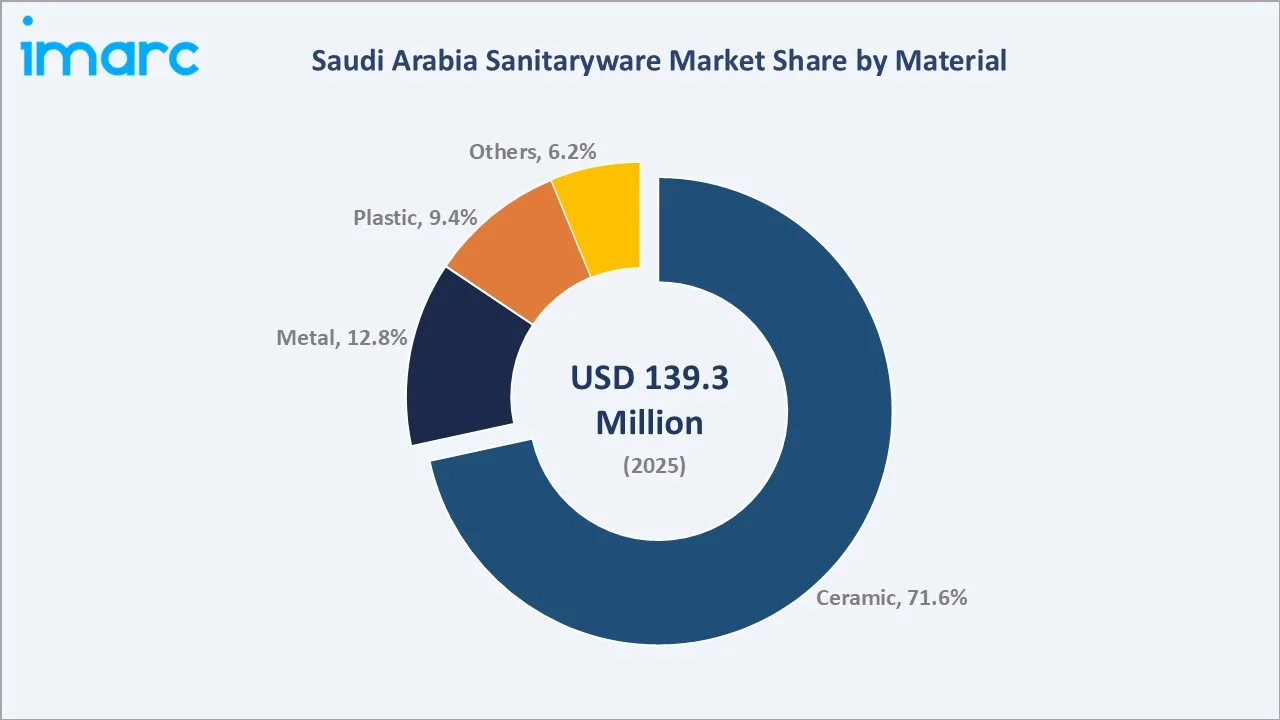
Metal holds 12.8% share in 2025, primarily in commercial and industrial applications where stainless steel fixtures offer superior durability and resistance to heavy use and chemical cleaning.
Regional Market Insights
|
Region |
Share (2025) |
Key Growth Drivers |
|
Northern and Central Region |
39.3% |
Large urban population, government infrastructure investment, and high construction activity in Riyadh and Qassim |
|
Western Region |
29.0% |
Tourism-driven hospitality expansion, Makkah and Madinah pilgrimage infrastructure, and Jeddah urban development |
|
Eastern Region |
20.1% |
Oil sector workforce housing, commercial real estate growth, and expanding industrial zone infrastructure |
|
Southern Region |
11.6% |
Rising public housing projects, growing urbanization, and government-funded regional development programs |
Northern and Central Region at 39.3% in 2025 leads the market, anchored by Riyadh's position as the Kingdom's primary construction market. The capital hosts a disproportionate share of Vision 2030-aligned mega-projects, government-delivered housing, and private sector commercial real estate development.
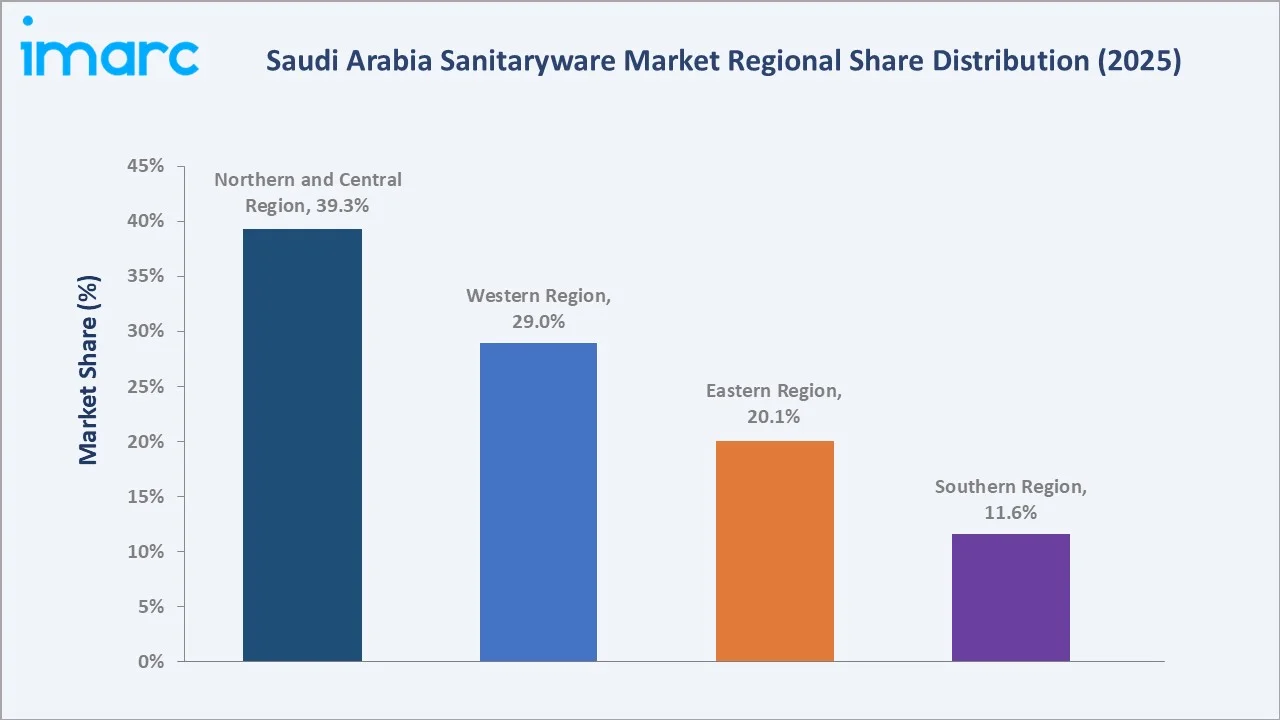
Western Region, at 29.0%, is the fastest growing region, supported by expanding construction activity, hospitality development, and rising demand for modern sanitaryware solutions.
Competitive Landscape
The Saudi Arabia sanitaryware market is moderately concentrated, with established international brands competing alongside domestic producers. Market leaders hold competitive advantages through strong brand equity, broad product portfolios, established distributor networks, manufacturing capabilities, and consistent product quality.
|
Company Name |
Brand / Key Product |
Position |
Strategic Focus |
|
Roca Group |
ROCA |
Leader |
Expanding premium product portfolio and strengthening distribution in the market |
|
Geberit AG |
Geberit |
Leader |
Growing in-wall cistern and concealed system adoption across commercial and hospitality segments |
|
Kohler Co. |
Kohler Kitchen and Bathroom |
Leader |
Strengthening luxury and smart bathroom product offerings in the premium Saudi Arabia market |
|
Villeroy & Boch AG |
Ideal Standard |
Challenger |
Expanding product accessibility across mid-range residential and commercial segments through the Ideal Standard brand |
|
LIXIL Corporation |
Grohe |
Challenger |
Enhancing water-efficient product range to align with Saudi regulatory and sustainability trends through the Grohe brand |
Key players include ROCA Group, Geberit AG, Kohler Co., Villeroy & Boch AG, and LIXIL Corporation, among others.
Key Company Profiles
Roca Group
Roca Group is a Spanish family-owned company headquartered in Barcelona, Spain, engaged in the design, production, and marketing of products for the bathroom space. Operating across several countries, it is one of the world's leading manufacturers of sanitaryware and bathroom solutions.
- Product Portfolio: Sanitaryware including water closets, wash basins, cisterns, pedestals, shower trays, and integrated bathroom solutions under the ROCA brand.
- Recent Developments: Roca Group has continued to invest in expanding its manufacturing footprint, launching new product collections, and growing its presence in high-growth emerging markets through distribution partnerships and showroom development.
- Strategic Focus: Broadening the premium product range and enhancing distribution capabilities to address rising demand from residential and hospitality construction projects.
Geberit AG
Geberit AG is a Swiss sanitary technology company headquartered in Rapperswil-Jona, Switzerland, and a leading European manufacturer of sanitary products and systems. The company specializes in concealed cisterns, in-wall installation systems, drainage systems, piping systems, and bathroom ceramics.
- Product Portfolio: In-wall cisterns, sanitary installation systems, piping systems, and bathroom ceramics under the Geberit brand.
- Recent Developments: Geberit AG has continued to advance its product range across installation systems and ceramics and invest in sustainability initiatives and digital tools for trade professionals.
- Strategic Focus: Increasing adoption of in-wall installation systems and strengthening relationships with architects and contractors across commercial and hospitality projects.
Kohler Co.
Kohler Co. is an American privately held company headquartered in Kohler, Wisconsin, engaged in the design and manufacture of kitchen and bath products, engines, and power systems.
- Product Portfolio: Water closets, wash basins, bathtubs, shower systems, and integrated bathroom suites.
- Recent Developments: Kohler Co. has continued to broaden its bathroom product range, grow its international distribution network, and invest in smart bathroom technologies to serve premium residential and hospitality segments globally.
- Strategic Focus: Strengthening luxury and smart bathroom offerings to address rising demand in the premium market through expanded project specifications and retail partnerships.
Market Concentration Analysis
The Saudi Arabia sanitaryware market exhibits moderate concentration. The top international players collectively account for a meaningful share of the premium and upper-mid-market tier, while the mid-range and affordable segments are more fragmented across a larger number of regional importers and domestic suppliers.
Barriers to entry in the premium segment are significant, encompassing SASO certification requirements, established distributor relationships, strong brand recognition among specifiers and developers, and the working capital requirements to manage import logistics and inventory across a large geography.
Consolidation activity is gradual, with larger international players strengthening their regional distribution footprint while domestic manufacturers expand capacity to compete more broadly across price tiers. The market is expected to remain moderately concentrated through the forecast period, with limited structural changes to the competitive framework.
Investment & Growth Opportunities
Fastest-Growing Segments
Within the material segment, ceramic is expanding, supported by its durability, design versatility, and widespread use across residential and commercial applications. Its suitability for contemporary bathroom designs is further strengthening adoption across new construction and renovation projects.
Emerging Markets
Western Region is the fastest-growing region, supported by expanding construction activity, hospitality development, and increasing demand for modern bathroom fixtures. Ongoing urban development and investment in residential and commercial infrastructure are creating additional opportunities for sanitaryware suppliers.
Venture & Investment Trends
Investment activity in the Saudi Arabia sanitaryware sector is concentrated around capacity expansion by domestic manufacturers, retail showroom development by premium international brands, and distribution network investment by regional wholesalers responding to growing construction volumes.
Future Market Outlook (2026-2034)
The Saudi Arabia sanitaryware market is forecast to expand from USD 139.3 Million in 2025 to USD 146.3 Million in 2026, reaching USD 216.8 Million by 2034 at a CAGR of 5.04%, adding approximately USD 77.5 Million in absolute market value over the forecast period.
Four forces will shape the market through 2034: continued delivery of large-scale residential and hospitality construction under Vision 2030; rising adoption of water-efficient and smart sanitaryware driven by regulatory standards and consumer preferences; expansion of domestic manufacturing capacity reducing import dependency; and increasing competition from lower-cost regional manufacturers that will apply pressure to mid-market pricing.
By 2034, the Saudi Arabia sanitaryware market is expected to be more competitive and increasingly shaped by domestic manufacturing, construction activity, and evolving pricing dynamics. Market expansion will also depend on the pace of infrastructure development and the ability of manufacturers to respond to changing demand conditions.
Research Methodology
Primary Research
Primary research included structured interviews with sanitaryware manufacturers, regional distributors, construction project procurement managers, plumbing contractors, and retail showroom operators across Saudi Arabia. These interviews provided on-the-ground insights into product demand patterns, pricing dynamics, buyer preferences, and emerging market developments.
Secondary Research
Secondary sources included Saudi Ministry of Housing publications, SASO regulatory standards, Saudi Ceramics Company annual reports, GCC trade data from customs authorities, construction industry reports, and publicly available company disclosures. International sanitaryware manufacturer publications and regional building materials trade databases were also incorporated.
Forecasting Models
Market forecasts used top-down and bottom-up modeling approaches combining construction activity indicators, population growth projections, housing delivery data, hospitality pipeline data, and historical market size trends. CAGR calculations were calibrated against regional construction investment projections and macroeconomic scenarios aligned with Vision 2030 delivery timelines.
Saudi Arabia Sanitaryware Market Report Coverage:
| Report Features | Details |
|---|---|
| Base Year of the Analysis | 2025 |
| Historical Period | 2020-2025 |
| Forecast Period | 2026-2034 |
| Units | Million USD |
| Scope of the Report | Exploration of Historical and Forecast Trends, Industry Catalysts and Challenges, Segment-Wise Historical and Predictive Market Assessment:
|
| Products Covered | Water Closets, Wash Basins, Pedestals, Cisterns, Others |
| Materials Covered | Ceramic, Metal, Plastic, Others |
| End Users Covered | Residential, Commercial |
| Distribution Channels Covered | Home Centers, Specialty Stores, Online, Others |
| Regions Covered | Northern and Central Region, Western Region, Eastern Region, Southern Region |
| Companies Covered | Roca Group, Geberit AG, Kohler Co., Villeroy & Boch AG, LIXIL Corporation, etc. |
| Customization Scope | 10% Free Customization |
| Post-Sale Analyst Support | 10-12 Weeks |
| Delivery Format | PDF and Excel through Email (We can also provide the editable version of the report in PPT/Word format on special request) |
Key Benefits for Stakeholders:
- IMARC’s industry report offers a comprehensive quantitative analysis of various market segments, historical and current market trends, market forecasts, and dynamics of the Saudi Arabia sanitaryware market from 2020-2034.
- The research report provides the latest information on the market drivers, challenges, and opportunities in the Saudi Arabia sanitaryware market.
- Porter's five forces analysis assist stakeholders in assessing the impact of new entrants, competitive rivalry, supplier power, buyer power, and the threat of substitution. It helps stakeholders to analyze the level of competition within the Saudi Arabia sanitaryware industry and its attractiveness.
- Competitive landscape allows stakeholders to understand their competitive environment and provides an insight into the current positions of key players in the market.
Frequently Asked Questions About the Saudi Arabia Sanitaryware Market Report
The Saudi Arabia sanitaryware market size is estimated at USD 146.3 Million in 2026, driven by Vision 2030 construction programs, rising residential demand, and growing hospitality infrastructure development.
The market is projected to grow at a CAGR of 5.04% from 2026-2034, reaching USD 216.8 Million, supported by sustained construction activity and growing premium product adoption.
Water closets lead the product segment at 36.8% in 2025, driven by their mandatory installation requirement across all residential, commercial, and hospitality bathroom configurations.
Ceramic dominates the material segment at 71.6% in 2025, reflecting its durability, hygienic properties, wide design availability, and competitive pricing relative to alternative materials.
Northern and Central Region commands 39.3% share in 2025, led by higher construction activity, concentrated urban development, and strong residential and commercial demand for sanitaryware.
Leading players include ROCA Group, Geberit AG, Kohler Co., Villeroy & Boch AG, and LIXIL Corporation, among others.
Vision 2030 is the primary structural driver, generating large-scale residential, commercial, and hospitality construction across the Kingdom, each project requiring extensive sanitaryware installation across bathroom and sanitation facilities.
Saudi Arabia's water scarcity context and tightening regulatory standards are driving increased adoption of dual-flush cisterns, low-flow fixtures, and sensor-activated products, creating a premium growth pocket within the broader market.
Key opportunities include smart and water-efficient sanitaryware, domestic manufacturing capacity expansion, and digital procurement platforms serving the construction industry.
Key challenges include intense competition from low-cost Asian imports, volatility in raw material and energy prices, dependence on government-linked construction spending, and the cost and complexity of SASO certification for new market entrants.
Need more help?
- Speak to our experienced analysts for insights on the current market scenarios.
- Include additional segments and countries to customize the report as per your requirement.
- Gain an unparalleled competitive advantage in your domain by understanding how to utilize the report and positively impacting your operations and revenue.
- For further assistance, please connect with our analysts.
 Request Customization
 Speak to an Analyst
 Request Brochure
 Inquire Before Buying
Benefits of Customization
- Personalize this research
- Triangulate with your data
- Get data as per your format and definition
- Gain a deeper dive into a specific application, geography, customer, or competitor
- Any level of personalization
Get in Touch With Us
UNITED STATES
Phone: +1-201-971-6302
INDIA
Phone: +91-120-433-0800
UNITED KINGDOM
Phone: +44-753-714-6104
Email: [email protected]
Client Testimonials




.webp)




.webp)













Related Reports

Choose your plan
*Please note that the prices mentioned below are starting prices for each bundle type. Kindly contact our team for further details.*
Single User License
- 1 User License, Access on 2 Devices
- PDF Report + Excel Dataset (Password Protected)
- Lifetime Access
- No Printing Rights
- 10% Free Report Customization
- 10–12 Weeks of Analyst Support
Five User License
- Access for 5 Users, 2 Devices per User
- PDF Report + Excel Dataset (Password Protected)
- Lifetime Access
- Dedicated Account Manager
- 12–14 Weeks of Analyst Support
- No Printing Rights
- 15% Free Report Customization
- 25% Discount on Your Next Purchase
Corporate User License
- Unlimited User Access (Within Your Organization)
- PDF Report + Excel Dataset
- Lifetime Access
- Dedicated Account Manager
- 14–20 Weeks of Analyst Support
- No Printing Rights
- 20% Free Report Customization
- 30% Discount on Your Next Purchase
Essential Insights
What's included:
3 reports
- Lifetime Access
- PDF Reports
- Excel Datasets
- 2 Weeks of Free Analyst Support
- 2 User Licenses
- Access on 2 Devices
- Printing Rights
- Complimentary PowerPoint (PPT) Version
- Complimentary License Upgrade
Professional Access
What's included:
5 reports
- Lifetime Access
- PDF Reports
- Excel Datasets
- 8 Weeks of Free Analyst Support
- 2 User Licenses
- Access on 2 Devices
- Printing Rights
- Complimentary PowerPoint (PPT) Version
- Complimentary License Upgrade
Business Advantage
What's included:
8 reports
- Lifetime Access
- PDF Reports
- Excel Datasets
- 14 Weeks of Free Analyst Support
- 2 User Licenses
- Access on 2 Devices
- Printing Rights
- Complimentary PowerPoint (PPT) Version
- Complimentary License Upgrade
Enterprise Intelligence
What's included:
10 reports
- Lifetime Access
- PDF Reports
- Excel Datasets
- 20 Weeks of Free Analyst Support
- 2 User Licenses
- Access on 2 Devices
- Printing Rights
- Complimentary PowerPoint (PPT) Version
- Complimentary License Upgrade