
Saudi Arabia Snack Bar Market Size, Share, Trends and Forecast by Product Type, Distribution Channel, and Region, 2026-2034
Saudi Arabia Snack Bar Market Size, Share, Trends & Forecast (2026-2034)
The Saudi Arabia snack bar market grew from USD 260.5 Million in 2025 to USD 279.9 Million in 2026 and is projected to reach USD 414.6 Million by 2034, growing at a CAGR of 5.04% during 2026-2034. The market is driven by rising health consciousness among Saudi consumers shifting toward nutritious on-the-go snacking alternatives, growing fitness and sports culture generating energy bar demand, and increasing product innovation in clean-label and low-sugar formulations. Saudi Arabia achieved a major urban health milestone, with WHO recognizing 16 Healthy Cities covering nearly 9 million residents and promoting environments that support healthier lifestyles, supporting demand for nutritious snack bars. Cereal bars lead at 51.4% by product type, hypermarkets/supermarkets dominate at 44.6% by distribution channel, and the Northern and Central region commands the largest share at 39.2%.
Market Snapshot
|
Metric |
Value |
|
Base Year Market Size (2025) |
USD 260.5 Million |
| Market Size (2026) | USD 279.9 Million |
|
Forecast Market Size (2034) |
USD 414.6 Million |
|
CAGR (2026-2034) |
5.04% |
|
Base Year |
2025 |
|
Historical Period |
2020-2025 |
|
Forecast Period |
2026-2034 |
|
Dominant Product Type |
Cereal Bars (51.4%, 2025) |
|
Dominant Distribution Channel |
Hypermarket/Supermarkets (44.6%, 2025) |
|
Leading Region |
Northern and Central Region (39.2%, 2025) |
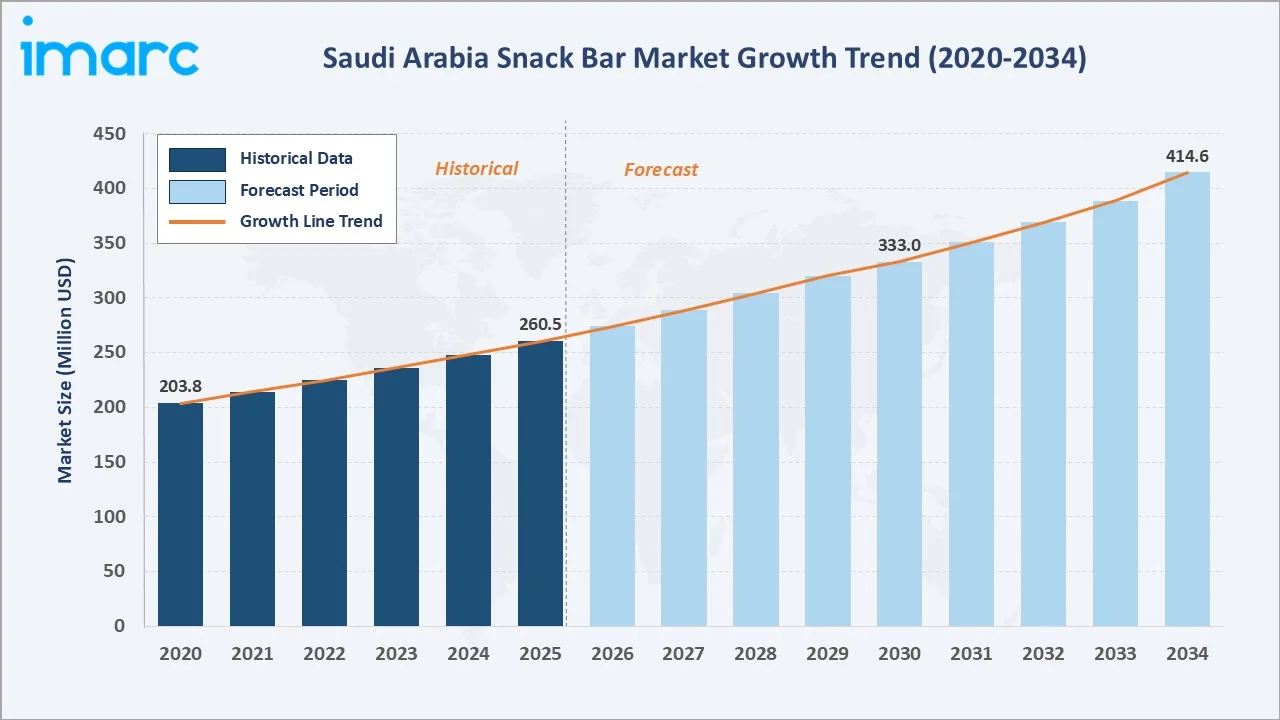
The Saudi Arabia snack bar market has grown from USD 203.8 Million in 2020 to USD 260.5 Million in 2025 and an estimated USD 279.9 Million in 2026, reflecting consistent expansion driven by health and wellness trends and evolving snacking habits among Saudi consumers. The market is projected to reach USD 333.0 Million by 2030 and USD 414.6 Million by 2034.
To get more information on this market, Request Sample
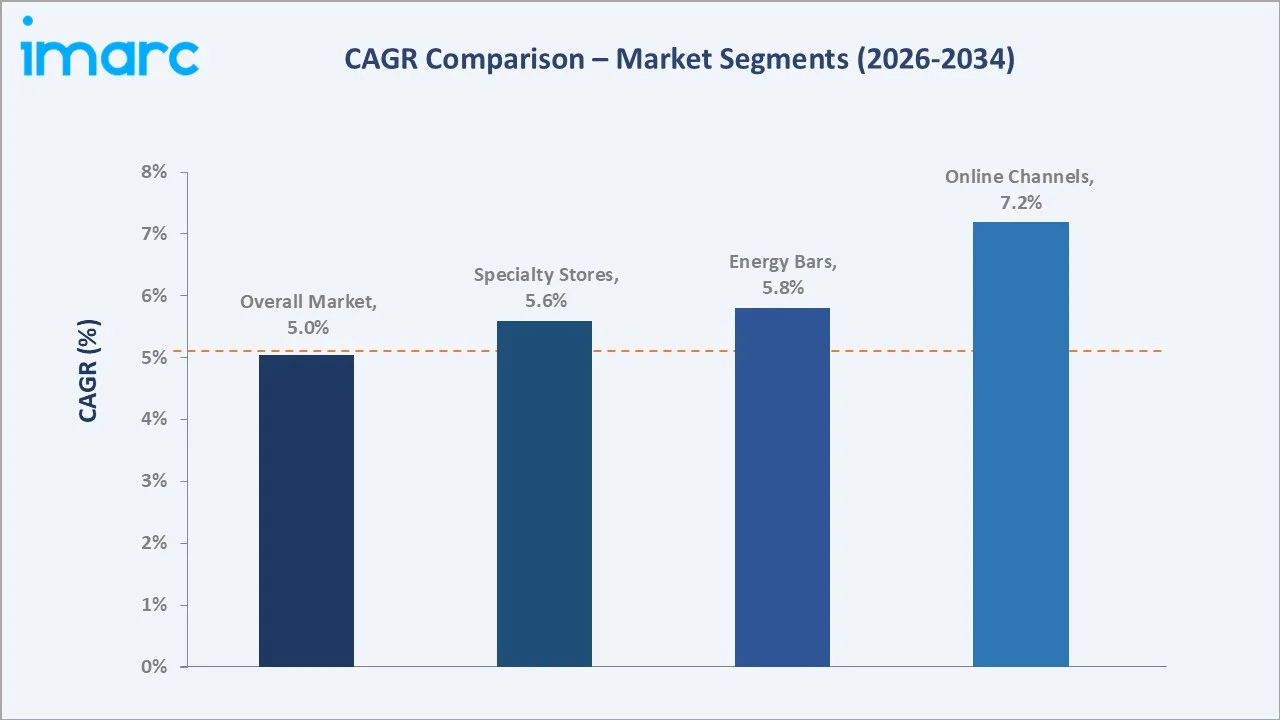
Online channels grow at ~7.2% CAGR through e-grocery adoption and D2C brand penetration. Energy bars grow at ~5.8% CAGR through sports nutrition and fitness culture demand. Specialty stores grow at ~5.6% CAGR through health food retail expansion and premium brand positioning.
Executive Summary
The Saudi Arabia snack bar market is experiencing sustained growth as a structural shift in consumer snacking behavior transforms the nutritional profile of the Kingdom's between-meal consumption. Saudi Arabia's demographics, with a young population of 70% under 35, rising female workforce participation, and growing sports participation, are creating the primary consumer constituency for convenient, nutritious snack bars that provide portable nutrition without the preparation requirements of traditional meal alternatives. Cereal bars at 51.4% lead through mainstream consumer familiarity and breakfast replacement positioning. Hypermarkets/supermarkets at 44.6% lead by distribution through retail reach and consumer accessibility. Northern & Central region leads regionally at 39.2%.
Key Market Insights
|
Insight |
Data |
|
Dominant Product Type |
Cereal Bars - 51.4% share (2025) |
|
Dominant Distribution Channel |
Hypermarket/Supermarkets - 44.6% (2025) |
|
Leading Region |
Northern & Central Region - 39.2% (2025) |
|
Key Market Opportunities |
Growing demand for healthy, protein-rich, and functional snack bars driven by rising health awareness, active lifestyles, and increasing preference for convenient on-the-go nutrition. |
Key Analytical Observations Supporting the Above Data:
- Cereal Bars at 51.4%: Cereal bars dominate through their positioning as a familiar, accessible, and versatile snacking option that serves both breakfast replacement and between-meal nutrition needs. Various brands have built strong mainstream consumer awareness through hypermarket shelf space, recognized brand trust, and competitive pricing relative to specialty energy and protein bars.
- Hypermarkets/Supermarkets at 44.6%: Hypermarkets and supermarkets command distribution channel leadership through their unmatched retail footprint across Saudi Arabia's urban centers. Saudi consumers' preference for comprehensive grocery shopping at hypermarkets sustains the channel's dominant market position for everyday snack bar purchases.
- Northern & Central Region at 39.2%: The Northern and Central region leads through Riyadh's status as Saudi Arabia's largest consumer market, the highest concentration of modern retail channels including hypermarkets and specialty health food stores, the largest gym and fitness club membership base, and the highest density of corporate office environments where on-the-go snacking is prevalent among professionals.
Saudi Arabia Snack Bar Market Overview
The Saudi Arabia snack bar market encompasses packaged nutritional bars consumed as on-the-go snacks, meal replacements, pre- and post-workout nutrition, and portable energy solutions across three primary product categories: cereal bars (including granola bars, oat bars, and muesli bars), energy bars (including protein bars, sports nutrition bars, and high-energy workout bars), and others (including fruit and nut bars, date bars, protein clusters, and functional wellness bars). Vision 2030's National Transformation Program includes specific targets for reducing lifestyle disease prevalence that indirectly support consumer migration toward healthier snack bar alternatives.
Market Dynamics
To evaluate market opportunities, Request Sample
Market Drivers
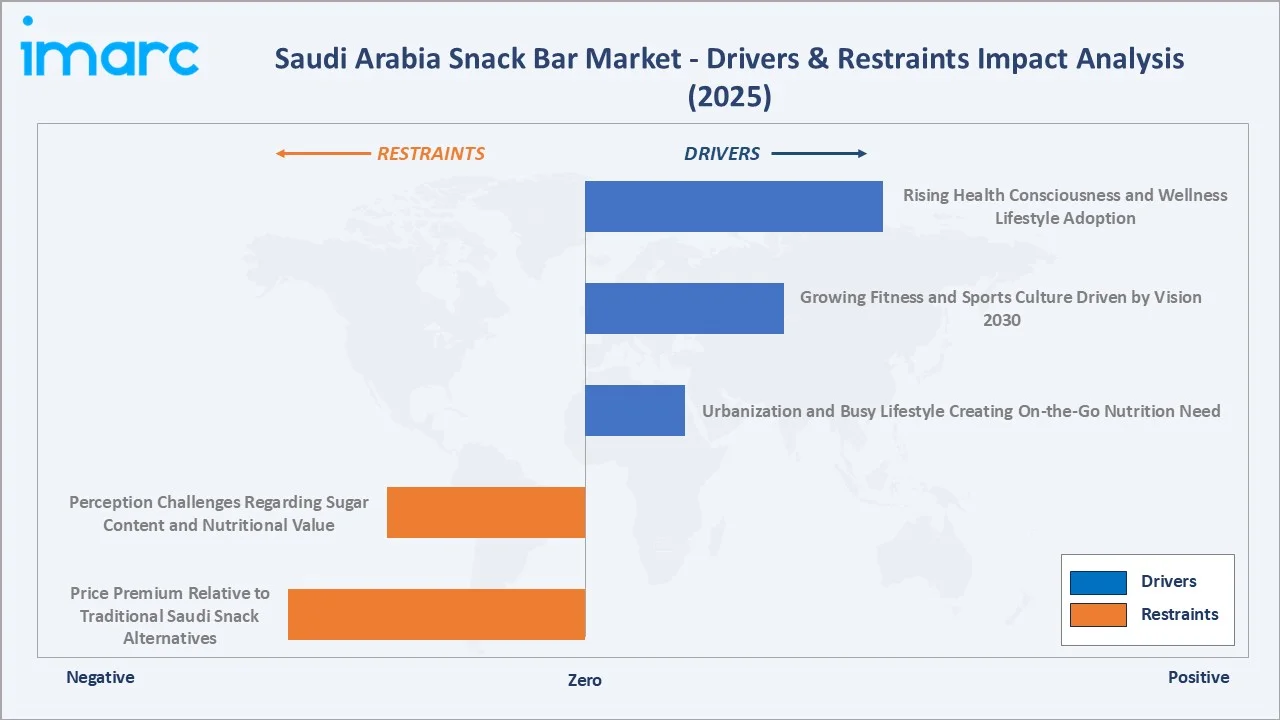
- Rising Health Consciousness and Wellness Lifestyle Adoption: Saudi Arabia's health and wellness megatrend is transforming consumer snacking preferences, with a growing cohort of health-aware consumers actively seeking nutritious alternatives to traditional confectionery and high-calorie snacks. Government awareness campaigns addressing Saudi Arabia's high rates of obesity, diabetes affecting over 25% of adults, and cardiovascular disease are increasing consumer receptivity to functional food claims on snack bars, including high-protein, high-fiber, low-sugar, and low-GI nutritional positioning.
- Growing Fitness and Sports Culture Driven by Vision 2030: Vision 2030's Quality of Life Program has generated unprecedented investment in sports infrastructure across Saudi Arabia, with thousands of new gym facilities, sports clubs, running tracks, cycling paths, and recreational centers opening nationwide. This growing fitness-engaged consumer segment represents the primary target for energy bars and protein bars, where pre- and post-workout consumption drives regular, habitual purchase behavior.
- Urbanization and Busy Lifestyle Creating On-the-Go Nutrition Need: Approximately 76% of Saudi nationals live in urban areas, compared with 24% in rural areas. Saudi Arabia's rapid urbanization and the growing proportion of working women and professionals with demanding schedules are driving demand for convenient, portable nutrition solutions that fit busy lifestyles without compromising nutritional quality. Snack bars provide a uniquely suitable solution that aligns with the practical nutrition requirements of Saudi Arabia's modernizing workforce.
Market Restraints
- Perception Challenges Regarding Sugar Content and Nutritional Value: Many mainstream cereal and granola bars contain sugar levels comparable to confectionery products, creating consumer skepticism regarding claimed health benefits among more nutritionally literate buyers. As Saudi consumers become increasingly educated about ingredient labels and nutritional benchmarks through social media health content, the gap between marketing claims and actual nutritional value in lower-quality snack bars is creating category credibility challenges that can slow adoption.
- Price Premium Relative to Traditional Saudi Snack Alternatives: Premium energy and protein bars are priced significantly above traditional Saudi snack alternatives, including dates, nuts, and conventional biscuits that provide comparable calories at lower cost. In price-sensitive consumer segments - particularly outside major cities and among younger consumers with limited discretionary income - this price differential limits habitual snack bar adoption to special occasions or post-workout contexts rather than daily consumption.
Market Opportunities
- Date-Based and Locally Inspired Snack Bar Innovation: Saudi Arabia's cultural affinity for dates, a traditional and nutritionally dense food integral to Saudi hospitality, creates a significant product innovation opportunity for date-based snack bars that combine international snack bar formats with beloved local ingredients. Date and nut bars, date and tahini bars, and date-based protein bars with Saudi date varieties represent authentically positioned product lines that can differentiate domestic brands from international imports.
- Female Consumer Segment Development and Targeting: Saudi women’s workforce participation has increased significantly, rising from approximately 17% in 2016 to a record 36.3% in Q1 2025, representing a high-value snack bar consumer segment with specific nutritional needs including bone health, iron, and energy formulations. Female-targeted cereal and wellness bars positioned around beauty nutrition, hormonal health, and sustained energy for professional women represent an underserved segment that international brands, including specialist wellness bars, are beginning to address.
Market Challenges
- Regulatory Registration and Halal Certification Complexity for New Brands: International snack bar brands seeking to enter or expand in Saudi Arabia must navigate product registration, Arabic labeling compliance, and halal certification requirements that can extend time-to-market and add significant compliance costs. The complexity of Saudi food import regulations creates barriers for smaller craft and D2C snack bar brands that cannot efficiently absorb compliance costs, limiting market diversity in the premium and artisanal snack bar segments.
- Consumer Habit Change from Traditional to Packaged Snacking: Despite growing health consciousness, Saudi Arabia's snacking culture remains heavily anchored in traditional options including fresh dates, nuts, Arabic sweets, and baked goods that are embedded in social and hospitality rituals. Shifting deeply ingrained snacking habits toward packaged snack bars requires sustained consumer education investment, convenient retail placement, and compelling taste and texture experiences that overcome the perceived artificiality of processed nutritional bars relative to whole food alternatives.
Emerging Market Trends
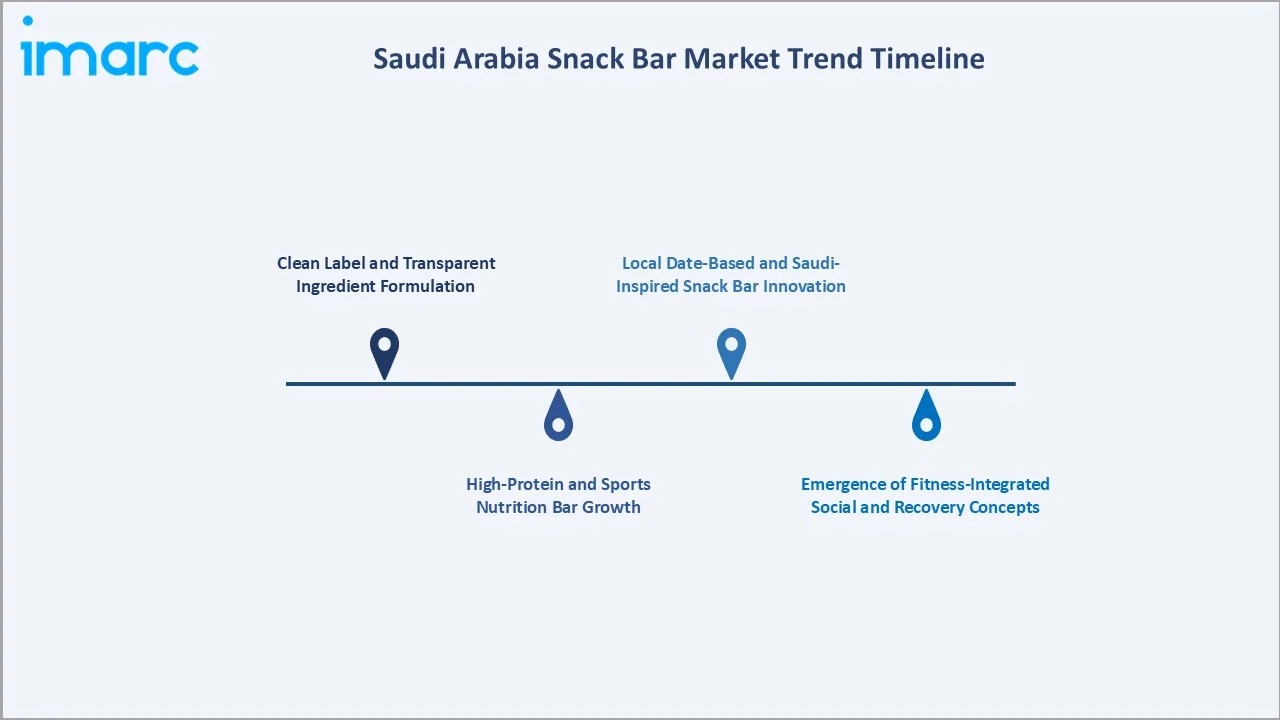
1. Clean Label and Transparent Ingredient Formulation
Saudi Arabia's health-conscious consumer segment is increasingly demanding snack bars with short, recognizable ingredient lists, no artificial preservatives, and transparent nutritional claims. Clean label certifications including non-GMO, organic, gluten-free, and naturally sweetened are gaining traction in specialty retail channels and online platforms.
2. High-Protein and Sports Nutrition Bar Growth
The rapid expansion of Saudi Arabia's gym and fitness culture is driving accelerating demand for high-protein snack bars that support muscle recovery, satiety, and active lifestyle nutrition. Saudi consumers following ketogenic, low-carb, or high-protein dietary patterns are creating a receptive market for protein bars that align with structured nutritional goals, supported by fitness influencer recommendations on Saudi social media.
3. Local Date-Based and Saudi-Inspired Snack Bar Innovation
A growing number of Saudi and GCC-origin snack bar brands are innovating around locally sourced ingredients, particularly Saudi dates, Arabian nuts, tahini, carob, and regional grains, to create snack bar products that resonate culturally with Saudi consumers while meeting international nutritional standards. These locally inspired snack bars position authentically within Saudi Arabia's food culture narrative and can command patriotic premium pricing while supporting Vision 2030's domestic food production objectives. The success of date-based snack products in the GCC market is demonstrating the commercial viability of this innovation approach.
4. Emergence of Fitness-Integrated Social and Recovery Concepts
The emergence of fitness-integrated social and recovery concepts is shaping the Saudi Arabia snack bar market by linking healthy snacking with active lifestyles, wellness, and social experiences. Fitness centers, sports clubs, recovery studios, and wellness-focused venues are increasingly creating opportunities for protein-rich, low-sugar, and functional snack bars positioned around pre- and post-workout nutrition. This trend is further supported by Saudi Arabia’s growing emphasis on physical activity and preventive wellness under Vision 2030, encouraging brands to develop convenient snacks featuring protein, fiber, natural ingredients, and other functional benefits.
Industry Value Chain Analysis
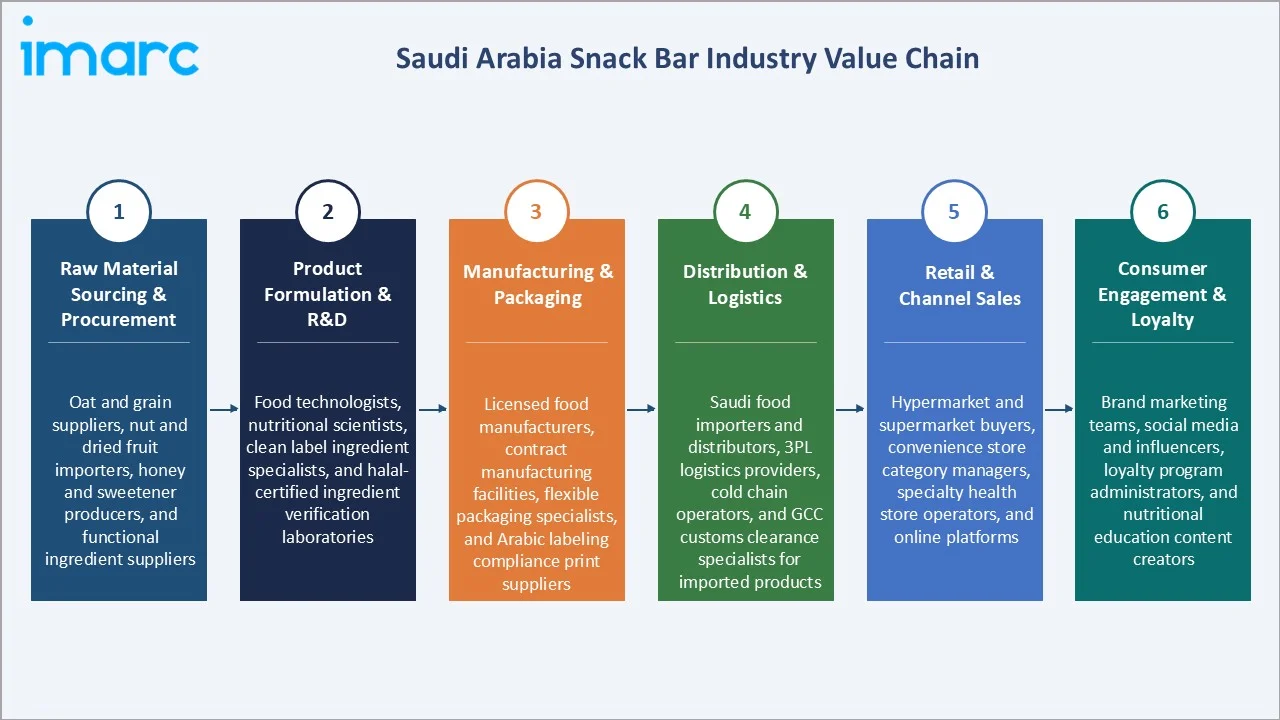
The Saudi Arabia snack bar value chain integrates raw material sourcing and procurement, product formulation and R&D, manufacturing and packaging, distribution and logistics, retail and channel sales, and consumer engagement and loyalty programs across cereal bar and energy bar product categories.
|
Stage |
Key Participants |
|
Raw Material Sourcing & Procurement |
Oat and grain suppliers, nut and dried fruit importers, honey and sweetener producers, and functional ingredient suppliers. |
|
Product Formulation & R&D |
Food technologists, nutritional scientists, clean label ingredient specialists, and halal-certified ingredient verification laboratories. |
|
Manufacturing & Packaging |
Licensed food manufacturers, contract manufacturing facilities, flexible packaging specialists, and Arabic labeling compliance print suppliers. |
|
Distribution & Logistics |
Saudi food importers and distributors, 3PL logistics providers, cold chain operators, and GCC customs clearance specialists for imported products. |
|
Retail & Channel Sales |
Hypermarket and supermarket buyers, convenience store category managers, specialty health store operators, and online platforms. |
|
Consumer Engagement & Loyalty |
Brand marketing teams, social media and influencers, loyalty program administrators, and nutritional education content creators. |
Product formulation and R&D represent the highest strategic value stage in the Saudi Arabia snack bar value chain, as the quality of nutritional formulation, taste profile, texture, and ingredient selection directly determines consumer repeat purchase behavior, retail buyer listings, and the ability to command premium price positioning.
Technology Landscape in the Saudi Arabia Snack Bar Industry
Food Technology and Functional Ingredient Innovation
Advanced food technology is enabling snack bar manufacturers to achieve superior nutritional profiles, extended shelf life, and improved taste and texture in regulatory-compliant formulations. High-pressure processing (HPP) technology preserves nutritional value while extending shelf life without artificial preservatives, aligning with clean label consumer preferences. Plant-based protein extraction technologies from pea, brown rice, and hemp are enabling halal-certified protein enrichment of energy bars at competitive ingredient costs. Prebiotic fiber incorporation from chicory root and acacia gum, and probiotic snack bar development, represent functional food technology trends emerging in Saudi specialty channels.
Digital Commerce and E-Commerce Platform Technology
Saudi Arabia's snack bar brands are leveraging sophisticated e-commerce and digital commerce technologies to reach health-conscious consumers through data-driven targeting. AI-powered product recommendation engines are presenting snack bars to consumers with compatible purchase histories at the moment of grocery decision-making. WhatsApp commerce integration is enabling specialty snack bar brands to maintain direct relationships with loyal customer bases through personalized promotion and product launch communications. Subscription management platforms are enabling recurring snack bar delivery programs that sustain habitual purchase frequency beyond impulse purchase occasions.
Smart Packaging and Consumer Engagement Technology
Saudi Arabia's snack bar market is progressively adopting QR code-enabled packaging that links consumers to detailed nutritional information, ingredient sourcing stories, and halal certification documentation in Arabic, responding to Saudi consumers' desire for comprehensive product transparency. Some premium brands are deploying NFC-enabled packaging that connects to digital loyalty programs, recipe content, and personalized nutrition advice platforms. These digital packaging technologies are particularly effective in the specialty health food retail environment where engaged health-conscious consumers actively research product information before purchase.
Market Segmentation Analysis
The report covers the following segments:
|
Segment Category |
Leading Segment |
Market Share |
Year |
|
Product Type |
Cereal Bars |
51.4% |
2025 |
|
Distribution Channel |
Hypermarket/Supermarkets |
44.6% |
2025 |
|
Region |
Northern and Central Region |
39.2% |
2025 |

By Product Type
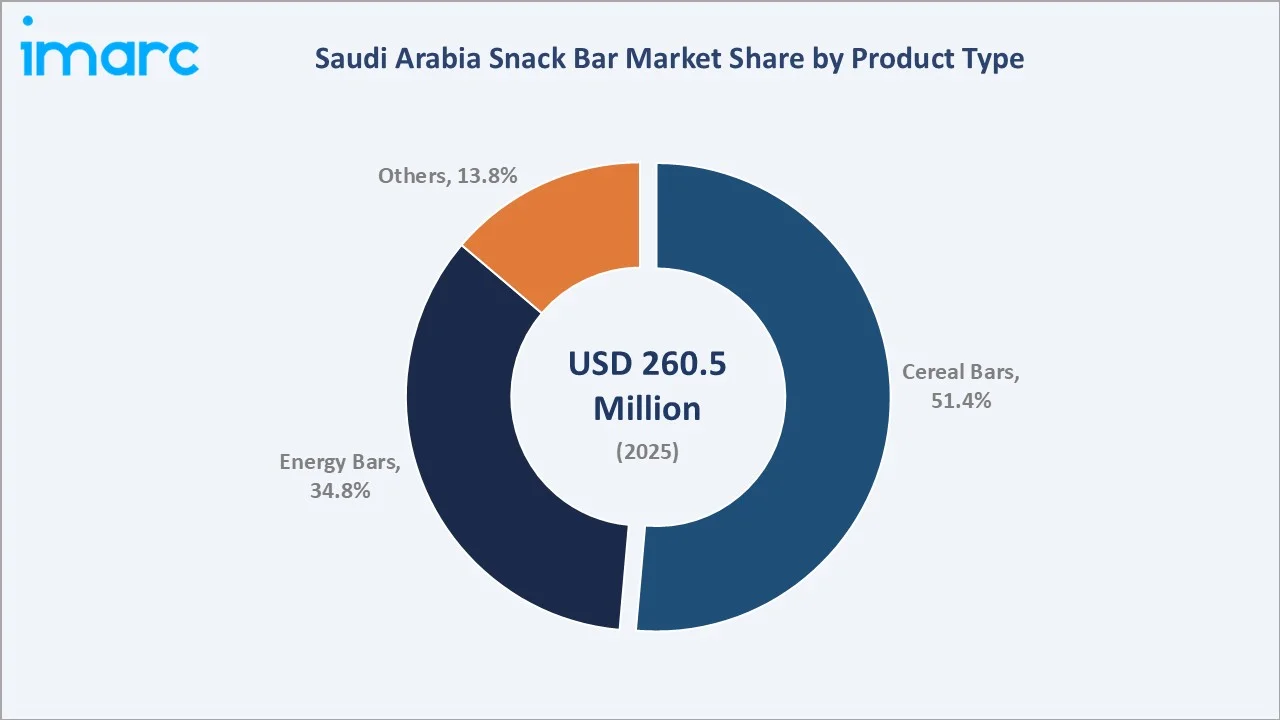
Cereal bars lead at 51.4% (2025), through mainstream consumer familiarity, breakfast replacement positioning, widely accessible price points, and strong shelf presence across Saudi hypermarkets and supermarkets under recognized international brands.
To access detailed market analysis, Request Sample
Energy bars at 34.8% are growing at ~5.8% CAGR through gym culture, sports nutrition adoption, and high-protein consumer segment expansion. The energy bar sub-category includes both traditional carbohydrate-focused sports energy bars for endurance athletes and the growing protein bar sub-segment for strength training and daily protein supplementation. Others at 13.8% includes date bars, fruit and nut bars, and specialty wellness bars growing through the clean eating movement.
By Distribution Channel
Hypermarkets/supermarkets lead at 44.6% (2025), through Saudi Arabia's large modern retail infrastructure, comprehensive snack bar category management, and the consumer preference for consolidated grocery shopping that drives snack bar purchases as part of regular household provisioning.
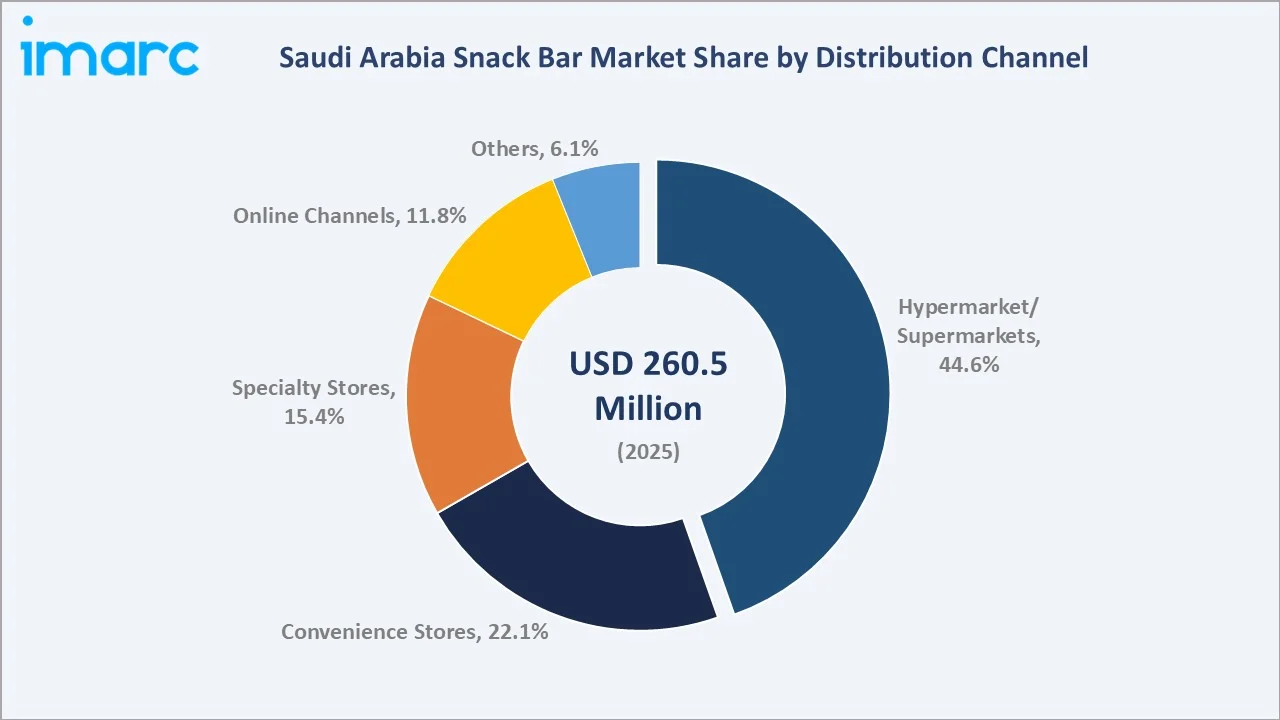
Convenience stores at 22.1% serve impulse purchase and immediate consumption needs through widespread locations near gyms, offices, and transit points. Specialty stores at 15.4% serve health-focused consumers through premium positioning and curated product ranges. Online channels at 11.8% are the fastest-growing channel at ~7.2% CAGR through e-grocery and D2C adoption. Others at 6.1% include vending machines and corporate wellness programs.
Regional Market Insights
|
Region |
Share (2025) |
Key Saudi Arabia Snack Bar Market Drivers & Characteristics |
|
Northern & Central Region |
39.2% |
Reflecting Riyadh's largest consumer population base, highest concentration of modern hypermarket and specialty health food retail, largest gym and fitness club density, and highest share of office-going professionals driving on-the-go snacking demand. |
|
Western Region |
29.3% |
Reflecting Jeddah's cosmopolitan and health-conscious consumer culture, strong specialty health food retail presence, Makkah and Madinah pilgrimage visitor snacking demand, and established international brand distribution network in the Western Region. |
|
Eastern Region |
19.8% |
Reflecting large expatriate professional population with strong international snack bar brand familiarity, industrial workforce convenience snacking demand, and the Eastern Province's established modern retail infrastructure. |
|
Southern Region |
11.7% |
Reflecting growing health awareness in Asir and Jizan provinces, expanding modern retail penetration in southern Saudi cities, and government investment in Vision 2030 sports and wellness facilities driving fitness-linked snack bar adoption. |
The Northern and Central region's 39.2% leadership reflects Riyadh's extraordinary convergence of market drivers: Saudi Arabia's largest urban population, the highest density of premium modern retail formats, the greatest concentration of fitness clubs and sports facilities created by Vision 2030 investment, and the largest cohort of corporate professionals driving workplace snacking demand. The Western region's 29.3% reflects Jeddah's historically more cosmopolitan consumer culture that has embraced international health food trends earlier than the national average, combined with a well-developed specialty health food retail ecosystem.
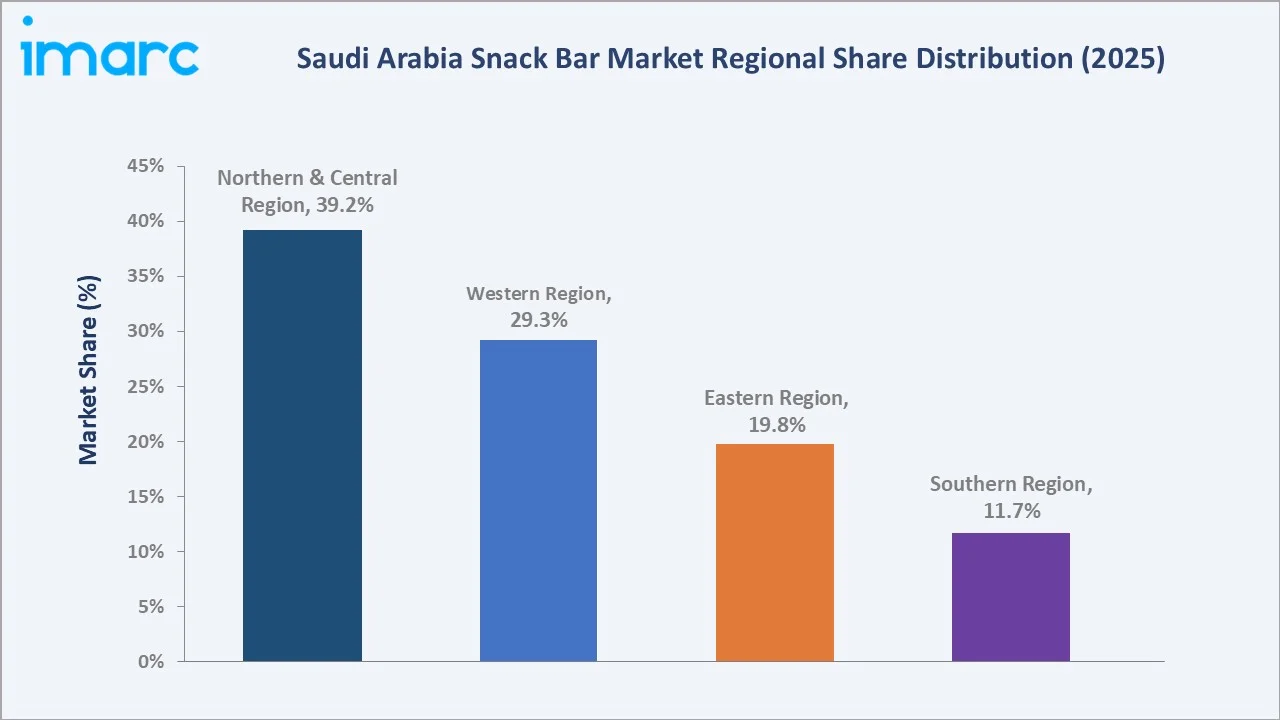
The Eastern region's 19.8% reflects the unique demand profile of a large expatriate professional community, who maintain international brand preferences and drive premium snack bar demand through specialty retail channels. The Southern region at 11.7% represents growing potential as Vision 2030 infrastructure investment expands modern retail access and increases sports facility availability in previously underserved southern Saudi provinces.
Competitive Landscape
The Saudi Arabia snack bar market is moderately concentrated, led by global food multinationals with established Saudi Arabia distribution. International specialist snack bar brands are growing their Saudi market presence. Competition is driven by brand recognition, nutritional positioning, retail shelf placement, taste and texture differentiation, and halal certification compliance.
|
Company |
Key Products |
Market Position |
Core Strength |
|
Nestlé |
FITNESS Chocolate Bar, NESQUIK Bar |
Market Leader |
Nestlé leads the Saudi snack bar category through its comprehensive breakfast and snacking portfolio, including the Nestlé Fitness range of cereal bars. |
|
General Mills Inc. |
Nature Valley Crunchy Granola Bars, Golden Grahams Treat Bars, Lucky Charms Treat Bars, Fiber One Snack Bar, Lärabar Gluten Free Wellness Bars |
Market Leader |
General Mills, Inc. operates as a leading international player in the Saudi Arabia snack bar market through its established retail product presence and extensive distribution networks. |
|
Mars, Incorporated |
SNICKERS candy bars, TWIX Caramel Cookie Bar, MILKY WAY bars, MARS bar |
Market Leader |
Mars, Incorporated acts as a major key player in the Saudi Arabia snack and confectionery market, driving local production, expanding health-focused snack brands, and increasing its overall market reach |
|
PepsiCo |
Quaker Chewy Granola Bars, Quaker Chewy Classic Granola Bars, Quaker Chewy Protein Granola Bars, Quaker Chewy Yogurt Flavored Granola Bars |
Established Player |
PepsiCo's Quaker brand competes in the Saudi cereal bar segment through its recognized Quaker oat bar range, leveraging Quaker's established credibility as a heart-healthy whole grain food authority. |
|
Mondelēz International |
CLIF Bar, Perfect Bar, The Original Refrigerated Protein Bar |
Established Player |
Mondelēz International operates as a key global and regional industry player participating in the broader Saudi Arabia snack bar and confectionery market |
Companies across the competitive landscape are investing in halal product development, Saudi Arabic packaging adaptation, social media influencer marketing through Saudi fitness personalities, and retail placement expansion in specialty health retailers.
Key Company Profiles
Nestlé
Nestlé, the largest food and beverage company, operates a comprehensive Saudi Arabia business across multiple product categories, including snack bars, through its Nestlé Fitness and related ranges. Nestlé's Saudi Arabia operations benefit from decades of market presence, well-established distribution relationships with every major retail chain, product registration for its complete product portfolio, and the brand trust of one of the most recognized food companies. In the snack bar category, Nestlé competes through its Nestlé Fitness cereal bar range positioned for health-conscious consumers, and through brand extensions from its established confectionery and breakfast cereal ranges that provide credible snack bar extensions.
- Key Products: FITNESS Chocolate Bar, NESQUIK Bar.
- Strategic Focus: Expanding Nestlé's health and wellness snack bar portfolio to address Saudi Arabia's growing demand for nutritious on-the-go options, developing Nestlé Fitness range extensions aligned with Saudi women's health and beauty nutrition trends, and strengthening Nestlé's online channel presence to capture the growing e-grocery snack bar demand.
General Mills Inc.
General Mills Inc. operates in Saudi Arabia primarily through its various snack brands, which has achieved significant brand recognition among Saudi health-conscious consumers as a natural, whole grain, and outdoor-lifestyle-associated snack bar brand. Nature Valley's crunchy granola bars, soft-baked oat bars, and nut and fruit bar ranges are widely distributed through Saudi hypermarkets and are established as school lunchbox and workplace snacking staples. General Mills' Saudi Arabia business benefits from distribution through established GCC food import and distribution partners that maintain a consistent retail presence across hypermarket chains.
- Key Products: Nature Valley Crunchy Granola Bars, Golden Grahams Treat Bars, Lucky Charms Treat Bars, Fiber One Snack Bar, Lärabar Gluten Free Wellness Bars.
- Strategic Focus: Expanding Nature Valley's Saudi Arabia distribution into online and specialty health food channels where the brand's natural ingredient positioning commands premium shelf space and consumer loyalty, developing Nature Valley bar variety aligned with emerging Saudi dietary trends including lower sugar and higher protein formats, and investing in Saudi social media marketing through outdoor and fitness lifestyle influencer partnerships.
Market Concentration Analysis
The Saudi Arabia snack bar market exhibits moderate concentration, with food multinationals commanding the majority of mainstream cereal bar category revenue through their established hypermarket distribution and brand recognition. Specialist snack bar brands collectively address the premium health food and sports nutrition segments. Market concentration is expected to moderate through 2034 as D2C digital brands and local Saudi snack bar producers develop market presence enabled by e-commerce and social commerce distribution channels.
Investment & Growth Opportunities
Highest Growth Segments
Online channel distribution (~7.2% CAGR), energy bars and protein bars (~5.8% CAGR), date-based and locally inspired snack bars, female-targeted wellness bar innovations, and corporate wellness and vending channel development represent the highest-growth investment vectors in the Saudi Arabia snack bar market through 2034.
Investment Themes
- Date-based and Saudi-inspired snack bar brand development: Building a Saudi or GCC-origin snack bar brand centered on high-quality Saudi dates, regional nuts, and culturally resonant ingredients creates authentic differentiation from international imports, patriotic consumer preference appeal, and Vision 2030 local food production alignment. Date-based energy bars can command premium pricing while leveraging Saudi Arabia's world-class date production agriculture.
- D2C e-commerce snack bar brand for health-conscious Saudi consumers: Developing a digitally native snack bar brand leveraging fitness communities for discovery and subscription delivery for habitual consumption creates a scalable business model without the retail listing investment required by traditional snack bar brands. The Saudi D2C food market is nascent but growing rapidly.
Future Market Outlook (2026-2034)
The Saudi Arabia snack bar market is projected to grow from USD 260.5 Million in 2025 to USD 279.9 Million in 2026, reaching USD 414.6 Million by 2034, exhibiting a CAGR of 5.04% during 2026-2034. The market is projected to reach an anchor value of USD 333.0 Million by 2030, representing the mid-period milestone at which Vision 2030's fitness and wellness infrastructure investments reach maturity and e-commerce grocery adoption achieves mainstream consumer penetration.
Three structural forces will define the Saudi Arabia snack bar market through 2034. First, Vision 2030's Quality of Life Program will continue generating millions of new fitness and sports participants who represent the core energy bar and protein bar consumer segment. Second, the online and digital commerce channel will sustain above-market growth through the forecast period, progressively shifting snack bar discovery and purchase from purely physical retail to hybrid digital-physical consumer journeys. Third, product innovation in clean-label, functional, and locally inspired snack bar formats will progressively expand the category's appeal beyond current health food enthusiast consumers to mainstream Saudi snacking occasions.
Research Methodology
Primary Research
Primary research comprised in-depth interviews with snack bar brand category managers, Saudi retail buyers and category development teams, specialty health food store operators, sports nutrition distributors, and consumer behavior analysts specializing in the Saudi FMCG market. These discussions validated market size estimates, assessed product type and channel demand dynamics, evaluated competitive positioning, and provided insights into consumer preference evolution and future market development.
Secondary Research
Secondary research encompassed food import and product registration data, retail sector statistics, Saudi Arabia FMCG panel data, major snack bar brand annual reports and Middle East market disclosures, Saudi Arabia e-commerce market publications, Vision 2030 Quality of Life Program health and wellness reports, and industry publications tracking GCC and Saudi Arabia food and beverage market developments.
Forecasting Models
Forecasting models incorporated historical snack bar market revenue trends, Vision 2030 fitness and wellness participation growth projections, e-commerce grocery adoption rate forecasts, per-capita health food spending trends, consumer health consciousness index evolution, and macroeconomic indicators including Saudi disposable income growth and urbanization rates. Both top-down category spending models and bottom-up product segment volume and value estimates were cross-validated for consistency.
Saudi Arabia Snack Bar Market Report Coverage:
| Report Features | Details |
|---|---|
| Base Year of the Analysis | 2025 |
| Historical Period | 2020-2025 |
| Forecast Period | 2026-2034 |
| Units | Million USD |
| Scope of the Report |
Exploration of Historical and Forecast Trends, Industry Catalysts and Challenges, Segment-Wise Historical and Predictive Market Assessment:
|
| Product Types Covered |
|
| Distribution Channels Covered | Hypermarket/Supermarkets, Convenience Stores, Specialty Stores, Online Channels, Others |
| Regions Covered | Northern and Central Region, Western Region, Eastern Region, Southern Region |
| Companies Covered | Nestlé, General Mills Inc., Mars, Incorporated, PepsiCo, Mondelēz International, etc. |
| Customization Scope | 10% Free Customization |
| Post-Sale Analyst Support | 10-12 Weeks |
| Delivery Format | PDF and Excel through Email (We can also provide the editable version of the report in PPT/Word format on special request) |
Key Benefits for Stakeholders:
- IMARC’s industry report offers a comprehensive quantitative analysis of various market segments, historical and current market trends, market forecasts, and dynamics of the Saudi Arabia snack bar market from 2020-2034.
- The research report provides the latest information on the market drivers, challenges, and opportunities in the Saudi Arabia snack bar market.
- Porter's five forces analysis assist stakeholders in assessing the impact of new entrants, competitive rivalry, supplier power, buyer power, and the threat of substitution. It helps stakeholders to analyze the level of competition within the Saudi Arabia snack bar industry and its attractiveness.
- Competitive landscape allows stakeholders to understand their competitive environment and provides an insight into the current positions of key players in the market.
Frequently Asked Questions About the Saudi Arabia Snack Bar Market Report
The Saudi Arabia snack bar market size is estimated at USD 279.9 Million in 2026, driven by rising health consciousness among Saudi consumers, growing fitness and sports culture, Vision 2030 Quality of Life Program wellness investment, expanding e-commerce accessibility, and product innovation in clean-label and protein-enriched bar formulations.
The Saudi Arabia snack bar market is projected to grow at a CAGR of 5.04% during 2026-2034, sustained by Vision 2030 fitness infrastructure expansion creating active nutrition demand, e-commerce channel growth enabling D2C brand penetration, clean-label product innovation attracting mainstream health consumers, and date-based local snack bar category emergence.
The market is projected to reach approximately USD 333.0 Million by 2030, representing the mid-period milestone at which Vision 2030's fitness and wellness investments reach maturity, e-grocery adoption achieves mainstream consumer penetration, and Saudi snack bar consumption frequency expands beyond specialized health occasions.
Cereal bars lead with a 51.4% share in 2025, through mainstream consumer familiarity, breakfast replacement positioning, widely accessible price points in hypermarkets and supermarkets, and strong shelf presence under recognized international brands.
Hypermarkets/supermarkets lead with a 44.6% share in 2025, through Saudi Arabia's large modern retail infrastructure, comprehensive snack bar category management, and consumer preference for consolidated grocery shopping that drives snack bar purchase as part of regular household provisioning.
The Northern and Central region leads with a 39.2% share in 2025, driven by Riyadh's largest consumer population, highest concentration of modern retail channels, largest gym and fitness club density, and highest share of office-going professionals creating consistent on-the-go snacking demand throughout the business week.
Key players include Nestlé, General Mills Inc., Mars, Incorporated, PepsiCo, and Mondelēz International, among others.
The Saudi Arabia snack bar market is projected to reach USD 414.6 Million by 2034, driven by an expanded active lifestyle consumer base, a mature e-commerce channel, growing local Saudi brand development, functional food bar innovation, and normalized snack bar consumption across diverse Saudi consumer demographic segments.
Need more help?
- Speak to our experienced analysts for insights on the current market scenarios.
- Include additional segments and countries to customize the report as per your requirement.
- Gain an unparalleled competitive advantage in your domain by understanding how to utilize the report and positively impacting your operations and revenue.
- For further assistance, please connect with our analysts.
 Request Customization
 Speak to an Analyst
 Request Brochure
 Inquire Before Buying
Benefits of Customization
- Personalize this research
- Triangulate with your data
- Get data as per your format and definition
- Gain a deeper dive into a specific application, geography, customer, or competitor
- Any level of personalization
Get in Touch With Us
UNITED STATES
Phone: +1-201-971-6302
INDIA
Phone: +91-120-433-0800
UNITED KINGDOM
Phone: +44-753-714-6104
Email: [email protected]
Client Testimonials




.webp)




.webp)













Related Reports

Choose your plan
*Please note that the prices mentioned below are starting prices for each bundle type. Kindly contact our team for further details.*
Single User License
- 1 User License, Access on 2 Devices
- PDF Report + Excel Dataset (Password Protected)
- Lifetime Access
- No Printing Rights
- 10% Free Report Customization
- 10–12 Weeks of Analyst Support
Five User License
- Access for 5 Users, 2 Devices per User
- PDF Report + Excel Dataset (Password Protected)
- Lifetime Access
- Dedicated Account Manager
- 12–14 Weeks of Analyst Support
- No Printing Rights
- 15% Free Report Customization
- 25% Discount on Your Next Purchase
Corporate User License
- Unlimited User Access (Within Your Organization)
- PDF Report + Excel Dataset
- Lifetime Access
- Dedicated Account Manager
- 14–20 Weeks of Analyst Support
- No Printing Rights
- 20% Free Report Customization
- 30% Discount on Your Next Purchase
Essential Insights
What's included:
3 reports
- Lifetime Access
- PDF Reports
- Excel Datasets
- 2 Weeks of Free Analyst Support
- 2 User Licenses
- Access on 2 Devices
- Printing Rights
- Complimentary PowerPoint (PPT) Version
- Complimentary License Upgrade
Professional Access
What's included:
5 reports
- Lifetime Access
- PDF Reports
- Excel Datasets
- 8 Weeks of Free Analyst Support
- 2 User Licenses
- Access on 2 Devices
- Printing Rights
- Complimentary PowerPoint (PPT) Version
- Complimentary License Upgrade
Business Advantage
What's included:
8 reports
- Lifetime Access
- PDF Reports
- Excel Datasets
- 14 Weeks of Free Analyst Support
- 2 User Licenses
- Access on 2 Devices
- Printing Rights
- Complimentary PowerPoint (PPT) Version
- Complimentary License Upgrade
Enterprise Intelligence
What's included:
10 reports
- Lifetime Access
- PDF Reports
- Excel Datasets
- 20 Weeks of Free Analyst Support
- 2 User Licenses
- Access on 2 Devices
- Printing Rights
- Complimentary PowerPoint (PPT) Version
- Complimentary License Upgrade