
Saudi Arabia Toothpaste Market Size, Share, Trends and Forecast by Type, Distribution Channel, End User, and Region, 2026-2034
Saudi Arabia Toothpaste Market Size, Share, Trends & Forecast (2026-2034)
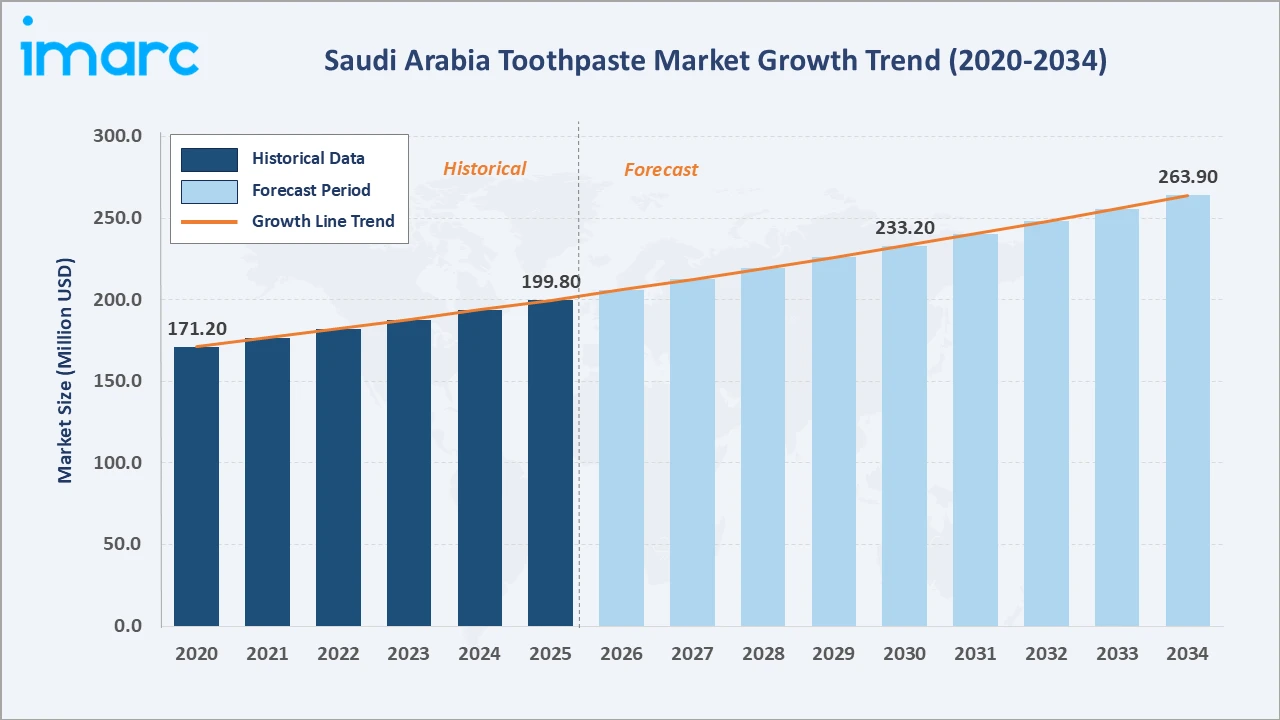
The Saudi Arabia toothpaste market reached USD 199.8 Million in 2025 and is projected to reach USD 263.9 Million by 2034, growing at a CAGR of 3.14% during 2026-2034. Growth is anchored in rising oral health awareness, a young and expanding population, and increasing consumer spending on premium personal care. Conventional toothpaste held 54.6% of type share in 2025, while whitening and sensitive variants are gaining ground through premiumization. Adults account for 84.3% of end-user demand. The Northern and Central Region leads regionally at 38.6%, anchored by Riyadh's population density and modern retail penetration.
Market Snapshot
|
Metric |
Value |
|
Market Size (2025) |
USD 199.8 Million |
|
Forecast Market Size (2034) |
USD 263.9 Million |
|
CAGR (2026-2034) |
3.14% |
|
Base Year |
2025 |
|
Historical Period |
2020-2025 |
|
Forecast Period |
2026-2034 |
|
Largest Type |
Conventional Toothpaste (54.6%, 2025) |
|
Largest End User |
Adults (84.3%, 2025) |
|
Dominant Region |
Northern & Central Region (38.6%, 2025) |
The market expanded from USD 171.2 Million in 2020 to USD 199.8 Million in 2025, reaching USD 233.2 Million by 2030, and is forecast to touch USD 263.9 Million by 2034. Growth is supported by Vision 2030's consumer-sector diversification, rising disposable incomes, and sustained demand from Saudi Arabia's young, growing population of around 35 million.
To get more information on this market, Request Sample
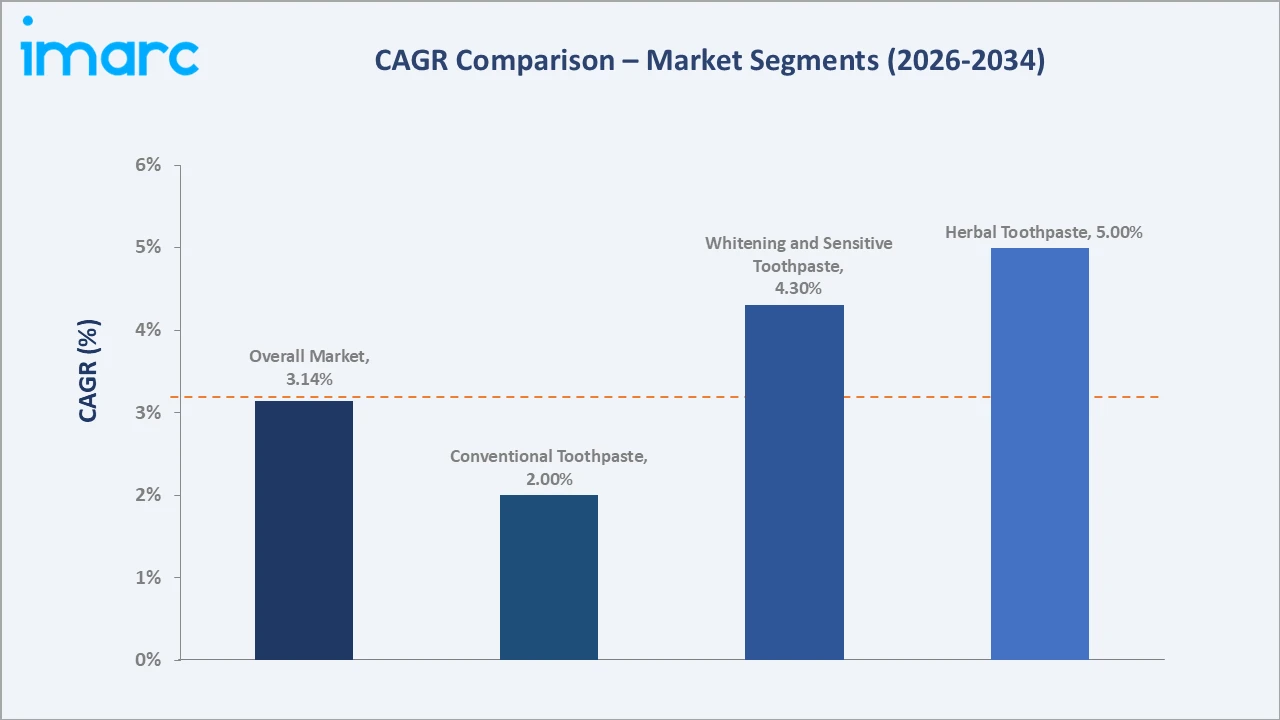
Herbal toothpaste is the fastest-growing type, expanding at an estimated ~5.0% CAGR (2026-2034), followed by whitening and sensitive variants at ~4.3%, while conventional toothpaste grows more modestly at ~2.0% amid category maturity and price sensitivity.
Executive Summary
The Saudi Arabia toothpaste market reached USD 199.8 Million in 2025, propelled by one of the Gulf region's youngest and fastest-growing populations and rising national focus on preventive healthcare under Vision 2030. Saudi Arabia's population climbed to approx. 35 million in 2025, with 74.7% in the working-age bracket, according to the General Authority for Statistics (GASTAT). This demographic base sustains structural demand across everyday oral care.
Conventional toothpaste commands 54.6% of the 2025 market, though whitening, sensitive, and herbal variants are capturing growing wallet share as consumers prioritize specialized oral health outcomes. The market is projected to reach USD 263.9 Million by 2034 at a 3.14% CAGR, supported by SFDA-regulated product safety standards, expanding e-commerce penetration, and rising dental health awareness.
Adults represent 84.3% of end-user demand in 2025, while the Northern and Central Region leads regionally at 38.6%, anchored by Riyadh's population concentration. Herbal and natural-ingredient toothpaste is the fastest-expanding type, reflecting a broader regional shift toward clean-label personal care.
Key Market Insights
|
Insight |
Data |
|
Largest Type |
Conventional Toothpaste - 54.6% share (2025) |
|
Fastest Growing Type |
Herbal Toothpaste - ~5.0% CAGR (2026-2034) |
|
Dominant End User |
Adults - 84.3% share (2025) |
|
Leading Region |
Northern & Central Region - 38.6% share (2025) |
|
Top Companies |
Colgate-Palmolive Company, Unilever, Haleon, and The Procter & Gamble Company |
|
Market Opportunity |
Premium whitening, sensitive & herbal product lines |
Key Analytical Observations Supporting The Above Data:
- Conventional toothpaste leads at 54.6% share (2025): Anchored by affordability and broad availability across Saudi Arabia's hypermarket and pharmacy networks, though growth trails premium categories.
- Herbal toothpaste is the fastest-growing type at an estimated ~5.0% CAGR: Rising consumer preference for miswak, charcoal, and plant-based formulations is reshaping category dynamics.
- Adults dominate end-user demand at 84.3% (2025): Reflecting Saudi Arabia's Ministry of Health-reported dental caries prevalence exceeding 90% among school-age children, driving family-wide preventive purchasing.
- The Northern and Central Region leads with 38.6% share (2025): Riyadh's population density, modern trade penetration, and higher disposable incomes anchor regional dominance.
Saudi Arabia Toothpaste Market Overview
Saudi Arabia's toothpaste market encompasses conventional, whitening and sensitive, and herbal formulations sold through supermarkets, pharmacies, retail stores, and online channels. The market is largely import-driven, with global manufacturers supplying both mass and premium tiers through licensed local distributors.
The Saudi Food and Drug Authority (SFDA) regulates toothpaste under its Cosmetic Law and GSO 1943 standard, requiring product notification through the GHAD electronic system before market entry. Fluoride-containing formulations sit at the borderline between cosmetic and drug classification. Macroeconomic tailwinds include Vision 2030's consumer-sector diversification, a population of approx. 35 million, and growing household spending on personal care and preventive health.
Market Dynamics
To evaluate market opportunities, Request Sample
Market Drivers
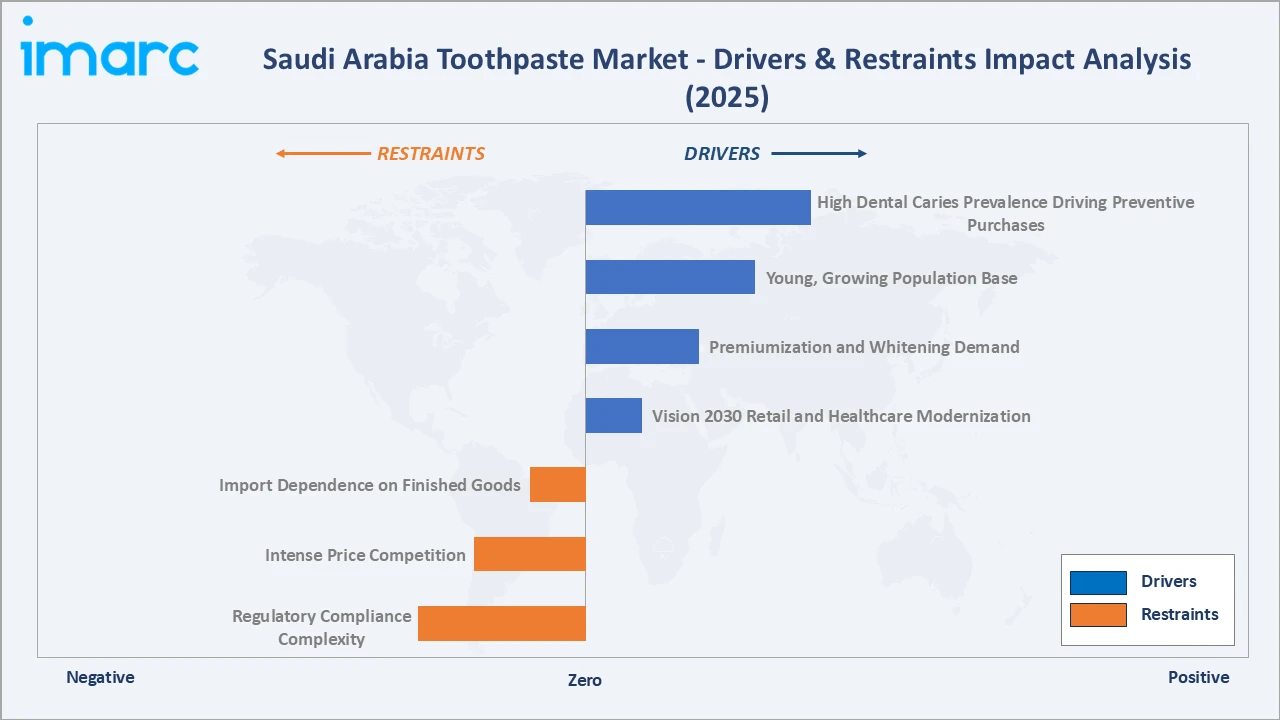
- High Dental Caries Prevalence Driving Preventive Purchases: Saudi Arabia's Ministry of Health reports dental caries affecting approximately 96% of 6-year-olds and 93.7% of 12-year-olds, sustaining structural demand for therapeutic and fluoride toothpaste.
- Young, Growing Population Base: Saudi Arabia's population reached approx. 35 million in 2025, with children aged 0-14 comprising 22.5% of residents, expanding the kids' oral care segment.
- Premiumization and Whitening Demand: Rising disposable incomes and social-media-driven beauty consciousness are lifting demand for whitening and sensitivity-relief toothpaste among urban Saudi consumers.
- Vision 2030 Retail and Healthcare Modernization: Expanding modern trade, pharmacy chains, and digital health awareness campaigns are widening toothpaste distribution and category education.
Market Restraints
- Import Dependence on Finished Goods: Saudi Arabia's toothpaste supply relies heavily on imported finished products and active ingredients, exposing the market to currency and freight cost volatility.
- Intense Price Competition: Established global brands and low-cost regional entrants compete aggressively on price, compressing margins across mass-market segments.
Market Opportunities
- Natural and Herbal Product Innovation: Consumer preference for miswak-based and charcoal formulations creates opportunities for brands blending traditional ingredients with clinical efficacy claims.
- E-Commerce Channel Expansion: Saudi Arabia's growing online retail penetration offers direct-to-consumer growth potential for niche and clinical-tier toothpaste brands.
Market Challenges
- Regulatory Compliance Complexity: SFDA's GHAD notification and labeling requirements demand sustained compliance investment, particularly for smaller regional manufacturers.
- Brand Saturation and Switching Behavior: A crowded competitive field encourages promotion-driven brand switching, complicating long-term consumer loyalty.
Emerging Market Trends
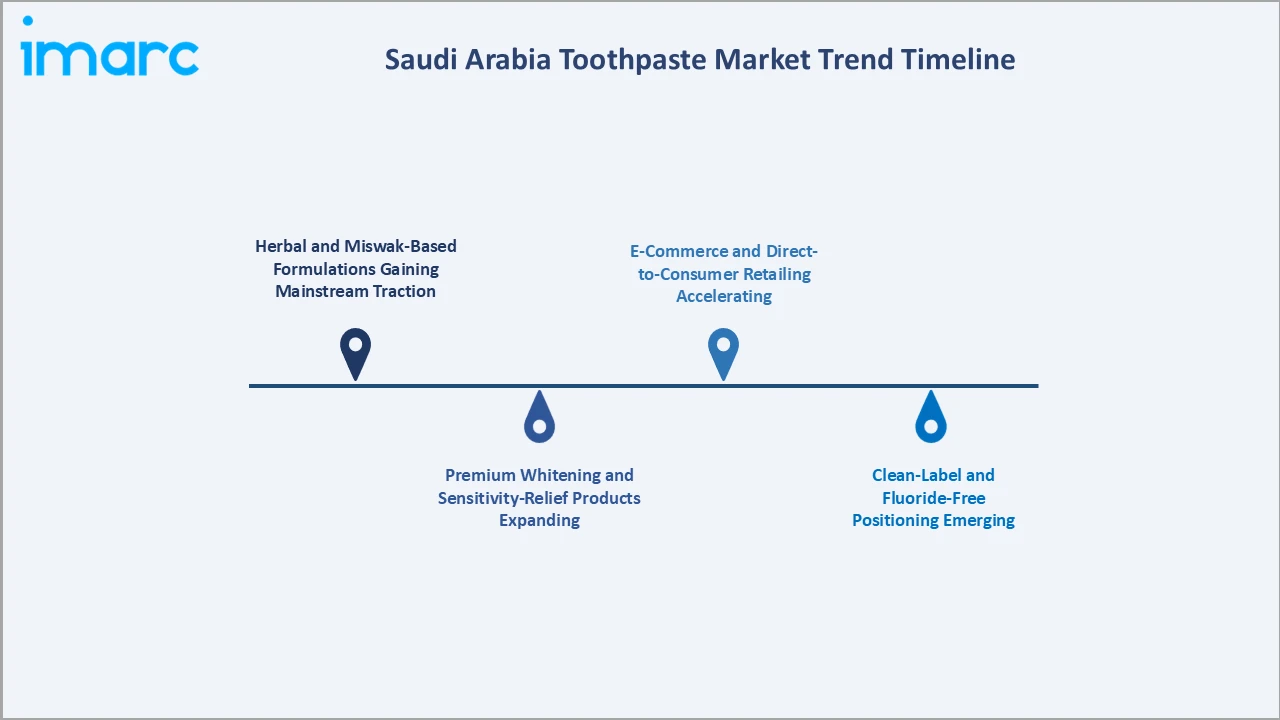
1. Herbal and Miswak-Based Formulations Gaining Mainstream Traction
Traditional miswak extract is being reformulated into modern toothpaste blends, appealing to Saudi consumers seeking natural ingredients without sacrificing clinical efficacy.
2. Premium Whitening and Sensitivity-Relief Products Expanding
Brands are launching dual-benefit formulations combining whitening agents with desensitizing compounds, targeting Saudi Arabia's growing urban, image-conscious consumer base.
3. E-Commerce and Direct-to-Consumer Retailing Accelerating
Online pharmacies and e-commerce platforms are expanding toothpaste accessibility, offering subscription models and doorstep delivery across major Saudi cities.
4. Clean-Label and Fluoride-Free Positioning Emerging
Rising ingredient-transparency awareness is prompting demand for fluoride-free, paraben-free toothpaste variants, particularly among health-conscious younger consumers.
Industry Value Chain Analysis
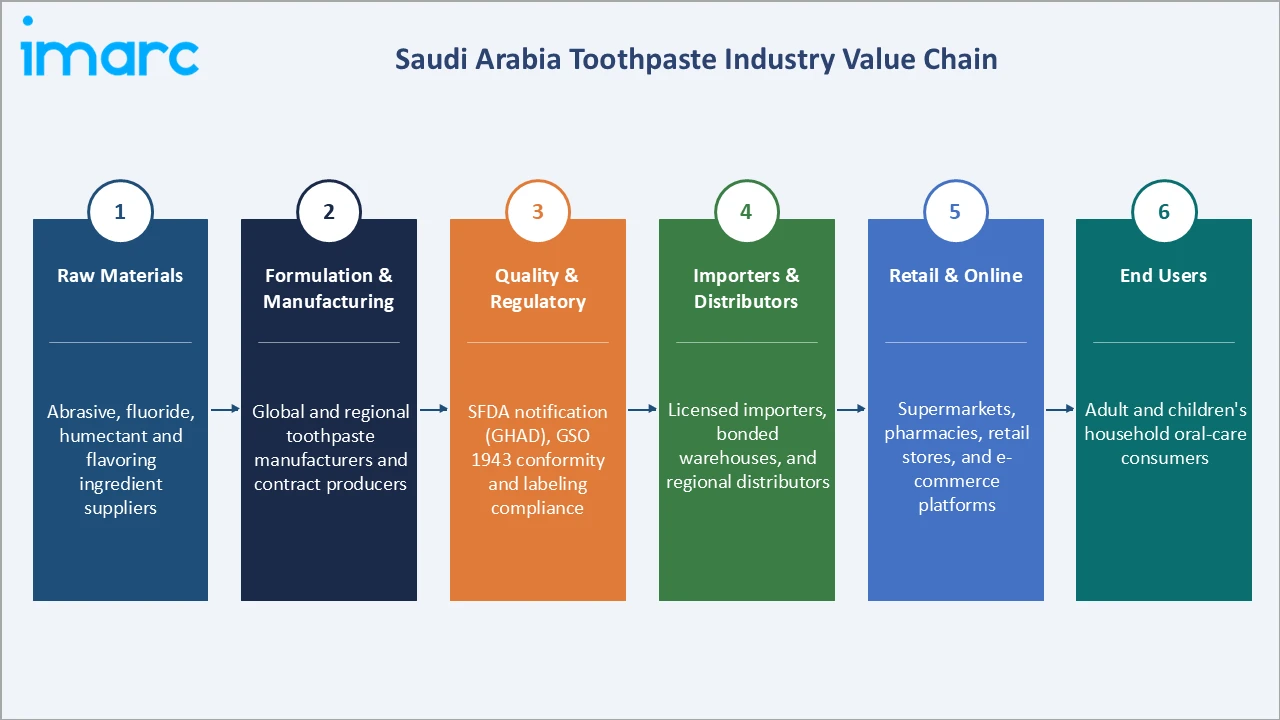
Saudi Arabia's toothpaste value chain spans raw material sourcing, formulation and manufacturing, SFDA regulatory clearance, multi-tier distribution, and end-consumer retail across offline and online channels serving a USD 199.8 Million market (2025).
|
Stage |
Key Participants |
|
Raw Materials |
Abrasive, fluoride, humectant and flavoring ingredient suppliers |
|
Formulation & Manufacturing |
Global and regional toothpaste manufacturers and contract producers |
|
Quality & Regulatory |
SFDA notification (GHAD), GSO 1943 conformity and labeling compliance |
|
Importers & Distributors |
Licensed importers, bonded warehouses, and regional distributors |
|
Retail & Online |
Supermarkets, pharmacies, retail stores, and e-commerce platforms |
|
End Users |
Adult and children's household oral-care consumers |
Distribution follows a multi-tier model: global manufacturers supply licensed Saudi importers and distributors, who in turn service supermarkets, pharmacies, and a fast-growing online retail channel. Direct-to-consumer e-commerce is compressing traditional importer margins and reshaping the distribution landscape.
Technology Landscape in the Saudi Arabia Toothpaste Industry
Fluoride and Remineralization Technology
Fluoride remains the core active ingredient across conventional and therapeutic toothpaste, with SFDA classifying high-fluoride formulations at the drug-cosmetic borderline. Advanced remineralization compounds are increasingly used in premium sensitive-care lines.
Natural and Herbal Ingredient Innovation
Manufacturers are investing in miswak extract, charcoal, and plant-based formulations that combine traditional positioning with modern clinical validation, addressing rising clean-label consumer demand.
Whitening and Sensitivity Technology
Dual-action formulations pairing whitening agents with desensitizing compounds such as potassium nitrate and stannous fluoride are expanding, targeting Saudi Arabia's premiumizing urban consumer base.
Digital Retail and Personalization
E-commerce platforms and pharmacy delivery apps are enabling subscription-based replenishment and targeted product recommendations, strengthening brand engagement across Saudi Arabia's expanding online retail channel.
Market Segmentation Analysis
The report covers the following segments:
|
Segment Category |
Leading Segment |
Market Share |
Year |
|
Type |
Conventional Toothpaste |
54.6% |
2025 |
|
Distribution Channel |
🔒 |
🔒 |
2025 |
|
End User |
Adults |
84.3% |
2025 |
|
Region |
Northern & Central Region |
38.6% |
2025 |

By Type
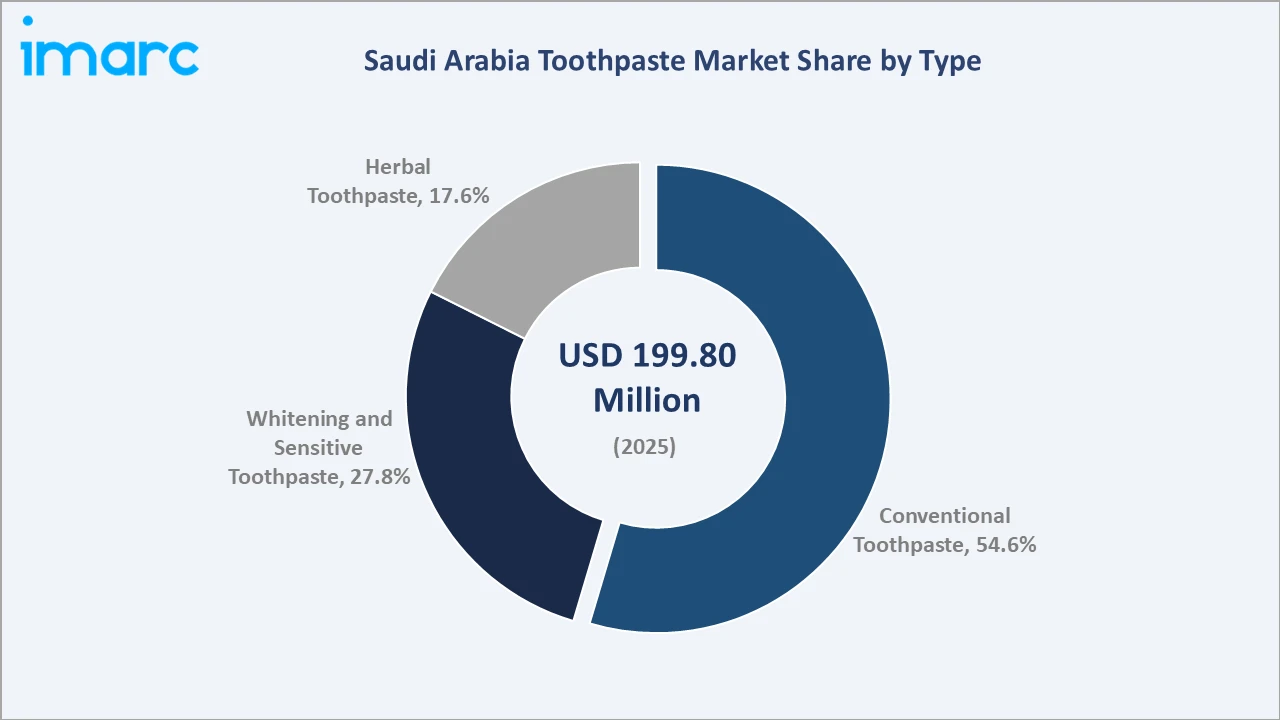
Conventional toothpaste dominates at 54.6% market share (2025), valued for affordability and broad distribution across hypermarkets and pharmacies, though it grows more modestly at an estimated ~2.0% CAGR amid category maturity.
To access detailed market analysis, Request Sample
Whitening and sensitive toothpaste holds 27.8% share, growing at an estimated ~4.3% CAGR (2026-2034) as premiumization accelerates. Herbal toothpaste, at 17.6% share, is the fastest-growing type at ~5.0% CAGR, driven by miswak and charcoal-based formulations gaining mainstream retail placement.
By End User
Adults account for 84.3% of end-user demand (2025), reflecting broad daily-use penetration across Saudi Arabia's 35.3 million population and habitual, multi-tube household purchasing.
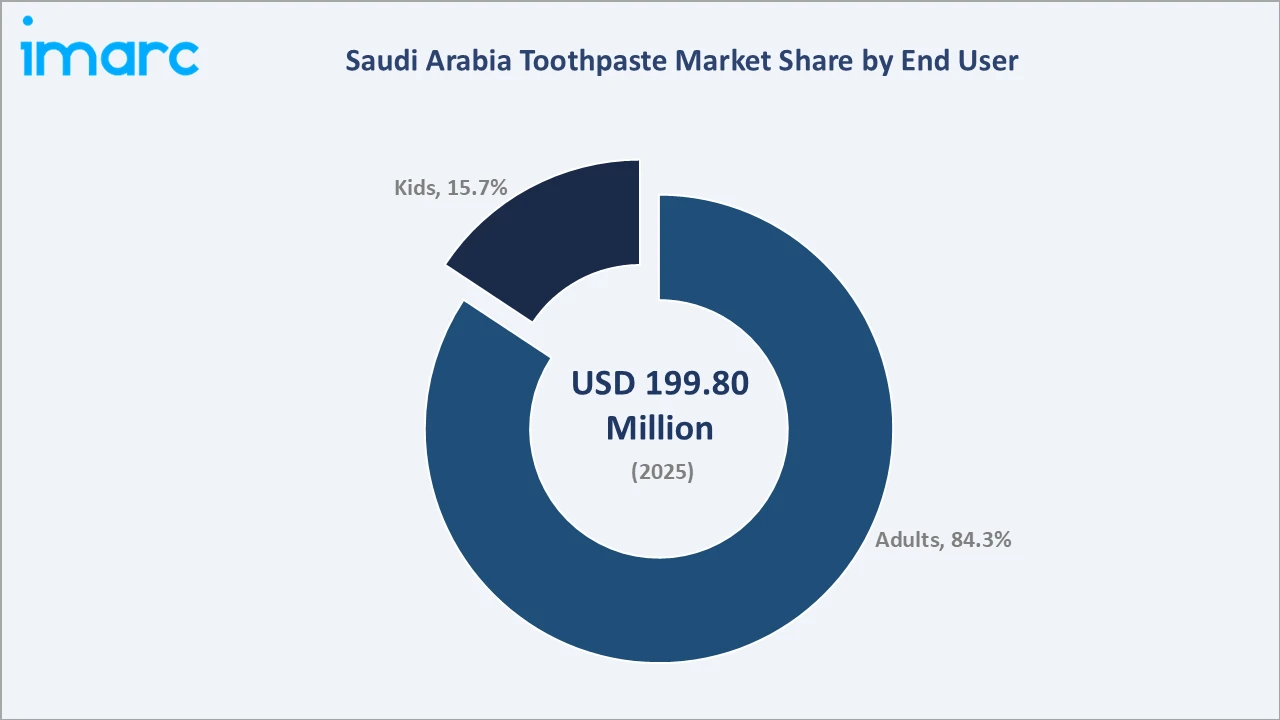
Kids represent 15.7% of demand and are growing faster at an estimated ~4.7% CAGR (2026-2034), supported by the Ministry of Health's reported high childhood caries prevalence and rising parental preventive spending on flavored, low-fluoride formulations.
Regional Market Insights
|
Region |
Share (2025) |
Key Growth Drivers & Characteristics |
|
Northern & Central Region |
38.6% |
Riyadh's population density, modern retail expansion, and higher household incomes driving premium toothpaste uptake |
|
Western Region |
24.7% |
Jeddah's commercial port activity and sustained Hajj and Umrah pilgrim traffic supporting personal care consumption |
|
Eastern Region |
22.5% |
Dammam-Khobar industrial corridor and expatriate population base sustaining steady retail demand |
|
Southern Region |
14.2% |
Emerging retail infrastructure and improving healthcare access supporting gradual category growth |
The Northern and Central Region's 38.6% dominance reflects Riyadh's status as Saudi Arabia's economic capital, home to the highest population concentration and most developed modern retail infrastructure in the Kingdom.
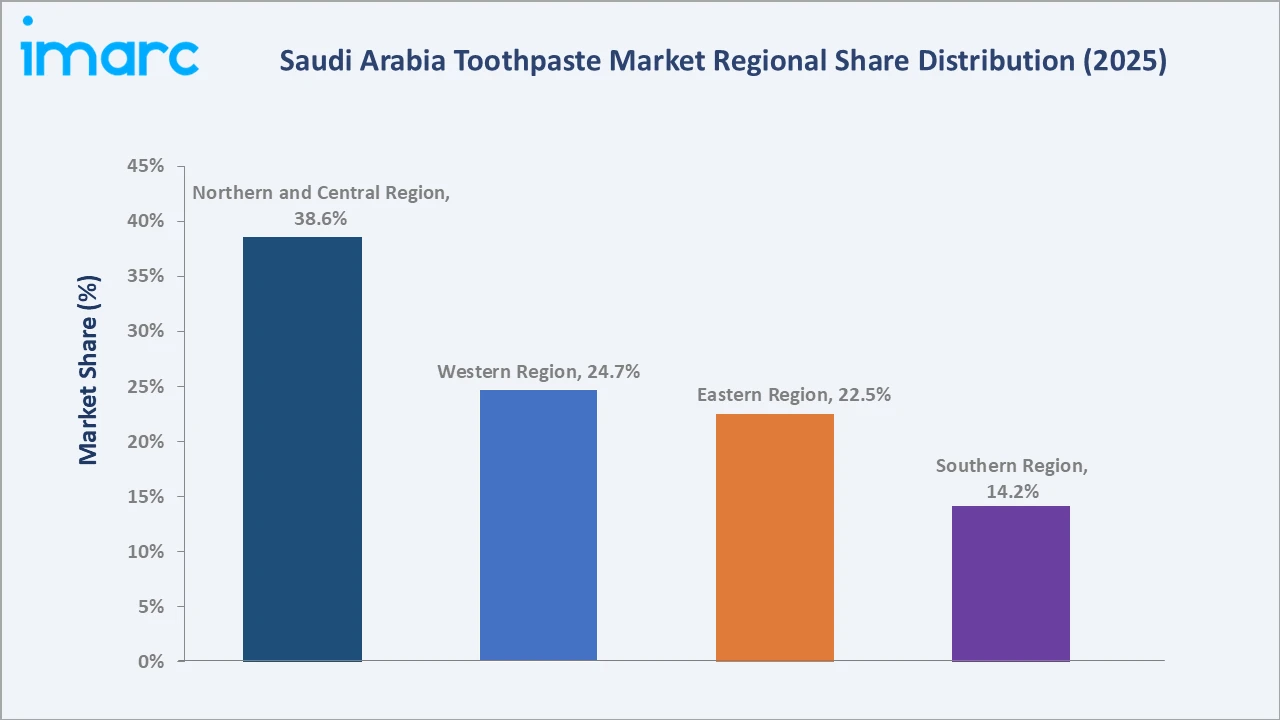
The Western Region's 24.7% share is anchored by Jeddah's role as Saudi Arabia's principal commercial port, with Makkah and Madinah's year-round pilgrimage traffic generating sustained personal-care consumption. The Eastern Region's 22.5% share reflects the Dammam-Khobar industrial corridor's dense expatriate and urban population base.
Competitive Landscape
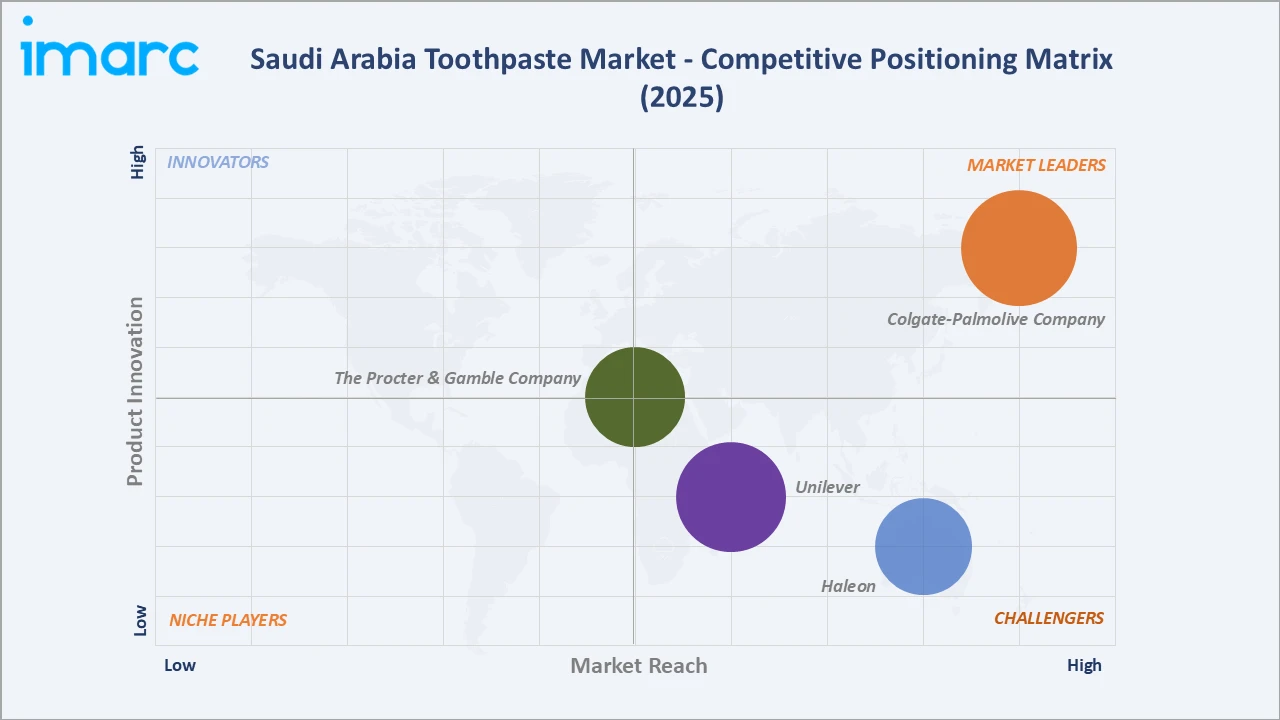
Saudi Arabia's toothpaste market is moderately concentrated among global branded players, with Colgate-Palmolive Company, Unilever, Haleon, and The Procter & Gamble Company, collectively commanding a majority value share (2025), supported by extensive distribution networks and marketing budgets.
|
Company Name |
Brand / Product Line |
Market Position |
Core Strength |
|
Colgate-Palmolive Company |
Colgate Total, Colgate Sensitive, Colgate Active Salt, Colgate Max Fresh |
Market Leader |
Extensive distribution network and dentist-recommended clinical positioning |
|
Unilever |
Signal, Closeup |
Strong Challenger |
Broad mass-market presence and value-tier affordability |
|
Haleon |
Sensodyne, Parodontax |
Strong Challenger |
Clinical, dentist-endorsed sensitivity and gum-care specialization |
|
The Procter & Gamble Company |
Oral-B, Crest |
Established Player |
Premium whitening innovation and oral-care technology portfolio |
Saudi Arabia's competitive landscape is bifurcated: premium and mid-market segments are dominated by long-established global brands, while the herbal and value tiers remain fragmented among regional manufacturers and miswak-based product lines competing on price and natural positioning.
Key Company Profiles
Colgate-Palmolive Company
Colgate-Palmolive Company, which operates through a long-standing joint venture, Colgate-Palmolive Arabia Ltd. (CPAL), maintains one of the broadest oral care distribution networks in Saudi Arabia, spanning hypermarkets, pharmacies, and online retail, anchored by strong dentist-recommendation positioning.
- Product Portfolio: Colgate Total, Colgate Sensitive, Colgate Max Fresh, Colgate Kids, and others.
- Strategic Focus: Clinical credibility and mass-market distribution scale.
Unilever
Unilever operates in Saudi Arabia through Binzagr Unilever Limited, a joint venture with the Binzagr Group. Its brands, Signal and Closeup brands hold strong volume share in Saudi Arabia's value and mid-market toothpaste segments, supported by extensive hypermarket and pharmacy distribution.
- Product Portfolio: Signal, Closeup, and others.
- Strategic Focus: Value-tier accessibility and family-oriented product positioning.
Market Concentration Analysis
Saudi Arabia's toothpaste market exhibits moderate concentration among global branded players, with Colgate-Palmolive Company, Unilever, Haleon, and The Procter & Gamble Company collectively commanding a majority value share in 2025, leveraging extensive distribution and marketing budgets.
Fragmentation persists in the herbal and value tiers, where regional manufacturers and miswak-based brands compete on price and natural positioning. No single regional or herbal brand holds a market-defining share, reflecting a structurally open niche segment.
Consolidation activity remains limited, though global brand owners continue expanding direct distribution agreements with Saudi retailers to strengthen shelf presence and reduce reliance on independent importers.
Investment & Growth Opportunities
Fastest Growing Segments
Herbal toothpaste (~5.0% CAGR), whitening and sensitive variants (~4.3% CAGR), and the kids' end-user segment (~4.7% CAGR) represent Saudi Arabia's highest-growth investment vectors through 2034, reflecting premiumization and rising family-oriented preventive spending.
Emerging Market Opportunities
Saudi Arabia's Vision 2030 localization agenda creates incentives for regional toothpaste manufacturing, reducing import dependence while serving the broader six-nation GCC market from a Saudi production base.
Investment Themes
- Herbal and Miswak Product Innovation: Brands investing in clinically validated natural formulations can capture rising clean-label demand among Saudi Arabia's health-conscious consumers.
- Digital and E-Commerce Retail Expansion: Online oral-care platforms integrating subscription and doorstep-delivery models present a scalable, asset-light growth opportunity.
- Pediatric Oral Care Specialization: Rising childhood caries prevalence supports investment in flavored, low-fluoride, and gamified kids' toothpaste product lines.
Future Market Outlook (2026-2034)
The Saudi Arabia toothpaste market is projected to grow from USD 199.8 Million in 2025 to USD 263.9 Million by 2034, at a 3.14% CAGR, reflecting steady, demographically anchored expansion. The market reaches USD 233.2 Million by 2030, shaped by continued premiumization and Vision 2030 consumer-sector growth.
Three structural forces will anchor growth through 2034: Saudi Arabia's young, expanding population sustaining daily-use demand; rising national focus on preventive dental health following persistently high childhood caries prevalence; and continued premiumization toward whitening, sensitive, and herbal formulations as household incomes rise.
Research Methodology
Primary Research
Primary research inputs were derived from publicly available regulatory filings, company disclosures, and industry publications relevant to Saudi Arabia's cosmetics and personal care sector.
Secondary Research
Secondary research drew on the Saudi Food and Drug Authority's (SFDA) cosmetic regulation database, General Authority for Statistics (GASTAT) population publications, Saudi Ministry of Health oral health data, and the official websites of major oral care manufacturers operating in Saudi Arabia.
Forecasting Models
Market value forecasts were developed using base-year (2025) market sizing validated against historical growth trends (2020-2025), applying segment-level compound annual growth rate modeling by type, end user, and region.
Saudi Arabia Toothpaste Market Report Coverage:
| Report Features | Details |
|---|---|
| Base Year of the Analysis | 2025 |
| Historical Period | 2020-2025 |
| Forecast Period | 2026-2034 |
| Units | Million USD |
| Scope of the Report |
Exploration of Historical Trends and Market Outlook, Industry Catalysts and Challenges, Segment-Wise Historical and Future Market Assessment:
|
| Types Covered | Conventional Toothpaste, Herbal Toothpaste, Whitening and Sensitive Toothpaste |
| Distribution Channels Covered | Supermarkets and Hypermarkets, Retail Stores, Pharmacies, Online Stores |
| End Users Covered | Adults, Kids |
| Regions Covered | Northern and Central Region, Western Region, Eastern Region, Southern Region |
| Companies Covered | Colgate-Palmolive Company, Unilever, Haleon, The Procter & Gamble Company, etc. |
| Customization Scope | 10% Free Customization |
| Post-Sale Analyst Support | 10-12 Weeks |
| Delivery Format | PDF and Excel through Email (We can also provide the editable version of the report in PPT/Word format on special request) |
Key Benefits for Stakeholders:
- IMARC’s industry report offers a comprehensive quantitative analysis of various market segments, historical and current market trends, market forecasts, and dynamics of the Saudi Arabia toothpaste market from 2020-2034.
- The research report provides the latest information on the market drivers, challenges, and opportunities in the Saudi Arabia toothpaste market.
- Porter's five forces analysis assist stakeholders in assessing the impact of new entrants, competitive rivalry, supplier power, buyer power, and the threat of substitution. It helps stakeholders to analyze the level of competition within the Saudi Arabia toothpaste industry and its attractiveness.
- Competitive landscape allows stakeholders to understand their competitive environment and provides an insight into the current positions of key players in the market.
Frequently Asked Questions About the Saudi Arabia Toothpaste Market Report
The Saudi Arabia toothpaste market reached USD 199.8 Million in 2025, driven by rising oral health awareness, a young growing population, and expanding premium and herbal product demand.
The market is projected to grow at a 3.14% CAGR during 2026-2034, reaching USD 263.9 Million by 2034, supported by premiumization and Vision 2030 consumer-sector growth.
Conventional toothpaste leads at 54.6% share (2025), valued for affordability and broad availability, though whitening, sensitive, and herbal variants are gaining share through premiumization.
Herbal toothpaste is the fastest-growing type at an estimated ~5.0% CAGR (2026-2034), driven by rising demand for miswak-based and natural-ingredient formulations.
Adults account for 84.3% of end-user demand (2025), though the kids' segment is growing faster at an estimated ~4.7% CAGR through 2034.
The Northern and Central Region leads with 38.6% market share (2025), anchored by Riyadh's population density, modern retail penetration, and higher household incomes.
Leading companies include Colgate-Palmolive Company, Unilever, Haleon, and The Procter & Gamble Company, alongside regional and herbal toothpaste brands.
The Saudi Food and Drug Authority requires toothpaste products to be notified through its GHAD electronic system and comply with the GSO 1943 cosmetic safety standard.
The market is projected to reach approximately USD 233.2 Million by 2030, supported by continued premiumization and rising household personal-care spending.
Rising consumer preference for miswak extract, charcoal, and plant-based ingredients, combined with clean-label awareness, is driving herbal toothpaste demand across Saudi Arabia.
Need more help?
- Speak to our experienced analysts for insights on the current market scenarios.
- Include additional segments and countries to customize the report as per your requirement.
- Gain an unparalleled competitive advantage in your domain by understanding how to utilize the report and positively impacting your operations and revenue.
- For further assistance, please connect with our analysts.
 Request Customization
 Speak to an Analyst
 Request Brochure
 Inquire Before Buying
Benefits of Customization
- Personalize this research
- Triangulate with your data
- Get data as per your format and definition
- Gain a deeper dive into a specific application, geography, customer, or competitor
- Any level of personalization
Get in Touch With Us
UNITED STATES
Phone: +1-201-971-6302
INDIA
Phone: +91-120-433-0800
UNITED KINGDOM
Phone: +44-753-714-6104
Email: [email protected]
Client Testimonials




.webp)




.webp)













Related Reports

Choose your plan
*Please note that the prices mentioned below are starting prices for each bundle type. Kindly contact our team for further details.*
Single User License
- 1 User License, Access on 2 Devices
- PDF Report + Excel Dataset (Password Protected)
- Lifetime Access
- No Printing Rights
- 10% Free Report Customization
- 10–12 Weeks of Analyst Support
Five User License
- Access for 5 Users, 2 Devices per User
- PDF Report + Excel Dataset (Password Protected)
- Lifetime Access
- Dedicated Account Manager
- 12–14 Weeks of Analyst Support
- No Printing Rights
- 15% Free Report Customization
- 25% Discount on Your Next Purchase
Corporate User License
- Unlimited User Access (Within Your Organization)
- PDF Report + Excel Dataset
- Lifetime Access
- Dedicated Account Manager
- 14–20 Weeks of Analyst Support
- No Printing Rights
- 20% Free Report Customization
- 30% Discount on Your Next Purchase
Essential Insights
What's included:
3 reports
- Lifetime Access
- PDF Reports
- Excel Datasets
- 2 Weeks of Free Analyst Support
- 2 User Licenses
- Access on 2 Devices
- Printing Rights
- Complimentary PowerPoint (PPT) Version
- Complimentary License Upgrade
Professional Access
What's included:
5 reports
- Lifetime Access
- PDF Reports
- Excel Datasets
- 8 Weeks of Free Analyst Support
- 2 User Licenses
- Access on 2 Devices
- Printing Rights
- Complimentary PowerPoint (PPT) Version
- Complimentary License Upgrade
Business Advantage
What's included:
8 reports
- Lifetime Access
- PDF Reports
- Excel Datasets
- 14 Weeks of Free Analyst Support
- 2 User Licenses
- Access on 2 Devices
- Printing Rights
- Complimentary PowerPoint (PPT) Version
- Complimentary License Upgrade
Enterprise Intelligence
What's included:
10 reports
- Lifetime Access
- PDF Reports
- Excel Datasets
- 20 Weeks of Free Analyst Support
- 2 User Licenses
- Access on 2 Devices
- Printing Rights
- Complimentary PowerPoint (PPT) Version
- Complimentary License Upgrade