
Scleroderma Market Size, Epidemiology, In-Market Drugs Sales, Pipeline Therapies, and Regional Outlook 2026-2036
Market Overview:
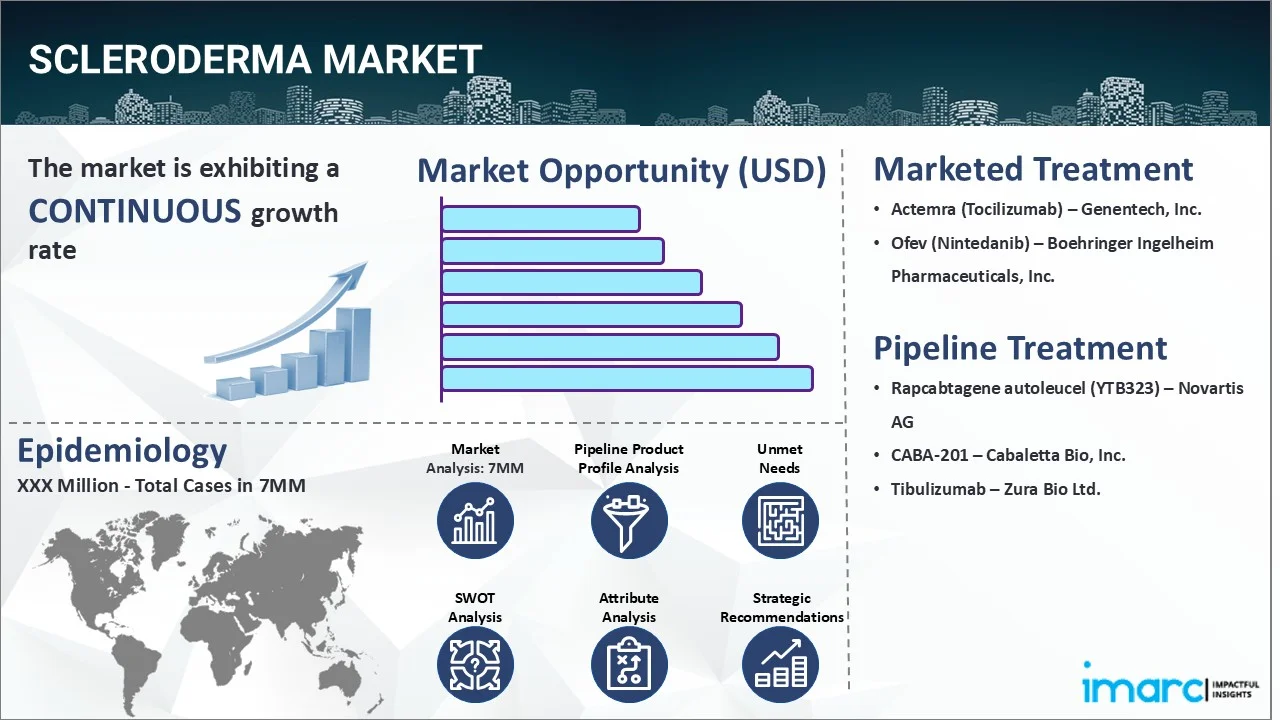
The scleroderma market reached a value of USD 2.5 Billion across the top 7 markets (US, EU4, UK, and Japan) in 2025. Looking forward, IMARC Group expects the top 7 major markets to reach USD 4.0 Billion by 2036, exhibiting a growth rate (CAGR) of 4.07% during 2026-2036.
|
Report Attribute
|
Key Statistics
|
|---|---|
| Base Year |
2025
|
| Forecast Years | 2026-2036 |
| Historical Years |
2020-2025
|
|
Market Size in 2025
|
USD 2.5 Billion |
|
Market Forecast in 2036
|
USD 4.0 Billion |
|
Market Growth Rate 2026-2036
|
4.07% |
The scleroderma market has been comprehensively analyzed in IMARC's new report titled "Scleroderma Market Size, Epidemiology, In-Market Drugs Sales, Pipeline Therapies, and Regional Outlook 2026-2036". Scleroderma, also referred to as systemic sclerosis, is a rare autoimmune disease that affects the connective tissues of the body. This condition causes the hardening and tightening of the skin and internal organs, which can lead to serious problems in the blood vessels and digestive tract. The symptoms of the ailment can vary widely depending on the type and severity of the disease, but can include joint pain and stiffness, shortness of breath, and difficulty swallowing. Individuals suffering from scleroderma may also experience small red spots, itchiness, heartburn, diarrhea, fecal incontinence, bloating, decreased exercise tolerance, dizziness, etc. The diagnosis of this condition relies on the identification of a patient's symptoms, medical history, and physical exam. The healthcare professional may also perform blood tests to validate elevated levels of specific antibodies produced by the immune system. Numerous imaging and organ-function tests are utilized among patients to help determine the extent and areas affected.
To get more information on this market, Request Sample
The rising cases of autoimmune disorders, which cause inflammation and excess collagen production in the affected cells, thereby leading to damage as well as scarring, are primarily driving the scleroderma market. Besides this, the increasing prevalence of various associated risk factors, such as gene variations, repeated exposure to certain harmful substances or chemicals, viral infections, etc., is also augmenting the market growth. Furthermore, the widespread adoption of calcium channel blockers and proton pump inhibitors, which respectively relax blood vessels and reduce acid release in the stomach, thereby providing symptom relief, is creating a positive outlook for the market. In addition to this, the escalating utilization of physical and occupational therapy for stabilizing strength and mobility, as well as maintaining independence with daily tasks among patients, is acting as another significant growth-inducing factor. Moreover, the emerging popularity of combination treatment, including light therapy and pharmacological medications, such as methotrexate, mycophenolate mofetil, cyclophosphamide, etc., since they target to suppress the immune system, minimize skin thickening, and prevent damage to the internal organs, is expected to drive the scleroderma market in the coming years.
IMARC Group's new report provides an exhaustive analysis of the scleroderma market in the United States, EU4 (Germany, Spain, Italy, and France), United Kingdom, and Japan. This includes treatment practices, in-market, and pipeline drugs, share of individual therapies, market performance across the seven major markets, market performance of key companies and their drugs, etc. The report also provides the current and future patient pool across the seven major markets. According to the report, the United States has the largest patient pool for scleroderma and also represents the largest market for its treatment. Furthermore, the current treatment practice/algorithm, market drivers, challenges, opportunities, reimbursement scenario, unmet medical needs, etc., have also been provided in the report. This report is a must-read for manufacturers, investors, business strategists, researchers, consultants, and all those who have any kind of stake or are planning to foray into the scleroderma market in any manner.
Recent Developments:
- In April 2024, BLR Bio announced that the United States Food and Drug Administration (FDA) approved the Orphan Drug Designation for its investigational medicine BLR-200 for the treatment of systemic sclerosis, also known as scleroderma.
- In March 2024, Cabaletta Bio, Inc. reported that CABA-201, a 4-1BB-containing completely human CD19-CAR T cell experimental therapy, has been given Orphan Drug Designation (ODD) by the United States FDA for the treatment of systemic sclerosis or scleroderma.
- In February 2024, Certa Therapeutics (Certa) announced that the United States Food and Drug Administration (FDA) had granted Fast Track Designation to its investigational medicine FT011 for the treatment of systemic sclerosis (scleroderma) after previously receiving Orphan Drug Designation.
- In December 2023, The Scleroderma Research Foundation (SRF) announced that the FDA had approved its Investigational New Drug Application (IND) to launch the CONQUEST clinical trial platform and commence patient enrollment. Sanofi and Boehringer Ingelheim will each contribute an experimental drug to CONQUEST, making them the first pharmaceutical partners to commit to this protocol aimed at swiftly advancing new scleroderma medicines through clinical development. The Sanofi agent is amlitelimab, a non-depleting monoclonal antibody that binds to OX40-Ligand, whereas the Boehringer Ingelheim medication is BI-1015550, an oral PDE-4B inhibitor.
- In August 2023, MediciNova, Inc. reported that it has received a Decision to Grant from the European Patent Office for a new patent covering MN-001 (tipelukast) for the treatment of scleroderma and/or systemic sclerosis.
Key Highlights:
- Systemic scleroderma affects 38 to 341 people per million people worldwide (prevalence) and affects 8 to 56 people per million people annually (incidence).
- The estimated incidence of systemic scleroderma in the United States is 20 cases per million population, and its prevalence has been estimated as 276 cases per million population, although the stated prevalence varies depending on the methodology utilized and the targeted demographic.
- Females with scleroderma outnumber males by 4-to-1.
- Prevalence rates are higher in Europe, North and South America than in East Asia.
- The peak onset occurs in those aged 30 to 50.
Time Period of the Study
- Base Year: 2025
- Historical Period: 2020-2025
- Market Forecast: 2026-2036
Countries Covered
- United States
- Germany
- France
- United Kingdom
- Italy
- Spain
- Japan
Analysis Covered Across Each Country
- Historical, current, and future epidemiology scenario
- Historical, current, and future performance of the scleroderma market
- Historical, current, and future performance of various therapeutic categories in the market
- Sales of various drugs across the scleroderma market
- Reimbursement scenario in the market
- In-market and pipeline drugs
Competitive Landscape:
This report also provides a detailed analysis of the current scleroderma marketed drugs and late-stage pipeline drugs.
In-Market Drugs
- Drug Overview
- Mechanism of Action
- Regulatory Status
- Clinical Trial Results
- Drug Uptake and Market Performance
Late-Stage Pipeline Drugs
- Drug Overview
- Mechanism of Action
- Regulatory Status
- Clinical Trial Results
- Drug Uptake and Market Performance
| Drugs | Company Name |
|---|---|
| Actemra (Tocilizumab) | Genentech, Inc. |
| Ofev (Nintedanib) | Boehringer Ingelheim Pharmaceuticals, Inc. |
| Rapcabtagene autoleucel (YTB323) | Novartis AG |
| CABA-201 | Cabaletta Bio, Inc. |
| Tibulizumab | Zura Bio Ltd. |
*Kindly note that the drugs in the above table only represent a partial list of marketed/pipeline drugs, and the complete list has been provided in the report.
Key Questions Answered in this Report:
Market Insights
- How has the Scleroderma market performed so far and how will it perform in the coming years?
- What are the markets shares of various therapeutic segments in 2025 and how are they expected to perform till 2036?
- What was the country-wise size of the Scleroderma across the seven major markets in 2025 and what will it look like in 2036?
- What is the growth rate of the Scleroderma across the seven major markets and what will be the expected growth over the next ten years?
- What are the key unmet needs in the market?
Epidemiology Insights
- What is the number of prevalent cases (2020-2036) of Scleroderma across the seven major markets?
- What is the number of prevalent cases (2020-2036) of Scleroderma by age across the seven major markets?
- What is the number of prevalent cases (2020-2036) of Scleroderma by gender across the seven major markets?
- What is the number of prevalent cases (2020-2036) of Scleroderma by type across the seven major markets?
- How many patients are diagnosed (2020-2036) with Scleroderma across the seven major markets?
- What is the size of the Scleroderma’ patient pool (2020-2025) across the seven major markets?
- What would be the forecasted patient pool (2026-2036) across the seven major markets?
- What are the key factors driving the epidemiological trend of Scleroderma?
- What will be the growth rate of patients across the seven major markets?
Scleroderma: Current Treatment Scenario, Marketed Drugs and Emerging Therapies
- What are the current marketed drugs and what are their market performance?
- What are the key pipeline drugs and how are they expected to perform in the coming years?
- How safe are the current marketed drugs and what are their efficacies?
- How safe are the late-stage pipeline drugs and what are their efficacies?
- What are the current treatment guidelines for Scleroderma drugs across the seven major markets?
- Who are the key companies in the market and what are their market shares?
- What are the key mergers and acquisitions, licensing activities, collaborations, etc. related to the Scleroderma market?
- What are the key regulatory events related to the Scleroderma market?
- What is the structure of clinical trial landscape by status related to the Scleroderma market?
- What is the structure of clinical trial landscape by phase related to the Scleroderma market?
- What is the structure of clinical trial landscape by route of administration related to the Scleroderma market?
Need more help?
- Speak to our experienced analysts for insights on the current market scenarios.
- Include additional segments and countries to customize the report as per your requirement.
- Gain an unparalleled competitive advantage in your domain by understanding how to utilize the report and positively impacting your operations and revenue.
- For further assistance, please connect with our analysts.
 Inquire Before Buying
 Speak to an Analyst
 Request Brochure
 Request Customization
Benefits of Customization
- Personalize this research
- Triangulate with your data
- Get data as per your format and definition
- Gain a deeper dive into a specific application, geography, customer, or competitor
- Any level of personalization
Get in Touch With Us
UNITED STATES
Phone: +1-201-971-6302
INDIA
Phone: +91-120-433-0800
UNITED KINGDOM
Phone: +44-753-714-6104
Email: [email protected]
Client Testimonials




.webp)




.webp)













Related Reports

Choose your plan
*Please note that the prices mentioned below are starting prices for each bundle type. Kindly contact our team for further details.*
Single User License
- 1 User License, Access on 2 Devices
- PDF Report + Excel Dataset (Password Protected)
- Lifetime Access
- No Printing Rights
- 10% Free Report Customization
- 10–12 Weeks of Analyst Support
Five User License
- Access for 5 Users, 2 Devices per User
- PDF Report + Excel Dataset (Password Protected)
- Lifetime Access
- Dedicated Account Manager
- 12–14 Weeks of Analyst Support
- No Printing Rights
- 15% Free Report Customization
- 25% Discount on Your Next Purchase
Corporate User License
- Unlimited User Access (Within Your Organization)
- PDF Report + Excel Dataset
- Lifetime Access
- Dedicated Account Manager
- 14–20 Weeks of Analyst Support
- No Printing Rights
- 20% Free Report Customization
- 30% Discount on Your Next Purchase
Essential Insights
What's included:
3 reports
- Lifetime Access
- PDF Reports
- Excel Datasets
- 2 Weeks of Free Analyst Support
- 2 User Licenses
- Access on 2 Devices
- Printing Rights
- Complimentary PowerPoint (PPT) Version
- Complimentary License Upgrade
Professional Access
What's included:
5 reports
- Lifetime Access
- PDF Reports
- Excel Datasets
- 8 Weeks of Free Analyst Support
- 2 User Licenses
- Access on 2 Devices
- Printing Rights
- Complimentary PowerPoint (PPT) Version
- Complimentary License Upgrade
Business Advantage
What's included:
8 reports
- Lifetime Access
- PDF Reports
- Excel Datasets
- 14 Weeks of Free Analyst Support
- 2 User Licenses
- Access on 2 Devices
- Printing Rights
- Complimentary PowerPoint (PPT) Version
- Complimentary License Upgrade
Enterprise Intelligence
What's included:
10 reports
- Lifetime Access
- PDF Reports
- Excel Datasets
- 20 Weeks of Free Analyst Support
- 2 User Licenses
- Access on 2 Devices
- Printing Rights
- Complimentary PowerPoint (PPT) Version
- Complimentary License Upgrade