
Security Paper Market Size, Share, Trends and Forecast by Type, Application, and Region, 2026-2034
Security Paper Market Size, Share, Trends & Forecast (2026-2034)
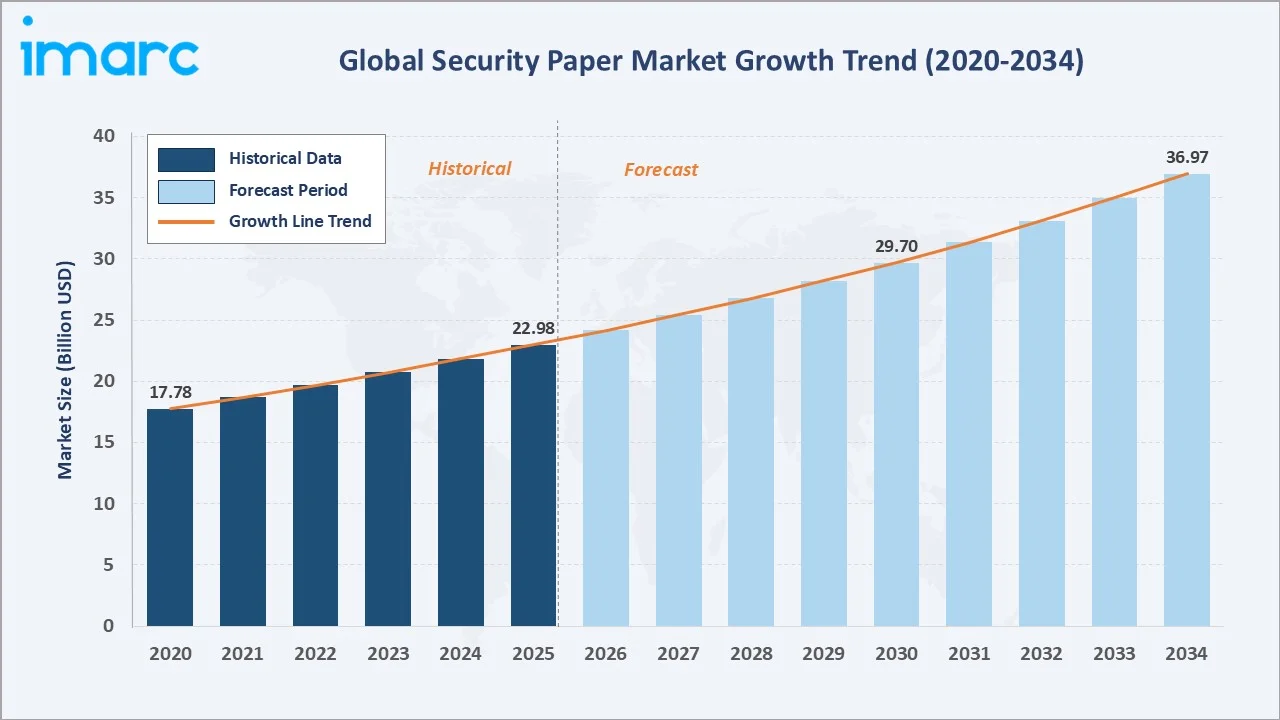
The security paper market grew from USD 22.98 Billion in 2025 to USD 24.19 Billion in 2026 and is projected to reach USD 36.97 Billion by 2034, growing at a CAGR of 5.26% during 2026-2034. Escalating government investments in anti-counterfeiting infrastructure and rising demand for secure banknotes, passports, and identity documents are the primary drivers shaping market growth.
Hybrid paper commands 38.5% of the type segment, bank notes account for the largest application share at 52.4%, and Asia-Pacific leads with 48.2% regional share.
Market Snapshot
|
Metric |
Value |
|
Base Year Market Size (2025) |
USD 22.98 Billion |
|
Market Size (2026) |
USD 24.19 Billion |
|
Forecast Market Size (2034) |
USD 36.97 Billion |
|
CAGR (2026-2034) |
5.26% |
|
Base Year |
2025 |
|
Historical Period |
2020-2025 |
|
Forecast Period |
2026-2034 |
|
Largest Region |
Asia-Pacific (48.2%, 2025) |
|
Second Largest Region |
Europe (20.6%, 2025) |
|
Leading Type |
Hybrid Paper (38.5%, 2025) |
|
Leading Application |
Bank Notes (52.4%, 2025) |
The security paper market size increased from USD 17.78 Billion in 2020 to USD 22.98 Billion in 2025 and is estimated to reach USD 24.19 Billion in 2026. The market is further expected to grow to USD 29.70 Billion by 2030 and USD 36.97 Billion by 2034. This growth is supported by continued demand for secure documents, currency-related applications, and other products requiring enhanced protection against counterfeiting.
To get more information on this market, Request Sample
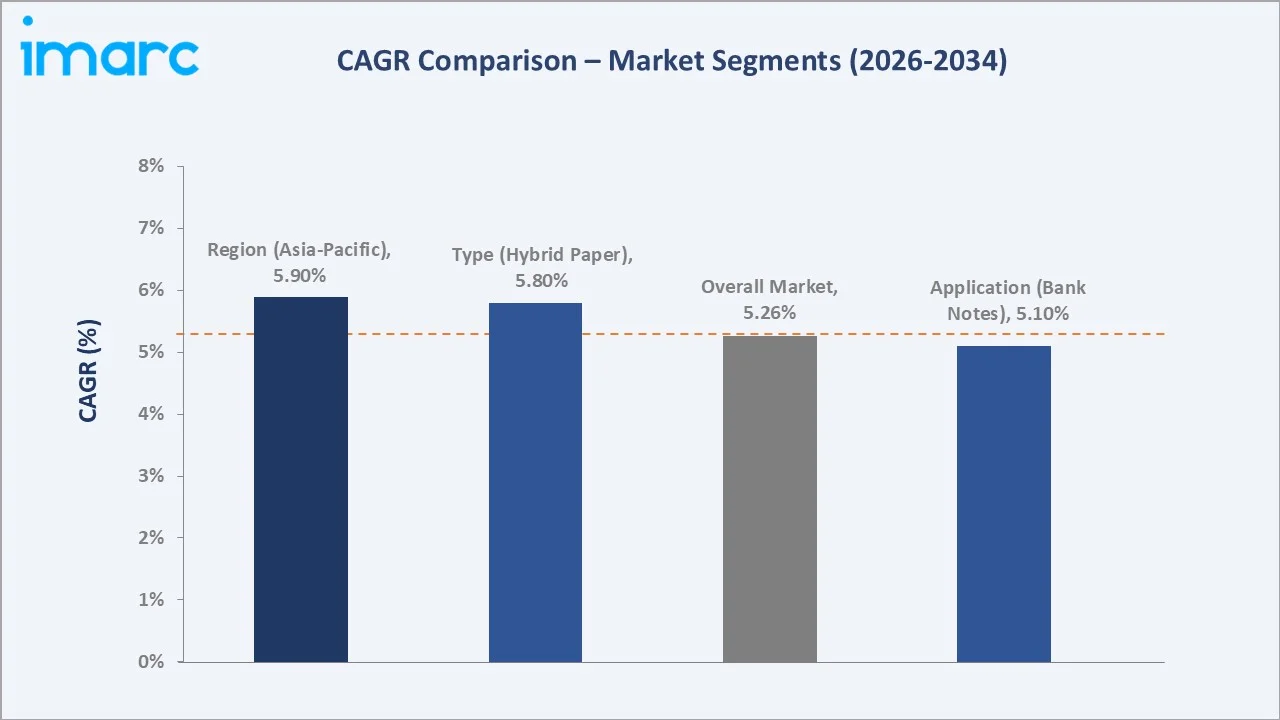
CAGR trajectories across type and application sub-segments, together with regional patterns, highlight that thread and UV fiber and Middle East and Africa are expanding faster than the overall 5.26% market CAGR, driven by rising demand for advanced authentication features, increasing currency and document security requirements, and investments in modern security printing infrastructure.
Executive Summary
The security paper market expanded from USD 22.98 Billion in 2025 to an estimated USD 24.19 Billion in 2026. The industry has evolved from basic watermark-embedded substrates to multi-functional security paper systems incorporating holograms, UV fibers, microprinting, and digital authentication codes. Rising currency replacement cycles, expanding passport issuance programs, and stricter anti-counterfeiting mandates from central banks and government agencies are collectively driving consistent demand.
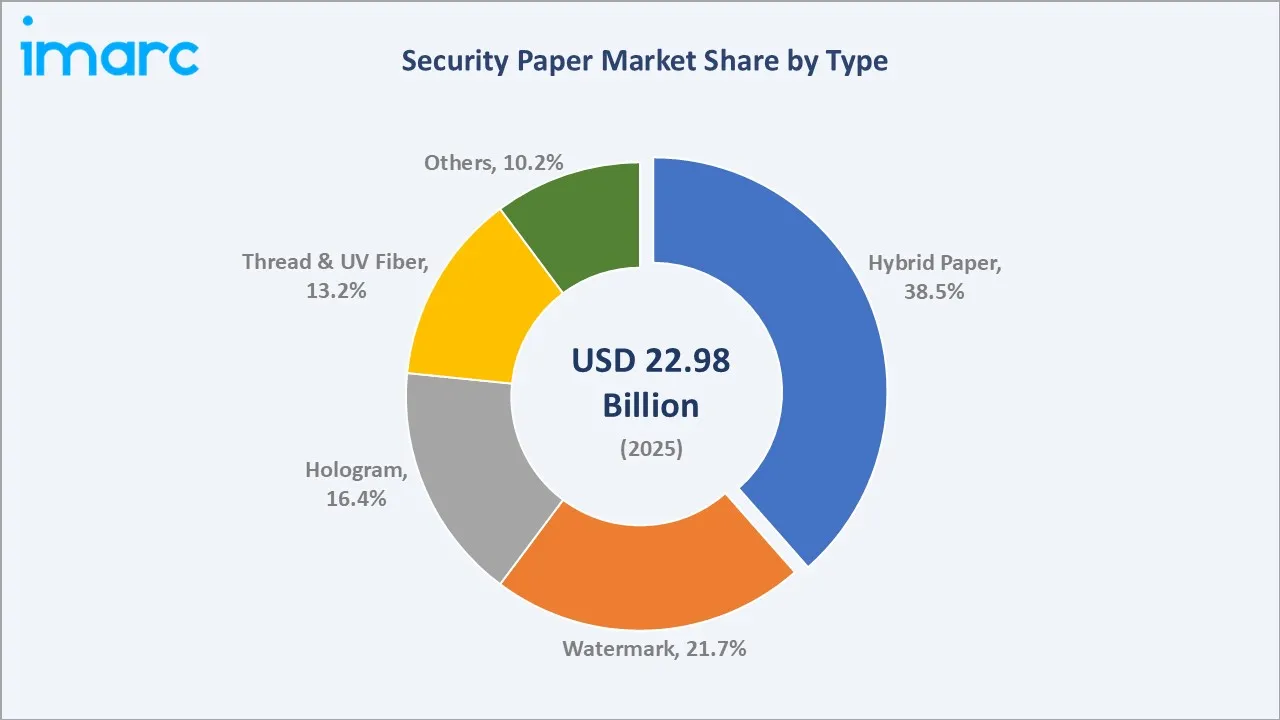
Hybrid paper leads the type segment at 38.5% in 2025, combining multiple authentication features within a single substrate. Bank notes dominate the application landscape at 52.4%, fueled by ongoing currency circulation, replacement cycles, and the need for advanced anti-counterfeiting features. Asia-Pacific commands nearly half the global share at 48.2%, anchored by large-scale currency printing programs in China, India, Japan, and Southeast Asian economies.
Key Market Insights
|
Insight |
Data |
|
Leading Type |
Hybrid Paper – 38.5% share (2025) |
|
Second Largest Type |
Watermark – 21.7% share (2025) |
|
Leading Application |
Bank Notes – 52.4% share (2025) |
|
Second Largest Application |
Passports – 15.8% share (2025) |
|
Leading Region |
Asia-Pacific – 48.2% share (2025) |
|
Second Largest Region |
Europe – 20.6% share (2025) |
|
Top Companies |
Crane NXT, Co., Giesecke+Devrient GmbH, Oberthur Fiduciaire |
Key Analytical Observations Expanding On the Data Above:
- Hybrid paper leadership at 38.5% reflects central banks' preference for multi-feature substrates that combine watermark, thread, and UV-reactive elements within a single sheet, offering layered authentication at lower incremental cost.
- Watermark at 21.7% remains entrenched in sovereign currency and passport programs due to its near-impossibility of replication outside controlled manufacturing environments.
- Bank notes commanding 52.4% of application demand highlights the direct linkage between global money supply growth and security paper consumption, with emerging market central banks driving incremental volume.
- Passports at 15.8% are supported by continued demand for secure identity documents, where embedded security features help prevent forgery, tampering, and unauthorized reproduction.
- Asia-Pacific at 48.2% is anchored by high currency circulation, expanding banking networks, increasing demand for secure identity documents, and continued investments in currency and document security infrastructure across major economies.
Security Paper Market Overview
Security paper refers to specialized substrates engineered to prevent unauthorized reproduction and counterfeiting of critical documents, including currency, passports, identity cards, certificates, and legal instruments. These substrates incorporate a range of physical and chemical authentication features, including watermarks, security threads, UV-reactive fibers, holograms, intaglio-receptive coatings, and microprinting-ready surfaces, that collectively make replication technically and economically impractical.
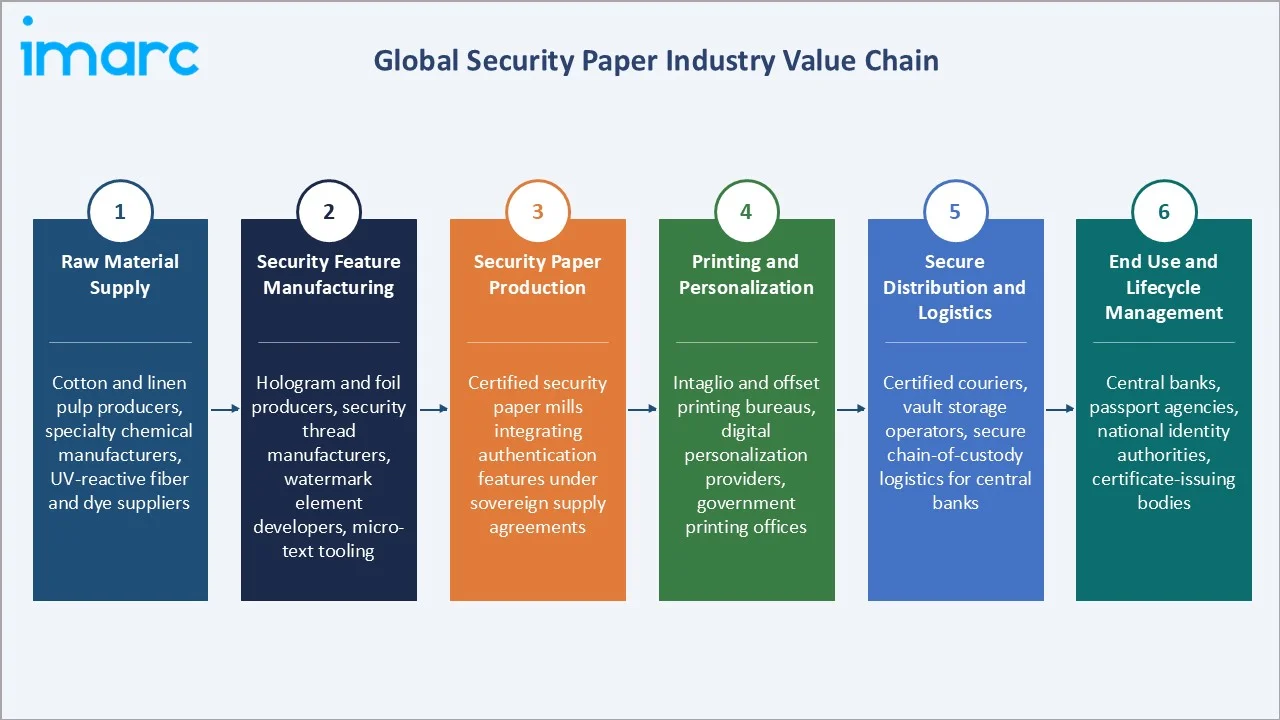
The global ecosystem spans raw material suppliers providing cotton and linen-based pulp; chemical additive manufacturers supplying UV fibers and dye complexes; specialized paper mills producing security substrates; printing and personalization bureaus converting substrates into finished documents; and sovereign clients including central banks, passport agencies, and government printing offices.
Market Dynamics
To evaluate market opportunities, Request Sample
Market Drivers
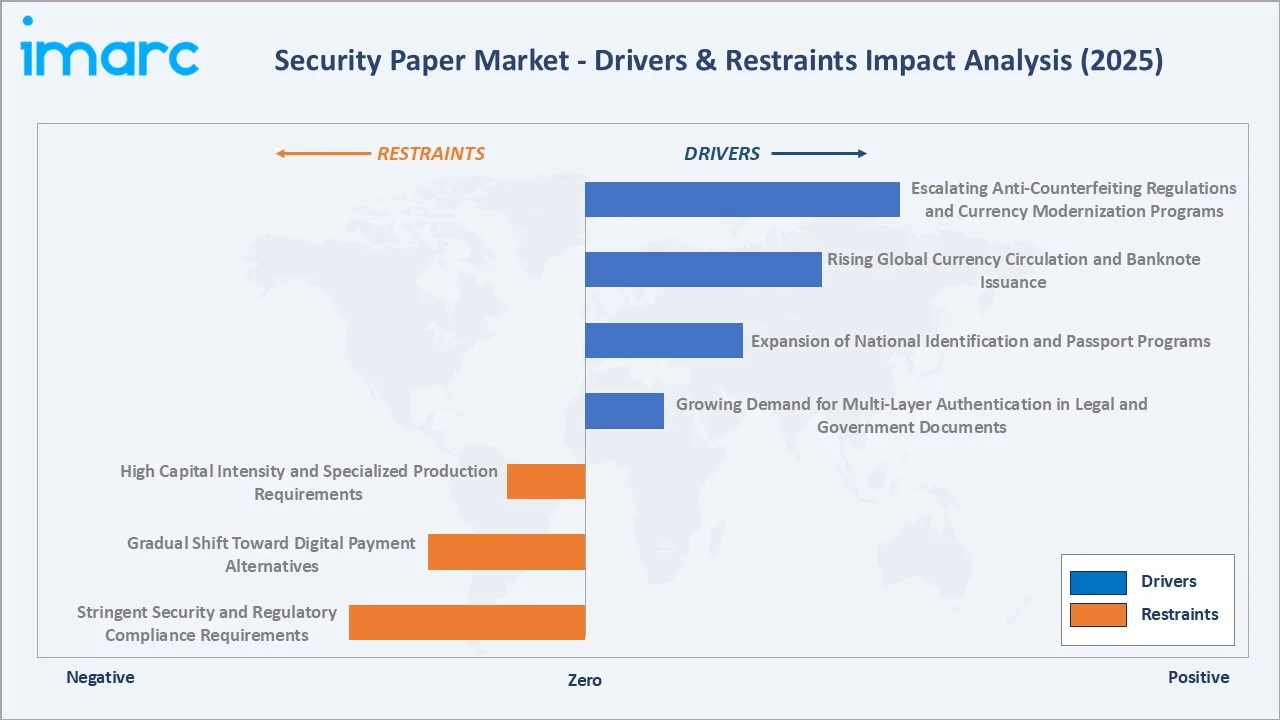
- Escalating Anti-Counterfeiting Regulations and Currency Modernization Programs: Governments and central banks worldwide are mandating periodic currency redesigns and introducing multi-generation security features to stay ahead of evolving counterfeiting techniques. Regulatory frameworks from the European Central Bank and the Reserve Bank of India require the integration of increasingly sophisticated security substrates.
- Rising Global Currency Circulation and Banknote Issuance: Increasing currency circulation and regular banknote issuance support recurring demand for secure substrates, while currency replacement cycles and new denomination requirements contribute to security paper market size expansion.
- Expansion of National Identification and Passport Programs: Rising cross-border travel, international migration, and global passport harmonization initiatives are driving sustained demand for security paper in passport booklets and identity documents. As per Eurostat, in 2024, 4.2 Million individuals moved to the EU from countries outside the EU. Governments in emerging economies are accelerating national biometric identity programs, requiring large volumes of tamper-resistant security paper for card and booklet substrates.
- Growing Demand for Multi-Layer Authentication in Legal and Government Documents: Beyond currency and passports, the proliferation of legally binding certificates, land deeds, academic credentials, and government permits requiring tamper-proof substrates is expanding the total addressable market for security paper beyond traditional core applications, particularly in South and Southeast Asia.
Market Restraints
- High Capital Intensity and Specialized Production Requirements: Security paper manufacturing demands highly controlled facilities, certified machinery, and stringent quality assurance processes, creating significant barriers to entry and limiting production flexibility. Raw material cost volatility and the capital-intensive nature of certification by sovereign clients add to the structural cost burden for manufacturers.
- Gradual Shift Toward Digital Payment Alternatives: The expansion of digital payment infrastructure, including central bank digital currency pilots and mobile payment platforms, is progressively reducing per-capita cash usage in select advanced economies, potentially moderating long-term banknote demand.
- Stringent Security and Regulatory Compliance Requirements: Security paper manufacturers must comply with strict specifications for authentication features, substrate quality, traceability, and production security, while meeting country-specific certification and procurement requirements. These requirements increase operational complexity, extend qualification timelines, and raise compliance costs, particularly for new and smaller manufacturers.
Market Opportunities
- Integration of Smart and Digital Authentication in Next-Generation Security Paper: Embedding NFC chips, machine-readable QR codes, and cryptographic digital signatures within security paper substrates represents a significant growth opportunity, enabling real-time document authentication and reducing reliance on physical inspection alone. Pilot programs by several European central banks for smart banknotes are expected to reach commercial deployment stages during the forecast period.
- Rising Demand from Emerging Market Governments: Government-led identity and document modernization programs across Sub-Saharan Africa, South Asia, and Latin America are creating large incremental demand pools for security paper, particularly for national ID cards, voter registration documents, and education certificates.
Market Challenges
- Procurement Concentration and Sole-Supplier Dependencies: Sovereign procurement processes often concentrate orders among a limited number of pre-qualified suppliers, creating significant dependency and limiting competitive dynamics. Small and mid-sized manufacturers face structural disadvantages in securing long-term government contracts due to certification requirements and scale expectations.
- Environmental and Sustainability Pressures: Growing regulatory pressure on paper manufacturers to reduce chemical use, adopt sustainable fiber sourcing, and minimize effluent discharge is increasing compliance requirements and production costs.
Emerging Market Trends
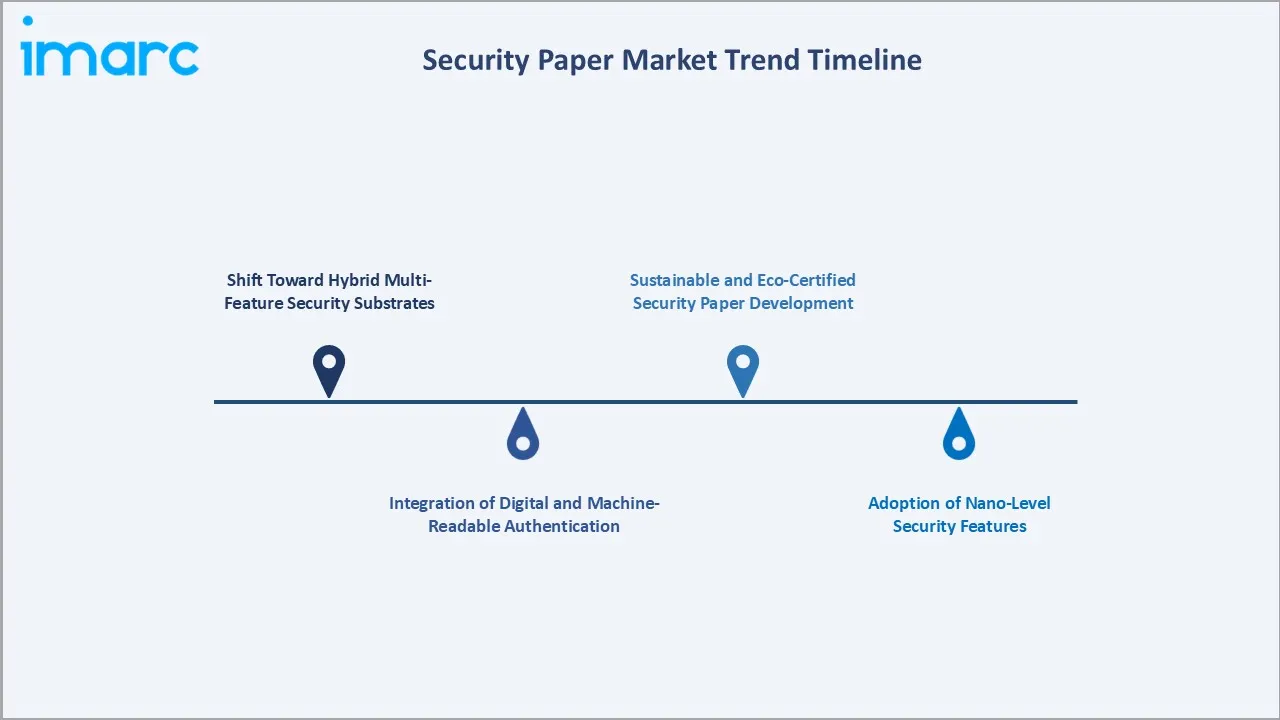
1. Shift Toward Hybrid Multi-Feature Security Substrates
Central banks are increasingly specifying hybrid substrates that combine watermark, security thread, UV fiber, and intaglio-receptive coating within a single sheet, replacing single-feature paper across new denomination series. This trend is reducing per-unit authentication cost while significantly raising the difficulty of counterfeiting, reflecting key security paper market trends in substrate specification.
2. Integration of Digital and Machine-Readable Authentication
Security paper manufacturers are increasingly integrating machine-readable features such as QR codes, RFID elements, optical markers, and digitally encoded identifiers into secure substrates. These features enable automated verification and traceability while complementing traditional paper-based security features, reflecting the growing convergence of physical and digital authentication in security paper market trends.
3. Adoption of Nano-Level Security Features
Nano-printing, micro-perforation, and laser-reactive coatings are being introduced into premium security paper grades, offering authentication features that are invisible to the naked eye but verifiable by machine, raising the sophistication floor for government-approved document substrates.
4. Sustainable and Eco-Certified Security Paper Development
Leading manufacturers are developing FSC-certified, reduced-chemical security paper formulations in response to government procurement policies that increasingly mandate sustainability criteria alongside security specifications, creating a differentiation axis beyond pure authentication performance, a priority that security paper market analysis consistently identifies as central to sovereign procurement decisions.
Industry Value Chain Analysis
The security paper industry value chain spans six interdependent stages, from specialized fiber and chemical raw material supply through certified document issuance and lifecycle management. The manufacturing and substrate conversion stages capture the highest value-add, while the secure distribution and traceability infrastructure increasingly determines competitive positioning among sovereign-grade suppliers.
|
Stage |
Key Players / Examples |
|
Raw Material Supply |
Cotton and linen pulp producers, specialty chemical manufacturers, UV-reactive fiber producers, and dye complex suppliers |
|
Security Feature Manufacturing |
Hologram and foil producers, security thread manufacturers, watermark element developers, and micro-text tooling specialists |
|
Security Paper Production |
Certified security paper mills integrating authentication features into finished substrates under sovereign supply agreements |
|
Printing and Personalization |
Intaglio and offset printing bureaus, digital printing and personalization service providers, and government printing offices |
|
Secure Distribution and Logistics |
Certified couriers, vault storage operators, and secure chain-of-custody logistics providers serving central banks and ministries |
|
End Use and Lifecycle Management |
Central banks, passport agencies, national identity authorities, certificate-issuing bodies, and destruction and recycling service providers |
Vertically integrated manufacturers that control substrate production, security feature embedding, and printing capability are positioned to capture higher value-add margins and strengthen sovereign client relationships through single-vendor accountability.
Technology Landscape in the Security Paper Industry
Watermark and Thread Embedding Technologies
Advanced watermark formation through controlled paper mold design and multi-tone grey-scale image embedding represents the foundational technology in security paper. Windowed and fully embedded metallic and polymer security threads with machine-readable coding are now standard features across premium banknote substrates globally.
Holographic and Foil-Based Authentication
Micro-optic hologram integration, including diffractive optically variable image devices, has become a key differentiator in high-value denomination currency and travel document covers. Metallized and color-shift foil elements that are difficult to replicate with commercial printing equipment continue to evolve with each product generation.
UV-Reactive and IR-Detectable Fiber Technologies
UV-fluorescent and IR-absorptive fiber blends embedded in the paper web provide machine-verification capability for automated currency and document authentication. Multi-color UV fiber systems are increasingly specified by central banks for differentiated denomination authentication, expanding the technical scope and unit value of security paper substrates.
Digital Integration and Nano-Printing
The convergence of physical security paper with digital authentication through laser-engravable coatings, NFC-compatible substrate layers, and nano-scale printing-receptive surfaces is defining the next technology frontier for the industry. These advances are enabling the creation of sovereign documents that support both physical inspection and network-connected machine authentication within a single substrate, a technological evolution underpinning long-term security paper market growth.
Market Segmentation Analysis
The report covers the following segments:
|
Segment Category |
Leading Segment |
Market Share |
Year |
|
Type |
Hybrid Paper |
38.5% |
2025 |
|
Application |
Bank Notes |
52.4% |
2025 |
|
Region |
Asia-Pacific |
48.2% |
2025 |

By Type
Hybrid paper commands a 38.5% majority share in 2025, driven by central banks' preference for substrate systems that incorporate multiple authentication layers within a single sheet, reducing per-feature unit cost while raising the combined authentication barrier significantly.
To access detailed market analysis, Request Sample
Watermark at 21.7% in 2025 remains foundational to sovereign document programs globally, valued for its integration within the substrate itself rather than as an applied feature.
By Application
Bank notes dominate with 52.4% share in 2025, underpinned by the large and persistent global currency circulation base, periodic currency redesign programs by central banks, and the continued primacy of physical currency in emerging market economies.
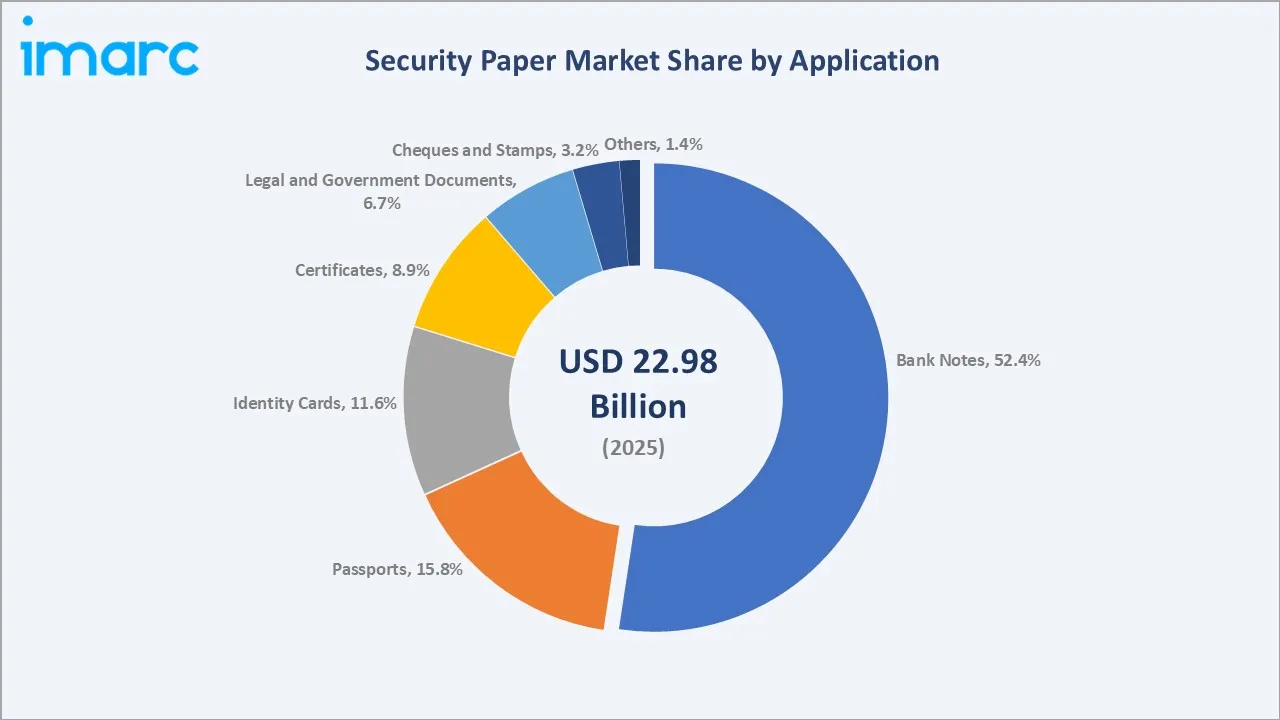
Passports at 15.8% in 2025 reflect rising international travel and biometric document upgrade programs.
Regional Market Insights
|
Region |
Share (2025) |
Key Growth Drivers |
|
Asia-Pacific |
48.2% |
Large-scale banknote issuance programs, growing passport and identity card production, and rising anti-counterfeiting investment across China, India, and Southeast Asia |
|
Europe |
20.6% |
Mature euro zone currency printing, premium passport programs, and ongoing denomination security upgrade mandates from the European Central Bank |
|
North America |
15.7% |
United States dollar note printing programs, passport issuance growth, and domestic security document manufacturing capacity |
|
Middle East and Africa |
8.9% |
Expanding national identity programs, growing government document issuance, and rising investment in anti-counterfeiting infrastructure across Gulf and African nations |
|
Latin America |
6.6% |
Currency modernization programs, rising passport demand from cross-border migration, and expanding national identity card rollouts across Brazil, Mexico, and Andean economies |
Asia-Pacific leads at 48.2% in 2025, driven by the scale of currency printing programs in China and India, rising passport issuance in Southeast Asia, and expanding government identity card programs across the region. China's large banknote replacement volumes and India's currency modernization initiatives anchor regional demand.
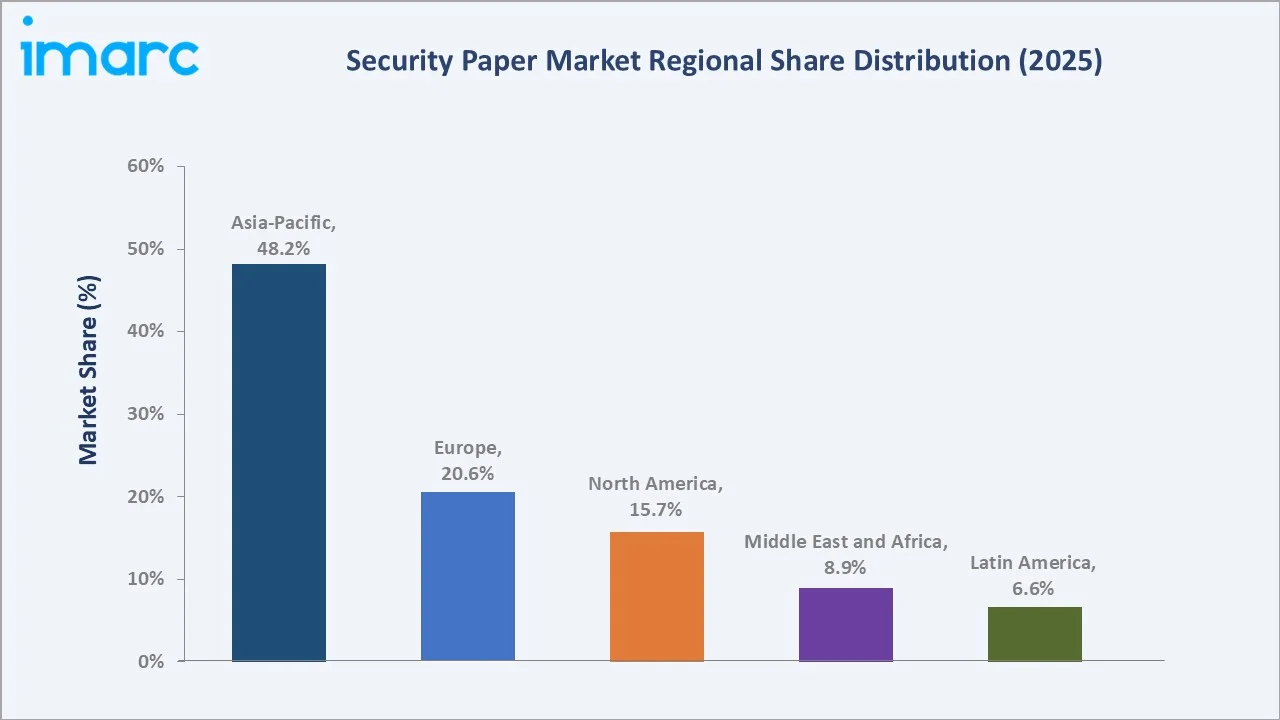
Europe, with 20.6% share in 2025, is characterized by mature demand concentrated in euro zone currency printing, premium passport substrates, and certificate-grade security paper.
Competitive Landscape
The security paper market is moderately concentrated, with a small number of highly specialized manufacturers holding dominant positions based on proprietary substrate technology, certified production facilities, and long-term sovereign supply agreements. Technology depth, regulatory certifications, and the ability to deliver consistent quality at sovereign-grade specifications form the primary competitive differentiators across the industry.
|
Company Name |
Brand / Key Product |
Position |
Strategic Focus |
|
Crane NXT, Co. |
Crane Currency |
Leader |
Strengthening multi-feature banknote substrate capabilities and expanding sovereign client partnerships globally |
|
Giesecke+Devrient GmbH |
G+D Banknote Solutions |
Leader |
Growing end-to-end currency and identity document capabilities through integration of substrate and digital authentication technologies |
|
Oberthur Fiduciaire |
VHP Security Paper |
Challenger |
Expanding integrated banknote printing and paper capabilities through sovereign client partnerships and security feature innovation |
Key players include Crane NXT, Co., Giesecke+Devrient GmbH, and Oberthur Fiduciaire, among others.
Key Company Profiles
Crane NXT, Co.
Crane NXT, Co. is a United States-based technology company specializing in security features and authentication solutions for currency, government documents, and commercial applications, serving central banks and sovereign clients globally.
- Product Portfolio: Security paper substrates, thread and foil-embedded banknote materials, and advanced authentication features for sovereign currency programs.
- Recent Developments: Crane NXT, Co. has continued to enhance its security substrate capabilities and broaden the range of authentication solutions available to central bank and government clients across established and emerging markets.
- Strategic Focus: Integrating advanced authentication technologies within security paper substrates to deliver multi-feature currency solutions that address evolving sovereign specifications and central bank requirements worldwide.
Giesecke+Devrient GmbH
Giesecke+Devrient GmbH is a Germany-based technology company offering end-to-end currency management, security printing, and identity document solutions to central banks, governments, and financial institutions globally.
- Product Portfolio: Security paper and banknote substrates, digital identity and passport solutions, currency processing equipment, and advanced authentication technologies.
- Recent Developments: Giesecke+Devrient GmbH has continued to invest in broadening its currency and identity document capabilities, reinforcing its position as an end-to-end solutions provider for sovereign clients across global markets.
- Strategic Focus: Building comprehensive currency and identity document programs by combining substrate expertise with digital authentication capabilities to support central bank and government clients navigating evolving security requirements.
Oberthur Fiduciaire
Oberthur Fiduciaire is a France-based security paper manufacturer focusing on production of banknote, passport, and identity document substrates for sovereign and government clients globally.
- Product Portfolio: Watermark-embedded security paper, UV fiber substrates, and premium passport and identity document paper for government printing offices.
- Recent Developments: Oberthur Fiduciaire has continued to advance its security paper product range in response to sovereign procurement requirements, with ongoing development of substrate solutions for biometric passport and national identity card applications.
- Strategic Focus: Developing high-performance security paper grades for biometric passport and identity card programs, supporting government clients across European, Asian, and African markets with compliant and certified substrate solutions.
Market Concentration Analysis
The security paper market exhibits moderate-to-high concentration, with the top three manufacturers accounting for a significant share of certified production capacity globally. Concentration is reinforced by the specialized nature of sovereign procurement, which requires manufacturers to hold certified supplier status before being eligible for government and central bank tenders.
Barriers to entry include the capital intensity of certified security paper mills, the long-lead time required to obtain sovereign supplier qualification, the proprietary nature of authentication technology, and the necessity of maintaining continuous quality compliance under government oversight programs. These structural barriers have historically limited market entry to a small group of established participants.
Consolidation within the industry has occurred through acquisitions of specialty paper mills by larger security technology groups, and through strategic partnerships between paper manufacturers and hologram or foil producers seeking to offer integrated substrate systems. The trend toward bundled substrate and printing service contracts is further concentrating procurement among a smaller pool of vertically capable suppliers.
Investment & Growth Opportunities
Fastest-Growing Segments
Thread and UV fiber is the fastest-growing type segment, driven by universal machine-authentication adoption in banknote and passport programs. Among applications, identity cards are expanding most rapidly due to government digital identity rollouts and biometric document upgrades, representing near-term investment opportunities for manufacturers able to meet sovereign specification upgrades.
Emerging Markets
Middle East and Africa is the fastest-growing region, underpinned by national identity infrastructure programs, growing passport issuance, and currency modernization across Gulf Cooperation Council economies and Sub-Saharan African nations.
Venture & Investment Trends
Investment activity is concentrated in smart banknote substrate development, digital-physical hybrid authentication systems, and sustainable security paper formulations that meet environmental procurement standards. Capital is also flowing into manufacturing capacity expansion in Asia-Pacific, where sovereign demand growth is outpacing current certified production capacity, creating a structural supply-demand imbalance that supports new investment.
Future Market Outlook (2026-2034)
The security paper market is forecast to expand from USD 22.98 Billion in 2025 to USD 24.19 Billion in 2026, reaching USD 36.97 Billion by 2034, adding approximately USD 14.0 Billion in incremental market value at a CAGR of 5.26% over the 2026-2034.
Four key forces will shape the market through 2034: continued sovereign document modernization programs driving replacement and new issuance demand; progressive integration of digital and machine-readable authentication into physical security paper substrates; expanding identity document programs in emerging markets; and regulatory pressure on manufacturers to develop sustainable substrate formulations without compromising security specifications.
By 2034, the market is expected to show broader adoption of advanced security features, greater integration of digital authentication technologies, continued banknote replacement programs, and expanding demand for secure identity documents and sustainable substrates.
Research Methodology
Primary Research
Primary research included structured interviews with security paper manufacturing executives, central bank procurement specialists, government printing bureau officials, and independent authentication technology experts, validating market sizing, segment mix, and regional demand patterns across key geographic markets.
Secondary Research
Secondary sources included central bank annual reports, Bank for International Settlements publications, INTERPOL Banknote Security Program documentation, government printing office procurement disclosures, annual reports and investor presentations from publicly listed security paper manufacturers, and trade association publications from the Currency Research Association and the International Association of Document Examiners.
Forecasting Models
Market forecasts utilized top-down and bottom-up models combining global banknote circulation volumes, passport and identity document issuance statistics, government document program budgets, and macroeconomic variables. Scenario analysis addressed regulatory developments, digital payment penetration trends, sovereign document technology upgrade cycles, and manufacturing capacity expansion timelines.
Security Paper Market Report Coverage:
| Report Features | Details |
|---|---|
| Base Year of the Analysis | 2025 |
| Historical Period | 2020-2025 |
| Forecast Period | 2026-2034 |
| Units | Billion USD |
| Scope of the Report |
Exploration of Historical Trends and Market Outlook, Industry Catalysts and Challenges, Segment-Wise Historical and Future Market Assessment:
|
| Types Covered | Hybrid Paper, Watermark, Hologram, Thread and UV Fiber, and Others |
| Applications Covered | Bank Notes, Passports, Identity Cards, Certificates, Legal and Government Documents, Cheques and Stamps, and Others |
| Regions Covered | Asia Pacific, Europe, North America, Latin America, Middle East and Africa |
| Countries Covered | United States, Canada, Germany, France, United Kingdom, Italy, Spain, Russia, China, Japan, India, South Korea, Australia, Indonesia, Brazil, Mexico |
| Companies Covered | Crane NXT, Co., Giesecke+Devrient GmbH, Oberthur Fiduciaire, etc. |
| Customization Scope | 10% Free Customization |
| Post-Sale Analyst Support | 10-12 Weeks |
| Delivery Format | PDF and Excel through Email (We can also provide the editable version of the report in PPT/Word format on special request) |
Frequently Asked Questions About the Security Paper Market Report
The security paper market size is estimated at USD 24.19 Billion in 2026, driven by rising banknote issuance, passport program expansion, and growing government investment in anti-counterfeiting infrastructure worldwide.
The market is projected to grow at a CAGR of 5.26% from 2026-2034, reaching USD 36.97 Billion by 2034, supported by currency modernization programs and expanding sovereign document demand globally.
Hybrid paper leads the type segment with 38.5% share in 2025. Its dominance reflects central banks' preference for substrates that combine watermark, thread, and UV-reactive elements within a single sheet, reducing per-feature cost while maximizing authentication strength.
Bank notes account for the largest application share at 52.4% in 2025. The sustained global currency circulation base, periodic denomination redesign cycles, and the continued primacy of physical cash in emerging economies collectively underpin this dominant position.
Asia-Pacific commands 48.2% share in 2025, anchored by large-scale banknote and identity document programs in China, India, and Southeast Asia.
Leading players include Crane NXT, Co., Giesecke+Devrient GmbH, and Oberthur Fiduciaire, among others.
Key drivers include escalating anti-counterfeiting mandates from central banks, rising global currency circulation volumes, expansion of national identity and passport programs, and growing demand for multi-layer authentication features in sovereign documents.
Key trends include the shift toward hybrid multi-feature substrates, integration of digital and machine-readable authentication elements, adoption of nano-level security features, and development of sustainable eco-certified security paper formulations.
Need more help?
- Speak to our experienced analysts for insights on the current market scenarios.
- Include additional segments and countries to customize the report as per your requirement.
- Gain an unparalleled competitive advantage in your domain by understanding how to utilize the report and positively impacting your operations and revenue.
- For further assistance, please connect with our analysts.
 Request Customization
 Speak to an Analyst
 Request Brochure
 Inquire Before Buying
Benefits of Customization
- Personalize this research
- Triangulate with your data
- Get data as per your format and definition
- Gain a deeper dive into a specific application, geography, customer, or competitor
- Any level of personalization
Get in Touch With Us
UNITED STATES
Phone: +1-201-971-6302
INDIA
Phone: +91-120-433-0800
UNITED KINGDOM
Phone: +44-753-714-6104
Email: [email protected]
Client Testimonials























Related Reports

Choose your plan
*Please note that the prices mentioned below are starting prices for each bundle type. Kindly contact our team for further details.*
Single User License
- 1 User License, Access on 2 Devices
- PDF Report + Excel Dataset (Password Protected)
- Lifetime Access
- No Printing Rights
- 10% Free Report Customization
- 10–12 Weeks of Analyst Support
Five User License
- Access for 5 Users, 2 Devices per User
- PDF Report + Excel Dataset (Password Protected)
- Lifetime Access
- Dedicated Account Manager
- 12–14 Weeks of Analyst Support
- No Printing Rights
- 15% Free Report Customization
- 25% Discount on Your Next Purchase
Corporate User License
- Unlimited User Access (Within Your Organization)
- PDF Report + Excel Dataset
- Lifetime Access
- Dedicated Account Manager
- 14–20 Weeks of Analyst Support
- No Printing Rights
- 20% Free Report Customization
- 30% Discount on Your Next Purchase
Essential Insights
What's included:
3 reports
- Lifetime Access
- PDF Reports
- Excel Datasets
- 2 Weeks of Free Analyst Support
- 2 User Licenses
- Access on 2 Devices
- Printing Rights
- Complimentary PowerPoint (PPT) Version
- Complimentary License Upgrade
Professional Access
What's included:
5 reports
- Lifetime Access
- PDF Reports
- Excel Datasets
- 8 Weeks of Free Analyst Support
- 2 User Licenses
- Access on 2 Devices
- Printing Rights
- Complimentary PowerPoint (PPT) Version
- Complimentary License Upgrade
Business Advantage
What's included:
8 reports
- Lifetime Access
- PDF Reports
- Excel Datasets
- 14 Weeks of Free Analyst Support
- 2 User Licenses
- Access on 2 Devices
- Printing Rights
- Complimentary PowerPoint (PPT) Version
- Complimentary License Upgrade
Enterprise Intelligence
What's included:
10 reports
- Lifetime Access
- PDF Reports
- Excel Datasets
- 20 Weeks of Free Analyst Support
- 2 User Licenses
- Access on 2 Devices
- Printing Rights
- Complimentary PowerPoint (PPT) Version
- Complimentary License Upgrade