
Skimmed Milk Powder Market in India Size, Share, Trends and Forecast by Sector, and Region, 2026-2034
Skimmed Milk Powder Market in India Summary:
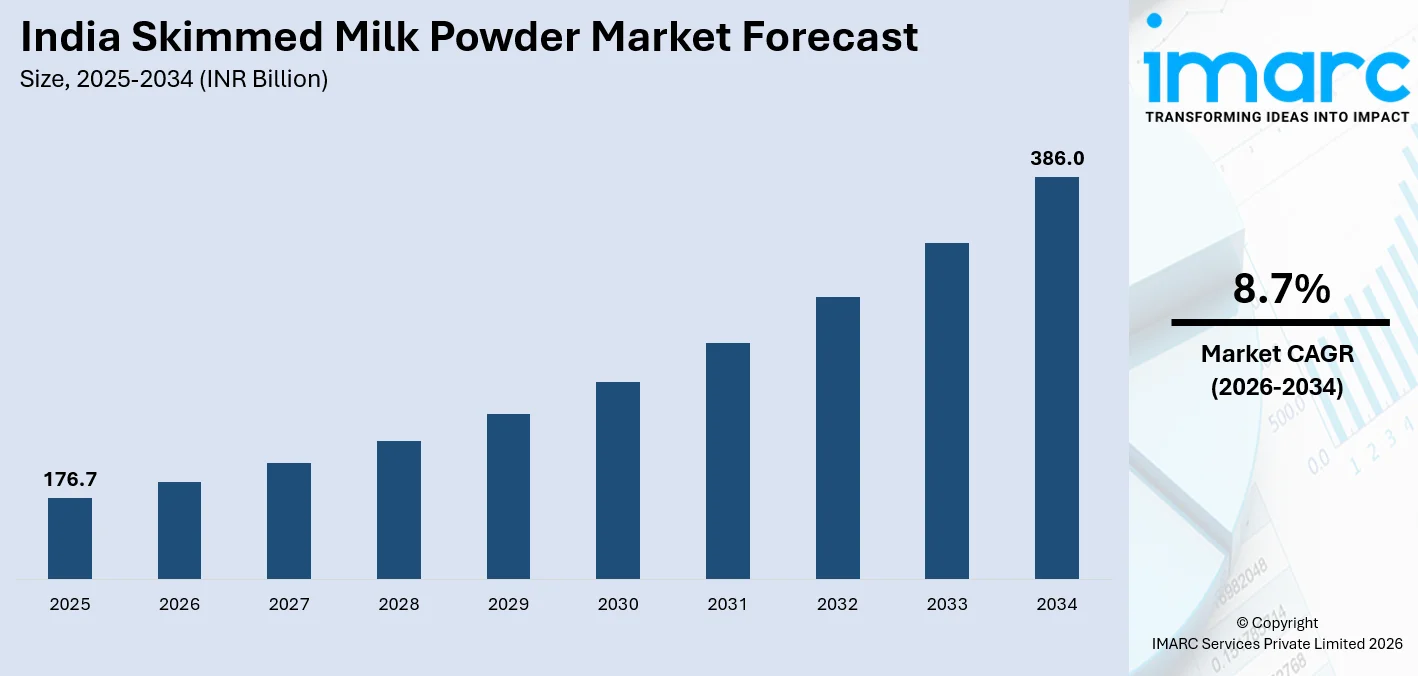
The skimmed milk powder market in India size was valued at INR 176.7 Billion in 2025 and is projected to reach INR 386.0 Billion by 2034, growing at a compound annual growth rate of 8.7% during 2026-2034.
The skimmed milk powder market in India is driven by rising demand for dairy ingredients in the food processing industry and the need for longer shelf-life dairy products. Skimmed milk powder is widely used in bakery items, confectionery, infant nutrition, and ready-to-drink (RTD) beverages due to its high protein content and easy storage. Increasing milk production, expanding dairy processing capacity, and growing demand for convenient dairy ingredients among manufacturers continue to support the market growth across the country.
Key Takeaways and Insights:
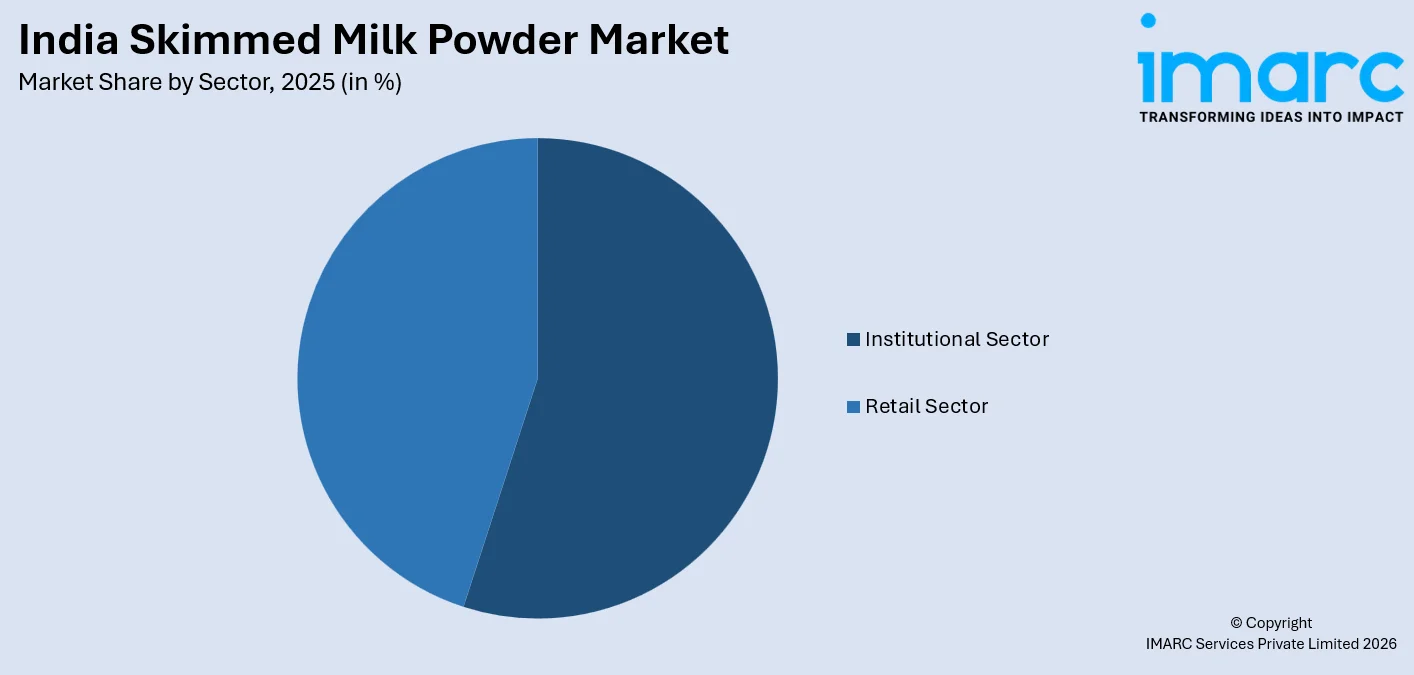
- By Sector: Institutional sector dominates the market with a share of 53.0% in 2025, owing to the widespread adoption in bakery, confectionery, food processing, and dairy manufacturing operations across India.
- By Region: West Bengal represents the largest segment with a market share of 12.5% in 2025, driven by rising RTE food consumption, robust confectionery traditions, and strong product accessibility across urban and semi-urban areas.
- Key Players: The Skimmed Milk Powder Market in India features a competitive mix of dairy cooperatives and private players operating across institutional and retail segments, competing on product quality, pricing, and distribution network reach.
To get more information on this market Request Sample
The skimmed milk powder market in India is experiencing growth as demographic and economic developments reshape dairy consumption patterns across the country. Rapid urbanization, rising middle-class income levels, and increasing awareness of balanced nutrition are encouraging consumers to shift toward low-fat, protein-rich dairy products. The Ministry of Statistics reported that per capita Net National Income increased to INR 2,05,324 in FY2024–25 from INR 1,88,892 in FY2023–24, reflecting stronger consumer purchasing power and greater spending on processed and packaged food products. Skimmed milk powder offers advantages such as longer shelf life, easy storage, and versatility in food manufacturing, making it widely used in bakery products, beverages, and nutritional formulations. Strengthening consumer purchasing capacity is also supporting this demand. In addition, the expansion of organized food processing industries and the increasing demand for convenient dairy ingredients are further accelerating market growth, as manufacturers rely on skimmed milk powder to maintain consistent quality, extend product shelf life, and improve production efficiency across multiple food applications.
Skimmed Milk Powder Market in India Trends:
Increasing Demand from Food Processing Industry
Skimmed milk powder is widely used as a functional dairy ingredient due to its extended shelf life, convenient storage, and stable nutritional composition. Food manufacturers incorporate it in a variety of processed products including bakery goods, confectionery items, dairy-based beverages, infant nutrition formulations, and ready-to-eat (RTE) foods. Its ability to provide consistent milk solids and maintain uniform product quality makes it particularly suitable for large-scale commercial food production. The strong growth of the food processing sector further illustrates this trend. According to the PHDCCI, the Indian food processing market reached INR 30,49,800 Crore in 2024 and is projected to grow to INR 4,584,415 Crore by the end of FY26. This expansion is significantly increasing demand for stable dairy ingredients, such as skimmed milk powder, across multiple food manufacturing applications.
Growth of E-commerce and Organized Retail for Dairy Products
The expansion of e-commerce platforms and organized retail networks is significantly improving consumer access to packaged dairy products, including skimmed milk powder. Online grocery platforms and modern retail outlets are offering a wide variety of milk powder products in convenient packaging formats suited for household and commercial use. These channels enhance product availability across urban and semi-urban markets while strengthening brand visibility and consumer awareness. The growing scale of digital commerce further highlights this shift in distribution. As per the India Brand Equity Foundation (IBEF), India’s e-commerce industry, valued at INR 10,82,875 Crore in 2024, is projected to grow to INR 29,88,735 Crore by 2030, reflecting a compound annual growth rate of 15%. The continued expansion of digital retail infrastructure and organized distribution systems is therefore supporting greater market accessibility and stronger sales of skimmed milk powder products across India.
Increasing Urbanization and Changing Consumption Patterns
Rapid urbanization in India is significantly influencing dietary habits and consumption patterns, contributing to the growth of the skimmed milk powder market. As populations increasingly migrate to urban centers, demand for convenient, shelf-stable, and easy-to-prepare food products continues to rise. Skimmed milk powder offers advantages, such as longer storage life, simple transportation, and quick reconstitution, making it well suited to fast-paced urban lifestyles. The scale of this demographic transition further highlights its market impact. According to the Economic Survey 2023–24, studies and reports by NITI Aayog estimate that more than 40% of India’s population will reside in urban areas by 2030. This growing urban population is increasingly adopting packaged and convenient food options, encouraging both households and food manufacturers to incorporate skimmed milk powder into daily consumption and processed food formulations.
Market Outlook 2026-2034:
The skimmed milk powder market in India demonstrates strong growth potential throughout forecast period, underpinned by sustained demographic expansion, rising disposable incomes, and evolving dietary preferences favoring nutritious, low-fat dairy alternatives. The market generated a revenue of INR 176.7 Billion in 2025 and is projected to reach a revenue of INR 386.0 Billion by 2034, growing at a compound annual growth rate of 8.7% from 2026-2034. Increasing adoption across institutional segments, ongoing e-commerce penetration, and government-led dairy development programs are expected to sustain demand. Product innovation in fortified and functional skimmed milk powder variants will further reinforce market momentum throughout the forecast period.
Skimmed Milk Powder Market in India Report Segmentation:
| Segment Category | Leading Segment | Market Share |
|---|---|---|
|
Sector |
Institutional Sector |
53.0% |
|
Region |
West Bengal |
12.5% |
Sector Insights:
Access the comprehensive market breakdown Request Sample
- Retail Sector
- Institutional Sector
The institutional sector dominates with a market share of 53.0% of the total skimmed milk powder market in India in 2025.
The institutional sector holds the biggest market share owing to the consistent demand for bulk dairy ingredients from food service providers, hospitality businesses, and large-scale catering operations. Skimmed milk powder offers advantages, such as longer shelf life, easy storage, and convenient transportation, making it suitable for institutions that require stable dairy supply throughout the year. Hotels, restaurants, bakeries, and food service companies use skimmed milk powder in beverages, desserts, bakery products, and processed foods. Its ability to maintain product consistency while reducing storage challenges encourages institutional buyers to rely on powdered dairy ingredients. As organized food service and catering industries expand across urban centers, institutional procurement of skimmed milk powder continues to increase.
The leadership of the institutional sector is also driven by the growing demand from large-scale food manufacturing units and commercial kitchens that require standardized dairy ingredients for high-volume production. Skimmed milk powder allows food processors and institutional kitchens to control fat content while maintaining nutritional value and protein levels in prepared products. This makes it widely suitable for applications, such as bakery fillings, confectionery products, sauces, and RTE foods. Institutions prefer skimmed milk powder because it helps maintain consistent taste and texture across large batches of products. With the continued expansion of the hospitality industry, food processing companies, and organized catering services in India, institutional consumption remains a major contributor to the growth of the skimmed milk powder market.
Regional Insights:
- Karnataka
- Maharashtra
- Tamil Nadu
- Delhi
- Gujarat
- Andhra Pradesh and Telangana
- Uttar Pradesh
- West Bengal
- Kerala
- Haryana
- Punjab
- Rajasthan
- Madhya Pradesh
- Bihar
- Orissa
West Bengal leads with a market share of 12.5% of the total skimmed milk powder market in India in 2025.
West Bengal represents the largest segment due to its large population base and strong demand for dairy-based food products across both urban and rural areas. The state has a well-established dairy consumption culture where milk-based beverages, sweets, and processed dairy foods are widely consumed. Skimmed milk powder is frequently used by sweet manufacturers, bakeries, and small food businesses to maintain consistent supply when fresh milk availability fluctuates. Its longer shelf life and ease of storage make it a practical alternative for commercial users. In addition, the presence of numerous dairy cooperatives and processing units supports the distribution of powdered dairy products across the state, strengthening regional demand.
The region’s leadership is also supported by the strong presence of traditional sweet manufacturing clusters and a large network of small and medium food producers. West Bengal is widely recognized for its dairy-based confectionery products, many of which require stable dairy ingredients for large-scale production. Skimmed milk powder helps manufacturers maintain consistent product texture, flavor, and quality while managing raw milk supply variations. The growing urbanization and rising consumption of packaged foods are also encouraging bakeries, cafés, and food processors to adopt powdered dairy ingredients. Moreover, improvements in cold chain logistics and retail distribution across the state enable wider availability of dairy products, further contributing to the sustained demand for skimmed milk powder.

Market Dynamics:
Growth Drivers:
Why is the Skimmed Milk Powder Market in India Growing?
Increasing Demand for Affordable Dairy Ingredients
Skimmed milk powder is gaining popularity in India as a cost-effective dairy ingredient for both commercial and household consumption. Compared to fresh milk, skimmed milk powder offers greater price stability and longer storage capability, making it an attractive option for manufacturers and consumers seeking economical dairy solutions. Food producers utilize skimmed milk powder to manage input costs while maintaining product quality in dairy-based formulations. Additionally, institutional buyers, such as bakeries, catering services, and food manufacturers, rely on skimmed milk powder to ensure consistent supply without the risk of spoilage. This affordability and practicality are contributing to the increasing the demand for skimmed milk powder across various sectors.
Improved Dairy Processing and Drying Technologies
Advancements in dairy processing technologies to enhance production activities are playing a significant role in strengthening the skimmed milk powder market in India. Modern drying techniques and improved processing equipment enable manufacturers to produce milk powder with enhanced solubility, texture, and nutritional quality. These technological improvements also help increase production efficiency and reduce operational costs in dairy processing facilities. As dairy processors adopt advanced technologies, they are able to produce high-quality skimmed milk powder that meets both domestic and international quality standards. The continuous modernization of dairy processing infrastructure is therefore supporting the expansion and competitiveness of skimmed milk powder production.
Growing Shelf-Life Requirements in Food Supply Chains
The need for longer shelf life in food supply chains is another important factor driving the skimmed milk powder market in India. Unlike fresh milk, skimmed milk powder can be stored for extended periods without refrigeration, reducing spoilage and logistical challenges. This characteristic makes it particularly valuable in large-scale food distribution networks where transportation and storage conditions may vary. Food manufacturers and distributors prefer skimmed milk powder because it ensures product stability during long-distance transportation and storage. The growing complexity of food supply chains and the need to maintain product quality throughout distribution channels are therefore encouraging the use of milk powder products.
Market Restraints:
What Challenges the Skimmed Milk Powder Market in India is Facing?
Raw Material Price Volatility Constraining Profitability
Fluctuations in raw milk procurement prices directly impact skimmed milk powder production costs and market pricing stability. Seasonal variations in milk availability, fodder shortages, and climatic disruptions create supply-side pressures that translate into price volatility for finished products. These cost instabilities challenge manufacturers in maintaining competitive pricing structures, particularly for institutional buyers operating on fixed procurement budgets, potentially constraining market accessibility and limiting volume growth during periods of elevated input costs.
Cold Chain and Distribution Infrastructure Gaps in Rural Markets
Inadequate cold chain infrastructure and fragmented rural distribution networks represent significant barriers to market penetration in India’s non-metropolitan regions. The absence of reliable temperature-controlled logistics in remote areas constrains the efficient movement of raw milk to processing facilities, limiting production consistency. Additionally, underdeveloped retail distribution channels in rural markets restrict consumer access to packaged skimmed milk powder, leaving substantial demand potential in agrarian and semi-urban areas systematically underserved.
Competitive Pressure from Alternative Dairy Protein Products
The growing availability of alternative protein sources, including whole milk powder, dairy whiteners, and plant-based protein products, introduces competitive pressure within India’s skimmed milk powder market. Consumers exploring diverse nutritional options and food manufacturers seeking cost optimization may substitute skimmed milk powder with lower-cost alternatives depending on application-specific requirements. This competitive dynamic constrains market share expansion, particularly in price-sensitive consumer segments where purchasing decisions are primarily driven by cost considerations rather than nutritional attributes.
Competitive Landscape:
The skimmed milk powder market in India exhibits a structured competitive landscape characterized by the coexistence of large dairy cooperatives and private sector manufacturers competing across institutional and retail segments. Dairy cooperatives, benefiting from integrated milk procurement networks and established brand recognition, command significant market positions, leveraging scale advantages and government support to maintain cost competitiveness. Private sector players compete through product quality differentiation, expanded distribution reach, and targeted investments in processing technology. Competition is particularly intense in the institutional segment, where bulk procurement volumes incentivize aggressive pricing strategies and service reliability. Market participants are increasingly investing in product innovation, developing fortified and functional skimmed milk powder variants to capture premium consumer segments. Expanding e-commerce capabilities are enabling producers to access direct-to-consumer channels, reducing distribution intermediaries.
Recent Developments:
- May 2025: Nova Dairy launched a skimmed milk powder designed for health-conscious consumers seeking low-fat dairy options. The product retained essential nutrients, such as protein and calcium while reducing fat content, making it suitable for weight management and heart-healthy diets. It also offered convenience with longer shelf life and versatile use in beverages, cooking, and health-focused recipes.
Skimmed Milk Powder Market in India Market Report Coverage:
|
Report Features |
Details |
|
Base Year of the Analysis |
2025 |
|
Historical Period |
2020-2025 |
|
Forecast Period |
2026-2034 |
|
Units |
INR Billion |
|
Scope of the Report |
Exploration of Historical Trends and Market Outlook, Industry Catalysts and Challenges, Segment-Wise Historical and Future Market Assessment:
|
|
Sectors Covered |
Retail Sector, Institutional Sector |
|
Regions Covered |
Karnataka, Maharashtra, Tamil Nadu, Delhi, Gujrat, Andhra Pradesh and Telangana, Uttar Pradesh, West Bengal, Kerala, Haryana, Punjab, Rajasthan, Madhya Pradesh, Bihar, Orissa |
|
Customization Scope |
10% Free Customization |
|
Post-Sale Analyst Support |
10-12 Weeks |
|
Delivery Format |
PDF and Excel through Email (We can also provide the editable version of the report in PPT/Word format on special request) |
Frequently Asked Questions About the Skimmed Milk Powder Market in India Report
The skimmed milk powder market in India size was valued at INR 176.7 Billion in 2025.
The skimmed milk powder market in India is expected to grow at a compound annual growth rate of 8.7% during 2026-2034 to reach INR 386.0 Billion by 2034.
The institutional sector dominates the market in India with a revenue share of 53.0% in 2025, driven by its extensive adoption across food manufacturing, bakery, confectionery, and dairy processing industries throughout India.
Key factors driving the skimmed milk powder market include expanding e-commerce platforms and organized retail networks that improve consumer access and product visibility. For example, India’s e-commerce industry, valued at INR 10,82,875 Crore in 2024, is projected to reach INR 29,88,735 Crore by 2030.
Major challenges include raw material price volatility driven by seasonal milk supply fluctuations, inadequate cold chain and rural distribution infrastructure limiting market penetration, and competitive pressure from alternative dairy protein products constraining market share expansion in price-sensitive consumer segments.
Need more help?
- Speak to our experienced analysts for insights on the current market scenarios.
- Include additional segments and countries to customize the report as per your requirement.
- Gain an unparalleled competitive advantage in your domain by understanding how to utilize the report and positively impacting your operations and revenue.
- For further assistance, please connect with our analysts.
 Request Customization
 Speak to an Analyst
 Request Brochure
 Inquire Before Buying
Benefits of Customization
- Personalize this research
- Triangulate with your data
- Get data as per your format and definition
- Gain a deeper dive into a specific application, geography, customer, or competitor
- Any level of personalization
Get in Touch With Us
UNITED STATES
Phone: +1-201-971-6302
INDIA
Phone: +91-120-433-0800
UNITED KINGDOM
Phone: +44-753-714-6104
Email: [email protected]
Client Testimonials




.webp)




.webp)













Related Reports

Choose your plan
*Please note that the prices mentioned below are starting prices for each bundle type. Kindly contact our team for further details.*
Single User License
- 1 User License, Access on 2 Devices
- PDF Report + Excel Dataset (Password Protected)
- Lifetime Access
- No Printing Rights
- 10% Free Report Customization
- 10–12 Weeks of Analyst Support
Five User License
- Access for 5 Users, 2 Devices per User
- PDF Report + Excel Dataset (Password Protected)
- Lifetime Access
- Dedicated Account Manager
- 12–14 Weeks of Analyst Support
- No Printing Rights
- 15% Free Report Customization
- 25% Discount on Your Next Purchase
Corporate User License
- Unlimited User Access (Within Your Organization)
- PDF Report + Excel Dataset
- Lifetime Access
- Dedicated Account Manager
- 14–20 Weeks of Analyst Support
- No Printing Rights
- 20% Free Report Customization
- 30% Discount on Your Next Purchase
Essential Insights
What's included:
3 reports
- Lifetime Access
- PDF Reports
- Excel Datasets
- 2 Weeks of Free Analyst Support
- 2 User Licenses
- Access on 2 Devices
- Printing Rights
- Complimentary PowerPoint (PPT) Version
- Complimentary License Upgrade
Professional Access
What's included:
5 reports
- Lifetime Access
- PDF Reports
- Excel Datasets
- 8 Weeks of Free Analyst Support
- 2 User Licenses
- Access on 2 Devices
- Printing Rights
- Complimentary PowerPoint (PPT) Version
- Complimentary License Upgrade
Business Advantage
What's included:
8 reports
- Lifetime Access
- PDF Reports
- Excel Datasets
- 14 Weeks of Free Analyst Support
- 2 User Licenses
- Access on 2 Devices
- Printing Rights
- Complimentary PowerPoint (PPT) Version
- Complimentary License Upgrade
Enterprise Intelligence
What's included:
10 reports
- Lifetime Access
- PDF Reports
- Excel Datasets
- 20 Weeks of Free Analyst Support
- 2 User Licenses
- Access on 2 Devices
- Printing Rights
- Complimentary PowerPoint (PPT) Version
- Complimentary License Upgrade