
Small Cell Networks Market Report by Cell Type (Femtocell, Microcell, Metrocell, Picocell), Operating Environment (Indoor, Outdoor), End Use Industry (BFSI, IT and Telecom, Healthcare, Retail, Power and Energy, and Others), and Region 2026-2034
Market Overview:
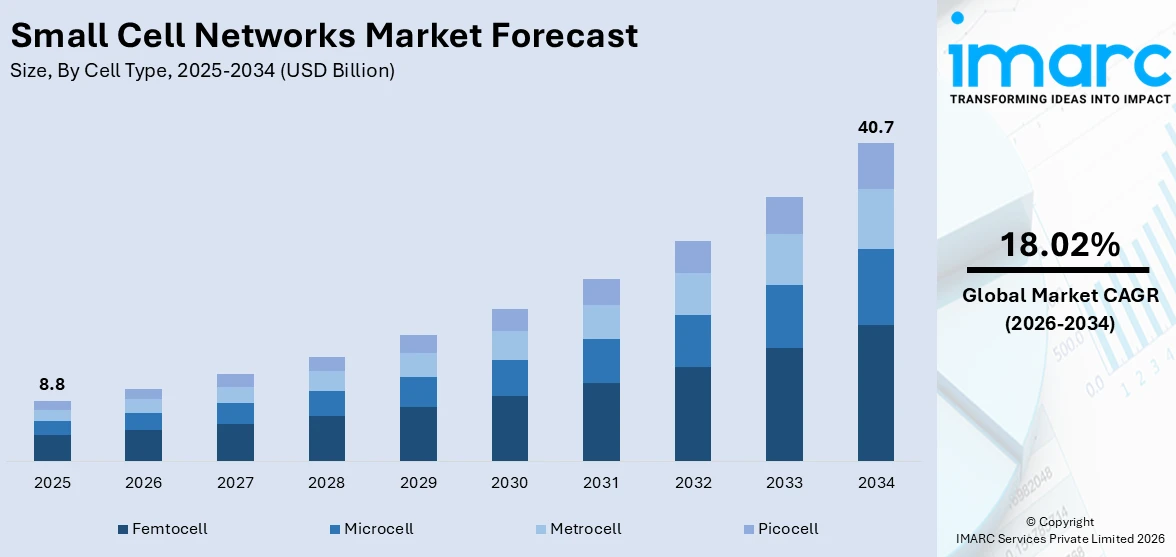
The global small cell networks market size reached USD 8.8 Billion in 2025. Looking forward, IMARC Group expects the market to reach USD 40.7 Billion by 2034, exhibiting a growth rate (CAGR) of 18.02% during 2026-2034.
|
Report Attribute
|
Key Statistics
|
|---|---|
|
Base Year
|
2025
|
|
Forecast Years
|
2026-2034
|
|
Historical Years
|
2020-2025
|
|
Market Size in 2025
|
USD 8.8 Billion |
|
Market Forecast in 2034
|
USD 40.7 Billion |
| Market Growth Rate (2026-2034) | 18.02% |
A small cell is a cost-effective radio access point with a low radio frequency (RF) power output, footprint, and range that can be installed indoors and outdoors and in licensed, shared, and unlicensed spectrum. It delivers high-quality and secure cellular coverages, enhances macro networks, adds targeted capacities, and supports new services and user experiences. In addition, it offloads cellular traffic, improves network efficiency, and consumes low power as compared to base stations (BSs). It relies on the maximum available frequency spectrum by reusing the same frequencies across a geographical area. At present, there is a rise in the demand for small cell networks for enhanced teleconferencing, online education, and telemedicine applications.
To get more information on this market Request Sample
Small Cell Networks Market Trends:
The growing demand for small cell networks to offer direct connectivity among different devices represents one of the key factors driving the market. Moreover, there is a rise in the utilization of the internet of things (IoT) devices across the globe. This, along with the increasing traction of 5G network for higher multi-Gbps peak data speeds, ultra-low latency, more reliability, and massive network capacity, is bolstering the growth of the market. In addition, the escalating demand for small cell networks to increase bandwidth, in confluence with the growing number of connected devices worldwide, is positively influencing the market. Besides this, the rising employment of small cell networks in stadiums, shopping malls, college campuses, and residential buildings for better cellular connectivity is offering lucrative growth opportunities to end-users and investors. Furthermore, key market players are focusing on strategic partnerships and product developments to introduce new product variants. These players are also focusing on mergers and acquisitions (M&A), which is projected to increase their overall profitability.
Key Market Segmentation:
IMARC Group provides an analysis of the key trends in each sub-segment of the global small cell networks market report, along with forecasts at the global, regional and country level from 2026-2034. Our report has categorized the market based on cell type, operating environment, and end use industry.
Breakup by Cell Type:
- Femtocell
- Microcell
- Metrocell
- Picocell
Breakup by Operating Environment:
- Indoor
- Outdoor
Breakup by End Use Industry:
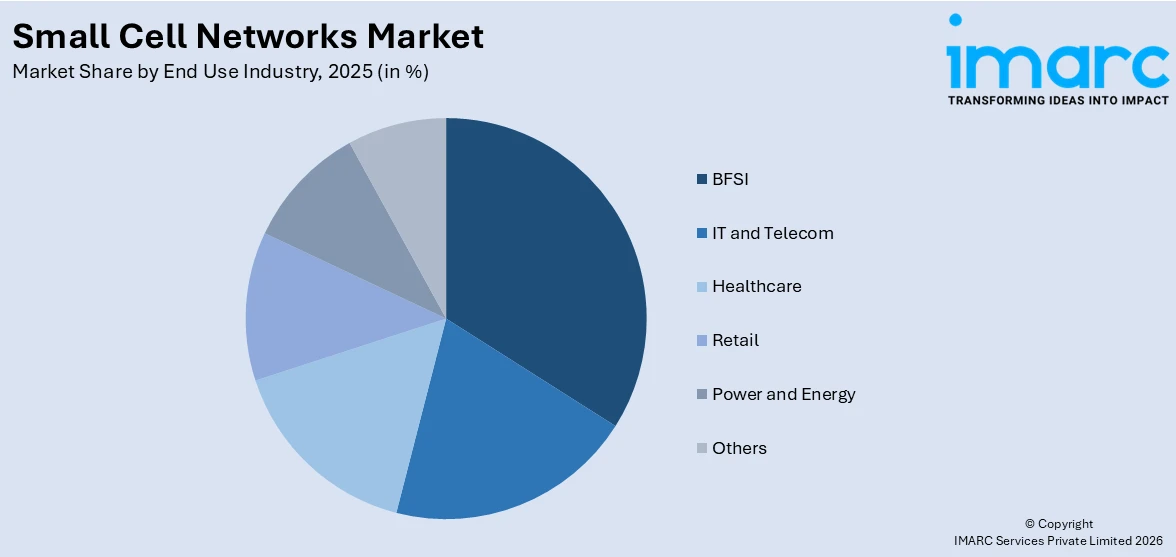
Access the comprehensive market breakdown Request Sample
- BFSI
- IT and Telecom
- Healthcare
- Retail
- Power and Energy
- Others
Breakup by Region:
- North America
- United States
- Canada
- Asia-Pacific
- China
- Japan
- India
- South Korea
- Australia
- Indonesia
- Others
- Europe
- Germany
- France
- United Kingdom
- Italy
- Spain
- Russia
- Others
- Latin America
- Brazil
- Mexico
- Others
- Middle East and Africa
Competitive Landscape:
The competitive landscape of the industry has also been examined along with the profiles of the key players being Airspan Networks Inc., ATC IP LLC, Baicells Technologies, Cisco Systems Inc., CommScope, Huawei Technologies Co. Ltd., Mavenir, Nokia Corporation, Telefonaktiebolaget LM Ericsson, Texas Instruments Incorporated and ZTE Corporation.
Report Coverage:
| Report Features | Details |
|---|---|
| Base Year of the Analysis | 2025 |
| Historical Period | 2020-2025 |
| Forecast Period | 2026-2034 |
| Units | Billion USD |
| Segment Coverage | Cell Type, Operating Environment, End Use Industry, Region |
| Region Covered | Asia Pacific, Europe, North America, Latin America, Middle East and Africa |
| Countries Covered | United States, Canada, Germany, France, United Kingdom, Italy, Spain, Russia, China, Japan, India, South Korea, Australia, Indonesia, Brazil, Mexico |
| Companies Covered | Airspan Networks Inc., ATC IP LLC, Baicells Technologies, Cisco Systems Inc., CommScope, Huawei Technologies Co. Ltd., Mavenir, Nokia Corporation, Telefonaktiebolaget LM Ericsson, Texas Instruments Incorporated and ZTE Corporation. |
| Customization Scope | 10% Free Customization |
| Post-Sale Analyst Support | 10-12 Weeks |
| Delivery Format | PDF and Excel through Email (We can also provide the editable version of the report in PPT/Word format on special request) |
Frequently Asked Questions About the Small Cell Networks Market Report
The global small cell networks market was valued at USD 8.8 Billion in 2025.
We expect the global small cell networks market to exhibit a CAGR of 18.02% during 2026-2034.
The rising demand for small cell networks to offer direct connectivity, along with the increasing penetration of 5G network for higher multi-Gbps peak data speeds, ultra-low latency, more reliability, etc., is primarily driving the global small cell networks market.
The sudden outbreak of the COVID-19 pandemic has led to the growing adoption of small cell networks for teleconferencing, online education, and telemedicine applications, during the lockdown scenario.
Based on the cell type, the global small cell networks market has been segmented into femtocell, microcell, metrocell, and picocell. Among these, femtocell currently holds the majority of the total market share.
Based on the operating environment, the global small cell networks market can be divided into indoor and outdoor. Currently, indoor exhibits a clear dominance in the market.
On a regional level, the market has been classified into North America, Asia-Pacific, Europe, Latin America, and Middle East and Africa, where North America currently dominates the global market.
Some of the major players in the global small cell networks market include Airspan Networks Inc., ATC IP LLC, Baicells Technologies, Cisco Systems Inc., CommScope, Huawei Technologies Co. Ltd., Mavenir, Nokia Corporation, Telefonaktiebolaget LM Ericsson, Texas Instruments Incorporated, and ZTE Corporation.
Need more help?
- Speak to our experienced analysts for insights on the current market scenarios.
- Include additional segments and countries to customize the report as per your requirement.
- Gain an unparalleled competitive advantage in your domain by understanding how to utilize the report and positively impacting your operations and revenue.
- For further assistance, please connect with our analysts.
 Request Customization
 Speak to an Analyst
 Request Brochure
 Inquire Before Buying
Benefits of Customization
- Personalize this research
- Triangulate with your data
- Get data as per your format and definition
- Gain a deeper dive into a specific application, geography, customer, or competitor
- Any level of personalization
Get in Touch With Us
UNITED STATES
Phone: +1-201-971-6302
INDIA
Phone: +91-120-433-0800
UNITED KINGDOM
Phone: +44-753-714-6104
Email: [email protected]
Client Testimonials




.webp)




.webp)













Related Reports

Choose your plan
*Please note that the prices mentioned below are starting prices for each bundle type. Kindly contact our team for further details.*
Single User License
- 1 User License, Access on 2 Devices
- PDF Report + Excel Dataset (Password Protected)
- Lifetime Access
- No Printing Rights
- 10% Free Report Customization
- 10–12 Weeks of Analyst Support
Five User License
- Access for 5 Users, 2 Devices per User
- PDF Report + Excel Dataset (Password Protected)
- Lifetime Access
- Dedicated Account Manager
- 12–14 Weeks of Analyst Support
- No Printing Rights
- 15% Free Report Customization
- 25% Discount on Your Next Purchase
Corporate User License
- Unlimited User Access (Within Your Organization)
- PDF Report + Excel Dataset
- Lifetime Access
- Dedicated Account Manager
- 14–20 Weeks of Analyst Support
- No Printing Rights
- 20% Free Report Customization
- 30% Discount on Your Next Purchase
Essential Insights
What's included:
3 reports
- Lifetime Access
- PDF Reports
- Excel Datasets
- 2 Weeks of Free Analyst Support
- 2 User Licenses
- Access on 2 Devices
- Printing Rights
- Complimentary PowerPoint (PPT) Version
- Complimentary License Upgrade
Professional Access
What's included:
5 reports
- Lifetime Access
- PDF Reports
- Excel Datasets
- 8 Weeks of Free Analyst Support
- 2 User Licenses
- Access on 2 Devices
- Printing Rights
- Complimentary PowerPoint (PPT) Version
- Complimentary License Upgrade
Business Advantage
What's included:
8 reports
- Lifetime Access
- PDF Reports
- Excel Datasets
- 14 Weeks of Free Analyst Support
- 2 User Licenses
- Access on 2 Devices
- Printing Rights
- Complimentary PowerPoint (PPT) Version
- Complimentary License Upgrade
Enterprise Intelligence
What's included:
10 reports
- Lifetime Access
- PDF Reports
- Excel Datasets
- 20 Weeks of Free Analyst Support
- 2 User Licenses
- Access on 2 Devices
- Printing Rights
- Complimentary PowerPoint (PPT) Version
- Complimentary License Upgrade