
South East Asia Autonomous Ships Market Size, Share, Trends and Forecast by Component, Level of Autonomy, Fuel Type, Installation, Ship Type, and Country, 2026-2034
South East Asia Autonomous Ships Market Size, Share, Trends & Forecast (2026-2034)
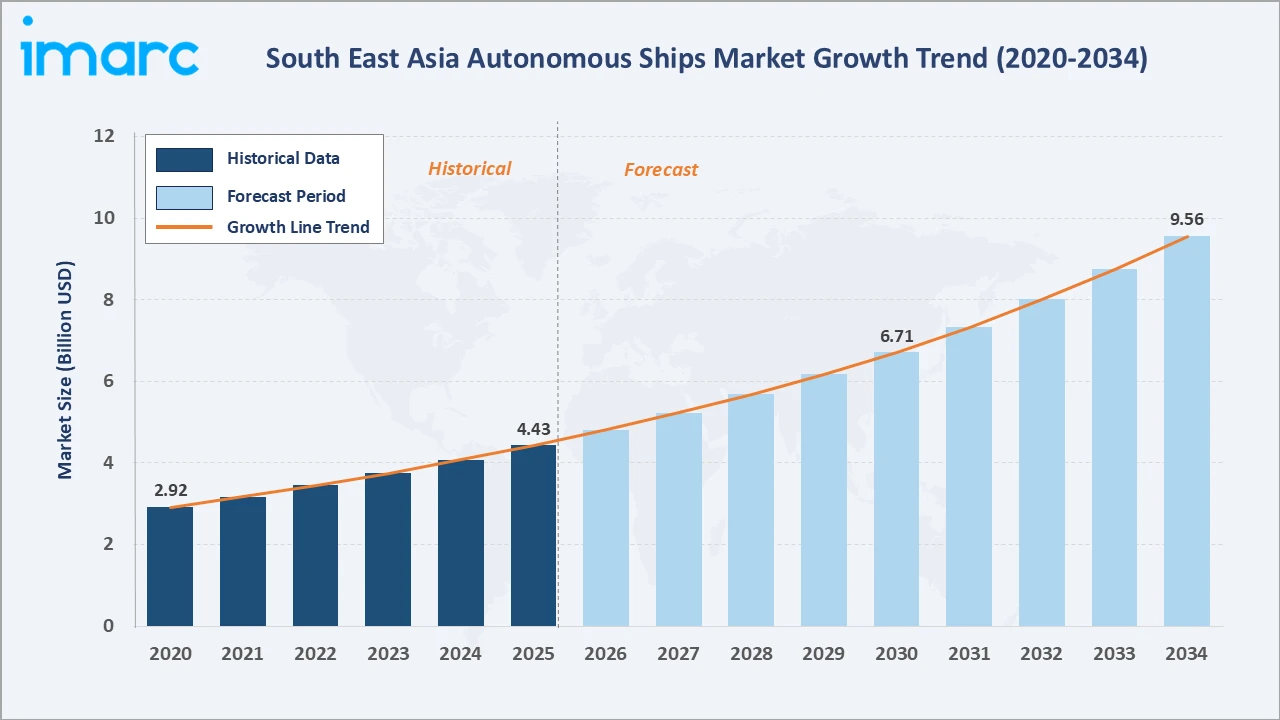
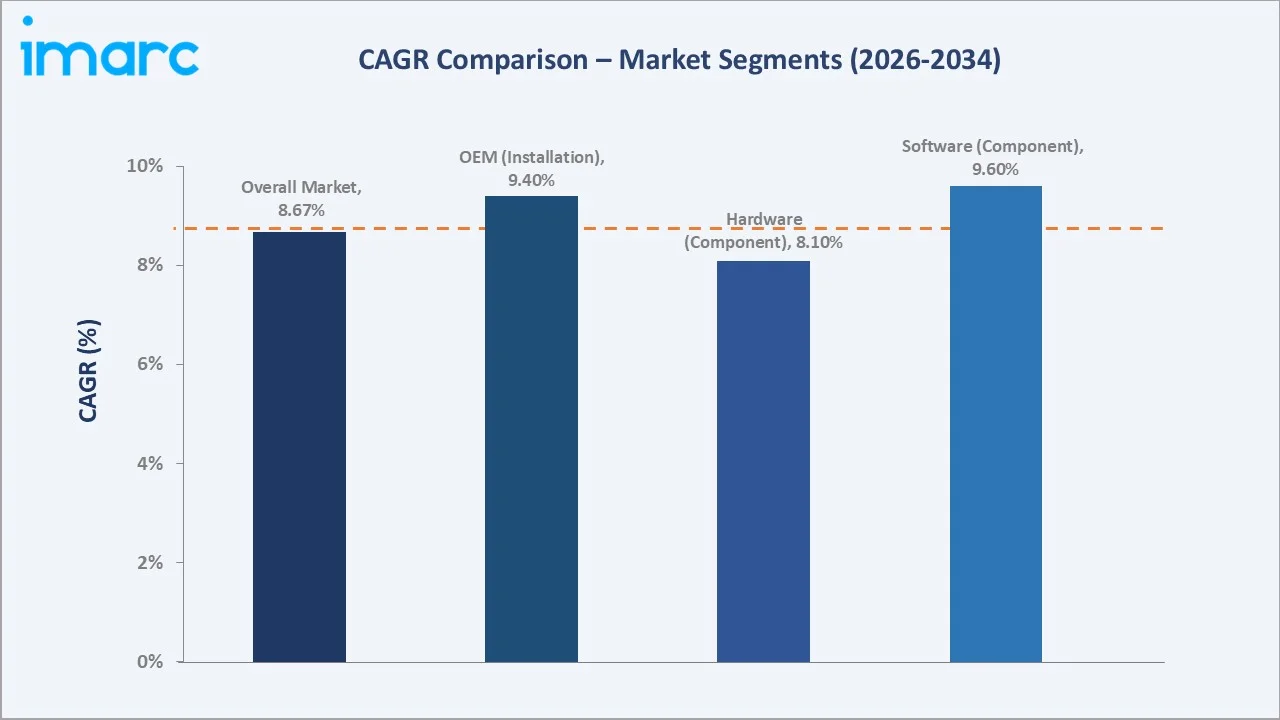
The South East Asia autonomous ships market reached USD 4.43 Billion in 2025 and is projected to reach USD 9.56 Billion by 2034, growing at a CAGR of 8.67% during 2026-2034. The market is driven by rising safety concerns in the maritime industry, growing sustainability focus, and expanding collaborations between governing bodies, research institutions, and industry players. Growth is further reinforced by the region's dense shipping lanes, expanding port infrastructure, and rising defense modernization budgets across South East Asian nations. The OEM installation segment dominates at 72.3%, reflecting shipbuilders' preference for factory-integrated autonomous systems. Hardware leads the component segment at 58.7%, driven by sustained demand for sensors, radar, and communication equipment. Singapore commands the largest regional share at 28.6%.
Market Snapshot
|
Metric |
Value |
|
Market Size (2025) |
USD 4.43 Billion |
|
Forecast Market Size (2034) |
USD 9.56 Billion |
|
CAGR (2026-2034) |
8.67% |
|
Base Year |
2025 |
|
Historical Period |
2020-2025 |
|
Forecast Period |
2026-2034 |
|
Dominant Installation |
OEM (72.3%, 2025) |
|
Dominant Component |
Hardware (58.7%, 2025) |
|
Leading Region |
Singapore (28.6%, 2025) |
The market expanded from USD 2.92 Billion in 2020 to USD 4.43 Billion in 2025, reflecting sustained structural demand for automated maritime systems across the region, and is anchored at USD 6.71 Billion in 2030 before reaching USD 9.56 Billion by 2034. This trajectory reflects sustained investment in AI-enabled navigation, expanding commercial shipping fleets, and rising defense modernization budgets across Singapore, Indonesia, Malaysia, Vietnam, Thailand, and the Philippines.
To get more information on this market, Request Sample
OEM installation and the software component segment are projected to grow fastest through the forecast period, as shipbuilders increasingly embed autonomous systems at the construction stage and vessel operators adopt AI-driven navigation and remote-monitoring platforms at an accelerating pace across South East Asia's expanding maritime economy.
Executive Summary
The South East Asia autonomous ships market reached USD 4.43 Billion in 2025, reflecting the region's accelerating shift toward automated maritime operations across commercial, defense, and passenger fleets. Autonomous ships integrate radar, lidar, cameras, and AI-driven navigation systems to reduce human error, optimize routes, and lower operating costs. The market is projected to reach USD 9.56 Billion by 2034, delivering an 8.67% CAGR.
OEM installation at 72.3% dominates by capturing shipbuilders' growing preference for factory-integrated autonomous systems over post-build retrofits. Hardware at 58.7% leads the component segment through sustained demand for sensors, radar, and communication equipment across new vessel construction. Singapore at 28.6% leads regionally through its status as a global maritime hub, advanced port infrastructure, and active government-backed autonomous vessel trial programs.
Key Market Insights
|
Insight |
Data |
|
Dominant Installation |
OEM - 72.3% share (2025) |
|
Dominant Component |
Hardware - 58.7% share (2025) |
|
Leading Region |
Singapore - 28.6% share (2025) |
|
Market Opportunity |
AI-based collision avoidance; remote vessel monitoring; smart port integration; defense fleet automation |
Key Analytical Observations Supporting the Above Data:
- OEM at 72.3%: OEM installation dominates as shipbuilders increasingly integrate autonomous navigation, sensor suites, and control systems directly during vessel construction, ensuring optimal system compatibility and reducing post-build integration costs. Its widespread adoption across commercial and defense shipbuilding programs by regional shipyards further strengthens segment demand.
- Hardware at 58.7%: The hardware segment dominates due to the high cost of radar, lidar, cameras, and sensor arrays required to equip autonomous vessels, alongside ongoing demand for robust onboard communication infrastructure. Continuous upgrades to sensor precision and durability standards are reinforcing hardware's revenue share across the region.
- Singapore at 28.6%: Singapore leads the region due to its position as a global transshipment hub and strong consumer and government demand for maritime innovation. Singapore's Maritime and Port Authority expanded its autonomous vessel trial programs, thereby generating substantial demand for autonomous navigation systems.
South East Asia Autonomous Ships Market Overview
The South East Asia autonomous ships market encompasses the design, manufacture, and supply of all autonomous navigation and control systems used to operate unmanned or remotely supervised vessels across all ship categories, including commercial ships, defense ships, and passenger ships.
The ecosystem integrates sensor and component suppliers, navigation software developers, shipbuilders and system integrators, autonomous ship OEMs, port authorities and operators, classification and regulatory bodies, and commercial, defense, and passenger fleet owners. Macroeconomic factors include rising seaborne trade, growing maritime tourism, persistent seafarer shortages, and sustained investment in maritime automation infrastructure.
Market Dynamics
To evaluate market opportunities, Request Sample
Market Drivers
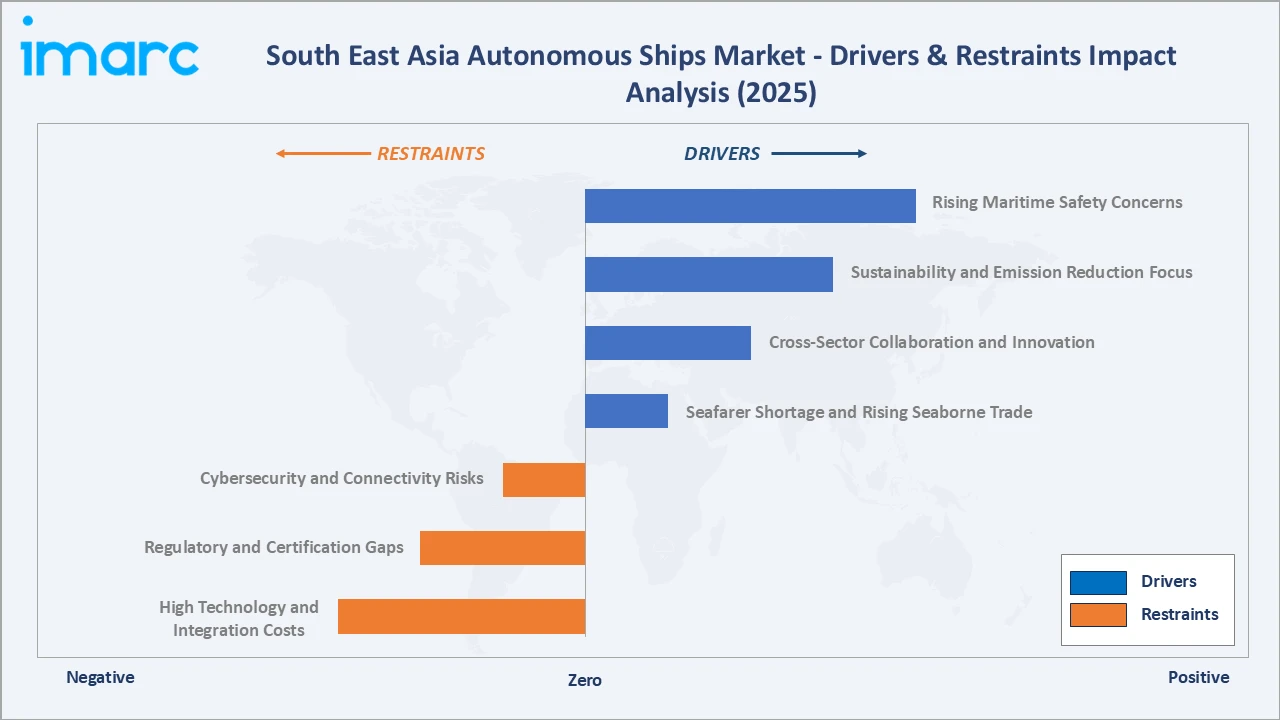
- Rising Maritime Safety Concerns: Growing concerns about human-error-related maritime accidents are driving the adoption of autonomous ships equipped with advanced sensors and AI algorithms capable of detecting hazards and navigating challenging conditions with greater precision, thereby reducing accident rates across regional shipping lanes. These systems continuously monitor vessel surroundings using radar, lidar, and thermal imaging to identify potential collision risks well in advance. Regional maritime authorities are actively encouraging fleet operators to adopt such technologies as part of broader safety compliance frameworks.
- Sustainability and Emission Reduction Focus: The rising focus on lowering the environmental impact of maritime transportation is encouraging adoption of autonomous ships that optimize routes and fuel consumption, supporting greener, more eco-efficient shipping operations across the region. AI-driven route optimization reduces unnecessary fuel burn and idle time at ports, directly lowering vessel emissions. Several South East Asian ports have also introduced green shipping incentives that favor operators deploying autonomous and low-emission vessel technologies.
- Cross-Sector Collaboration and Innovation: Increasing collaboration between governing bodies, research institutions, and industry players is fostering innovation, helping overcome technical challenges and accelerating integration of autonomous vessels into regional maritime infrastructure. Joint pilot programs between port authorities and technology developers are shortening the testing-to-deployment cycle for new autonomous navigation systems. These partnerships are also helping standardize data-sharing protocols between vessels and shore-based control centers.
- Seafarer Shortage and Rising Seaborne Trade: A persistent shortage of skilled seafarers, combined with rising seaborne trade and maritime tourism, is increasing reliance on autonomous systems capable of performing navigation and cargo-handling tasks with reduced crew dependency. The growing unattractiveness of seafaring careers among younger workers is compounding this shortage across several South East Asian shipping nations. As regional trade volumes continue to expand, autonomous systems are increasingly viewed as a structural solution to sustained crew capacity constraints.
Market Restraints
- High Technology and Integration Costs: The advanced sensors, AI systems, and communication infrastructure required for autonomous ships involve substantial upfront capital expenditure, limiting adoption among smaller regional shipping operators. Retrofitting older vessels with autonomous-capable systems often requires structural modifications that further add to overall project costs. These cost barriers are particularly pronounced for small and medium-sized fleet operators across emerging South East Asian markets.
- Regulatory and Certification Gaps: Inconsistent regulatory frameworks for autonomous vessel operation across South East Asian countries create uncertainty for operators and slow large-scale commercial deployment of fully autonomous ships. The absence of harmonized cross-border certification standards complicates fleet operations for shipping companies serving multiple regional markets. Operators must often navigate varying compliance requirements on a country-by-country basis, adding administrative complexity and delaying deployment timelines.
- Cybersecurity and Connectivity Risks: Autonomous ships depend on continuous data transmission for remote control and coordination, exposing them to cybersecurity vulnerabilities and connectivity disruptions that can compromise safe operation at sea. Unreliable satellite or cellular connectivity in remote maritime zones can interrupt real-time navigation data, creating operational risk. Growing awareness of these vulnerabilities is pushing operators to invest in more robust encryption and redundant communication systems, adding to overall costs.
Market Opportunities
- AI-Based Collision Avoidance Systems: Advancements in AI-based collision avoidance technology present significant opportunities for technology providers to develop next-generation navigation systems tailored to the region's dense and congested shipping lanes. These systems can process multiple sensor data streams simultaneously to make real-time navigational decisions with minimal latency. Growing regulatory encouragement for enhanced vessel safety standards is expected to accelerate commercial adoption of such systems over the forecast period.
- Smart Port Integration: The growing development of smart port infrastructure across Singapore, Malaysia, and other regional hubs creates opportunities for autonomous vessel systems to integrate seamlessly with automated docking, cargo handling, and traffic management platforms. Ports investing in 5G connectivity and IoT-enabled infrastructure are particularly well positioned to support real-time data exchange with autonomous vessels. This convergence of port and vessel automation is expected to create new revenue streams for technology integrators.
Market Challenges
- Fragmented Regional Regulatory Standards: The absence of a unified South East Asian regulatory framework for autonomous vessel certification creates operational complexity for technology providers and fleet operators seeking to scale across multiple countries. Companies must often adapt system designs and documentation to meet differing national requirements, increasing time-to-market. This fragmentation also complicates cross-border insurance and liability arrangements for autonomous vessel operations.
- Limited Skilled Workforce for AI Systems: A shortage of engineers and technicians skilled in AI-based maritime navigation systems constrains the pace at which regional shipbuilders and operators can deploy and maintain autonomous vessel technology. Training programs for this specialized skill set remain limited across much of the region. This workforce gap is prompting some companies to invest directly in local training partnerships to build long-term technical capacity.
Emerging Market Trends
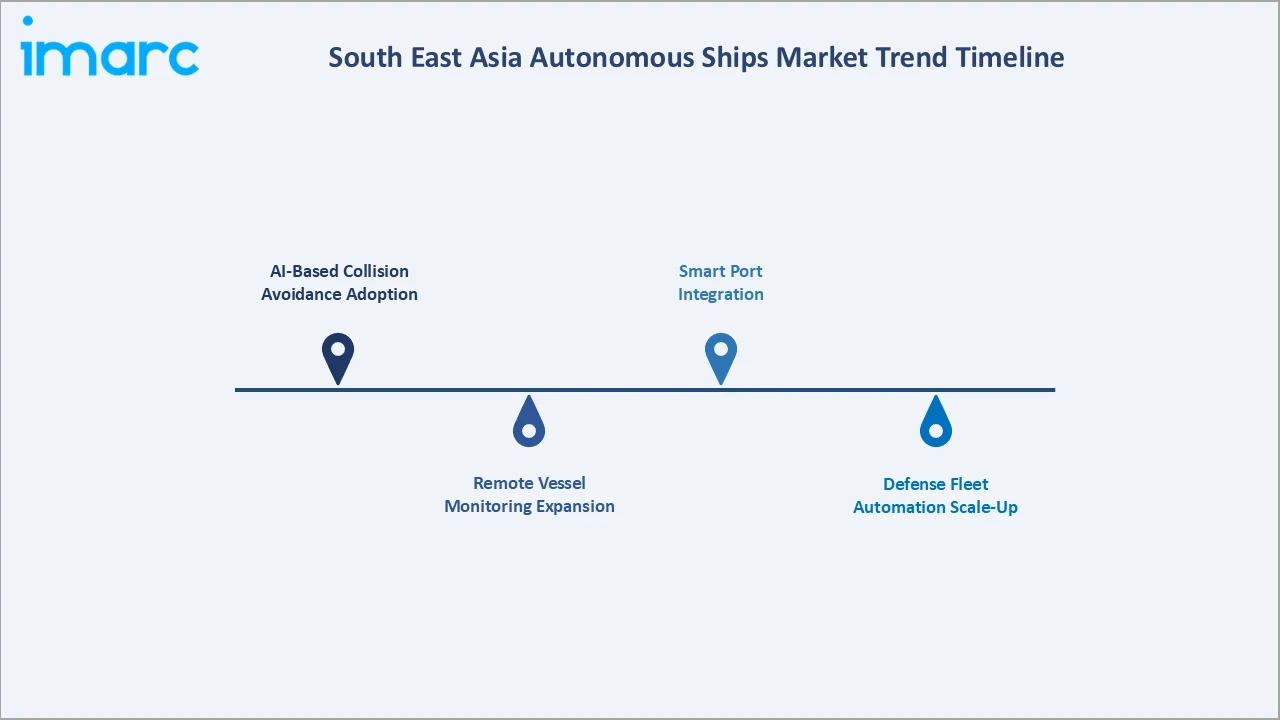
1. AI-Based Collision Avoidance Adoption
Adoption of AI-based collision avoidance systems is accelerating as regional shipping operators seek to reduce accident risk across increasingly congested South East Asian shipping lanes. These systems combine radar, lidar, and camera data to detect and respond to potential hazards in real time, supporting safer navigation across both commercial and defense fleets.
2. Remote Vessel Monitoring Expansion
Remote vessel monitoring platforms are expanding as fleet operators seek greater visibility into vessel performance, location, and operational status from shore-based control centers. This trend is supporting improved fleet management efficiency and enabling faster response to operational anomalies across dispersed regional shipping networks.
3. Smart Port Integration
Smart port integration is emerging as regional ports invest in automated docking, cargo handling, and traffic management systems designed to interface directly with autonomous vessel navigation platforms. This integration is expected to reduce port turnaround times and improve overall supply chain efficiency across South East Asia's major maritime hubs.
4. Defense Fleet Automation Scale-Up
Defense fleet automation is scaling up as regional navies invest in unmanned surface vessel platforms for surveillance, patrol, and reconnaissance missions. This trend reflects growing defense modernization budgets and a strategic emphasis on extending maritime domain awareness while reducing crew exposure to risk in contested waters.
Industry Value Chain Analysis
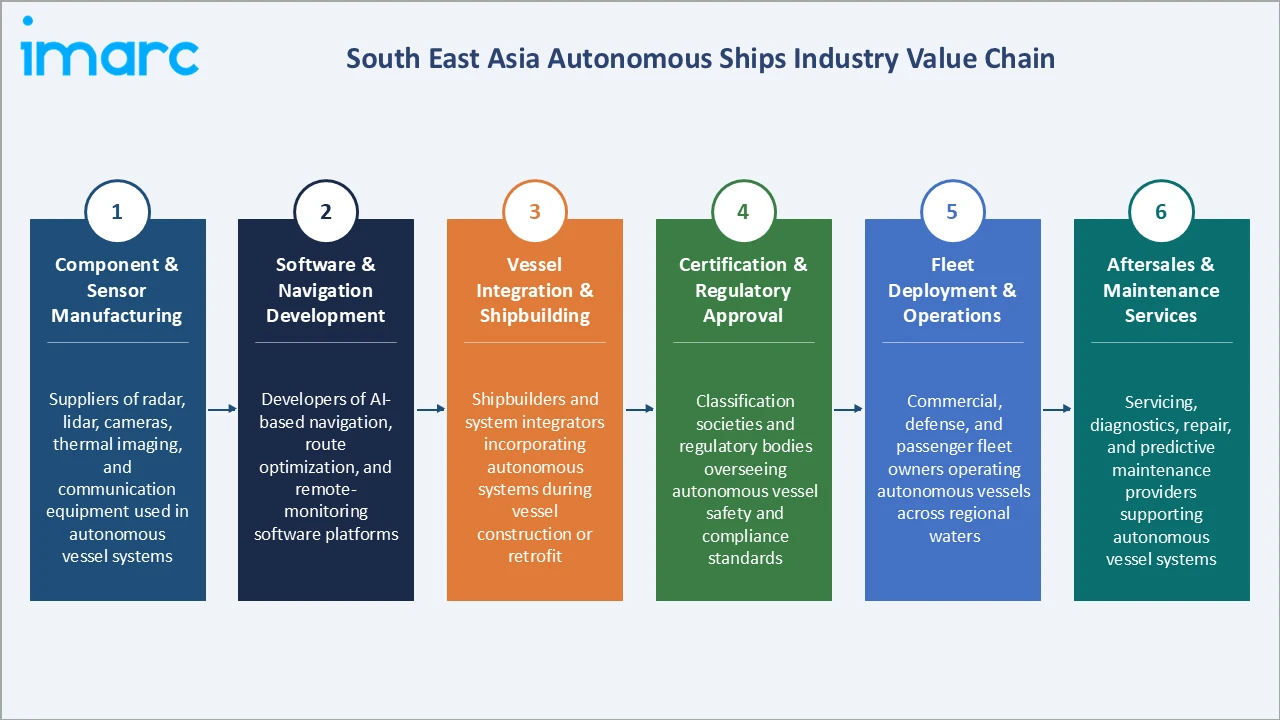
The South East Asia autonomous ships value chain integrates component and sensor manufacturing, software and navigation system development, vessel integration and shipbuilding, certification and regulatory approval, fleet deployment and operations, and aftersales and maintenance services. The value chain has been progressively consolidating toward integrated OEM delivery as the primary commercial format, reflecting shipbuilders' growing preference for factory-installed autonomous systems over standalone retrofits.
|
Stage |
Key Participants |
|
Component & Sensor Manufacturing |
Suppliers of radar, lidar, cameras, thermal imaging, and communication equipment used in autonomous vessel systems |
|
Software & Navigation Development |
Developers of AI-based navigation, route optimization, and remote-monitoring software platforms |
|
Vessel Integration & Shipbuilding |
Shipbuilders and system integrators incorporating autonomous systems during vessel construction or retrofit |
|
Certification & Regulatory Approval |
Classification societies and regulatory bodies overseeing autonomous vessel safety and compliance standards |
|
Fleet Deployment & Operations |
Commercial, defense, and passenger fleet owners operating autonomous vessels across regional waters |
|
Aftersales & Maintenance Services |
Servicing, diagnostics, repair, and predictive maintenance providers supporting autonomous vessel systems |
The component and sensor manufacturing tier remains the value chain's most commercially critical stage, given the high cost and technical complexity of radar, lidar, and communication systems. The software and navigation development tier is experiencing the value chain's fastest innovation cycle as AI-based systems continue to advance in accuracy and processing speed.
Market Segmentation Analysis
The report covers the following segments:
|
Segment Category |
Leading Segment |
Market Share |
Year |
|
Installation |
OEM |
72.3% |
2025 |
|
Component |
Hardware |
58.7% |
2025 |
|
Level of Autonomy |
🔒 |
🔒 |
2025 |
|
Fuel Type |
🔒 |
🔒 |
2025 |
|
Ship Type |
🔒 |
🔒 |
2025 |
|
Country |
Singapore |
28.6% |
2025 |

By Installation
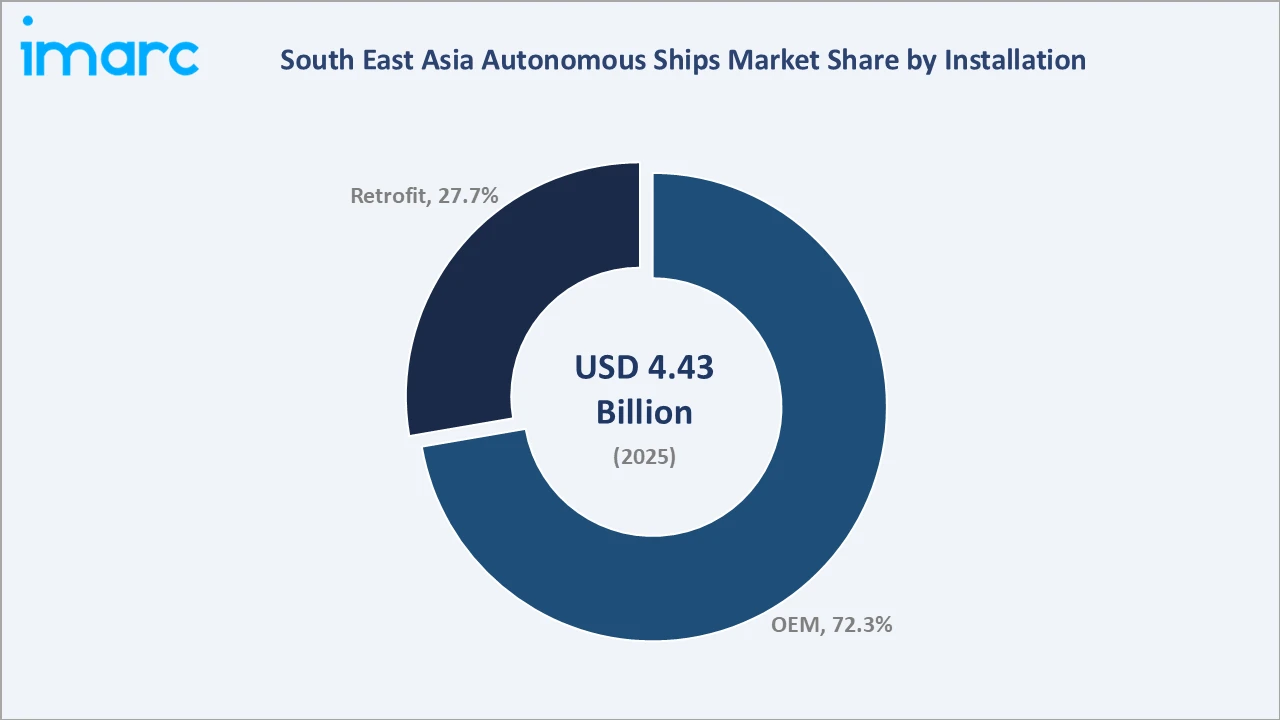
OEM installation leads the market at 72.3% in 2025, as shipbuilders increasingly embed autonomous navigation and sensor systems directly during vessel construction, ensuring seamless integration and long-term system reliability.
To access detailed market analysis, Request Sample
Retrofit installation, at 27.7%, serves operators seeking to upgrade existing fleets with autonomous capabilities without full vessel replacement, offering a lower-cost entry path for smaller commercial and passenger ship operators across the region.
By Component
Hardware leads the component segment at 58.7% in 2025, driven by demand for radar, lidar, high-definition cameras, thermal imaging systems, and communication equipment essential to autonomous vessel operation.
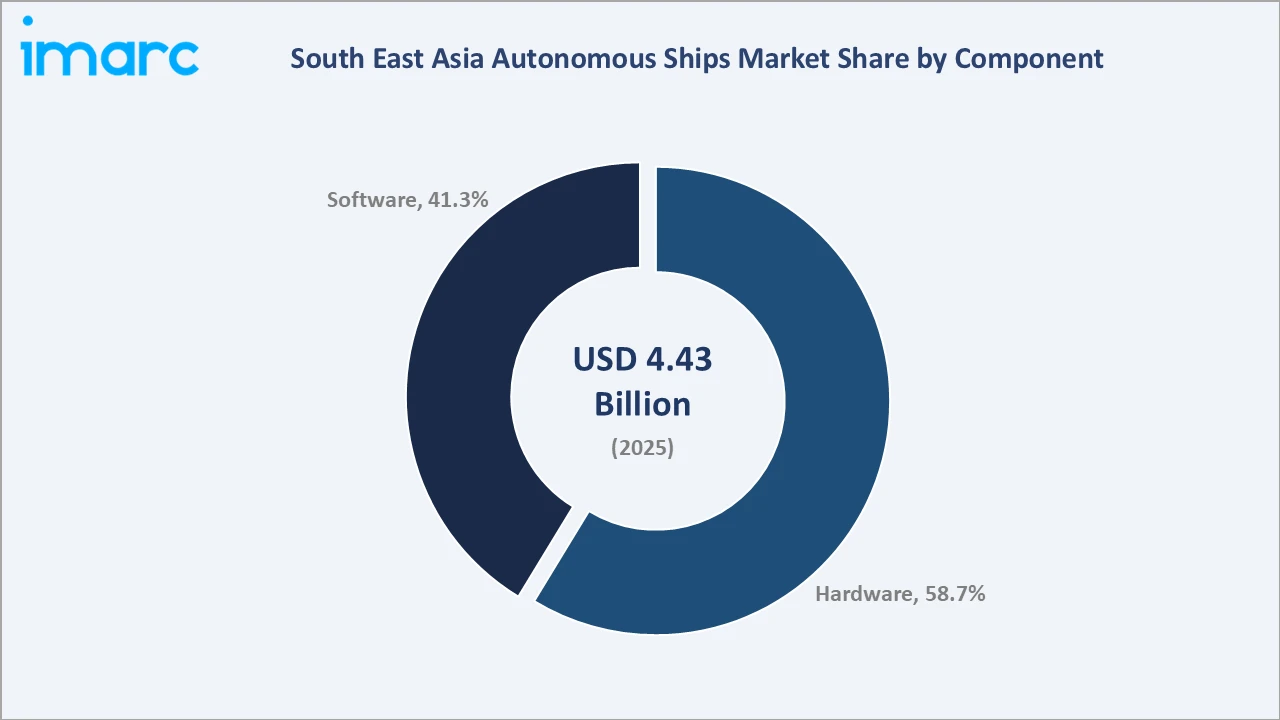
Software, at 41.3%, encompasses AI-based navigation, route optimization, and remote-monitoring platforms, and is expected to grow steadily as vessel autonomy levels advance and data-driven decision-making systems mature.
Regional Market Insights
|
Region |
Share (2025) |
Key Market Characteristics |
|
Singapore |
28.6% |
Driven by its strong port infrastructure, supportive government policies, and high adoption of maritime automation technology |
|
Indonesia |
22.4% |
Supported by its extensive shipping network, rising seaborne trade, and growing investment in maritime safety technology |
|
Malaysia |
14.8% |
Driven by expanding port modernization initiatives and increasing adoption of automated navigation across commercial fleets |
|
Vietnam |
12.7% |
Supported by growing maritime trade volumes and government initiatives to modernize domestic shipping and defense fleets |
|
Thailand |
9.4% |
Driven by rising investment in smart port technology and expanding commercial shipping operations |
|
Philippines |
7.3% |
Emerging market supported by increasing maritime tourism and gradual modernization of inter-island passenger shipping |
|
Others |
4.8% |
Early-stage markets reflecting growing regional interest in autonomous maritime technology adoption |
Singapore, at 28.6%, leads through its role as one of the world's busiest transshipment hubs, coupled with sustained government investment in maritime autonomy pilots. Indonesia, at 22.4%, benefits from its vast archipelagic geography, which favors autonomous vessel deployment for inter-island commercial and defense shipping.
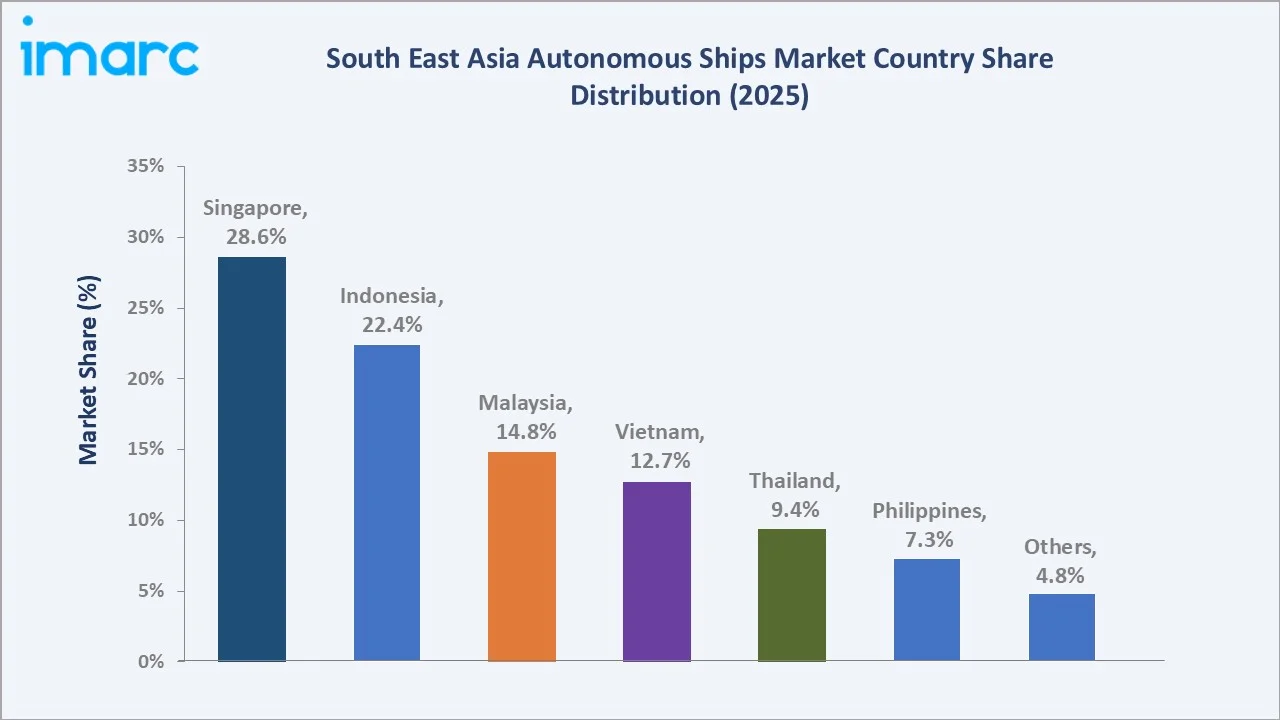
Malaysia, Vietnam, and Thailand collectively account for a significant share through expanding port infrastructure and rising commercial fleet modernization, while the Philippines and other regional markets remain in earlier stages of autonomous ship adoption.
Competitive Landscape
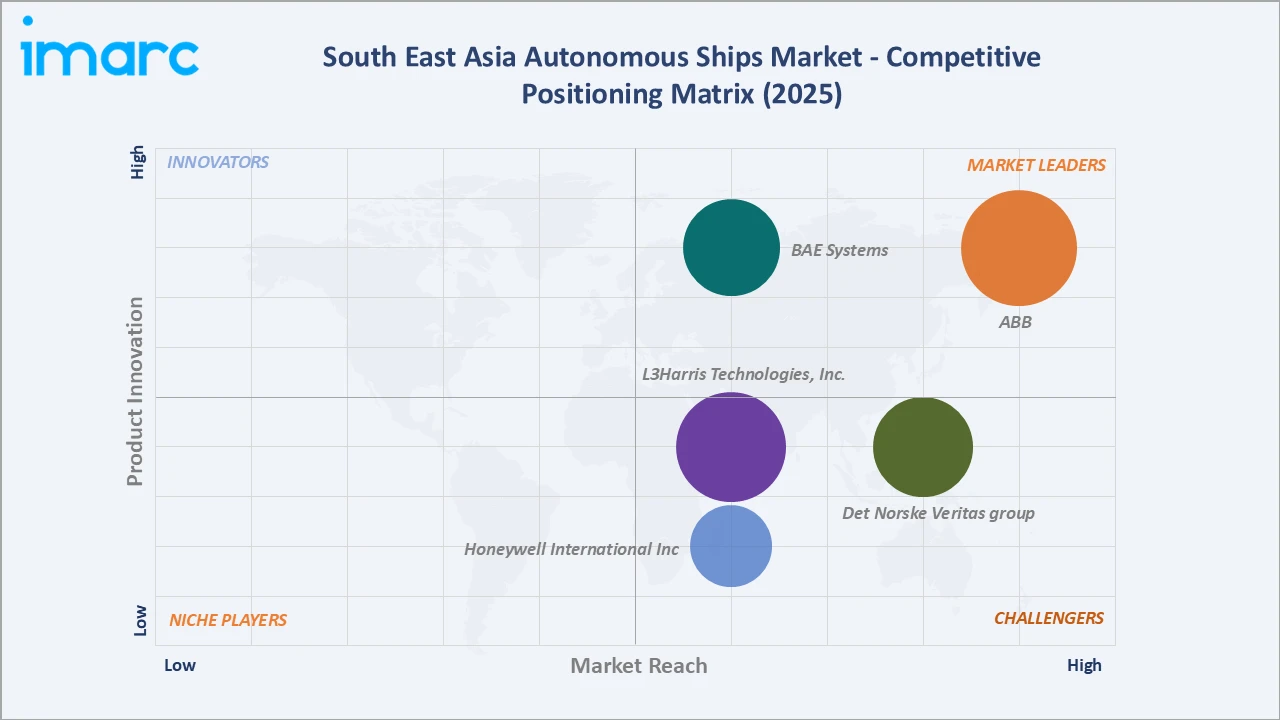
The South East Asia autonomous ships market competitive landscape is moderately fragmented, comprising global marine technology conglomerates, defense systems integrators, and classification societies offering certification for autonomous vessel operations.
|
Company Name |
Key Products |
Market Position |
Core Strength |
|
ABB |
Marine Automation Systems, Integrated Power & Propulsion Control Platforms |
Market Leader |
ABB specializes in the development of automation and electrification systems that support autonomous vessel power and control. |
|
BAE Systems |
Unmanned Surface Vessel Systems, Nautomate |
Market Leader |
BAE Systems is a leading defence technology company specializing in unmanned surface vessel systems for naval and surveillance applications. |
|
Det Norske Veritas group |
Autonomous Vessel Classification & Certification Services |
Strong Challenger |
Det Norske Veritas specializes in classification, certification, and safety standards development for autonomous ship technology worldwide. |
|
Honeywell International Inc |
Sensor, Navigation & Communication Systems for Autonomous Vessels |
Strong Challenger |
Honeywell specializes in advanced sensor, navigation, and communication technologies for autonomous maritime platforms. |
|
L3Harris Technologies, Inc. |
Unmanned Maritime Systems, Autonomous Defense Vessel Technology |
Strong Challenger |
L3Harris Technologies specializes in unmanned maritime systems supporting defense and surveillance vessel operations. |
Key players include ABB, BAE Systems, Det Norske Veritas group, Honeywell International Inc, L3Harris Technologies, Inc., and others.
Key Company Profiles
ABB
ABB is a global technology company with a strong presence in the autonomous ships market through its marine automation and electrification systems.
- Key Products: Marine automation systems, integrated power and propulsion control platforms.
- Strategic Focus: Expanding integrated automation and electrification solutions for autonomous and remotely operated vessels across commercial shipping segments. The company is also investing in scalable digital platforms that allow shipowners to monitor and control multiple autonomous vessels from centralized shore-based facilities. In parallel, ABB continues to deepen partnerships with regional shipbuilders to co-develop electrification systems suited to South East Asia's diverse fleet requirements.
BAE Systems
BAE Systems is a global defense and security company with a growing footprint in unmanned and autonomous maritime surface vessel systems.
- Key Products: Unmanned surface vessel systems, autonomous defense navigation platforms.
- Strategic Focus: Expanding autonomous defense vessel capabilities to support regional naval modernization programs across South East Asia. The company is also collaborating with regional defense ministries to tailor unmanned surface vessel platforms to local maritime surveillance requirements. BAE Systems continues to invest in enhanced sensor fusion technology to improve situational awareness for autonomous defense missions in congested coastal waters.
Market Concentration Analysis
The South East Asia autonomous ships market is moderately fragmented, with global marine technology providers, defense systems integrators, and classification societies collectively competing for share across commercial and defense vessel segments. Regional shipbuilders' growing partnerships with global technology providers are expected to gradually consolidate the competitive landscape through the forecast period as autonomous system standards mature and adoption scales across the region.
Global technology conglomerates currently account for a significant share of installed autonomous systems across major regional shipyards, while classification societies play a growing role in shaping certification pathways for new market entrants. As regional adoption matures, mid-sized regional technology providers are also expected to gain share by offering cost-competitive alternatives tailored to smaller commercial fleet operators.
Investment & Growth Opportunities
Highest Growth Segments
OEM installation, the software component segment, and defense fleet automation represent the highest-growth investment vectors through 2034, supported by shipbuilders' growing preference for factory-integrated systems and rising regional defense modernization budgets.
Emerging Investment Opportunities
Smart port integration and AI-based collision avoidance systems represent the market's highest-value emerging opportunities, as regional ports and fleet operators increasingly seek interoperable, data-driven maritime automation solutions across South East Asia's expanding shipping networks.
Defense-focused autonomous vessel platforms also present a substantial emerging investment opportunity, as regional navies allocate growing budgets toward unmanned surveillance and patrol capabilities. Technology providers that can offer modular, upgradeable systems compatible with existing naval fleets are well positioned to capture a disproportionate share of this emerging defense procurement cycle.
Future Market Outlook (2026-2034)
The South East Asia autonomous ships market is projected to grow from USD 4.43 Billion in 2025 to USD 9.56 Billion by 2034, delivering an 8.67% CAGR over the forecast period. Continued investment in port modernization, defense fleet automation, and AI-based navigation systems is expected to sustain demand across the region's commercial and defense maritime segments.
OEM installation is expected to maintain its lead as shipbuilders increasingly embed autonomous systems at the construction stage, while hardware components remain central to vessel automation, even as software-driven navigation platforms gain a growing share of overall market value through the forecast period.
Research Methodology
Primary Research
Primary research comprised structured interviews with regional shipping operators, port authority representatives, and autonomous navigation system engineers across South East Asia.
Secondary Research
Secondary research encompassed company reports, maritime authority publications, regional trade data, and industry association records covering autonomous vessel adoption across South East Asia.
Forecasting Models
Market revenue forecasts were developed using a bottom-up model incorporating vessel deployment volumes by country, installation type adoption rates, and component-level revenue contribution across the forecast period. Historical data from 2020 to 2025 was triangulated against regional trade statistics and shipbuilding output to validate baseline market estimates before projecting forward through 2034.
South East Asia Autonomous Ships Market Report Coverage:
| Report Features | Details |
|---|---|
| Base Year of the Analysis | 2025 |
| Historical Period | 2020-2025 |
| Forecast Period | 2026-2034 |
| Units | Billion USD |
| Scope of the Report | Exploration of Historical and Forecast Trends, Industry Catalysts and Challenges, Segment-Wise Historical and Predictive Market Assessment:
|
| Components Covered | Hardware, Software |
| Levels of Autonomy Covered | Semi-Autonomous, Fully-Autonomous |
| Fuel Types Covered | Carbon Neutral Fuel, Liquefied Natural Gas, Electric Batteries, Heavy Fuel Oil (HFO) |
| Installations Covered | OEM, Retrofit |
| Ship Types Covered | Commercial Ships, Defense Ships, Passenger Ships |
| Countries Covered | Indonesia, Thailand, Singapore, Philippines, Vietnam, Malaysia, Others |
| Companies Covered | ABB, BAE Systems, Det Norske Veritas group, Honeywell International Inc, L3Harris Technologies, Inc., etc. |
| Customization Scope | 10% Free Customization |
| Post-Sale Analyst Support | 10-12 Weeks |
| Delivery Format | PDF and Excel through Email (We can also provide the editable version of the report in PPT/Word format on special request) |
Key Benefits for Stakeholders:
- IMARC’s industry report offers a comprehensive quantitative analysis of various market segments, historical and current market trends, market forecasts, and dynamics of the South East Asia autonomous ships market from 2020-2034.
- The research report provides the latest information on the market drivers, challenges, and opportunities in the South East Asia autonomous ships market.
- Porter's five forces analysis assist stakeholders in assessing the impact of new entrants, competitive rivalry, supplier power, buyer power, and the threat of substitution. It helps stakeholders to analyze the level of competition within the South East Asia autonomous ships industry and its attractiveness.
- Competitive landscape allows stakeholders to understand their competitive environment and provides an insight into the current positions of key players in the market.
Frequently Asked Questions About the South East Asia Autonomous Ships Market Report
The South East Asia autonomous ships market reached USD 4.43 Billion in 2025, driven by the OEM installation segment dominant at 72.3%, hardware components leading at 58.7%, and Singapore commanding the largest regional share at 28.6% through its global transshipment hub status and strong maritime innovation support.
The South East Asia autonomous ships market grows at 8.67% CAGR during 2026-2034, reaching USD 9.56 Billion by 2034. This growth reflects rising maritime safety priorities, sustainability-driven fleet modernization, expanding smart port infrastructure, and rising regional defense automation budgets.
OEM installation leads at 72.3%, capturing shipbuilders' growing preference for factory-integrated autonomous systems. This segment grows steadily as new vessel construction across the region increasingly embeds autonomous navigation and sensor systems at the build stage.
Hardware leads at 58.7%, capturing the sensors, radar, cameras, and communication equipment essential to autonomous vessel operation. Software, at 41.3%, is expected to grow steadily as AI-driven navigation platforms mature across the region.
Singapore leads at 28.6% through its global transshipment hub status, advanced port infrastructure, and strong government-backed support for autonomous vessel trials and maritime innovation.
Leading companies include ABB, BAE Systems, Det Norske Veritas group, Honeywell International Inc, L3Harris Technologies, Inc., and others.
The South East Asia autonomous ships market is projected to reach approximately USD 6.71 Billion by 2030, with continued expansion in OEM installation, smart port integration, and AI-based navigation system adoption across the region.
Three priority investment opportunities include AI-based collision avoidance system development, smart port integration technology, and defense fleet automation platforms supporting regional naval modernization programs.
Need more help?
- Speak to our experienced analysts for insights on the current market scenarios.
- Include additional segments and countries to customize the report as per your requirement.
- Gain an unparalleled competitive advantage in your domain by understanding how to utilize the report and positively impacting your operations and revenue.
- For further assistance, please connect with our analysts.
 Request Customization
 Speak to an Analyst
 Request Brochure
 Inquire Before Buying
Benefits of Customization
- Personalize this research
- Triangulate with your data
- Get data as per your format and definition
- Gain a deeper dive into a specific application, geography, customer, or competitor
- Any level of personalization
Get in Touch With Us
UNITED STATES
Phone: +1-201-971-6302
INDIA
Phone: +91-120-433-0800
UNITED KINGDOM
Phone: +44-753-714-6104
Email: [email protected]
Client Testimonials




.webp)




.webp)













Related Reports

Choose your plan
*Please note that the prices mentioned below are starting prices for each bundle type. Kindly contact our team for further details.*
Single User License
- 1 User License, Access on 2 Devices
- PDF Report + Excel Dataset (Password Protected)
- Lifetime Access
- No Printing Rights
- 10% Free Report Customization
- 10–12 Weeks of Analyst Support
Five User License
- Access for 5 Users, 2 Devices per User
- PDF Report + Excel Dataset (Password Protected)
- Lifetime Access
- Dedicated Account Manager
- 12–14 Weeks of Analyst Support
- No Printing Rights
- 15% Free Report Customization
- 25% Discount on Your Next Purchase
Corporate User License
- Unlimited User Access (Within Your Organization)
- PDF Report + Excel Dataset
- Lifetime Access
- Dedicated Account Manager
- 14–20 Weeks of Analyst Support
- No Printing Rights
- 20% Free Report Customization
- 30% Discount on Your Next Purchase
Essential Insights
What's included:
3 reports
- Lifetime Access
- PDF Reports
- Excel Datasets
- 2 Weeks of Free Analyst Support
- 2 User Licenses
- Access on 2 Devices
- Printing Rights
- Complimentary PowerPoint (PPT) Version
- Complimentary License Upgrade
Professional Access
What's included:
5 reports
- Lifetime Access
- PDF Reports
- Excel Datasets
- 8 Weeks of Free Analyst Support
- 2 User Licenses
- Access on 2 Devices
- Printing Rights
- Complimentary PowerPoint (PPT) Version
- Complimentary License Upgrade
Business Advantage
What's included:
8 reports
- Lifetime Access
- PDF Reports
- Excel Datasets
- 14 Weeks of Free Analyst Support
- 2 User Licenses
- Access on 2 Devices
- Printing Rights
- Complimentary PowerPoint (PPT) Version
- Complimentary License Upgrade
Enterprise Intelligence
What's included:
10 reports
- Lifetime Access
- PDF Reports
- Excel Datasets
- 20 Weeks of Free Analyst Support
- 2 User Licenses
- Access on 2 Devices
- Printing Rights
- Complimentary PowerPoint (PPT) Version
- Complimentary License Upgrade