
South East Asia E-Learning Market Size, Share, Trends and Forecast by Technology, Provider, Application, and Country, 2026-2034
South East Asia E-Learning Market Size, Share, Trends & Forecast (2026-2034)
The South East Asia e-learning market reached USD 13.59 Billion in 2025 and is projected to reach USD 49.37 Billion by 2034, growing at a CAGR of 14.94% during 2026-2034. The market is driven by rising smartphone and internet penetration, government-led digital education initiatives, and increasing corporate investment in workforce upskilling. Online e-learning dominates at 32.6%. Academic applications lead at 51.6%. Indonesia commands 24.6% of the regional market share.
Market Snapshot
|
Metric |
Value |
|
Market Size (2025) |
USD 13.59 Billion |
|
Forecast Market Size (2034) |
USD 49.37 Billion |
|
CAGR (2026-2034) |
14.94% |
|
Base Year |
2025 |
|
Historical Period |
2020-2025 |
|
Forecast Period |
2026-2034 |
|
Dominant Technology |
Online E-Learning (32.6%, 2025) |
|
Dominant Application |
Academic (51.6%, 2025) |
|
Leading Country |
Indonesia (24.6%, 2025) |
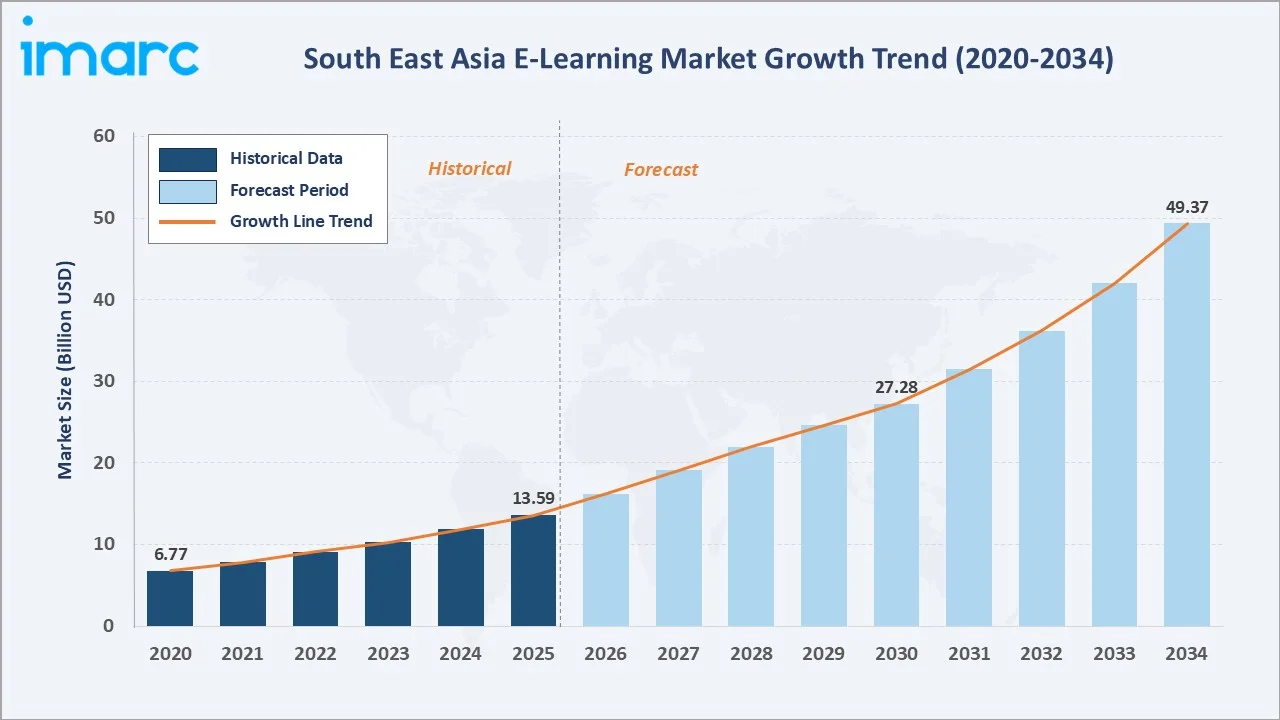
The South East Asia e-learning market expanded from USD 6.77 Billion in 2020 to USD 13.59 Billion in 2025, anchored at USD 27.28 Billion in 2030, and forecast to reach USD 49.37 Billion by 2034. The COVID-19 pandemic triggered an unprecedented shift toward remote and digital learning across the region in 2020-2021, and the post-pandemic period sustained above-trend e-learning adoption as governments and institutions formalized hybrid and blended learning models through 2022-2025.
To get more information on this market, Request Sample
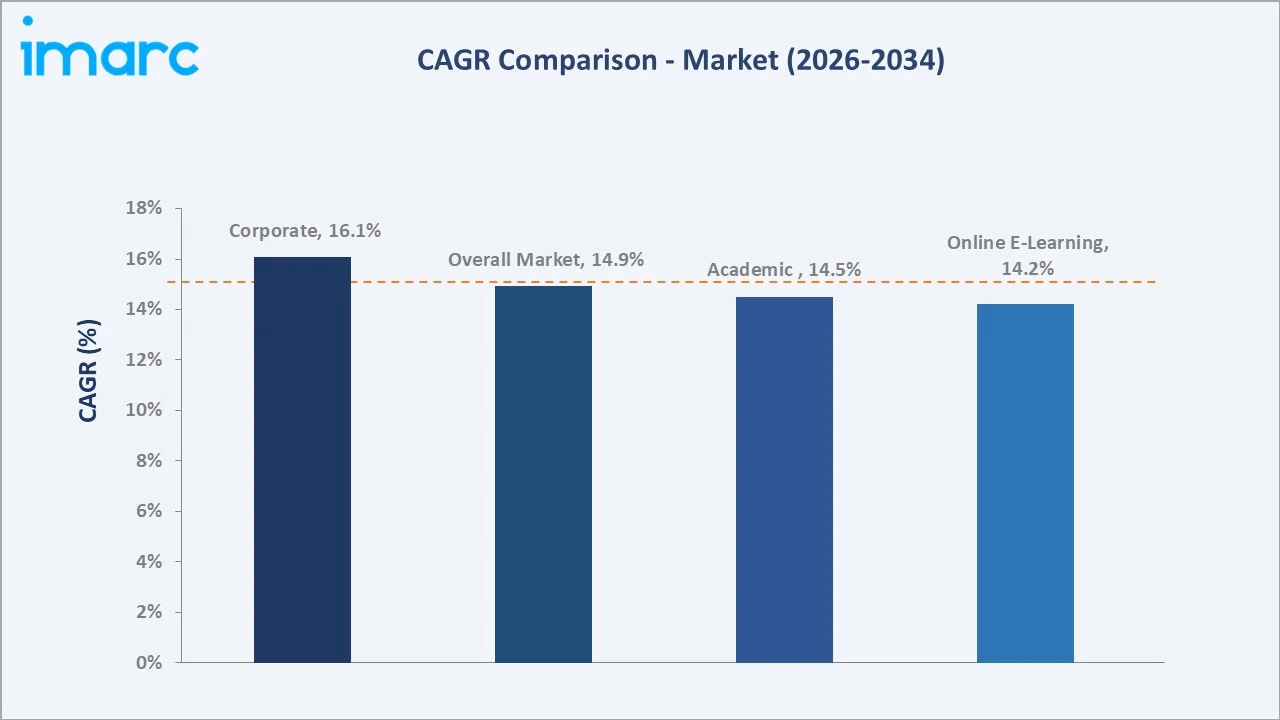
Learning Management System grows fastest among technology segments at an estimated ~16.8% CAGR as institutions and enterprises scale centralized digital learning infrastructure. Corporate applications grow at ~16.1% CAGR through accelerating workforce reskilling investment across the region's expanding digital economy.
Executive Summary
The South East Asia e-learning market reached USD 13.59 Billion in 2025, representing one of the region's most dynamic intersections of education, technology, and workforce development. The market encompasses online course platforms, learning management systems, mobile learning applications, virtual classroom infrastructure, and rapid content-authoring tools.
Online e-learning at 32.6% dominates technology adoption through the flexibility and scalability of self-paced digital course delivery. Academic applications at 51.6% lead usage through the region's large school-age and higher-education population and sustained government digitalization mandates. Indonesia, at 24.6%, leads through its large population base, expanding internet infrastructure, and an active domestic ed-tech startup ecosystem.
Key Market Insights
|
Insight |
Data |
|
Dominant Technology |
Online E-Learning - 32.6% share (2025) |
|
Dominant Application |
Academic - 51.6% market share (2025) |
|
Leading Country |
Indonesia - 24.6% market share |
|
Market Opportunity |
AI-personalized adaptive learning; mobile micro-learning; corporate reskilling platforms; government digital curriculum programs; immersive AR/VR training; skills-based micro-credentialing |
Key Analytical Observations Supporting the Above Data:
- Online E-Learning at 32.6%: Online e-learning dominates due to its scalability, low delivery cost, and flexibility for both academic and corporate learners. Self-paced digital courses are widely preferred across the region's large student and working-age population for accessibility and affordability.
- Academic at 51.6%: The academic segment dominates because K-12, higher education, and vocational institutions across South East Asia are rapidly digitalizing curricula under national education reform programs. These initiatives support consistent, large-scale digital learning demand.
- Indonesia at 24.6%: Indonesia dominates the market due to its large population base, expanding 4G/5G mobile internet coverage, and a fast-growing domestic ed-tech ecosystem. The government's Merdeka Belajar (Freedom to Learn) policy further supports digital curriculum adoption.
South East Asia E-Learning Market Overview
The South East Asia e-learning market encompasses the design, delivery, and management of digital learning content and infrastructure across academic, corporate, and government end-users. The market spans online course platforms, learning management systems, mobile learning applications, virtual classroom technology, rapid content-authoring tools, and related assessment and analytics software.
Macroeconomic factors include rising mobile internet penetration, expanding middle-class populations, and growing government investment in digital education infrastructure. Corporate upskilling needs, English-language and vocational skills gaps, and post-pandemic acceptance of remote learning are further accelerating regional e-learning adoption.
Market Dynamics
To evaluate market opportunities, Request Sample
Market Drivers
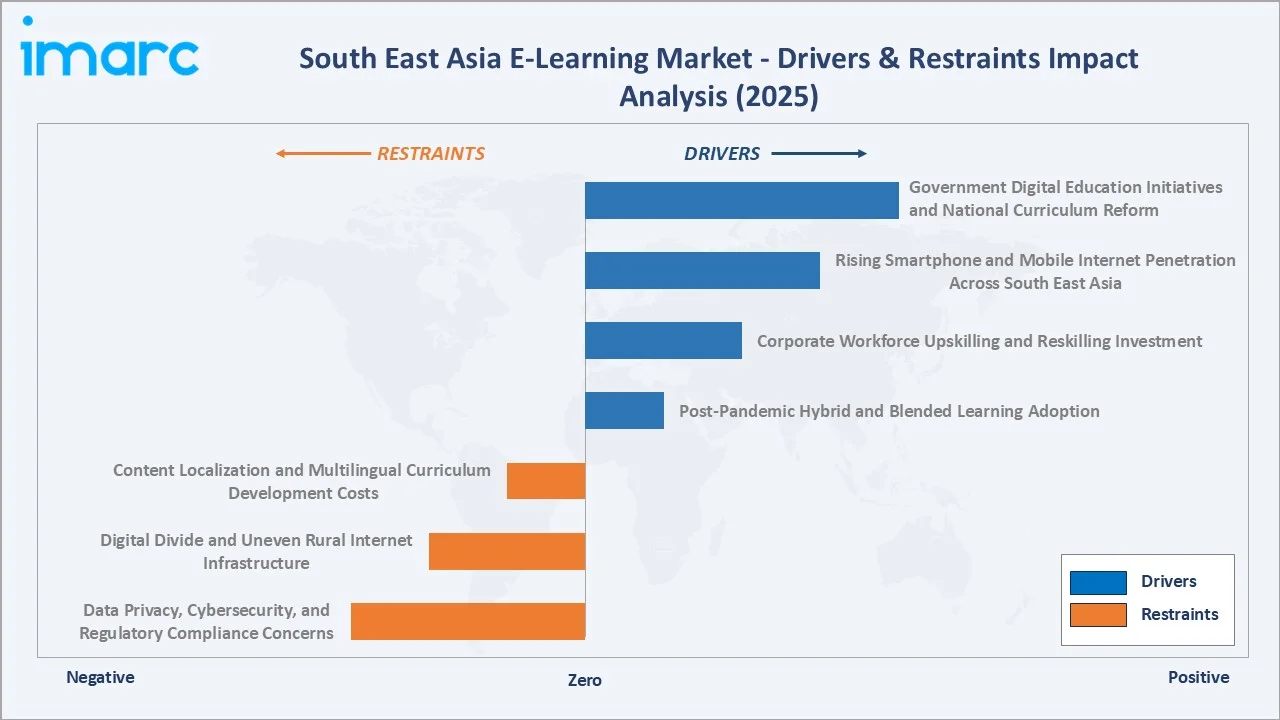
- Government Digital Education Initiatives and National Curriculum Reform: Governments across South East Asia are investing in national digital education programs, including Indonesia's Merdeka Belajar curriculum reform, Singapore's Student Learning Space, and Malaysia's MyDigital education blueprint. These programs mandate digital content integration in public school curricula and fund device and connectivity access for students, creating a durable base of institutional e-learning demand independent of private-sector adoption cycles.
- Rising Smartphone and Mobile Internet Penetration Across South East Asia: South East Asia has one of the world's fastest-growing mobile internet user bases, with affordable smartphones and expanding 4G/5G network coverage extending digital access into secondary cities and rural areas. This infrastructure growth is the primary enabler of mobile-first e-learning models, allowing platforms to reach learners who previously lacked access to formal digital education channels.
- Corporate Workforce Upskilling and Reskilling Investment: Regional economies are undergoing rapid digital transformation, creating persistent skills gaps in technology, data, and digital marketing roles. Enterprises across Singapore, Malaysia, and Vietnam are increasingly deploying corporate LMS platforms and subscription-based online course libraries to reskill employees at scale, supported by national schemes such as Singapore's SkillsFuture initiative.
- Post-Pandemic Hybrid and Blended Learning Adoption: The COVID-19 pandemic normalized remote instruction across schools and universities, and institutions have since retained blended learning models that combine in-person and digital instruction. This structural shift has embedded e-learning tools into standard academic operations rather than treating them as a temporary contingency measure.
Market Restraints
- Digital Divide and Uneven Rural Internet Infrastructure: Despite strong urban connectivity growth, large parts of rural Indonesia, the Philippines, and Vietnam continue to face inconsistent broadband access and limited device ownership. This digital divide constrains e-learning penetration among lower-income and rural student populations and slows nationwide rollout of digital curricula.
- Data Privacy, Cybersecurity, and Regulatory Compliance Concerns: The expansion of student and employee data collection through e-learning platforms has heightened regulatory scrutiny across the region, including Singapore's Personal Data Protection Act and Indonesia's Personal Data Protection Law. Compliance costs and cybersecurity investment requirements can slow platform deployment, particularly for smaller ed-tech providers.
- Content Localization and Multilingual Curriculum Development Costs: South East Asia's linguistic diversity requires e-learning providers to localize content across multiple languages, including Bahasa Indonesia, Thai, Vietnamese, and regional dialects. High-quality localization and cultural adaptation increase content development costs and can slow time-to-market for regional platform expansion.
Market Opportunities
- AI-Personalized Adaptive Learning Platform Expansion: AI-personalized adaptive learning platforms present a significant growth opportunity as institutions and enterprises seek to improve completion rates and learner outcomes through dynamically tailored content sequencing. Providers that build cost-effective, regionally localized adaptive learning engines are positioned to capture rising institutional and corporate demand as AI infrastructure costs continue to decline.
- Skills-Based Micro-Credentialing and Corporate Reskilling Platforms: Growing employer emphasis on verified digital skills credentials, supported by national schemes such as Singapore's SkillsFuture, is creating opportunity for platforms that offer portable, industry-recognized micro-credentials. Providers that partner with government skills agencies and industry bodies to develop recognized credentialing pathways are well placed to capture enterprise reskilling budgets.
Market Challenges
- Learner Engagement and Course Completion Rate Management: Sustaining learner engagement and course completion remains a persistent challenge for e-learning providers, particularly for self-paced online courses where dropout rates are historically high. Providers must continually invest in interactive content design, gamification, and progress-tracking features to maintain learner motivation, adding to platform development and content-refresh costs.
- Fragmented Regulatory and Curriculum Standards Across Countries: South East Asia's e-learning market spans multiple countries with distinct national curriculum standards, data protection regulations, and accreditation requirements. This regulatory fragmentation increases compliance complexity and content customization costs for providers seeking to scale a single platform across multiple national markets.
Emerging Market Trends
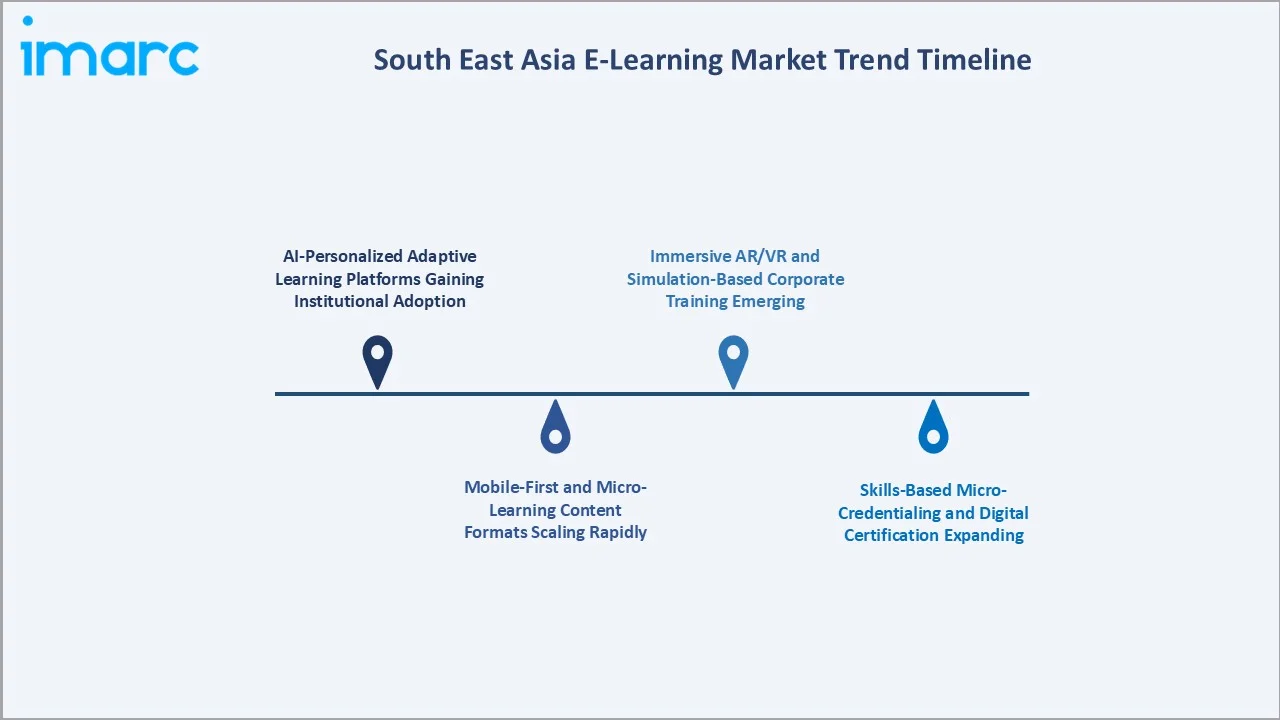
1. AI-Personalized Adaptive Learning Platforms Gaining Institutional Adoption
Artificial intelligence-driven adaptive learning platforms are increasingly deployed across academic and corporate e-learning systems to personalize content sequencing, pacing, and assessment difficulty to individual learner performance. Regional platforms are integrating AI-based recommendation engines and automated progress tracking to improve learner retention and completion rates. As AI models become more cost-effective to deploy, adaptive learning is shifting from a premium feature to a standard expectation across institutional and corporate learning platforms in the region.
2. Mobile-First and Micro-Learning Content Formats Scaling Rapidly
Given South East Asia's mobile-first internet access patterns, e-learning providers are increasingly designing short-form, bite-sized micro-learning modules optimized for smartphone consumption. This format supports higher completion rates among working professionals and students with limited dedicated study time, and is particularly prevalent in corporate upskilling and vocational training content across Indonesia, the Philippines, and Vietnam.
3. Skills-Based Micro-Credentialing and Digital Certification Expanding
Employers across the region are placing growing emphasis on verified digital skills credentials over traditional degree qualifications for certain technical and vocational roles. E-learning platforms are responding by expanding micro-credential and digital badge programs, often developed in partnership with industry bodies and government skills agencies such as Singapore's SkillsFuture, to provide portable, verifiable proof of competency.
4. Immersive AR/VR and Simulation-Based Corporate Training Emerging
Early-stage adoption of augmented and virtual reality-based training simulations is emerging in technical, healthcare, and manufacturing corporate training programs across Singapore and Malaysia. These immersive formats support hands-on skills practice in safety-critical or high-cost environments without physical equipment risk and are expected to scale gradually as hardware costs decline through the forecast period.
Industry Value Chain Analysis
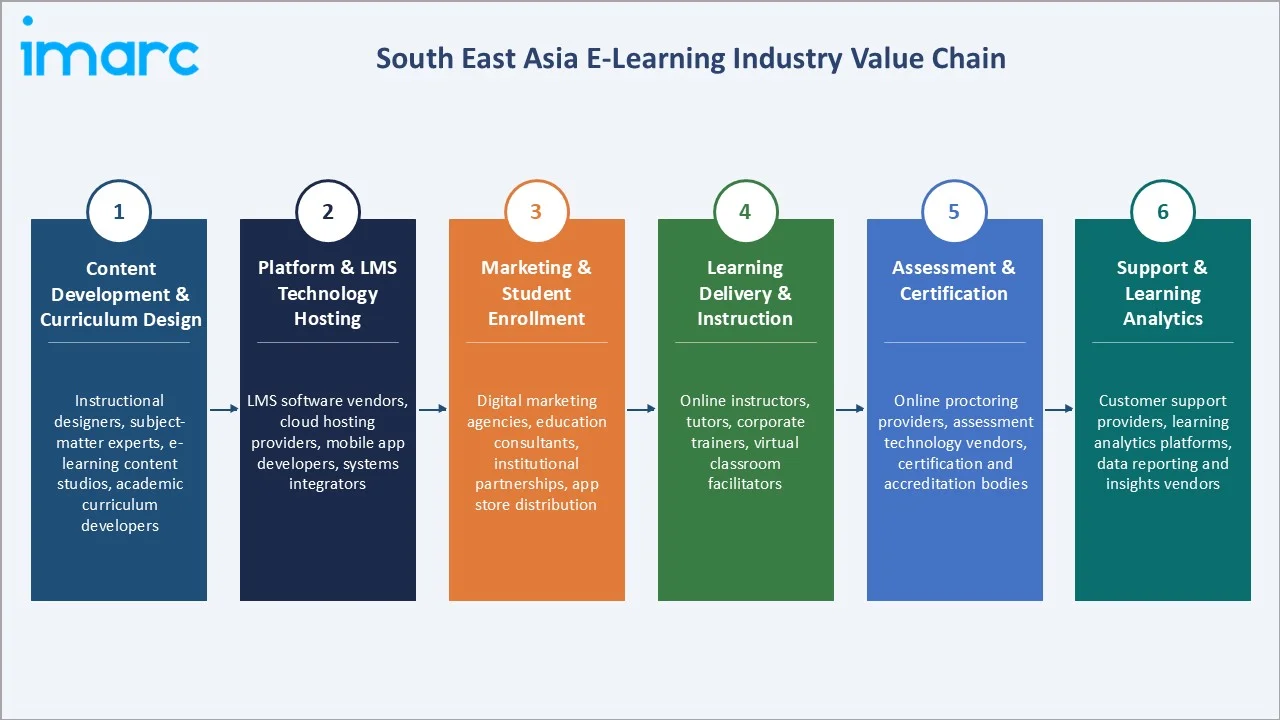
The South East Asia e-learning value chain integrates content development and curriculum design, platform and LMS technology hosting, marketing and student enrollment, learning delivery and instruction, assessment and certification, and ongoing support and learning analytics.
|
Stage |
Key Participants |
|
Content Development & Curriculum Design |
Instructional designers, subject-matter experts, e-learning content studios, academic curriculum developers |
|
Platform & LMS Technology Hosting |
LMS software vendors, cloud hosting providers, mobile app developers, systems integrators |
|
Marketing & Student Enrollment |
Digital marketing agencies, education consultants, institutional partnerships, app store distribution |
|
Learning Delivery & Instruction |
Online instructors, tutors, corporate trainers, virtual classroom facilitators |
|
Assessment & Certification |
Online proctoring providers, assessment technology vendors, certification and accreditation bodies |
|
Support & Learning Analytics |
Customer support providers, learning analytics platforms, data reporting and insights vendors |
Platform and LMS technology hosting is the value chain's most technically complex stage, as scalable cloud infrastructure and mobile-optimized delivery determine platform reliability across the region's varied connectivity environments. Assessment and certification technology increasingly sustains the credibility premium that verified digital credentials command with employers.
Technology Landscape in the South East Asia E-Learning Industry
Adaptive Learning and AI-Personalization Technology
Adaptive learning and AI-personalization technology enables platforms to dynamically adjust content difficulty, pacing, and recommended learning paths based on individual learner performance data. These systems improve completion rates and retention by tailoring the learning experience rather than delivering uniform content to all users, and are becoming a standard differentiator among regional providers as AI infrastructure costs decline.
Mobile-First Learning App and Micro-Learning Technology
Mobile-first learning app technology enables offline content caching, low-bandwidth video streaming, and short-form micro-learning modules optimized for smartphone consumption. Given the region's mobile-dominant internet access, this technology is central to reaching learners in areas with limited fixed broadband infrastructure, driving platform adoption outside major metropolitan centers.
Cloud-Based LMS and SCORM/xAPI Interoperability Technology
Cloud-based LMS technology, built on interoperability standards such as SCORM and xAPI, enables institutions and enterprises to integrate content from multiple providers into a unified environment with centralized progress tracking. This reduces vendor lock-in and supports scalable deployment across multi-campus institutions and multinational corporate learners.
Market Segmentation Analysis
The report covers the following segments:
|
Segment Category |
Leading Segment |
Market Share |
Year |
|
Technology |
Online E-Learning |
32.6% |
2025 |
|
Provider |
🔒 |
🔒 |
2025 |
|
Application |
Academic |
51.6% |
2025 |
|
Country |
Indonesia |
24.6% |
2025 |

By Technology
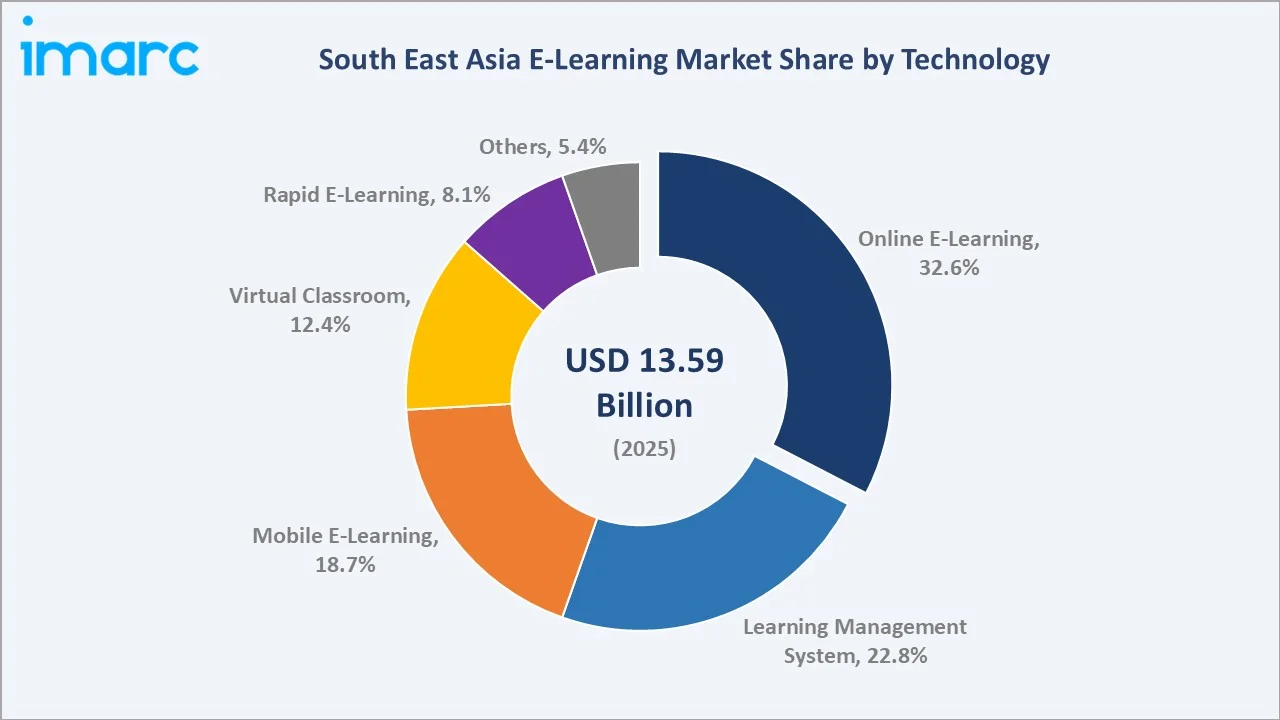
Online e-learning leads at 32.6% (2025). The online e-learning segment encompasses self-paced video-based courses, digital textbooks, and structured online degree and certificate programs delivered through web and mobile platforms across academic and corporate end-users.
To access detailed market analysis, Request Sample
Learning Management System at 22.8% encompasses centralized platforms used by academic institutions and enterprises to administer, track, and report on digital learning activity. Learning Management System's estimated ~16.8% CAGR is the fastest among technology segments, reflecting sustained institutional and corporate platform consolidation. Mobile E-Learning at 18.7% reflects the region's mobile-first internet access pattern, while Virtual Classroom at 12.4% and Rapid E-Learning at 8.1% serve live-instruction and fast content-authoring use cases respectively.
By Application
Academic applications lead at 51.6% (2025). The academic segment encompasses K-12, higher education, and vocational training institutions deploying digital learning tools to support formal curricula and supplementary instruction.
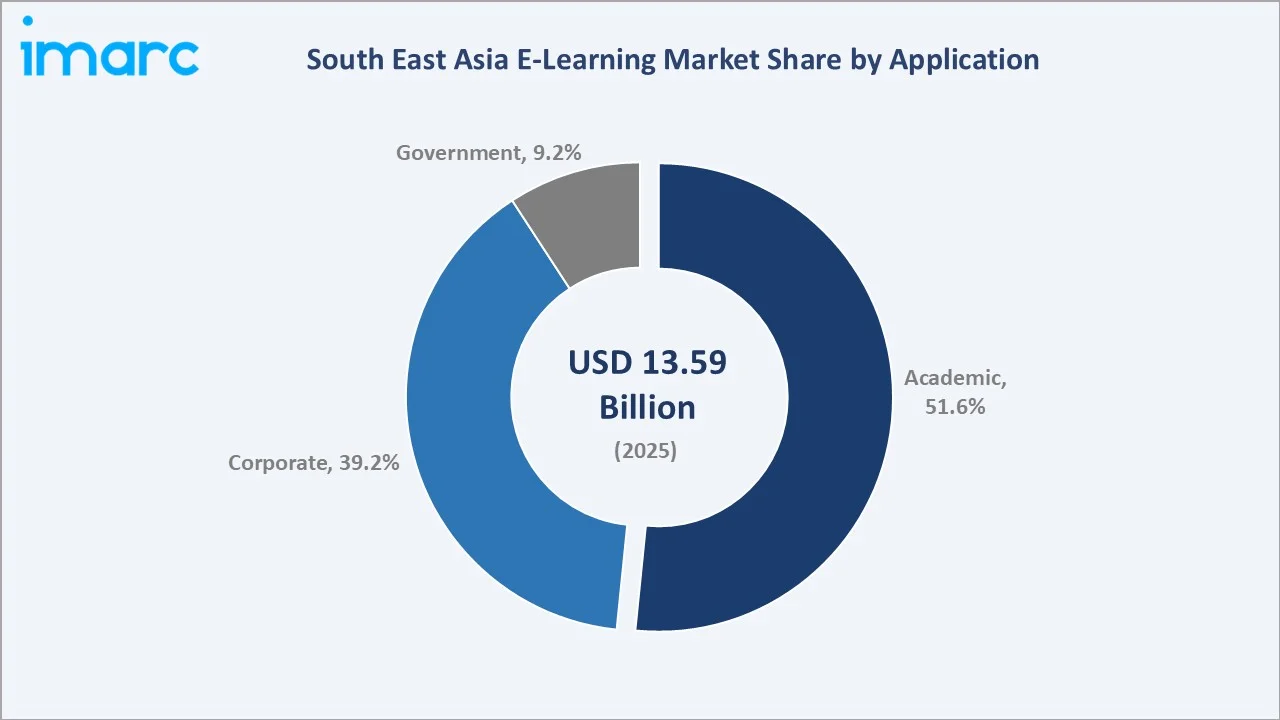
Corporate applications at 39.2% are growing fastest at an estimated ~16.1% CAGR, driven by enterprise workforce upskilling and reskilling investment across the region's expanding digital economy. Government applications at 9.2% encompass civil service training and public digital literacy programs, representing a smaller but policy-anchored share of total demand.
Regional Market Insights
|
Country |
Share (2025) |
Key South East Asia E-Learning Market Drivers & Characteristics |
|
Indonesia |
24.6% |
Driven by the region's largest population base, expanding 4G/5G mobile internet coverage, and a fast-growing domestic ed-tech startup ecosystem. |
|
Singapore |
20.8% |
Driven by advanced digital infrastructure, high corporate learning and development spending, and government-backed skills initiatives such as SkillsFuture. |
|
Malaysia |
16.7% |
Supported by strong government digital education investment under the MyDigital blueprint and rising smartphone-based learning adoption. |
|
Thailand |
14.1% |
Driven by growing corporate upskilling demand and expanding academic institution adoption of digital learning platforms. |
|
Vietnam |
10.9% |
Supported by a young population, rapidly expanding mobile internet access, and rising demand for English-language and vocational e-learning. |
|
Philippines |
8.6% |
Driven by high mobile internet penetration, strong demand for English-language online education, and growing corporate BPO-sector training needs. |
|
Others |
4.3% |
Includes remaining South East Asia markets such as Cambodia, Myanmar, Laos, and Brunei, where e-learning adoption is at an earlier stage, driven by gradual internet infrastructure expansion and rising government interest in digital education. |
Indonesia's 24.6% market leadership is anchored by its position as South East Asia's most populous nation, combined with expanding 4G/5G coverage and an active domestic ed-tech startup ecosystem. Singapore's 20.8% share reflects its advanced digital infrastructure, high corporate learning and development spending per employee, and status as a regional ed-tech and corporate training hub.
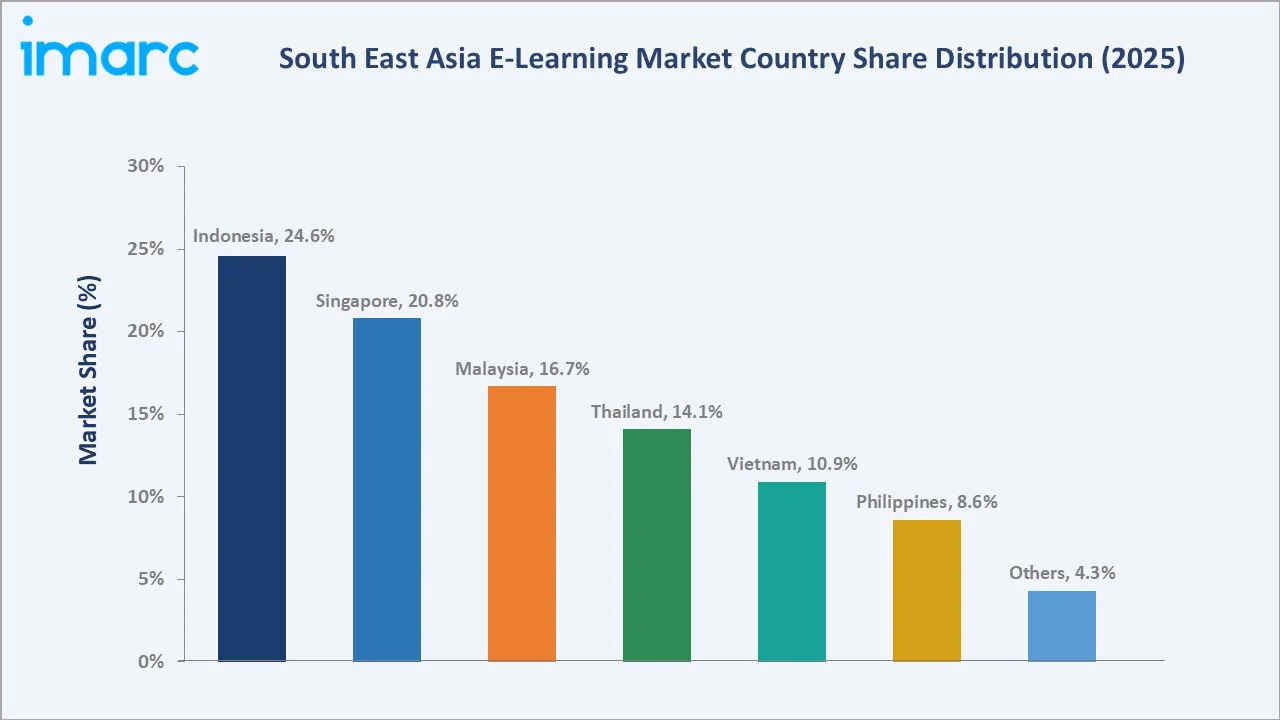
Malaysia's 16.7% share is supported by strong government digital education investment under the MyDigital blueprint, while Thailand's 14.1% reflects growing corporate and academic platform adoption. Vietnam and the Philippines, at 10.9% and 8.6% respectively, represent the region's fastest-growing e-learning markets by CAGR, driven by young populations and rapidly expanding mobile internet access.
Competitive Landscape
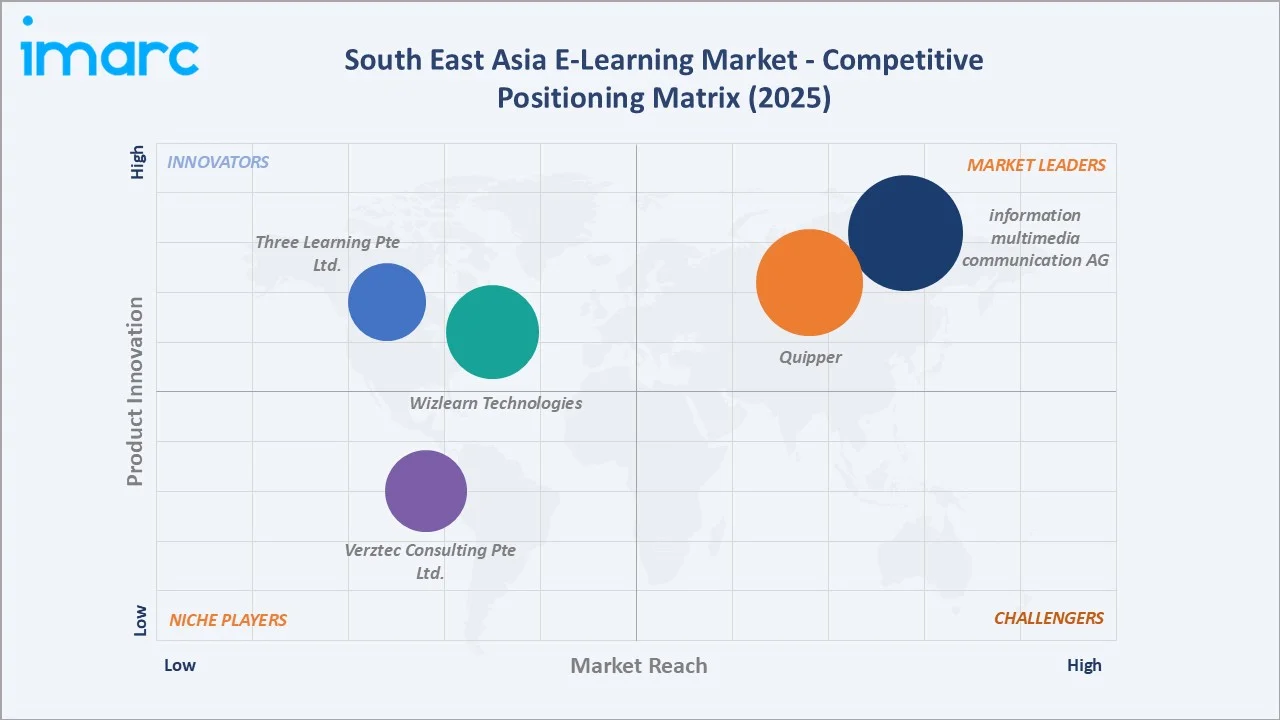
The South East Asia e-learning market competitive landscape encompasses distinct tiers: global online course platforms, regional academic content and LMS providers, and corporate training and content-development specialists.
|
Company Name |
Key Products |
Market Position |
Core Strength |
|
information multimedia communication AG |
imc Learning Suite, imc Content Studio |
Market Leader |
information multimedia communication AG plays a central role in the region's corporate e-learning market by providing an integrated learning management, content authoring, and coaching platform used by multinational enterprises operating across South East Asia. |
|
Quipper |
Quipper Learn, Quipper School |
Market Leader |
Quipper plays a central role in South East Asia's academic e-learning market by providing K-12 focused digital learning content, assessment tools, and classroom management software widely adopted across Indonesia and the Philippines. |
|
Wizlearn Technologies |
LEP (Learning Experience Platform), mobile learning apps |
Established Player |
Wizlearn Technologies plays a central role in the region's academic e-learning market by providing mobile-enabled learning management platforms adopted by schools and institutions, particularly in Singapore. |
|
Verztec Consulting Pte Ltd. |
Custom e-learning content development |
Established Player |
Verztec Consulting plays a central role in the region's corporate e-learning market by providing custom instructional design and multilingual e-learning content development for multinational clients. |
|
Three Learning Pte Ltd. |
Learning Application – Scaffoldlearn |
Established Player |
Three Learning Pte Ltd. plays a role in the region's corporate training market by providing bespoke e-learning content development and learning management system integration services. |
Singapore-based providers benefit from the city-state's position as a regional corporate and technology hub, sustaining a competitive advantage in enterprise and multinational client relationships. Indonesia and the Philippines-focused academic platforms benefit from deep localization and large addressable student populations, while global platforms compete primarily on content breadth and brand recognition.
Key Company Profiles
information multimedia communication AG
information multimedia communication AG is a leading provider of corporate learning management, content authoring, and digital coaching solutions serving multinational enterprises across South East Asia. The company specializes in integrated learning technology platforms and blended learning consulting services.
- Key Products: imc Learning Suite, imc Content Studio, imc Coach.
- Recent Developments: In February 2025, imc AG launched Innovation Pack 14.23 for its imc Learning Suite, introducing AI-powered features including AI-generated course images and one-click translation of learning content into multiple languages. The update also improved integration with imc Express for web-based training content and added enhanced notification capabilities. These developments strengthen the company's AI-enabled digital learning and e-learning platform offerings.
- Strategic Focus: Focuses on integrated corporate learning management, multilingual content authoring, and AI-enabled personalized learning technology for multinational enterprise clients.
Quipper
Quipper is a leading provider of K-12 focused digital learning content and classroom management tools, with a strong presence in Indonesia and the Philippines. The company specializes in curriculum-aligned video content, adaptive assessments, and teacher-facing classroom analytics tools.
- Key Products: Quipper Learn, Quipper School, Quipper Video.
- Recent Developments: In May 2026, Quipper Philippines partnered with the Catholic Educational Association of the Philippines–National Capital Region (CEAP-NCR) to digitally deliver its Harmonized GMRC/Values Education with Christian Living Education content through the Quipper LMS. The partnership makes the curriculum available digitally from Kinder to Grade 12 and demonstrates Quipper’s continued expansion of curriculum-aligned digital learning content and LMS-based education solutions. This development is directly relevant to the E-Learning Market, particularly the growing adoption of digital curriculum, online learning platforms, and technology-enabled education in schools.
- Strategic Focus: Centered on curriculum-aligned academic content, adaptive assessment technology, and classroom-level learning analytics for K-12 institutions.
Verztec Consulting Pte Ltd.
Verztec Consulting Pte Ltd. is a Singapore-based provider of custom e-learning content development and corporate training solutions serving multinational enterprise clients across the region. The company specializes in instructional design, multilingual content localization, and blended learning program development.
- Key Products: Custom e-learning content development, corporate training solutions, multilingual localization services.
- Strategic Focus: Focuses on custom instructional design, multilingual e-learning content localization, and enterprise corporate training program development.
Market Concentration Analysis
The South East Asia e-learning market is moderately fragmented, with academic content providers competing on local-market curriculum alignment and corporate training providers competing on multinational client relationships and localization capability. Global online course platforms maintain a smaller but growing share, competing on content breadth and brand recognition. Concentration is expected to increase gradually at the corporate LMS tier as enterprises consolidate around fewer, more integrated vendors.
Investment & Growth Opportunities
Highest Growth Segments
Learning Management System (~16.8% CAGR), Corporate applications (~16.1% CAGR), mobile-first micro-learning content (~17% CAGR), AI-personalized adaptive learning platforms (~19% CAGR from a small base), and skills-based micro-credentialing programs (~18% CAGR from a small base) represent the highest-growth investment vectors through 2034.
Emerging Investment Opportunities
Corporate workforce reskilling platforms represent the largest near-term investment opportunity, supported by national skills initiatives such as Singapore's SkillsFuture and expanding enterprise learning and development budgets. Providers that establish preferred vendor relationships with large employers and government skills agencies are positioned for above-market revenue growth.
Investment Themes
- AI-personalized adaptive learning platform development for regional subscription revenue: AI-based adaptive learning has demonstrated meaningful improvements in learner completion and retention rates, creating recurring subscription revenue potential as institutional and corporate adoption scales across the region.
- Mobile-first micro-learning content investment capturing underserved rural and secondary-city learners: Mobile-optimized, low-bandwidth micro-learning content addresses the region's large population of learners outside major metropolitan centers, positioning early investors to capture this underserved demand segment.
Future Market Outlook (2026-2034)
The South East Asia e-learning market is projected to grow from USD 13.59 Billion in 2025 to USD 49.37 Billion by 2034, delivering a 14.94% CAGR over the forecast period. The market's anchor value of USD 27.28 Billion in 2030 represents an e-learning industry at a transformative inflection point, as AI-personalized adaptive learning achieves mainstream deployment and skills-based micro-credentialing gains broad employer recognition alongside traditional academic qualifications.
Government-backed digital education mandates across Indonesia, Singapore, Malaysia, Thailand, and Vietnam create policy-anchored institutional demand that is largely insulated from short-term commercial market conditions. Rising smartphone and mobile internet penetration continues to expand the addressable learner population into underserved rural and secondary-city markets, while corporate digital transformation sustains durable enterprise demand for workforce upskilling platforms.
Research Methodology
Primary Research
Primary research comprised structured interviews with Chief Learning Officers, ed-tech platform executives, corporate learning and development directors, academic administrators, and regional e-learning market specialists across South East Asia.
Secondary Research
Secondary research encompassed government digital education policy publications, ICT and education ministry statistics, ed-tech industry reports, company annual reports, and regional internet and mobile penetration data.
Forecasting Models
Market revenue forecasts were developed using a segment bottom-up model: (i) technology component; (ii) provider component; (iii) application component.
South East Asia E-Learning Market Report Coverage:
| Report Features | Details |
|---|---|
| Base Year of the Analysis | 2025 |
| Historical Period | 2020-2025 |
| Forecast Period | 2026-2034 |
| Units | Billion USD |
| Scope of the Report |
Exploration of Historical and Forecast Trends, Industry Catalysts and Challenges, Segment-Wise Historical and Predictive Market Assessment:
|
| Technologies Covered | Online E-Learning, Learning Management System, Mobile E-Learning, Rapid E-Learning, Virtual Classroom, Others |
| Providers Covered | Services, Content |
| Applications Covered |
|
| Countries Covered | Indonesia, Thailand, Singapore, Philippines, Vietnam, Malaysia, Others |
| Companies Covered | information multimedia communication AG, Quipper, Wizlearn Technologies, Verztec Consulting Pte Ltd., Three Learning Pte Ltd., etc. |
| Customization Scope | 10% Free Customization |
| Post-Sale Analyst Support | 10-12 Weeks |
| Delivery Format | PDF and Excel through Email (We can also provide the editable version of the report in PPT/Word format on special request) |
Key Benefits for Stakeholders:
- IMARC’s industry report offers a comprehensive quantitative analysis of various market segments, historical and current market trends, market forecasts, and dynamics of the South East Asia e-learning market from 2020-2034.
- This research report provides the latest information on the market drivers, challenges, and opportunities in the South East Asia e-learning market.
- Porter's five forces analysis assist stakeholders in assessing the impact of new entrants, competitive rivalry, supplier power, buyer power, and the threat of substitution. It helps stakeholders to analyze the level of competition within the South East Asia e-learning industry and its attractiveness.
- A competitive landscape allows stakeholders to understand their competitive environment and provides an insight into the current positions of key players in the market.
Frequently Asked Questions About the South East Asia E-Learning Market Report
The South East Asia e-learning market reached USD 13.59 Billion in 2025. The market is driven by rising smartphone and internet penetration, government digital education initiatives, and increasing corporate investment in workforce upskilling.
The market grows at a 14.94% CAGR during 2026-2034, reaching USD 49.37 Billion by 2034. Learning Management System grows fastest among technology segments at an estimated ~16.8% CAGR.
Online E-Learning leads at 32.6% through the scalability, low delivery cost, and flexibility of self-paced digital course delivery across academic and corporate learners.
Academic applications lead at 51.6% share in 2025, driven by rapid curriculum digitalization across K-12, higher education, and vocational institutions under national education reform programs.
Indonesia leads with a 24.6% revenue share in 2025, driven by its large population base, expanding mobile internet coverage, and an active domestic ed-tech ecosystem. Singapore at 20.8% and Malaysia at 16.7% follow as the next-largest markets.
Key drivers include government digital education initiatives and curriculum reform, rising smartphone and mobile internet penetration, corporate workforce upskilling and reskilling investment, and sustained post-pandemic adoption of hybrid and blended learning models.
Learning Management System is the fastest-growing technology segment at an estimated ~16.8% CAGR through 2034. Corporate is the fastest-growing application segment at an estimated ~16.1% CAGR, driven by enterprise digital upskilling investment.
Leading companies include information multimedia communication AG, Quipper, Wizlearn Technologies, Verztec Consulting Pte Ltd., and Three Learning Pte Ltd.
The region's mobile-first internet access is driving demand for offline-capable, low-bandwidth mobile learning applications and short-form micro-learning content, particularly among learners outside major metropolitan centers.
AI is applied across adaptive learning systems that personalize content sequencing to learner performance, automated assessment tools, and content recommendation engines that improve engagement and completion rates.
Need more help?
- Speak to our experienced analysts for insights on the current market scenarios.
- Include additional segments and countries to customize the report as per your requirement.
- Gain an unparalleled competitive advantage in your domain by understanding how to utilize the report and positively impacting your operations and revenue.
- For further assistance, please connect with our analysts.
 Request Customization
 Speak to an Analyst
 Request Brochure
 Inquire Before Buying
Benefits of Customization
- Personalize this research
- Triangulate with your data
- Get data as per your format and definition
- Gain a deeper dive into a specific application, geography, customer, or competitor
- Any level of personalization
Get in Touch With Us
UNITED STATES
Phone: +1-201-971-6302
INDIA
Phone: +91-120-433-0800
UNITED KINGDOM
Phone: +44-753-714-6104
Email: [email protected]
Client Testimonials




.webp)




.webp)













Related Reports

Choose your plan
*Please note that the prices mentioned below are starting prices for each bundle type. Kindly contact our team for further details.*
Single User License
- 1 User License, Access on 2 Devices
- PDF Report + Excel Dataset (Password Protected)
- Lifetime Access
- No Printing Rights
- 10% Free Report Customization
- 10–12 Weeks of Analyst Support
Five User License
- Access for 5 Users, 2 Devices per User
- PDF Report + Excel Dataset (Password Protected)
- Lifetime Access
- Dedicated Account Manager
- 12–14 Weeks of Analyst Support
- No Printing Rights
- 15% Free Report Customization
- 25% Discount on Your Next Purchase
Corporate User License
- Unlimited User Access (Within Your Organization)
- PDF Report + Excel Dataset
- Lifetime Access
- Dedicated Account Manager
- 14–20 Weeks of Analyst Support
- No Printing Rights
- 20% Free Report Customization
- 30% Discount on Your Next Purchase
Essential Insights
What's included:
3 reports
- Lifetime Access
- PDF Reports
- Excel Datasets
- 2 Weeks of Free Analyst Support
- 2 User Licenses
- Access on 2 Devices
- Printing Rights
- Complimentary PowerPoint (PPT) Version
- Complimentary License Upgrade
Professional Access
What's included:
5 reports
- Lifetime Access
- PDF Reports
- Excel Datasets
- 8 Weeks of Free Analyst Support
- 2 User Licenses
- Access on 2 Devices
- Printing Rights
- Complimentary PowerPoint (PPT) Version
- Complimentary License Upgrade
Business Advantage
What's included:
8 reports
- Lifetime Access
- PDF Reports
- Excel Datasets
- 14 Weeks of Free Analyst Support
- 2 User Licenses
- Access on 2 Devices
- Printing Rights
- Complimentary PowerPoint (PPT) Version
- Complimentary License Upgrade
Enterprise Intelligence
What's included:
10 reports
- Lifetime Access
- PDF Reports
- Excel Datasets
- 20 Weeks of Free Analyst Support
- 2 User Licenses
- Access on 2 Devices
- Printing Rights
- Complimentary PowerPoint (PPT) Version
- Complimentary License Upgrade